Walter Breen's Encyclopedia of United States and Colonial Proof Coins 1722-1989
Walter Breen
XI. BRILLIANT PROOFS MAKE A COMEBACK: 1936-1964
1936
Proof sets were once again made for public distribution beginning April 28, 1936. The earlier and later types are reputedly a result respectively of inexperience of mint personnel in making proofs, or difficulty in making old-style brilliant proofs with the equipment at hand (notably on the 5¢ dies), and too vigorous attempts to imitate the oldstyle brilliant proofs.
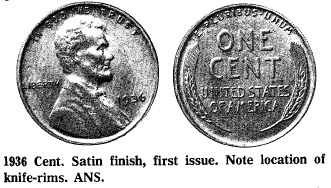
Cent. [5569 total] Type I. Surfaces satin finish, sometimes nearly matte. Needle sharp inner and outer edges to rims, obv. and rev. Occasionally mistaken for uncirculated coins or vice versa. Usually dull red in color. Cf. NN 43: 754-55 for comparison with the Type II (lot 756). An excellent comparison piece is in ANS. An estimate from the then Mint Superintendent in Philadelphia, transmitted to me by Lester Merkin, was that - contrary to common belief - approximately % or between 3500 and 3700 of the proof cents made this year were of this kind. They were not popular, did not sell well, and in some instances were evidently mistakenly spent as business strikes, as I have seen specimens showing evidence of brief circulation.
At the moment most of the traceable 1936 proof cents are Type I's. Perfect coins lacking nicks or scratches are quite rare - and it is not often that one can call a "modern" proof (1936 and after) rare.
-Type II. Extra brilliant mirrorlike surfaces, some mirrorlike finish even on devices, exactly as in 1937; needle sharp inner and outer edges to rims. Brighter color than Type I, usually fiery orange similar to 1937 unless stained or cleaned. Mintage, by subtraction, in the neighborhood of 1800 to 2000. Now highly prized for appearance; popular though not of great rarity. Dangerous forgeries exist made by buffing or copperplating regular uncirculated coins. Beware of any offered that have less relief detail in Lincoln's hair and beard than uncirculated coins of the same period -or that do not have sharp inner and outer edges to rims.
Five Cents. [Total 4420] Type I. Satin finish, sometimes almost matte; unusual sharpness on Indian's hair and details of bison's skin as in former matte proofs; sharp inner and outer edges to rims. Edges (cylindrical surfaces) are, by contrast, mirrorlike as in the later years - the close collar was brilliantly polished, perhaps unintentionally by use. Mintage of this type (from the same source) was also supposedly close to % the total, say 2600 to 2800 specimens, possibly somewhat smaller. Many of these coins were, like the cents, mistaken for uncirculated pieces and spent; not so many have been recovered from among circulated coins. The Type I nickel is now rarer than the Type II; Lester Merkin has estimated it as five times as rare, i.e. about 1/6 as often seen, about 1/6 of the total of traceable 1936 proof nickels, individually or in sets. Comparison piece: ANS. Cf. also NN 43: 768-769 (with a Type II as lot 770).
- Type II. Extra brilliant, similar to the cent and to the 1937 issue. The vast majority of these show nicks andscratches, and quite a few were recovered from circulation. I myself have at various times between 1947 and about 1953 owned nine or ten so found - those were the days! Perfect coins are very uncommon. Dangerous forgeries exist, made in the same manner as the cents, though buffing is more common than nickelplating. Beware of any offered that do not have sharp edges to rims. The majority even of unimpaired 1936 nickel proofs are of Type II, but these bring higher prices than Type I for appearance.
It is barely possible that frosted devices might exist on a few Type II's, as on some later years, but none are reported.
No minor proof sets are known to have been made, though individual proof coins were certainly sold outside sets.
Dimes. [4139 total] Type I. Satin finish, somewhat similar to the cent. Extremely sharp relief details and rims. Extremely rare, not over six seen in the last 15 years. Cf. NN 43:783 (lot 784 was a Type II), and the set in LM 3/68:369 (below).
- Type II. Extra brilliant, even the devices showing some mirrorlike surface, exactly as in 1937. Relief detail and rims extra sharp, which at once distinguishes them from the buffed and plated pieces sometimes offered. Over 99% of 1936 proof dimes examined are of this type. Many are impaired.
Quarter. [3837] Extra brilliant finish only, as in 1937. All are from the third hub as seen on the last 1934 coins ("Type III" or "Type of 1936"), showing heavy wide motto with middle stroke of W highest. Rev. Lower relief than 1937-64, ES about touch. Very popular as the lowest mintage of proofs of this year. Several small hoards exist. No frosted heads are known. Many survivors are impaired.
Half Dollar. [3901] Extra brilliant finish only, as in 1937. No frosted devices known. All are from the second hub (1918-36) showing large stars and incised garment details at throat, none from the 1937 hub. Dangerous forgeries exist, buffed or plated. These are ordinarily identified by loss of relief detail at Ms. Liberty's head and branch hand and flag stripes, compared to even the best uncirculated specimens. In particular, branch hand should be well defined, all fingers clear - never the case on buffed or plated pieces, almost never on business strikes.
Proof Sets. Not more than 3837 could have been made and the number is probably more like 3750 or less. No figures have been published on actual numbers of coins or sets released, 'sold, or melted, or when the change to Type II began. A set with Type I cent, nickel and dime was LM 6/68:369. Barlett:l007 had Type I cent and nickel. Most sets either are completely Type II or not described. Usually, the distinction is not made at all, perhaps because dealers or speculators fear that mention of type will adversely affect prices. Many sets have been assembled, some having a Type I cent and Type II nickel or vice versa. Or, more ominously, one or more coins in the set will prove to have been manufactured by buffing or plating.