Abe Kosoff: Dean of Numismatics
Q. David Bowers
Conducting business on two coasts simultaneously was not easy, and the viewing of auction lots was split. Coins were shown in New York City at 42 East 50th Street from February 6th through February 12th, after which they were transferred to Fresno, California, for the convention of the California State Numismatic Association, February 22nd and 23rd, after which time they went to Beverly Hills to the new gallery, where they remained until the sale date.
The sale catalogue followed the general format of the World's Greatest Collection and offered gold coins from dollars through double eagles in sequence, with each denomination starting with the Philadelphia Mint, followed by branch mint issues. A number of examples were noted as having a pedigree from the World's Greatest Collection sold two years earlier. A profit was shown on some, such as the 1849 gold dollar which brought $16 at the 1946 event and $18 in the 1948 event but others did not do as well. For example, the 1855 Proof gold dollar from the World's Greatest Collection at $155 fetched just $75 in its subsequent 1948 appearance, the 1856 gold dollar from the same offering at $125 brought $107.50, and the 1857 at $70 in 1946 slept at $37.50 in 1948.
1948 was a quiet year for the coin hobby, the bloom was off the rose, and the recent run-up in the market which characterized the postwar years was coming to an end. Auction sales of various firms, not only the Numismatic Gallery but the sales of its competitors as well, showed reductions in prices realized figures for many different issues-in comparison to what the same coins had sold for a few years earlier. As it later turned out, the 1948-1949 years represented one of the best buying opportunities of the era. After the market low had run its course, prices rose sharply, and the sales figures from the late 1940s became but wistful memories.
The highest price in the March 1948 sale was $4,200 for Lot 101, the 1841 Proof quarter eagle which also had the honor of being the highest priced coin in the World's Greatest Collection, at which event it sold for $6,000 in January 1946. The 1854-S quarter eagle, also from the World's Greatest Collection, brought $900, just $100 shy of the figure it sold for two years earlier. Lot 261, an 1875 Proof $3 described as a "Superb Gem," fetched $2,100, while an 1876 $3 in similar condition fetched $430, possibly because it was illustrated with a photograph-perhaps of a different coin, which seemed to show rubbing or friction.
A double spread appearing on pages 26 and 27 of the catalogue featured a complete set of Proof $4 stellas of the Flowing Hair and Coiled Hair varieties of 1879 and 1880. Commencing with the 1879 Flowing Hair issue, the Proofs sold for $450, $825, $825, and $925 respectively.
The highlight of the half eagle series was the rare 1815, described as Uncirculated, which brought $3,300. The cataloguer noted:
"The excessively rare 1815 is one of the greatest rarities in the entire series of United states coinage. In all our experiences, with all the fine collections which have been handled by the Numismatic Gallery, this is the first time we have been privileged to offer an 1815 half eagle-and the finest known specimen at that. There are just six or seven examples known. Many famous collections have lacked this 1815 coin. Dunham didn't own one, and the World's Greatest Collection of United States Gold Coins didn't have it... "
Lot 316, offered shortly after the 1815 half eagle, was the rare 1819 which had brought $1,400 in the World's Greatest Collection but which in 1948 was able to command just $850, again reflective of the times. An 1820 half eagle with curled 2, large letter, was described as a superb Proof and fetched $1,200. An 1825/1 overdate, offered as a Gem Brilliant Uncirculated coin, went to a new owner at $305, while an Uncirculated 1826 of the same denomination brought $222.50. An 1877 half eagle, described as a Superb Brilliant Proof, one of just 87 pieces struck of that date, crossed the auction block at $245, while numerous later Proofs of a more plentiful nature fetched from the $30 range upward.
Many important $10 pieces were offered, including a 1875 not graded in the catalogue, but probably a Choice Proof, at $575 and an Uncirculated 1933 which brought $260.
Double eagles comprised a spectacular offering of Proofs, including the landmark issues of the 1880s. An 1882 fetched $267.50, an 1883 sold for $775, the rare 1884 fetched $1,000, an 1885 brought $250, an 1886 realized $310, and an 1887 sold for $450. In keeping with general price levels of the time, later Liberty Head Proofs sold from $130 each upward. The glory days of Proof gold coins were yet to come.
Among branch mint double eagles, a Fine specimen of the famous 1870-CC, an example of which was not in the World's Greatest Collection, crossed the auction block at $212.50. An Extremely Fine 1854-O brought $155, a sleeper, for the true rarity of this issue was not realized until a couple decades later.
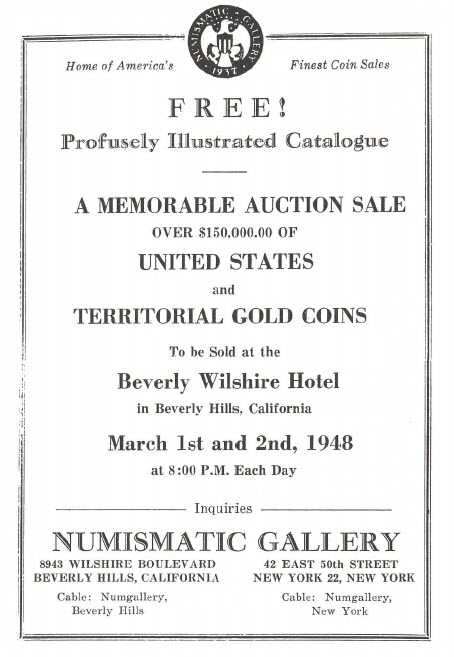
"A Memorable Auction Sale," held in Beverly Hills in March 1948, featured coins con-signed by Chicago collector J.F. Bell. The market was at a low point, interest was slack, and numerous pieces realized substantially less than they did a few years earlier. ("The Numismatic Scrapbook Magazine," February 1948)