Abe Kosoff: Dean of Numismatics
Q. David Bowers
Chapter 4
The Higgy Sale: A Turning Point
The first large-format auction catalogue issued by Abe Kosoff was that featuring the Michael F. Higgy Collection. Conducted in two sessions, September 10th and 11th, 1943, the sale featured he cabinet of a Columbus, Ohio numismatist. For he first time in one of Abe Kosoff's catalogues, several pages were devoted to illustrations of the lots being offered. 1,852 pieces were featured, primarily United States series, but with a generous selection of foreign crowns, an offering of numismatic medals relating to medicine, and a selection of foreign gold.
After each lot the new 1944 Standard Catalogue values were listed. The estimates make interesting reading today: 1882 Proof nickel three-cent piece $2, 1866 Proof Shield nickel $12.50, 1901 Proof Liberty nickel $2.50, 1921-S Uncirculate Buffalo Nickel $8.50, 1851-O Uncirculated silver three-cent piece $3.50, 1796 Very Fine half dime $40, 1849 Uncirculated half dime $1.25, 1829 Uncirculated lime $3, 1860 Proof dime $5, 1895 Proof dime $5, . 912 Proof dime $2.50, 1877 Proof 20-cent piece ;22.50, 1796 Fine quarter dollar $35, 1849 Uncirculated quarter dollar $6, 1916 Liberty Standing Uncirculated quarter $40, 1928-D Uncirculated quarter $2.50, Uncirculated 1935 Hudson commemorative half dollar $8, Uncirculated 1935 Old Spanish Trail half dollar $7.50, 1939 Uncirculated Oregon commemorative set $22.50, 1877 Proof grade dollar $9, 1802 Proof restrike silver dollar "worth $150 easily"), 1836 Gobrecht Proof dollar with Gobrecht on base $60, 1836 with GOBRECHT below base $200, 1839 Proof Gobrecht dollar $350, 1851 Proof silver dollar $150, 1895 'roof Morgan dollar $12.50, 1876 Proof gold dollar $17.50, and others.
Early in the second session an extensive offering of United States large cents attributed to Crosby, Doughty, and other references was offered with illustrations of the most important pieces. This was followed by a listing of half cents, small cents, colonials, several medals, Confederate-related pieces, $3 coins, United States patterns, and others.
As it developed, the Higgy Collection coins were not to sell for the new 1944 catalogue prices. With relatively few exceptions, the new Standard Catalogue valuations were left far behind in what amounted to a frantic bidding contest for just about everything as it came across the auction block. Years later, Abe Kosoff was to pinpoint the Higgy Collection as the start of what he called the modern coin market. The traditional quiet buying and selling of coins was left behind as collectors, dealers, and investors scrambled to pay record prices to acquire pieces for their cabinets. Clearly it was a seller's market, and the Michael F. Higgy Collection was presented at precisely the right time.
The Higgy Collection almost went elsewhere. In 1942, after contracting a fatal disease, Michael F. Higgy decided to sell his coin collection by soliciting offers from three dealers: James Kelly of Dayton, Ohio, James Macallister of Philadelphia, and Abe Kosoff. Each was invited to come to Columbus, view the coins, and then submit an offer.
It turned out that Jim Kelly's offer was the highest, and he was awarded the holdings. Kelly left a check on deposit, went home, and set up the financing. Abe Kosoff figured the collection was lost. Then, Higgy telephoned from Columbus to state that Jim Kelly learned that Uncle Sam had classified him as 1-A and that he was eligible to be drafted. His local bank, learning this, was reluctant to advance the necessary funds to buy the collection. Kelly's deposit check was returned by Higgy, and Abe was contacted. Backed by a $5,000 loan from his friend Adolph Friedman, Abe Kosoff picked up the collection and brought it back to New York City, where he promptly set about cataloguing it for auction.
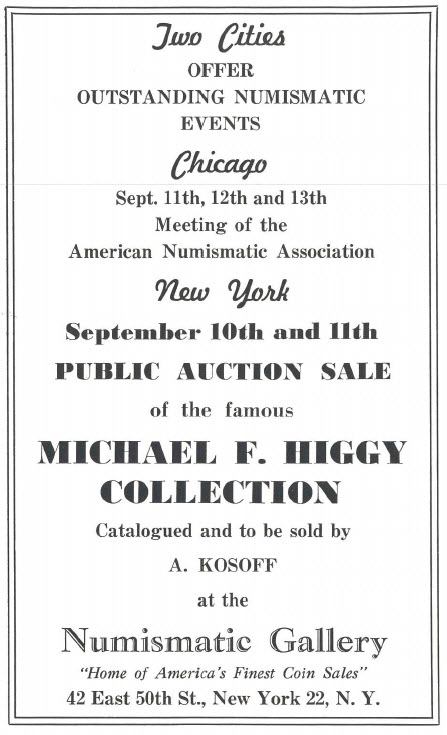
The Michael F. Higgy Collection, auctioned in New York City on September 10th and 11th, 1943, was the best yet for Abe Kosoff. Although the financial rewards were small, the publicity awards were immense. Many items brought multiples of catalogue listings, and the event created a sensation in the hobby. The sale catalogue was the first Kosoff production to have certain lots illustrated. (The Numismatist," September, 1943)