



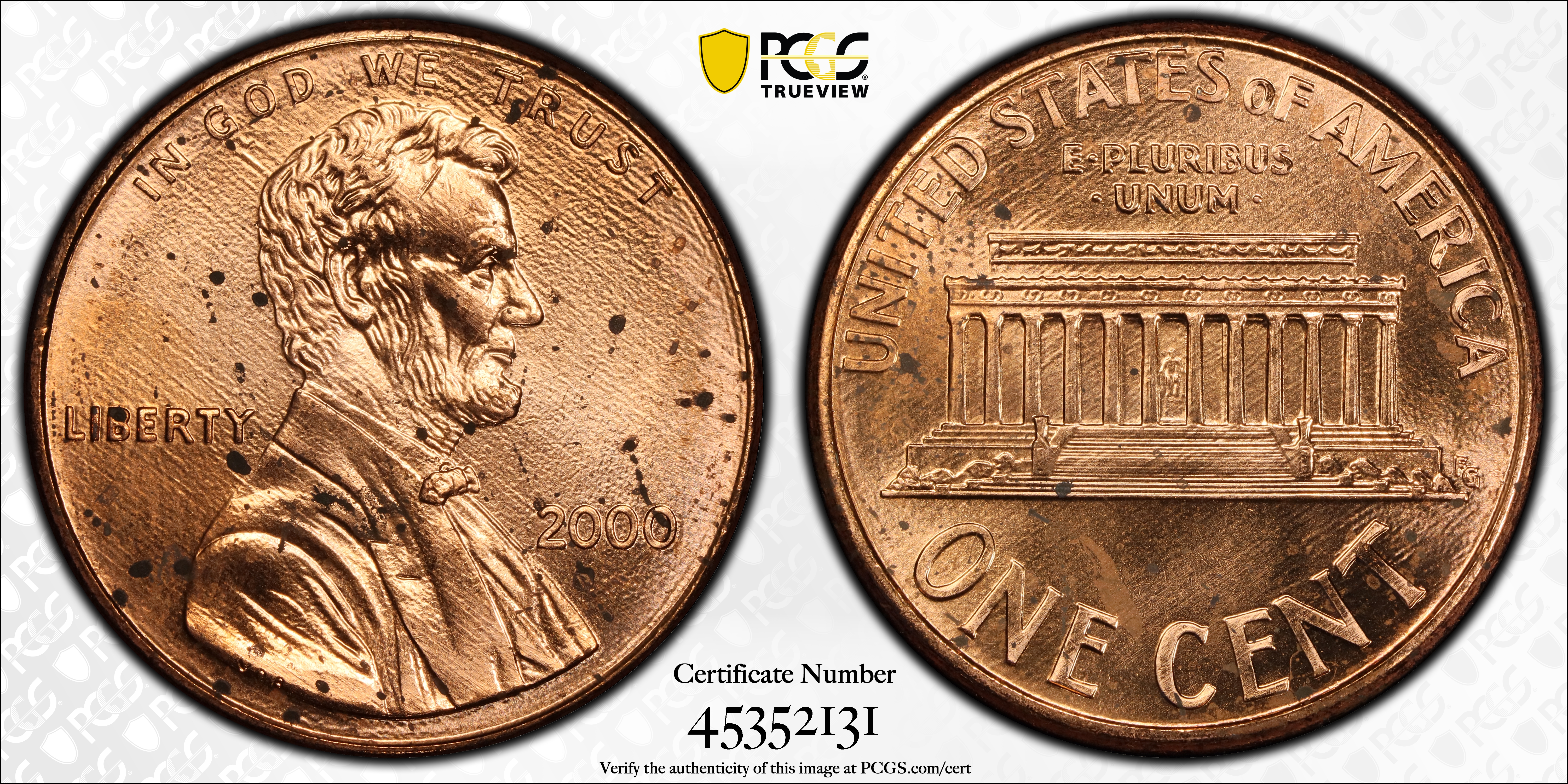
2000 1C "Cheerios" Cent, BN N1BN Certification #45352131, PCGS #515760
Expert Comments
Charles Morgan
The 2000 Lincoln "Cheerios" Cent
To support the rollout of the Sacagawea Dollar, the United States Mint launched several innovative PR campaigns designed to give the new coin a "fun factor" that its predecessor—the stern Susan B. Anthony Dollar—sorely lacked.
The most successful of these efforts was a collaboration with General Mills. The Mint delivered 10 million 2000 Lincoln Cents (Base #3160; Cheerios #515762) and 5,500 2000-P Sacagawea "Golden Dollars" (base #9584; Cheerios: #411990) to be distributed in cereal boxes. Each coin was housed in a blister pack on a black-bordered card. Curiously, while the actual coins were Philadelphia strikes, the card illustrations depicted "S" mint mark coins from San Francisco. For boxes containing the dollar, both the dollar and the cent were housed together in the same packet. In these instances, the blister pack is notably larger and rectangular in shape.
The top of the card features the Cheerios logo in gold trade dress, while the bottom is inscribed in gold: "ONE of the 10,000,000 First-Minted Year 2000 Coins."
The back of the card is white with gold-border depictions of the Lincoln Cent obverse. It features a Certificate of Authenticity, which reads:
This is to certify that the United States Mint at its Philadelphia, Pennsylvania facility—the largest coin manufacturing plant in the world—produced the enclosed coin(s). Your 2000-dated coin is one of the first 10,000,000 to be produced by the Mint and has been packaged by Cheerios as a special memento of the new millennium.
The Treasury Seal appears to the left, Phillip N. Diehl, a facsimile of Diehl's signature, and his title. Below the signature is a blank box for "NAME, EVENT, and DATE," along with a card number (A23683).
While every specially marked box contained a Lincoln Cent, the distribution of higher-value prizes was tiered:
- Every 2,000th box: Included both a cent and a Sacagawea Dollar.
- Every 4,400th box: Contained a certificate redeemable for $100 in Sacagawea Dollars.
In hindsight, the luckiest buyers were those who found the single Sacagawea Dollar; many of these were later discovered to be the rare "Cheerios Dollar" variety, distinguished by significantly enhanced detail in the eagle's tail feathers.
Struck with Multiple Dies
Photographic examination of multiple 2000 Cheerios Cents indicates that numerous dies were used to strike the coins. Because of this, original sealed packaging is necessary for authentication.
According to numismatic writer Richard Giedroyc, roughly 10% (one million) of these cents are the Wide AM variety (#147831). On these coins, the letters “AM” in "AMERICA" are spaced noticeably further apart than on the standard business strike. This occurred because a Proof reverse die was inadvertently used for circulation production.
Stains are Common
Unfortunately, as is common with many zinc-core cents, the Mint’s planchet washing process often leaves a residue on the surface that eventually develops into permanent staining. Because this issue is inherent to the 2000-dated strikes, collectors must take these "as-struck" imperfections into account when evaluating a coin's overall quality and eye appeal.
* * *
Condition Census Learn More
| #1 PCGS MS66BN |
| #2 PCGS MS64BN |
| #3 PCGS MS63BN |