



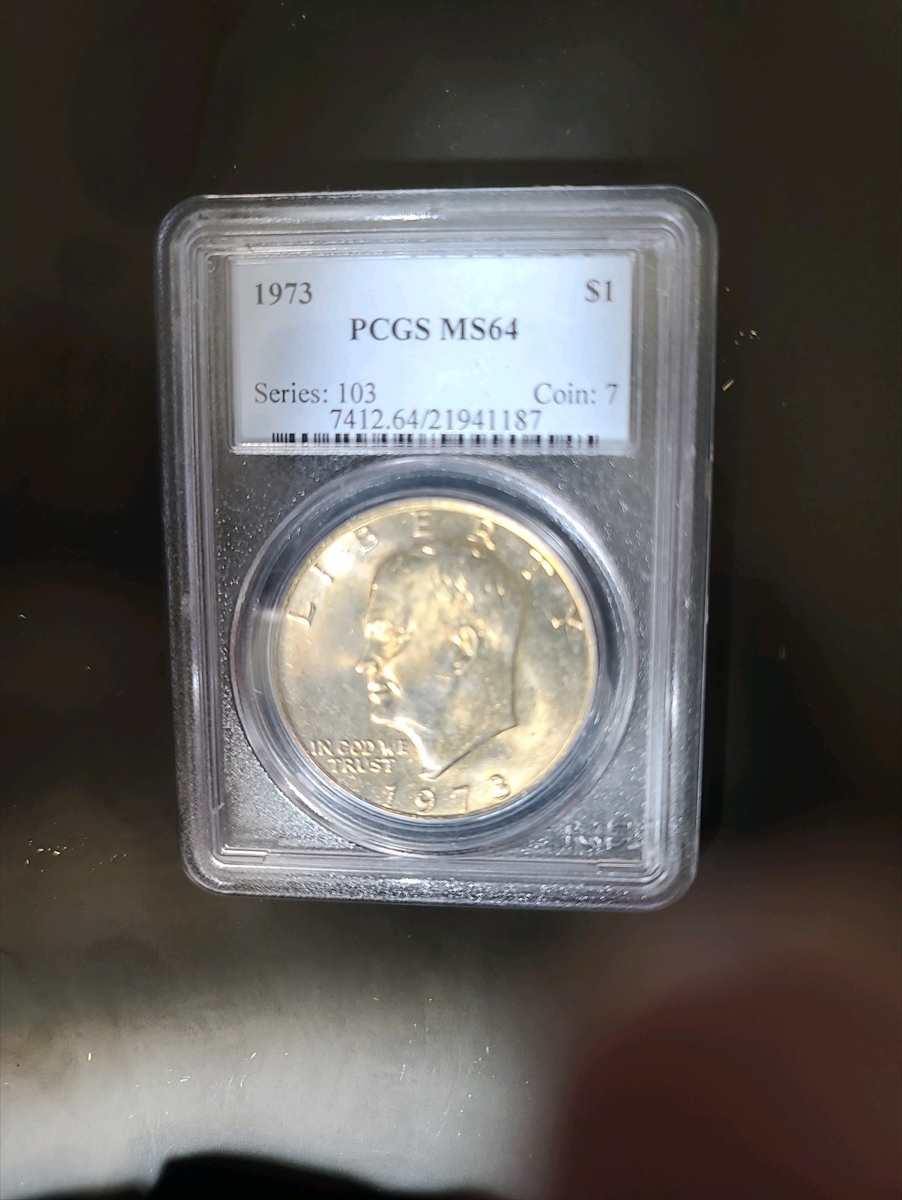
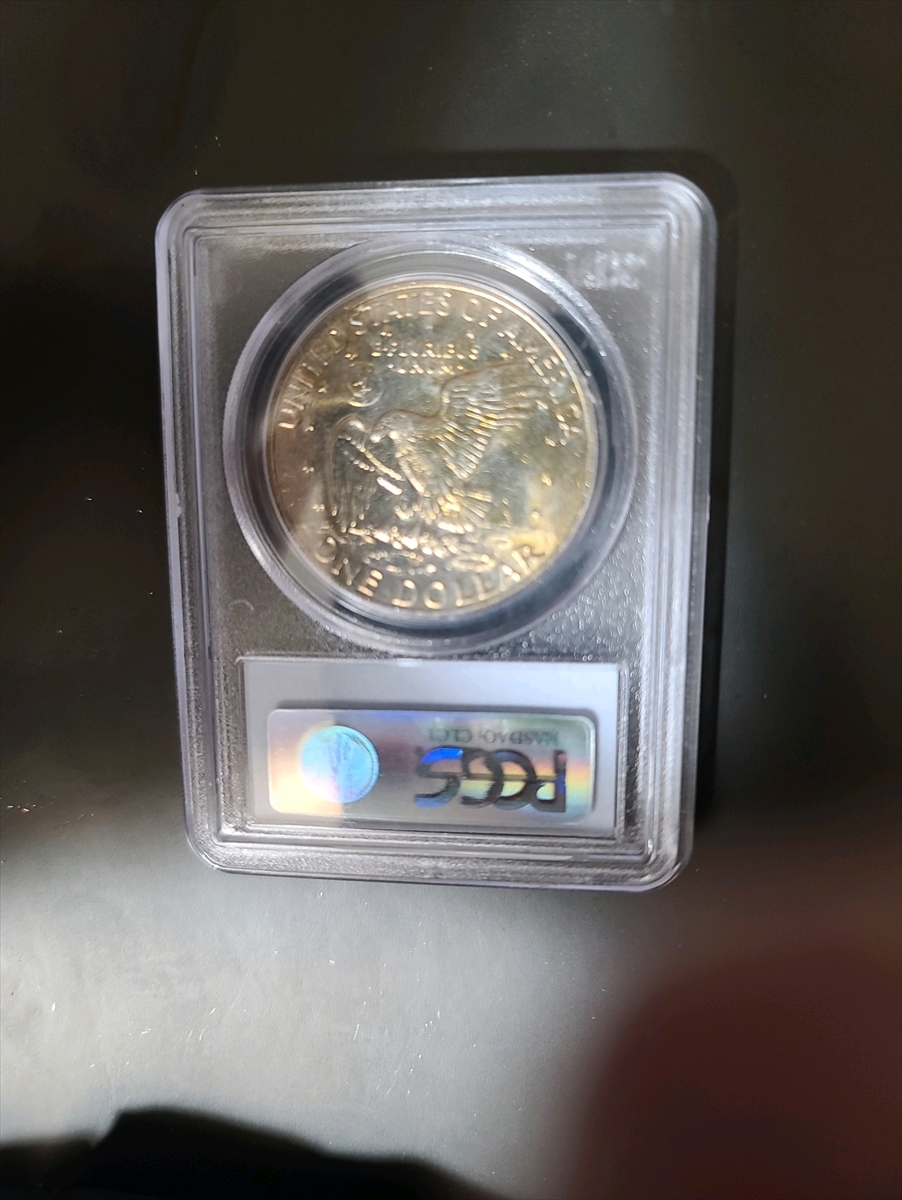
1973 $1 MS64 Certification #21941187, PCGS #7412
Expert Comments
PCGS Set Registry
Despite high mintage totals in 1971 and 1972, the Eisenhower Dollar had not become a mainstay in American commerce—nor was that the primary intention of the program's architects in Congress. The coin was chiefly seen as a means to honor a popular president in the aftermath of his passing, to provide a suitable silver dollar replacement for the Las Vegas gaming industry, and to raise money for the financially struggling Eisenhower College of Seneca Falls, New York, and for the Samuel-Rayburn Library.
President Eisenhower and Speaker Rayburn shared a long and complex working relationship. While Rayburn, a New Deal Democrat, opposed many of the Republican President's domestic policies, he consistently stood with him on foreign policy, defending America and its allies against the growing Cold War with the Soviet Union.
Having struck more than 282 million Eisenhower Dollars for circulation in 1971 and 1972, the U.S. Mint decided to forgo producing additional coins for general release in 1973. Instead, the Philadelphia Mint struck a quantity of just 2,000,056 coins for inclusion in the 1973 United States Mint Uncirculated Coin Set.
- Sold: 1,769,258 sets were ultimately sold.
- Destroyed: The remaining 230,742 1973 (P) and 1973-D Ike Dollars were officially reported as destroyed.
Dispelling the "Key Date" Myth
The limited mintage of the 1973 and 1973-D Eisenhower Dollars (#7413) has led some to mistakenly assert that these are "key dates" for the series. Simply put, they are not. The 1973 and 1973-D were notable as the first Ike Dollars included in the Mint's annual Uncirculated Coin Set, making them the first clad circulating versions that collectors had to purchase directly from the Mint. However, market evidence shows that the Philadelphia issues of 1971 (#7406) and 1972 (#87409, #97409, #7409) are scarcer in Mint State, with the 1972, Type 2 reverse rightfully claiming the title of the series key.
Harder Die Steel Improves Coin Quality
Grappling with the technical demands of striking the hard Copper-Nickel clad planchets, the Mint significantly improved its die production. It switched from the W-1 die steel used in 1971 and part of 1972 to hardened 52100 die steel. The result of this change was that the dies lasted longer and produced better-struck coins. The 1973 Eisenhower Dollar specifically benefited: Gem MS65 coins are much more prevalent than in preceding years, and the typical 1973 issue grades about one point finer in Mint State than the 1971 issue.
* * *
Rarity and Survival Estimates Learn More
| 65 or Better | 1900000 |
| All Grades | 40000 |
| 60 or Better | 400 |
| 65 or Better | R-1.0 |
| All Grades | R-2.6 |
| 60 or Better | R-6.2 |
| 65 or Better | 2 / 14 TIE |
| All Grades | 2 / 14 TIE |
| 60 or Better | 1 / 14 TIE |
| 65 or Better | 2 / 18 TIE |
| All Grades | 2 / 18 TIE |
| 60 or Better | 1 / 18 TIE |
Condition Census Learn More
 #1 PCGS MS67
As PCGS MS66+ #51608491. As PCGS MS67 #56912322. Stack's Bowers, August 30, 2025, Lot 6172 - $6,600. As PCGS MS67 #58779737. Rim tick at 12 o'clock. Small tick between T and Y. |
 #2 PCGS MS66+
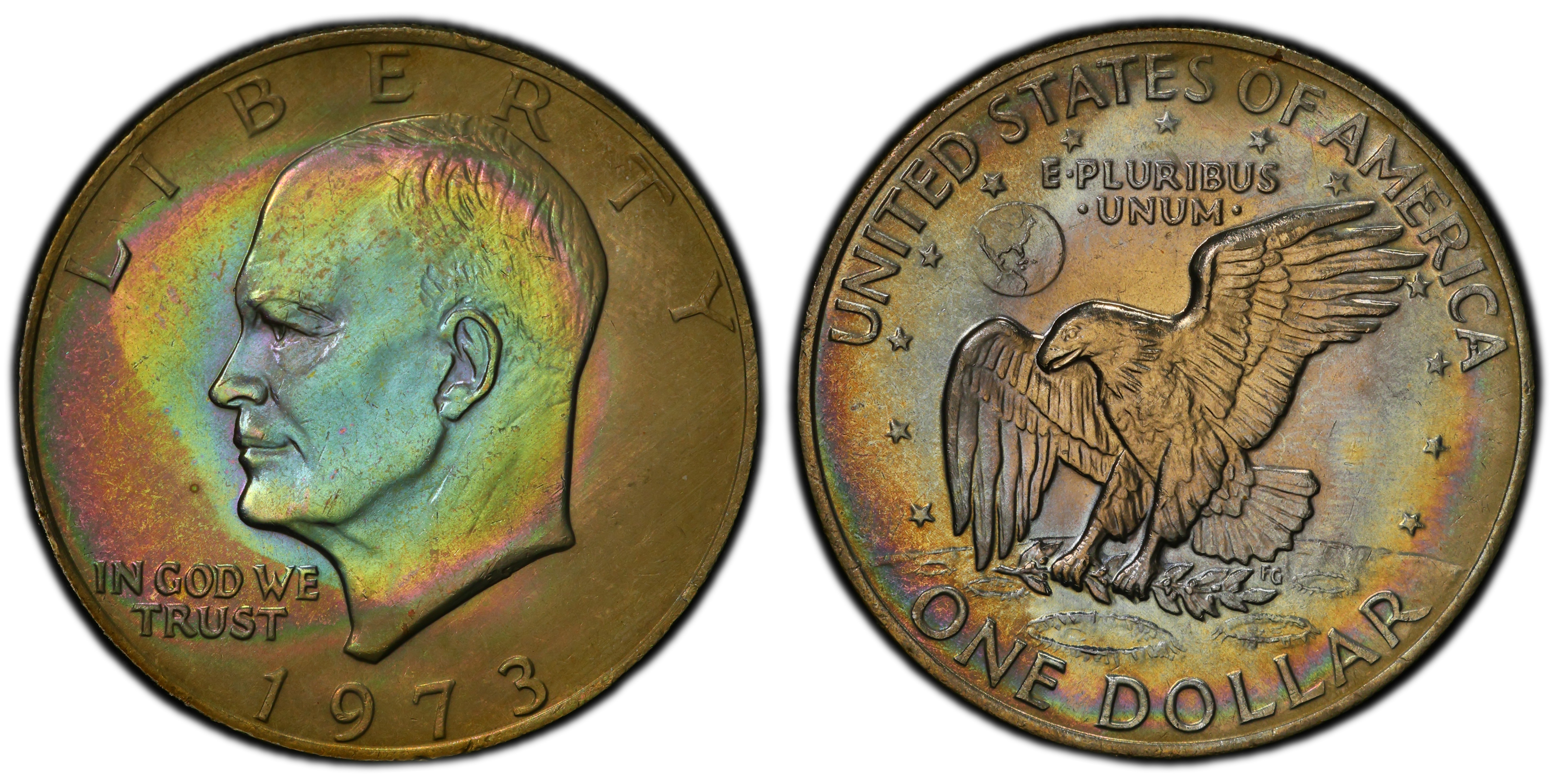
Stack's Bowers, June 25, 2025, Lot 2305 - $4,320. Vivid peacock toning on both sides. |
 #2 PCGS MS66+
|
 #2 PCGS MS66+
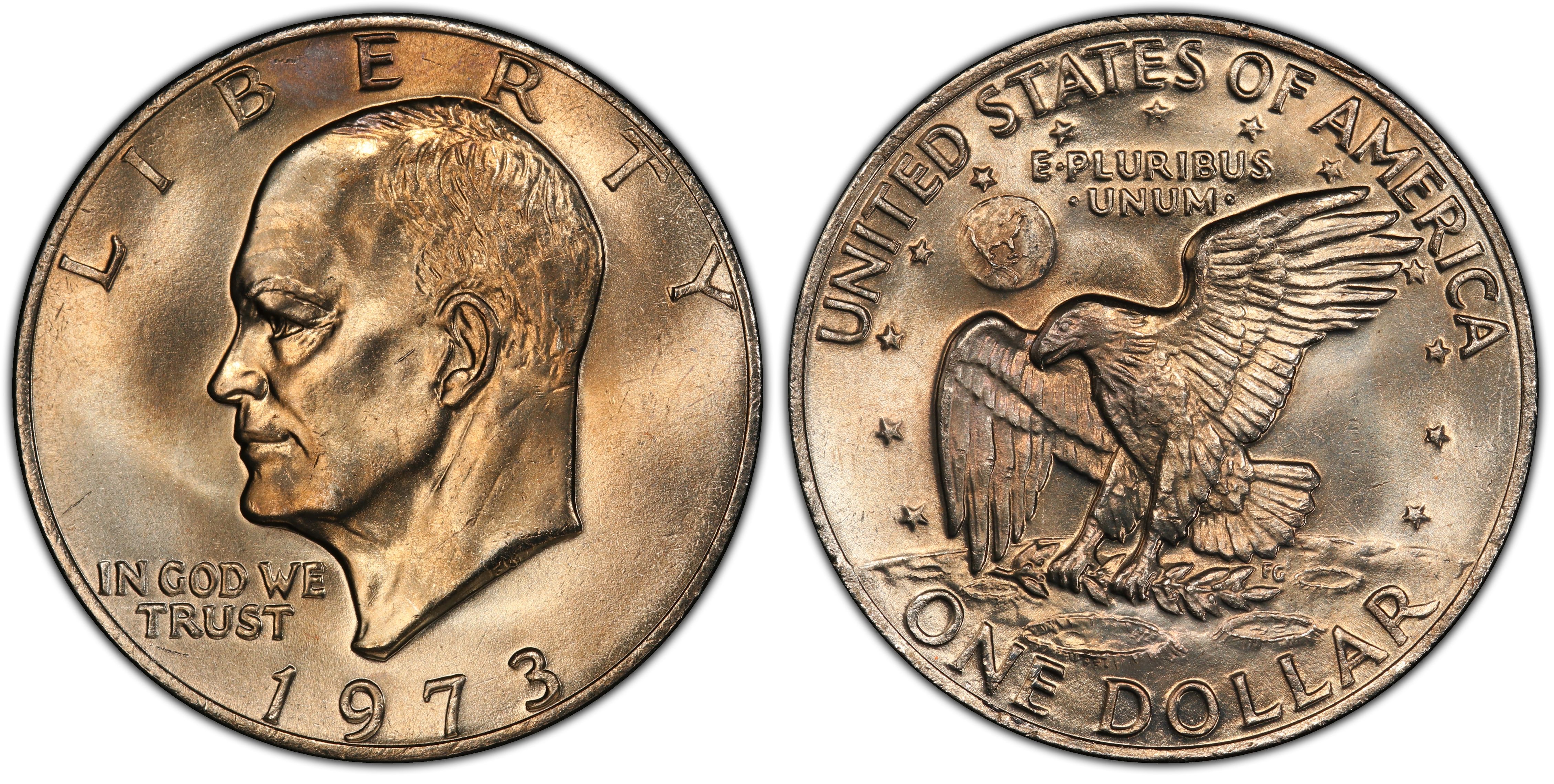
Stack's Bowers, March 23, 2023, Lot 6769 - $5,520. Blue-grey and antique gold toning throughout. |
 #2 PCGS MS66+
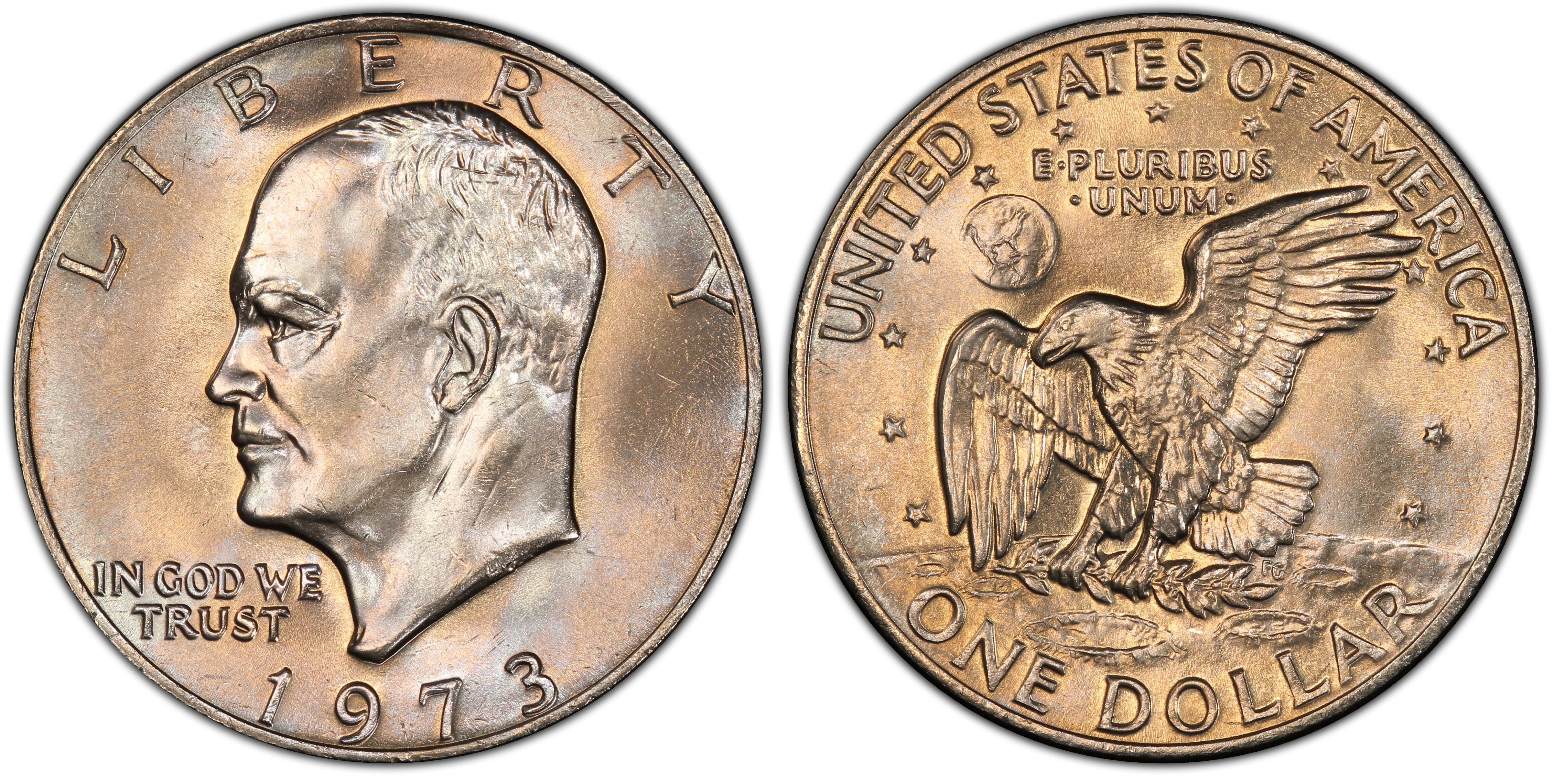
Heritage Auctions, April 29, 2016, Lot 5463 - $2,585. "K Hayse" (PCGS Set Registry). Gold and steel blue toning throughout. Cluster of horizontal cuts in Eisenhower's hair below R. |