



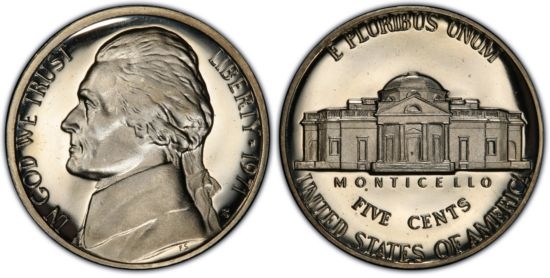
1971-S 5C, CAM PR67CAM Certification #12408809, PCGS #84203
Owner's Comments
Expert Comments
Charles Morgan
The 1971-S Jefferson Nickel Proof
By late 1970, the master dies for the Jefferson Nickel Proof had become severely worn, resulting in a loss of fine detail. To address this, the United States Mint created new masters to restore the integrity of Felix Schlag’s iconic design. During this re-engraving process, both the portrait of Thomas Jefferson and the reverse image of Monticello were significantly "touched up." The Mint also strengthened the strike by slightly widening the rim.
These modifications resulted in dozens of minor varieties for the 1971-S Jefferson Nickel:
- Obverse (ODV-021): Identified by a "TR" in "TRUST" that is slightly thinner than normal.
- Reverse (RDV-005 vs. RDV-006): These varieties involve the redesigned Monticello.
On RDV-005, the rooftop railings feature low relief; on RDV-006, the railings are much more prominent and sharply defined. According to Variety Vista, the 1971-S is a favorite for variety hunters, with 10 known Double Die Obverses (DDOs) and 34 Double Die Reverses (DDRs) recorded for the San Francisco Mint alone. PCGS attributes the DDR-028 (Cherrypickers' Guide FS-801, PCGS #569534), which shows thicker letters on E PLURIBUS UNUM and signs of doubling on the right edge of Monticello.
More coveted is the 1971 "No S" Proof (#569530). While these coins were struck in San Francisco, the Philadelphia Mint was responsible for die production. In a rare oversight, Philadelphia shipped an incomplete die that lacked the "S" mintmark. These are the only coins in the entire Jefferson series to completely lack a required mintmark. Mint officials estimate that only 1,655 examples were accidentally released within that year’s Proof Sets, making them a centerpiece for any serious Jefferson Nickel collection.
Collecting the 1971-S Jefferson Nickel Proof
The United States Mint reported sales of 3,220,733 for the 1971 Proof Set. This five-coin set was the first issued to not include a single coin struck in a precious metal alloy, as the 40% silver composition for the half dollar was changed to copper-nickel clad that year. Coins from this set generally trade for a dollar or two apiece, although the 1971-S Kennedy Half Dollar Proof (#6807) and 1971-S Lincoln Cent Proof (#3434) are the two most collected denominations.
Because the set's plastic holder is not airtight, these Proof coins may develop haze over time. The nickel's composition is particularly prone to toning; while they usually develop a golden hue, some specimens may turn shades of blue or purple.
Collectors of modern Proof issues are accustomed to coins with Deep Cameo (DCAM) contrast. In the early 1970s, Cameo coins were more common than they had been during the 1950s, yet many coins were still shipped with brilliant, non-frosted surfaces. In the PCGS Population Report, Cameos outnumber Deep Cameos by a factor of 2:1, and the combined population of both frosted designations remains lower than that of brilliant Proofs. Notably, no frosted 1971-S Jefferson Nickel Proof has ever earned a "70" grade from PCGS; the single existing PCGS PR70, certified in 2020, is a brilliant specimen.
Vintage Market Snippet
Q. David Bowers notes that the 1971-S was the first five-cent piece since 1878 to be struck exclusively in a Proof finish. Since that year, every nickel produced at the San Francisco Mint has been intended solely for collectors.
* * *
Condition Census Learn More
|
#1 PCGS PR69CAM
eBay, January 4, 2026 - $20. |
|
#1 PCGS PR69CAM
eBay, December 21, 2025 - $7.07. |
|
#1 PCGS PR69CAM
eBay, December 19, 2025 - $12.49. |
|
#1 PCGS PR69CAM
eBay, December 17, 2025 - $6.50. |
|
#1 PCGS PR69CAM
eBay, December 15, 2025 - $9.25. |