



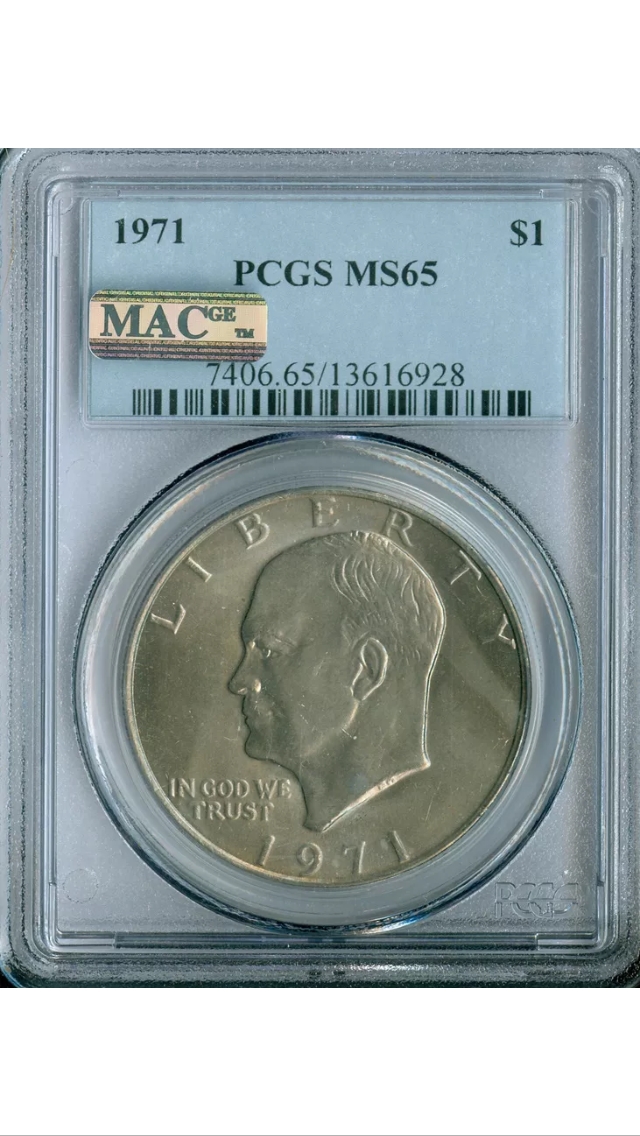
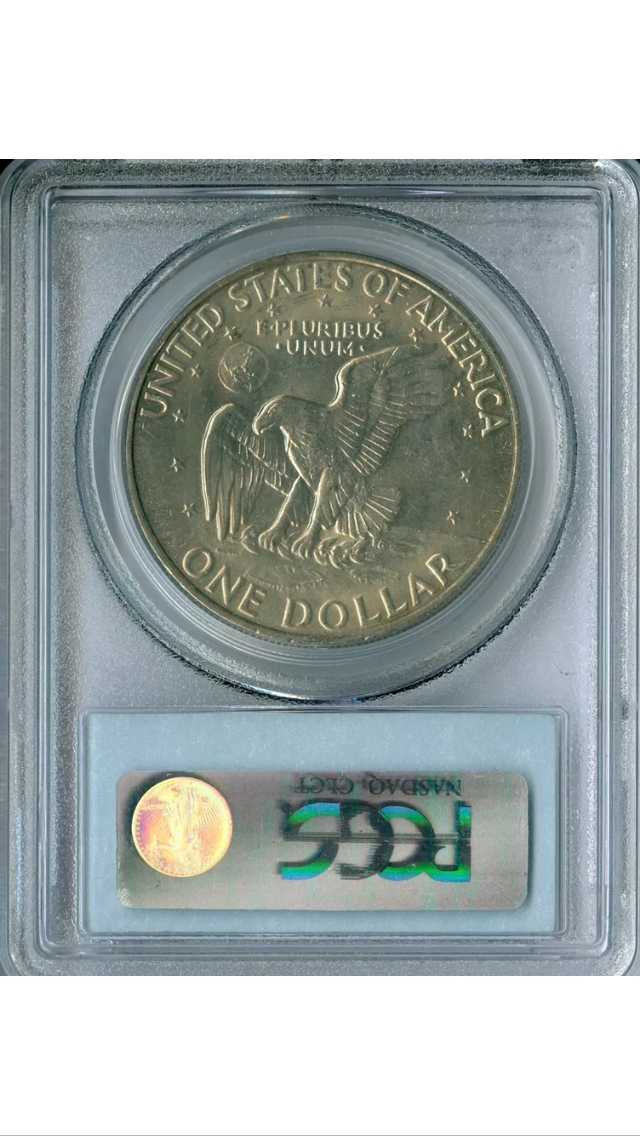
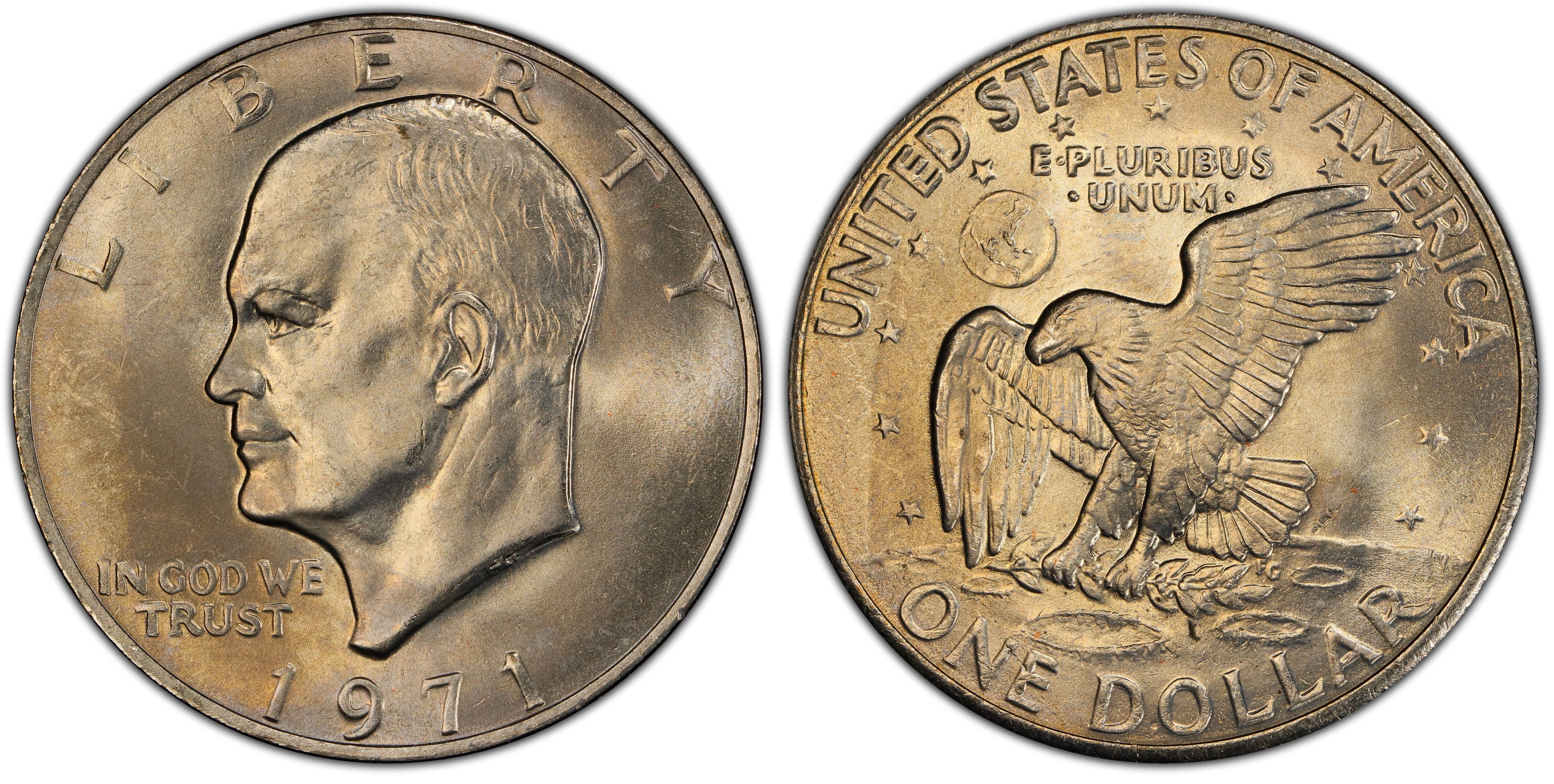
1971 $1 MS65 Certification #13616928, PCGS #7406
Expert Comments
Charles Morgan
The United States had no need for a circulating silver dollar when Congress overrode a Presidential Veto to authorize production of the Morgan Dollar in 1878. The Mint introduced the Peace Dollar design in 1921, only after producing 86 million Morgan Dollars that year as part of a Congressionally-mandated requirement to recoin the 270 million dollar coins that had been melted to support Great Britain during World War I.
Just six years before the Eisenhower Dollar's release, the country had undergone a massive transition from circulating silver to circulating clad coins. While the Kennedy Half Dollar was partially spared, it was debased to a 40% silver-clad composition. The future of the dollar coin was unclear, as an effort to strike and release the denomination in 1964 was abandoned after the Denver Mint struck only 316,106 pieces.
Still, the large dollar coin circulated to some degree in the American West. When available at face value, silver dollars served as standard currency in Montana and Wyoming, and were widely used in the gaming halls of Las Vegas and Reno. When the coins became too valuable to be spent at face value, the gambling houses introduced tokens to replace them.
The Drive to Reintroduce the Dollar
The effort to reintroduce the dollar coin gained momentum in 1969 following the death of President Dwight D. Eisenhower at the age of 78. Congress began to deliberate the coin's production, a bipartisan effort similar to the one that authorized the Kennedy Half Dollar in December 1963. The primary sticking point was the coin's metal composition.
The Coinage Act of 1965 had explicitly prohibited the mintage of a silver dollar during the five-year period that began on the date of the law’s enactment. That prohibition ended on July 23, 1970. For the new coin, a compromise on the composition led to the creation of copper-nickel clad versions for circulation and 40% silver-clad versions for the collector market.
The Bank Holding Company Act Amendments of 1970, signed into law by President Richard M. Nixon on December 31, 1970, provided the final authorization for the coin's production. Notably, these same amendments also allowed the General Services Administration (GSA) to sell 2.8 million Carson City Morgan Dollars held in the U.S. Treasury vaults.
Quality Issues and Mintages
The law set a maximum limit of 150 million silver-clad coins, but demand for such quantities never materialized. The quality of the 1971-S Eisenhower Dollar, the uncirculated silver-clad issue (#7408), was so poor that demand for the 1972 collector issue fell by almost 70%.
Circulation mintages peaked in 1972, but the initial 1971 mintage was already high. The Philadelphia Mint struck 47,799,000 coins, while the 1971-D Ike Dollar (#7407) had a mintage of 68,587,424. These numbers still paled in comparison to the massive mintages of the 1971 (#6716) and 1971-D Kennedy Half Dollars (#6717), which were in their first year as copper-nickel clad coins.
Condition Rarities and Grading
It probably went unnoticed for years, but when PCGS introduced commercial third-party grading to the coin market, collectors began to recognize that the Eisenhower Dollar series offered a number of condition rarities. The large clad planchets were not ideal canvases for striking attractive, mark-free coins. Any hits to the coin’s obverse are immediately noticeable, and in many instances, they look like pre-strike planchet marks. The presence of annealing chatter makes it difficult for most clad Ikes to ever reach the grade of MS66, much less the ultimate grades of MS67 or higher.
Regarding strike quality, the Philadelphia Mint typically lagged behind Denver. This is true for the 1971 and 1971-D Eisenhower Dollars and remains consistent throughout the series; the typical Philadelphia strike is never superior to its Denver counterpart. This is a well-known fact among those building competitive sets in the PCGS Set Registry.
The typical PCGS-graded 1971 Eisenhower Dollar falls in the MS64 and MS65 grade band. The issue tops out at MS67, with only four coins currently achieving this level. Even on high-end examples, planchet chatter along the coin’s periphery and the presence of small ticks on Eisenhower’s forehead and jaw are the persistent bane of the meticulous Ike Dollar collector.
This issue was not included in the Mint's 1971 Uncirculated Coin Set. Consequently, fresh coins in quantity will have to must be derived from original bags or rolls. Neither of which are commonly available for trade.
* * *
Rarity and Survival Estimates Learn More
| 65 or Better | 47700000 |
| All Grades | 955980 |
| 60 or Better | 9550 |
| 65 or Better | R-1.0 |
| All Grades | R-1.1 |
| 60 or Better | R-3.0 |
| 65 or Better | 2 / 14 TIE |
| All Grades | 11 / 14 TIE |
| 60 or Better | 12 / 14 |
| 65 or Better | 2 / 18 TIE |
| All Grades | 13 / 18 TIE |
| 60 or Better | 13 / 18 |
Condition Census Learn More
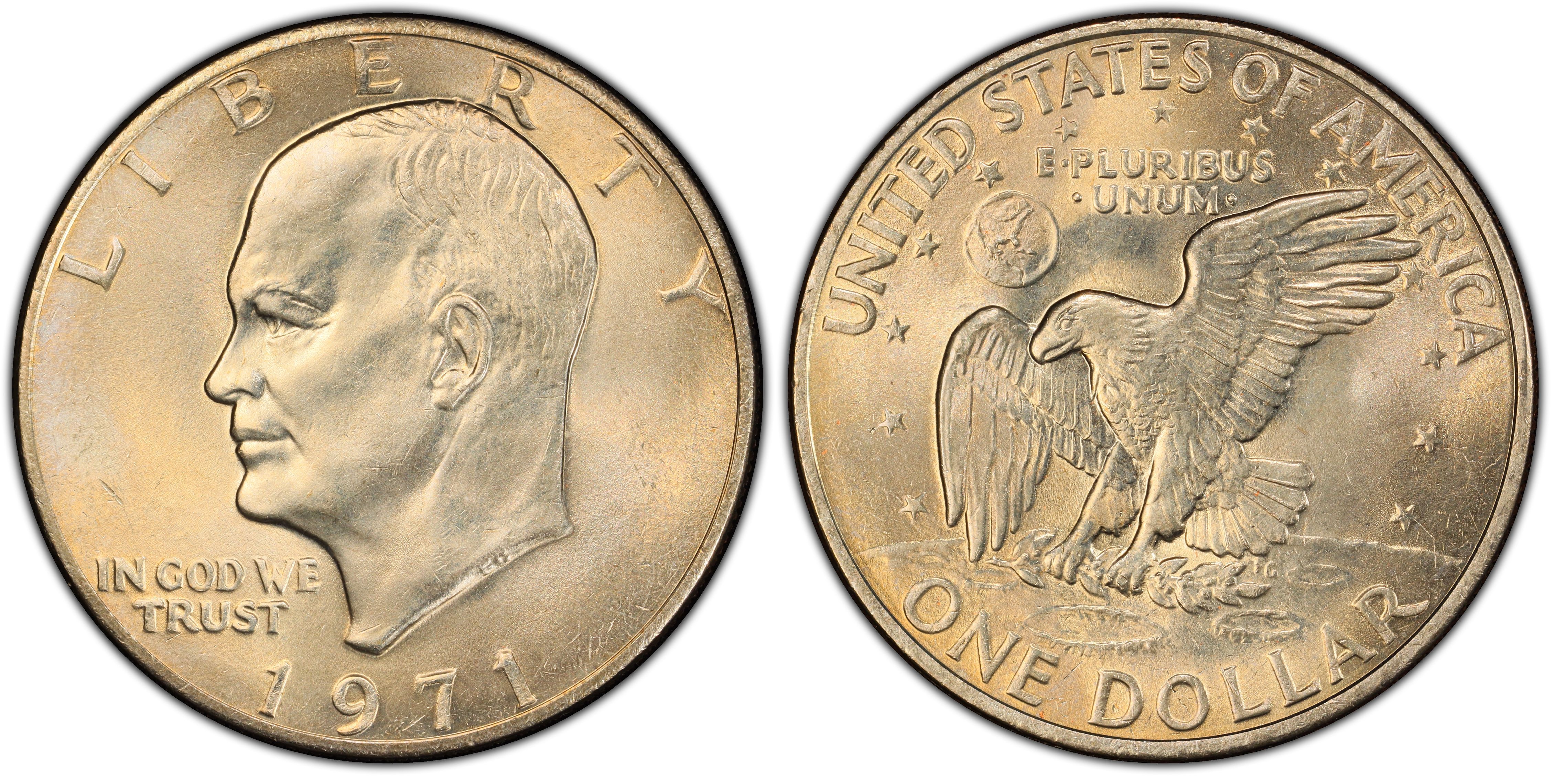 #1 PCGS MS67
GreatCollections, June 25, 2023, Lot 1357838 – View; The Bray Collection (PCGS Set Registry). Brilliant. Diagonal mark above IN. |
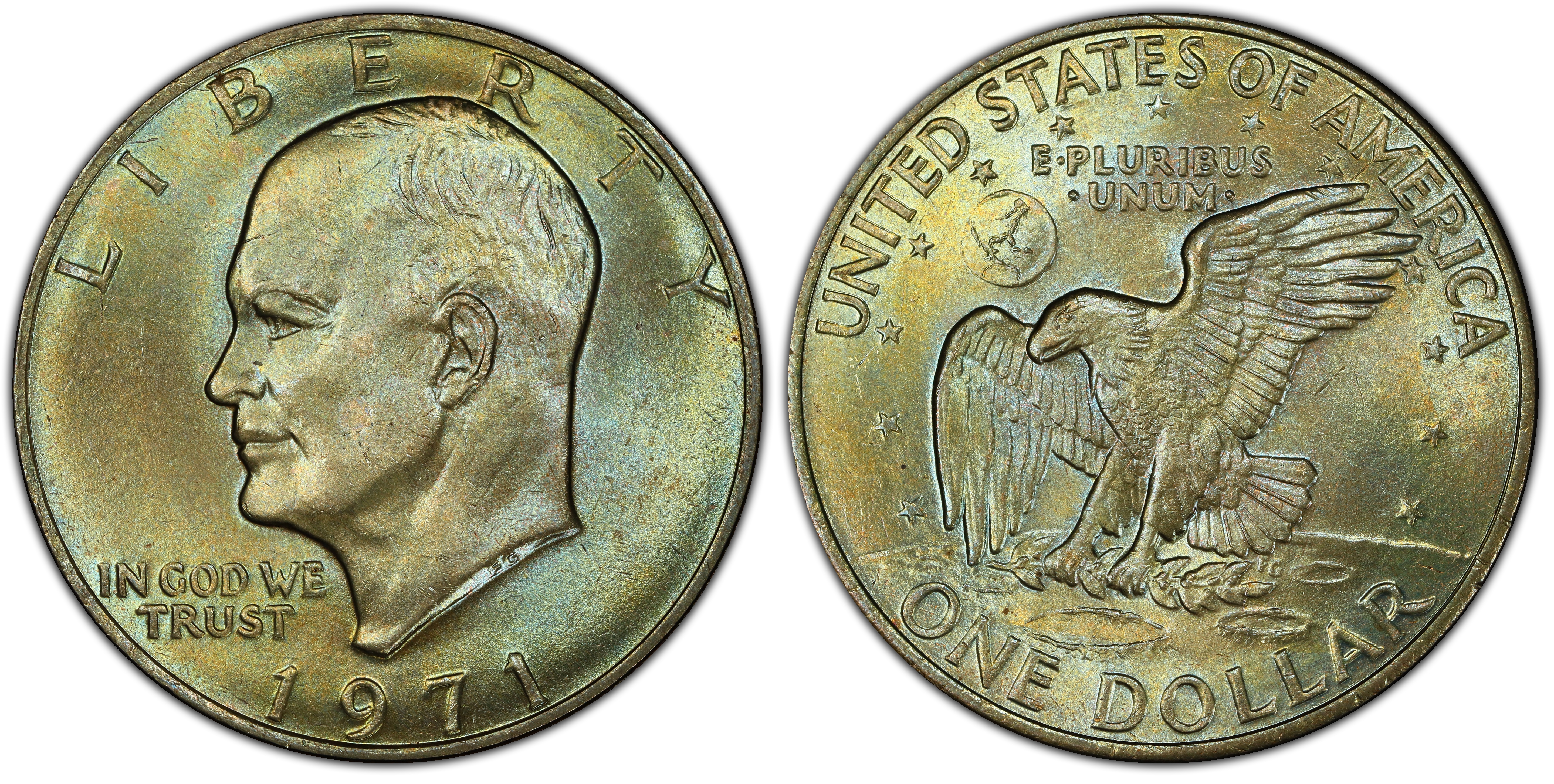 #1 PCGS MS67
|
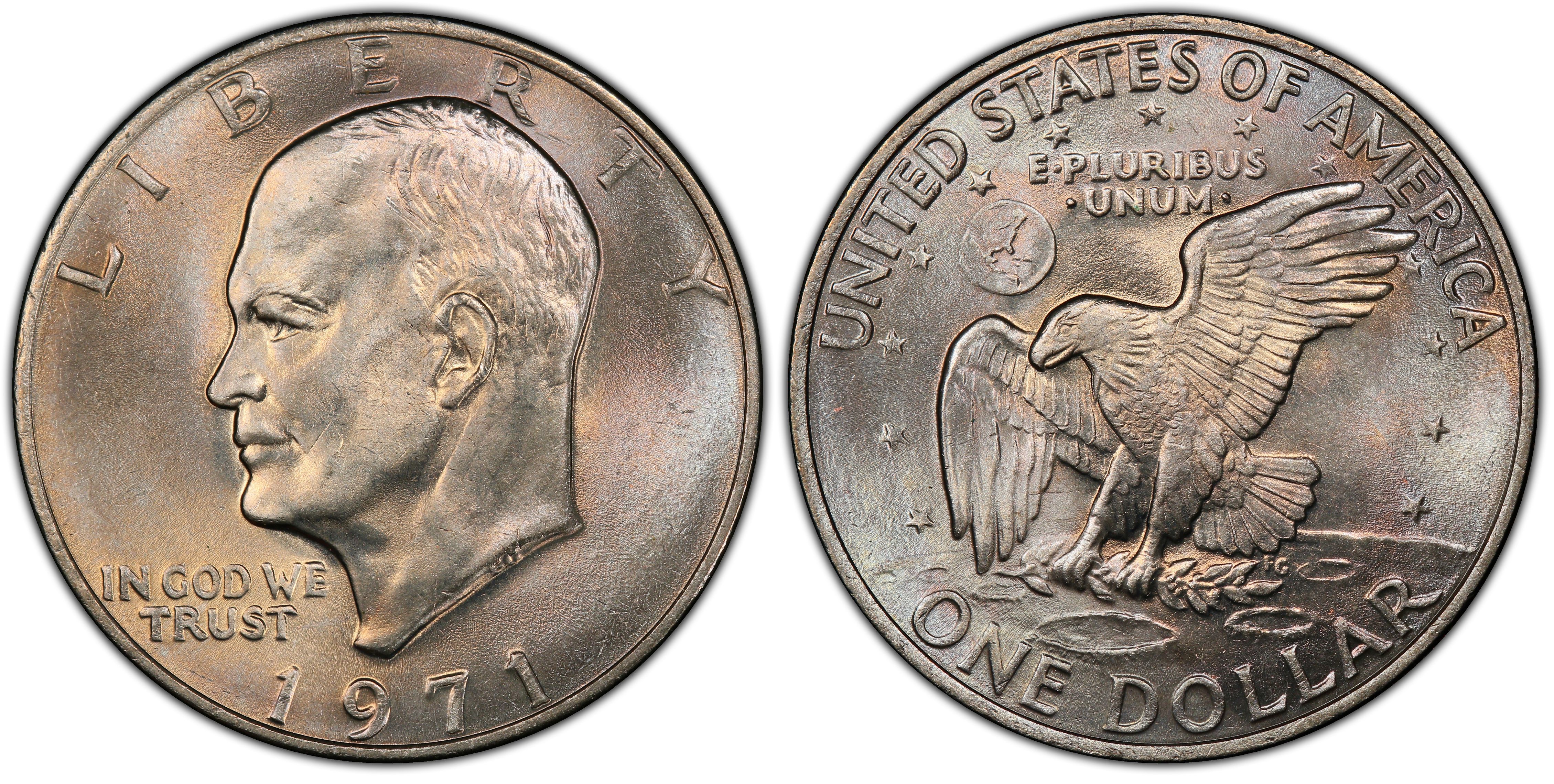 #1 PCGS MS67
GreatCollections, June 13, 2021, Lot 986175 – $19,186.88. franks78 (PCGS Set Registry). Brilliant. Auction record. |
 #1 PCGS MS67
|
 #5 PCGS MS66+
Heritage Auctions, September 8, 2017, Lot 4775 - $3,840. Brilliant. Ike clean. Diagonal mark in the field behind the eagle's tail feathers. Another thin mark above O of ONE. |