



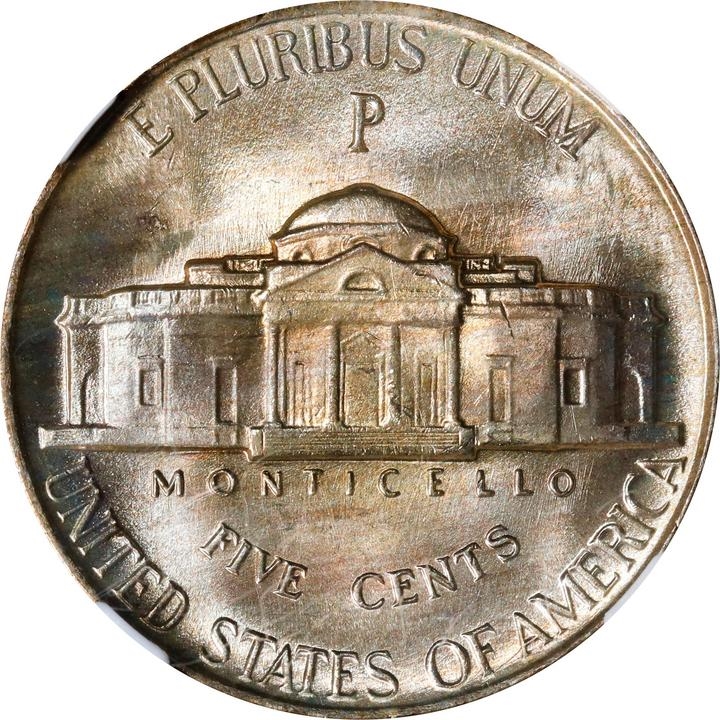
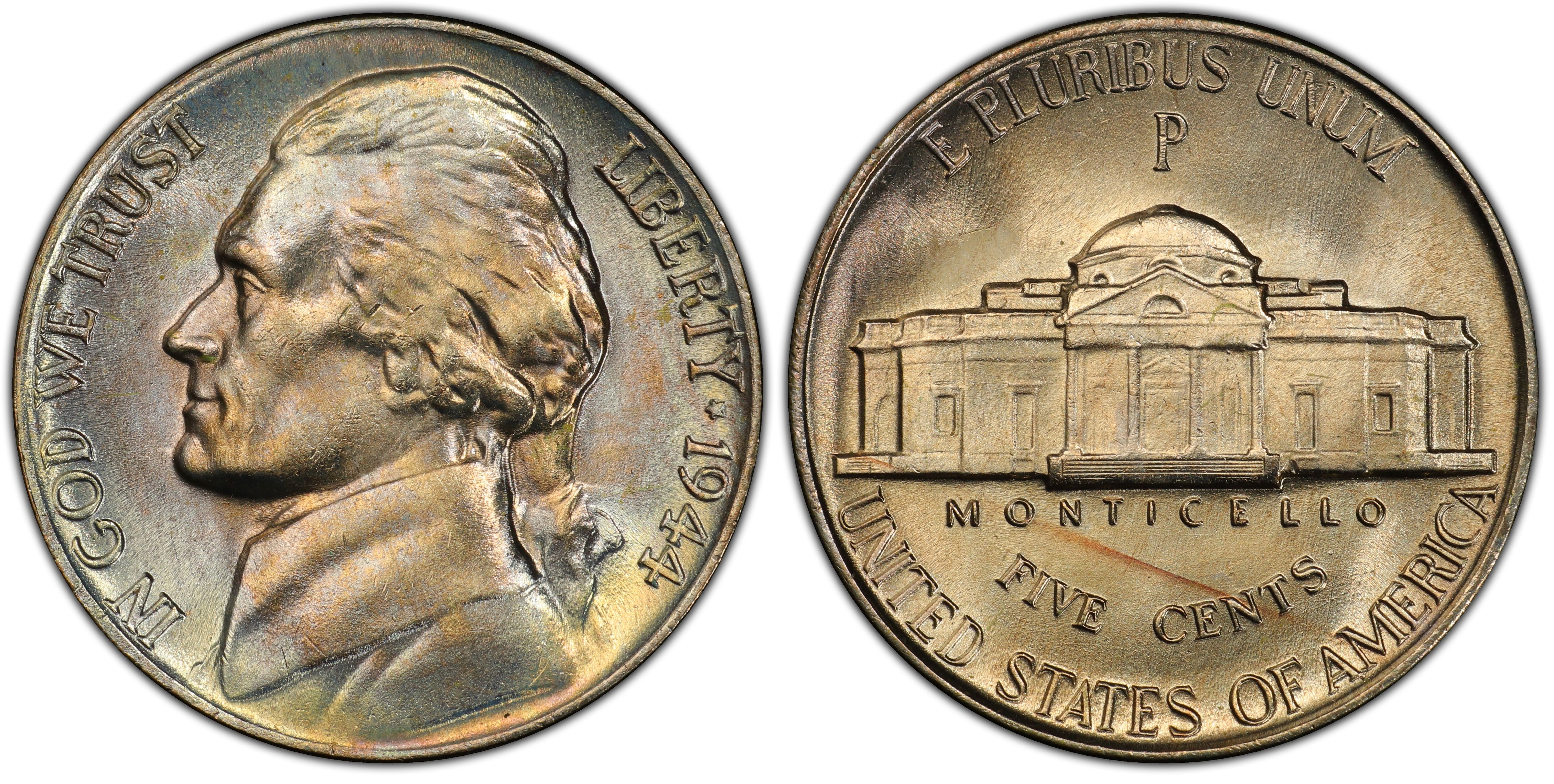
1944-P 5C, FS MS67+5FS PCGS #84022
Owner's Comments
Expert Comments
Charles Morgan
The 1944-P Jefferson Nickel
In January 1942, the War Production Board (WPB) began redirecting domestic resources toward the manufacture of weapons and munitions. Copper and nickel were prioritized for defense, forcing the United States Mint to innovate. As numismatic author Roger W. Burdette notes in United States Patterns and Experimental Coinage of WWII, the WPB held absolute authority over metal allocation.
The Mint’s first attempt at conservation—the 1943 zinc-coated steel cent—was a public relations disaster, as the coins were frequently confused with dimes and corroded quickly. The nickel presented a similar challenge. Since 1866, the five-cent piece had consisted of 75% copper and 25% nickel. By late 1941, the Mint began experimenting with alternatives, even briefly considering the return of the silver half-dime.
In April 1942, The Numismatist highlighted the strategic importance of this change:
“Nickel can do work where silver cannot... the nickel that goes into our coinage can be redirected to supply adequate metal to harden the steel for 1,000 heavy tanks.”
By September 1942, the Mint settled on a composition of 35% silver, 56% copper, and 9% manganese. This alloy proved difficult to work with, leading to frequent production issues such as poor mixing, oxidation, and inconsistent annealing.
Identifying the "War Nickel"
To ensure these silver-clad coins could be easily sorted and withdrawn from circulation after the war, Mint Director Nellie Tayloe Ross ordered a significant design change. A large mintmark was placed above the dome of Monticello on the reverse. This marked the first time the letter "P" was used to denote the Philadelphia Mint.
By 1944, the balance of power had shifted decisively toward the Allies. As American, British, and Canadian forces prepared for the D-Day landings, the Soviet Union had effectively broken the back of the Wehrmacht to the east—liberating Leningrad and forcing a bedraggled German army westward. The American and Canadian economies were roaring; their industrial might not only fueled an imposing war machine but also propped up the embattled British Treasury and provided essential infrastructure to their Russian allies through programs like Lend-Lease.
Against this monumental backdrop, the Philadelphia Mint struck over 119 million 1944-P Jefferson Nickels (#4022). During the war years, coin production skyrocketed, with minor denominations seeing the most dramatic gains. For the first time in history, annual Lincoln Cent mintages surpassed one billion (partly driven by the need to replace the unwanted steel-plated zinc cents issued the year before). In that same year, Philadelphia alone produced over 230 million silver 1944 Mercury Dimes (#5050), the two larger denominations were struck in more modest, yet ample, numbers.
The Fate of the Silver Nickel
Of the three lower denomination coins of 1944, only the Lincoln Cent remained a common sight in circulation into the late 1960s. The silver dimes and "War Nickels" became casualties of the Coinage Act of 1965. While the nickel’s 35% silver alloy was clearly identified by the oversized mintmark above Monticello’s dome, the government did not immediately recall or redeem the coins after the war ended. Instead, they circulated alongside their base-metal counterparts for two decades until the rising price of silver led to their widespread withdrawal by both the Treasury and savvy collectors.
A Famous Fake
The 1944-P is also famous for a blunder in the criminal underworld. It was the only wartime date chosen by counterfeiter Francis LeRoy Henning, whose failure to include the distinctive large mintmark ultimately led to his downfall.
In 1954, "1944" nickels without a mintmark began appearing in New Jersey. Henning, an engineer working in Philadelphia, operated a clandestine press in Erial, New Jersey. He produced thousands of nickels dated 1939, 1944, 1946, 1947, and 1953. His choice of the 1944 date was a fatal error; by omitting the "P," he created a coin that technically never existed in legitimate commerce.
Key Identifiers of a "Genuine" Henning "Nickel":
- Missing Mintmark: No large "P" above Monticello on a 1944-dated coin.
- The "R" Hook: A small defect or "hook" on the leg of the "R" in PLURIBUS.
- Composition: Henning used a base-metal alloy (79% copper, 20% nickel) rather than the official silver wartime mix.
When the story broke in 1955, Henning dumped his remaining stock into Cooper Creek and the Schuylkill River. He was eventually arrested in Cleveland and sentenced to three years in prison. Today, Henning Nickels are a popular addition to "black cabinets" (collections of counterfeits). Note: PCGS does not certify counterfeit coins and will not encapsulate Henning forgeries.
Collecting the 1944-P Jefferson Nickel
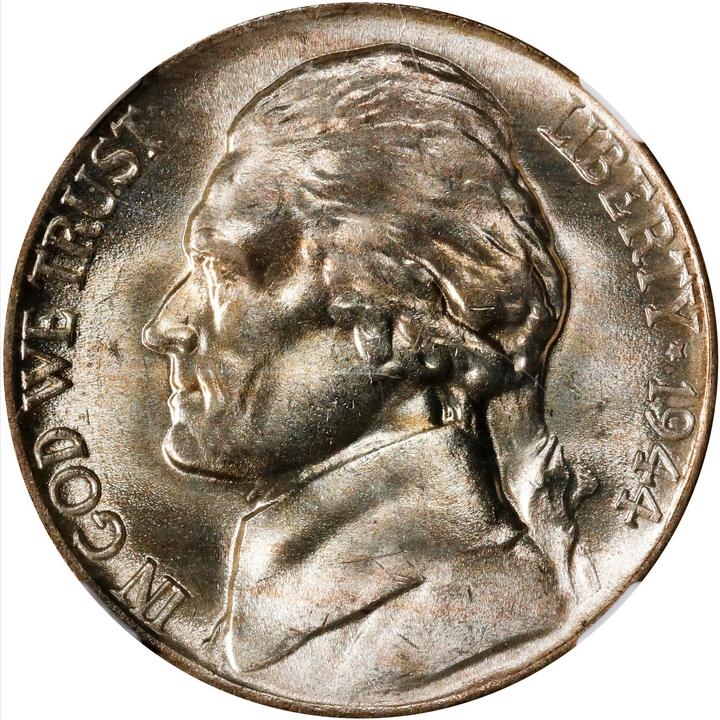
The silver alloy gives War Nickels a brilliant finish ranging from satin to frosty. Unlike nickels struck in the standard cupronickel pieces, the toning colorations of War Nickels can sometimes develop toning in shades of blues, green, ruby red, magenta, and gold.
While examples struck from fresh dies can exhibit razor-sharp details, Full Steps (FS) designations are elusive. According to PCGS Population Report data, non-FS examples outnumber FS specimens by a ratio of 4.33 to 1, making a fully-struck 1944-P a prized find for any Jefferson Nickel enthusiast.
* * *
Rarity and Survival Estimates Learn More
| 65 or Better | 85000 |
| All Grades | 85000 |
| 60 or Better | 37500 |
| 65 or Better | R-2.1 |
| All Grades | R-2.1 |
| 60 or Better | R-2.6 |
| 65 or Better | 9 / 14 |
| All Grades | 9 / 14 |
| 60 or Better | 9 / 14 |
| 65 or Better | 51 / 79 TIE |
| All Grades | 51 / 79 TIE |
| 60 or Better | 45 / 79 TIE |
Condition Census Learn More
 #1 PCGS MS67+FS
GreatCollections, December 7, 2025, Lot 1999883 - $2,306.25. Ruby and green toning barely encroaches upon the upper right side of the obverse, partially covering LIBERTY. Reverse is fully rainbow toned with Dark red diagonal streak above the dome. |
 #1 PCGS MS67+FS
GreatCollections, September 28, 2025, Lot 1934641 - $4,050; "The RickJones Collection" (PCGS Set Registry). Amber toning forms a crescent around the lower right portion of the obverse. A dusting of amber toning on the reverse. |
 #1 PCGS MS67+FS
Heritage Auctions, March 21, 2014, Lot 10192 - $9,400; "The Incline Collection," Legend Rare Coin Auctions, July 16, 2020, Lot 183 - $3,407.50; "The Sontag Collection," Stack's Bowers, August 23, 2024, Lot 4609 - $2,040; "The BTS FS War Nickels Collection" (PCGS Set Registry). Pearlescent toning. Diagonal streaks of amber at the bottom of Jefferson's coat. |
|
#1 PCGS MS67+FS
"The E Fisher #1 PCGS Registry Set of War Nickels," GreatCollections, February 4, 2024, Lot 1493259 - $3,487.50. Pearlescent toning. Peacock toning along the periphery. |
 #1 PCGS MS67+FS
|