



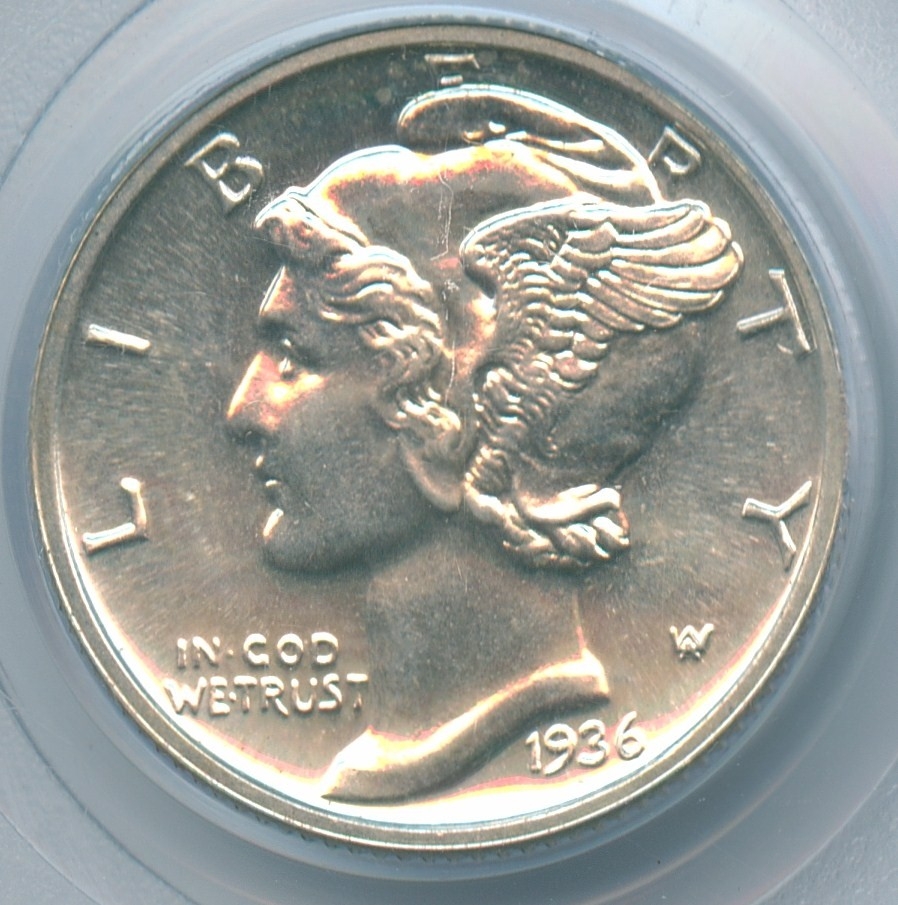
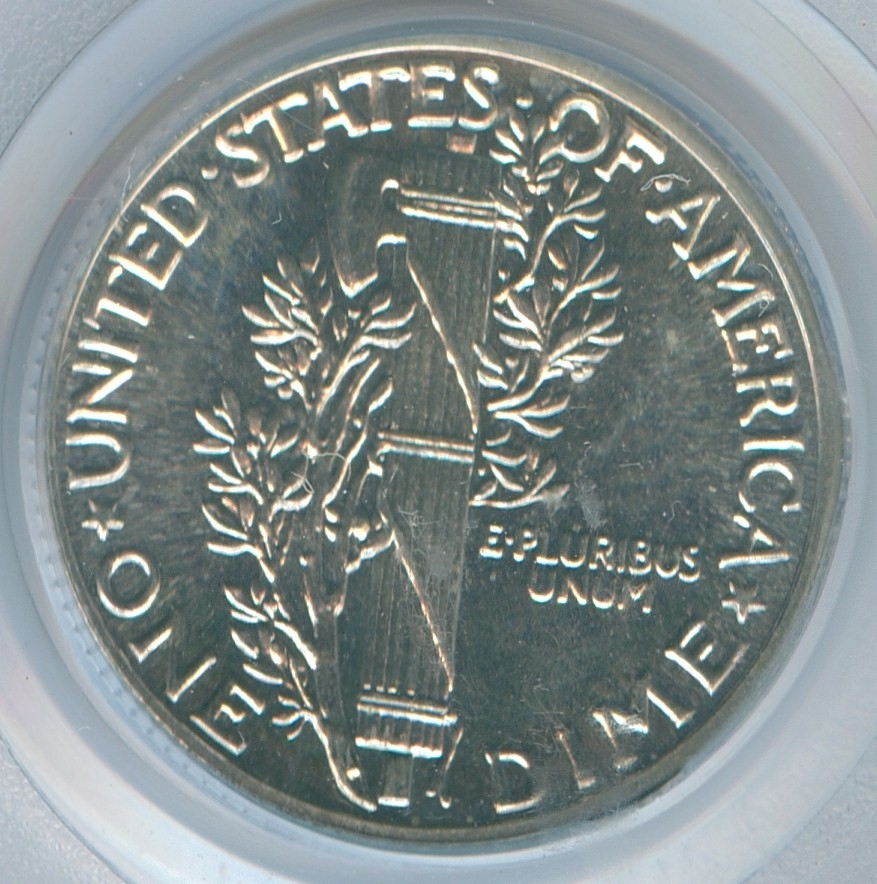
1936 10C PR66 Certification #50170717, PCGS #5071
Expert Comments
Charles Morgan
1936 Mercury Dime Proof: A "Brilliant" Return to Form
Following a 20-year hiatus driven by low demand, the United States Mint resumed the production of Proof coinage in 1936. This revival served a dual purpose: satisfying a growing hobbyist base and generating much-needed revenue for the Treasury Department during the Great Depression.
According to numismatist Roger W. Burdette in United States Proof Coins: 1936-1942 (2016), the program’s return was championed by Louis Howe, a close advisor to President Franklin D. Roosevelt. After Howe’s initial proposal—selling existing Treasury gold coins to collectors at a premium—was rejected, he pivoted to Proof versions of the nation's circulating coinage. The very first Proof struck in this resumed series was a 1936 Washington Quarter Proof (#5975), presented to Howe shortly before his death in April 1936. While some at the Treasury Department hoped Howe's passing would end the matter, Secretary Henry Morgenthau, Jr. and President Roosevelt decided to move ahead.
Sales Window Opens
On April 16, 1936 the Treasury Department issued a public announcement that Proof issues were available for purchase at the following prices:
- 1936 Lincoln Cent Proof (#3330 - #83335) | 1¢ + 15¢ (surcharge)
- 1936 Buffalo Nickel Proof (#3994 - #3995) | 5¢ + 15¢ (surcharge)
- 1936 Mercury Dime Proof (#5071) | 10¢ + 10¢ (surcharge)
- 1936 Washington Quarter Proof (#5975) | 25¢ + 25¢ (surcharge)
- 1936 Walking Liberty Half Dollar Proof (#6636) | 50¢ + 25¢ (surcharge)
In addition to the cost of the coins, customers also were required to pay 8¢ for postage.
Deliveries Begin
Burdette's research into the Mint's records held at the National Archives reveals modest deliveries starting on May 14 and continuing through the summer. A small burst of activity in October and December.
| 1936 Mercury Dime Proof Deliveries | |||
| May 14 | 515 | May 25 | 203 |
| June 1 | 352 | June 5 | 301 |
| June 9 | 303 | June 15 | 303 |
| June 25 | 60 | July 14 | 303 |
| July 23 | 301 | August 6 | 503 |
| October 5 | 403 | December 3 | 101 |
| December 9 | 201 | December 18 | 303 |
| Total: 4,130* | |||
*Less 25 held for Assay. Source: Burdette, Roger. United States Proof Coins: 1936-1942. Seneca Mill Press. (2016)
Quality Issues
Having not struck Proof coins for two decades, the Mint struggled to replicate the "Brilliant Cameo" quality of the late 19th century. Furthermore, Mint Chief Engraver John R. Sinnock showed little interest in applying the specialized die treatments necessary to create the cameo contrast found on earlier Proof issues.
Early 1936 Proof Lincoln Cents and Buffalo Nickels were struck using normal dies and lightly polished planchets, resulting in a "Satin" finish. While the silver coinage was struck to a brilliant finish, the Mint did not achieve consistent, mirror-like surfaces across all denominations until 1937.
Collecting the 1936 Mercury Dime Proof
Roughly 75% of the total mintage has been certified, with approximately 50% of those graded by PCGS. While these figures suggest a high survival rate, collectors should note that at least half of the certified population grades PR64 or lower due to mishandling or improper storage. Long-term storage in the original government packaging (OGP) introduces significant risks, such as environmental damage; furthermore, improper cleaning to remove tarnish or "cloudiness" often leaves coins with permanent hairlines or worse.
Quality examples in PR65 to PR67 remain available in quantity, but the zenith for the issue is PR68 or 68+. Currently, three of the five finest-known specimens are held in significant PCGS Registry Sets.
* * *
Rarity and Survival Estimates Learn More
| 65 or Better | 3400 |
| All Grades | 3350 |
| 60 or Better | 1550 |
| 65 or Better | R-4.3 |
| All Grades | R-4.3 |
| 60 or Better | R-4.7 |
| 65 or Better | 1 / 7 |
| All Grades | 1 / 7 |
| 60 or Better | 1 / 7 |
| 65 or Better | 1 / 7 |
| All Grades | 1 / 7 |
| 60 or Better | 1 / 7 |
Condition Census Learn More
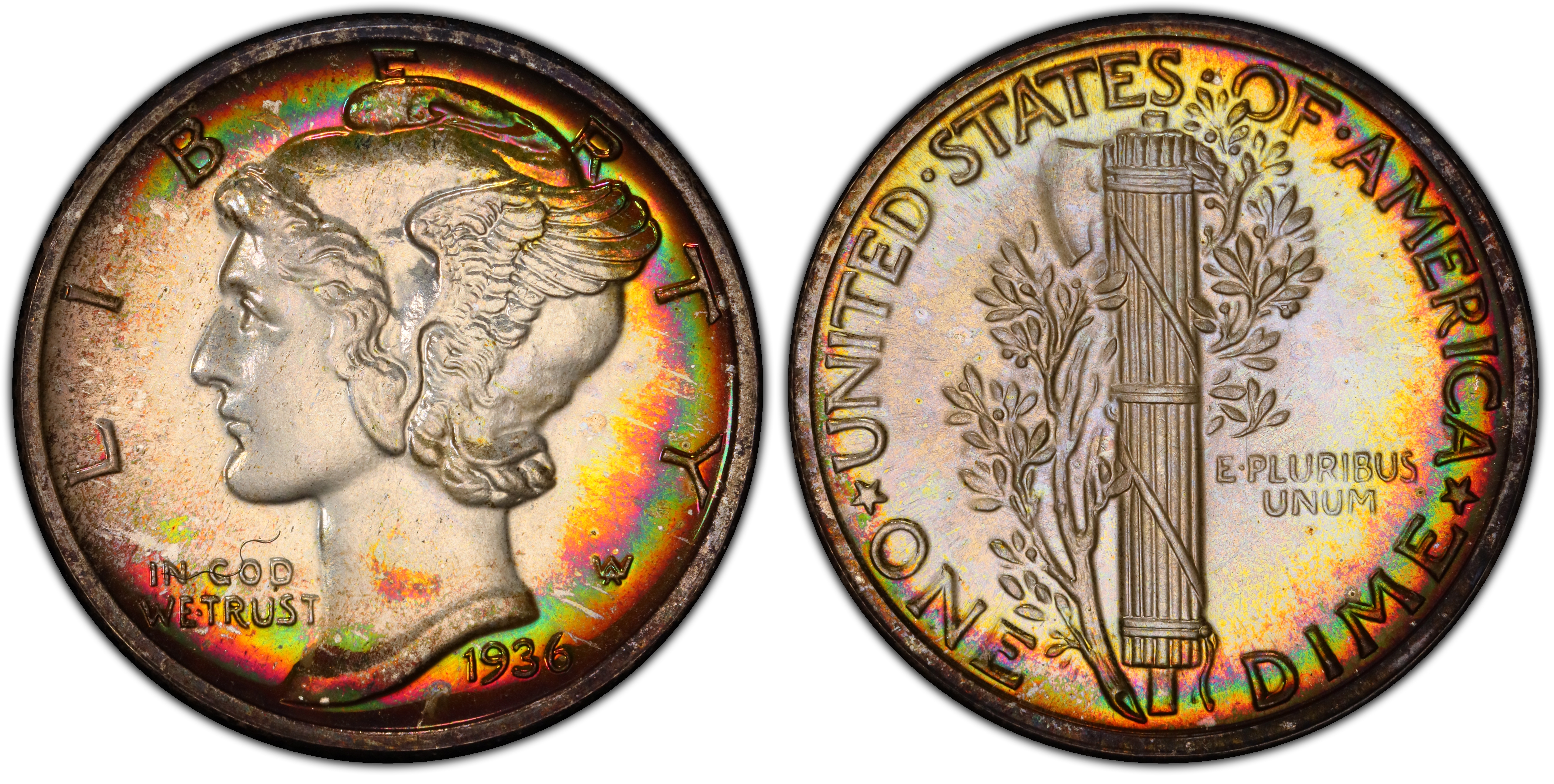 #1 PCGS PR68+
Glassy mirrors. Vivid ring of prismatic peacock toning along the obverse and reverse borders. Patch of amber toning on Liberty's neck. |
 #2 PCGS PR68
GreatCollections, August 17, 2025, Lot 1835406 - $24,300. Vibrant peacock toning on the obverse. Vibrant sun yellow toning in the right reverse field. |
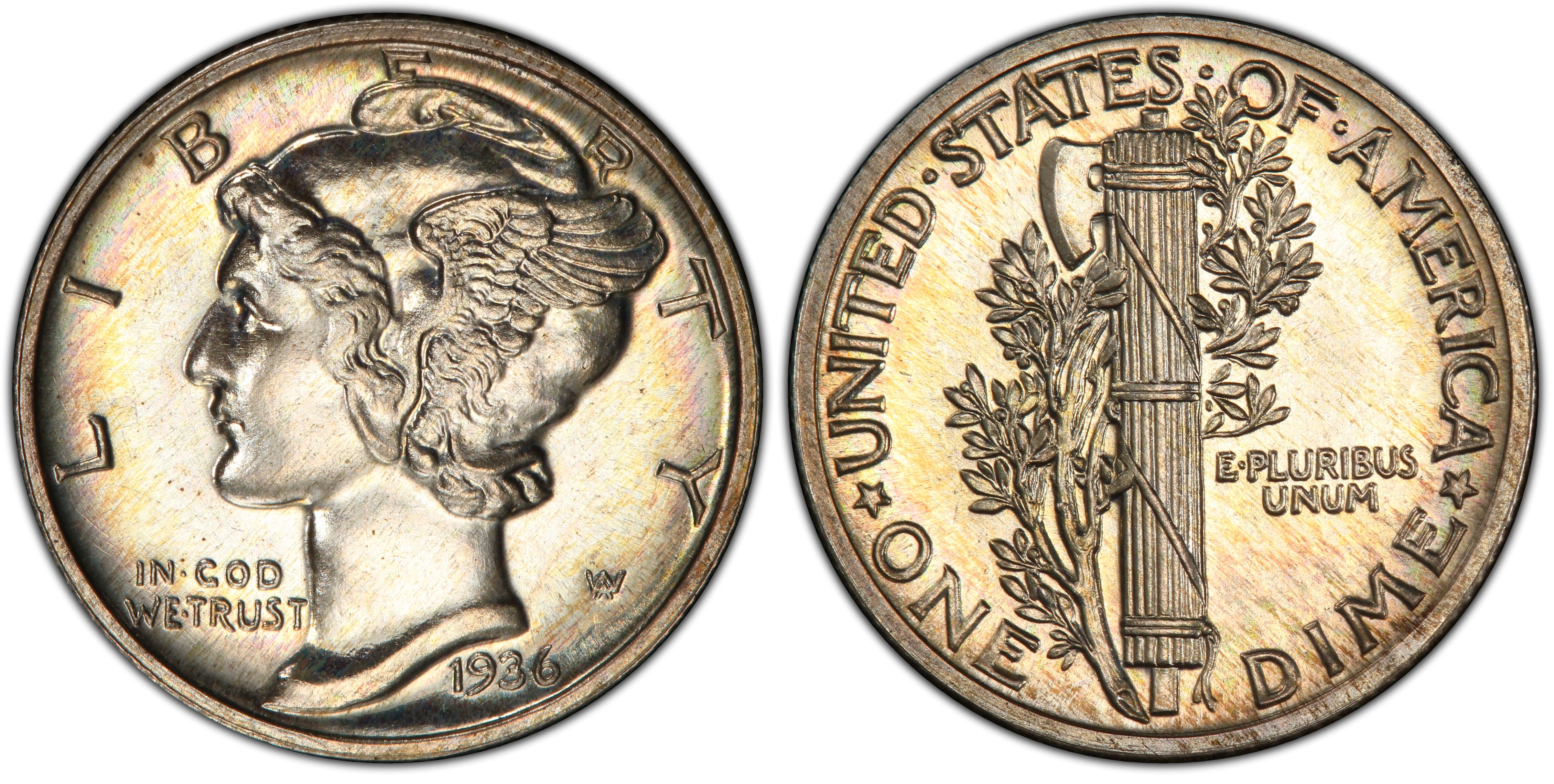 #2 PCGS PR68
Heritage Auctions, June 2016, Lot 4412 – $23,500. Pop two at PCGS when offered; Heritage Auctions, July 14, 2022, Lot 3070 – $28,800 ; MADHATTER's "MERC MADNESS Collection" (PCGS Set Registry). Faint diagonal streaks of gold, orange, red, magenta, and blue toning on the obverse and reverse. Three small specks to the left of Liberty’s chin. |
|
#2 PCGS PR68
Heritage Auctions, December 3, 2015, Lot 3122 – $29,375. "The JCL Collection" (PCGS Set Registry). Sole finest at PCGS when offered. Old Green Holder. Diagonal streaks of gold, orange, and red toning on the obverse and reverse. On the obverse, there is a small toning spot centered between the T and Y of LIBERTY. |
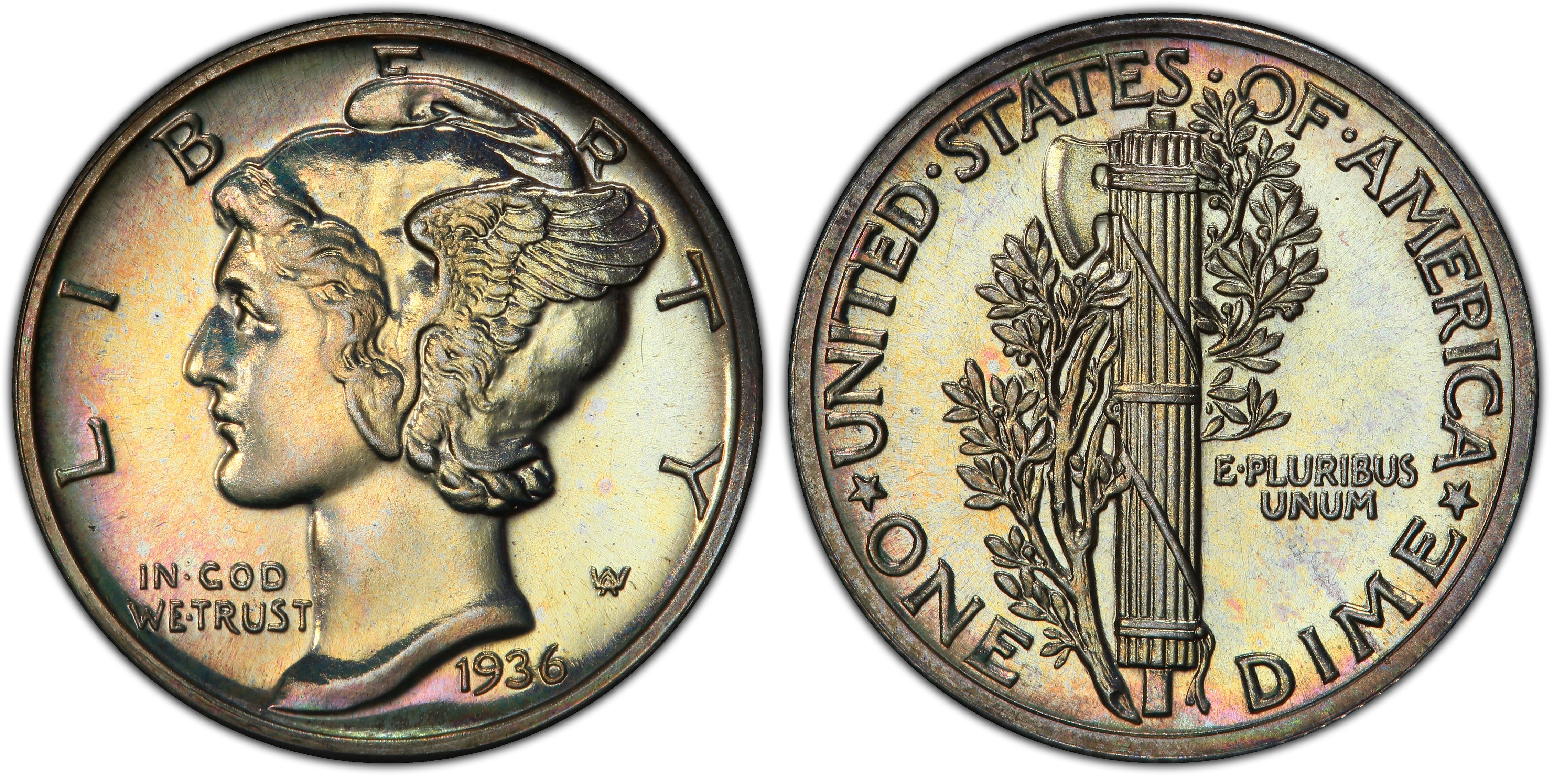 #2 PCGS PR68
Dell Loy Hansen; "The D.L. Hansen Mercury Proof Collection" (PCGS Set Registry). Glassy mirrors with blue, gold, and green toning throughout. Small circular spot above the gap between IN and GOD. |