



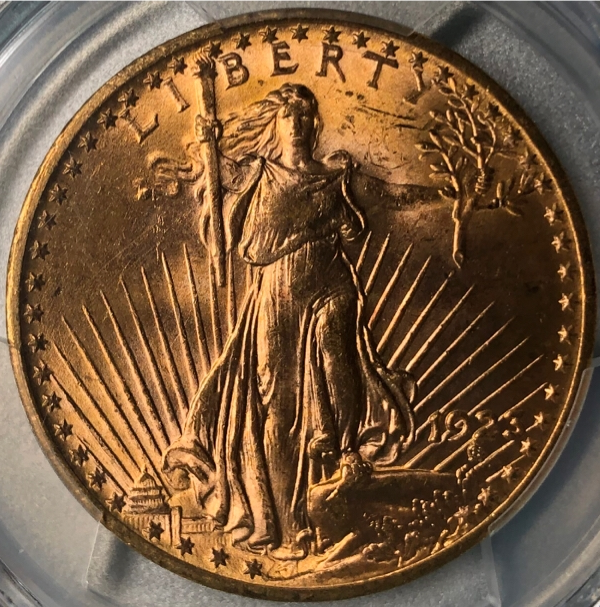
1923 $20 MS64 Certification #44504100, PCGS #9175
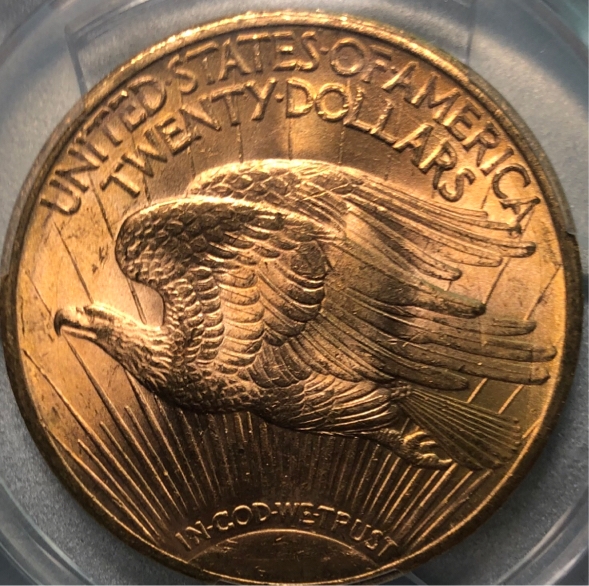
Owner's Comments
Expert Comments
Charles Morgan
The 1923 Saint-Gaudens Double Eagle
For many collectors new to the thrill of classic United States gold coins, the 1923 Saint-Gaudens Double Eagle (#9175) serves as an enticing "first bite." The coin features one of the most famous American designs—arguably the most beautiful and artistic ever realized in the United States. Its existence came about only at the insistence of President Theodore Roosevelt (in office 1901–1909), who sought for years to beautify America’s "humdrum" coinage.
American sculptor Augustus Saint-Gaudens’ involvement was intended to be more far-reaching than it ultimately was. The artist set out to redesign every denomination of America’s circulating coinage but fell seriously ill before the plan could come to fruition. In fact, the Saint-Gaudens-designed $10 and $20 gold coins were made possible only through the assistance of his pupil, Henry Hering.
The Price of Innovation
Technical challenges in putting the Saint-Gaudens masterpiece into mass production were numerous—but that is the price of innovation. Throughout American history, Mint engravers understood the limitations of materials and machinery, often choosing conservative designs over the extravagant. However, as America entered its "Golden Age" of numismatic design, outside sculptors like Saint-Gaudens, Adolph Weinman, and James Earle Fraser approached the medium as artists first. Mint Chief Engraver Charles Barber was left to pick up the pieces, making the necessary adjustments so that the vision of these outside artists could shine in a circulating format.
By 1923, the design had been settled. The national motto, "IN GOD WE TRUST," initially omitted, was restored in 1908. Additional stars denoting the admission of New Mexico and Arizona into the Union were added to the obverse in 1912. Mintages remained somewhat modest through the 1910s before surging in 1922, as international trade began to normalize following World War I and international debts were repaid.
The average American consumer may never have encountered a Double Eagle in daily commerce—much as they likely never encountered a $500 or $1,000 bill. Instead, the coin served an institutional purpose. It is precisely because of its voluminous export that so many survive today. Despite a modest mintage of just 566,000 pieces, the 1923 is popularly collected as a "type" coin. Its value remains closely tied to the prevailing price of gold, plus a numismatic premium dependent on its state of preservation.
Collecting the 1923 Saint-Gaudens Double Eagle
The 1923 Saint-Gaudens Double Eagle is typically well struck. Sometimes one will find an example with peripheral weakness, especially on the Capitol building and the surrounding stars. Rims are typically boldly impressed. The most common uncirculated grade for a PCGS-certified 1923 $20 Saint is MS63; statistically, it is more likely that a raw coin will grade lower than higher. Given the coin’s large size and its history of heavy institutional handling, it is remarkable that any examples survive in "Gem" condition. According to PCGS Population Data, there is a modest population of approximately 600 pieces in MS65 and only six in MS66. Each of these MS66 specimens has a story to tell:
- The Auction Record: The record price for this grade is $72,000, set at a May 2022 Heritage sale of the Warren Collection.
- The Duckor Provenance: Before that sale, the same coin was part of Dr. Steven L. Duckor’s historic holdings. Duckor was a true connoisseur known to collect duplicates in his search for the perfect specimen—a common trait among collectors chasing PCGS Set Registry greatness.
* * *
Rarity and Survival Estimates Learn More
| 65 or Better | 152500 |
| All Grades | 118333 |
| 60 or Better | 2250 |
| 65 or Better | R-1.9 |
| All Grades | R-1.9 |
| 60 or Better | R-4.5 |
| 65 or Better | 42 / 49 TIE |
| All Grades | 43 / 49 TIE |
| 60 or Better | 36 / 49 TIE |
| 65 or Better | 46 / 54 TIE |
| All Grades | 47 / 54 TIE |
| 60 or Better | 39 / 54 TIE |
Condition Census Learn More
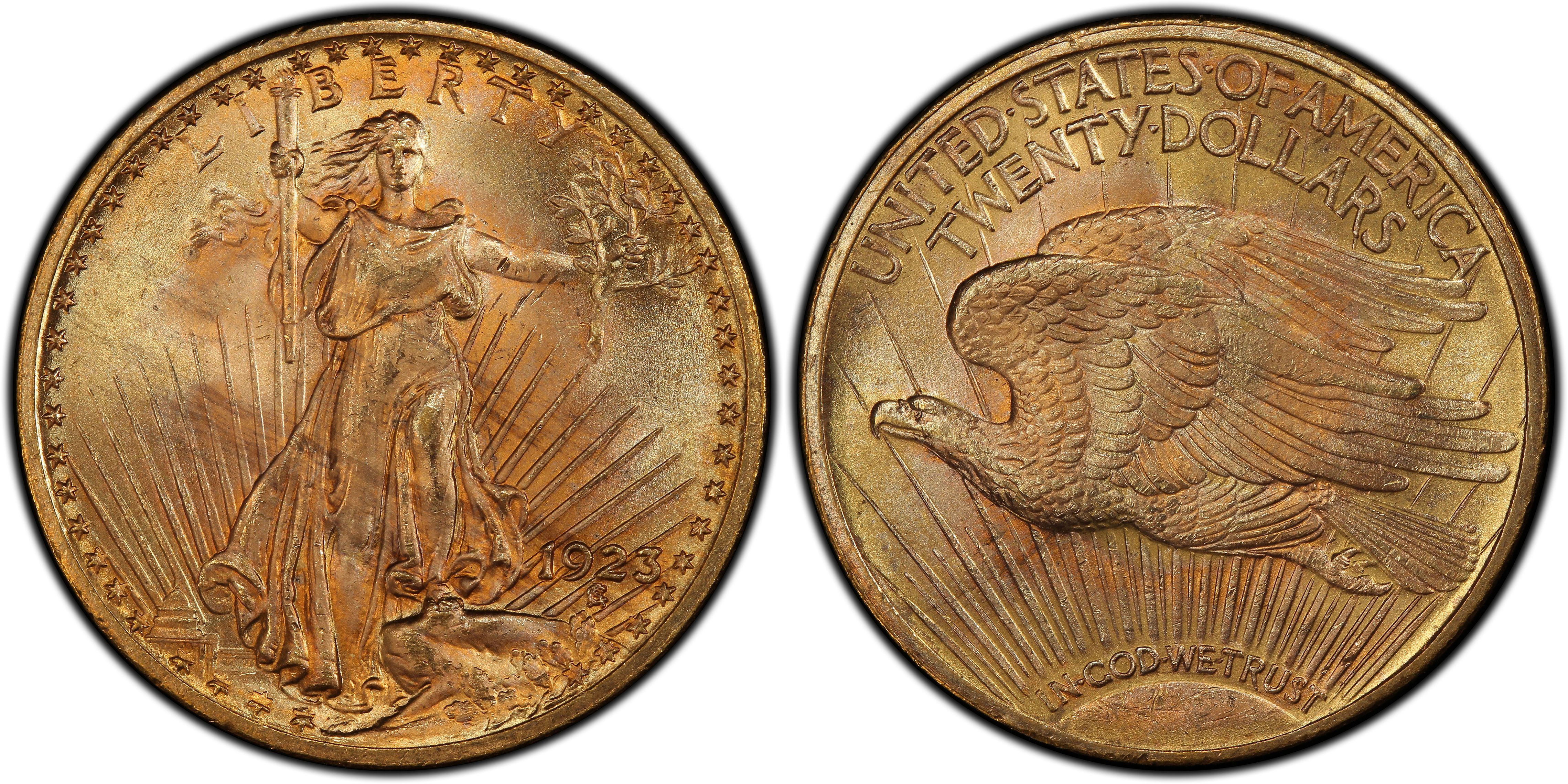 #1 PCGS MS66
As MS65+. Auction ’84, Paramount, Lot 994; David W. Akers; Dr. Steven L. Duckor; As PCGS MS66 #4987563. “The Philip H. Morse Collection of Saint-Gaudens Coinage,” Heritage Auctions, November 3, 2005, Lot 6653 – $48,875; Dr. Steven L. Duckor, 2007. As PCGS MS66 #16342395. “The Dr. and Mrs Steven L. Duckor Collection,” Heritage Auctions, Janaury 5, 2012, Lot 4633 – $40,250. As PCGS MS66 #45420968. “The Bob R. Simpson Collection, Part IX,” Heritage Auctions, August 22, 2022, Lot 3412 – $66,000; Bob R. Simpson; "The Simpson Collection" (PCGS Set Registry). Large diagonal toning streak across the obverse from center down. Diagonal ticks on left arm and below left arm elbow (to the left of the branch). |
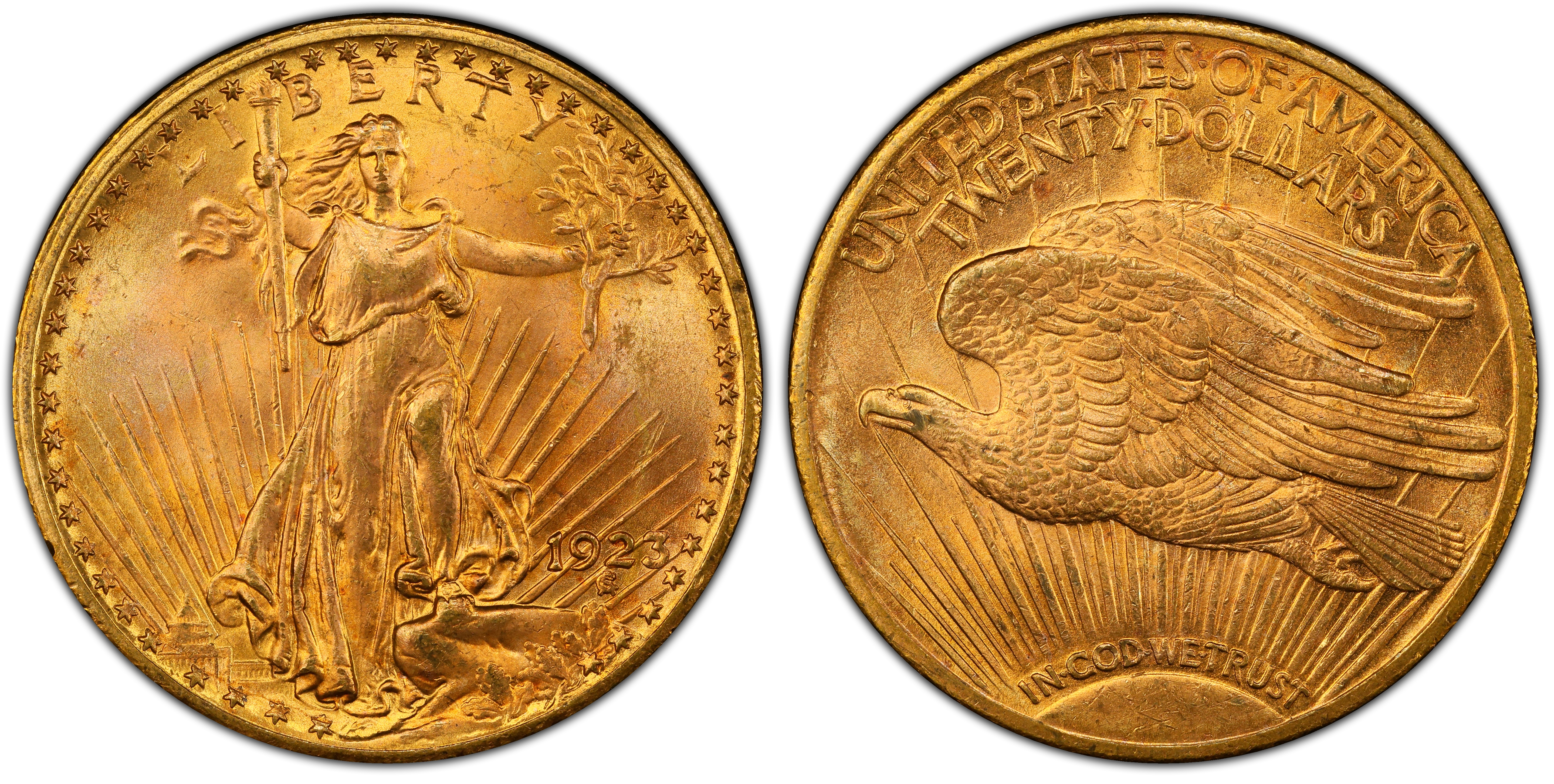 #1 PCGS MS66
As PCGS MS66 #10156894. Dr. Steven L. Duckor; Heritage Auctions, June 2007, Lot 2781 – $34,500; Bowers and Merena, February 2008, Lot 2895; “The Oliver Collection,” Heritage Auctions, August 2011, Lot 7703 – $29,900; “The Warren Collection,” Heritage Auctions, May 5, 2022, Lot 4090 – $72,000. As PCGS MS66 #47216349. "The Elite Collection" (PCGS Set Registry). Diagonal streak only above date to knee. Planchet void at 9 o’clock rim on the reverse. |
 #1 PCGS MS66
Heritage Auctions, June 6, 2019, Lot 3296 – $33,600. Thin horizontal mark on left arm. Copper spot above left bicep. Copper spot to the left of eagle’s beak. |
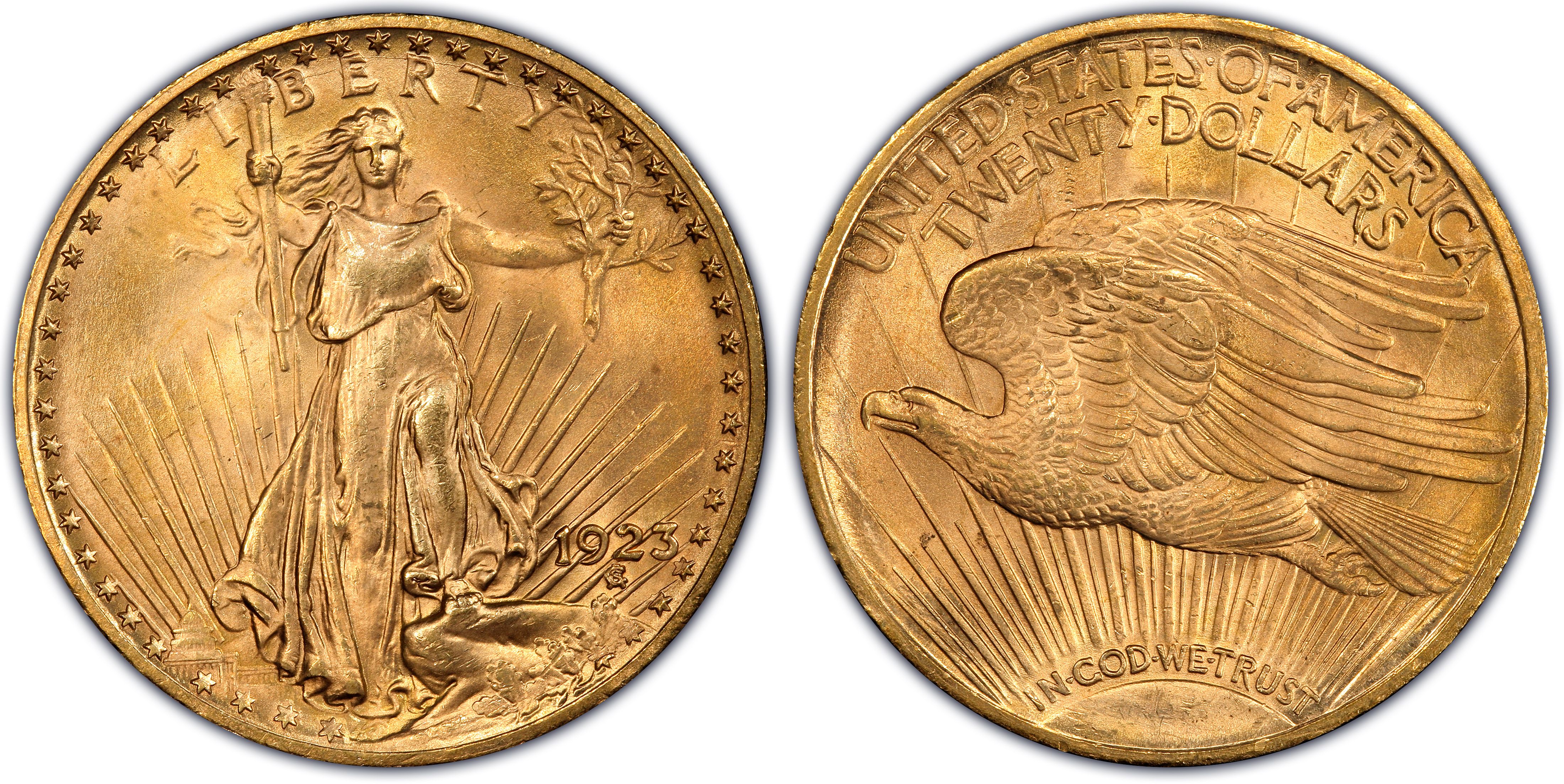 #1 PCGS MS66
As PCGS MS66 #21929544: “The Kutasi Collection,” Heritage Auctions, January 4, 2007, Lot 3291 – $37,375; “The Stephen Stokely Collection, Part Five,” Heritage Auctions, July 31, 2008, Lot 2109 – $34,500. As PCGS #30415782. "The Hanalei Bay Saint Collection"; "The Luna Collection" (PCGS Set Registry) Tiny diagonal ticks running up from the left on the obverse. Curved die crack across BERTY. Tiny mark at the upper fold of the eagle's left wing. |
 #1 PCGS MS66
"The D.L. Hansen Collection" (PCGS Set Registry). Small diagonal mark to the left of the torch. Copper spot in the crook of the eagle's wings. |