



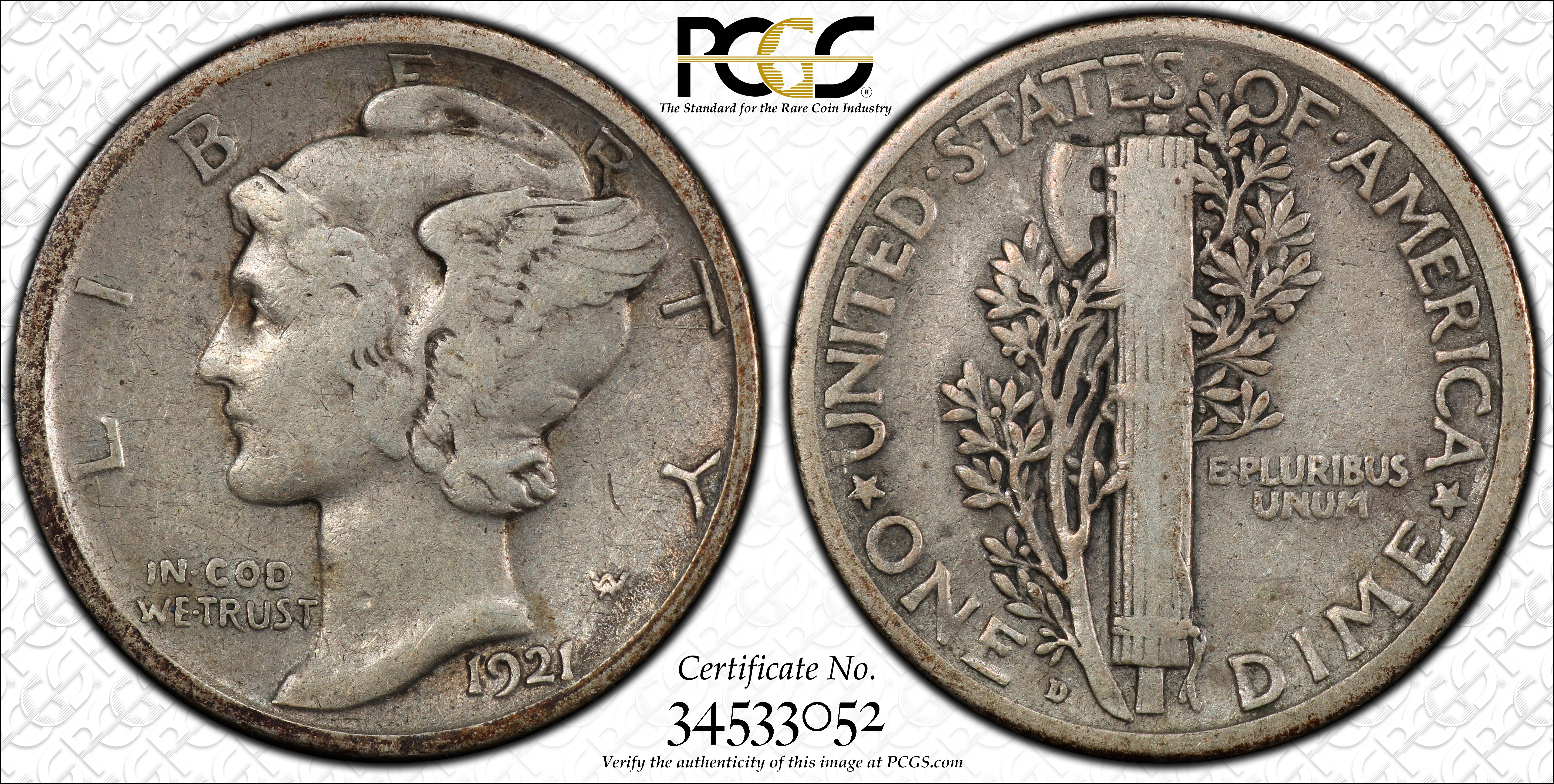
1921-D 10C VF20 Certification #34533052, PCGS #4936
Owner's Comments
Expert Comments
Charles Morgan
The 1921-D Mercury Dime: A "Forgotten Depression" Era Rarity
The 1921-D Mercury Dime (#4936, #4937) is a numismatic artifact of the "Forgotten Depression"—a sharp, deflationary collapse that bridged the end of the Great War and the dawn of the Roaring Twenties. While the mintage of just 1,080,000 pieces relected a cratering economy, the coin coin's status as a "Semi-Key" reflects a misgotten notion that the coin plays second fiddle to the famous 1916-D Mercury Dime (#4906, #4907). Those who get their insights by studying the coins themselves and the PCGS Population Report, know that the '21-D is the scarcer coin.
The Pittman (Imp)Act
In a year where San Francisco ceased dime production entirely, Denver stood as the only branch mint to strike the denomination. This curtailed mintage was driven by two primary factors: a volatile post-war economy and the legislative mandate of the Pittman Act.
Between 1920 and 1921, the U.S. economy weathered a period of massive deflation—estimated between 13% and 15%—which triggered a sharp decline in industrial production and a spike in unemployment. Although this recession lasted only 18 months, it caused the demand for new circulating coinage to crater. Simultaneously, the U.S. Mint shifted its silver bullion reserves toward the reintroduction of the Morgan Silver Dollar, as required by the Pittman Act of 1918. Denver alone struck over 20 million 1921-D Morgan Dollars (#7298), a massive undertaking that dwarfed all other denominations.
In fact, Denver’s output that year was limited strictly to Morgans, Walking Liberty Half Dollars, and Mercury Dimes. While the 1921-D Mercury Dime mintage of 1,080,000 pieces represented a nearly 95% production decrease from the previous year, the coins are generally well-struck. Unlike many Philadelphia issues of 1921, the 1921-D rarely exhibits extreme peripheral weakness.
Technical Oddities and Survival Rates
Interestingly, it is not unusual to encounter a 1921-D with significant die cracks. Given the low mintage, this was likely not the result of die fatigue, but rather improper die hardening or incorrect collar machining. Even on high grade pieces, dramatic die cracks can add collector interest for those interested in die deterioration studies.
Unlike the 1916-D—which was saved in significant numbers as a "first-year" curiosity—the rarity of the 1921-D went largely unnoticed by the contemporary public. Consequently, few were set aside, and the vast majority of surviving examples show heavy wear. Collectors eventually recognized their oversight; by 1961, dealer Lester Merkin was offering Brilliant Uncirculated (BU) examples for $125—roughly $1,300 in today’s inflation-adjusted dollars.
Market Analysis and Grading
The 1921-D is a true conditional rarity. It is far more common in lower grades, with 55% of the PCGS certified population graded VF-35 or lower. PCGS has certified fewer than 1,000 examples in Mint State, and by a slim margin, Full Band coins outnumber those without.
* * *
Rarity and Survival Estimates Learn More
| 65 or Better | 3500 |
| All Grades | 300 |
| 60 or Better | 50 |
| 65 or Better | R-4.3 |
| All Grades | R-6.4 |
| 60 or Better | R-8.5 |
| 65 or Better | 9 / 80 TIE |
| All Grades | 15 / 80 TIE |
| 60 or Better | 14 / 80 TIE |
| 65 or Better | 9 / 80 TIE |
| All Grades | 15 / 80 TIE |
| 60 or Better | 14 / 80 TIE |
Condition Census Learn More
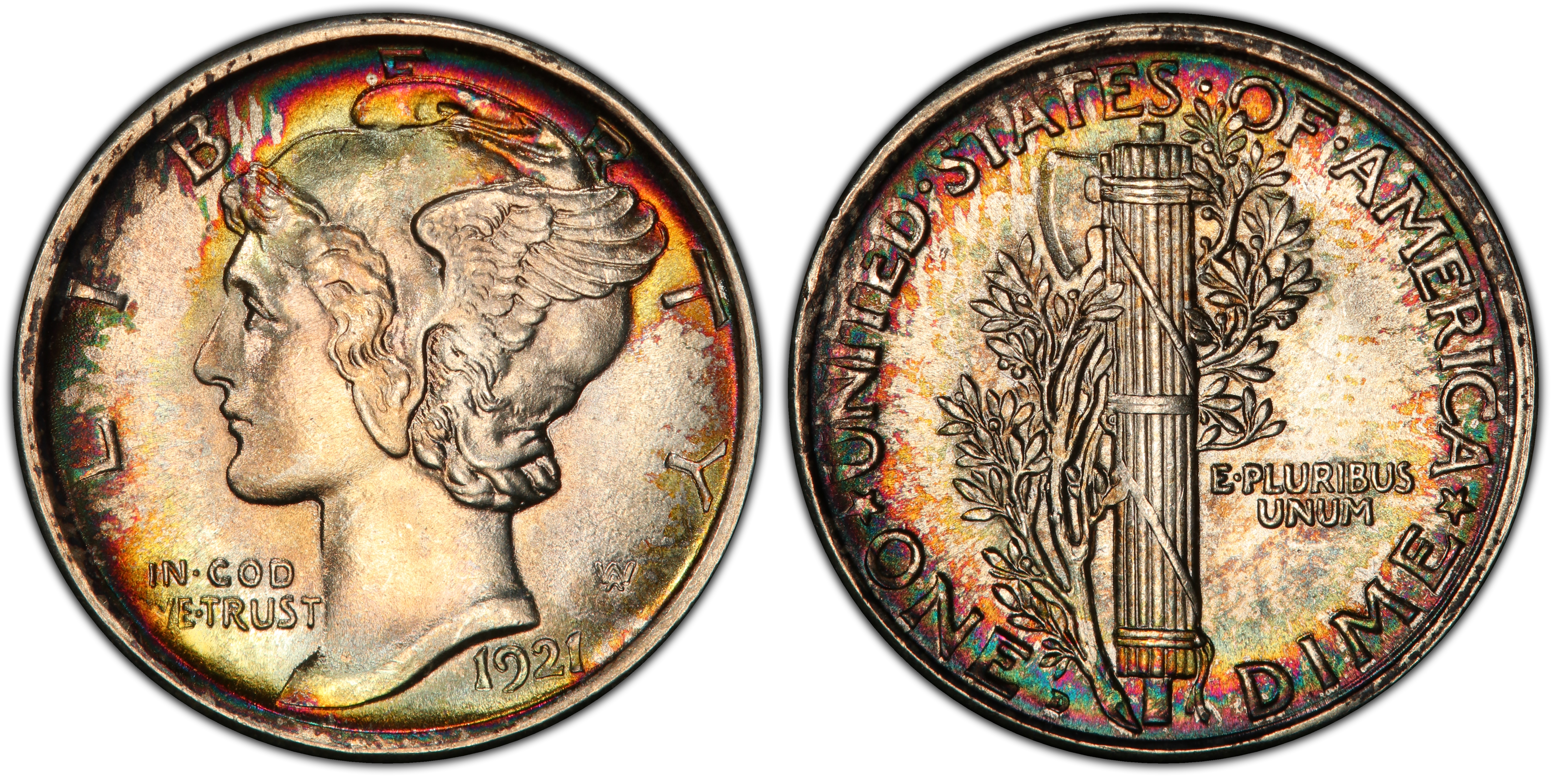 #1 PCGS MS67+
Legend Rare Coin Auctions, February 25, 2021, Lot 107 - $23,500; MADHATTER's "MERC MADNESS Collection" (PCGS Set Registry). Golden centers with intense amber, blue, and green rainbow toning along the borders. |
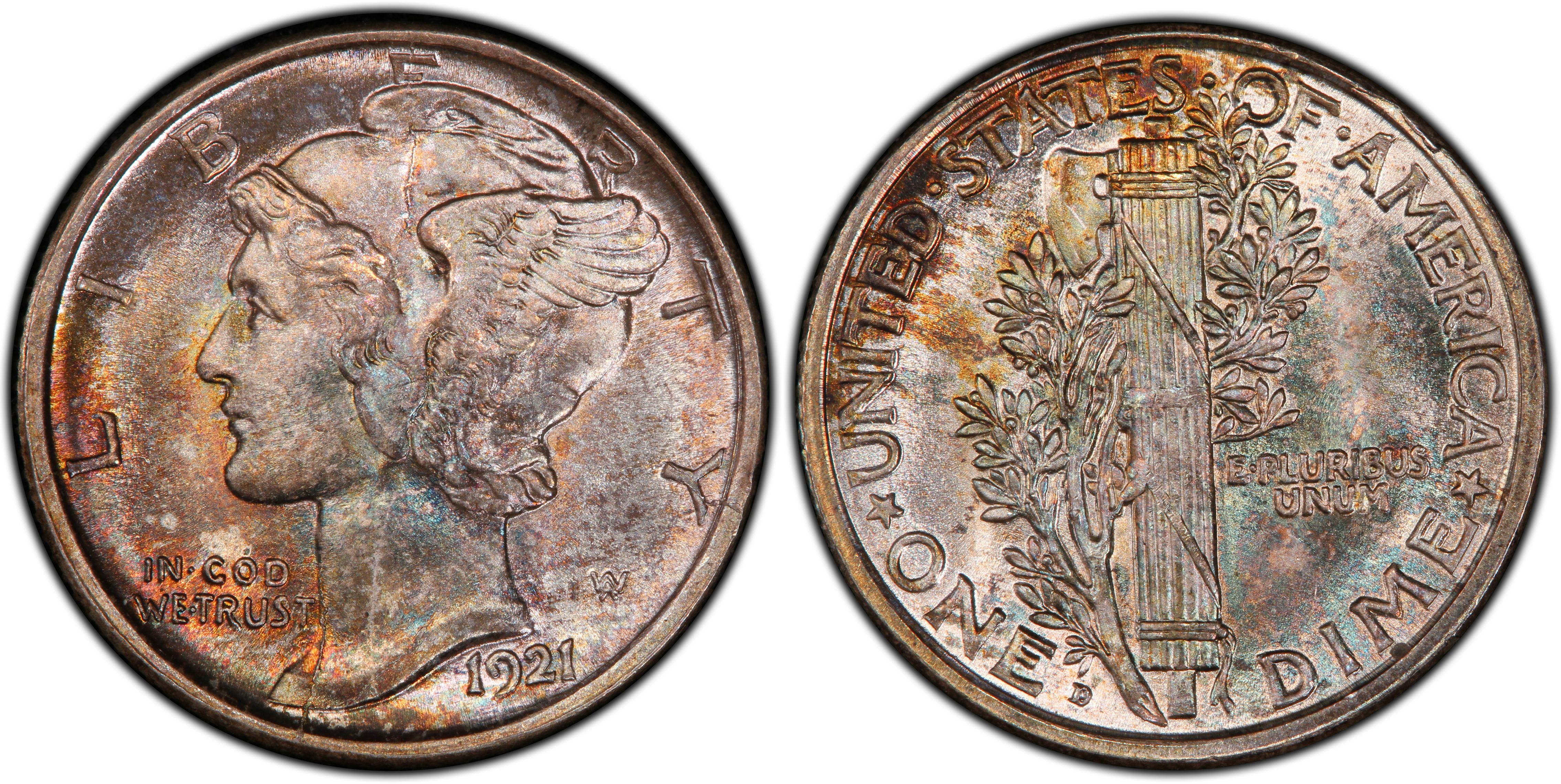 #1 PCGS MS67+
Stack's Bowers, August 2012, Lot 5649 - $5,875 - Goldberg Auctioneers, June 2014, Lot 365 - Passed; Dell Loy Hansen. Copper toning throughout, with a rich concentration of color in the lower left obverse field. Spiderweb die crack from rim near 6 o'clock runs up the front of Liberty's neck and splits at the bottom of the bust to run along the top of the truncation above 19. Other cracks as well. Another major crack from 12 o'clock through the cap.Patches of electric-teal color dominates the right-side of the reverse. |
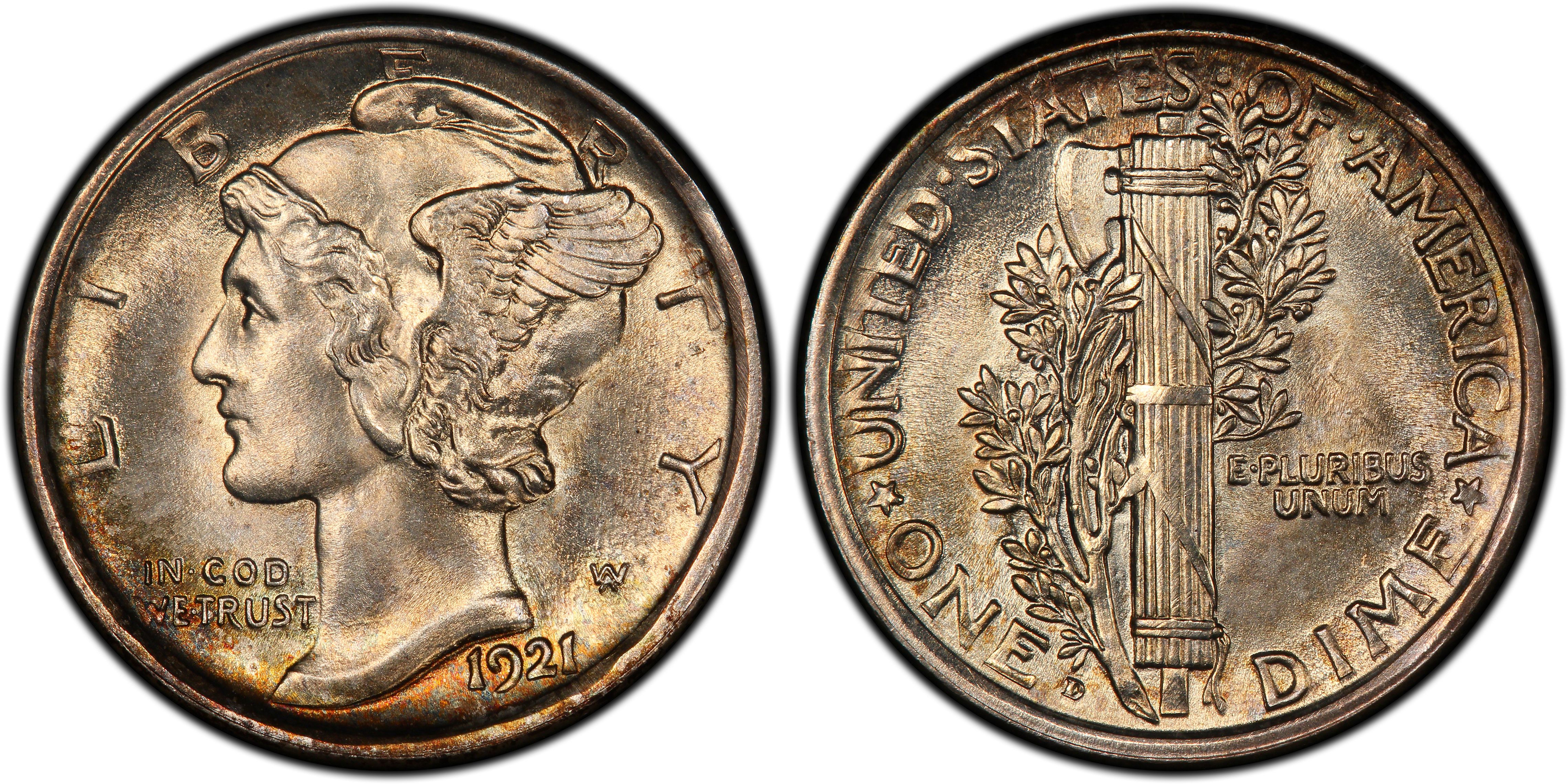 #1 PCGS MS66+
"The Old Merc No Band Date Set" (PCGS Set Registry). |
 #1 PCGS MS67+
Sun Yellow centers with magenta toning along the borders. |