



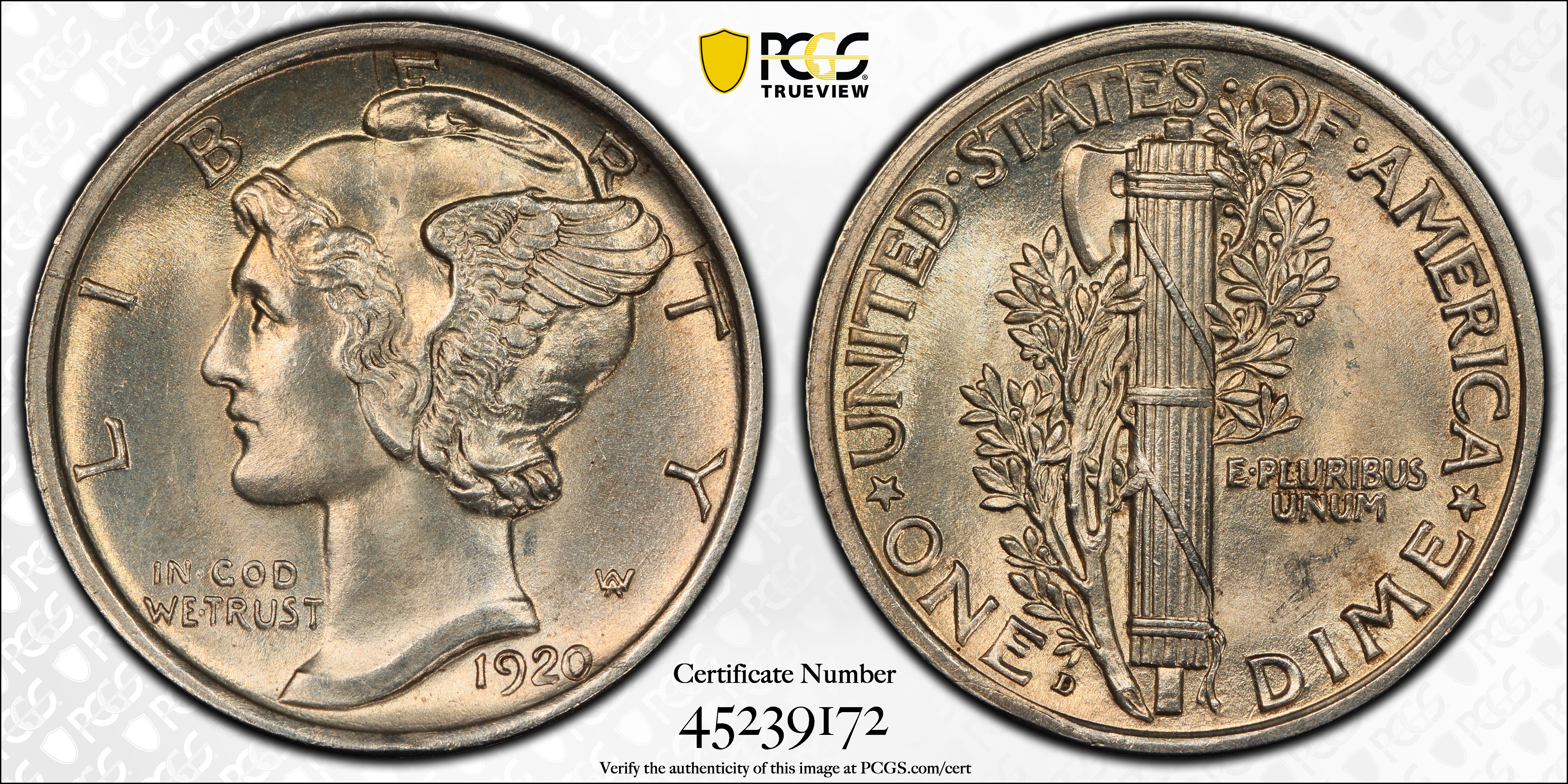
1920-D 10C, FB MS64FB Certification #45239172, PCGS #4931
Expert Comments
Charles Morgan
While the "Spanish" flu pandemic began to recede by 1920, its shadow remained draped over Denver. The preceding 18 months had been a grueling preview of modern pandemic life: mask mandates, shuttered businesses, and the bitter fruit of isolation. Frustration boiled over, manifesting as scapegoating of immigrant communities—a precursor to the anti-immigrant and anti-labor politics that the Ku Klux Klan would soon exploit to dominate the city.
This social friction ignited in August 1920, just blocks from the Denver Mint. A tramway workers' strike for higher wages turned into a deadly riot when strikebreakers arrived. Seven people were killed, buildings were torched, and order was only restored after hundreds of federal troops moved in to quell the violence that the mayor’s citizen militia could not.
The Silver Crisis and the Mint's Response
Against this backdrop of civil unrest, the Denver Mint faced a global economic storm. While the flu likely impacted labor, it was the "silver fever" of 1920 that truly dictated coinage operations.
In February 1920, silver prices skyrocketed to $1.38 per ounce, driving the metal's intrinsic value higher than the face value of the coins themselves. In Europe, silver disappeared into hoards; in the U.S., the Treasury scrambled to release silver dollars for Asian export to stabilize the market.
When the bubble burst in May, the government pivoted. Under the Pittman Act of 1918, the Treasury began aggressively repurchasing silver. This led to a dramatic shift in production:
- The Melting Pot: Millions of silver dollars were melted down to be reborn as subsidiary coinage.
- Denver’s Role: The Denver Mint converted nearly 2.6 million ounces of silver into over 24 million coins to meet the sudden surge in demand.
1920 Denver Mint Coin Production
Despite the chaos of the riots and a volatile silver market, the Denver Mint was simultaneously undergoing a massive modernization. Drawing inspiration from the Philadelphia Mint, leadership overhauled the melting furnaces and sweeps cellars to improve efficiency. During this time, the Mint limited its 1920 production to minor and silver denominations up to the half dollar, as it had not struck gold since 1914.
- Lincoln "Wheat" Cent (BN #2525, RB #2526, RD #2527) | Mintage: 49,280,000 | Scarce above MS65RD.
- Buffalo Nickel (#3945) | Mintage: 9,418,000 | Scarce above MS65.
- Mercury Dime (#4930, FB #4931) | Mintage: 19,171,000
- Standing Liberty Quarter (#5736 , FH #5737) | Mintage: 3,586,400
- Walking Liberty Half Dollar (#6581) | Mintage: 1,551,000 | Rare above MS65.
The 1920-D Mercury Dime: A Collecting Story
While the 1920-D Mercury Dime is scarcer than the Philadelphia issue, it is not quite as elusive as the 1920-S (#4932, #4933). Given the mintage disparity—Denver struck over 19 million dimes while San Francisco produced fewer than 14 million—one would expect a wider gap in PCGS population data. Clearly, neither branch mint met the production standards of Philadelphia, and far fewer Denver and San Francisco coins were preserved in high grades. For collectors of Full Band (FB) Mercury dimes, the 1920-D poses no greater challenge than any other pre-1934 date. While regular strikes outnumber Full Bands, they do not do so by a wide margin. Gem examples survive in a variety of states, from those with spectacular toning to others in brilliant blast white.
* * *
Rarity and Survival Estimates Learn More
| 65 or Better | 450 |
| All Grades | 450 |
| 60 or Better | 75 |
| 65 or Better | R-6.1 |
| All Grades | R-6.1 |
| 60 or Better | R-8.2 |
| 65 or Better | 15 / 80 TIE |
| All Grades | 15 / 80 TIE |
| 60 or Better | 11 / 80 TIE |
| 65 or Better | 15 / 80 TIE |
| All Grades | 15 / 80 TIE |
| 60 or Better | 11 / 80 TIE |
Condition Census Learn More
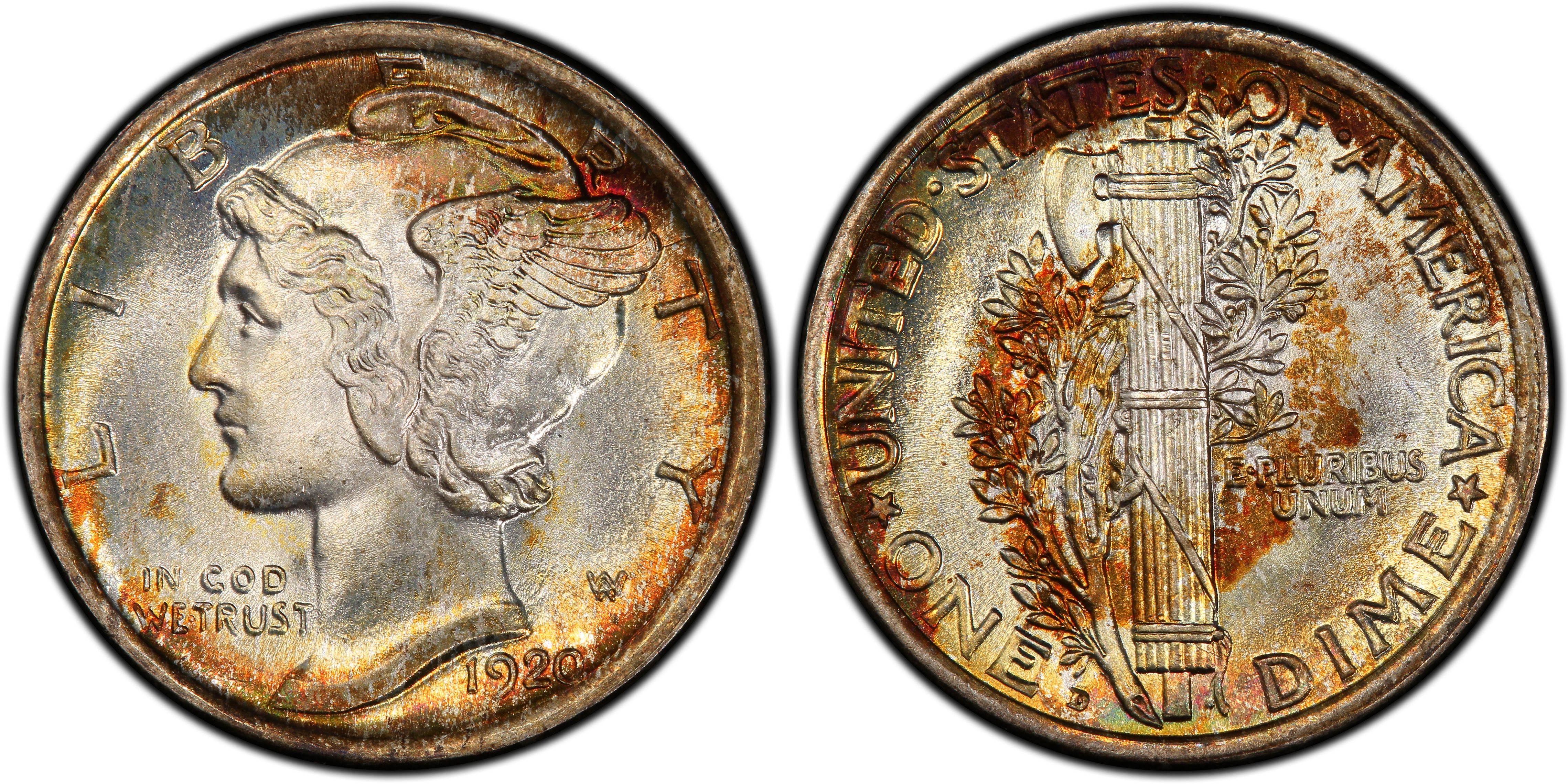
 #1 PCGS MS68FB
Rust-colored and olive toning accents the obverse periphery, while gold and orange toning appears along the reverse. A tiny tick is present on Liberty’s eyebrow. |
 #2 PCGS MS67+FB
As PCGS MS67FB #50242218. Heritage Auctions, September 22, 2005, Lot 2504 - $27,600; “The Forsythe II Collection,” Stack’s Bowers, August 14, 2013, Lot 4072 - Passed; As PCGS MS67+FB #27236855. Heritage Auctions, December 5, 2013, Lot 3578 - $38,187.50; Heritage Auctions, July 10, 2014, Lot 3687 - $44,062.50. As PCGS MS67+FB #37912935. PCGS User MADHATTER's "Merc Madness Collection" (PCGS Set Registry). Rust-colored rim toning on obverse, same color toning along the upper rim and center on the reverse. Die crack from cap to rim to the left of T. |
|
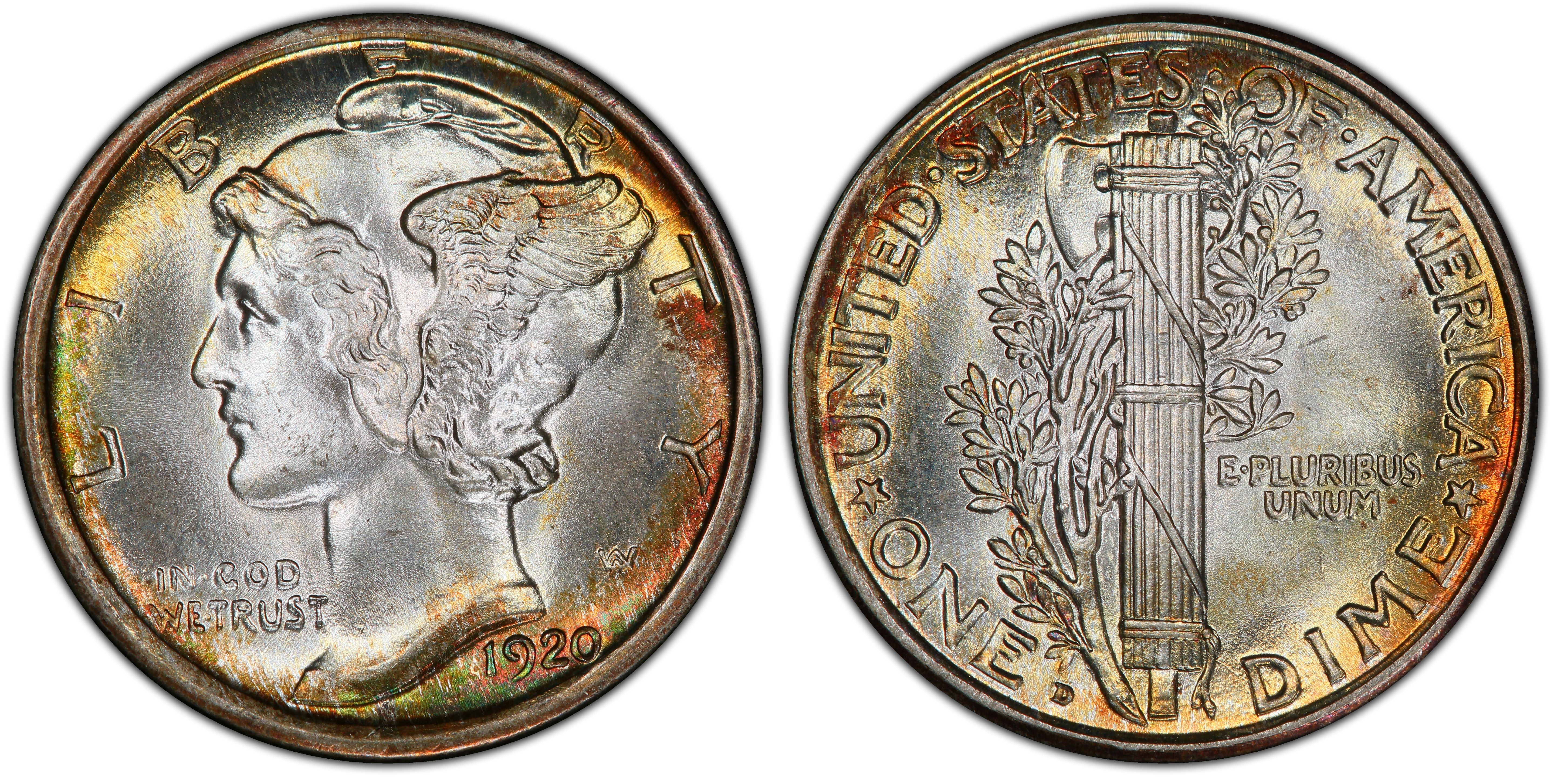
#2 PCGS MS67+FB
As PCGS MS67FB #06425362. “The Joshua II Collection of Mercury Dimes, #1 All-Time PCGS Finest PCGS Registry Set,” Heritage Auctions, August 12, 2010, Lot 4501 – $43,125. As PCGS MS67+FB #06622959. Heritage Auctions, January 4, 2012, Lot 3157 – $43,125. The obverse is over halfway covered in rust and gold toning. The same color is also present along the left rim area of the reverse. |
 #4 PCGS MS67FB
Legend Rare Coin Auctions, March 21, 2019, Lot 129 - $52,875 ; Dell Loy Hansen; "The D.L. Hansen Mercury Dimes FB/Major Varieties Collection" (PCGS Set Registry). Gold, orange, and rust-brown toning along the periphery. There is a patch of rust-brown toning to the right of the T of LIBERTY. Faint diagonal mark across Liberty's neck. |
 #4 PCGS MS67FB
As PCGS MS67FB #06698487. Heritage Auctions, July 31, 2009, Lot 1075 – $29,900. Brilliant. As PCGS MS67FB #31814090. “The Charles McNutt Collection,” Heritage Auctions, January 10, 2019, Lot 4411 – $50,400. Between encapsulations, a light layer of goldenrod toning has developed along the periphery. Die crack from cap to rim to the left of T and another from rim at 6 o’clock through truncation. Tick on Liberty’s hair that touches her cheek. A second small tick at the leftmost edge of the bottom of her cap. Tick on the axe blade. |