



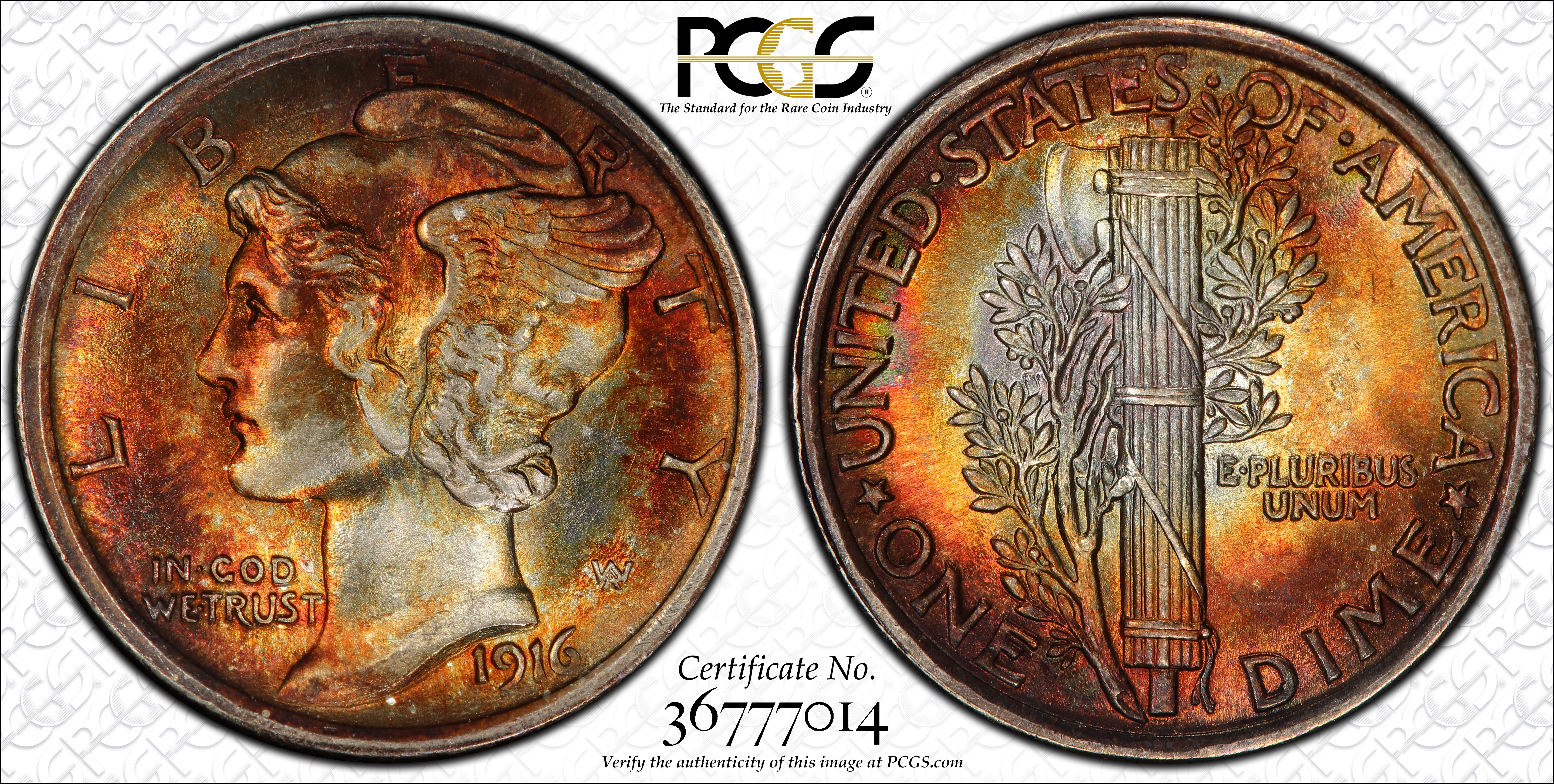
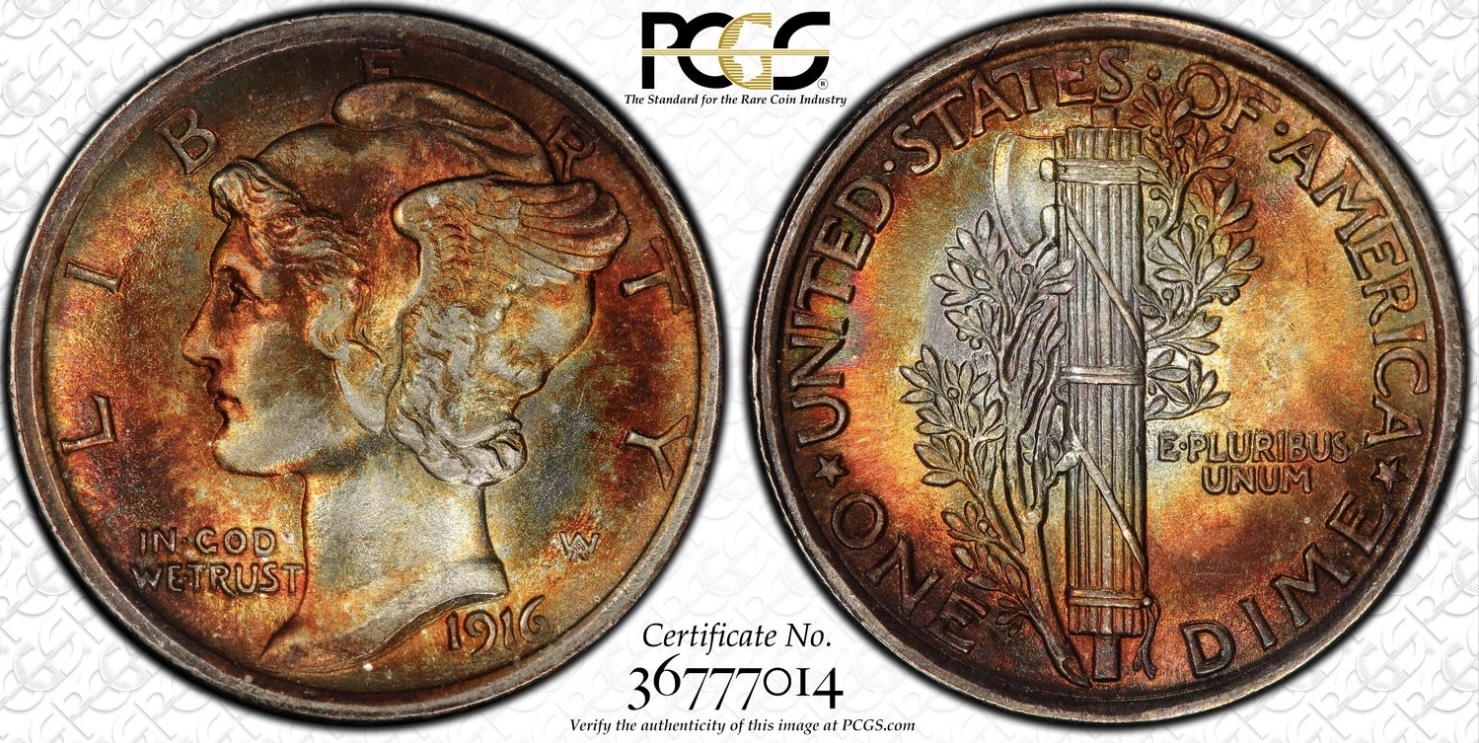
1916 10C Mercury, FB MS68FB Certification #36777014, PCGS #4905
Owner's Comments
Expert Comments
Charles Morgan
Adolph A. Weinman’s Winged Liberty Dime—popularly named the "Mercury Dime"—debuted in October 1916, ushering in a "Golden Age" of American coinage. Released alongside the Walking Liberty Half Dollar and the Standing Liberty Quarter, Weinman’s design drew heavily from the French Beaux Arts movement, elevating the image of American coinage through classical elegance, while remarking on the burgeoning power of the United States.
The obverse features Liberty (of Thought) facing left, adorned with a winged Phrygian cap. Her portrait is framed by the legend LIBERTY, with the letters "E" and "R" partially tucked behind her cap. Weinman’s monogram (a "W" surmounting an "A") rests behind her neck, while the motto IN GOD WE TRUST is divided to the left. A subtle "basin" or dish-like field gives the coin a distinctive depth.
On the reverse, a central fasces—a bundle of rods bound by leather around an axe—symbolizes unity and strength, while a curvilinear olive branch represents peace. The legend UNITED STATES OF AMERICA and the denomination ONE DIME encircle the design, separated by two five-pointed stars. The motto E PLURIBUS UNUM is positioned to the right of the fasces.
A Cultural Pillar
For nearly thirty years, the Mercury Dime saw America through World Wars and the Great Depression. It was the coin of the March of Dimes and the inspiration for "Yip" Harburg’s Depression-era anthem, "Brother, Can You Spare a Dime?" Unlike the Buffalo Nickel, the Mercury Dime was a triumph of minting; it circulated without incident until 1945, when the death of Franklin D. Roosevelt led to its replacement by the Roosevelt Dime.
The 1916 Dimes: A Transition Year
The year 1916 stands as a pivotal date in American coinage. It marked the transition from the Barber design to the Mercury design. During the first half of the year, the Philadelphia and San Francisco Mints produced a combined total of 24.3 million Barber dimes before pivoting to the new Mercury motif, striking an additional 32.6 million coins.
The Denver Mint, however, largely abstained from dime production until the very end of the year. This resulted in the famous mintage of only 264,000 1916-D Mercury Dimes (#4906, #4907), creating one of the premier "key date" rarities of the 20th century.
Collector Behavior and Availability
In numismatics, "firsts and lasts" carry significant weight, and both collectors and the general public tend to gravitate toward these "bookend" issues. While this fascination undoubtedly led to the preservation of some Mint State 1916-D Mercury Dimes, the 1916 Mercury Dime (#4904, #4905) and 1916-S Mercury Dime (#4908, #4909) are far more common in Brilliant Uncirculated (BU) condition simply due to their higher original mintages.
The Philadelphia Mint struck 22,180,080 Mercury Dimes in 1916. While well-circulated examples typically sell for roughly double the silver spot price, the value climbs steadily through the higher circulated grades. Once these coins reach Mint State, they become excellent candidates for PCGS certification.
Strike Quality and "Full Bands"
In Mint State, the population of 1916 Mercury Dimes bifurcates based on strike quality—specifically the Full Bands (FB) designation. Interestingly, Mint State 1916 and 1916-D dimes are more often than not found with Full Bands. Conversely, the San Francisco Mint—notorious for "mushy" strikes—did produce a significant quantity of FB dimes in 1916, though they remain the minority within the total population.
Market Analysis
The PCGS population for 1916 (P) Mercury dimes is most heavily concentrated in the MS64 to MS65 range. Conditional rarity begins to significantly impact the market at the MS67+ level and above.
At these elite grades, high-end examples trade at vastly different price points. These variances are largely driven by:
- Intensity of competition within the PCGS Set Registry.
- A coin's eye appeal and intensity of luster.
- Vivid toning, which may add value, or turn off collectors looking for brilliant coins.
For those not well-versed in the competitive landscape of upper-tier Registry Sets, these price gaps can seem inexplicable. At this level of the market, emotional appeal often supersedes the technical grade. The allure of a "monster" coin—one with extraordinary eye appeal or toning—is not always apparent to those simply reviewing population reports.
Furthermore, a standard price guide cannot account for the "X-factor" of specific collector demand. In many cases, these price spikes occur because a handful of top-tier collectors are not merely looking for a single representative example; they are actively acquiring multiple high-end pieces for their specialized holdings. When elite collectors compete for the finest known examples, the resulting price action defies the expectations of those looking only at general market trends.
* * *
Rarity and Survival Estimates Learn More
| 65 or Better | 6000 |
| All Grades | 6000 |
| 60 or Better | 1500 |
| 65 or Better | R-3.8 |
| All Grades | R-3.8 |
| 60 or Better | R-4.8 |
| 65 or Better | 59 / 80 TIE |
| All Grades | 59 / 80 TIE |
| 60 or Better | 49 / 80 TIE |
| 65 or Better | 59 / 80 TIE |
| All Grades | 59 / 80 TIE |
| 60 or Better | 49 / 80 TIE |
Condition Census Learn More
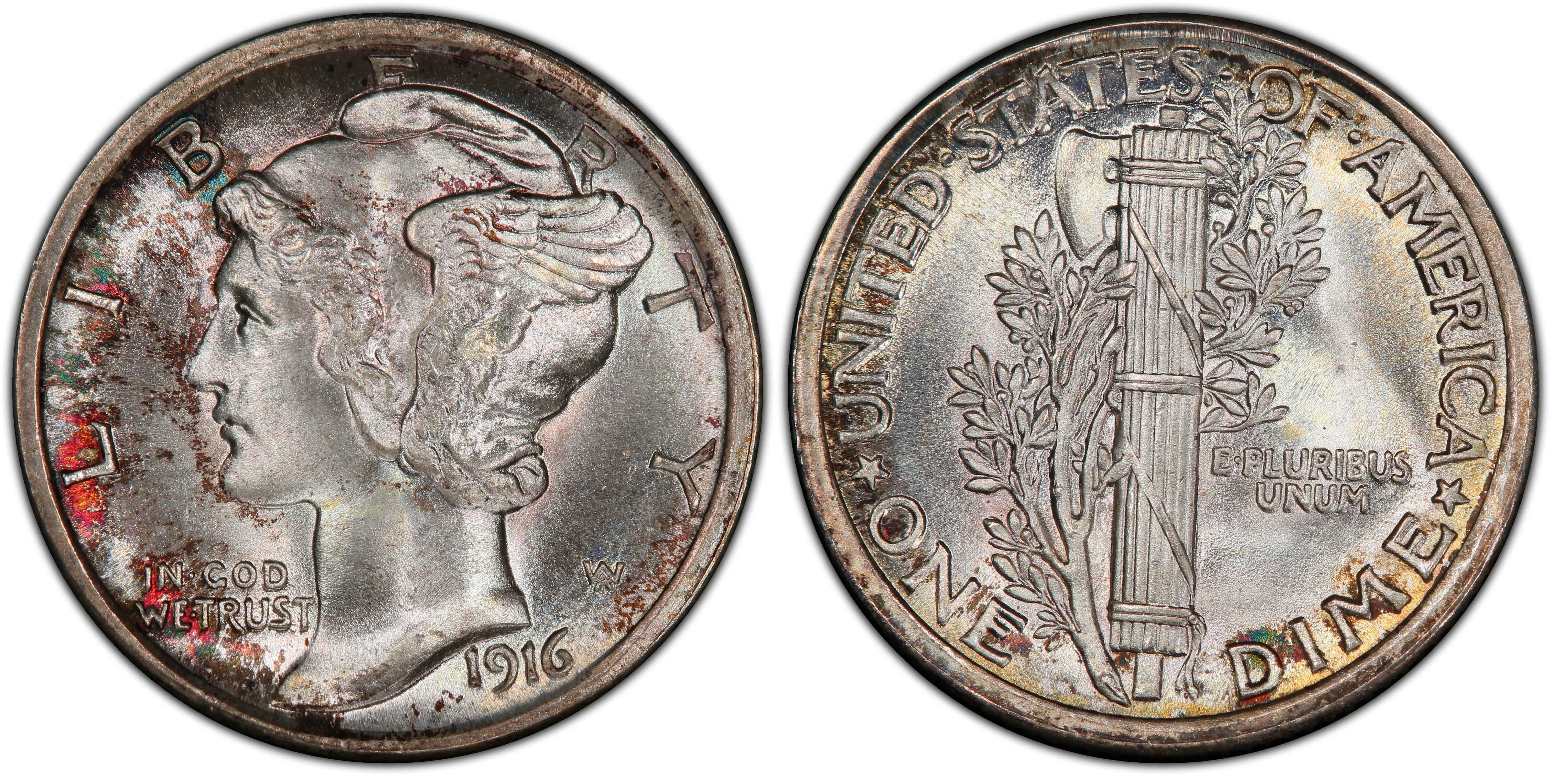 #1 PCGS MS68+FB
As PCGS MS68FB #36099536. Legend Rare Coin Auctions, September 26, 2019, Lot 212 - $8,225. As PCGS MS68+FB #39478604. Stack’s Bowers, August 2020, Lot 1180 – $20,400. MADHATTER's "MERC MADNESS Collection" (PCGS Set Registry). Light spray of intense red and green toning on the obverse and reverse. |
|
#2 PCGS MS68FB
GreatCollections, January 14, 2024, Lot 1471081 - $14,627.25. "The remumc Collection" (PCGS Set Registry). Rose and silvery blue toning throughout. Small dark spot to the right of 6, under the monogram. |
|
#2 PCGS MS68FB
“The Larry Shapiro #1 All-Time Finest Mercury Dimes Full bands Basic PCGS Registry Set,” Heritage Auctions, January 2006, Lot 1866 – $6,325; Heritage Auctions, February 7, 2013, Lot 3764 – $10,692.50; “The Samuel Zavellas Collection,” Heritage Auctions, November 16, 2023, Lot 3025 – $10,800. Brilliant. Die crack along bust truncation. Tiny tick on chin. Top of TES flatly struck. |
 #2 PCGS MS68FB
"The Gerald R. Forsythe Collections," GreatCollections, December 4, 2022, Lot 1270401 - $10,518.75. Brilliant centers, with a band of iridescent gold and magenta toning at the upper border of the obverse. Toning along the upper and lower border of the reverse. |
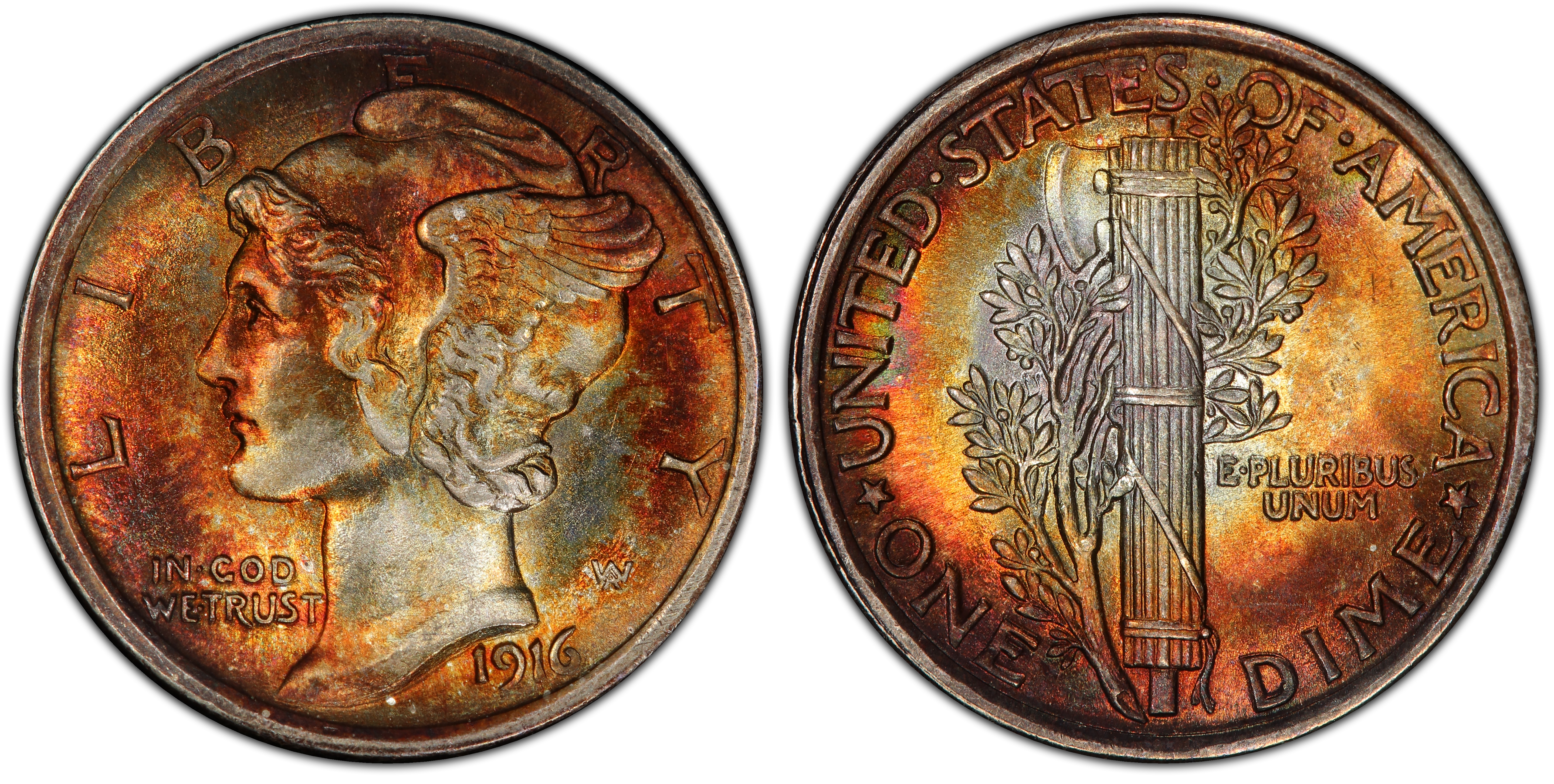 #2 PCGS MS68FB
"The Sedona Collection, Part I," GreatCollections, September 8, 2019, Lot 730930 – $9,286.88; Legend Rare Coin Auctions, May 14, 2020, Lot 131 – $9,693.75; Heritage Auctions, February 24, 2021, Lot 3671 – $9,900. "The New Hampshire Set" (PCGS Set Registry). Richly toned in red and gold on both sides. |