



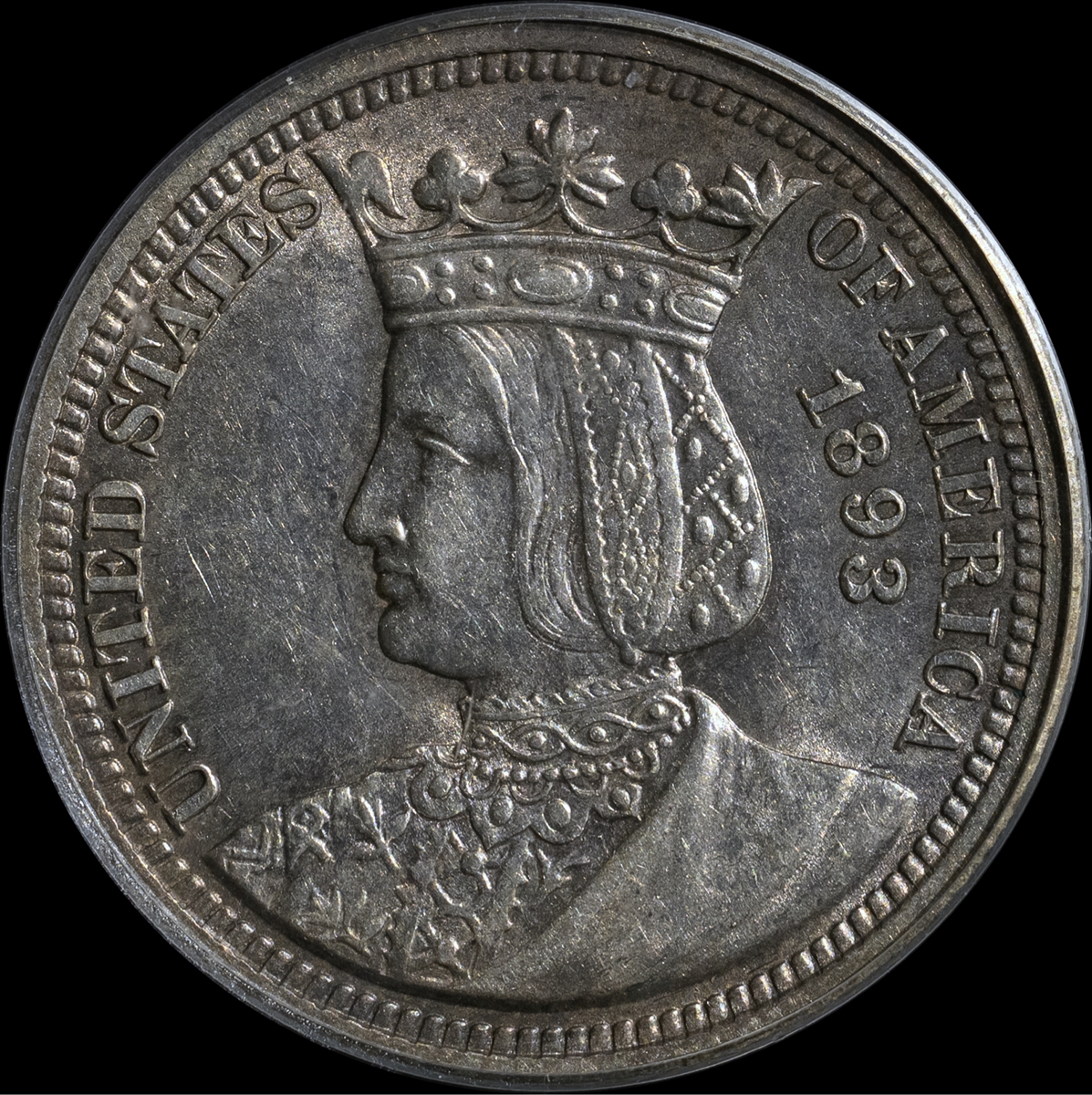
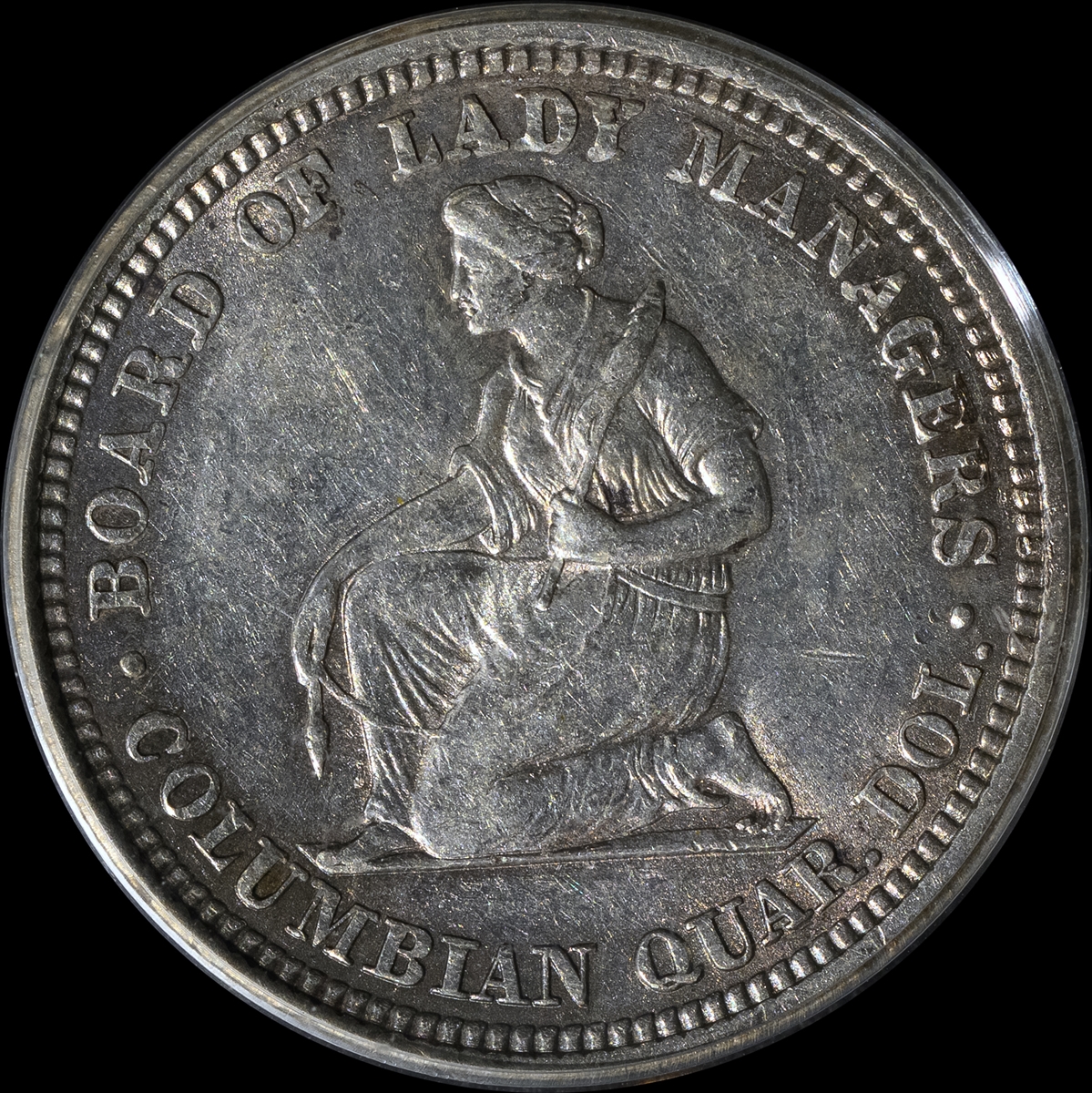
1893 25C Isabella AU55 Certification #13219283, PCGS #9220
Expert Comments
Charles Morgan
The 1893 Isabella Quarter (#9220, Proof #9221) is the United States’ first commemorative quarter dollar and only the second commemorative coin ever produced by the U.S. Mint. Struck for sale during the 1893 World’s Columbian Exposition in Chicago, the coin features a portrait of Queen Isabella I of Spain, the royal patron of Christopher Columbus. The issue honored the 400th anniversary of Columbus's historic voyage to the New World.
Isabella became the first historical woman to appear on a U.S. coin—distinguishing her from "Liberty," who serves as a female allegorical representation—and the first foreign monarch so honored. Only two other foreign monarchs would later appear on U.S. coinage: King William “the Silent” of Orange-Nassau on the 1924 Huguenot-Walloon Tercentenary Half Dollar (#9314), and King Kamehameha I of Hawaii on the 2008 State Quarter (P #39048, D #39049).
The reverse design features a kneeling woman holding a distaff and spindle, symbolizing women’s industry, encircled by the inscription “Board of Lady Managers.” While this motif is often interpreted as a celebration of female labor, numismatic scholar Cornelius Vermeule suggested in Numismatic Art in America that the design may have been inspired by a servant girl from the East Pediment of the Temple of Zeus at Olympia.
The Board of Lady Managers and the Design Controversy
In 1890, Congress passed legislation enabling the creation of the Board of Lady Managers, an act of social progressivism that gave women an official role in highlighting their achievements in art and society. Bertha Honoré Palmer, a prominent socialite and wife of real estate magnate Potter Palmer, served as president. Inspired by the newly authorized Columbian Half Dollar (1892 #9296, 1892 Proof #9295, 1893 #9297, 1893 Proof #9298), Palmer proposed that the Lady Managers market their own commemorative coin to fund their efforts.
Congressional authorization arrived on March 3, 1893, but the design process was fraught with conflict. The Board originally hired sculptor Caroline Peddle in March 1893 to produce a full-bodied portrait of Isabella. However, Mint Chief Engraver Charles E. Barber and other officials clashed with her vision, insisting on a simpler profile bust. Frustrated by the Mint's interference, Peddle resigned on April 8, 1893, leaving Barber to complete the design himself.
Barber also rejected the Board's request to depict the Woman’s Building on the reverse, opting instead for the kneeling spinner. Even the inscription was a point of contention; Palmer’s requested 1492–1892 commemorative text was rejected by the Treasury Secretary, who claimed there was insufficient space on the coin's surface.
Production and Initial Reception
The silver used for the quarters was derived from obsolete coinage. The Philadelphia Mint struck 40,000 coins for distribution, plus 23 for assay. It is believed that 103 of these were Proofs, consisting of the first 100 coins struck as well as numbers 400, 1492, and 1892. These Proofs are rarely offered and command significant premiums. For example, dealer Dan Brown featured one in a March 1965 Numismatist ad for $450. Today PCGS-graded Gem Proofs are expected to bring in excess of $85,000.
Early hopes for the coin were high, but upon release, demand proved sluggish. Contemporary numismatists panned the design. The American Journal of Numismatics (AJN) published a scathing review: “If these coins really represent the highest achievements of our medalist and our mints... we might as well despair its future.” While harsh, such criticism was common for the era; the coin’s primary aesthetic "sin" was perhaps its too-close approximation to Barber's standard 1892 coinage designs.
1893 Isabella Quarter: Market History
Unlike the 1892 and 1893 World’s Columbian Half Dollars—which were struck in quantities nearly on par with their Philadelphia Barber Half Dollar counterparts—the Isabella Quarter was a comparitive rarity. Its total distribution of 24,214 pieces represented a mere 0.29% of the Philadelphia Mint’s annual quarter production. However, as the Isabella Dime was never issued into circulation, and saved as a souvenir, far fewer Mint State 1893 Barber Dimes (#4800) survive today.
The Isabella Quarter struggled at the Exposition because it was priced at $1.00—the same as the half dollar. Souvenir buyers naturally viewed the larger coin as a better value and many complained about the exorbitant surcharge.
Estimates suggest only 10,000 to 12,000 were sold at the show. In late 1893, the Scott Stamp & Coin Company purchased several thousand, while Mrs. Potter Palmer and her associates sequestered 10,000 at face value, slowly releasing them to dealers through the 1920s. During this period, New York coin dealer Thomas Elder reportedly purchased 1,000 coins from the Board for 40¢ each, and many additional examples at 45¢. Chicago coin dealer Silas Curtis Stevens is said to have handled an unknown quantity of the coins, selling them in 100-coin lots for 50¢ to 60¢ per coin as late as the mid-1920s.
Ultimately, 15,809 unsold coins were returned to the Mint to be melted.
Collecting The Isabella Quarter Through the Years
Given the relative scarcity of the 1893 Isabella Quarter and its unsuccessful distribution, those who did buy the coin could have potentially realized a tidy profit, because by 1896, it was trading for $1.50.
The commemorative coin boom of the 1930s introduced a new generation of collectors to the hobby and many got sucked into a cycle of seeking out the latest low mintage issue. At this point, the Isabella was infrequently mentioned in dealer ads, and when it was, its $2.50 to $3.00 asking price was well below recent marketer-made rarities like the 1921 Missouri, 2*4 (#9331), or the 1935-D/34-D Boone (#9263).
In the December 1947 issue of The Numismatist, New York dealer Henry Grunthal listed examples of the 1893 Isabella Quarter for just $9.00 each. By July 1964, Oklahoma dealer Roy L. Baker offered a Brilliant Uncirculated (BU) specimen in the Numismatic Scrapbook Magazine for $90—a tenfold increase in less than twenty years.
Market appreciation continued through the 1970s, evidenced by California dealer Joel Rettew’s October 1976 Numismatist ad offering Gem BU examples at $245. This price surged during the early 1980s bull market, where Gem specimens reached $1,200 and Superb Gems moved into even higher price brackets.
Perhaps the most intriguing pedigree involves a specific coin purported to be a Proof and the fourth specimen struck. Complete with two affidavits confirming its provenance, the coin was offered by Chicago dealer William Evans in the November 1937 Numismatic Scrapbook Magazine. This same historic set reappeared decades later in the April 1964 issue of the same publication, offered by Ken Nichols of Costa Mesa, California, for $750.
Collecting Isabella Quarters
Due to their age and original distribution methods, 1893 Isabella Quarters are frequently found fully toned. While this toning is often dull and detracts from the coin’s eye appeal, it can also manifest as vibrant colors that significantly enhance the design. Mark-free, vividly toned examples dominate the upper echelon of the PCGS Condition Census and remain highly coveted by advanced PCGS Set Registry participants. Conversely, brilliant or near-brilliant examples represent their own desirable category, supported by a dedicated subset of collectors. As a side note, assembling a Gem 144-coin commemorative set of beautifully toned examples is every bit as rewarding as completing one with original, fully brilliant coins and flashy luster.
* * *
David Hall
The 1893 Isabella quarter is one of the most important issues of the silver commemorative series. And it is also one of the most desirable. The Isabella has many things that distinguish it from it's silver commemorative half dollar brothers;
1. The Isabella is the only U.S. silver commemorative quarter, though it might be noted that the 1932 Washington quarter was originally intended as a commemorative issue, but morphed into the regular issue quarter series that is still minted today.
2. The Isabella quarter is one of the earliest U.S. commemoratives. Actually, it is the second issue of the commemorative series after the 1892 (and 1893) Columbian half dollar. This is an important factor in explaining the rarity of the early silver commemorative issues in Choice and Gem condition. There were a ton of different silver commemorative issues in the 1930s. But prior to 1934, there were a few issues minted every few years. The issues of the 1930s were generally saved at the time of issue and seldom saw circulation (ever seen a circulated Norfolk???) These 1930s era silver commemoratives are readily available in Gem condition. The earlier issues were also saved at the time of issue, but not in the enormous percentage of the mintage as the 1930s issues. Many of the earlier issues are often found in circulated condition. And many of them are quite rare in Gem and Superb Gem condition. The 1893 Isabella quarter did see some circulation, though since the issue price was $1.00, many were saved. Nonetheless, the Isabella quarter is rare in Gem condition.
3. The Isabella quarter is one of the highest demand issues in the silver commemorative series. Because it is the only quarter, because it is one of the earliest issue, because it is rare in top condition...all of these factors make the Isabella quarter one of the most sought after of all United States commemorative coins.
I've always been a big fan of this issue. In 1973, I spent about six months trying to buy every Gem Isabella I saw. I was paying $150 a coin at the time and managed to acquire about 80 pieces...and that was back in the days when good rare coins were a lot easier to buy. I've been dealing in Gem quality silver commems since 1973 and I always try to keep at least one Isabella quarter in stock at all times. To me it just doesn't seem like you're a commemorative dealer if you don't have an Isabella quarter.
The typical Isabella quarter grades MS62 to MS64. There are also quite a few lightly circulated "AU" examples. A small number of Isabellas found their way into circulation and worn pieces are occasionally encountered. Gem MS65 examples are rare, Superb Gem MS66 examples are very rare, and only a handful of MS67s exist. Isabellas usually have frosty luster and some can be highly lustrous. Isabellas also come with varying degrees of toning, including some beautiful rainbow Gems. Most Isabellas are well struck and most don't seem to have many marks or abraisions.
Rarity and Survival Estimates Learn More
| 65 or Better | 20000 |
| All Grades | 16500 |
| 60 or Better | 1750 |
| 65 or Better | R-2.8 |
| All Grades | R-2.8 |
| 60 or Better | R-4.7 |
| 65 or Better | 96 / 144 TIE |
| All Grades | 103 / 144 TIE |
| 60 or Better | 23 / 144 TIE |
| 65 or Better | 96 / 144 TIE |
| All Grades | 103 / 144 TIE |
| 60 or Better | 23 / 144 TIE |
Condition Census Learn More
 #1 PCGS MS68+
As NGC MS69 #163965-001. Heritage Auctions, July 2002, Lot 5040 - $46,000. As PCGS MS68 #21627266. "The JFS Collection, Part Two," Heritage Auctions, August 18, 2004, Lot 4198 - $51,750. As PCGS MS68+ #56831733. "The J & L Commemorative Type Set" (PCGS Set Registry). |
 #1 PCGS MS68+
"San Diego Collection"; current status unknown. |
 #1 PCGS MS68+
As PCGS MS68. "The Schultz Collection" (PCGS Set Registry). As PCGS MS68+ 29949436. Stack’s Bowers, August 15, 2019 , Lot 5391 – Passed; "The MJF Collection". Vivid cobalt blue and gold toning. Light area near G on reverse. |
 #4 PCGS MS68
|
| #4 PCGS MS68 |