



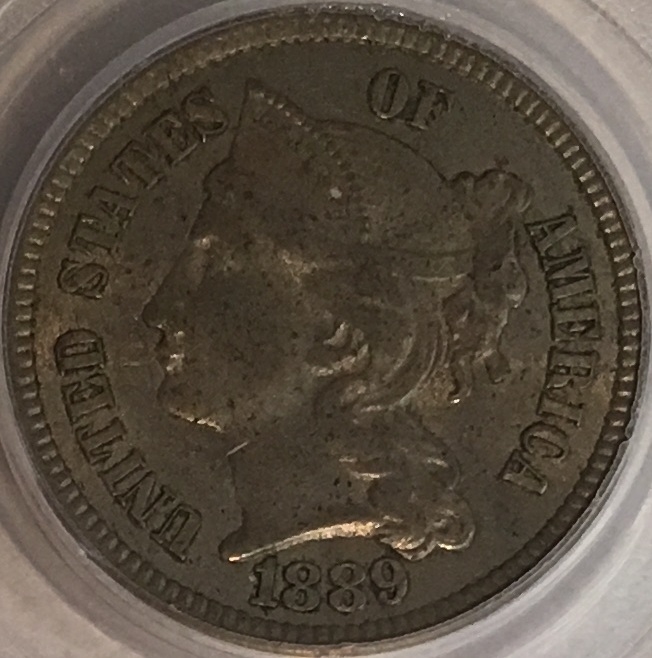
1889 3CN AU55 Certification #14298108, PCGS #3758
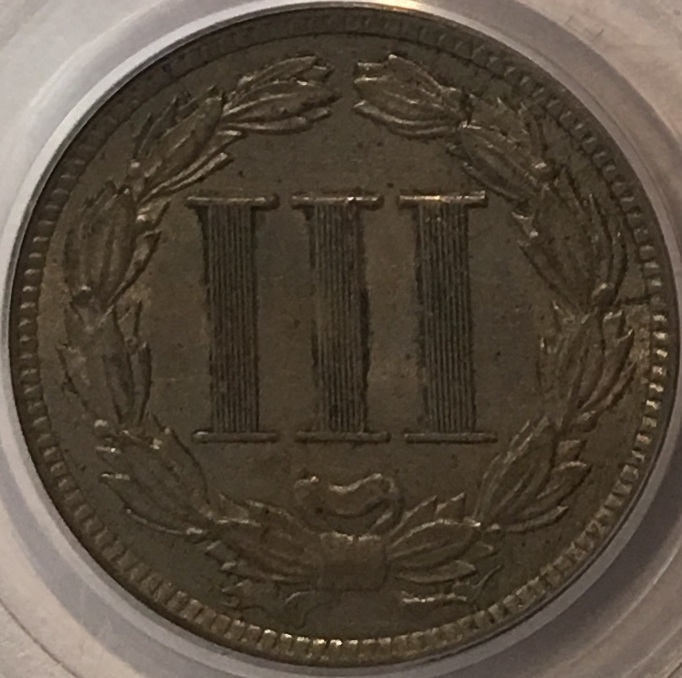
Owner's Comments
Expert Comments
Charles Morgan
The End of an Era: The 1889 Three-Cent Nickel
The year 1889 marked the final production run for the Three-Cent Nickel. The demise of this "oddball" denomination had been a long time coming; the Philadelphia Mint last struck the coin in significant quantities in 1881. For the remainder of the decade, stagnant demand led the Mint to produce only token amounts—generally fewer than 5,000 business strikes per year. In fact, from 1883 to 1885, Proofs actually outnumbered business strikes, and in 1886, the Mint produced Proofs exclusively.
While the coin was originally issued to redeem Civil War-era “shinplasters” (fractional paper currency), Congress never granted the Three-Cent Piece unlimited legal tender status. Redemptions were capped at just 20 coins per transaction.
Debate over the coin’s limited utility persisted for years. In 1873, Congress abolished the nation’s first three-cent coin—the thin three-cent silver piece—but allowed the nickel version to continue. While this decision likely favored the interests of nickel magnate Joseph Wharton, it did little for American consumers or businesses. Though production ceased in 1889, the denomination was not officially abolished until September 26, 1890, when Congress eliminated it alongside the Gold Dollar and the Three-Dollar Gold Piece.
CHAP. 945.- An act to discontinue the coinage of the three-dollar and one-dollar gold pieces and three-cent nickel piece.
Be it enacted by the Senate and House of Reprsentatives of the United States of America in Congress assembled, That from and after the passage of this act the coinage of the three-dollar gold piece, the one-dollar gold piece, and the three-cent nickel piece be, and the same is hereby, prohibited, and the pieces named shall not be struck or issued by the Mint of the United States.
Sec. 2. That as fast as the said coins shall be paid into the Treasury of the United States they shall be withdrawn from circulation and be recoined into other denominations of coins.
Sec. 3. That all laws and parts of laws in conflict with this act are hereby repealed.
Approved, September 26, 1890.
Collecting the 1889 Three Cent Nickel
While not a "key date," the 1889 Three-Cent Nickel (#3758) is considered a "better date" within the series. Typical uncirculated examples fall within the PCGS MS63 to MS64 range; superb gems remain scarce. Fortunately for modern specialists, a fair number of coins were preserved in high grades; our condition census consists entirely of MS67+ examples. Collectors today can choose between attractive specimens boasting delicate original toning and those retaining much of their full original brilliance.
Interestingly, the coining room seemingly ignored the fact that the reverse die was shattered early in production. This shattered-die feature serves as a fittingly eccentric characteristic for the final circulation issue of this curious denomination.
* * *
Rarity and Survival Estimates Learn More
| 65 or Better | 1000 |
| All Grades | 600 |
| 60 or Better | 200 |
| 65 or Better | R-5.0 |
| All Grades | R-5.8 |
| 60 or Better | R-7.0 |
| 65 or Better | 7 / 23 TIE |
| All Grades | 15 / 23 |
| 60 or Better | 15 / 23 TIE |
| 65 or Better | 7 / 23 TIE |
| All Grades | 15 / 23 |
| 60 or Better | 15 / 23 TIE |
Condition Census Learn More
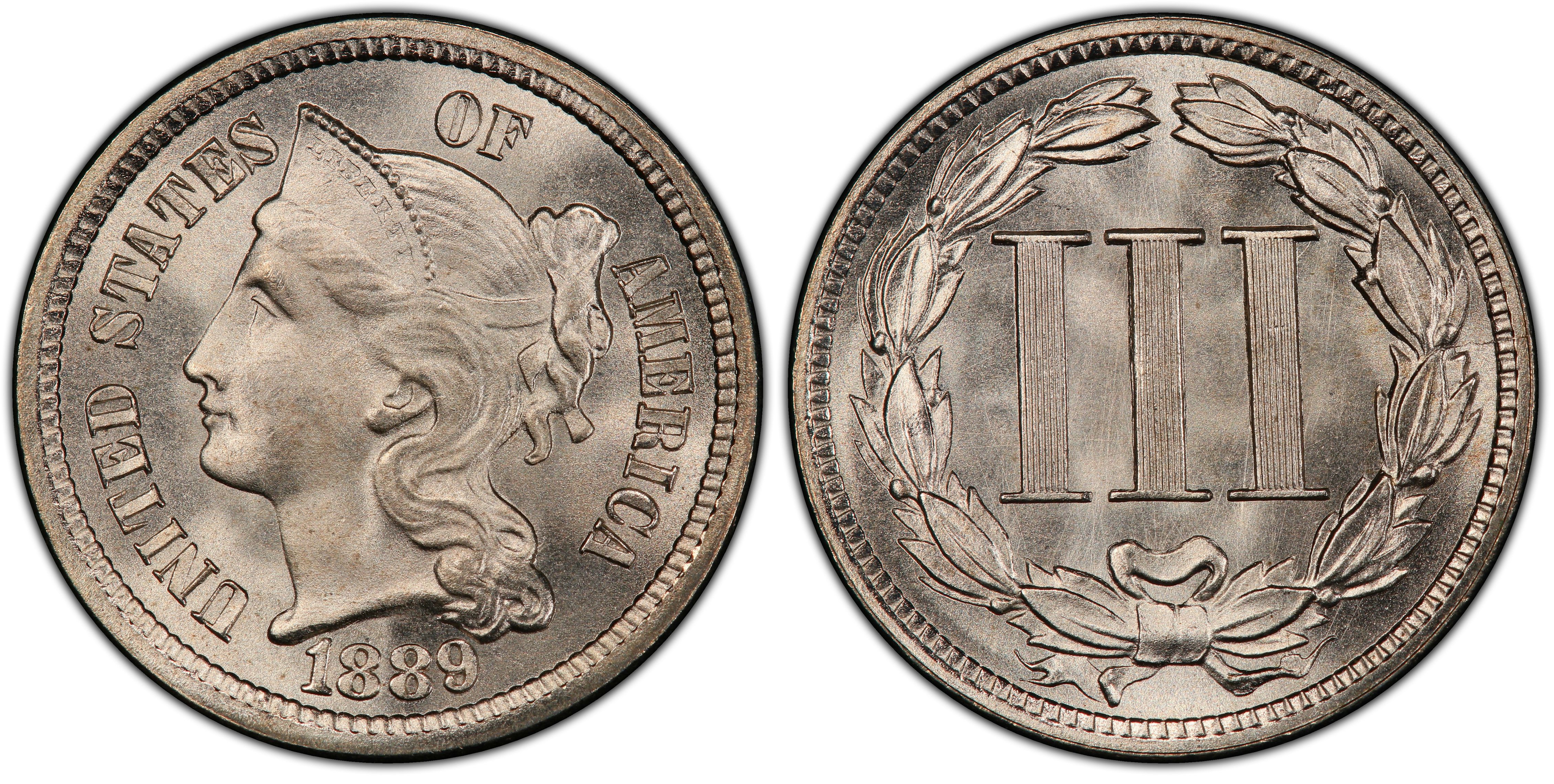 #1 PCGS MS67+
Legend Rare Coin Auctions, October 28, 2021, Lot 270 - $7,343.75; Dell Loy Hansen; "The D.L. Hansen Three Cent Complete (1851-1889) Collection" (PCGS Set Registry). |
 #1 PCGS MS67+
Legend Rare Coin Auctions, September 26, 2019, Lot 98 - $7,050. Small diagonal mark above first 8 of date. Typical reverse die cracks. |
 #1 PCGS MS67+
As PCGS MS67 #06678437. “The Classic Collection,” Heritage Auctions, April 28, 2010, Lot 399 – $3,737.50; Heritage Auctions, August 12, 2010, Lot 4069 – $3,593.75; “The Western Hills Collection,” Heritage Auctions, February 16, 2017, Lot 3210 – $6,462.50. As PCGS MS67+ #84296776. "The Tompet38 Collection" (PCGS Set Registry). Lavender blue toning along the periphery with peach centers, more intense on the reverse. Toning spot below the topmost branch on the right. Typical reverse die cracks present. |
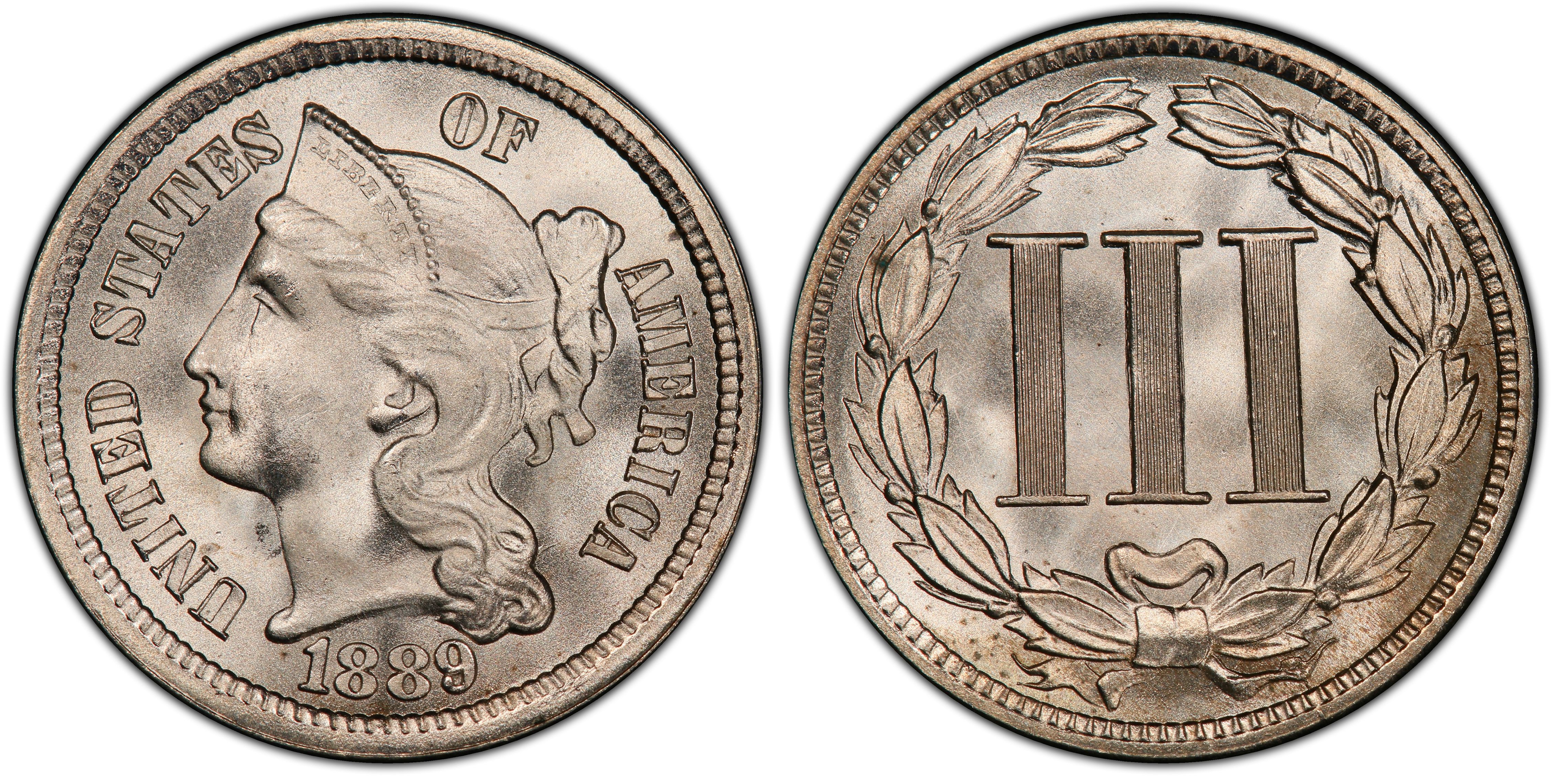 #1 PCGS MS67+
"Rafus 3CN Basic Set" (PCGS Set Registry). Small toning spot to the left of 1. Toning spots on the reverse near the border at 7 o'clock. Typical reverse die cracks. |
 #1 PCGS MS67+
Lightly impressed dull diagonal mark on rim at 10 o'clock. Typical reverse die cracks. |