



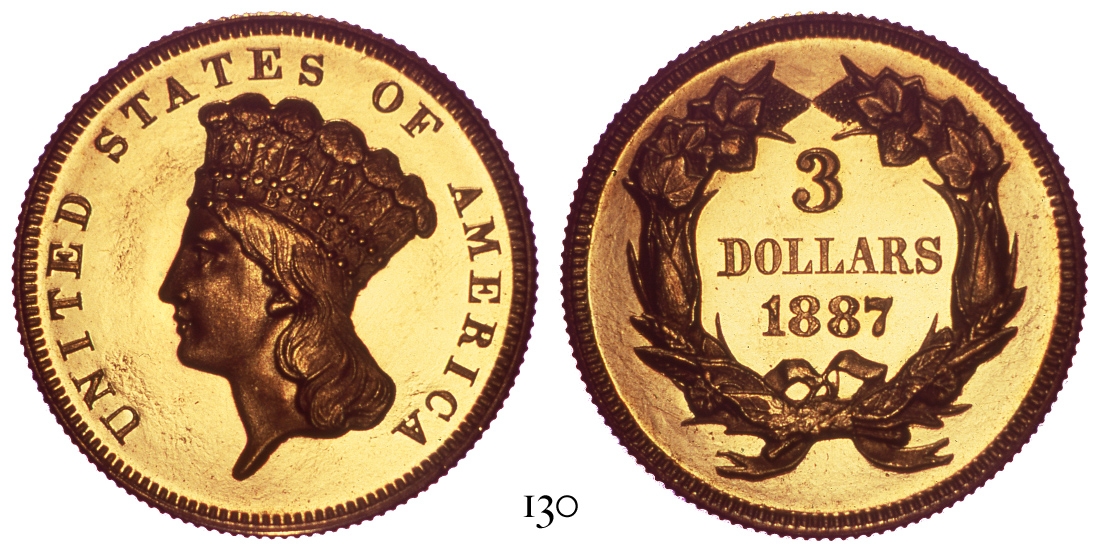
1887 $3 PR65 Certification #-9867, PCGS #8051
Owner's Comments
Estimated grade.
Expert Comments
David Akers (1975/88)
The 1887 has the second highest proof mintage in the series, and as the auction records indicate, proofs appear on the market with some regularity. Several very interesting proofs of this date exist. They are, in fact, mint errors, and such errors are extremely unusual in proof gold coins since those coins were genrally struck with considerable care. The 1887 three dollar gold piece errors were first struck with the reverse die aligned 180 degrees from normal and then struck again with the dies properly aligned. As a result, strong traces of the denomination and date appear upside down within the wreath on the reverse beneath the normal date and denomination. Only a few such specimens have been discovered and the first was reported and offered in Lester Merkin's November, 1965 sale. Another similar piece sold in the Ullmer Sale in 1974, although it was not catalogued as an error. As is the case with most dates after 1866, deceptive first strikes of 1887 exist. Even the most deceptive, however, lack the depth of field and orange peel surface that are characteristic of a true proof. However, they may be confusing to some people and so I will point out here that all proofs that I have seen show a very prominent outline along the outer edge of the top left side of the wreath, as well as very faint outlines on both terminal tassels above the 3. These outlines are missing from the business strikes that I have seen. Many proofs of 1887, and most other years as well, have a peculiar porosity in the field that can give a "halo" effect around the head of Liberty. This porosity is not an impairment and should not be confused with hairlines or rubbing.Ron Guth
David Akers mentioned that some of the 1887 $3 Proofs were double struck, with the second strike oriented 180 degrees from the first. Akers noted only two examples of this error but also wrote of "a few" in his book. This unusual error was first discovered in 1965 by Walter Breen.
In January 2015, Heritage offered an NGC PR65CAM with double striking. That coin sold for $29,375, which is hardly any premium at all over the price of a non-error striking.
PCGS #
8051
Designer
James Barton Longacre
Edge
Reeded
Diameter
20.50 millimeters
Weight
5.02 grams
Mintage
160
Metal
90% Gold, 10% Copper
Pop Higher
5
Pop Lower
45
Region
The United States of America
Price Guide
PCGS Population
Auctions - PCGS Graded
Auctions - NGC Graded
Rarity and Survival Estimates Learn More
| 65 or Better | 100 |
| All Grades | 90 |
| 60 or Better | 40 |
| 65 or Better | R-8.0 |
| All Grades | R-8.1 |
| 60 or Better | R-8.7 |
| 65 or Better | 35 / 37 TIE |
| All Grades | 35 / 37 |
| 60 or Better | 36 / 37 |
| 65 or Better | 35 / 37 TIE |
| All Grades | 35 / 37 |
| 60 or Better | 36 / 37 |
Condition Census Learn More
| #1 PR66 PCGS grade |
| #1 PR66 PCGS grade |
| #1 PR66 PCGS grade |
| #1 PR66 PCGS grade |
| #1 PR66 PCGS grade |