



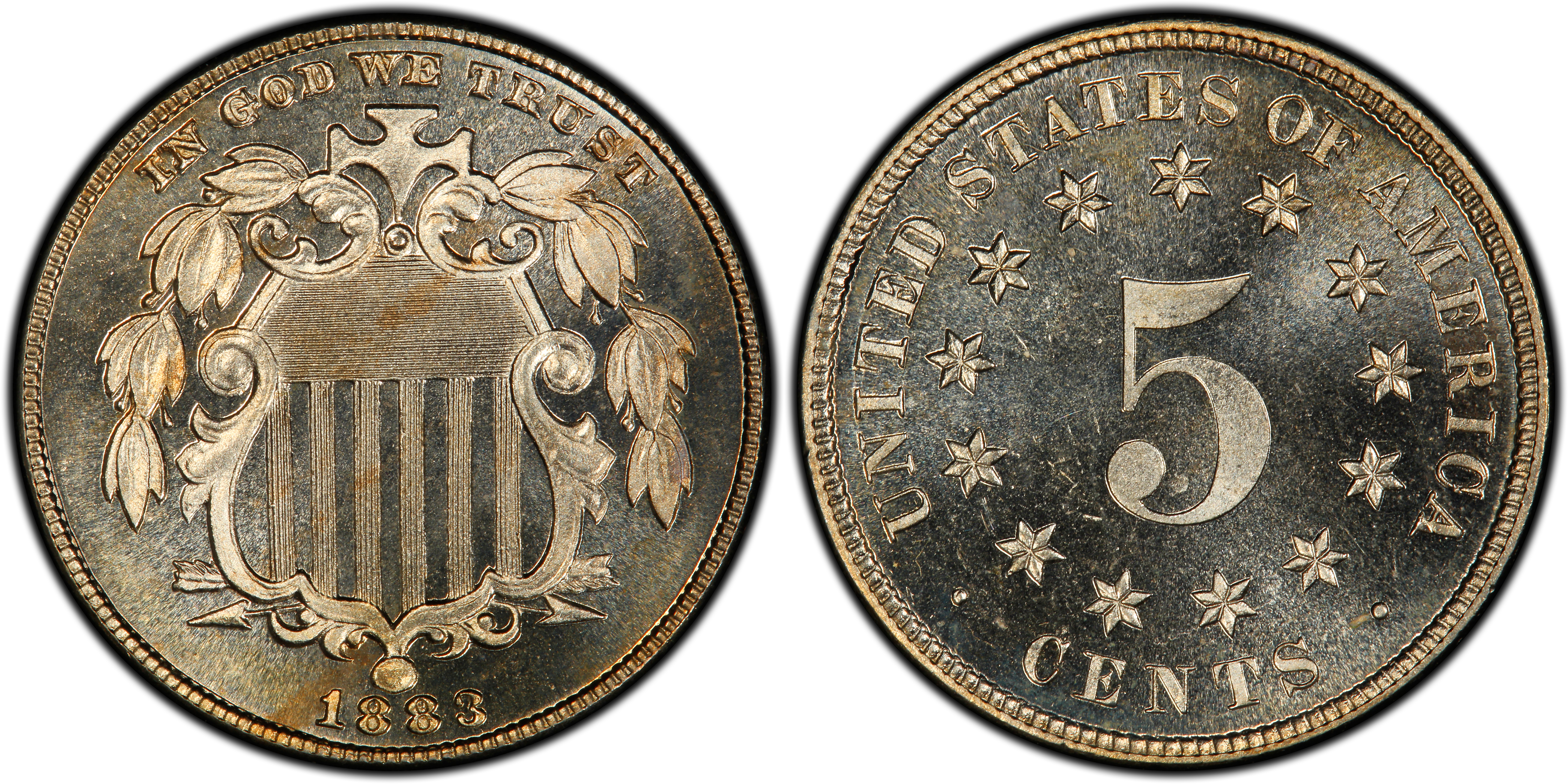
1883 5C Shield, CAM PR66+ CAM Certification #18322042, PCGS #83838
Owner's Comments
Expert Comments
Charles Morgan
The 1883 Shield Nickel Proof
In 1883, coin collectors were presented with a rare opportunity to acquire three different five-cent designs as James Barton Longacre’s Shield Nickel gave way to Charles E. Barber’s Liberty Head design. This transition was marked by controversy; the new nickel was initially issued without an explicit mention of its denomination, leading to the infamous "Racketeer Nickel" legends where some suggested the coin could be gold-plated and passed off as a five-dollar gold piece.
I have always been skeptical of this claim. Even if a fraudster gold-plated a "V" nickel and added reeds to the edge, the coin measured 20.5 mm and weighed 5 grams. In contrast, the gold Liberty Head Half Eagle measured 21.65 mm and weighed 8.36 grams. One would assume that merchants familiar with the heft of federal gold would have noticed the discrepancy. Furthermore, the use of the Roman numeral "V" had precedent on both the silver and nickel Three-Cent pieces—both of which, featured a plain edge, and the latter was still a circulating denomination in 1883.
Regardless of the actual risk, the Treasury Department ordered Barber to revise the design to include the word CENTS. This resulted in three distinct nickel types for the year: the final Shield issue, the short-lived "No Cents" Liberty Head, and the revised Liberty Head "With Cents." Proofs were struck for all three and it has been suggested that Mint Director Horatio C. Burchard authorized the continued production of 1883 Shield Nickel Proofs to discourage speculators from hoarding the outgoing design.
1883 Five-Cent Nickel Proofs
- 1883 Shield Nickel Proof (#3838) | Mintage: 5,419*
- 1883 Liberty Head Nickel, Without Cents Proof (#3878) | Mintage: 5,219
- 1883 Liberty Head Nickel, With Cents (#3881) | Mintage: 6,783
While the Shield Nickel and the "No Cents" Liberty Head Proofs have roughly equivalent mintages, the "With Cents" Proof was struck at a significantly higher level to meet the surging demand from collectors eager to document the design change. Regardless of type, the five-cent nickel was the most popular Proof denomination of 1883, eclipsing the combined mintage of the year's other two minor coins (the Cent and Three-Cent Nickel) by more than 10,000 pieces.
According to R.W. Julian’s research at the National Archives, 3,919 Shield Nickel Proofs were minted as of March 31, with an additional 1,500 pieces delivered by June 26, bringing the total to the widely recognized 5,419. However, John W. Dannreuther suggests this figure may be inflated. In United States Proof Coins, Volume II: Nickel (2023), Dannreuther estimates the actual mintage is closer to 4,000. He bases this figure on discrepancies found between reported mintages and records contained in the Mint’s die-use and destruction documents. Even if Dannreuther’s observations are correct, a 25% reduction in the mintage would likely do little to change collector psychology regarding the issue's overall scarcity; a reduced figure would simply align the 1883 mintage with the Proof levels established between 1879 and 1882.
Dannreuther has identified five specific die marriages for this issue, struck from a combination of three obverse and three reverse dies. Of the five, JD-2 and JD-3 currently appear to be the scarcest, though our understanding of their relative rarity will improve as more coins appear at auction with updated attributions. Notably, none of these Proof marriages include the famous 1883/2 overdate found on certain business strikes. For those seeking a professional review of their 1883 Shield Nickel Proof, PCGS offers formal attribution through our Variety Program.
Vintage Market Snippet
Coin dealer Ken Nichols listed a “Gem” Proof 1883 Shield Nickel for sale for $42.50 in his July 1964 Numismatic Scrapbook Magazine advertisement.
The first PCGS PR67+ Cameo was certified in April 2013 as part of Dan Rosenthal's renowned "Just Having Fun Collection." It would take another six years for the Gerald R. Forsythe specimen—a "pre-plus era" PR67 Cameo—to deservedly earn the second PR67+ Cameo designation. No coin since has been added to this "top pop" grade level.
* * *
Condition Census Learn More
|
#1 PCGS PR67+CAM
"The Just Having Fun Collection," Stack’s Bowers, November 6, 2013, Lot 2048 – $10,000 Reserve Not Met; Stack's Bowers, February 2014, Lot 1074 - $8,812.50. Top pop, pop one when offered. Black and white. Very faint surface spot just above 5. |
 #1 PCGS PR67+CAM
As PCGS PR67CAM #50067253. Heritage Auctions, March 28, 2009, Lot 551 - $2,070. As PCGS PR67+CAM #37482118. "The Gerald R. Forsythe Collection," GreatCollections, September 19, 2021, Lot 1027459 - $11,812.50; Stack's Bowers, November 19, 2024, Lot 3008 - $8,400. JD-2. Faint champagne-pink toning. Small cluster of toning spots in the field below TR of TRUST. Small toning spot above the first T of STATES. |
| #3 PCGS PR67CAM |
|
#3 PCGS PR67CAM
Heritage Auctions, November 29, 2012, Lot 3330 – $3,055; GreatCollections, August 25, 2019, Lot 721323 – $1,631.25. "The KCV comp-w/MV, Proof Collection" (PCGS Set Registry). Faint gold toning. |
|
#3 PCGS PR67CAM
As PCGS PR67CAM #9009819. Heritage Auctions, July 27, 2002, Lot 6397 – $6,325; “The Western Hills Collection,” Heritage Auctions, June 2, 2005, Lot 5552 – $2,760; Heritage Auctions, April 18, 2012, Lot 3554 – $2,530; “The Eugene H. Gardner Collection, Part III,” Heritage Auctions, May 2015, Lot 98133 – $1,292.50. As PCGS PR67CAM #32631918. Heritage Auctions, October 30, 2015, Lot 3948 – $1,586.25; "John's Basic U.S. Set" (PCGS Set Registry). Wispy golden toning on both sides. Dimpled surfaces inside the ring of stars on the reverse. |