



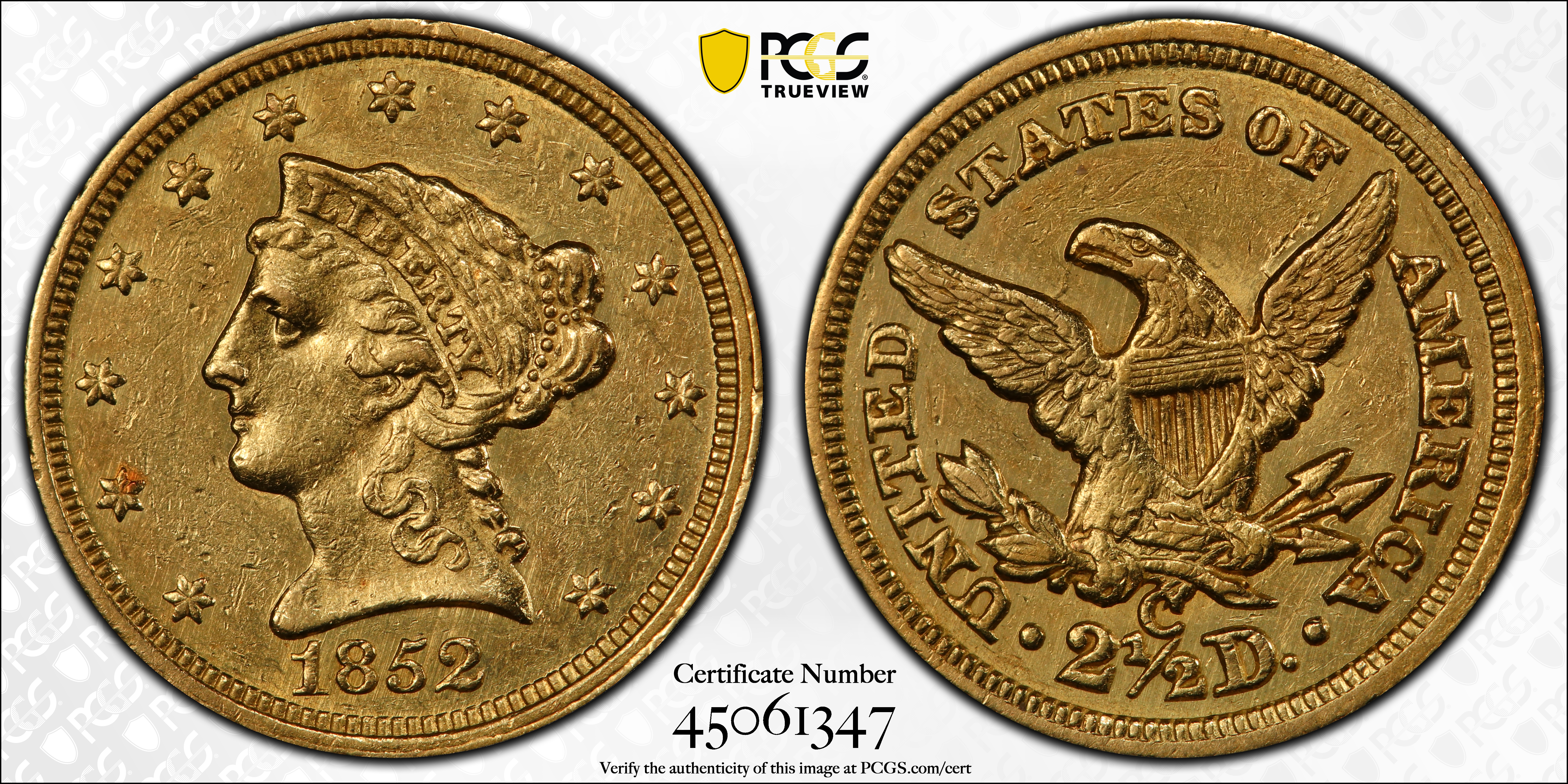
1852-C $2.50 AU55 Certification #45061347, PCGS #7764
Expert Comments
David Akers (1975/88)
Always seen weakly struck, particularly on the hair around Liberty's face and on the eagle on the reverse. Many specimens show a distinct wire rim. (Note: On many coins, a wire rim denotes a sharp strike. However, the wire rim that is seen on many C Mint coins is not the result of a strong strike but rather the result of improperly matched dies and collars.) The 1852-C is very scarce in all grades and is, in fact, very nearly as rare as the much lower mintage and more highly regarded 1852-D. In full mint state, it is actually more rare than the 1852-D.Charles Morgan
While the Philadelphia and New Orleans Mints efficiently converted massive shipments of California gold into coinage in 1852—leveraging their status as major metropolitan centers and port cities—the landlocked Charlotte and Dahlonega Mints lagged behind, relying primarily on diminishing deposits of locally sourced gold.
In 1852, the four operating U.S. Mints produced over $59.3 million in gold coin. Charlotte's contribution was a paltry $396,734, a meager 0.67% of the total. Dahlonega fared only slightly better, despite minting substantially more Half Eagles; its total output amounted to 102,022 coins valued at $474,475.
For the 1852-C Liberty Head Quarter Eagle (#7764), the Philadelphia Mint supplied three die pairs, yet Charlotte only deployed one (Winter variety 14-I). As is typical of gold struck at the Charlotte facility, the coins frequently exhibit partial wire rims due to the use of mismatched dies and collars. Center details are often weak, with ill-defined curls on Liberty and a lack of detail on the eagle's neck, right leg, and shield. Following this issue, the Charlotte Mint paused Quarter Eagle production in 1853, resuming it in 1854 and closing out the denomination with intermittent issues in 1855, 1856, 1858, and 1860. The Charlotte Mint closed at the outset of the Civil War. The facility reopened in 1867 as a U.S. Assay Office, a status it retained until its closure in 1913.
How Rare is the 1852-C Liberty Head Quarter Eagle
PCGS estimates that 200 or fewer 1852-C Liberty Head Quarter Eagles survive, most falling in the Very Fine (VF) to Extra Fine (XF) range. Mint State examples typically exhibit some degree of contact marks and broken luster, limiting them to the low end of the Mint State grade range. Those accustomed to the Gem and Superb Gem examples of the late 1890s or early 1900s may object to this, but branch mint gold collectors find these features charming and can find beauty even in an MS61 coin—a lucky survivor to be sure.
The Harry Bass, Jr. specimen, last sold at auction in October 1999, is the sole finest known.
One Die Marraige Known
The Charlotte Mint used only a single die pair to strike the entire mintage of 1852-C Liberty Head Quarter Eagles.
- Obverse: On the obverse die, the "1" in the date is equidistant between the bust and the denticles, while the position of the "2" is set slightly lower.
- Reverse: The reverse die was new for 1852, but it saw continued use to strke the 1854-C (#7770) and 1855-C Liberty Head Quarter Eagles (#7775)—Charlotte did not strike $2.50 gold pieces in 1853. This reverse features a large mintmark whose serif is embedded in the feathers, extending up the arrow shaft, with an arrow feather extending through the center of the mintmark from the upper right.
1852-C Liberty Head Quarter Eagle: Physical Characteristics
(Per Doug Winter)
Surfaces and Luster
Surfaces: This is among the most difficult Charlotte quarter eagles to find with choice surfaces. Nearly all known examples are heavily abraded, and many show hairlines from having been cleaned at some point. Light to medium clashmarks are usually present, and mint-made roughness is often visible around the portrait. Reverse clashmarks are also sometimes present above the olive leaves, below both wings, and above the left wing.
Luster: Most examples exhibit poor luster. While this is partly due to the way the date was produced, it is primarily the result of numismatic abuse (i.e., cleaning). On the few pieces that have never been cleaned, the luster is soft and frosty in texture.
Coloration and Eye Appeal
Coloration: Original pieces display attractive deep green-gold coloration with strong orange-gold or coppery-gold overtones. I have not seen a higher-grade 1852-C with original color (i.e., not dipped) in a number of years.
Eye Appeal: This date is almost never seen with good eye appeal. The combination of a poor strike and having been cleaned is typical. An example boasting a good strike, original color, and original surfaces is very rare and should command a strong premium compared to a typical specimen. DIE CHARACTERISTICS The 18 in the date shows light repunching at the base of both digits. The bottom of the 5 is very lightly repunched, but this characteristic is only visible on early die states.
* * *
Rarity and Survival Estimates Learn More
| 65 or Better | 140 |
| All Grades | 4 |
| 60 or Better | 0 |
| 65 or Better | R-7.6 |
| All Grades | R-9.8 |
| 60 or Better | R-10.1 |
| 65 or Better | 56 / 147 TIE |
| All Grades | 5 / 147 TIE |
| 60 or Better | 1 / 147 |
| 65 or Better | 56 / 147 TIE |
| All Grades | 5 / 147 TIE |
| 60 or Better | 1 / 147 |
Condition Census Learn More
|
#1 PCGS MS63
"The Harry W. Bass, Jr. Collection," Bowers & Merena, October 1999, Lot 453 - $26,450. |
| #2 PCGS MS62 |
|
#2 Est. MS62
Stack’s, June 1977, Lot 841 ; Stack’s, February 1980, Lot 49; Elrod Collection; Paul Dingler Collection; “The Grand Lake Collection”, Heritage Auctions, February 6, 2009, Lot 2517 – $16,100; “The Cherokee County Collection”, Heritage Auctions, January 5, 2012 – $18,400. Discoloration to the right of Liberty’s neck between stars 12 and 13. Dark spots frame star 11. Wire rim from about 10 o’clock to about 7 o’clock on the obverse. Eagle strike is average. Spot on eagle’s neck. Dark spot below second S of STATES. |
 #4 PCGS MS61
Heritage Auctions, November 2, 2017 – $15,600. Thin scratch below stars 7 and 8. Scattered toning spots throughout. |
 #4 PCGS MS61
Heritage Auctions, January 2016, Lot 5548 - $12,925. |