



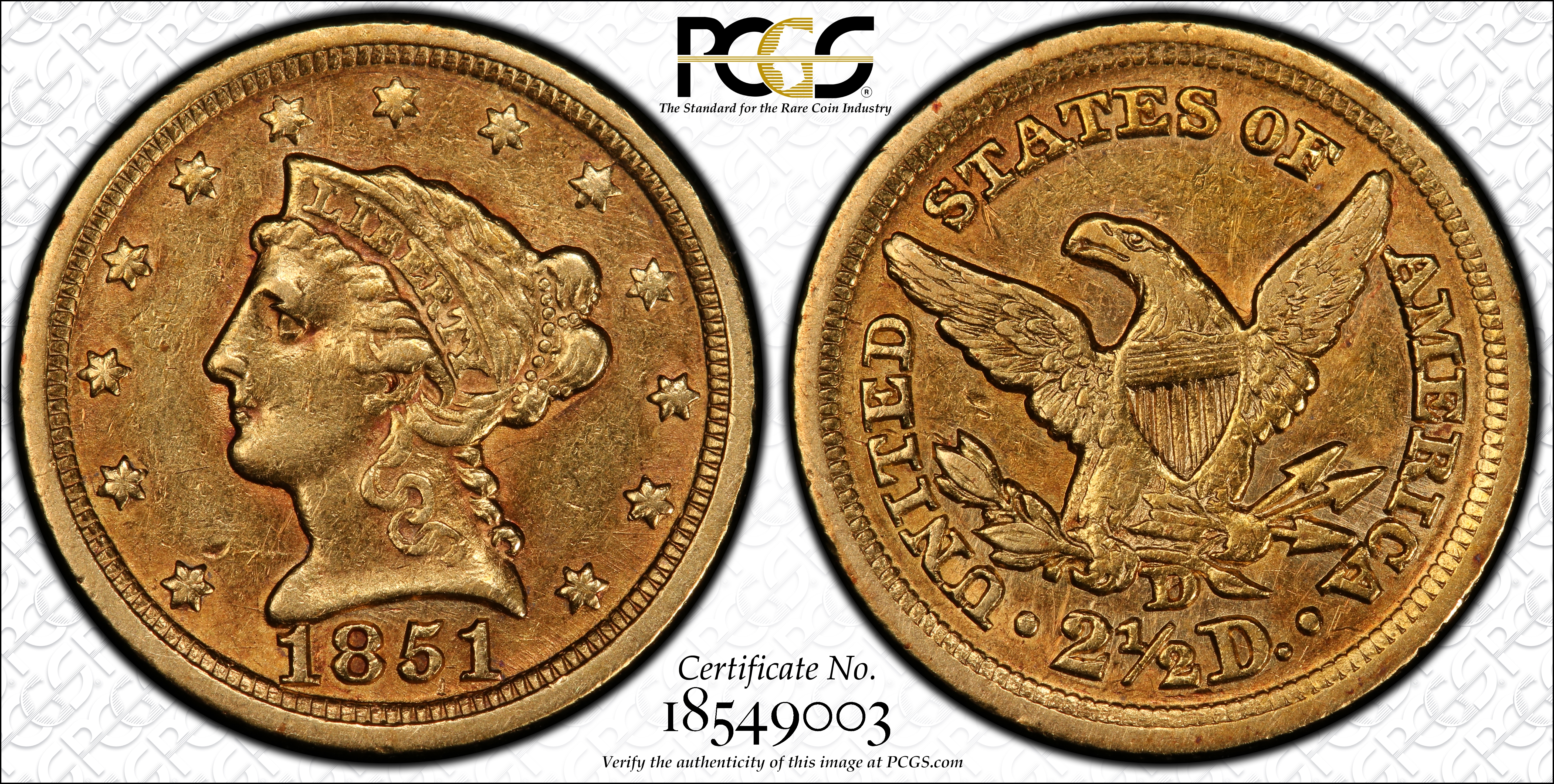
1851-D $2.50 XF45 Certification #18549003, PCGS #7761
Owner's Comments
Expert Comments
PCGS Set Registry
Of the three gold denominations struck by the Dahlonega Mint in 1851, the 1851-D Liberty Head Half Eagle received the most attention. Quarter Eagle production was on the lower end of average for the Mint, and the decline in output from the peak of the mid-to-late 1840s foreshadowed further decreases in the years to come. The 1851-D marked the final year that a D-Mint quarter eagle would see a mintage over 10,000 coins. In just five years, Dahlonega quarter eagle production would fall to just 874 pieces, paving the way to one of the series' key dates, the 1856-D.
The 1851-D Liberty Head Quarter Eagle had a mintage of 11,264 pieces, situated between the Gold Dollar and the Half Eagle.
Dahlonega Mint Gold Coin Production
- 1851-D Liberty Head Half Eagle | Mintage: 62,710
- 1851-D Liberty Head Quarter Eagle | Mintage: 11,264
- 1851-D Gold Dollar | Mintage: 9,882
Production History
For the Quarter Eagle, the Philadelphia Mint sent Dahlonega three obverse dies, but only one was utilized. The reverse die was remarkable for its longevity: it was carried over from the previous year, had first been used in 1847, and would continue to be used through 1859—the final year of D-Mint quarter eagle production.
Die Varieties
For the 1851-D Liberty Head Quarter Eagle, only one die variety is known.
- Variety 14-M Obverse: The top of the first '1' in the date is joined to the bust, and the base nearly touches a denticle. The right base of the second '1' also nearly touches a denticle, but its top is not close to the bust. An extra segment extends from the center of the lower loop of the '5' toward the upright of the second '1'; this feature fades in later die states.
- Reverse: The reverse die is the same as that described for the 1847-D Variety 9-M.
Surface Condition and Features
Most 1851-D Quarter Eagles encountered will exhibit extensive abrasion marks (bag marks/scratches), which are often densest in the obverse fields.
Furthermore, many specimens were struck with rusted dies, which pockmarked the die surface, leaving raised bumps on the struck coin. This is particularly visible on Liberty's cheek, brow, forehead, and near the date, and is less frequent on the reverse.
Obverse Scratches
Two distinct die scratches, which are inherent to the coin's manufacture and should not be mistaken for post-mint damage, serve as identification markers:
- A scratch runs from the denticles, passes through the top point of star twelve, and extends into the field between stars eleven and twelve.
- A second scratch originates at the denticles and runs into the field situated between stars twelve and thirteen.
Luster and Coloration
Luster on high-grade pieces is generally robust, characterized by a bright, frosty sheen and a satiny texture. The original coloration of untouched coins is varied, encompassing shades from deep rose-gold to pale green-gold and yellow. However, due to the widespread practice of cleaning or dipping, examples retaining their fully original color are quite scarce.
Overall Eye Appeal
The 1851-D is relatively accessible for collectors seeking an acceptable example when compared to many other dates from the 1850s. This is mainly due to the common presence of a good strike and appealing luster. Although a small number of truly superb and highly attractive pieces exist, locating a specimen that is completely free of defects and boasts unadulterated, original color is exceptionally difficult. The die rust feature may turn off Type collectors.
Market Characteristics
The 1851-D Liberty Head Quarter Eagle saw heavy circulation, and most lower-grade examples were culled in the late 19th and early 20th centuries, before coin collecting became widespread in America. In numismatist David Akers‘ United States Gold Coins, An Analysis of Auction Records, Volume I (1975), the gold coin specialist estimated a surviving population of 55 pieces. More recently published survival estimates range from 100 to 120 coins in all grades, with five to six known in Mint State.
The coins PCGS has reviewed typically fall within the Very Fine (VF) to About Uncirculated (AU) grade range, with just six grading events reported at the Mint State level. The 1851-D is tougher than the 1851-C, but the grade distribution for the Charlotte issue is more concentrated in the Extremely Fine (XF) range, while the Dahlonega release exhibits a heavier concentration of AU coins. Doug Winter calls the 1851-D "one of the more undervalued Dahlonega quarter eagles," noting that the coin typically trades in the same price range as the more common 1849-D and 1850-D. Current population data confirms this disparity, indicating that the 1851-D has half as many AU examples as those two dates.
The finest known example of the date is the Eliasberg-Duke’s Creek (Jeffrey Fisher) example. One example, recovered from the S.S. Central America shipwreck, has been certified by PCGS in a special holder alongside a pinch of gold dust. Grading AU55, the coin exhibits weak denticulation (more so on the reverse), a weakly impressed eagle, and flattened stars from 3 to 7 o'clock. These features speak directly to the high degree of variability found in Dahlonega Mint coinage.
* * *
Rarity and Survival Estimates Learn More
| 65 or Better | 120 |
| All Grades | 6 |
| 60 or Better | 1 |
| 65 or Better | R-7.8 |
| All Grades | R-9.7 |
| 60 or Better | R-10.0 |
| 65 or Better | 43 / 147 TIE |
| All Grades | 27 / 147 TIE |
| 60 or Better | 1 / 147 TIE |
| 65 or Better | 43 / 147 TIE |
| All Grades | 27 / 147 TIE |
| 60 or Better | 1 / 147 TIE |
Condition Census Learn More
|
#1 PCGS MS64
“The Belden Roach Collection,” B. Max Mehl, February 1944; “The Louis Eliasberg, Sr. Collection,” Bowers and Ruddy, October 1982, Lot 158 - $6,325; Hancock and Harwell; George Elliott; “The Georgia Collection,” Mid-American Rare Coin Auctions, January 1987, Lot 1812; Hancock and Harwell; Leon Farmer; Hancock and Harwell. As MS65. “The Dukes Creek Collection of Dahlonega Gold,” Heritage Auctions, April 7, 2006, Lot 1508 – $63,250. As PCGS MS64. Thin diagonal tick across cheek. Thin streak between in the space above stars 6 and 7. On the reverse, two thin marks above branch and below eagle's right wing. |
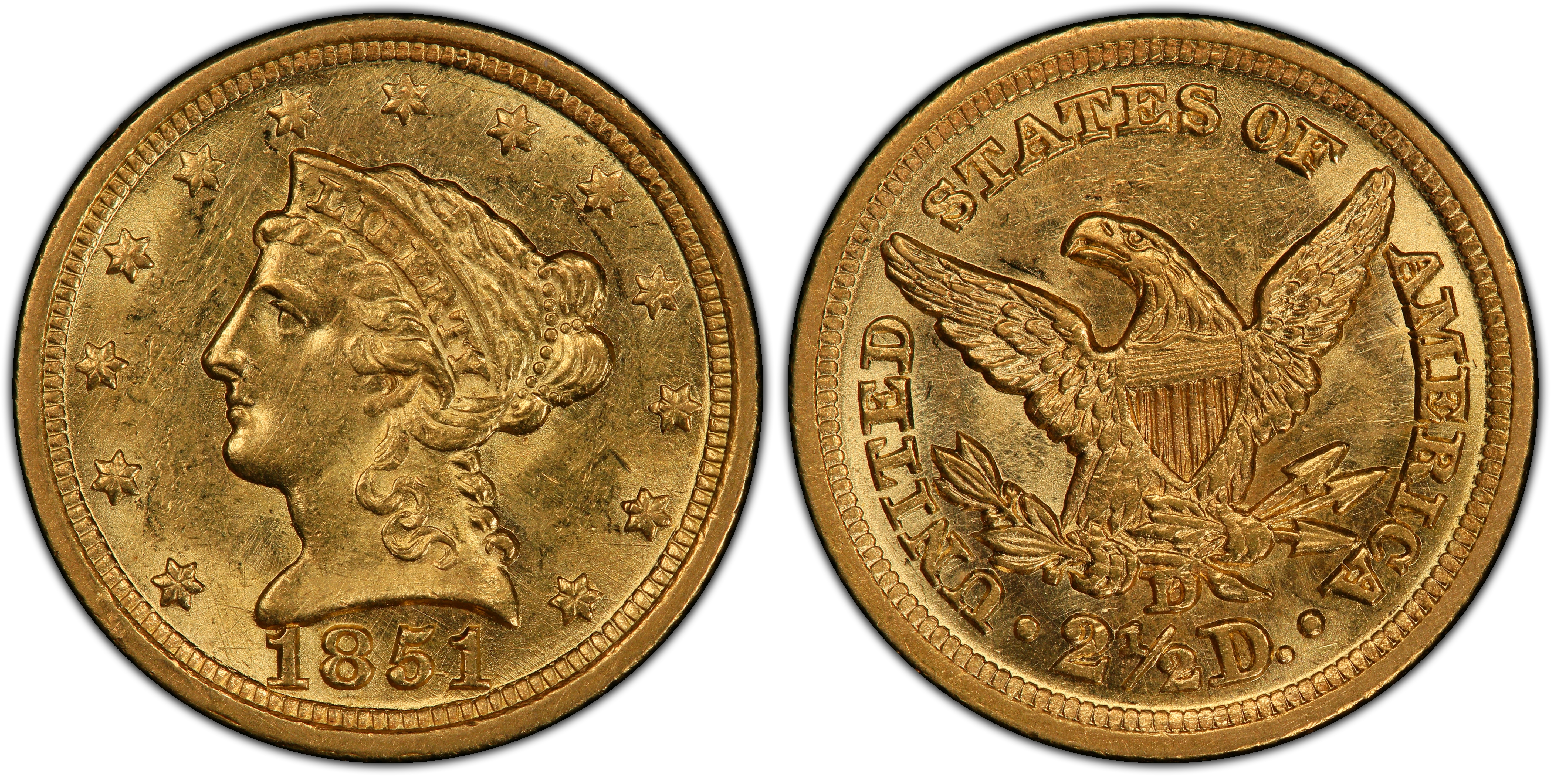 #1 PCGS MS62+
Diagonal cut in lower right obverse field between bottom of the bun and star 12. Tick on the tip of Liberty’s nose. Highly lustrous. On the reverse, thin stick below the right interpunct. |
 #3 PCGS MS62
Nice orange-gold color. Small gouge to the right of star 2. Diagonal cut in the left obverse field to the right of stars 4 and 5. Diagonal gouge to the left of stars 12 and 13. On the reverse, faint carbon spot between eagle’s neck and left wing. Small hit on the top of D mintmark. |
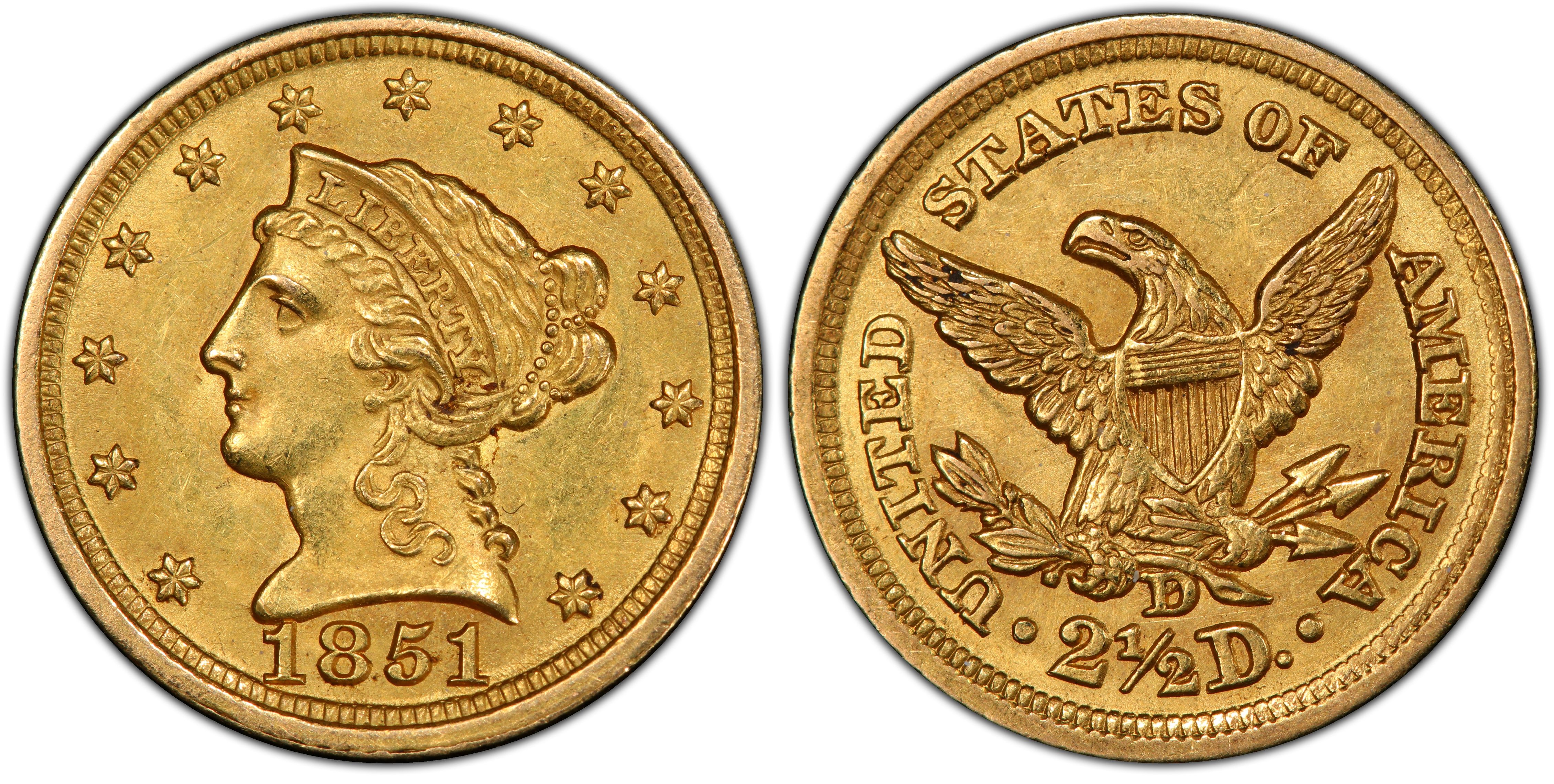 #3 PCGS MS62
Specks of red coppery toning at Y of LIBERTY and nearby hair. Diagonal mark from star 4 to hair. On the reverse, diagonal planchet void below OF. Dark spots on eagle’s right and left wing. |
|
#3 PCGS MS62
“The Buxton Collection,” Heritage Auctions, January 14, 2022, Lot 3908 – $26,400. Splotchy light discoloration throughout. Small scattered diagonal marks on face. Tick above eye, below right serif of L. Thin diagonal cut below jaw. Tick between bun and star 12. Reverse dentils weak from 12 to 3 o’clock and from 6 to 9 o’clock. Eagle’s right leg and both talons weak. |