



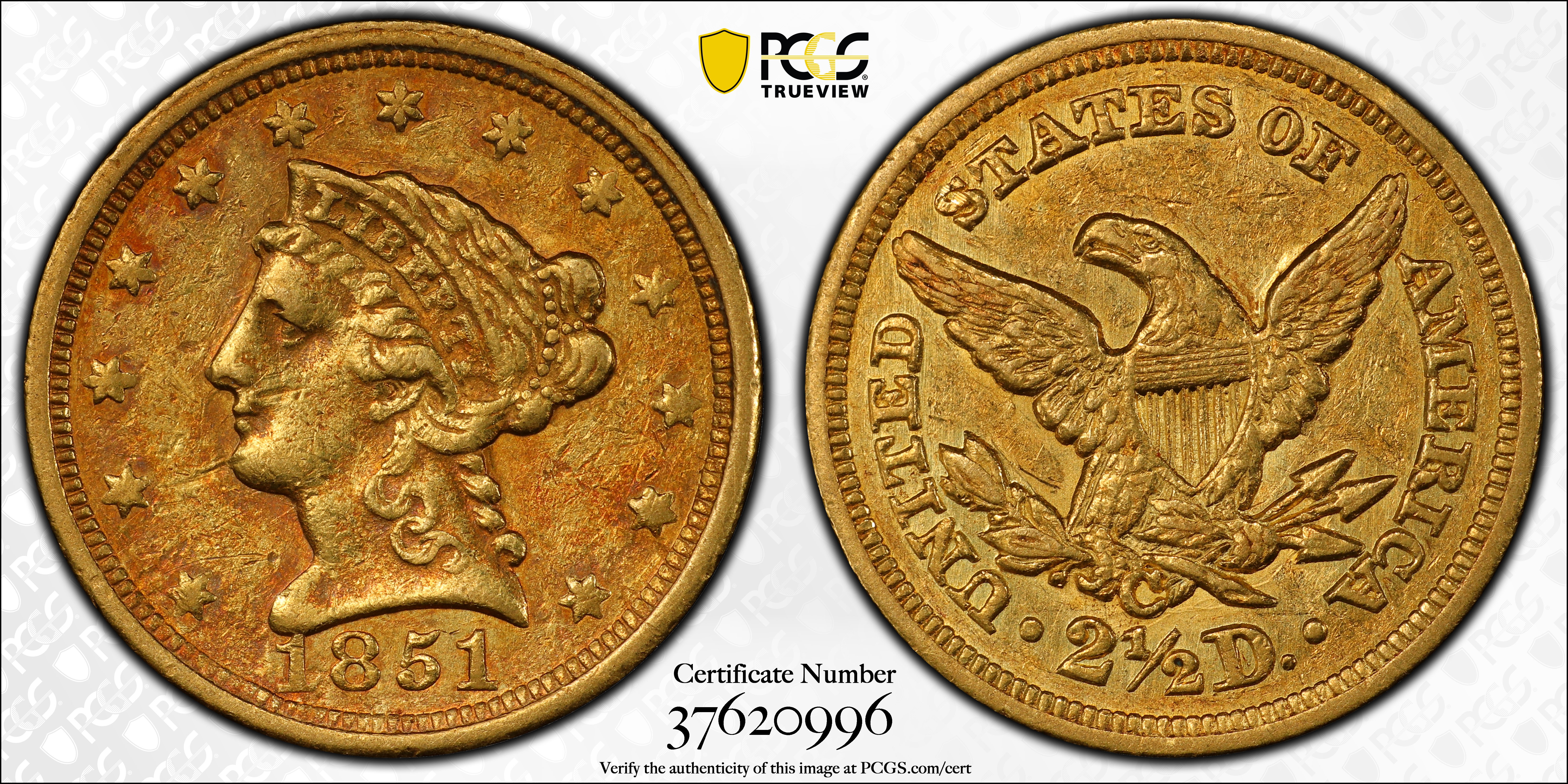
1851-C $2.50 XF45 Certification #37620996, PCGS #7760
Owner's Comments
Expert Comments
Charles Morgan
Of the three gold denominations struck by the Charlotte Mint in 1851 (the Gold Dollar, Quarter Eagle, and Half Eagle), the 1851-C Liberty Head Quarter Eagle had the lowest output, with 14,923 pieces. The Philadelphia Mint sent three 1851 obverse dies to Charlotte, but only one was ultimately deployed. The reverse die, carried over from 1849 and 1850, is distinguished by a "C" mintmark that rests atop the eagle’s claw, practically blending into the main device, and thin die lines above the wreath on the coin’s left side.
Charlotte Mint Gold Coin Production in 1851
- 1851-C Gold Dollar (#7514) | Mintage: 41,267 | Readily Available in Mint State.
- 1851-C Liberty Head Quarter Eagle (#7760) | Mintage: 14,923 | Scarce in Mint State.
- 1851-C Liberty Head Half Eagle (#8247) | Mintage: 49,176 | Scarce in Mint State.
The 1851-C Liberty Head Quarter Eagle is scarce in every grade. In fact, classic U.S. gold coin expert Doug Winter has written that, despite its higher mintage, the 1851-C is slightly scarcer than the 1850-C Liberty Head Quarter Eagle (#7756). Auction records do not tell the whole story for this date, as many coins have either been tightly held in collections or trade privately—all the more reason why advanced collectors benefit from the assistance of specialist dealers.
PCGS reports a total population of about 120 coins for this date, with the majority grading from Very Fine (VF) to About Uncirculated (AU). Since 2013, the Mint State census has only risen from seven to ten coins. Winter calls the date very scarce in properly graded AU.
While nothing is certain, it is reasonable to assume that the majority of surviving specimens have already been accounted for. Notably, even Stack’s Bowers’ recent offerings of the “Fairmont Collection,” a "collection" representing one of the most significant accumulations of 19th-century U.S. gold repatriated to America in decades, failed to increase the population report for this date.
Struck with a Single Die Pair
Only a single variety is known.
Variety 1 (formerly 13-G): The first "1" in the date touches both the bust and the denticles, while the second "1" is much closer to the denticles than the bust. The reverse die is the same one used for the 1849 issue and the first variety of 1850.
1851-C Liberty Head Quarter Eagle: Physical Characteristics
(per Doug Winter)
Strike quality for the 1851-C $2.50 gold coin varies. While some examples are known with a good overall strike, others show below-average to poor strikes. Even on the sharpest coins, there is often weakness on the hair below "RTY" in LIBERTY, and other examples show flatness on Liberty’s hair bun. A number of 1851-C quarter eagles are very weak at the top of the hair, likely due to a clogged die or foreign material adhering to the die during striking. The reverse is generally better struck. Most details on the wings and neck are sharp, while only minor weakness is often seen on the eagle’s right leg and claws.
Surfaces and Luster
Surfaces: This date is almost never seen with choice surfaces. Most examples are noticeably abraded in the fields and show evidence of having been roughly handled. These circulation marks are compounded by several production factors, including clash marks (ranging from light to heavy) seen below the arrowheads, around the eagle's neck, and outside the center of the wings. I have also observed at least five or six examples with deep mint-made parallel scratches on Liberty's face. These resemble adjustment marks, and their exact cause is unknown. Grading services typically net grade 1851-C quarter eagles that display these scratches, as they significantly detract from the coin's appearance. Raised die scratches can also be seen on the reverse extending from the middle of the olive leaves up into the field.
Luster: The luster is satiny with a somewhat grainy texture. It is very hard to locate an 1851-C with original mint luster since most survivors have been cleaned or processed. On the few that are original, the quality of the luster is below average.
Coloration and Eye Appeal
Coloration: The natural coloration of this date is light to medium green-gold. Most have an unnatural bright appearance due to having been cleaned or dipped. Original pieces command a substantial premium due to their scarcity.
Eye Appeal: It is very hard to find an example with good eye appeal. This date is slightly more available in higher grades (AU55 and above) than previously believed, but the typical coin is well-worn and unappealing.
* * *
Rarity and Survival Estimates Learn More
| 65 or Better | 125 |
| All Grades | 7 |
| 60 or Better | 0 |
| 65 or Better | R-7.7 |
| All Grades | R-9.6 |
| 60 or Better | R-10.1 |
| 65 or Better | 48 / 147 TIE |
| All Grades | 43 / 147 TIE |
| 60 or Better | 1 / 147 |
| 65 or Better | 48 / 147 TIE |
| All Grades | 43 / 147 TIE |
| 60 or Better | 1 / 147 |
Condition Census Learn More
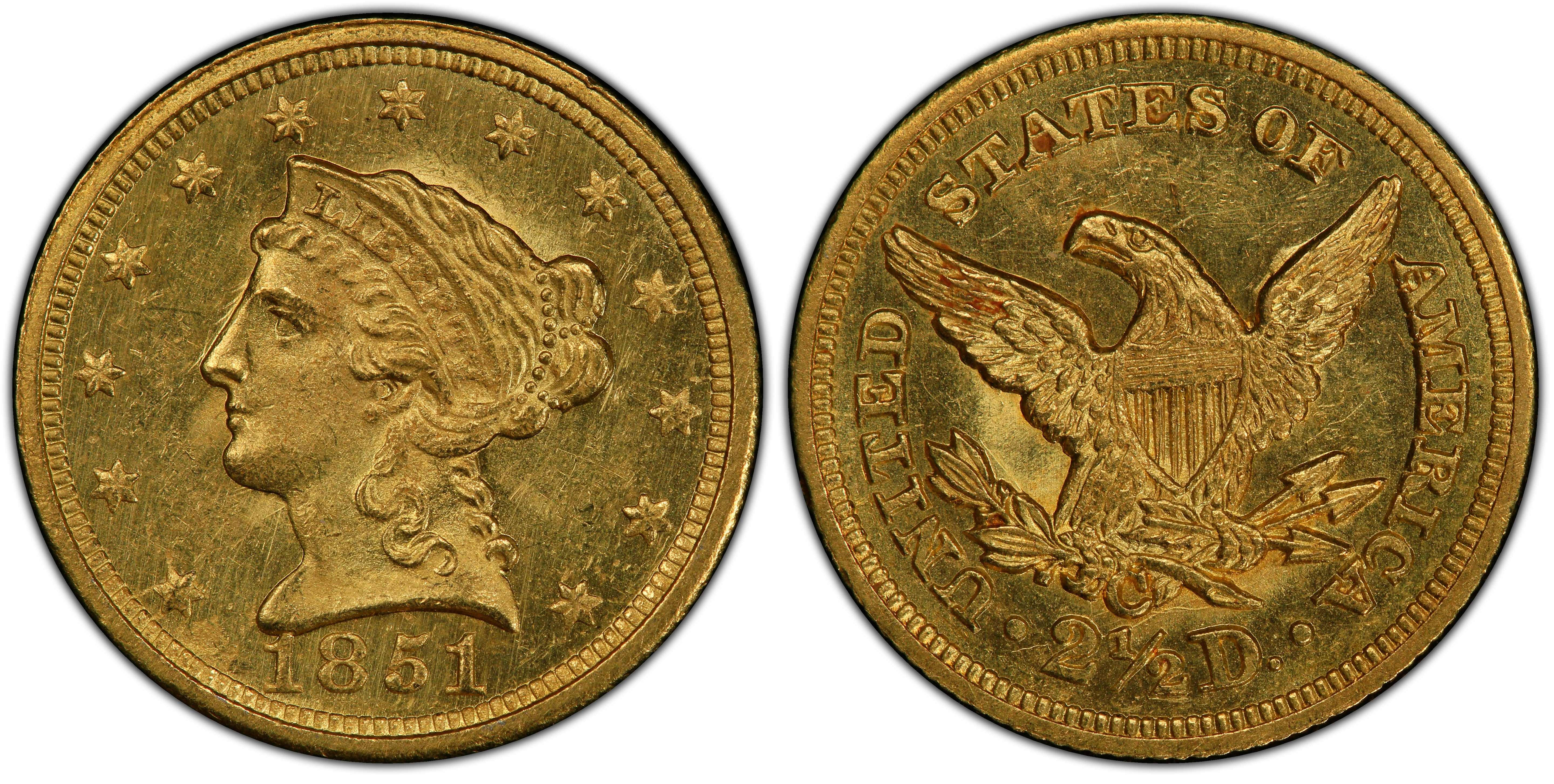 #1 PCGS MS64
Reddish-copper coloration at the tip of the eagle's right wing, in the protected areas of the branch, and the A of STATES. |
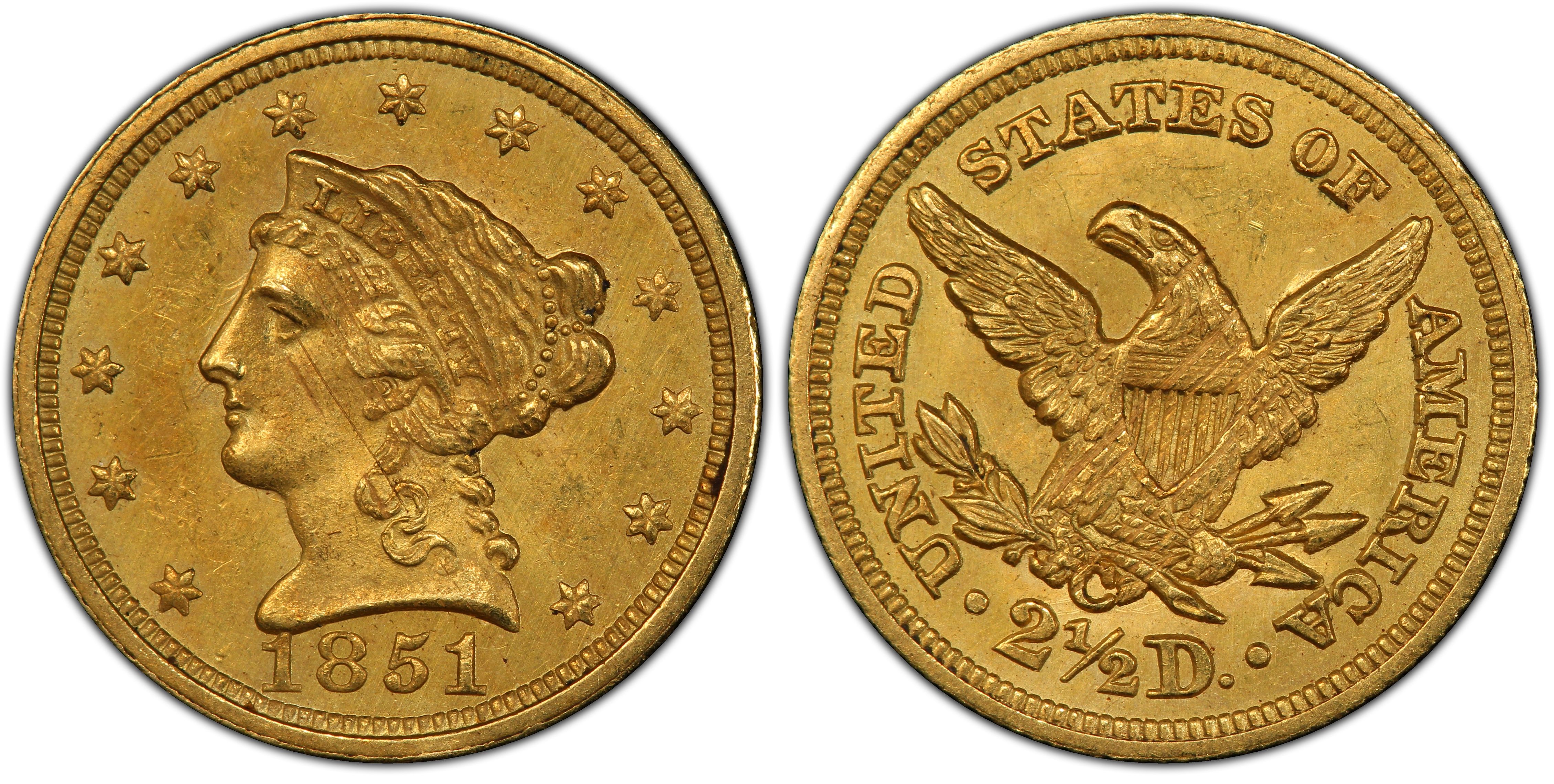 #2 PCGS MS63
As PCGS MS63 #30801334. Heritage, August 2017, Lot 4090 - $30,550. As PCGS MS63 #34601758. Diagonal roller marks across the coin's centers. |
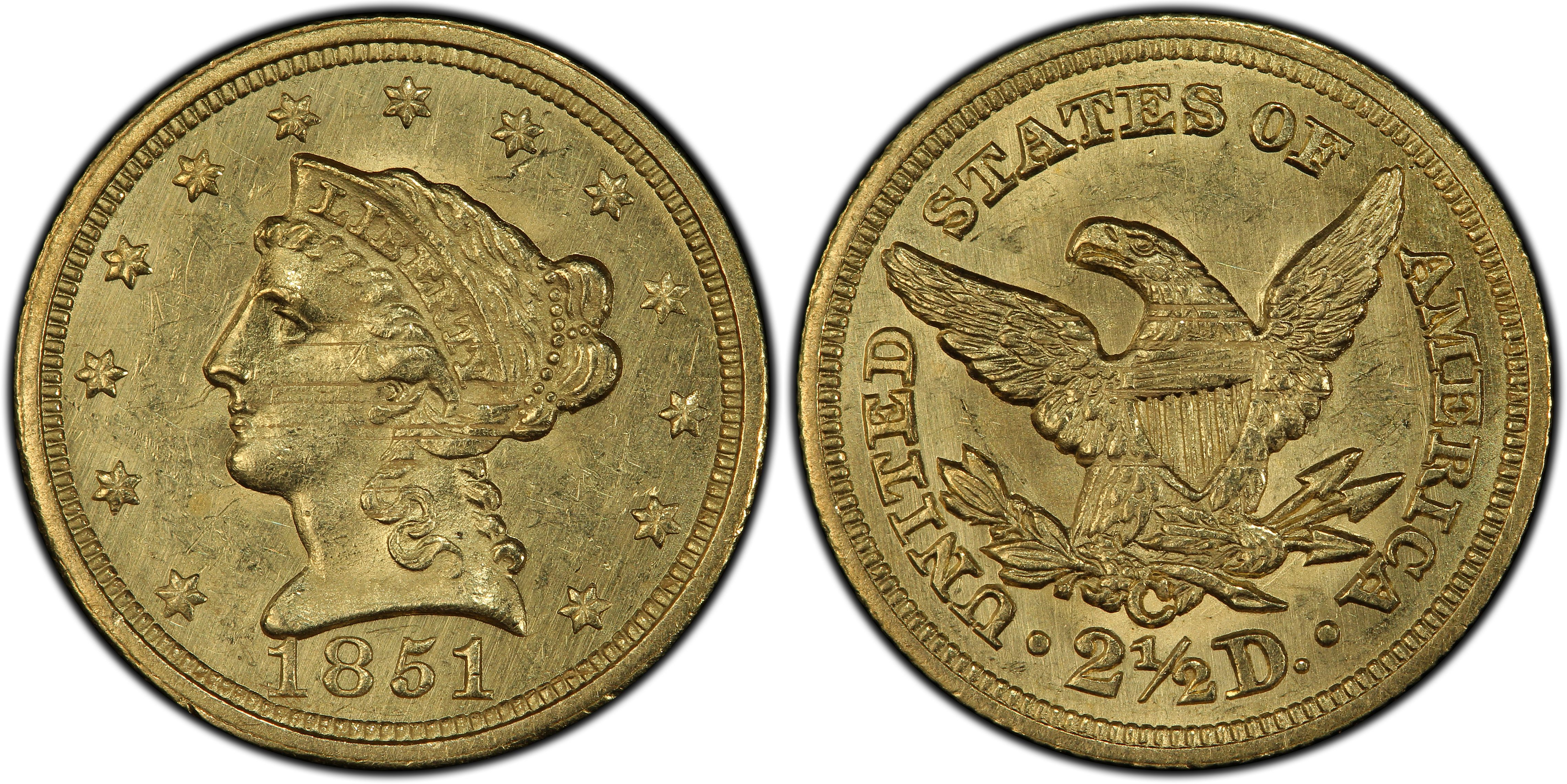 #2 PCGS MS63
Stack's Bowers, November 2013, Lot 2172 - $28,200. Pop two, none finer when offered. Light horizontal roller marks across the coin's centers. |
| #2 PCGS MS63 |
|
#5 PCGS MS62
“The James A. Stack Collection,” Stack’s, October 1994, Lot 905. As PCGS MS62 #50098523. “The Grand Lake Collection,” Heritage Auctions, February 6, 2009, Lot 2512 - $13,800. As PCGS MS62 #06652078. “The Cherokee County Collection," Heritage Auctions, January 5, 2012, Lot 4759 - $13,800. Small depression on the the left edge of Liberty's neck. Small curved hit on eagle's neck to shield. |