



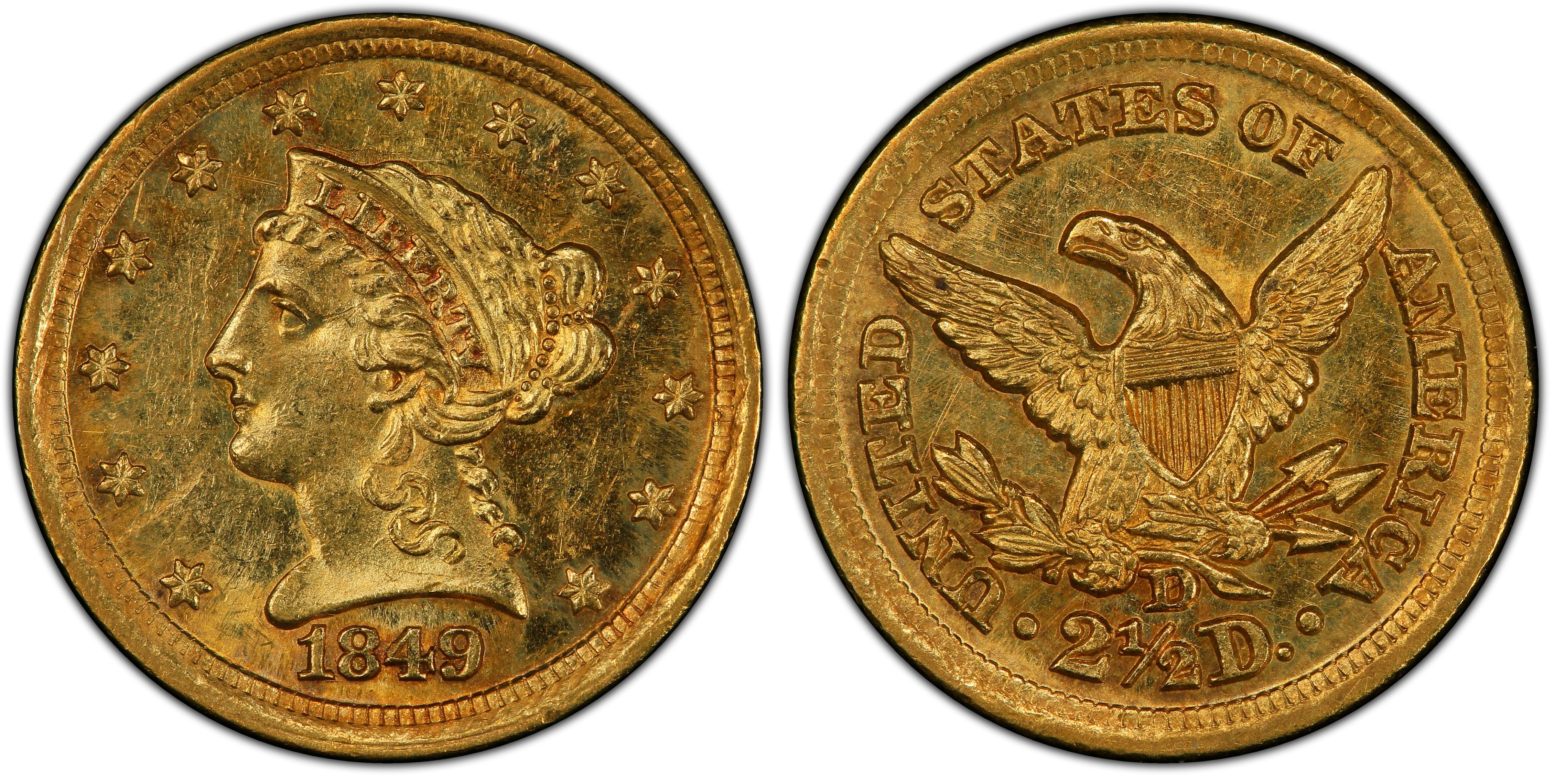
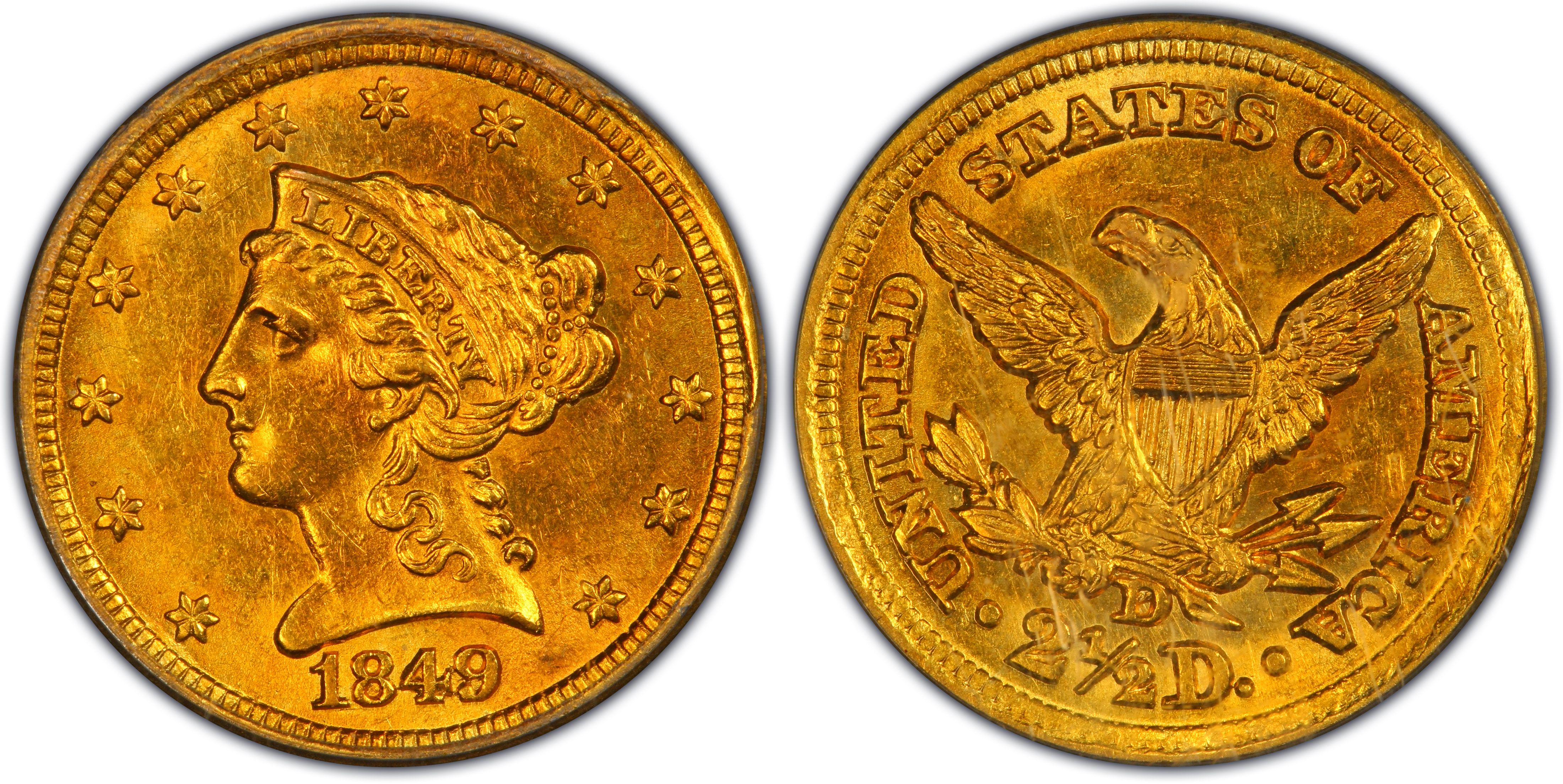
1849-D $2.50 AU50 Certification #26858539, PCGS #7754

Owner's Comments
Expert Comments
PCGS Set Registry
The California Gold Rush of 1849 produced a massive influx of placer gold, spurring Congress to introduce two new gold coin denominations. The Gold Dollar was introduced as a small, portable "everyman's" coin, while the Double Eagle was a much larger denomination, double the value of the $10 Liberty Head Eagle (a denomination that resumed production just 11 years earlier).
New Denominations and Dahlonega Production
While U.S. Mint Chief Engraver James B. Longacre successfully introduced the Gold Dollar in 1849, his efforts to launch the Liberty Head Double Eagle were delayed. The Mint produced only two successful pattern strikes of the $20 piece that year (only one is known to survive), pushing the Double Eagle's public debut back until 1850.
Dahlonega Mint Gold Coin Production in 1849
1849-D Gold Dollar | Mintage: 21,588
1849-D Liberty Head Quarter Eagle | Mintage: 10,945
1849-D Liberty Head Half Eagle | Mintage: 39,036
Of the four available gold coin denominations, the Dahlonega Mint in Georgia received dies for three: the Gold Dollar, the Liberty Head Quarter Eagle, and the Liberty Head Half Eagle. Dahlonega never struck the $10 (Eagles) or the $20 (Double Eagles); these larger denominations were reserved for the major metropolitan mints at Philadelphia, New Orleans, and San Francisco. The remote (and short-lived) Carson City Mint did begin striking double eagles starting in 1870 as an expedient way to process the vast quantities of gold flowing into the area. However, even in that case, the majority of Comstock gold was ultimately shipped directly to the San Francisco Mint for logistical purposes.
Despite having the smallest mintage of the three denominations struck at the Dahlonega Mint in 1849, the 1849-D Liberty Head Quarter Eagle is only slightly rarer than the 1849-D Half Eagle in Mint State. Counterintuitively, the 1849-D Gold Dollar—the most delicate of the three—is the most readily available Dahlonega Gold Dollar in uncirculated condition, with an estimated 100 to 120 pieces known. This number, representing Mint State survivors of the dollar, is actually a bit lower than the current estimated total surviving population of the Quarter Eagle in all conditions. This modern survival estimate sharply deviates from the historical data provided by David W. Akers, who estimated the 1849-D Quarter Eagle's total surviving population at a mere 51 pieces in his 1975 volume, United States Gold Coins, An Analysis of Auction Records, Volume I.
Varieties
The Philadelphia Mint sent three die pairs to Dahlonega to strike the Quarter Eagles, but only two die varieties are known. Both varieties are distinguished by the position of the date relative to the denticles:
- High Date (More Common, Die Marriage 11-N): The date is better centered in the space below the bust.
- Low Date (Scarcer, Die Marriage 12-N): The left tip of the foot of the "1" touches the denticle.
Since the reverse die was shared across both varieties, a common feature found on most 1849-D Liberty Quarter Eagles is weak reverse denticulation.
1849-D Liberty Head Quarter Eagle: Physical Characteristics
(per Doug Winter)
Beginning with this issue, the quality of strike for Dahlonega Quarter Eagles begins a steady decline. The strike on the 1849-D is notably better than many issues from the 1850s, though it does not match the quality seen in the 1846–1848 date run. The obverse is better impressed at the center than at the border. The hair and curls are well-detailed, although the curls near the eye are frequently weak. The stars are mostly sharp, but the denticles are always very weak from 11:00 to 2:00. The reverse shows a similar pattern: the eagle is well-detailed (except for the right leg and the arrow feather above the mintmark), while the denticles are very weak from 5:00 to 7:00. The denticles at the left reverse also become weak on some coins.
Surfaces and Luster
Surfaces: The 1849-D Quarter Eagle is almost always found with significant marks in the fields. These marks are often deep and obtrusive. Some pieces are known to exhibit mint-made roughness around the date and in the obverse fields. Many have been cleaned and show hairlines. This is a very difficult issue to locate with acceptable surfaces.
Luster: This date typically possesses inferior luster. Many examples are dull and display no luster at all. On some uncleaned, high-grade 1849-D quarter eagles, the luster is very good with a rich, frosty texture. Such coins are the exception for this date and tend to command a premium among specialists.
Coloration and Eye Appeal
Coloration: Original, uncleaned 1849-D Quarter Eagles have been observed with coloration ranging from orange-gold to dark coppery-gold. The coloration is often deep and intense. This is yet another date that has been ravaged by dipping and cleaning in recent years. Today, the only completely original examples one is likely to find are from collections that have been off the market for many years.
Eye Appeal: There are possibly as many as a dozen examples known that have very good eye appeal. However, the great majority are unappealing and lack eye appeal.
* * *
Rarity and Survival Estimates Learn More
| 65 or Better | 150 |
| All Grades | 4 |
| 60 or Better | 0 |
| 65 or Better | R-7.5 |
| All Grades | R-9.8 |
| 60 or Better | R-10.1 |
| 65 or Better | 58 / 147 TIE |
| All Grades | 5 / 147 TIE |
| 60 or Better | 1 / 147 |
| 65 or Better | 58 / 147 TIE |
| All Grades | 5 / 147 TIE |
| 60 or Better | 1 / 147 |
Condition Census Learn More
 #1 PCGS MS62
As NGC MS62 #1720150-005. “The Fenn Family Collection, Part III,” Heritage Auctions, January 5, 2017, Lot 5809 – $18,221.90. As PCGS MS62 #83837065. The Dell Loy Hansen Collection. Thin scratch from 9 o’clock rim to chin. Deeper cut from rim to chin from below star 2.Thin scrape from the corner of Liberty's eye to her hair. Red coloration in the protected areas. There is a series of thin hairlines on the reverse. Dark spot on eagle's right wing. |
 #1 PCGS MS62
As PCGS MS61 #21026477. Arthur Lamborn Collection; “The Fairfield Collection,” Bowers and Ruddy, October 1977, Lot 1518 – $1,350; Goliad Corporation (Mike Brownlee); “The Harry W. Bass, Jr. Collection,” Bowers and Merena, October 1999, Lot 423 – $16,100; Spectrum Numismatics; Doug Winter; Doug Winter sold in February 2000; Heritage Auctions, September 10, 2004, Lot 7408 – $15,985; “The Green Pond Collection,” Heritage Auctions,” September 18, 2005, Lot 1027; “The Charleston Collection,” American Numismatic Rarities, September 18, 2005, Lot 1111 – $16,100. As PCGS MS62 #12525226. Heritage Auctions, January 8, 2009, Lot 4010 – $23,000. Variety 11-M. High Date. Small spot to the upper left of star 2. Small tick on chin. Misshapen area on the right-side obverse rim. |
 #1 PCGS MS62
NGC MS62 #402605-003: (possibly) Heritage Auctions, September 2002, Lot 7980 – Passed; Heritage Auctions, December 24, 2002, Lot 17456 – $18,975; Heritage Auctions, January 4, 2007, Lot 3414 – $17,250. Tiny ticks on jaw. Vertical tick to the right of star 4. On the reverse, deep scratch from D of denomination to the second A of AMERICA. The upper portion of the second A is dented. Scratch to the right of ER. |
|
#1 Est. MS62
NGC MS62 #302714-010: “The Renz Collection,” B. Max Mehl, March 1948, Lot 3581; “The Bareford Collection,” Stack’s, December 1978, Lot 97 – $3,800; The Dr. Arthur Montgomery Collection; Hancock and Harwell; “Auction ’84,” Stack’s, August 1984, Lot 1318 – $5,500; Georgia Collection; Hancock and Harwell; “The Leon Farmer Collection”; “The Duke’s Creek Collection,” Heritage Auctions, April 7, 2006, Lot 1506 – $24,150; Heritage Auctions, August 7, 2014, Lot 5626 – $18,800. Variety 12-M. Vertical patch of discoloration dominates the left obverse field. Similar patches of discoloration elsewhere. Two ticks on the back of the cheek. Denticles weak on the reverse from 3 o’clock to 11 o’clock. Discoloration below STATES OF. |
 #5 PCGS MS61
|