



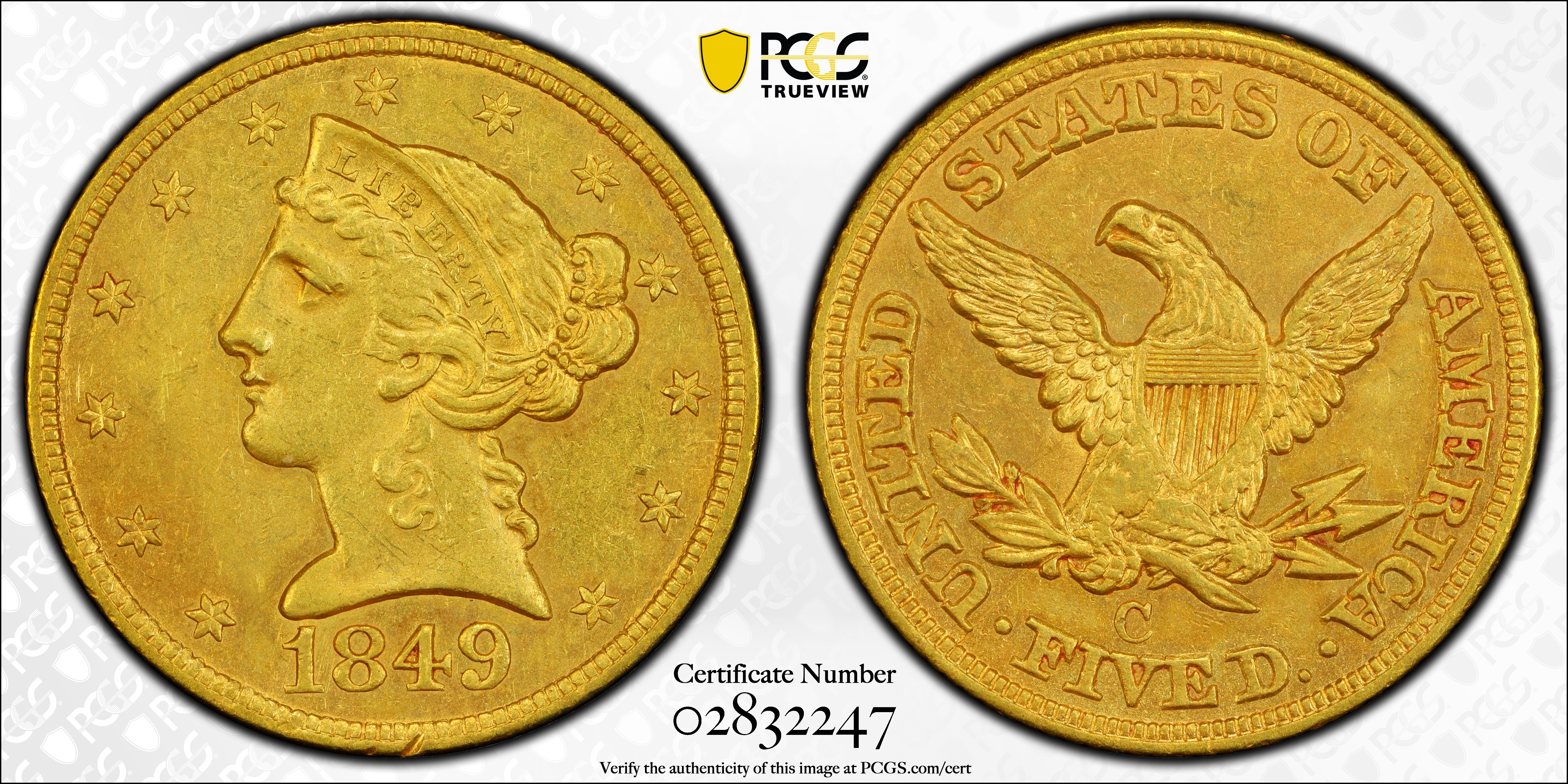
1849-C $5 AU55 Certification #02832247, PCGS #8241
Owner's Comments
The 1849-C is the most available Charlotte half eagle produced prior to 1850. It is often compared to the 1848-C due to similar mintage but the 1849-C is more readily available, especially in higher grades. The 1849-C is among the more common half eagles from this mint. It is relatively easy to locate in Very Fine ad Extremely Fine grades and can be found in the lower About Uncirculated grades without a huge effort. It is scarce in the higher AU grades and rare in Uncirculated... This is among the best struck half eagles from this mint. As a result, the 1849-C is very popular with type collectors who are seeking a single, well-produced example of this denomination. The detail on the obverse is actually comparable to that seen on Philadelphia half eagles of this era. The hair detail is typically sharp with the exception of the curls below LIB in LIBERTY which range from soft to very soft. On most examples, the stars have full radial lines and the denticles are individually defined. The reverse is well detailed as well. The legs and claws of the eagle are usually full and the neck feather and shield are sharp. The only area that sometimes shows weakness is the tip of the eagle’s right wing. Most 1849-C half eagles show moderate to heavy abrasions in the fields. These are compounded by hairlines from past cleanings as well as mint-made striations in the fields. There are some examples with comparably clean surfaces, but these are the exception to the rule. The luster is often above average. Most show a slight frosty texture with a bit of graininess in the fields. There are a few 1849-C half eagles that have superb luster. These are extremely frosty and have an appearance that is not seen on many other dates from this mint. The color most often seen is a distinctive green-gold, sometimes with light orange-gold overtones. Some have a medium to deep yellow-gold color that can be very attractive. As recently as a decade ago, the 1849-C was among the easier Charlotte half eagles to locate with original color. Since then, many examples have been dipped or processed. Today, coins exhibiting original color are quite rare. The eye appeal for this date tends to be better than on most other Charlotte half eagles. That said, it has become difficult to find a piece that is free of surface marks and has original color and luster. Certain 1849-C half eagles have an unfinished patch on the reverse below the eagle’s left wing... There are currently two varieties known. Given the large mintage figure, I believe it is possible that others may be discovered as collecting Charlotte half eagles by variety becomes more widespread. The 1849-C is one of the most common C Mint Half Eagles and it appeared at auction more times in my survey than any other Half Eagle from this Mint. That does not mean that it is not rare, however, because it is, especially in strictly uncirculated condition.
Expert Comments
Doug Winter
The 1849-C is the most available Charlotte half eagle produced prior to 1850. It is often compared to the 1848-C due to similar mintage but the 1849-C is more readily available, especially in higher grades.The 1849-C is among the more common half eagles from this mint. It is relatively easy to locate in Very Fine ad Extremely Fine grades and can be found in the lower About Uncirculated grades without a huge effort. It is scarce in the higher AU grades and rare in Uncirculated...
STRIKE: This is among the best struck half eagles from this mint. As a result, the 1849-C is very popular with type collectors who are seeking a single, well-produced example of this denomination. The detail on the obverse is actually comparable to that seen on Philadelphia half eagles of this era. The hair detail is typically sharp with the exception of the curls below LIB in LIBERTY which range from soft to very soft. On most examples, the stars have full radial lines and the denticles are individually defined. The reverse is well detailed as well. The legs and claws of the eagle are usually full and the neck feather and shield are sharp. The only area that sometimes shows weakness is the tip of the eagle’s right wing.
SURFACES: Most 1849-C half eagles show moderate to heavy abrasions in the fields. These are compounded by hairlines from past cleanings as well as mint-made striations in the fields. There are some examples with comparably clean surfaces, but these are the exception to the rule.
LUSTER: The luster is often above average. Most show a slight frosty texture with a bit of graininess in the fields. There are a few 1849-C half eagles that have superb luster. These are extremely frosty and have an appearance that is not seen on many other dates from this mint.
COLORATION: The color most often seen is a distinctive green-gold, sometimes with light orange-gold overtones. Some have a medium to deep yellow-gold color that can be very attractive. As recently as a decade ago, the 1849-C was among the easier Charlotte half eagles to locate with original color. Since then, many examples have been dipped or processed. Today, coins exhibiting original color are quite rare.
EYE APPEAL: The eye appeal for this date tends to be better than on most other Charlotte half eagles. That said, it has become difficult to find a piece that is free of surface marks and has original color and luster.
DIE CHARACTERISTICS: Certain 1849-C half eagles have an unfinished patch on the reverse below the eagle’s left wing...
DIE VARIETIES: There are currently two varieties known. Given the large mintage figure, I believe it is possible that others may be discovered as collecting Charlotte half eagles by variety becomes more widespread.
Variety 1 (formerly Variety 12-F): The date is positioned noticeably to the left. The 1 is closer to the bust than to the denticles while the 9 is centered between the bust and the denticles. The reverse was used in 1849 and again on some coins dated 1850. It has a large mintmark which has its right edge over the right serif of the V in FIVE and the left edge over the I in FIVE. The serif of the C is directly below the tip of the feather. The mintmark is centered between the feathers and the V.
This reverse is quickly identifiable by the presence of an unfinished area in the space between the eagle’s left wing and the leaves of the branch.
Two die states are known:
Die State I: Perfect reverse. Very rare.
Die State II: A reverse crack can be seen from the rim just past the left side of the U in United, into the leaves and ending at the eagle’s right leg. This is the usual die state and it is very common.
This is the more common of the two varieties by a considerable margin.
Variety 2 (formerly Variety 13-F): The date is placed slightly further to the right than on Variety 1 and the 9 is closer to the bust than the denticles. This obverse is found with the same reverse as described above. On this variety, the reverse is usually perfect(without the aforementioned crack).
David Akers (1975/88)
The 1849-C is one of the most common C Mint Half Eagles and it appeared at auction more times in my survey than any other Half Eagle from this Mint. That does not mean that it is not rare, however, because it is, especially in strictly uncirculated condition. Nevertheless, I have seen more AU's and uncs of this date (albeit no really choice ones) than I have of any other Charlotte Mint Half Eagle, although VF and EF are the grades one is most likely to encounter.
PCGS #
8241
Designer
Christian Gobrecht
Edge
Reeded
Diameter
21.65 millimeters
Weight
8.36 grams
Mintage
64823
Metal
90% Gold, 10% Copper
Pop Higher
28
Pop Lower
221
Region
The United States of America
Price Guide
PCGS Population
Auctions - PCGS Graded
Auctions - NGC Graded
Rarity and Survival Estimates Learn More
| 65 or Better | 600 |
| All Grades | 15 |
| 60 or Better | 0 |
| 65 or Better | R-5.8 |
| All Grades | R-9.3 |
| 60 or Better | R-10.1 |
| 65 or Better | 105 / 112 |
| All Grades | 77 / 112 TIE |
| 60 or Better | 1 / 112 |
| 65 or Better | 148 / 218 TIE |
| All Grades | 106 / 218 TIE |
| 60 or Better | 1 / 218 |
Condition Census Learn More
| #1 MS65 estimated grade |
| #2 MS64 PCGS grade |
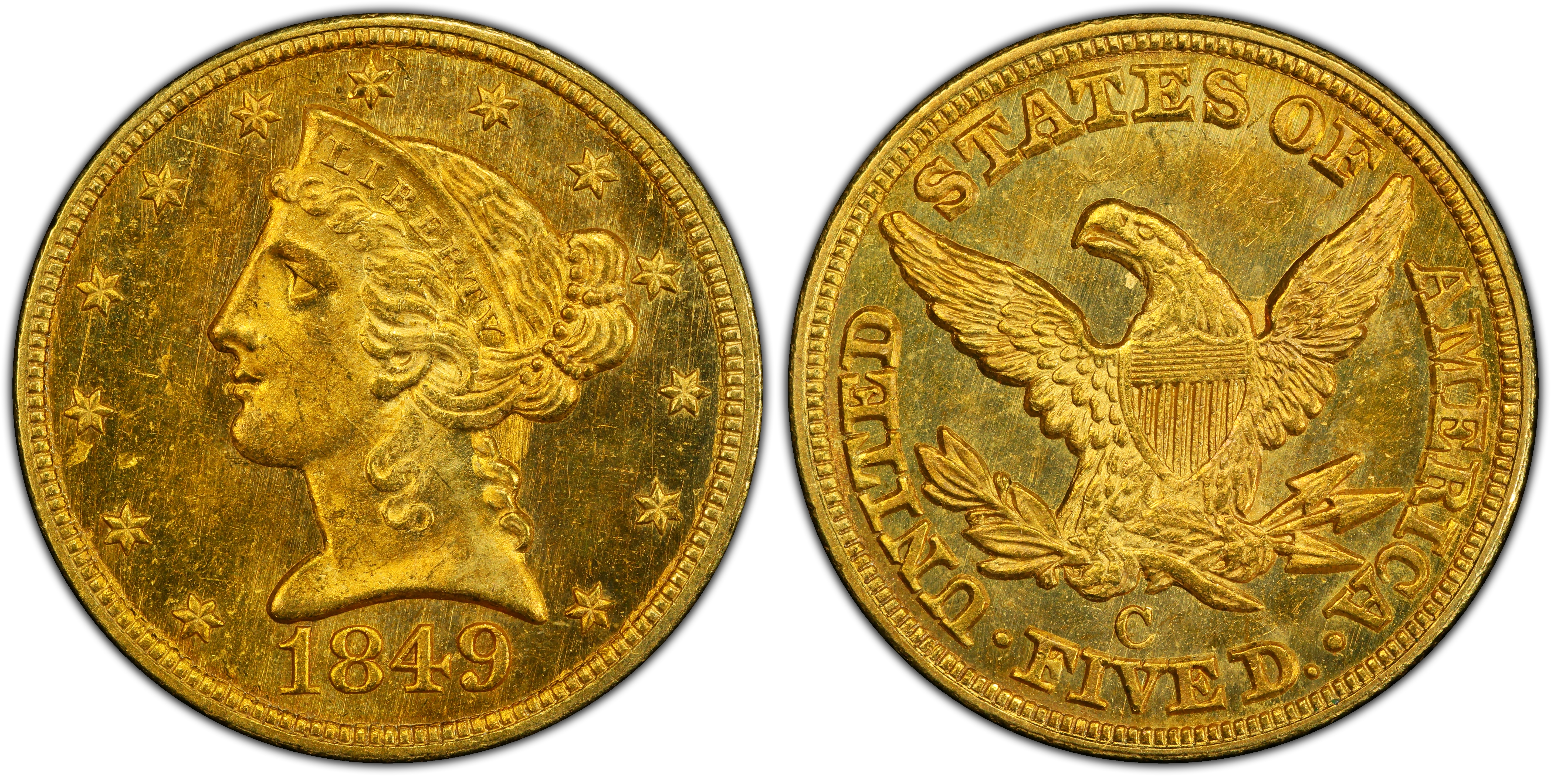 #2 MS64 PCGS grade
|
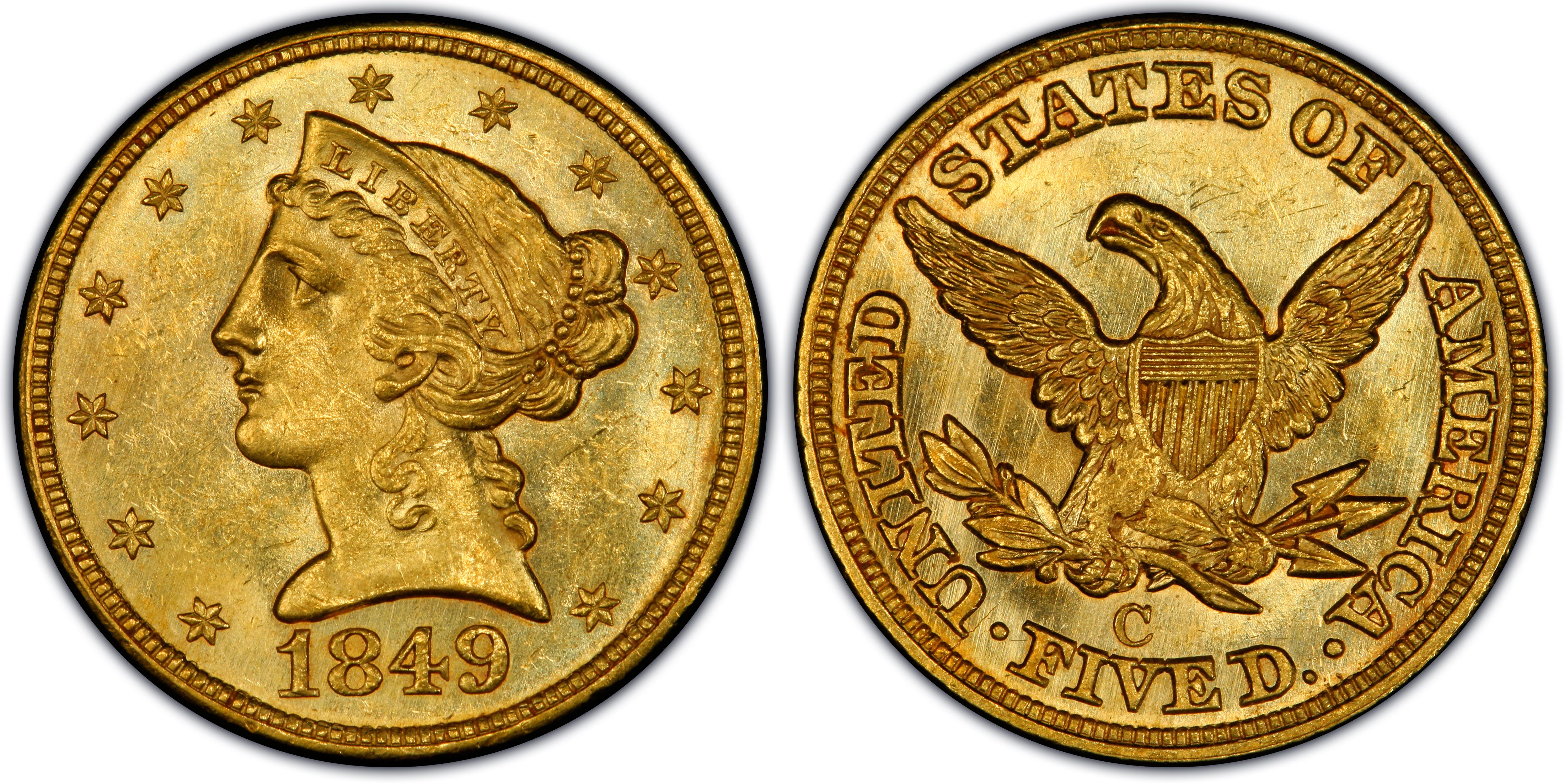 #4 MS63 PCGS grade
|
| #4 MS63 PCGS grade |