



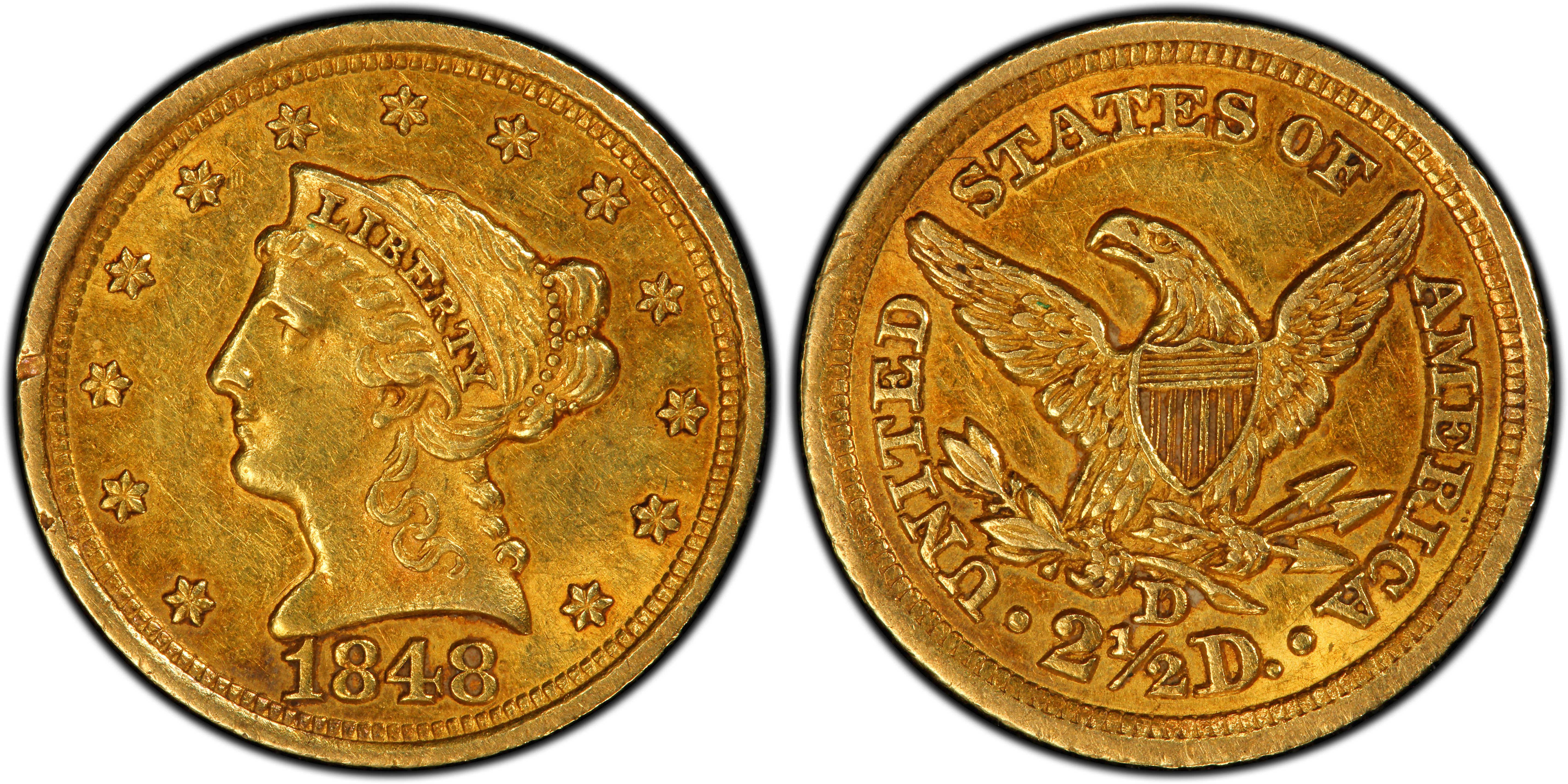
1848-D $2.50 AU55 Certification #18588604, PCGS #7751

Owner's Comments
Expert Comments
PCGS Set Registry
The 1848-D Liberty Head Quarter Eagle sometimes gets overlooked when compared with the popular 1848 "CAL." and the conditionally rare 1848-C, but it is a challenging coin in its own right, with an estimated 200 survivors from its mintage of 13,771 coins. Although this was not the highest output for the $2.50 gold denomination at the Georgia branch mint, it was the final time production reached this level. Quarter Eagle mintages at Dahlonega saw a significant decline beginning in 1852, and the mint ultimately ceased operations at the start of the Civil War.
For the 1848-D issue, the Philadelphia Mint supplied Dahlonega with three die pairs; however, only two die varieties are currently known. Both varieties were struck using the same obverse die and are differentiated solely by the placement and orientation of the "D" mintmark on the reverse. The 1848-D Liberty Head Quarter Eagle is generally considered well-struck for a Dahlonega Mint issue, yet a noticeable flaw exists: the denticulation on the reverse is often poorly defined in the upper left and lower right quadrants.
In his 1975 work, United States Gold Coins, An Analysis of Auction Records, Volume I, gold coin expert David Akers estimated a surviving population of just 69 pieces for the issue. He also observed that while the 1848-C and 1848-D Quarter Eagles typically sold for similar prices, the 1848-D was the more common of the two, especially in high grades.
Based on current PCGS population data, the 1848-D is significantly more common than the 1848-C in Mint State (MS) grades, by a factor of three to four. When comparing the total certified population across all grades (including lower grades), the 1848-D is only about 25% more common than the 1848-C. This indicates that the rarity levels between the two issues balance out somewhat in the grades up to About Uncirculated (AU). Specifically within the AU50 to AU58 range, the certified population of the 1848-D is more than double (approximately 120% more coins) than that of the 1848-C. Finally, the top-population rarity remains static: PCGS has not certified a new MS63 grade coin for this issue in more than 20 years.
1848-D Quarter Eagle Die Varieties
The Philadelphia Mint sent three die pairs to Dahlonega for 1848, but only two die varieties are known. Both varieties share the same obverse die and are distinguished by the placement and orientation of the "D" mintmark.
Variety 10-M: This variety utilizes Reverse M, which was also employed for the 1847-D Liberty Head Quarter Eagle and Obverse 10. On this obverse, the "1" in the date touches the bust, while its base is very close to the denticles. The second "8" in the date is closer to the denticles than to the bust.Some examples are known with the reverse rotated 45 degrees or more. This is considered the more common of the two 1848-D varieties.
Variety 10-N: Scarce. This variety shares the same obverse die as Variety 10-M. Reverse N was used only in 1848. It is distinguished by the following characteristics:
- The shaft of the arrow joins the mintmark at the right edge of its upright.
- The fraction bar extends to the center of the opening in the mintmark.
- Feathers fill the upper part of the opening in the mintmark and extend down to near the center of this opening.
Doug Winter notes that Reverse N is very similar to Reverse H, but the major differences are that on Reverse N, the feathers within the opening of the mintmark are bolder, the lower serif of the mintmark is closer to the upright of the "1" in the fraction, and none of the vertical stripes in the reverse shield extend up into the horizontal shield stripes. This is the scarcer of the two varieties of the year.
Physical Characteristics
(per Doug Winter)
The 1848-D Liberty Head Quarter Eagle is one of the final Dahlonega Quarter Eagles that can be found with a genuinely good strike.
The obverse is typically very boldly impressed. Hair detail is sharp with only slight weakness observed on the curls and the bun. The stars are well-formed and sharp, although the fourth through the eighth stars are sometimes a bit lighter and appear more delicate. The denticles are very bold. The reverse is generally less sharp than the obverse; the eagle shows good detail, but the right leg is often weak. The reverse denticles, specifically, exhibit moderate to pronounced weakness. A number of 1848-D Quarter Eagles also have light clash marks at the throat of Liberty.
Surfaces and Luster
Surfaces: The typical example displays much nicer surfaces than many other Dahlonega Quarter Eagles produced in the 1840s. The existence of numerous higher-grade pieces with relatively few marks strongly suggests the one-time discovery of a small hoard. However, this date is not commonly found with clean surfaces, as many exhibit deep, detracting abrasions or hairlines from being cleaned. Other examples show raised mint-made die scratches on the reverse, which should not be mistaken for hairlines.
Luster: The luster quality seen on higher-grade 1848-D Quarter Eagles is above average. Most display very frosty mint luster with a slightly grainy texture.
Coloration and Eye Appeal
Coloration: Uncleaned, original examples have been observed with color ranging from bright yellow-gold to rose and deep coppery-orange. It is very hard to locate an 1848-D Quarter Eagle that has not been cleaned or dipped.
Eye Appeal: It is still possible to find an attractive 1848-D Quarter Eagle. Some known coins combine very good strikes and clean surfaces with outstanding color and luster. These premium pieces are always in high demand among type and date collectors. However, most available examples have had their surfaces stripped in recent years.
* * *
Rarity and Survival Estimates Learn More
| 65 or Better | 195 |
| All Grades | 15 |
| 60 or Better | 0 |
| 65 or Better | R-7.0 |
| All Grades | R-9.3 |
| 60 or Better | R-10.1 |
| 65 or Better | 74 / 147 TIE |
| All Grades | 78 / 147 TIE |
| 60 or Better | 1 / 147 |
| 65 or Better | 74 / 147 TIE |
| All Grades | 78 / 147 TIE |
| 60 or Better | 1 / 147 |
Condition Census Learn More
 #1 PCGS MS63
Goldberg Auctioneers, September 2019, Lot 1152 - $24,000. Small tick behind lip. Another small tick on chin. Small tick on the upper right radial of star 1. Small tick below F of OF. |
|
#1 PCGS MS63
As Choice Brilliant Uncirculated. "Auction '80," RARCOA, August 15, 1980, Lot 1936 - $11,000; "The Dr. Arthur Montgomery Collection"; "The George Elliot Collection - Auction '84," Stack's, July 26, 1984, Lot 1317; Mid-American, May 1986, Lot 1863; "The Leon Farmer Collection," Hancock and Harwell. As PCGS MS63 #5549752. "The Chestatee Collection" (Duke's Creek Duplicate), Heritage Auctions, August 1999, Lot 7648 - $28,750; Bob Harwell / Jeff Garrett; Doug Winter. As PCGS MS63 #21026476. "The Green Pond Collection," (Winter); Heritage Auctions, January 2004, Lot 1026 - $23,575; Heritage Auctions, April 2014, Lot 5693 - $25,850. Deep hit on chin. Tick between stars 10 and 11. |
|
#1 PCGS MS63
As PCGS MS63 #06126001. Stack's, January 2, 2007, Lot 1154 - $26,450; Heritage Auctions, August 9, 2007, Lot 1833 - $25,300. As PCGS MS63 #13997366. Heritage Auctions, June 2008, Lot 1824 - $27,600; Heritage Auctions, October 13, 2011, Lot 4669 - $21,850. Two diagonal hits on the cheek/jaw. Small diagonal mark at the bottom right of star 3. On the reverse, there is a cluster of three marks under the eagle’s left wing. Two diagonal ticks below the second T of STATES. Diagonal mark across OF. |
| #1 PCGS MS63 |
| #1 PCGS MS63 |