



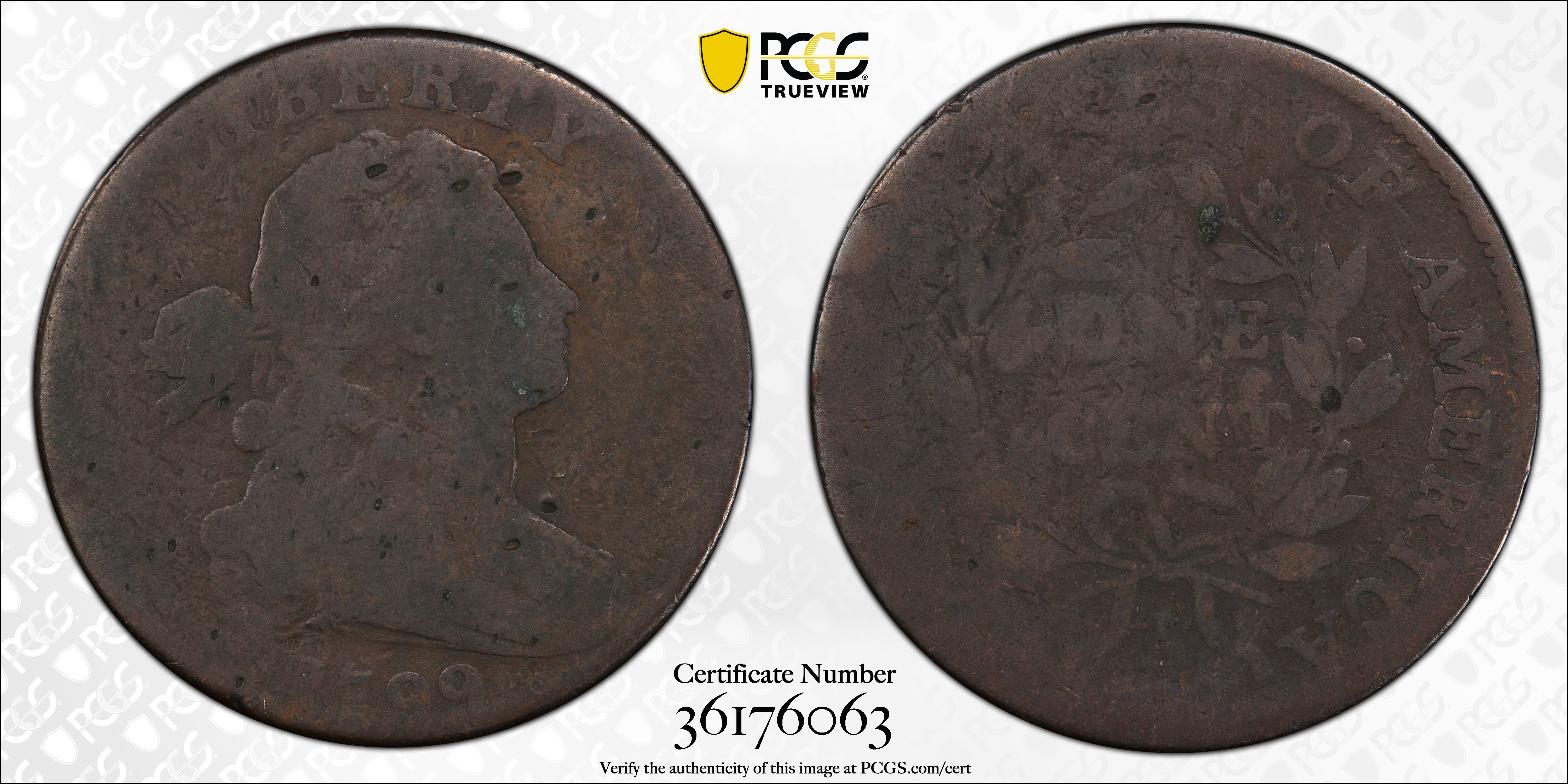
1799 1C, BN N1BN Certification #36176063, PCGS #1443
Owner's Comments
Expert Comments
Charles Morgan
The 1799 Draped Bust Cent (#1443) has been recognized as a legendary rarity since the mid-19th century, an era when American coin collecting was still in its infancy. One of the period's most famous collectors, Joseph Mickley, pursued the issue with legendary intensity- driven both by its reputation for scarcity and the fact that 1799 was his birth year. While Mickley eventually secured his prize, most modern Large Cent enthusiasts find the 1799 date to be quite elusive.
A Mystery of Mintages
Historical records show the Philadelphia Mint delivered 904,585 cents in 1799; however, the vast majority of these were actually struck using 1798-dated dies.
- The Breen Figure: For decades, numismatist Walter Breen’s estimate of 42,540 was accepted as gospel.
- The Modern "Correction": Subsequent research proved Breen’s figure inaccurate. In 1999, the Red Book officially replaced it with the 904,585 figure, though it carries a heavy caveat regarding the actual number of coins bearing the 1799 date.
Varieties and Overdates
Two obverse dies were used to strike 1799-dated cents:
- The 1799/8 Overdate (Sheldon-188, PCGS #1446) and (NC-1, PCGS #36134). A slightly rarer variety where the final digit is struck over an 8.
- The Normal (or "Perfect") Date (#1443). Slightly more common than the overdate, yet still rare.
Both varieties feature Liberty’s hair curl pointing precisely between the B and E of "LIBERTY." Interestingly, the 1799 production cycle is intertwined with both the previous and following years. The 1798 Draped Bust Cent (Sheldon-186, PCGS #36125) shares a reverse die with the S-188; however, all known examples of the S-186 exhibit a major die crack running from the rim at 6 o'clock to the rim above the M in AMERICA. Most S-188s are free of this catastropic die crack, save for a handful of late die state examples which also exhibit on obverse die crack in the upper right.
Also notable is the repurposing of 18th-century dies to create the 1800/1798 and 1800-79 overdates in the following year.
The 1799 "Perfect Date"
Collectors refer to the Sheldon-189 as the "Perfect Date" to contrast it to the overdate varieties. On the Perfect Date, the numerals are more closely spaced together and the date is more centered than on the 1799/8.
1799 Cents Were Worked to the Bone
In the late 1700s, the fledgling U.S. economy was desperate for copper to replace the circulating foreign currency then in circulation. Consequently, early U.S. copper coins were "worked to the bone." By the time the numismatic community realized the 1799's Draped Bust Cent's rarity in the mid-1800s, nearly every surviving specimen was heavily worn.
The only known uncirculated specimen was taken to England, presumably shortly after its manufacture, and was not repatriated to America until the late 1920s. This coin, currently in the High Desert Collection, brought $540,500 at a March 2017 auction. Even 150 years ago, the price of admission was steep: a "Common 1799" could fetch $25. Adjusted for inflation, that is roughly $750 today when adjusted for inflation. Today, that same coin might cost $50,000 or more. The coin remains a coveted "key date" for collectors of early date copper, where even honestly worn examples in VF or finer are well-known amongst enthusiasts.
* * *
David Hall
The year 1799 is a magic year for large cent enthusiasts. There are two varieties, the 1799 'normal date" and the 1799/8 overdate. There is only one known mint state example of this date, the 1799 normal date from the Dan Holmes collection. The coin's previous owners included Ted Naftzger and Dr. William Sheldon.
Rarity and Survival Estimates Learn More
| 65 or Better | 700 |
| All Grades | 0 |
| 60 or Better | 0 |
| 65 or Better | R-5.6 |
| All Grades | R-10.1 |
| 60 or Better | R-10.1 |
| 65 or Better | 14 / 40 |
| All Grades | 1 / 40 |
| 60 or Better | 1 / 40 |
| 65 or Better | 14 / 40 |
| All Grades | 1 / 40 |
| 60 or Better | 1 / 40 |
Condition Census Learn More
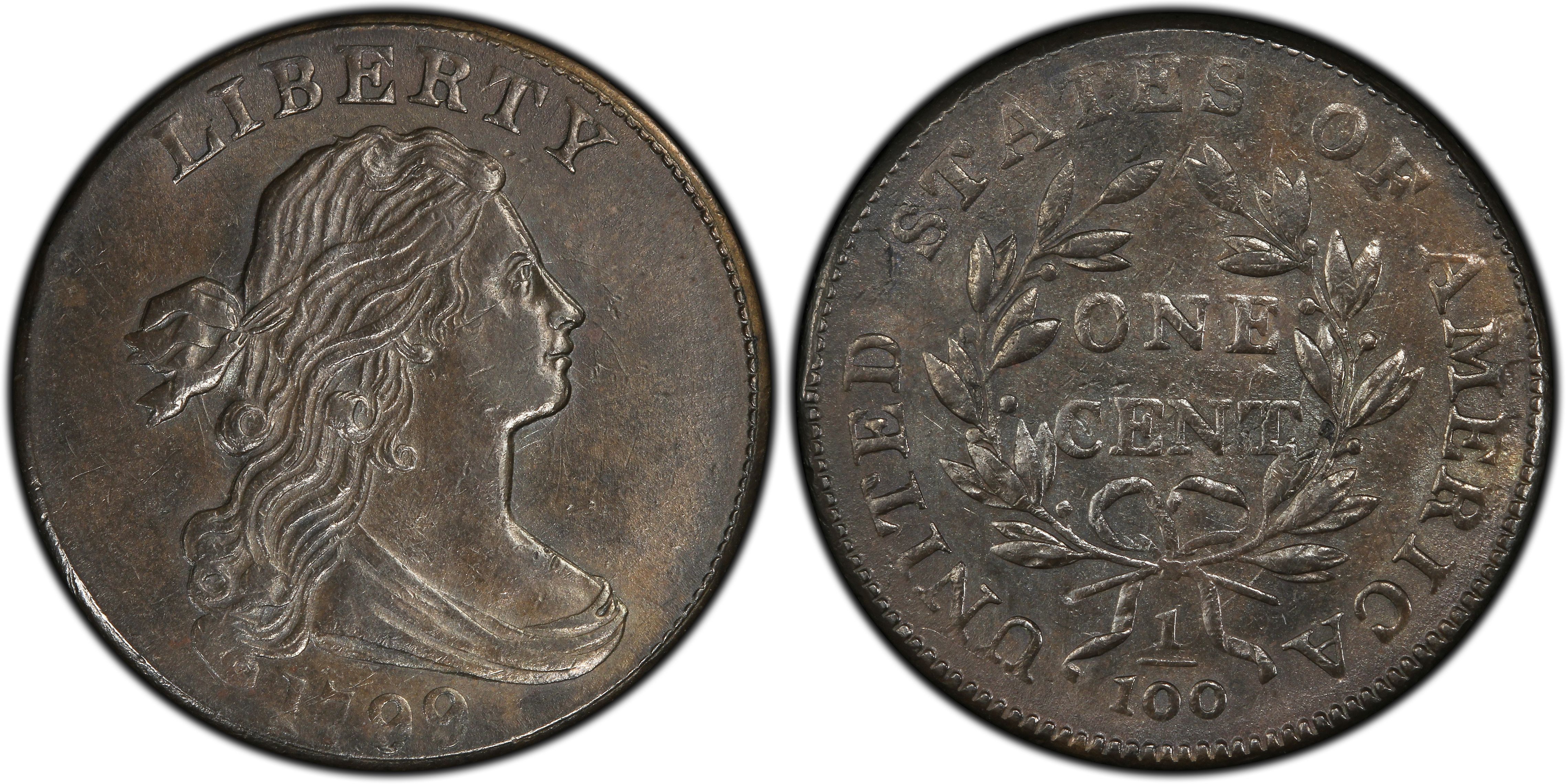 #1 PCGS MS61BN
England; A.H. Baldwin; brought to the United States in the late 1920s by an unknown collector; traded to Frank H. Shumway in 1928; Elmer S. Sears; Wayte Raymond, October 1928; Henry C. Hines; Carl Wurtzbach; Dr. William H. Sheldon, 1945; Harold E. Whiteneck (Sheraton Coin Company); Numismatic Gallery, August 1947, Lot 851; Harold E. Whiteneck; Dr. James O. Sloss, by sale in 1948; Sloss Collection sold, en bloc, to R.E. "Ted" Naftzger, Jr., September 1958; "The Dr. James O. Sloss Collection," Abe Kosoff, October 1959, Lot 50; R.E. "Ted" Naftzger, Jr.; Eric Streiner, by sale, en bloc, via Stack's, February 23, 1992; Jay Parrino (The Mint), sold privately on April 1996; W.M. “Jack” Wadlington, sold privately April 1996; Daniel Holmes, Jr., by sale, via Bob Grellman and Chris McCawley, November 2005; "The Daniel W. Holmes, Jr. Collection," Goldbergs, September 2009, Lot 352 - $977,500. As PCGS MS61BN #15656357. "The D. Brent Pogue Collection, Part V," Stack's/Bowers & Sotheby's, March 2017, Lot 5112 - $540,500; “The High Desert Collection" (PCGS Set Registry). Struck with clashed dies. Two parallel scratches arcoss Liberty's face. On from eye to Liberty's temple locks. The second appears to the left of her mouth. A thin diagonal hairline scratch appears over the 17 of the date. On the reverse, the copper is lighter at the ER of AMERICA. |
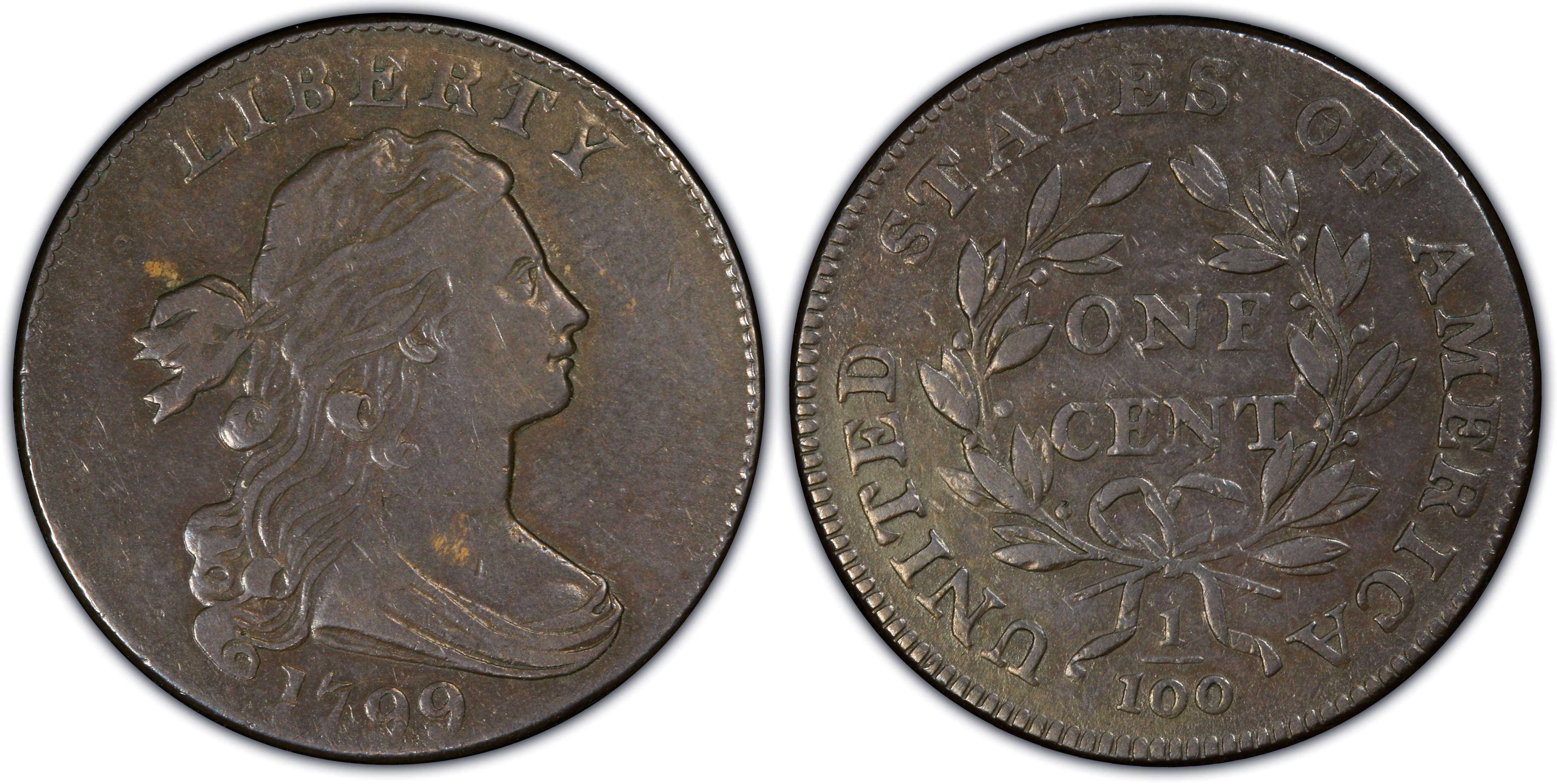 #2 PCGS XF45
Purchased from a countryman for $2 by C. Rogers, circa 1845 - $25; Lorenzo H. Abbey; W. Elliot Woodward, October 1864, Lot 628 - $32.50; Robert B. Chambers; W. Elliot Woodward, February 1866, Lot 575 - $27; Colin Lightbody; Edward Cogan, December 1866, Lot 553 - $45; Mortimer L. Mackenzie; Edward Cogan, June 1869, Lot 636 - $55; E. Harrison Sanford; Edward Cogan, November 1874, Lot 260 - $67.50; Richard B. Winsor; S.H. & H. Chapman, December 1895, Lot 863 - $125; George H. Earle, Jr.; Henry Chapman, June 1912, Lot 3415 – $85; Clarence C. Bement; Henry Chapman, May 1916, Lot 308 - $160; Fred E. Joy; B. Max Mehl; Col. E.H.R. Green; B.G. Johnson; Stack’s, privately; “The Oscar J. Pearl Collection,” Numismatic Gallery, 1944 Fixed Price List, Lot 139 – $900; Harry J. Stein; Max L. Kaplan; C. Douglas Smith, 1952; Thomas Warfield via New Netherlands, February 1953 - $1,150; “The Louis E. Eliasberg, Sr. Collection,” Bowers and Merena, May 1996, Lot 510 - $46,200. As PCGS XF45 #13457184. “The Walter J. Husak Collection,” Heritage Auctions, February 15, 2008, Lot 2192 – $161,000; Heritage Auctions, January 9, 2025, Lot 2111 – $210,000; Jay Parrino; "The St. Jude Copper Collection" (PCGS Set Registry). Struck with clashed dies. There is a small hit near the rim at 10 o'clock. A mark appears across the lower half of the "1," with a small hit on the arm of the "7." A tiny tick is visible at the rim between the two 9s. Obverse denticles are missing from most of the lower periphery. On the reverse, a small diagonal tick sits between the O and N. Two diagonally oriented ticks are located above and to the left of the C in CENT. Reverse dentils are nearly absent from 1 to 3 o'clock. |
 #2 PCGS XF45
Dull diagonal mark near the rim between 9 and 10 o'clock. Diagonal mark at rim to the left of 1. Parallael vertical cuts in hair behind Liberty's ear. Shallow marks on cheek. On the reverse, there is a cut between F and A. Small diagonal mark above ONE. |
 #4 PCGS XF40
Dull diagonal cut below BE. The details of OF are faint. |
 #5 PCGS VF35
"The Dr. Edward Maris Collection," Harlan P. Smith, June 1886, Lot 276; unknown intermediaries; Federal Brand Enterprises, January 1963, Lot 51A; unknown intermediaries; Stuart A. Levine, April 3, 1992; John B. MacDonald, January 1997; "The Robert C. Clark Collection," Bowers and Merena, August 2000, Lot 285; unknown intermediaries; Heritage Auctions, May 2009, Lot 65; Heritage Auctions, February 2012, Lot 3065. As PCGS VF35 #47850729. Stack's Bowers, August 13, 2024, Lot 3018 - $66,000. As PCGS VF35 #56865358. Two vertical ticks on cheek next to a single diagonal tick near nostril. Tick across the middle of the L. On the reverse, ATES OF and the left side of A, the wreath, and ONE CENT are heavily worn. |