



[email protected]'s Coin Album
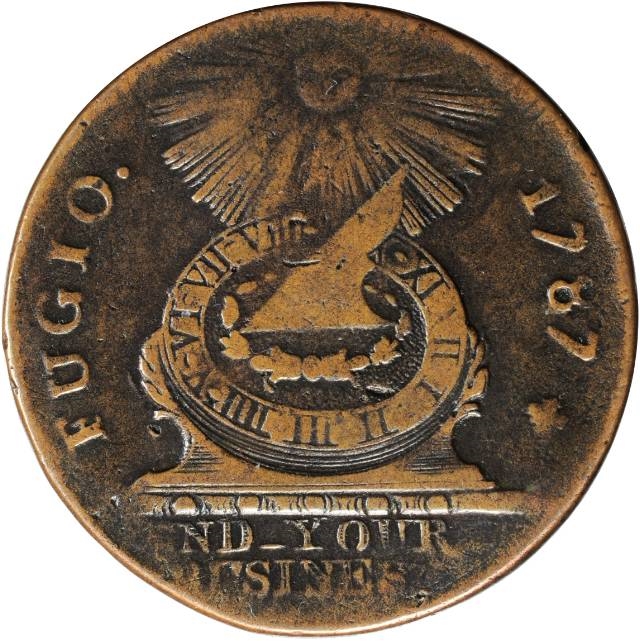
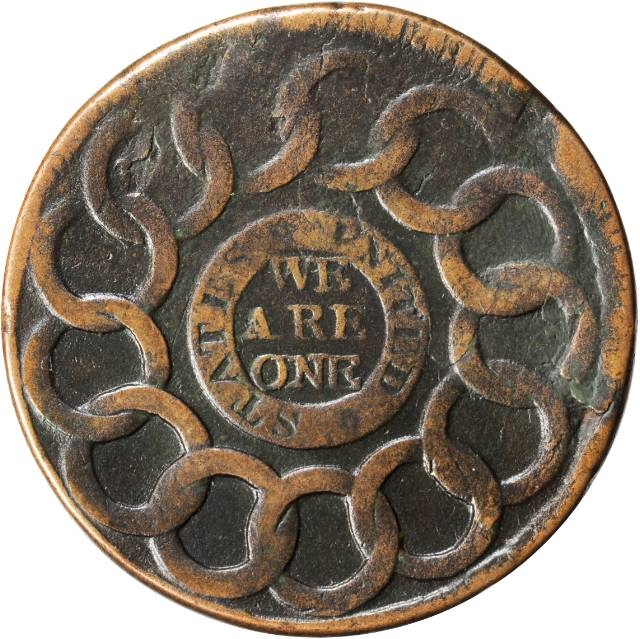
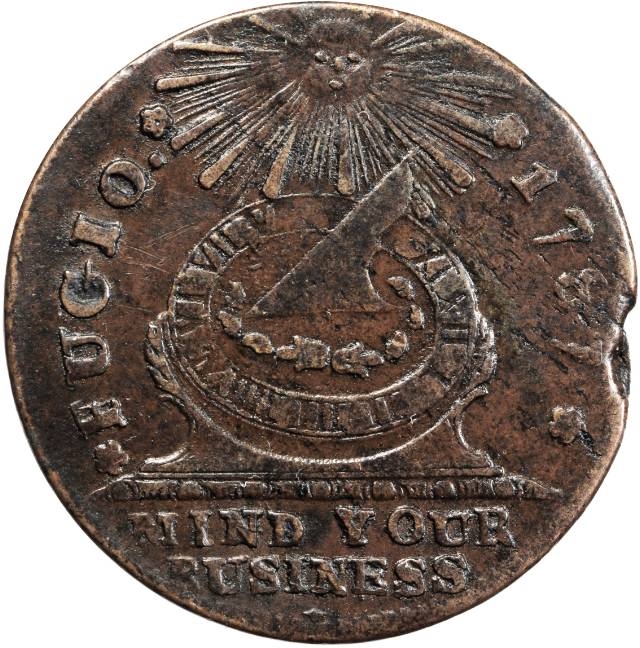
4-E R3. "148.9 grains. Attractive dark chocolate brown with excellent detail for this variety. Some dark verdigris is built up around obverse legends and the reverse peripheries, but it does not seriously impact the eye appeal. Rim flawed above final 7 of date, light striations mostly reserved to right obverse field and right side of reverse. A few short old scratches are present in the left obverse field. Early die state with no crumbling inside the 8. From the Robert Ayers Collection. Earlier from Rosa Americana, Ltd. in March 1985. Paper envelope with attribution notation included," per Stacks Bowers cataloger. Obtained from Stacks Bowers Auction of the Robert Ayers Collection on August 14, 2013, Lot 1338.
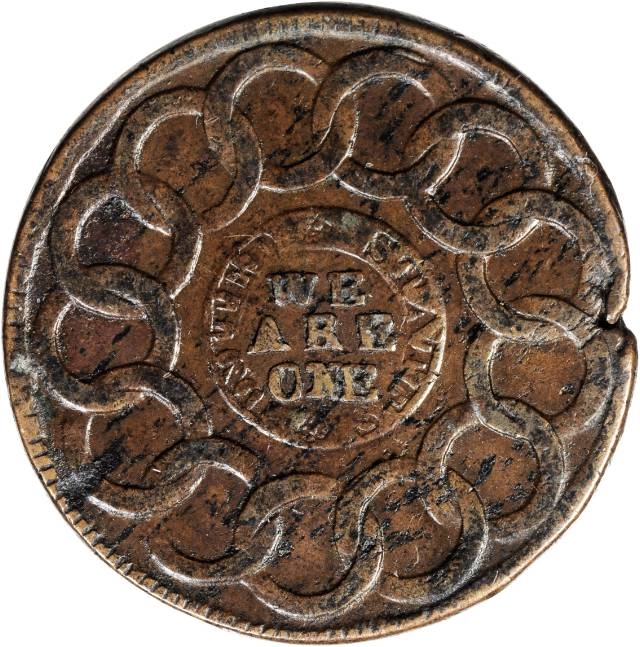
4-E R3. "148.9 grains. Attractive dark chocolate brown with excellent detail for this variety. Some dark verdigris is built up around obverse legends and the reverse peripheries, but it does not seriously impact the eye appeal. Rim flawed above final 7 of date, light striations mostly reserved to right obverse field and right side of reverse. A few short old scratches are present in the left obverse field. Early die state with no crumbling inside the 8. From the Robert Ayers Collection. Earlier from Rosa Americana, Ltd. in March 1985. Paper envelope with attribution notation included," per Stacks Bowers cataloger. Obtained from Stacks Bowers Auction of the Robert Ayers Collection on August 14, 2013, Lot 1338.
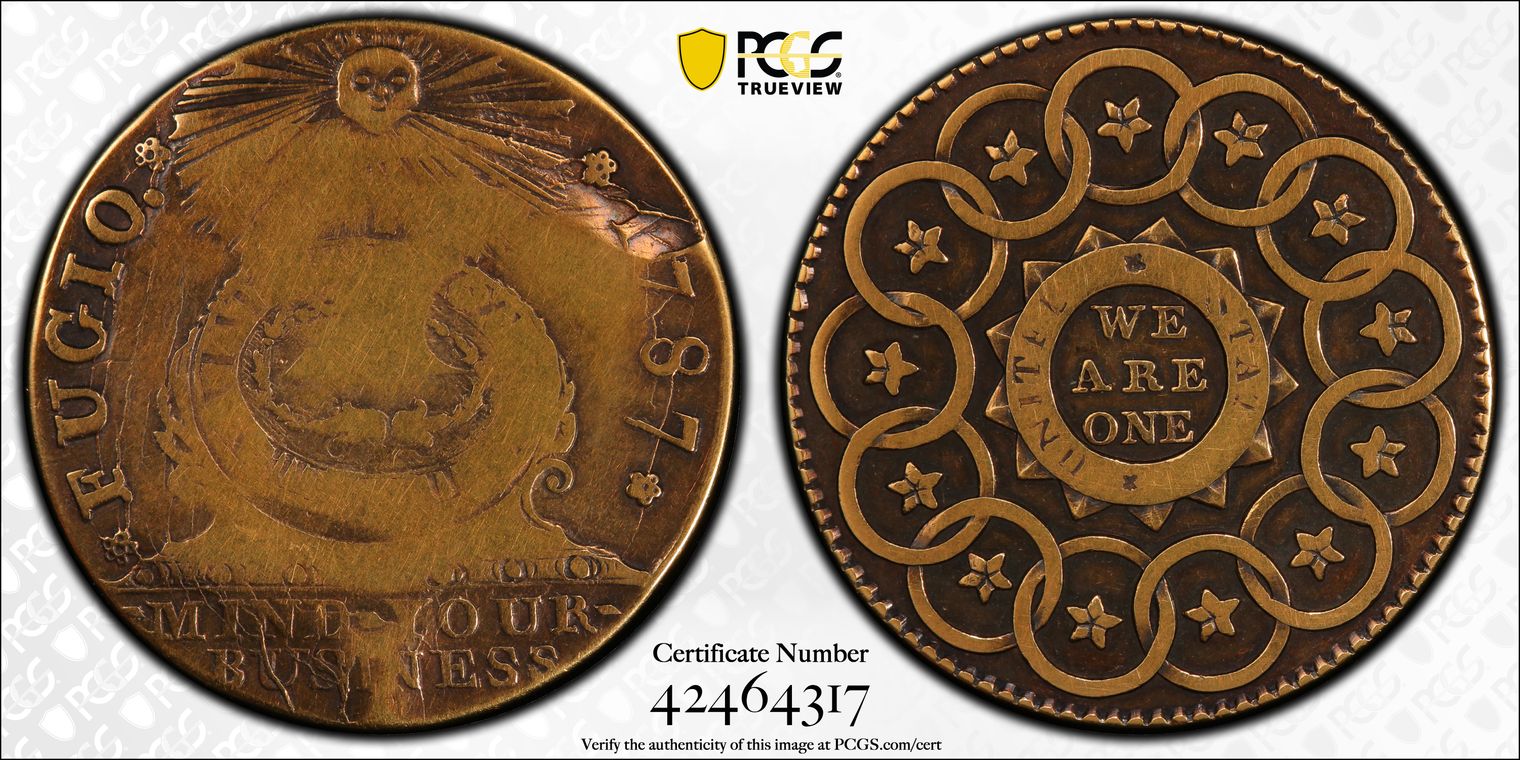
Newman 103-EE. R8+. Norweb. Unique in Gold. Fugio Cent Restrike. Per cataloger, "New Haven Restrike, Stars in Rings, Gold, VF20 NGC. N. 103-EE, Breen-1345, W-17530, Unique. 13.59 gm. Entrepreneur Horatio N. Rust was the man behind the misnamed New Haven Restrike Fugio cents. Circa 1860, he contracted with the Waterbury, Connecticut, firm Scoville Manufacturing Company to produce several varieties from copy dies. Today, the Plain Rings variety (Newman 104-FF) is relatively plentiful in copper and brass, but the American Congress and Stars in Rings marriages (and their various trials) are formidable rarities. No genuine Fugio cents have stars within the rings, which makes it unclear why Rust designed the EE die with 13 reverse stars. He might have believed the variety could be marketed to collectors familiar with 13 stars on one side (and, sometimes, both sides) of early Federal coins. In any event, not many were made. Two or three pieces are known in silver, including the Col. Green - Eric Newman piece we offered as lot 3076 in our November 2014 Newman Part V Signature. One is known in brass, and Breen lists a copper example but adds it is untraced. The gold example is unique, and was likely the final piece struck from the Newman 103-EE die pair, given the central failure of the obverse die. The obverse border also exhibits a network of fine die cracks. Presumably, the obverse die was not hardened prior to use. The high points are honey-gold, while the fields are tan-brown. No marks are noticeable, but the high-point wear evident on both sides indicates it must have been carried as a pocket piece. The wear may have been an attempt by Rust or an early owner to increase its acceptance as authentic by the 19th-century numismatic community. The present example appeared as lot 661 in the New York Coin & Stamp Co. auction of the celebrated Lorin G. Parmelee collection, and was described as having "no duplicate known in either type or metal." Parmelee sold it to Virgil M. Brand in 1899. Listed on page 90 of the 2021 Guide Book. Ex: Lorin G. Parmelee (New York Coin & Stamp Co., 6/1890), lot 661, where it was bought in; Lorin G. Parmelee (7/31/1899); Virgil M. Brand (Journal #20690); Brand Estate; later, Jon Hanson; Donald G. Partrick." Obtained from Heritage Auction of Donald Partrick Collection on April 22, 2021, Lot 3039.
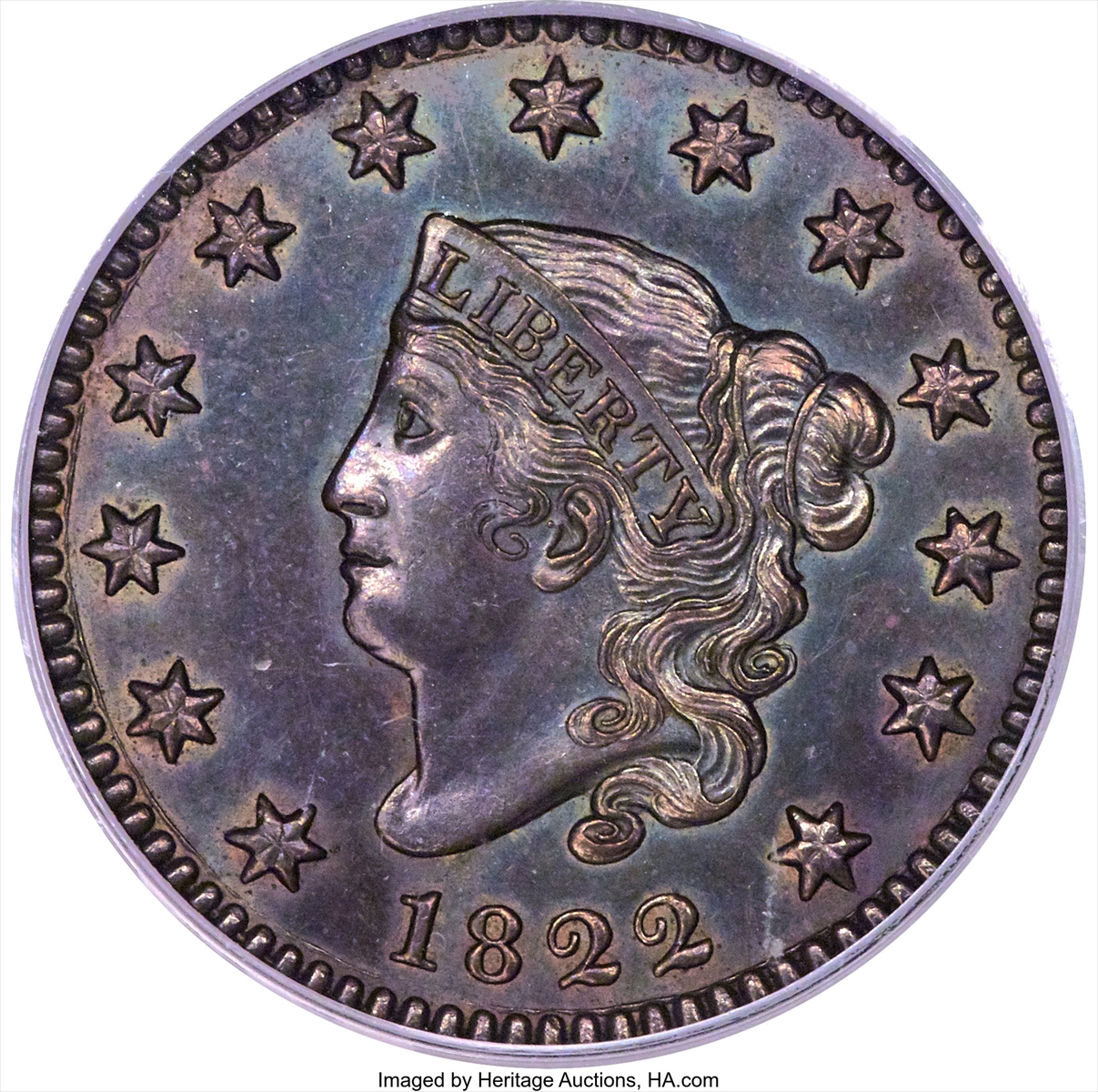
N-10 R.7. Obtained from Heritage Galleries Auction on January 9, 2020, Lot 4097. Per cataloger, "Ex: Frothingham-Wilson-Pittman Example. N-10, R.7 as a Proof. The manufacture of master coins, as they were known prior to the use of our current word "proof," was spotty at best prior to 1858. Curiously, there was some special need for proof cents in 1822, as at least nine pieces are known of this particular variety and several others are known of other varieties. In the Pittman Sale in 1997, Denis Loring contributed a brief roster of nine examples of proof N-10 cents. The pedigree of this particular coin is long and impressive, stretching back to 1883. The coin was described in this coin's first appearance in the Frothingham Sale as, "Fine proof of brilliant steel color. Very rare." This coin has a couple of distinctive pedigree identifiers: On the obverse a small planchet flake appears in the left field between star 2 and Liberty's chin. On the reverse a couple of lint marks occur around the left side of the N in ONE; another shallow planchet flake is seen above that same letter. Otherwise, the surfaces are deep brown with olive accents. The strike is unusually complete on Liberty's hair. The peripheral stars show just the slightest softness over the highest points. The fields are reflective as expected -- surprisingly so, given the depth of patina present over each side. A raised line surrounds the inner denticles on the obverse, undoubtedly a scribe line used to locate the placement of the denticles. As one can see from the pedigree below, this coin has always brought a high price when offered at public auction. However much it brings in this offering, one thing is certain, it will be impressively high. Our EAC grade PR55. Ex: Charles F. Frothingham Collection (H. G. Sampson, 5/1883), lot 100; James B. Wilson, Esq. Collection (Thomas Elder, 10/1908), lot 1057; Dr. George P. French (FPL, B. Max Mehl), lot 439; New Netherlands 54th Sale (4/1960), lot 1535; John Jay Pittman Collection (Akers, 10/1997), lot 205; Keusch, Snow, & Del Zorro Collections (Stack's, 11/2008), lot 3075; Greensboro Collection, Part II (Heritage, 1/2013), lot 5524. From the Joseph D. Osborne Collection."
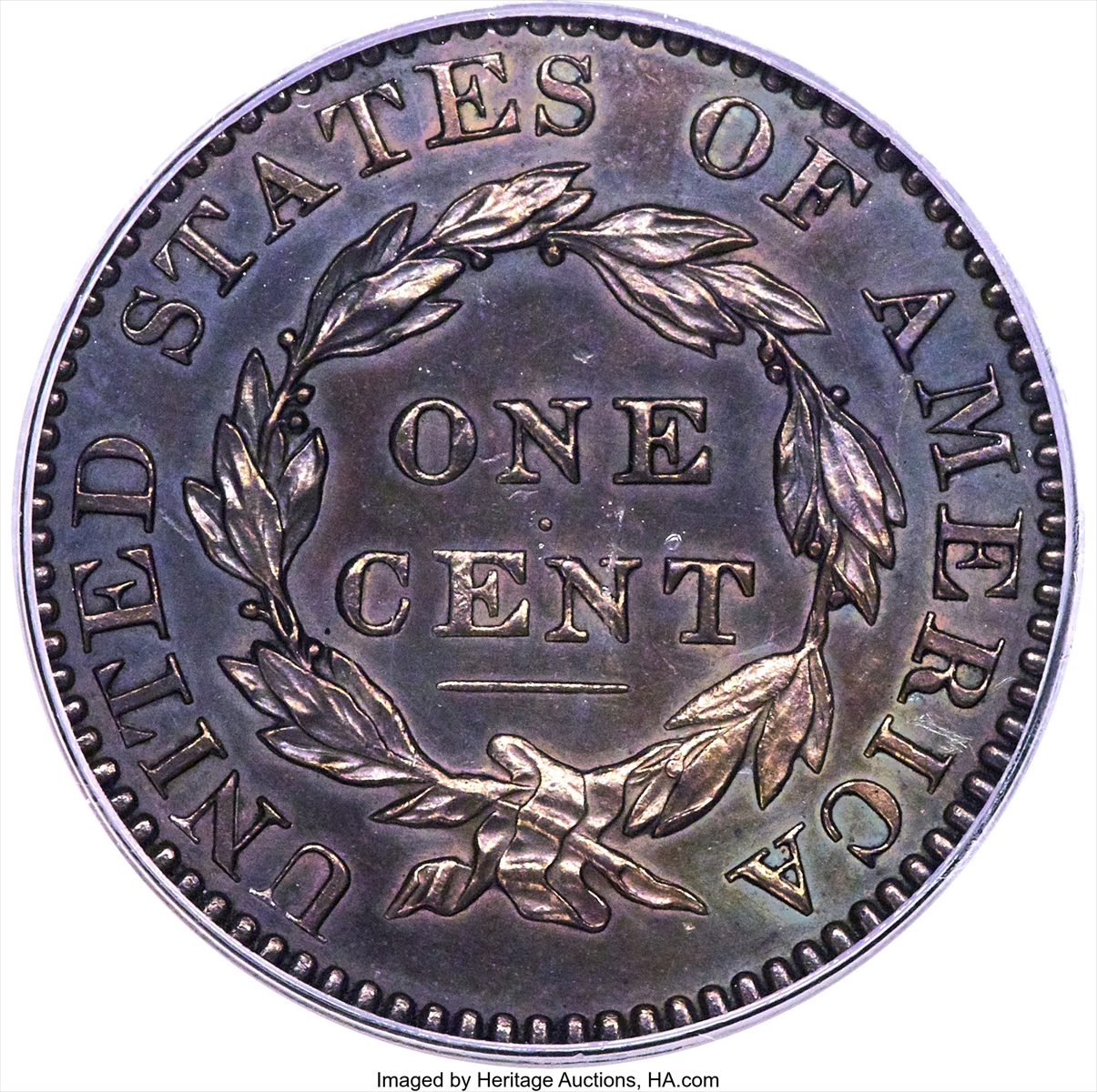
N-10 R.7. Obtained from Heritage Galleries Auction on January 9, 2020, Lot 4097. Per cataloger, "Ex: Frothingham-Wilson-Pittman Example. N-10, R.7 as a Proof. The manufacture of master coins, as they were known prior to the use of our current word "proof," was spotty at best prior to 1858. Curiously, there was some special need for proof cents in 1822, as at least nine pieces are known of this particular variety and several others are known of other varieties. In the Pittman Sale in 1997, Denis Loring contributed a brief roster of nine examples of proof N-10 cents. The pedigree of this particular coin is long and impressive, stretching back to 1883. The coin was described in this coin's first appearance in the Frothingham Sale as, "Fine proof of brilliant steel color. Very rare." This coin has a couple of distinctive pedigree identifiers: On the obverse a small planchet flake appears in the left field between star 2 and Liberty's chin. On the reverse a couple of lint marks occur around the left side of the N in ONE; another shallow planchet flake is seen above that same letter. Otherwise, the surfaces are deep brown with olive accents. The strike is unusually complete on Liberty's hair. The peripheral stars show just the slightest softness over the highest points. The fields are reflective as expected -- surprisingly so, given the depth of patina present over each side. A raised line surrounds the inner denticles on the obverse, undoubtedly a scribe line used to locate the placement of the denticles. As one can see from the pedigree below, this coin has always brought a high price when offered at public auction. However much it brings in this offering, one thing is certain, it will be impressively high. Our EAC grade PR55. Ex: Charles F. Frothingham Collection (H. G. Sampson, 5/1883), lot 100; James B. Wilson, Esq. Collection (Thomas Elder, 10/1908), lot 1057; Dr. George P. French (FPL, B. Max Mehl), lot 439; New Netherlands 54th Sale (4/1960), lot 1535; John Jay Pittman Collection (Akers, 10/1997), lot 205; Keusch, Snow, & Del Zorro Collections (Stack's, 11/2008), lot 3075; Greensboro Collection, Part II (Heritage, 1/2013), lot 5524. From the Joseph D. Osborne Collection."
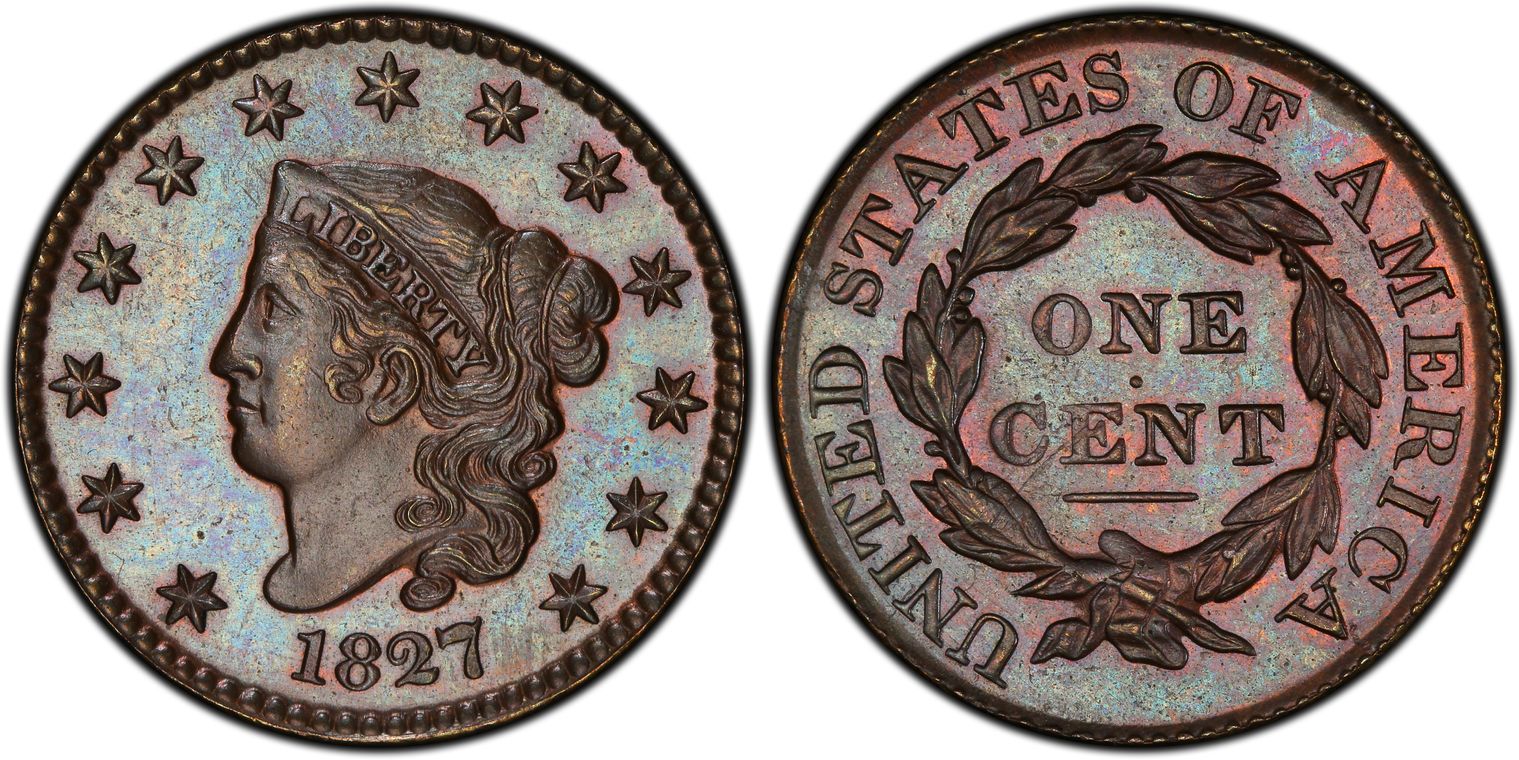
N-1 R7+. Naftzger. One of two known N-1 Proof Large Cents. Tied for finest known at PCGS. Obtained in trade arranged by Chr1s McCawley on September 29, 2021.
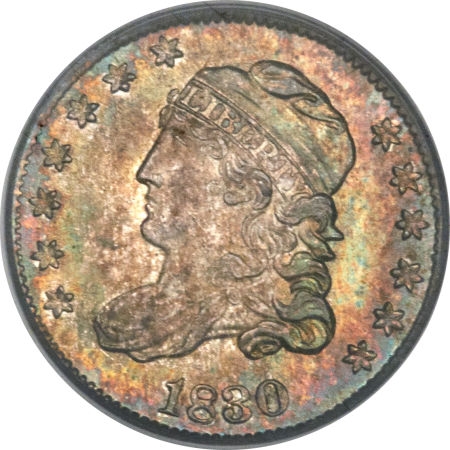
LM-12 R4. Lovely colorful, blazing luster, nice strike. Obtained from the heritage Auction #1214 of the Eugene Gardener Collection on 10/27/2014, Lot 98174.
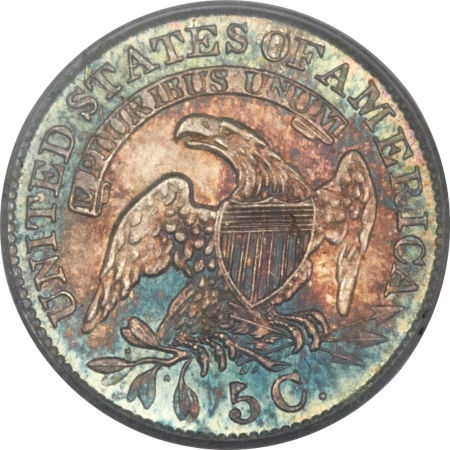
LM-12 R4. Lovely colorful, blazing luster, nice strike. Obtained from the heritage Auction #1214 of the Eugene Gardener Collection on 10/27/2014, Lot 98174.
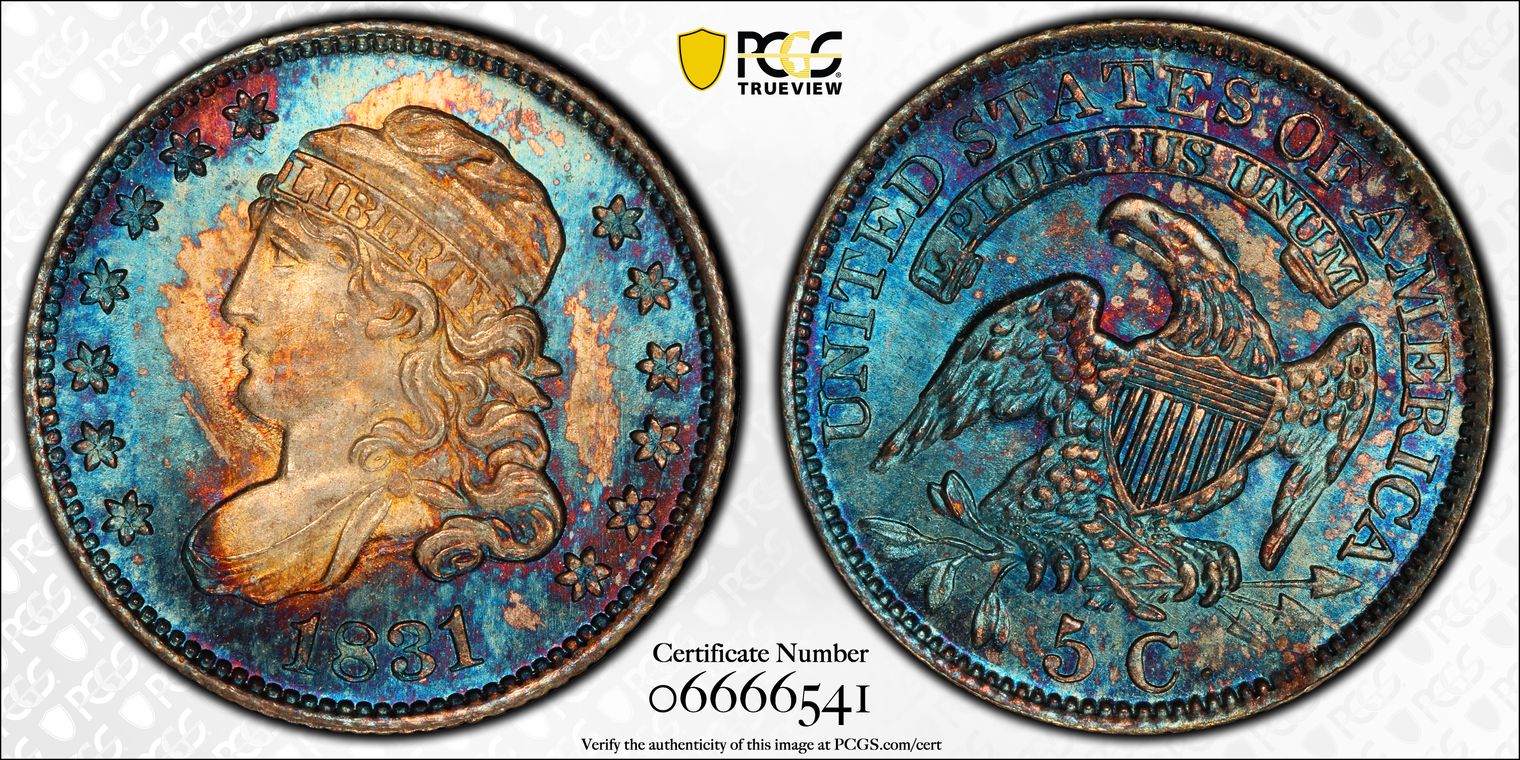
LM-7 R2. Simpson. Bender. Finest Known 1831 Capped Bust Half Dime. Visually stunning kaleidoscope of color on near perfection in an early half dime. Obtained from Heritage Auction of Bender Family Collection, Part I on August 24, 2022.
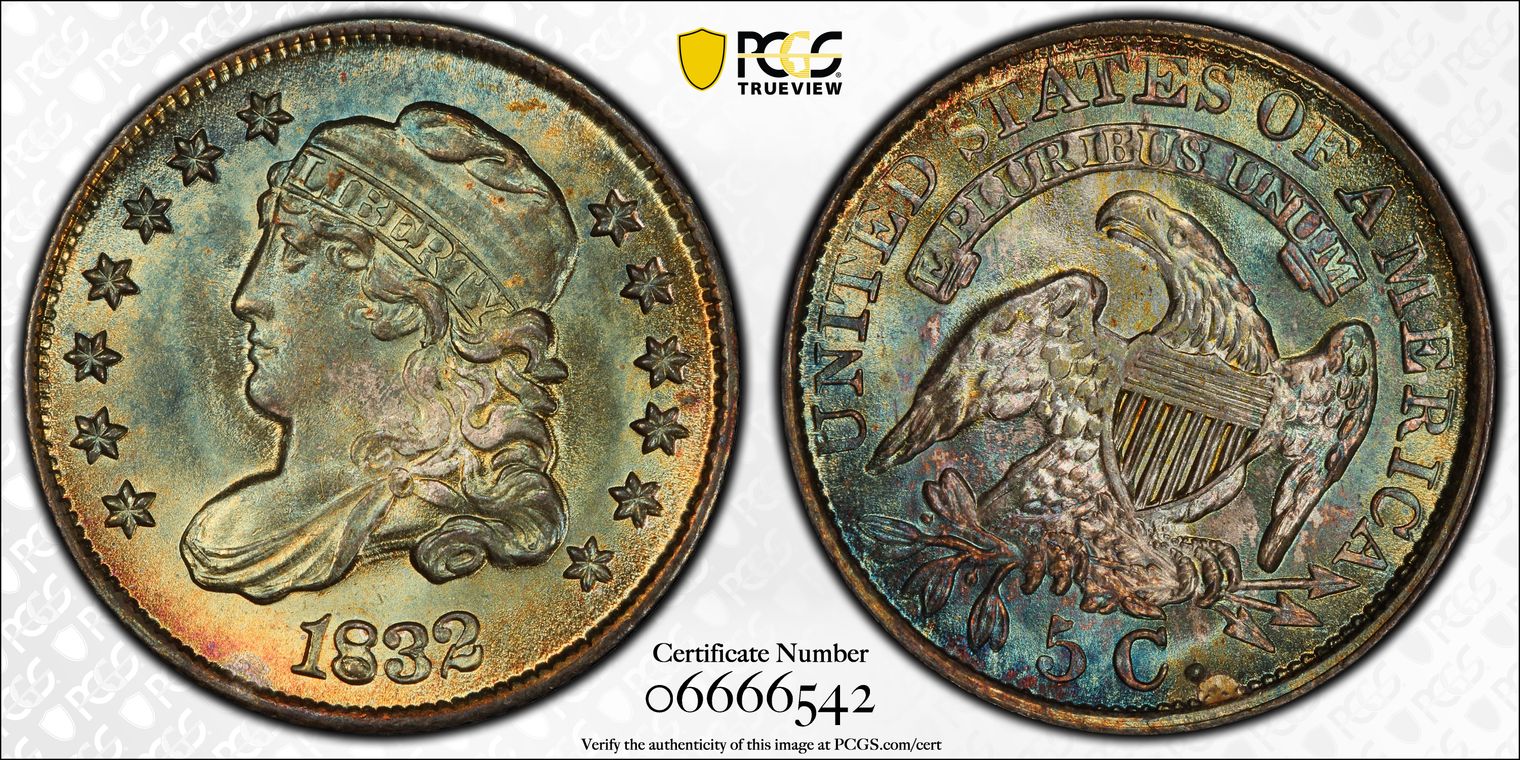
LM-13 R.3. CAC. Simpson. Bender. Finest Known Capped Bust Half Dime. Stunning quality, surfaces and eye appeal. Lovely colors with almost unbelievably clean surfaces. A beauty to behold. WOW! Obtained from Heritage Galleries Auction of the Bender Family Collection on August 24, 2022, Lot 3728.
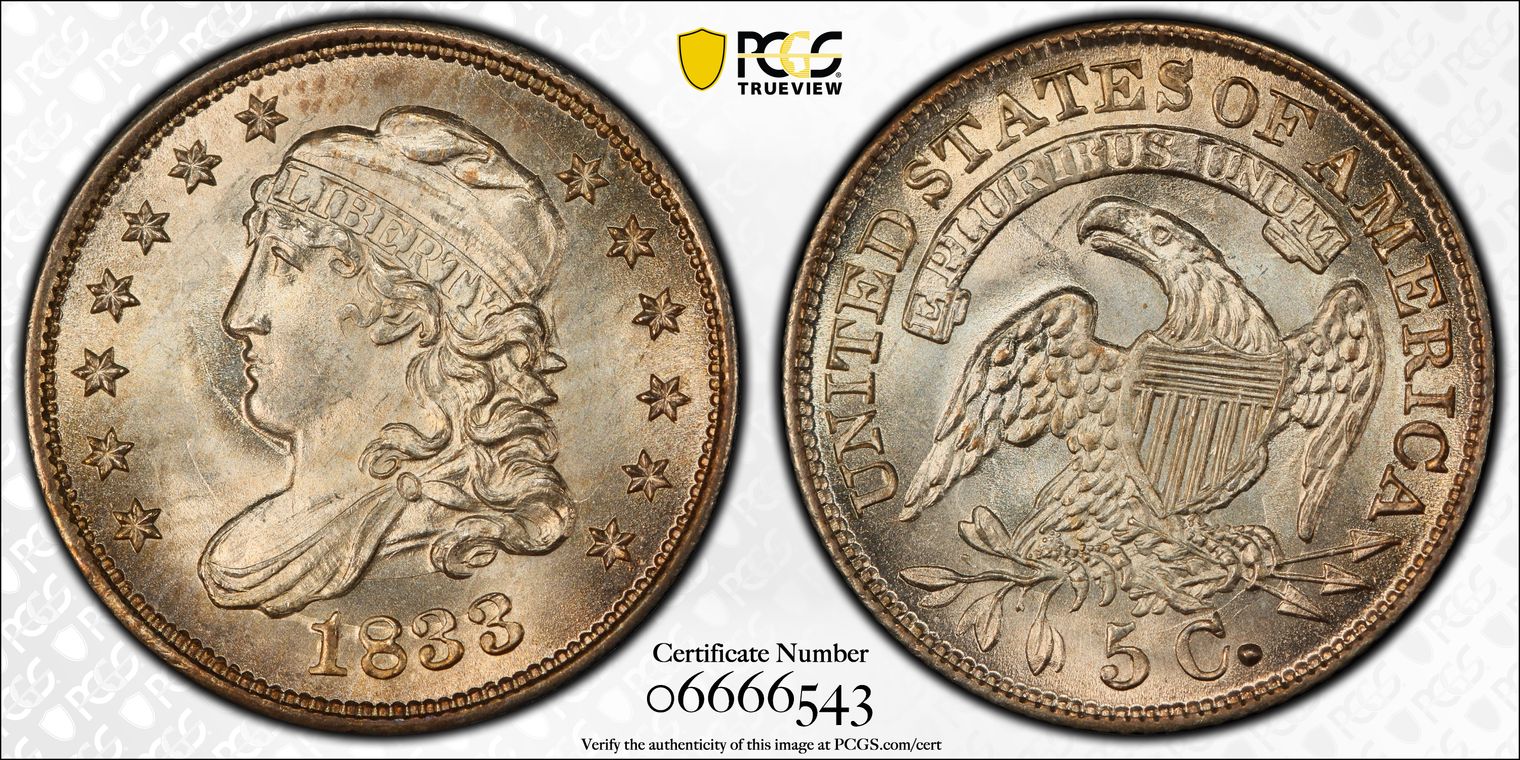
LM-3.4. R.2. CAC. Bender. Simpson. Tied finest known 1833 Capped Half Dime. Extensively clashing and cracking with superb gem surfaces. Pale golden color with superb luster. Obtained from Heritage Auction of Bender Family Collection on August 24, 2022, Lot 3729.
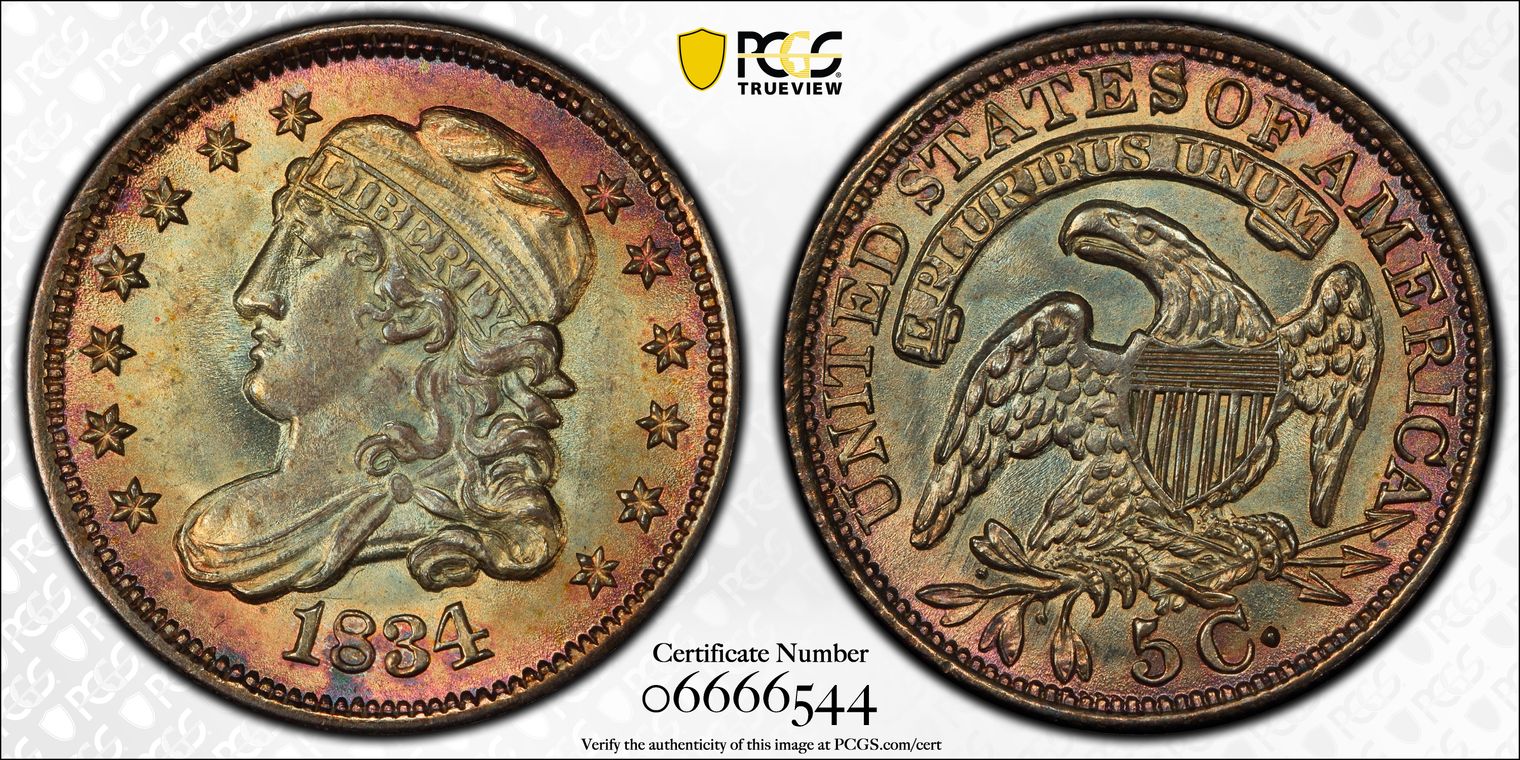
LM-2 R.1. CAC. Bender. Simpson. Tied Finest Known 1834 Capped Half Dime. Red, gold and navy toning with booming luster. Great eye appeal. Obtained from Heritage Auction of Bender Family Collection, Part 1 on August 24, 2022, Lot 3730.
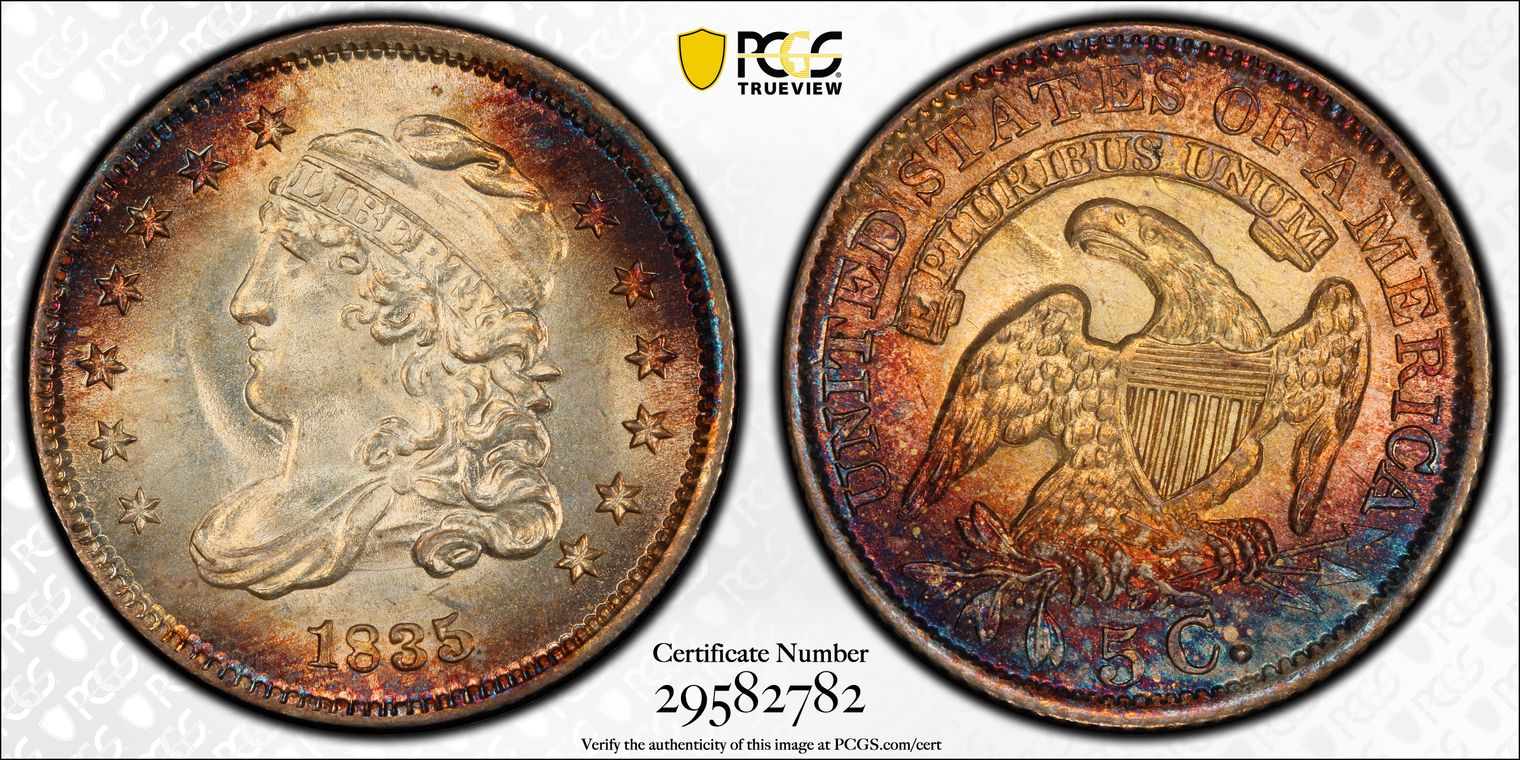
LM-8.2 R.2. CAC. Bender. Simpson. Finest Known 1835 Small Date, large 5C Capped Bust Dime. Golden toning with luster and originality. Obtained from Heritage Auction of the Bender Family Collection on August 24, 2022, Lot 3733.
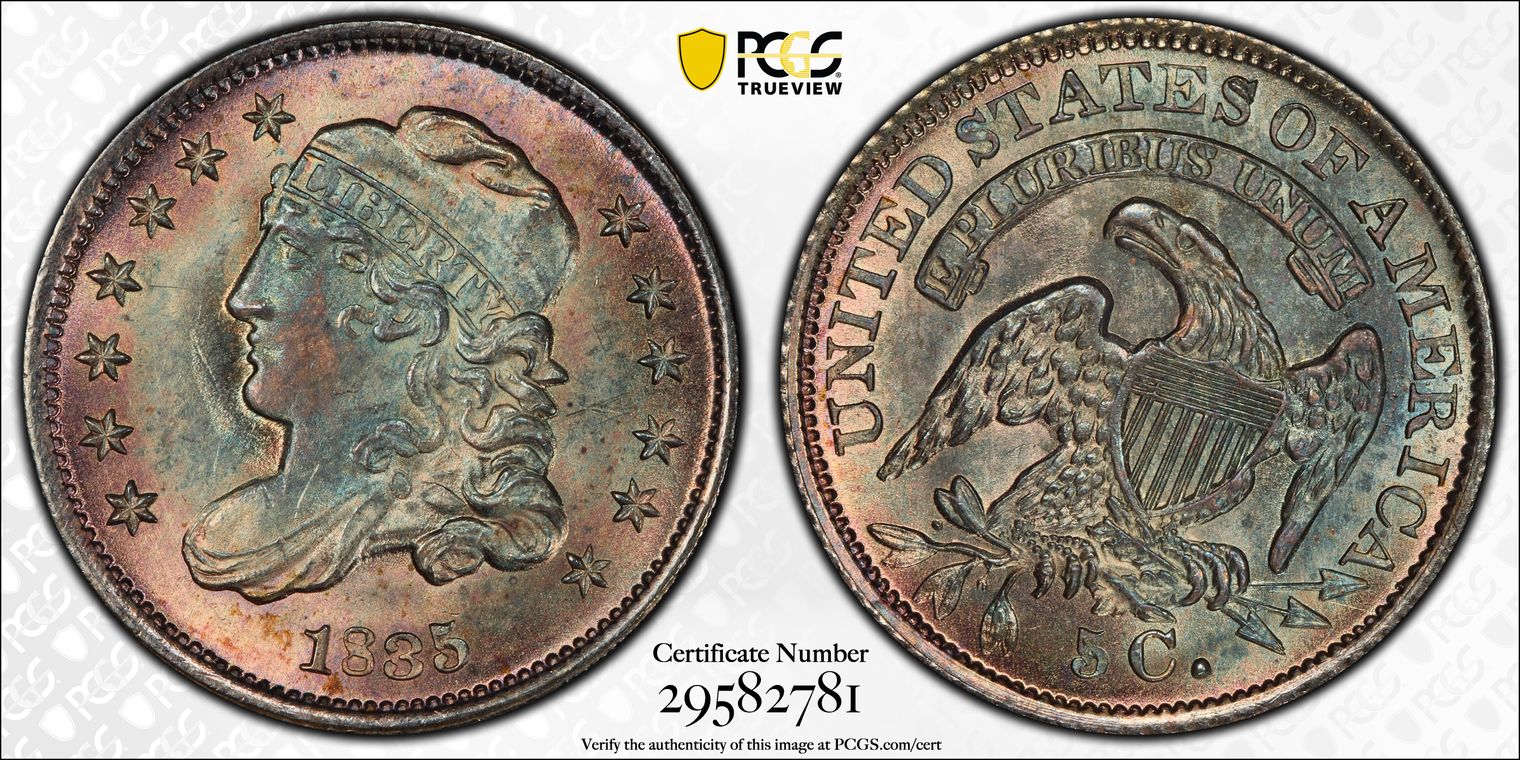
LM-10 R.1 CAC. Finest 1835 Small Date, Small 5C. Lovely rose and purplish toning emanating from flashy cartwheel luster. Heritage Auction of Tom Bender Family Collection, Part 1 on August 24, 2022, Lot 3734.
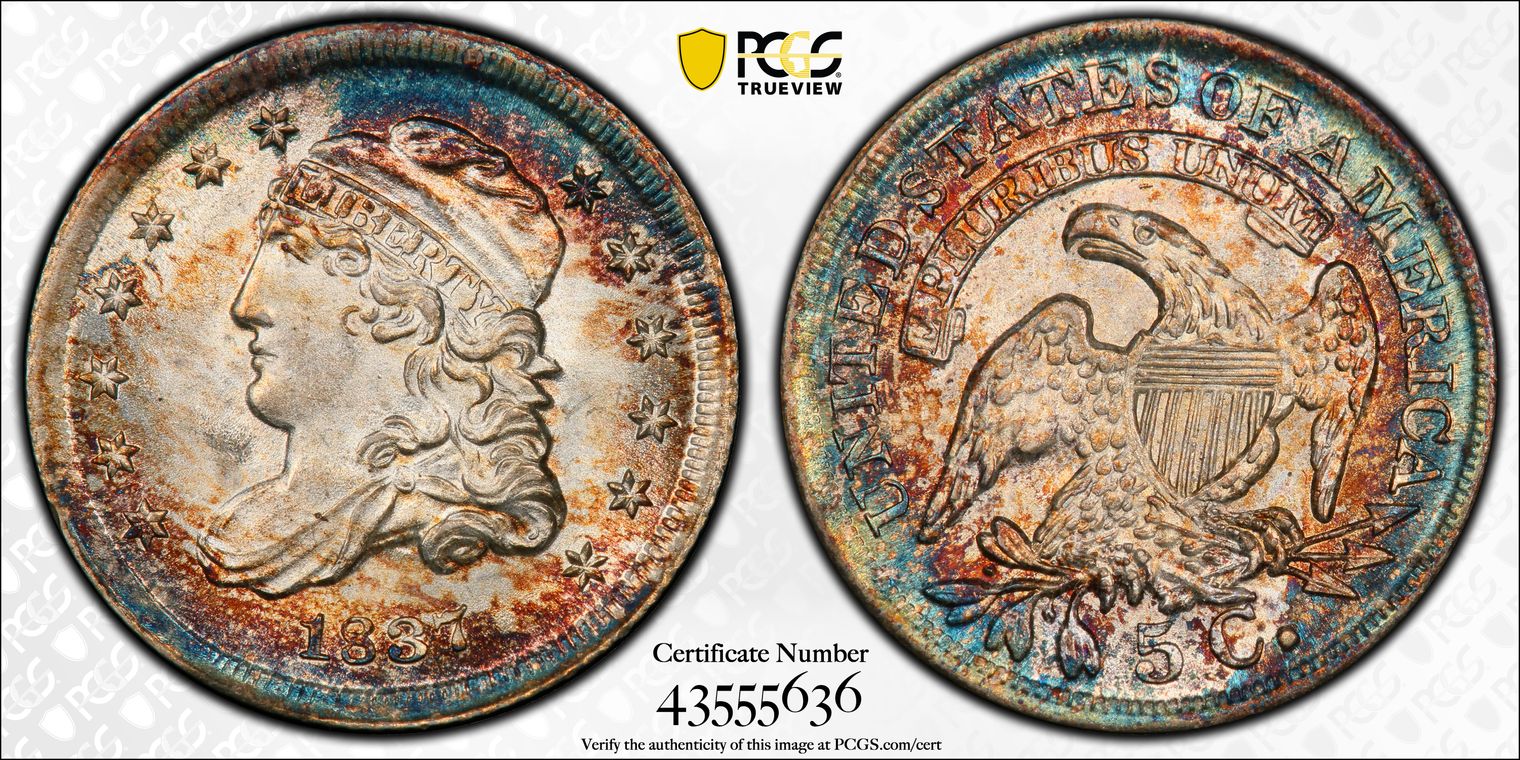
LM-? CAC. Finest Known 1837 Large 5C Capped Bust Half Dime. Obtained by private treaty from Matt Kleinstuber on August 17, 2022.

B-1 R.1. CAC. Tied Finest Known. "Several die states are known for the 1815 quarter, this piece being a later die state with very light clashing on each side but most notable on the reverse. Beautifully toned in shades of mauve, orange-gold, light purple and hints of green with exceptional luster and truly lovely overall eye appeal. PCGS has certified just 3 at this level with nothing graded finer and this is the only coin verified at this level by CAC. From The Clarendon Collection," per Mike Printz. "The December delivery was sent upon request of the Planter's Bank, who apparently needed the coins as a replacement for Mexican two reales coins of a similar value. An exchange of letters took place between Bailly Blanchard, cashier of the Planter's Bank, and Mint Director Robert L. Patterson. Blanchard insisted that the bank could only use quarter dollars, while Patterson wanted to send the entire amount in dimes. More than six months elapsed from the first letter requesting the coins and the date they were delivered. Several die states are known for the 1815 quarter, and this piece is a later die state with light clash marks on each side, especially visible on the reverse. It is probably one of the later January 10 coins. It is also a lovely Condition Census candidate with full silver luster beneath heavy iridescent toning, deepening to steel along the borders. Population: 3 in 66, 0 finer (11/09)," per heritage cataloger. Obtained by private treaty with Michael Printz at Harlan J Berk, Ltd. on 7/14/2013. Prior Heritage Auction 31136 on January 7, 2010, Lot 2503.

B-1 R.1. CAC. Tied Finest Known. "Several die states are known for the 1815 quarter, this piece being a later die state with very light clashing on each side but most notable on the reverse. Beautifully toned in shades of mauve, orange-gold, light purple and hints of green with exceptional luster and truly lovely overall eye appeal. PCGS has certified just 3 at this level with nothing graded finer and this is the only coin verified at this level by CAC. From The Clarendon Collection," per Mike Printz. "The December delivery was sent upon request of the Planter's Bank, who apparently needed the coins as a replacement for Mexican two reales coins of a similar value. An exchange of letters took place between Bailly Blanchard, cashier of the Planter's Bank, and Mint Director Robert L. Patterson. Blanchard insisted that the bank could only use quarter dollars, while Patterson wanted to send the entire amount in dimes. More than six months elapsed from the first letter requesting the coins and the date they were delivered. Several die states are known for the 1815 quarter, and this piece is a later die state with light clash marks on each side, especially visible on the reverse. It is probably one of the later January 10 coins. It is also a lovely Condition Census candidate with full silver luster beneath heavy iridescent toning, deepening to steel along the borders. Population: 3 in 66, 0 finer (11/09)," per heritage cataloger. Obtained by private treaty with Michael Printz at Harlan J Berk, Ltd. on 7/14/2013. Prior Heritage Auction 31136 on January 7, 2010, Lot 2503.
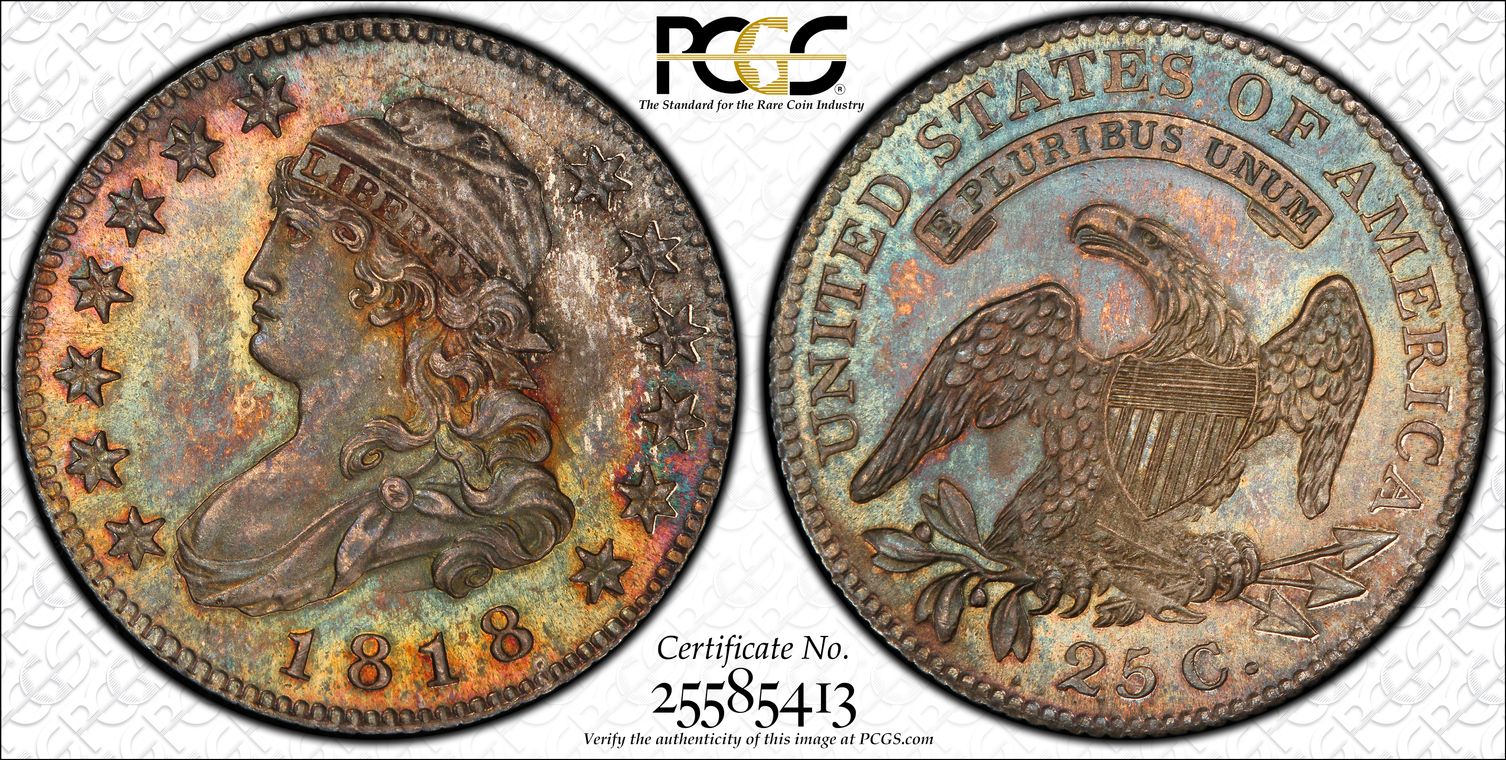
B-2 R1. CAC. Shield Holder. "Popular B-2 Variety, Only One Finer Coin at PCGS. No quarters were struck in 1816 and 1817, but a substantial mintage of 361,174 pieces was produced in 1818. Five obverse and seven reverse dies were combined to produce 10 known die varieties for the date. This coin represents the B-2 variety, with star 13 repunched and the scroll starting under the center of the upright of D in UNITED. The B-2 is the most available variety of the date. The present coin is a spectacular Premium Gem with iridescent shades of greenish-gold toning that fades to blue and violet. The design elements are sharply detailed and the well-preserved surfaces display vibrant mint luster under the toning. Population: 4 in 66, 1 finer ," per Heritage cataloger. Obtained from Heritage Galleries Auction #1192 on December 5, 2013, Lot 3587.
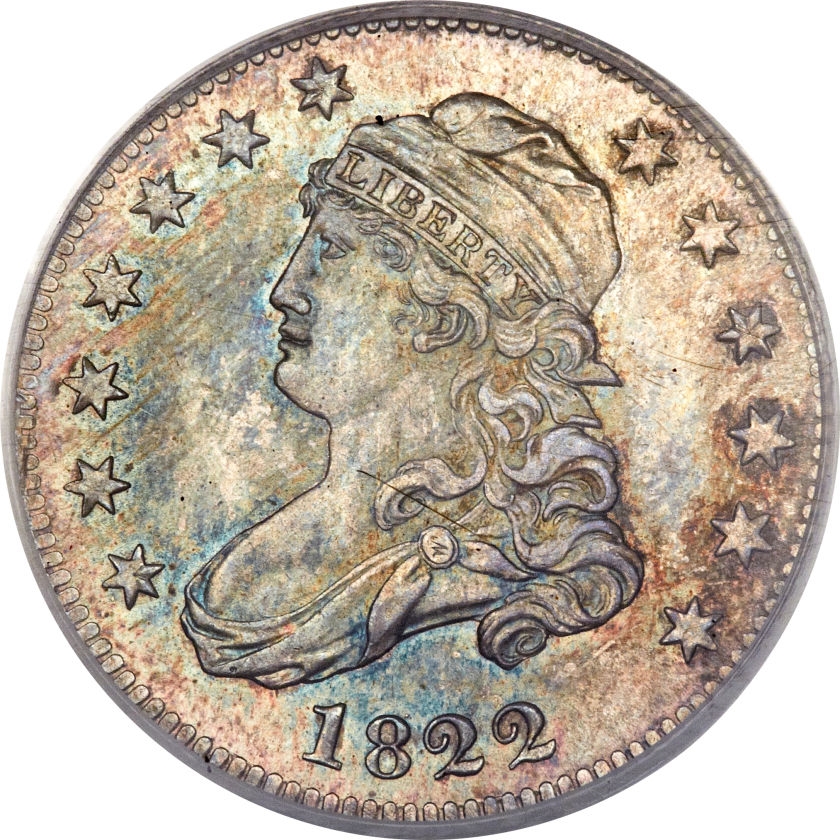
B-1 R2. Finest Known by 3 grading points. Only 4 large Sized Capped Quarters are graded MS67 at PCGS (and none finer) Per cataloger,"Single-Finest Certified. Recently Rediscovered Example. B-1, R.2, MS67 PCGS. A small mintage of 64,080 Capped Bust quarters was accomplished in 1822, with just two die varieties known for the date. This coin represents the more available B-1 variety, easily recognized by the Square Base 2 in the denomination. The scarce B-2 variety displays a blundered 25/5/50 denomination, and employs a Curl Base 2 numeral punch. A single obverse die was used to strike the entire production run and all coins seen were struck from perfect dies. The Capped Bust quarters were first studied and attributed by die varieties in the 1870s, by Captain John W. Haseltine and John Colvin Randall. In his famous Type Table catalog from November 1881, Haseltine described the 1822 B-1 quarter in lot 1330 as: "1822; No. 1; upper left star points to the junction of the upper curl with the band on the forehead; rev., P and I in 'Pluribus' are slightly to the left of being under the centres of S and second T in 'States' very fine; scarce." The lot realized $3.40, a strong price for the time. More recent sales include the spectacular MS64 NGC example from the "Colonel" Green-Eric P. Newman Collections (Heritage, 11/2013), lot 33168, which realized $25,850. That coin was billed as the finest known business-strike 1822 B-1 quarter at the time, but this piece easily eclipses it. The present coin has been off-the-market for decades and is not included in any recent Condition Census. It is the single-finest certified example at either of the leading grading services, with no serious challenger. We believe it is the Anderson Dupont example, last sold in lot 1796 of that Stack's sale in November of 1954, but the low-quality of the image in that appearance makes plate matching problematic. Like most examples seen, this coin shows just a touch of softness on some stars and the eagle's claw, but the eagle's feathers and Liberty's hair and drapery are boldly rendered. The impeccably preserved surfaces radiate vibrant mint luster, under spectacular shades of gold, lavender, and silver-gray toning. Eye appeal is terrific. This coin is a Registry Set essential. Population: 1 in 67, 0 finer (4/15)." Obained from Heritage Long Beach Auction #1221 on June 4, 2015, Lot 3896.
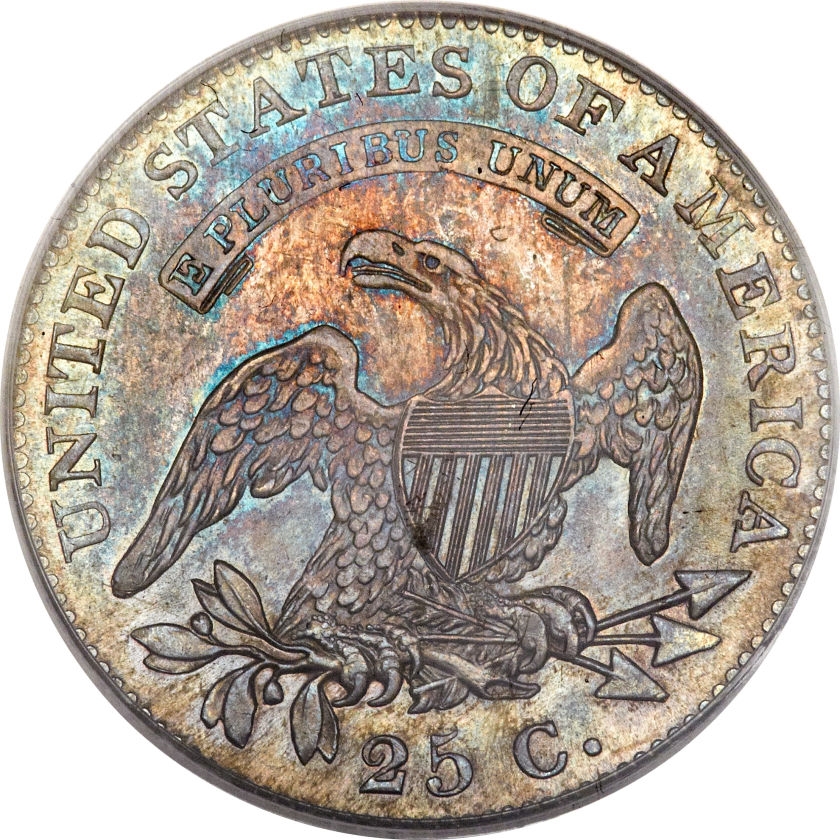
B-1 R2. Finest Known by 3 grading points. Only 4 large Sized Capped Quarters are graded MS67 at PCGS (and none finer) Per cataloger,"Single-Finest Certified. Recently Rediscovered Example. B-1, R.2, MS67 PCGS. A small mintage of 64,080 Capped Bust quarters was accomplished in 1822, with just two die varieties known for the date. This coin represents the more available B-1 variety, easily recognized by the Square Base 2 in the denomination. The scarce B-2 variety displays a blundered 25/5/50 denomination, and employs a Curl Base 2 numeral punch. A single obverse die was used to strike the entire production run and all coins seen were struck from perfect dies. The Capped Bust quarters were first studied and attributed by die varieties in the 1870s, by Captain John W. Haseltine and John Colvin Randall. In his famous Type Table catalog from November 1881, Haseltine described the 1822 B-1 quarter in lot 1330 as: "1822; No. 1; upper left star points to the junction of the upper curl with the band on the forehead; rev., P and I in 'Pluribus' are slightly to the left of being under the centres of S and second T in 'States' very fine; scarce." The lot realized $3.40, a strong price for the time. More recent sales include the spectacular MS64 NGC example from the "Colonel" Green-Eric P. Newman Collections (Heritage, 11/2013), lot 33168, which realized $25,850. That coin was billed as the finest known business-strike 1822 B-1 quarter at the time, but this piece easily eclipses it. The present coin has been off-the-market for decades and is not included in any recent Condition Census. It is the single-finest certified example at either of the leading grading services, with no serious challenger. We believe it is the Anderson Dupont example, last sold in lot 1796 of that Stack's sale in November of 1954, but the low-quality of the image in that appearance makes plate matching problematic. Like most examples seen, this coin shows just a touch of softness on some stars and the eagle's claw, but the eagle's feathers and Liberty's hair and drapery are boldly rendered. The impeccably preserved surfaces radiate vibrant mint luster, under spectacular shades of gold, lavender, and silver-gray toning. Eye appeal is terrific. This coin is a Registry Set essential. Population: 1 in 67, 0 finer (4/15)." Obained from Heritage Long Beach Auction #1221 on June 4, 2015, Lot 3896.
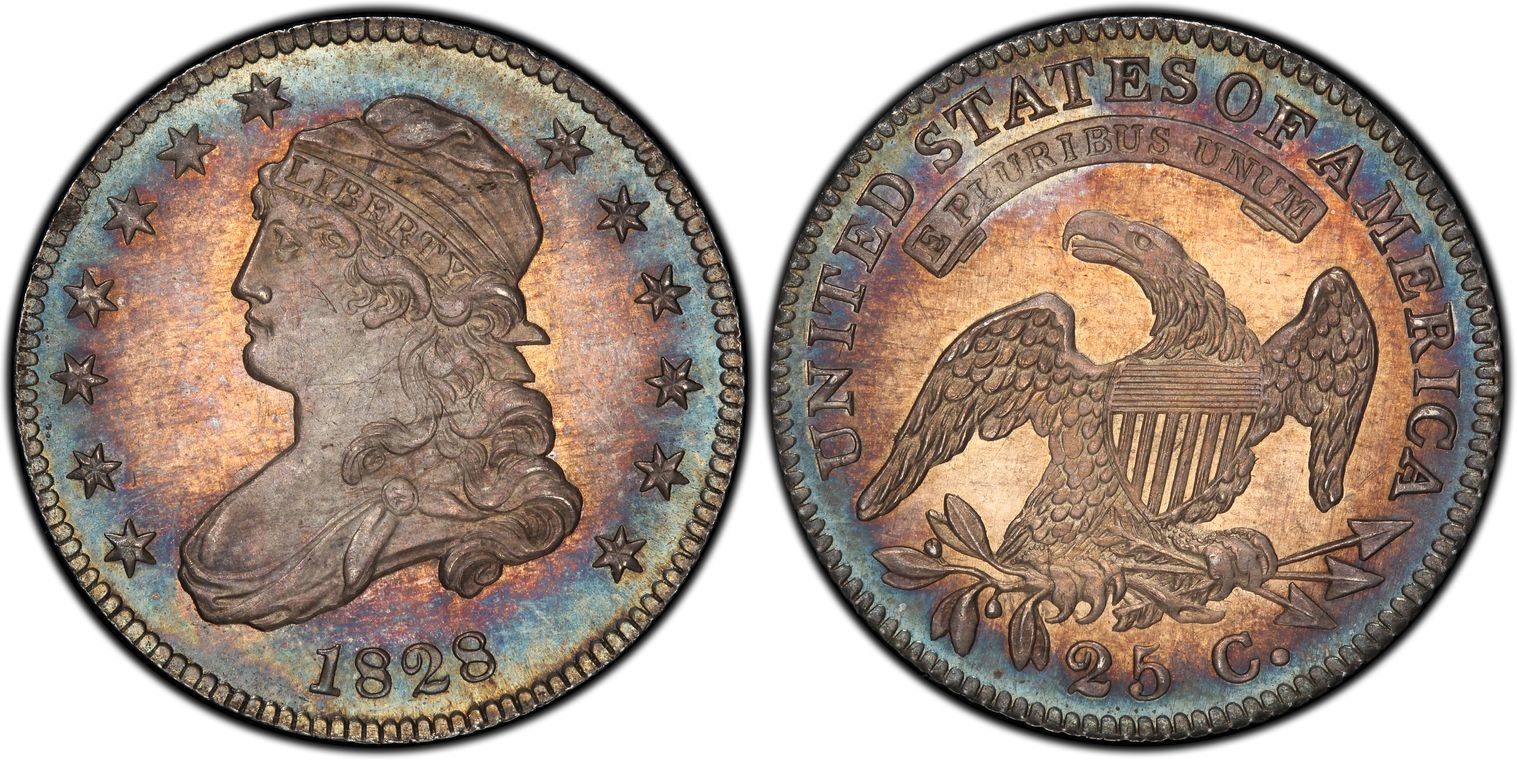
B-4 R3. CAC. Per cataloger, ""Incredible Gem 1828 Bust Quarter. Boldly Prooflike. Finest Graded by PCGS. 1828 Capped Bust Quarter. B-4. Rarity-3. MS-66+ (PCGS). CAC. The portrait of Miss Liberty is boldly rendered and displays delicate violet-gold iridescence. The surrounding reflective fields display amber and indigo iridescence radiating out toward the peripheries. The reflectivity is even more pronounced on the reverse, where the field contrasts markedly with a fully impressed, razor sharp eagle. Vibrant tangerine tones at the center of the reverse cool to teal at the borders. Virtually pristine and thoroughly appealing. This coin ranks as the single finest 1828 quarter of any die variety known to PCGS. We had the pleasure of offering this coin in our (Bowers and Ruddy) February 1976 Dr. D.C. Montgomery, Jr. Collection sale. As that time we described this piece as: ""1828 quarter dollar. Perfect reverse die. Purchased as a superb Proof, this coin possesses 99% of the characteristics of a later (i.e., Liberty seated) Proof, including prooflike surface within the shield stripes. It was undoubtedly struck as a presentation piece, so perfect are its fields and so sharp is its strike. ""If an equal or finer 1828 quarter dollar exists, we haven't seen it. Actually, it is doubtful if a finer one could exist, even in theory. A superb coin for the connoisseur!"" In the numismatic market of the 21st century, the science of positively identifying early (read: pre-1858) United States Mint Proof and specimen coins has become more exact, and PCGS has determined the present example to be a circulation strike. Proofs are known from the 1828 B-4 quarter dies, however, with the online version of the PCGS Population Report accounting for six to eight examples. That estimate squares nicely with the census of seven Proofs listed in the 2010 book Early Quarter Dollars of the United States Mint: 1796-1838 by Rory R. Rea, et al. The existence of Proofs for this variety, coupled with the exceptional strike and prooflike finish of this coin, suggest that it was one of the very first circulation strikes produced after these dies were used to strike one or more of the Proofs. However PCGS is in full concurrence with our earlier (and also current) assessment of this coin as they have confirmed it as the finest 1828 quarter ever to pass through their hands. One of the leading highlights in the Kaselitz Collection -- which is saying quite a lot given the multitude of significant offerings herein. This Gem is sure to see spirited bidding among leading numismatists. Pedigree: Ex our (Bowers and Ruddy's) Dr. D.C. Montgomery, Jr. Collection sale, February 1976, lot 1271.PCGS Population (all die varieties of the issue): just 1; 0 finer." Obtained from Stacks Bowers Auction of the Douglas Kaselitz Collection on July 17, 2015, Lot 5142.
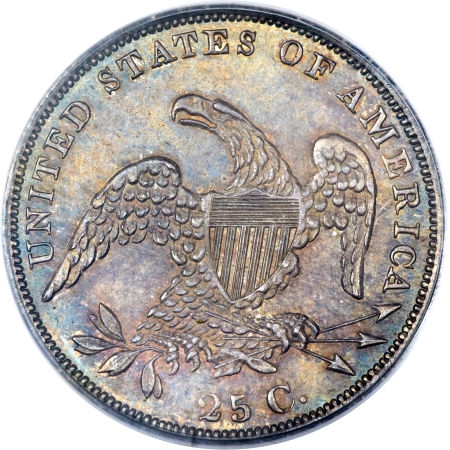
B-5 R.2. CAC. Gardner. Tied second finest at PCGS. Per cataloger, "Condition census for the date and variety. This stellar Gem B-5 1835 quarter is toned medium-gray in the centers while combining blue peripheral accents and hints of rose-gold in the fields. The surface quality is outstanding, as expected for the grade. This piece is identifiable by a pair of minute nicks in the field before Liberty's chin and another tick on the neck. The strike is sharp on all of Liberty's curls and each star save for star 7, which lacks the central radial lines." Sold previously in the Heritage Auction #1214 of the Eugene Gardner Collection on October 27, 2014, Lot 98351. Obtained by private treaty with legend Numismatics on October 31, 2014.
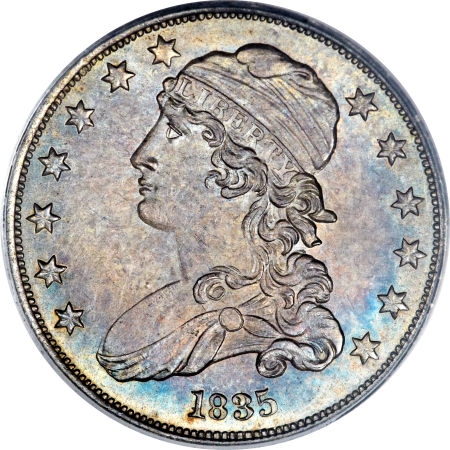
B-5 R.2. CAC. Gardner. Tied second finest at PCGS. Per cataloger, "Condition census for the date and variety. This stellar Gem B-5 1835 quarter is toned medium-gray in the centers while combining blue peripheral accents and hints of rose-gold in the fields. The surface quality is outstanding, as expected for the grade. This piece is identifiable by a pair of minute nicks in the field before Liberty's chin and another tick on the neck. The strike is sharp on all of Liberty's curls and each star save for star 7, which lacks the central radial lines." Sold previously in the Heritage Auction #1214 of the Eugene Gardner Collection on October 27, 2014, Lot 98351. Obtained by private treaty with legend Numismatics on October 31, 2014.
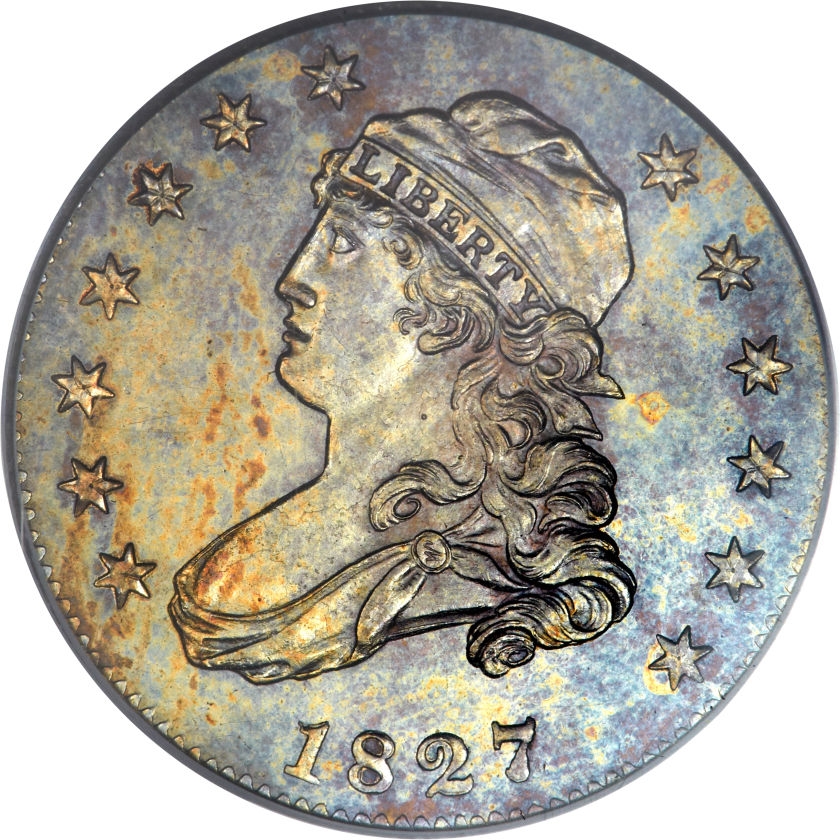
Original B-1 R.7 CAC. Variety, Ex: Boyd. Classic Silver Rarity, Nine Examples Known. This delightful Choice proof exhibits deeply reflective fields, even in the tiny spaces between the shield stripes. The central devices display razor-sharp definition and rich mint frost, but some stars show incomplete radials. The coin is well-centered. Vivid shades of cerulean-blue, champagne-gold, burnt-orange, and sea-green toning enhance the mirrored surfaces. Variety: All Original 1827 quarters were struck from the same pair of dies. The variety was designated as B-1 by Ard W. Browning in his seminal work on the series. The B-1 reverse features a Curl Base 2 in the denomination, while the B-2 Restrikes all display a Square Base 2. The 1827 B-1 obverse die was produced by overdating the 1823/2 B-1 obverse. Population Data (5/14): Only nine Original 1827 quarters are known, but several coins have been resubmitted or crossed over, as evidenced by the single known VF specimen appearing in the data of both services. Provenance: Arthur G. Coffin by December 1867, per a letter from Edward Cogan to Joseph Reakirt; Col. James H. Taylor Collection (William Strobridge, 11/1875), lot 1236; John G. Kellogg Sale (Thomas Elder, 10/1916), lot 1409; Virgil Brand, (Brand Journal number 81228); Armin Brand; F.C.C. Boyd; World's Greatest Collection (Numismatic Gallery, 3/1945), lot 89; Will W. Neil; Neil Collection (B. Max Mehl, 6/1947), lot 897; B. Max Mehl, offered in a full-page ad in the March 1952 The Numismatist, page 289; R.L. Miles; Miles Collection, Part II (Stack's, 4/1969), lot 898; H. Philip Speir; Speir Collection (Stack's, 3/1974), lot 20; ANA Convention Auction (Kagin's, 8/1977), lot 1175; Auction '79 (Stack's, 7/1979), lot 581; Arnold and Romisa Collections (Bowers and Merena, 9/1984), lot 2653; Baltimore Sale (Superior, 7/1993), lot 324; Harold Rothenberger Sale (Superior, 1/1994), lot 1248; May Auction (Superior, 5/1994), lot 576; September Auction (Superior, 9/1998), lot 251. Note: Although this coin was offered in the Col. James Taylor Collection catalog by William Strobridge in 1875, it was not part of Taylor's consignment. The actual consignor is unknown. Obtained from "The Eugene H. Gardner Collection of US Coins" Heritage Signature Auction - New York #1213 on June 23, 2014, Lot 30357.
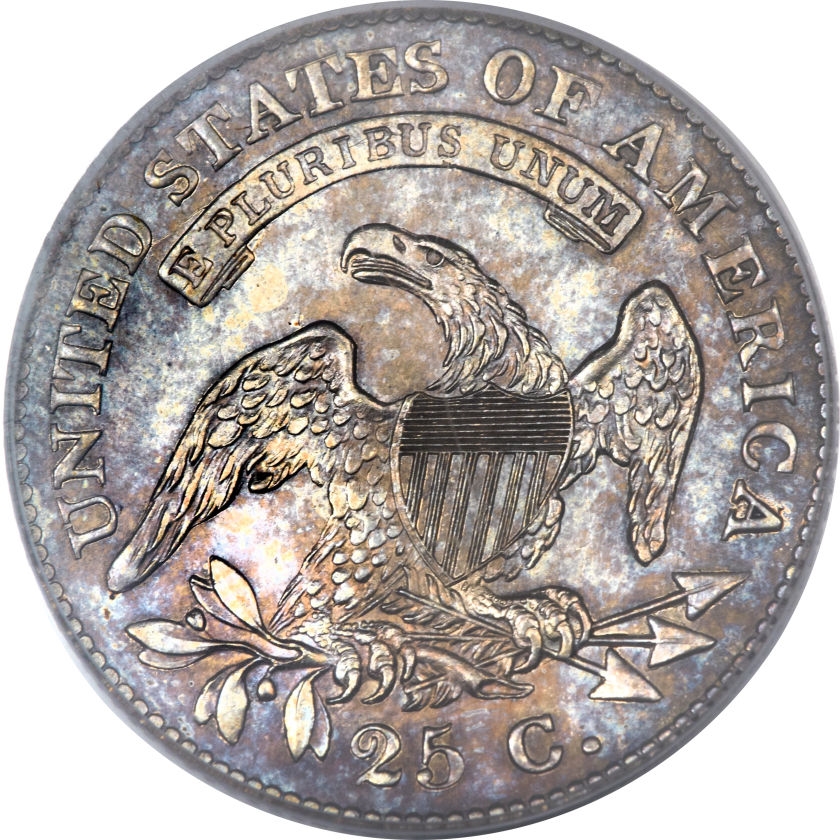
Original B-1 R.7 CAC. Variety, Ex: Boyd. Classic Silver Rarity, Nine Examples Known. This delightful Choice proof exhibits deeply reflective fields, even in the tiny spaces between the shield stripes. The central devices display razor-sharp definition and rich mint frost, but some stars show incomplete radials. The coin is well-centered. Vivid shades of cerulean-blue, champagne-gold, burnt-orange, and sea-green toning enhance the mirrored surfaces. Variety: All Original 1827 quarters were struck from the same pair of dies. The variety was designated as B-1 by Ard W. Browning in his seminal work on the series. The B-1 reverse features a Curl Base 2 in the denomination, while the B-2 Restrikes all display a Square Base 2. The 1827 B-1 obverse die was produced by overdating the 1823/2 B-1 obverse. Population Data (5/14): Only nine Original 1827 quarters are known, but several coins have been resubmitted or crossed over, as evidenced by the single known VF specimen appearing in the data of both services. Provenance: Arthur G. Coffin by December 1867, per a letter from Edward Cogan to Joseph Reakirt; Col. James H. Taylor Collection (William Strobridge, 11/1875), lot 1236; John G. Kellogg Sale (Thomas Elder, 10/1916), lot 1409; Virgil Brand, (Brand Journal number 81228); Armin Brand; F.C.C. Boyd; World's Greatest Collection (Numismatic Gallery, 3/1945), lot 89; Will W. Neil; Neil Collection (B. Max Mehl, 6/1947), lot 897; B. Max Mehl, offered in a full-page ad in the March 1952 The Numismatist, page 289; R.L. Miles; Miles Collection, Part II (Stack's, 4/1969), lot 898; H. Philip Speir; Speir Collection (Stack's, 3/1974), lot 20; ANA Convention Auction (Kagin's, 8/1977), lot 1175; Auction '79 (Stack's, 7/1979), lot 581; Arnold and Romisa Collections (Bowers and Merena, 9/1984), lot 2653; Baltimore Sale (Superior, 7/1993), lot 324; Harold Rothenberger Sale (Superior, 1/1994), lot 1248; May Auction (Superior, 5/1994), lot 576; September Auction (Superior, 9/1998), lot 251. Note: Although this coin was offered in the Col. James Taylor Collection catalog by William Strobridge in 1875, it was not part of Taylor's consignment. The actual consignor is unknown. Obtained from "The Eugene H. Gardner Collection of US Coins" Heritage Signature Auction - New York #1213 on June 23, 2014, Lot 30357.
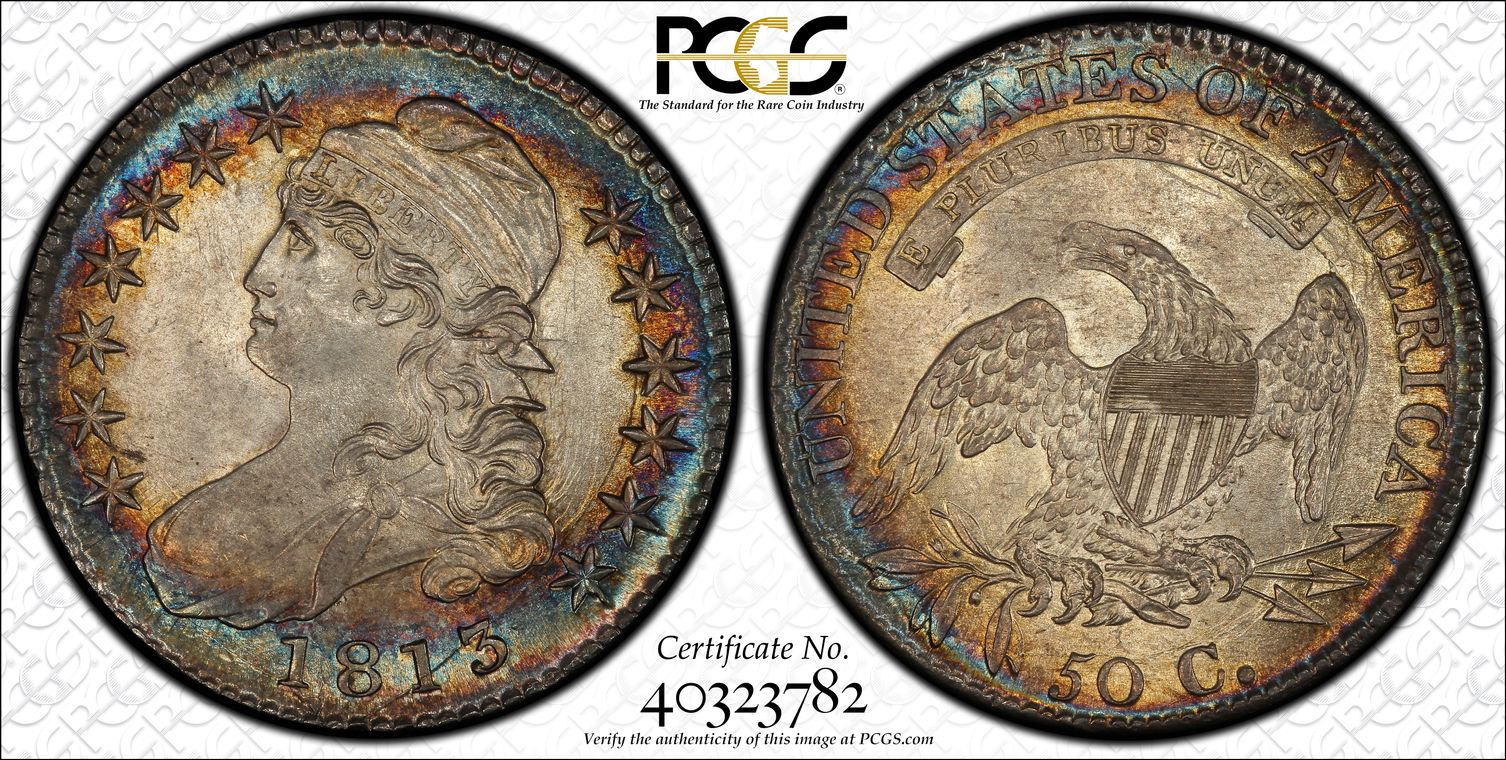
O.107a R1. CAC. Green, Newman, Simpson. Finest Known 1813 Capped Half Dollar by a country mile. Per cataloger, "Sole Finest. Ex: Green-Newman. Diagnostic markers for the O-107 die pair include a horizontal line through Liberty's hair curls and ribbon, and a die line from the leftmost leaf tip to the dentil. Most survivors from this die pair are in a later state with cracks through the arrowheads and denomination. The present coin is two full grading points finer than any other example of an 1813 O-107 (or O-107a) half dollar, clearly taking top spot on Stephen Herrman's Condition Census. It is actually one of only 26 Capped Bust halves certified at PCGS for any year between 1807 and 1836, and just two individual coins for all years are graded higher at that service. What might one say about a coin of this caliber? It is everything one would expect of the stratospheric MS67 designation. The coin is truly "as struck" in terms of luster and preservation, with the joyous addition of iridescent color through the stars and legend. The luminous silver centers are surrounded by champagne-gold and electrified cobalt-blue toning. This Superb Gem combines Registry Set technical quality with breathtaking eye appeal in one irresistible package. There is no question that bidders will enjoy an exhilarating experience competing for this remarkable, impeccably pedigree half dollar. Ex: "Colonel" E.H.R. Green; Green Estate; Partnership of Eric P. Newman / B.G. Johnson d.b.a. St. Louis Stamp & Coin Co.; Eric P. Newman @ $5.00; Eric P. Newman Numismatic Education Society; Newman Collection, Part II (Heritage, 11/2013), lot 33444." Obtained from Heritage Auction of the Robert Simpson Collection, Part 1 on September 17, 2020, Lot 10078.
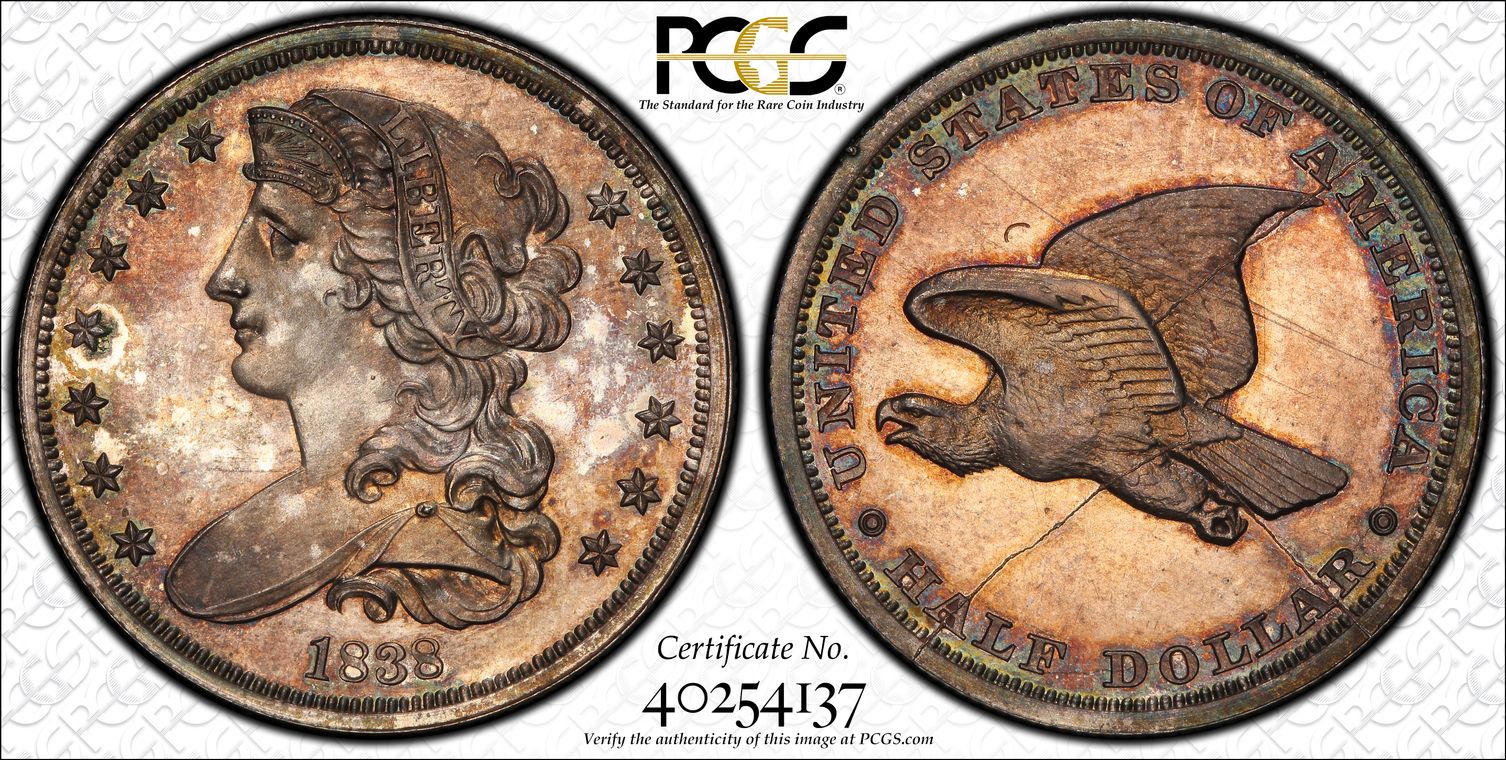
Judd-73 R.5. CAC. Simpson Lot 3039. Per cataloger, "Judd-73 Restrike, Pollock-77, R.5, PR64+ PCGS. CAC. Ex: Simpson. A draped bust of Liberty faces left on the obverse, with a flying eagle dominating the reverse. Kneass was once believed to designed this pattern, but visual evidence points to Christian Gobrecht, since the face of Liberty bears a strong resemblance to her counterpart on the ten dollar Liberty, also introduced in 1838. Struck in silver with a reeded edge. Medallic alignment. Probably all Judd-73 halves are restrikes, since the three prominent radial cracks on the reverse do not appear on Judd-79 patterns, which were struck in 1838. The obverse exhibits mottled gray-rose toning with occasional dabs of brilliance showing, while the reverse has a pronounced reddish hue with cobalt-blue around the margins." Obtained from Heritage Auction of Robert Simpson Collection on August 18, 2021.
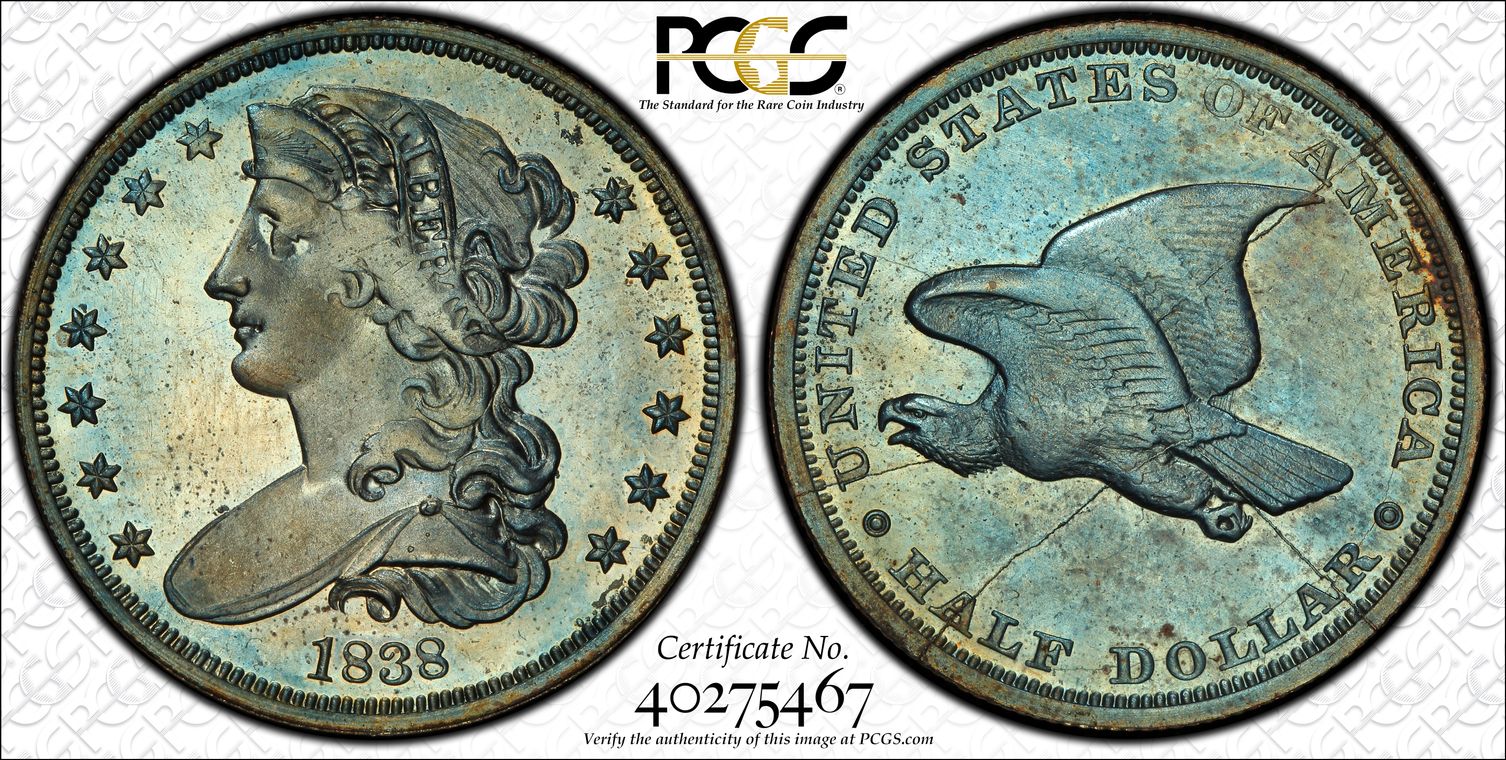
Judd-74. R8+. Unique. Norweb. Simpson. Copper version of Judd-73 in (Was in Simpson bought as NGC MS66BN). Lot 3098. Per cataloger, "Unique Judd-74 Restrike, Kneass Design PR66BN PCGS. Per cataloger, "Ex: Simpson. The obverse displays the William Kneass ("the last work executed by him," according to Judd, before his debilitating 1835 stroke) left-facing draped Liberty Head design (used on Judd-72 to Judd-75) showing an expansive bustline, wearing a coronet reading LIBERTY, 13 stars separated seven and six around the rim, the date 1838 below. The reverse design, attributed to Christian Gobrecht, features a crimp-necked eagle flying left with UNITED STATES OF AMERICA and HALF DOLLAR around. Four or five die cracks radiate to the rims from the central areas. Both the advanced die cracks and extensive die rust on both sides peg this coin as a late-state restrike dating to the 1870s, called by USPatterns.com a "fantasy piece." Struck in copper with a reeded edge. These dies have a long and fascinating history. Although "originals" (Judd-73, silver, reeded edge) are supposedly known, none survive with no die cracks. Such coins would weigh the statutory standard for 1838 of 206 grains, and would likely have been placed in the Mint Cabinet, formed in that same year -- yet none are there. The earliest die state examples known of the reverse die are a handful of Judd-79 coins (with Liberty Seated obverse, silver, reeded edge), showing a die crack running through F DOLLAR AMERICA. Ex: Woodside Collection (New York Coin & Stamp, 4/1892), lot 21; 22nd Sale (Thomas Elder, 12/16/1908), lot 954; to A.F. Holden; Norweb Collection; New Netherlands 41st Sale (9/1953), Macy's (6/1954), lot 1549; ANA Signature (Heritage, 8/2008); Simpson Collection." Obtained from Heritage Auction of the Simpson Collection Part 2 on November 19, 2020, Lot 3098.
Judd-76 R8. CAC. Simpson. Two Known. Silver Restrike with plain edge. Per cataloger, "Judd-76 Restrike, Pollock-83, R.8, PR63 PCGS. CAC. Ex: Simpson. The obverse is similar to the adopted design with only slight differences. The reverse, however, is noticeably different, with a spread-winged eagle that holds four arrows and a laurel branch. Struck in silver with a plain edge. The restrikes, such as seen here, show scattered die rust on the reverse and are believed to have been struck in the 1870s. The surfaces on each side are toned in different hues, with the obverse pale blue while the reverse is golden. The fields are bright and reflective throughout. Sharply detailed on the obverse, but the reverse shows just a bit of softness on the eagle's breast feathers." Obtained from Heritage Auction of Robert Simpson Collection Part 6 on 2021, Lot Simpson. Lot 3040. Silver Restrike with plain edge. Per cataloger, "Judd-76 Restrike, Pollock-83, R.8, PR63 PCGS. CAC. Ex: Simpson. The obverse is similar to the adopted design with only slight differences. The reverse, however, is noticeably different, with a spread-winged eagle that holds four arrows and a laurel branch. Struck in silver with a plain edge. The restrikes, such as seen here, show scattered die rust on the reverse and are believed to have been struck in the 1870s. The surfaces on each side are toned in different hues, with the obverse pale blue while the reverse is golden. The fields are bright and reflective throughout. Sharply detailed on the obverse, but the reverse shows just a bit of softness on the eagle's breast feathers." Obtained from Heritage Galleries Auction of the Robert Simpson Collection Part 6 on August 18, 2021, Lot 3048.
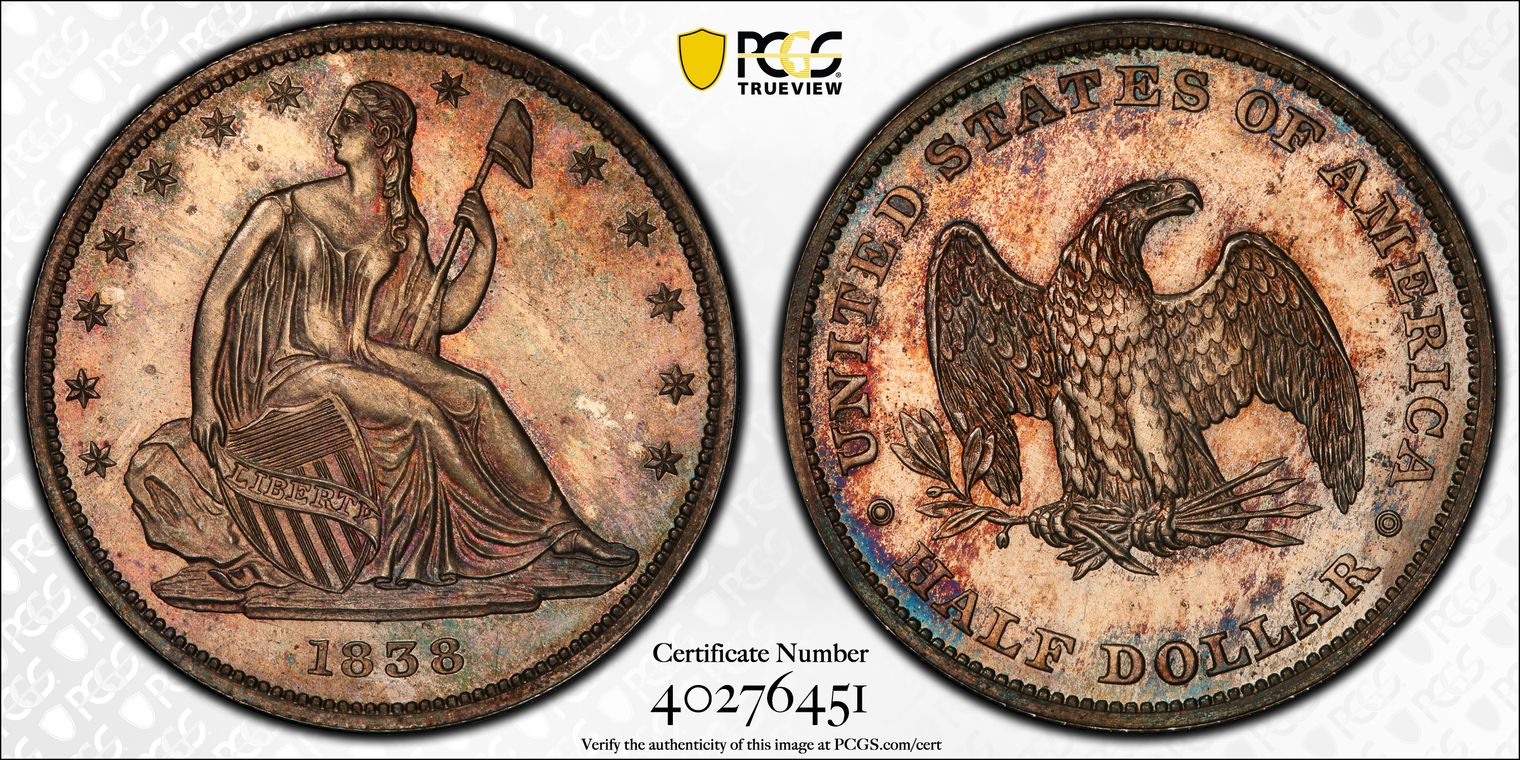
Judd-76a. R8. CAC. Simpson. Two Known. Per cataloger, "1838 Half Dollar in Silver. Judd-76a Restrike, PR64+. Just Two Pieces Known. 1838 P50C Seated Liberty Half Dollar, Judd-76a Restrike, Pollock-82, R.8, PR64+ PCGS. CAC. Ex: Simpson. The obverse is similar to the adopted Seated Liberty design. Differences include an incuse LIBERTY and a wide, slightly curved date. The reverse is noticeably different, with a spread-winged eagle that holds four arrows and a laurel branch. Struck in silver with a reeded edge. The die combination was also struck in silver with a plain edge (Judd-76), and in copper with a plain (Judd-77) and reeded (Judd-78) edge. All are believed to be struck during the 1870s, due to die rust evident on the reverse. Originals (Judd-76b) were coined in silver only, from a different obverse die with LIBERTY raised, and a rust-free reverse. This well-preserved near-Gem exhibits attractive original rose-gold, navy-blue, plum-red, and apple-green toning. The strike shows moderate incompleteness on the eagle's breast and legs. There are no relevant detractions. Only two Judd-76a patterns are confirmed, the present lot and the Witham-Queller specimen we auctioned in January, July, and September 2009. Ex: Édouard Frossard; T. Harrison Garrett; Robert Garrett; John Work Garrett; Johns Hopkins University; Garrett Collection, Part 1 (Bowers and Ruddy, 11/1979), lot 364; Harry W. Bass, Jr. Collection, Part I (Bowers and Merena, 5/1999), lot 1147; Elite Coin Auction (Superior, 4/2003), lot 240." Obtained from Heritage Galleries Auction of the Robery Simpson Collection Part 3 on January 20, 2021, Lot 3061.
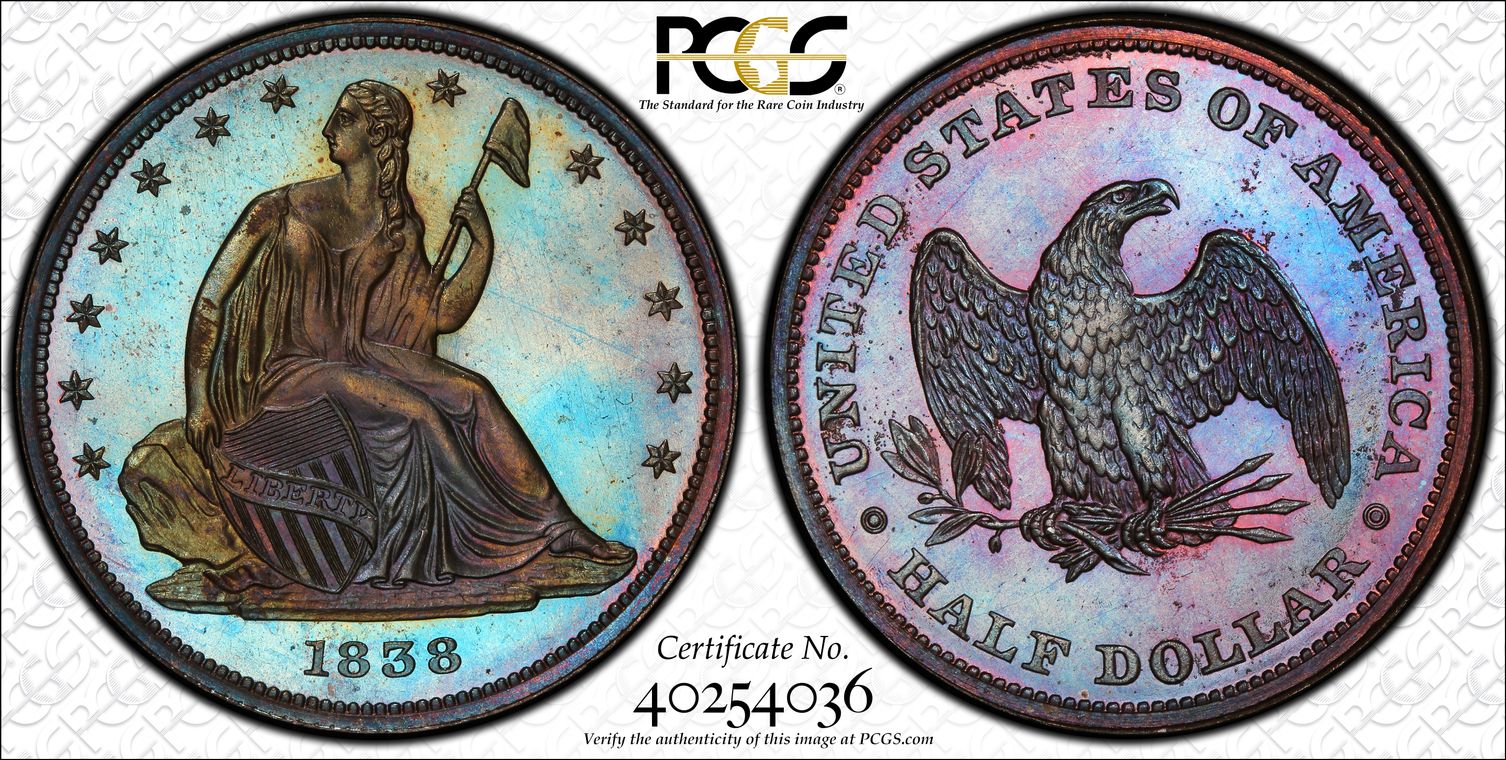
Judd-77. R7+. Simpson. Four Known. Per cataloger, "Judd-77 Restrike, Pollock-85, High R.7 PR66+ Red and Brown PCGS. Ex: Simpson. The obverse features the regular-issue No Drapery design, while the reverse has a heraldic eagle in the center that is similar to the two cent patterns from 1836. Struck in copper with a plain edge. Four examples of Judd-77 are known. These, like other patterns of this type in different metal/edge combinations, were actually produced during the 1870s. Heavy die rust on the reverse is a telltale diagnostic for restrikes, as is the incuse LIBERTY on the obverse. Both sides are glossy brown with iridescent accents of violet, olive-gold, and bluish toning when rotated. The coin is near-flawlessly preserved and virtually fully struck, save for a touch of softness on the eagle's breast. Ex: Greenwald and Jackson Collections (Bowers and Merena, 9/1995), lot 1632; Fixed Price List (Heritage, 5/1997); Lindesmith Collection (Bowers and Merena, 3/2000), lot 2025; Pre-Long Beach Sale (Superior, 10/2000), lot 4435." Heritage Galleries Auction of Robert Simpson Collection Part 6 on August 18, 2021, Lot 3041.
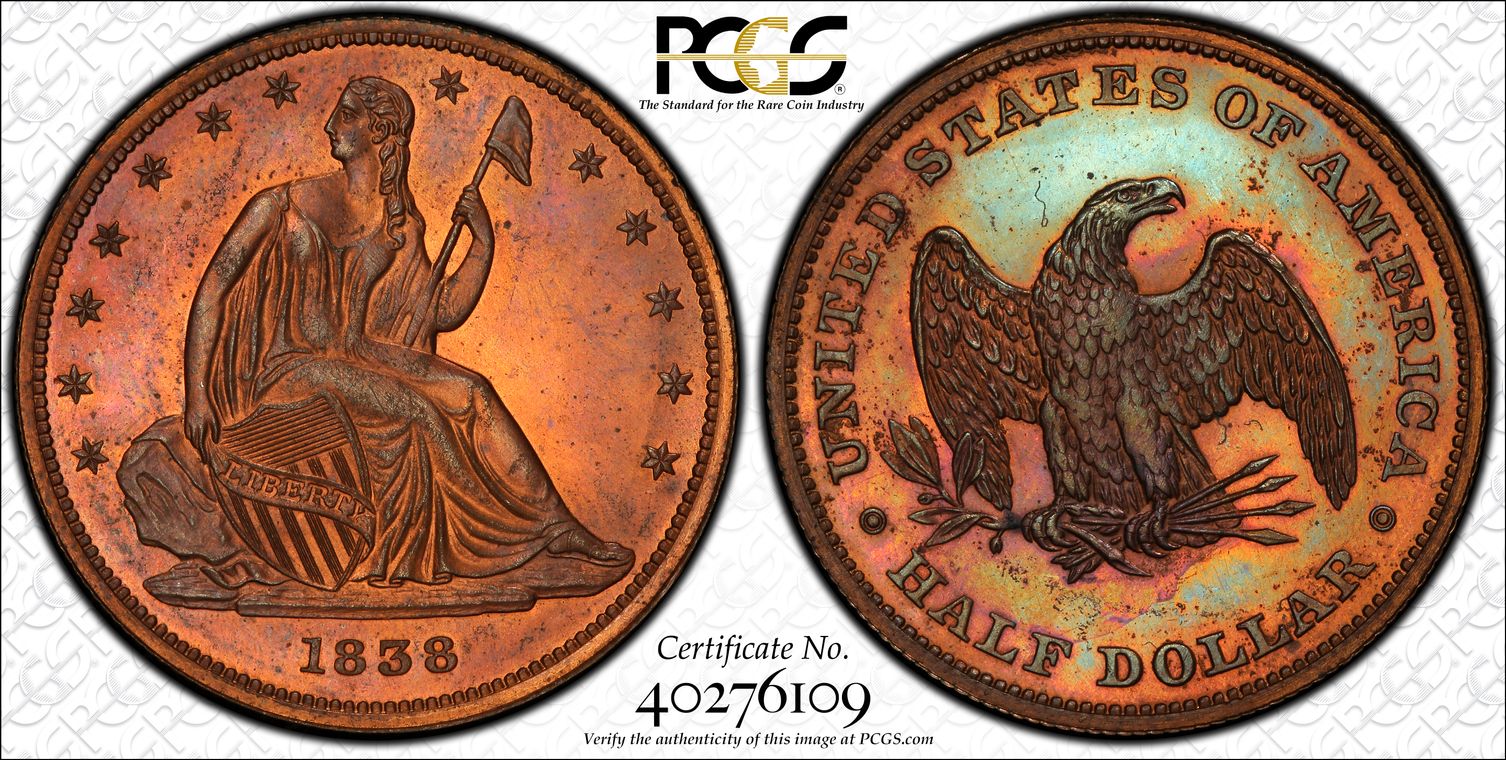
Judd-78. R7+. CAC. Simpson. PR66+RB. Copper Restrike. Per cataloger, "1838 Seated Liberty Half Dollar in Copper. Judd-78 Restrike, PR66+ Red and Brown. Only Four Confirmed Examples. 1838 P50C Seated Liberty Half Dollar, Judd-78 Restrike, Pollock-84, High R.7 PR66+ Red and Brown PCGS. CAC. Ex: Simpson. The obverse features Liberty seated on a rock with shield and pole. A scroll draped across the shield has the inscription LIBERTY in incuse letters. Thirteen stars around and the date below. The reverse shows an eagle with wings spread holding an olive branch and four arrows. The legend UNITED STATES OF AMERICA around and the denomination HALF DOLLAR below. Medallic turn. Struck in copper with a reeded edge." Obtained from Heritage Auction of Robert Simpson Collection Part 5 on April 23, 2021, Lot 4191 [Actually purchased immediately after the auction from the purchaser]. Judd-76 through Judd-78 are restrikes, possibly made during the 1870s. Their original counterparts feature the letters in LIBERTY raised on the shield and were only struck in silver. USPatterns.com confirms four examples of Judd-78. This Premium Gem with added recognition from PCGS and CAC is largely copper-orange with accents of pastel blue, green, and violet that are especially noticeable on the reverse. Well-preserved with a trace of softness on the eagle's right (facing) leg. Ex: Stewart Witham; Auction '81 (RARCOA, 7/1981), lot 316; Dallas Auction (Heritage, 6/1989), lot 1467; Morris Evans Collection (Bowers and Merena, 8/1998), lot 2034; Higman-Alterman (Larry Hanks/Mal Varner offering); Robert W. Schwan Collection (Bowers and Merena, 10/2000), lot 2018; Public Auction sale (Superior, 4/2003), lot 241.
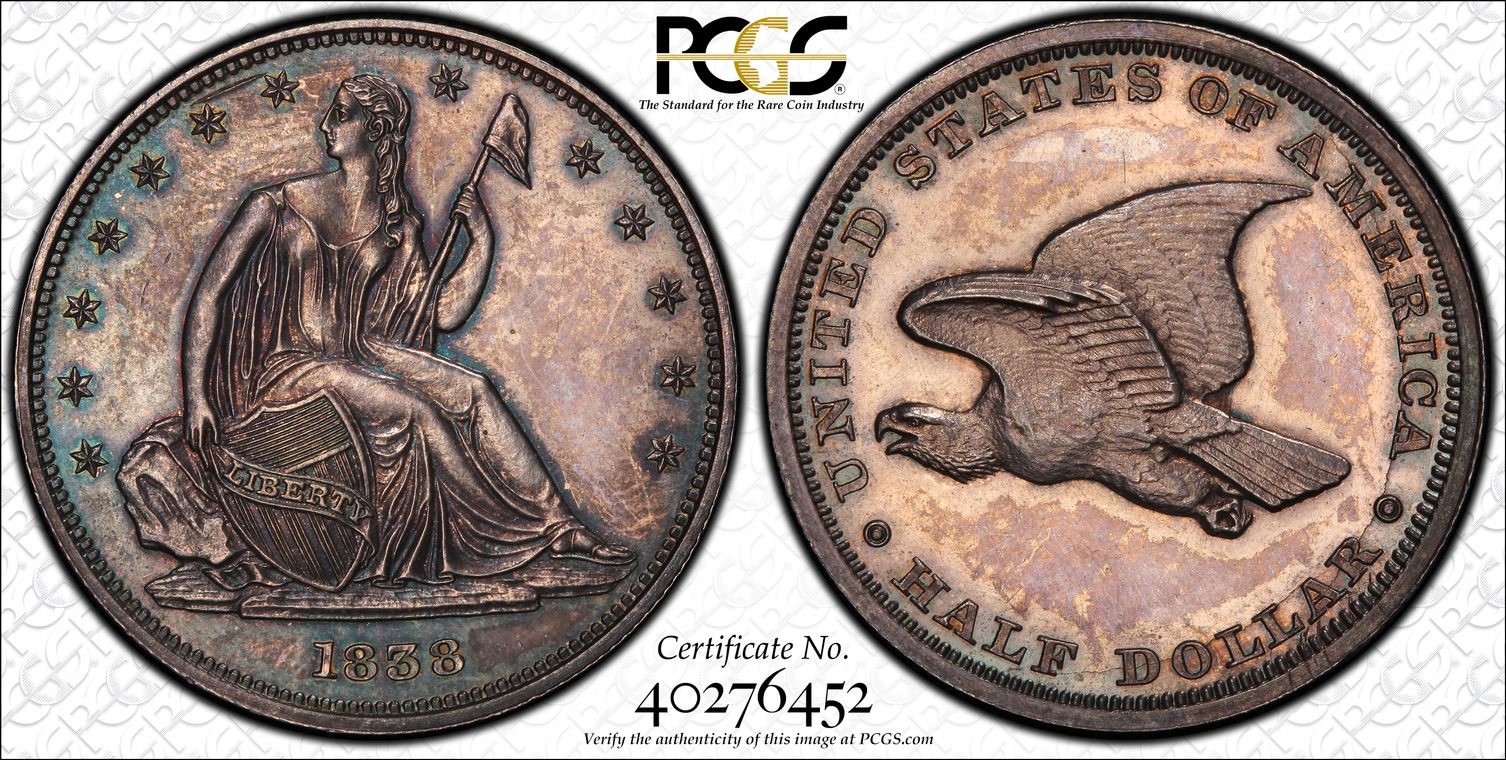
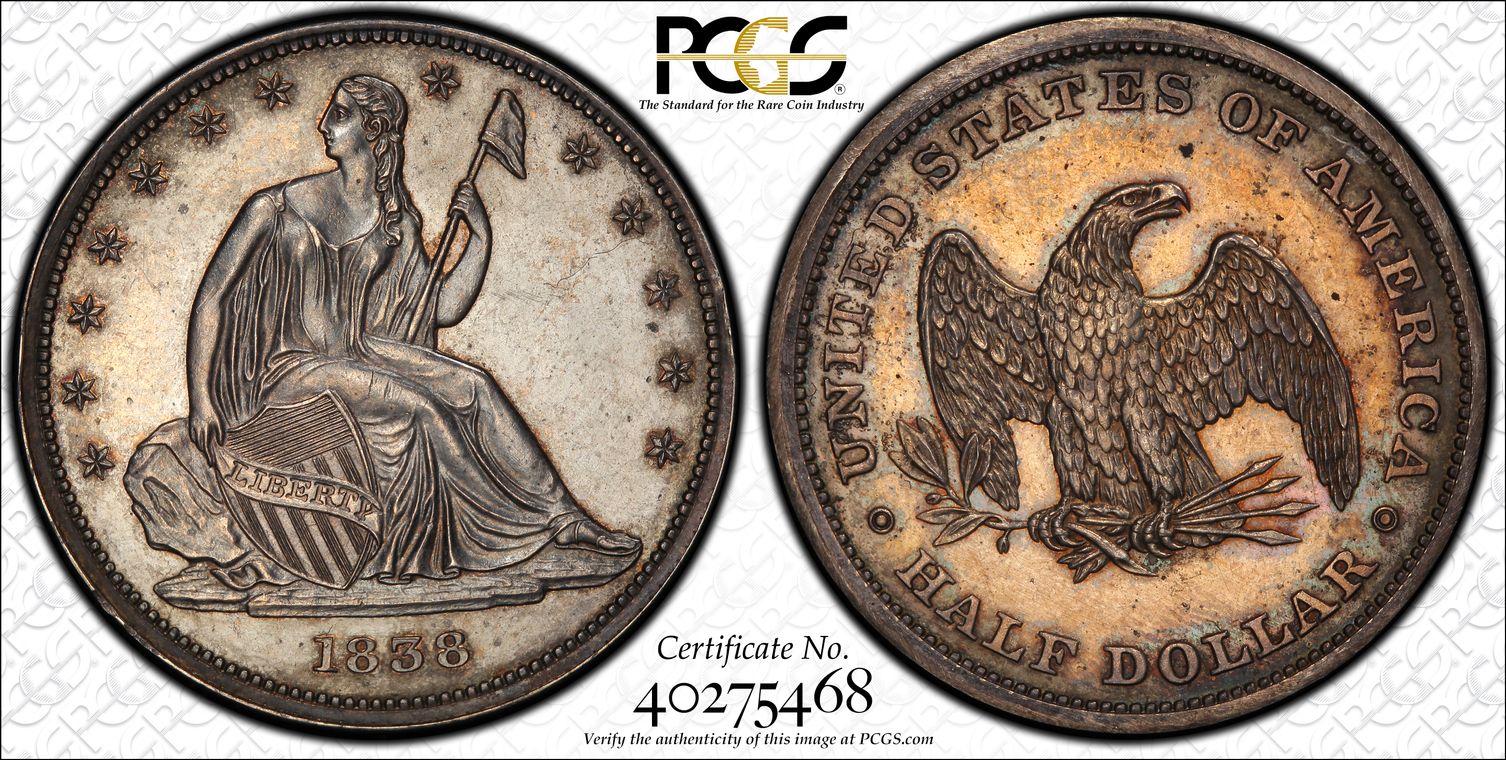
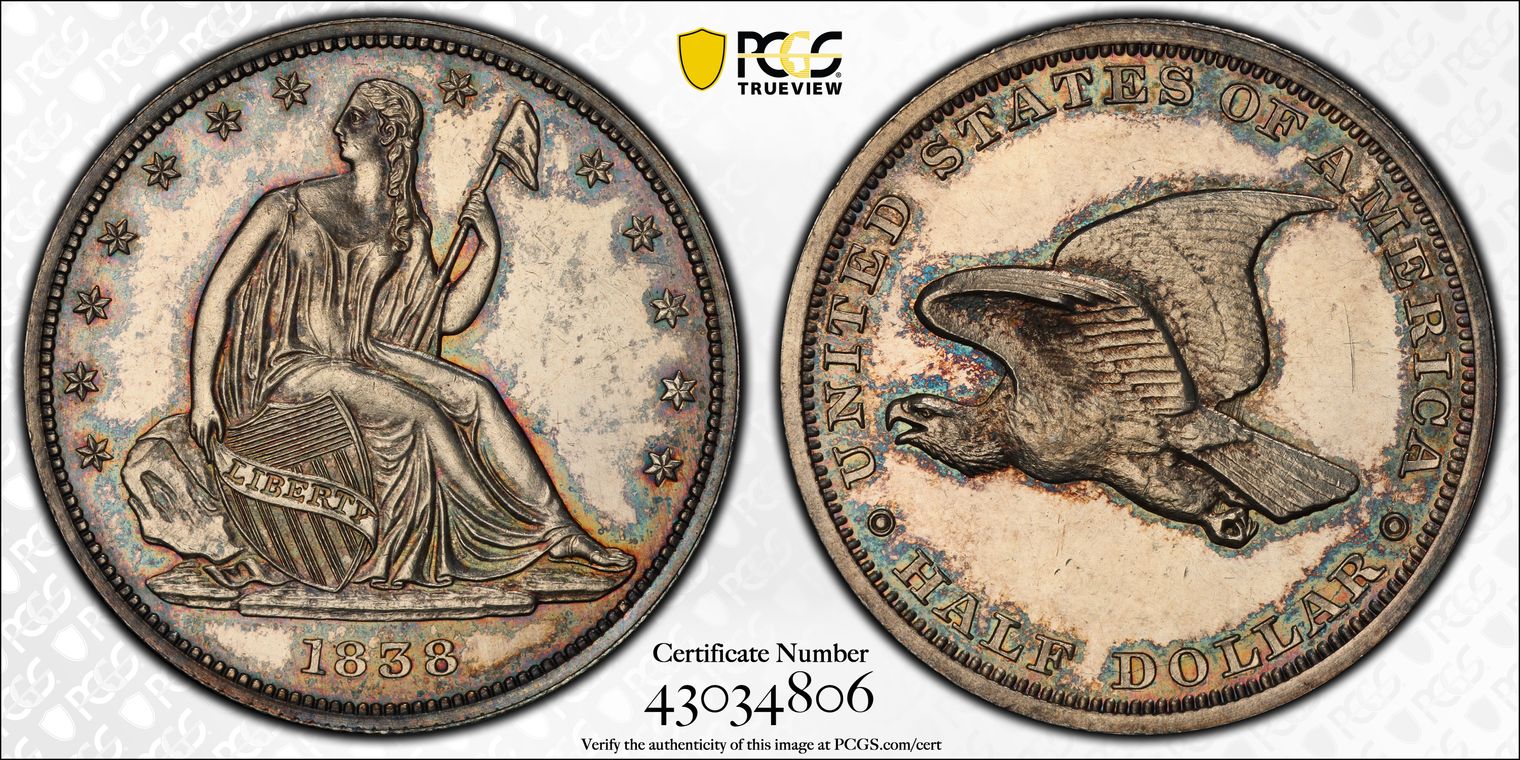
Judd-79. R7+. Bass. Simpson. Dupont. Five Known. Silver. Per cataloger, "1838 Seated Liberty Half in Silver. Judd-79 Original, PR63. Ex: Bass, One of Five Known. 1838 P50C Seated Liberty Half Dollar, Judd-79 Original, Pollock-89, High R.7, PR63 PCGS. Ex: Bass-Simpson. 201 grains, per its Auction '81 catalog appearance. The obverse displays the Seated Liberty design, close to the one adopted for circulation strikes, with the date slightly curved and the word LIBERTY raised on the shield. The reverse shows Gobrecht's Flying Eagle design, with UNITED STATES OF AMERICA on the upper rim and HALF DOLLAR at the lower margin. Struck in silver with a reeded edge. Medallic alignment. All examples of Judd-79 are originals, and lack the radial cracks seen on the reverses of the Judd-79a restrikes, which also show LIBERTY incused. The strike is fairly sharp, with only slight blending on the breast feathers of the high-relief eagle. The borders show ocean-blue toning, while the open fields display pastel pink and gold shades. The grade is limited solely by a narrow mark between stars 6 and 7. USPatterns.com confirms only five different specimens of Judd-79. Ex: Anderson Dupont Collection (Stack's, 11/1954, lot 2105; Witham Collection / Auction '81 (RARCOA, 7/1981), lot 317, Harry W. Bass, Jr.; Harry W. Bass, Jr. Research Foundation; Chicago ANA Signature (Heritage, 8/2014), lot 5794." Obtained from Heritage Galleries Auction of the Robert Simpson Collection on January 20, 2021, Lot
Judd-79a R7-. Eliasberg. Essai. "Incuse liberty obverse (so-called straight date) only original from this obverse die. The reverse die is in its earliest known state with die cracks only through "F Dollar * America". At least one was struck by W.E. Dubois for Matthew Stickney as there is a letter dated July 12, 1843 in the Peabody Essex Museum," per uspatterns.com. Per cataloger, "Ex: Eliasberg. The obverse is similar to the adopted design of 1839. The reverse is an early impression from Gobrecht's flying eagle design, which makes this coin a reduced version of the Gobrecht dollar. Struck in silver with a reeded edge. This is the so-called "Straight Date" variant of Judd-79, of which only a dozen or so pieces are known. The surfaces are bright and mostly pearl-gray with wisps of golden-brown and blue toning around the margins. A rare and infrequently offered pattern. Ex: Chapman Brothers April 1897 Sale; J.M. Clapp; Clapp Estate, 1942, to Louis E. Eliasberg, Sr.; Eliasberg Collection (Bowers and Merena, 5/96), lot 233, where it brought $7,920; Long Beach Signature (Heritage, 5/2003), where it realized $12,650. From The Collection of William Rau." Crossed from NGC PR63 [615406-024] to PCGS PR62 in 2021. Obtained from Heritage Auction #1284 on April 26, 2018, Lot 4483.
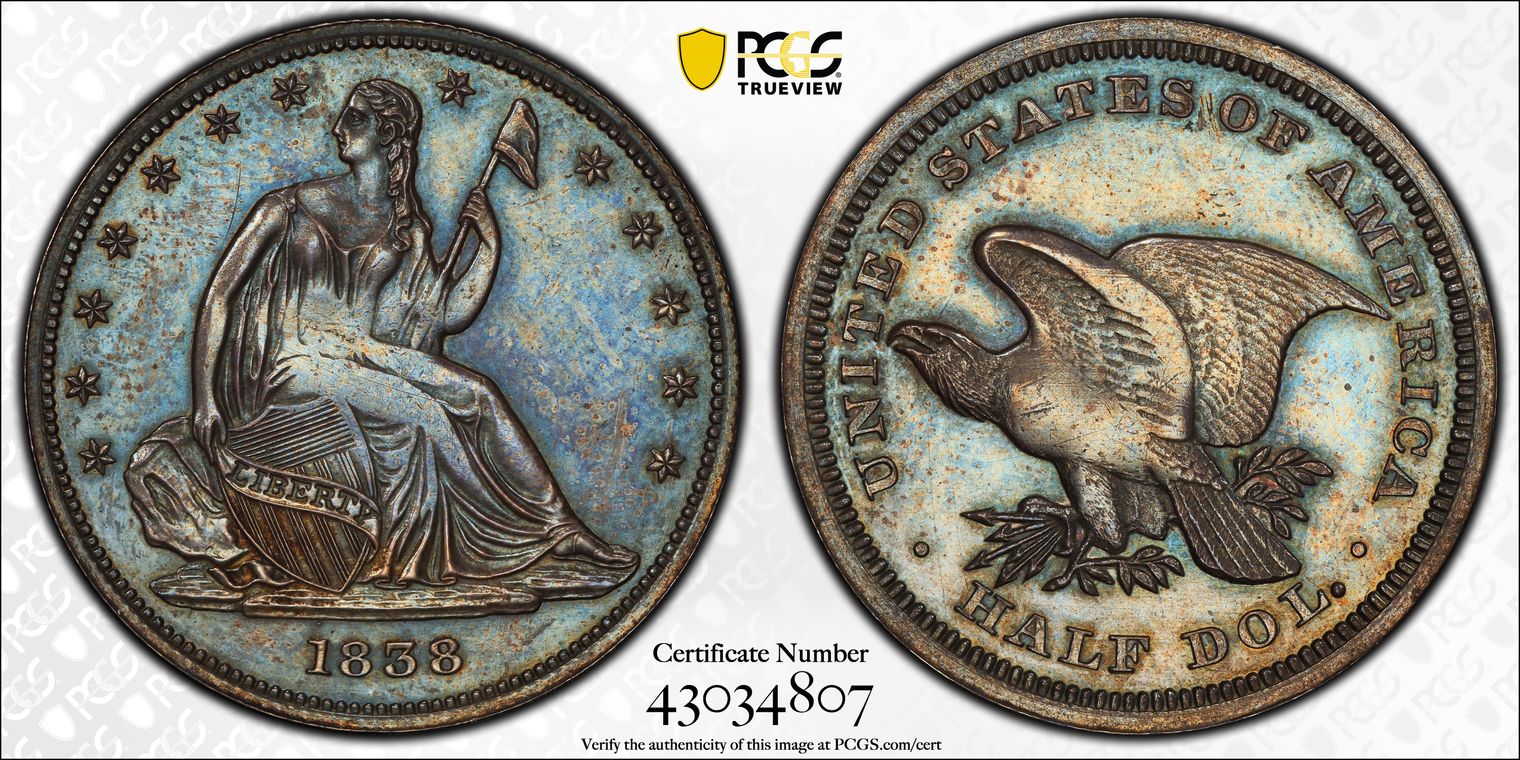
Judd-80 R7+. Simpson. Five Known. Restrike? in Silver with Reeded Edge. Per uspatterns.com, "Incuse liberty obverse (so-called straight date) the reverse not believed to have existed until the mid 1860s. To my knowledge, no originals were ever made using this reverse die. In fact, I believe that this die was actually finished many years later either in the late 1860s or early 1870s. This appears to be the last use of this obverse die as there is a crescent shaped bulge or clash to the left of Liberty's right arm, as shown below courtesy of PCGS, which does not appear on any other restrikes using this obverse die." Per Heritage cataloger, "Seated Liberty Half Dollar, Judd-80 Restrike, Pollock-87, High R.7, PR63 NGC. The obverse design is a slightly modified Seated Liberty motif, with the rock larger, the stars spaced differently, and Liberty's drapery rearranged. The word LIBERTY is incused on the scroll. The date is in the exergue. The reverse features a "defiant" eagle, clutching an olive branch and six arrows, with the legend UNITED STATES OF AMERICA around and HALF DOL. below. Struck in silver with a reeded edge. The Judd-80 is apparently a restrike from the late 1860s or early 1870s. Only a half dozen examples are known in silver and copper. While termed a restrike, no originals are known. The strike is weakly defined in the center of each side, most likely because the relief was too high on both obverse and reverse. As a result there was not enough metal to fill the recesses of the design. The color is well-balanced with brown and blue patina intermixed throughout. From The Bob Simpson Collection" Provenance: Heritage August 11, 2010, Lot 3700. Obtained by private treaty with Park Avenue Numismatics on August 6, 2014.
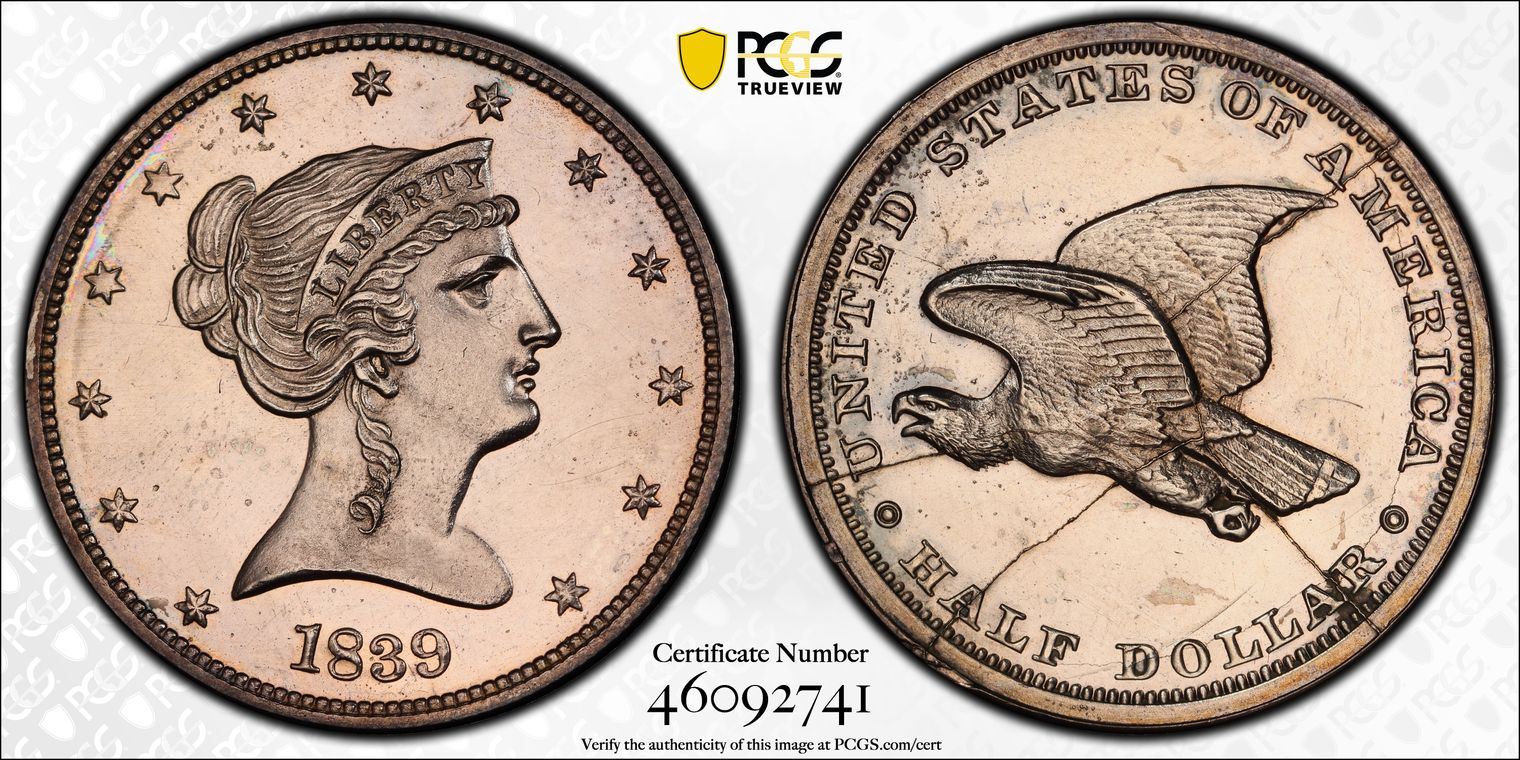
Judd-91 R.8. Bass. Farouk. Silver Restrike Half Dollar. Per cataloger, "Judd-91 Restrike, Terrific Pedigree, Only Two Known, One in Private Hands. (the other in Durham museum). Pollock-101, R.8 PR63 PCGS. Ex: Harry W. Bass, Jr. Collection. The obverse has a bust of Liberty, facing right, with thirteen stars around and the date 1839 below. Liberty's hair is knotted in a bun, and a long curl trails below the ear. This obverse is similar to the one used on 1838 eagles but it faces the other way. This particular design uses the regular 'Small Letters' reverse die of 1839. The reverse shows a Flying Eagle design, with UNITED STATES OF AMERICA on the upper rim and HALF DOLLAR at the lower margin. Struck in silver with a reeded edge. This remarkable rarity enjoys a pedigree that reads like a who's who of pattern collecting. Pale rose-gold patina drapes each side. A few small stray marks are noted and the impression is a bit incomplete, but those traits are entirely inconsequential. This will serve as the only example of Judd-91 in private hands. Ex: William H. Woodin; Waldo C. Newcomer; F.C.C. Boyd; King Farouk; Palace Collections of Egypt (Sotheby's, 2/1954), lot 1732; J. Hewitt Judd, Krouner-Coronet FPL #75; Stewart Witham; Auction '81 (RARCOA, 7/1981), lot 363." Obtained from Heritage Auction of the Bass Collection Part 1 on September 29, 2022, Lot 11073.
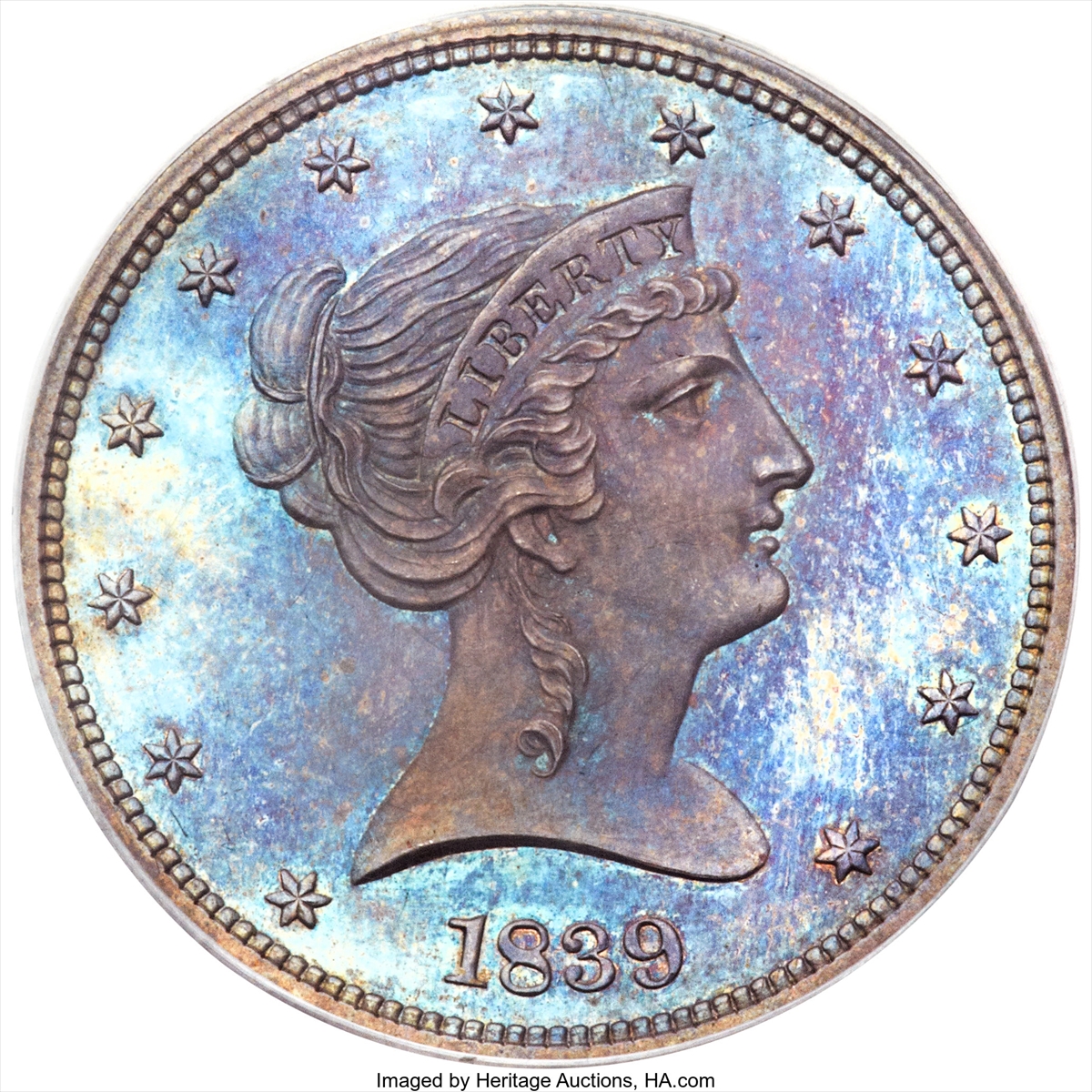
Judd-93. R7. Silver. Eight Known (3 in museums: Smithsonian, Bass Foundation, Byron Reed Museum). Per cataloger, "1839 Original Half Dollar, Judd-93, PR66. Finest Certified, Possibly Sole Finest Known. 1839 P50C Half Dollar Judd-93 Original, Pollock-105, R.7, PR66 PCGS. CAC. The obverse design resembles used on the 1839 gold eagles including the rounded forward bust truncation and pointed rear truncation, but the bust of Liberty faces right rather than left. The reverse employs the regular Small Letters die of the year. Per the authoritative USPatterns.com website, the Judd-93 coins are the only original patterns using this obverse die, of which perhaps seven survive today. (Several of those examples, however, are in institutional holdings.) Struck in silver with a reeded edge. This problem-free piece boasts incredible eye appeal on surfaces that show excellent preservation amid the beautiful medium blue tones around the peripheries with pale lavender centers on each side. This PR66 PCGS piece is possibly the sole finest known and apparently the finest certified. It is the finest at PCGS by two grade points; the finest at NGC is a single PR65 (11/14). From The A. James Evans Collection, Part II." Obtained from Heritage Galleries Auction on January 7, 2021, Lot 4492.
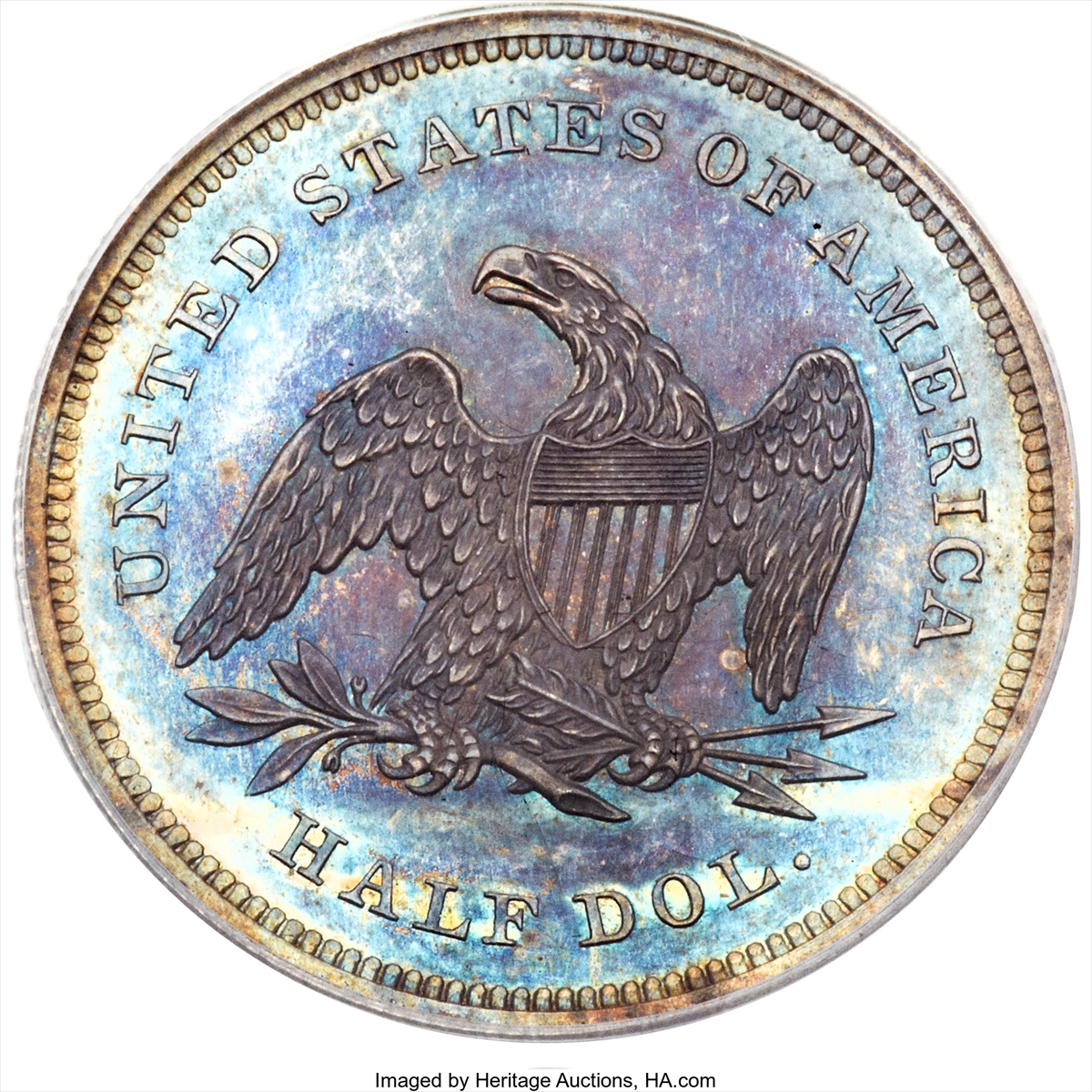
Judd-93. R7. Silver. Eight Known (3 in museums: Smithsonian, Bass Foundation, Byron Reed Museum). Per cataloger, "1839 Original Half Dollar, Judd-93, PR66. Finest Certified, Possibly Sole Finest Known. 1839 P50C Half Dollar Judd-93 Original, Pollock-105, R.7, PR66 PCGS. CAC. The obverse design resembles used on the 1839 gold eagles including the rounded forward bust truncation and pointed rear truncation, but the bust of Liberty faces right rather than left. The reverse employs the regular Small Letters die of the year. Per the authoritative USPatterns.com website, the Judd-93 coins are the only original patterns using this obverse die, of which perhaps seven survive today. (Several of those examples, however, are in institutional holdings.) Struck in silver with a reeded edge. This problem-free piece boasts incredible eye appeal on surfaces that show excellent preservation amid the beautiful medium blue tones around the peripheries with pale lavender centers on each side. This PR66 PCGS piece is possibly the sole finest known and apparently the finest certified. It is the finest at PCGS by two grade points; the finest at NGC is a single PR65 (11/14). From The A. James Evans Collection, Part II." Obtained from Heritage Galleries Auction on January 7, 2021, Lot 4492.
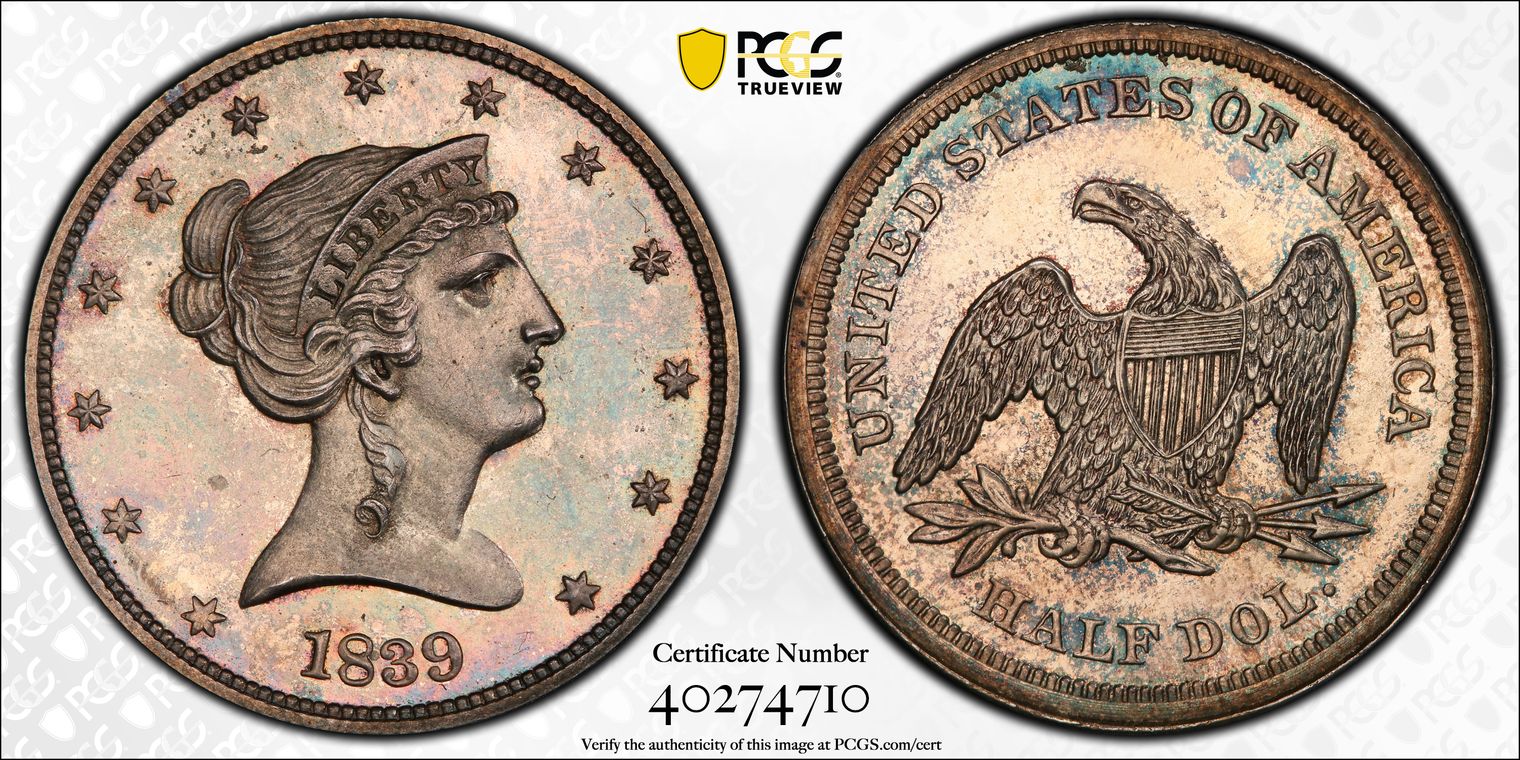
Judd-95. R8. Garret. Simpson. Two Known. Restrike in Silver. Per cataloger,"1839 'Backward Head' Half in Silver. Judd-95 Restrike, PR66. Ex: Garrett-Bass. 1839 P50C Half Dollar, Judd-95 Restrike, Pollock-103, R.8, PR66 PCGS. Ex: Garrett-Simpson. Sometimes called the Backward Head, this pattern features an obverse much like that found on the regular-issue 1839 gold eagles, with a rounded tip on the forward edge of the bust truncation and a pointed tip on the rear edge -- but the entire head is facing backward from that on the eagle, right rather than left. Thirteen stars ring the rim, with date 1839 below. The reverse is from the regular-issue Seated Liberty die, Medium Letters, as seen on the 1840 half dollars. Struck in silver with a reeded edge. Only two pieces are known in silver. All of the various half dollar patterns of 1838 and 1839 are incredibly rare to unique -- with the sole exceptions of the Judd-72 and 73 in silver -- and all are monumentally important. These pieces represent a profound shift in design, from the older Capped Bust style to more-modern designs, and as such are significant previews of the future of U.S. silver coinage. Much of the original silver surface remains on each side with additional layers of pale blue and rose toning. The strike is fully brought up in all areas. Ex: Édouard Frossard; T. Harrison Garrett; Johns Hopkins University; Garrett Collection, Part I (Bowers and Ruddy, 11/1979), lot 366; Auction '81; Harry Bass Collection, Part I (Bowers and Merena, 5/1999), lot 1153; Rarities Sale (Bowers and Merena, 5/2004), lot 556; Southern Collection." Obtained from Heritage Auction of the Bass Collection Part 5 on April 23, 2021, Lot 4193.
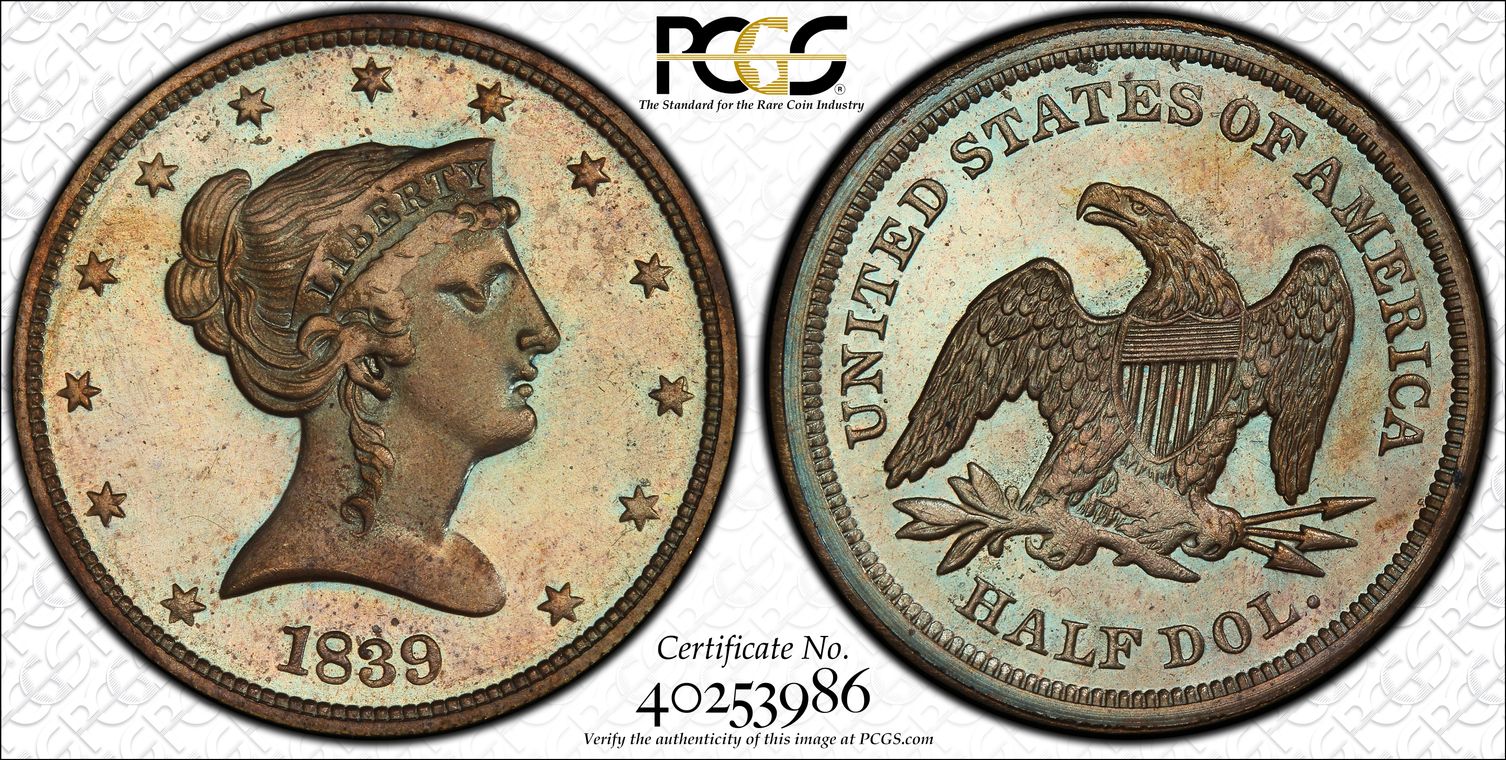
Judd-96 R8. Simpson. Three Known (one in museum). Copper with a reeded edge. Per cataloger, "Backward Head, Judd-96 Restrike, Pollock-104, R.8, PR66 Brown PCGS. Ex: Simpson. Sometimes called the Backward Head, this pattern features an obverse much like that found on the regular-issue 1839 gold eagles, with a rounded tip on the forward edge of the bust truncation and a pointed tip on the rear edge--but the entire head is facing backward from that on the eagle, right rather than left. Thirteen stars ring the rim, with date 1839 below. The reverse is from the regular-issue Seated Liberty die, Medium Letters, as seen on the 1840 half dollars. Struck in copper with a reeded edge. There are only three pieces believed known in copper (two in silver). The fields are moderately reflective and considerably enliven the lovely iridescent brown, pale red, and blue coloration. This evenly balanced coin has no detracting contact marks, and just a bit of slight strike softness appears in the centers of each side. Ex: Stewart Witham; Auction '81 (RARCOA, 7/1981), lot 326; Lemus-Queller Collection / FUN Signature (Heritage, 1/2009), lot 1522." Heritage Auction of Bob Simpson Collection #6 on August 18, 2021, Lot 3042.
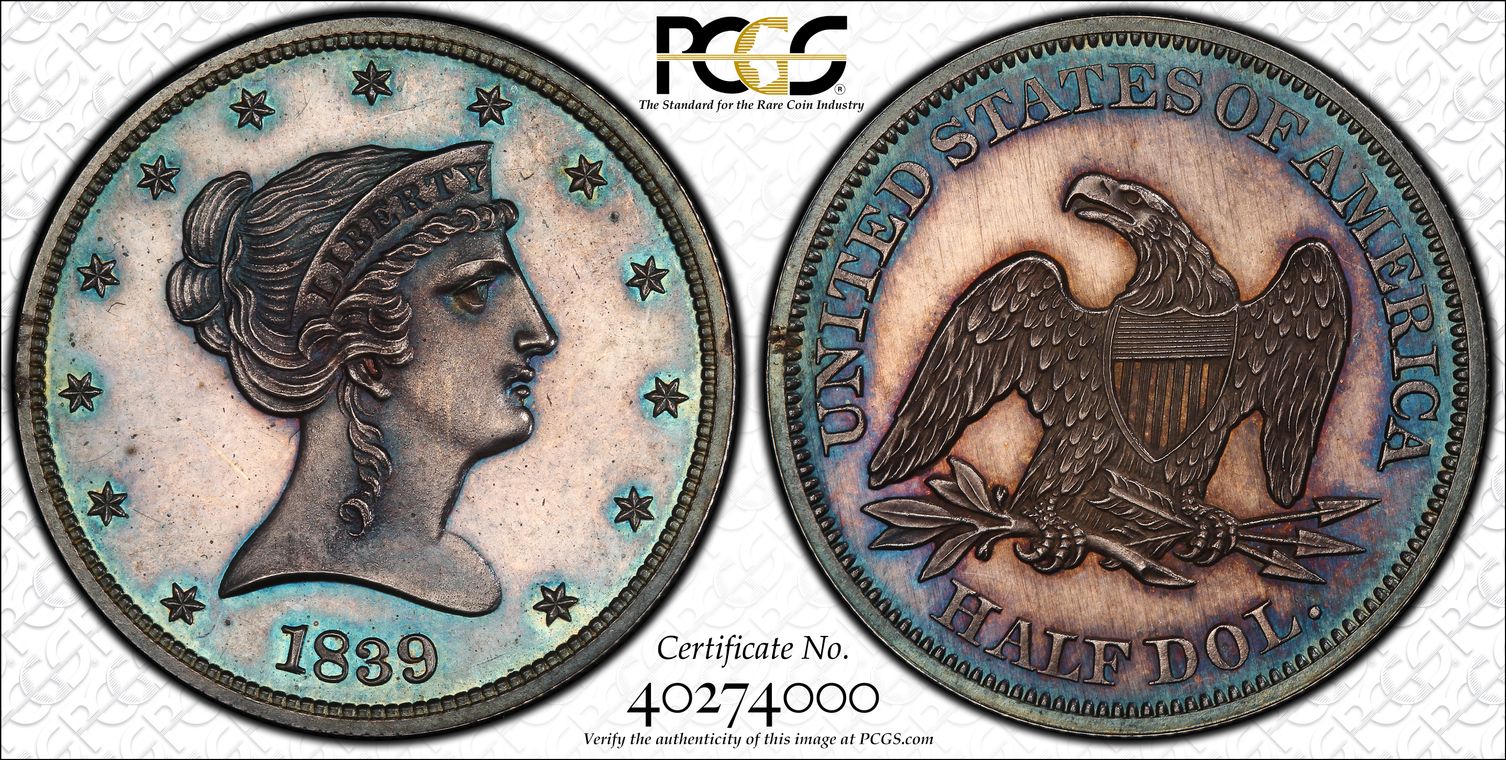
Judd-97. R7+. Simpson. Four Known (one in Smithsonian). Silver. Restrike. Per cataloger, "The Backward Liberty. Judd-97 Restrike, Pollock-107, High R.7, PR65 PCGS. CAC. Ex: Simpson. The obverse depicts a figure of Liberty facing right on the obverse, mouth open, hair tied in a bun, one curl draping down the neck behind the ear, sporting a coronet reading LIBERTY, rounded forward bust and pointed rear bust, 13 stars around, date 1839 below. The reverse offers the regular Large Letters die seen on some regular-issue 1839-dated half dollars. Struck in silver with a reeded edge. The design is called "Coronet Head facing right" in Judd, but it is sometimes known as the "Backward Liberty." It is strongly reminiscent of the ten dollar Coronet Head gold coins of 1838 and 1839 in the dangling curls and sharply pointed rear bust, but it nonetheless just looks decidedly odd. Because the profile of Liberty faces right rather than left, the LIBERTY on the coronet begins with the L behind the ear and the last letter Y is above the forehead. Judd comments that "neither this die nor any like it were ever used for coinage". This example shows die rust most perceptible on the profile of Liberty, although less so than on many of these 1860s- or 1870s-era restrikes. Lovely pale-blue and plum-rose patina prevails on well-mirrored surfaces, an extremely attractive coin. Perhaps four or five exist including the Smithsonian example, with this piece certainly among the finest. Population: 1 in 65, 0 finer (10/20). Ex: Anderson DuPont (Stack's, 11/1954), lot 2416; River Oaks (Bowers and Ruddy, 11/1976), lot 964; Stewart Witham-Auction '81 (RARCOA, 7/1981), lot 327; Morris Evans Collection (Bowers and Merena, 8/1998), lot 2037; Superior (5/2003)." Heritage Auction of Bob R. Simpson Part 2 on November 19, 2020, Lot 3100.
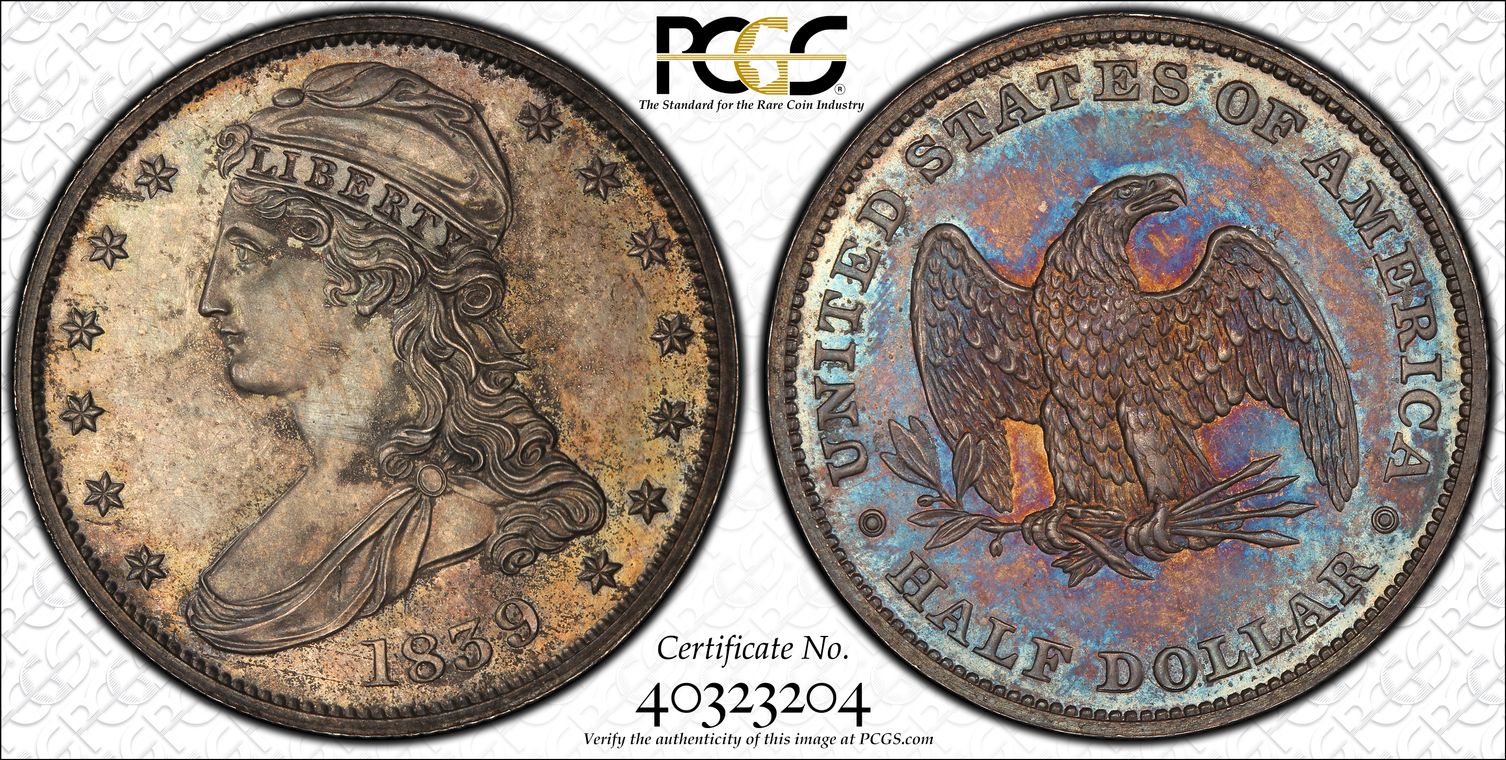
Judd-99. R8. Simpson. Two known. Per Heritage cataloger, "Judd-99 Restrike, Pollock-109, R.8 PR64 PCGS. Ex: Simpson. The obverse is the regular Capped Bust half dollar die as used from 1836 through 1839. The reverse shows an eagle with its head turned right (facing), with olive branch in the left talon and four arrows in the right. The usual legends encircle the rim. Struck in silver with a reeded edge. The reverse design will be instantly familiar to students of U.S. coinage, as it is similar to that used on the short-lived twenty cent coinage of 1875 through 1878. The arrows and olive sprig are switched, and other minor details vary, but there is no mistaking the many similar elements. The obverse was also used on Judd-72 of 1838. The weight of the Garrett-Bass-Simpson specimen is recorded as 192 grains, which would place it in the category of mid-19th century (or later) restrike. Saul Teichman of USPatterns.com calls these restrikes made for sale in the 1870s, as evidenced by the heavy die rust prominent on both sides. The obverse is gray with minor accents of yellow and rose. The reverse, on the other hand, displays rich blue patina with some cherry-red still remaining in the center. Ex: Édouard Frossard; Garrett-Johns Hopkins University (Bowers and Ruddy, 11/1979), lot 367; Harry W. Bass, Jr. Research Foundation; Bass Collection (Bowers and Merena, 5/1999), lot 1157; Southern Collection; Simpson Collection." Was PCGS PR63+ CAC then upgraded. Heritage Auction of Bob Simpson Collection #1 on September 17, 2020, Lot 10171.
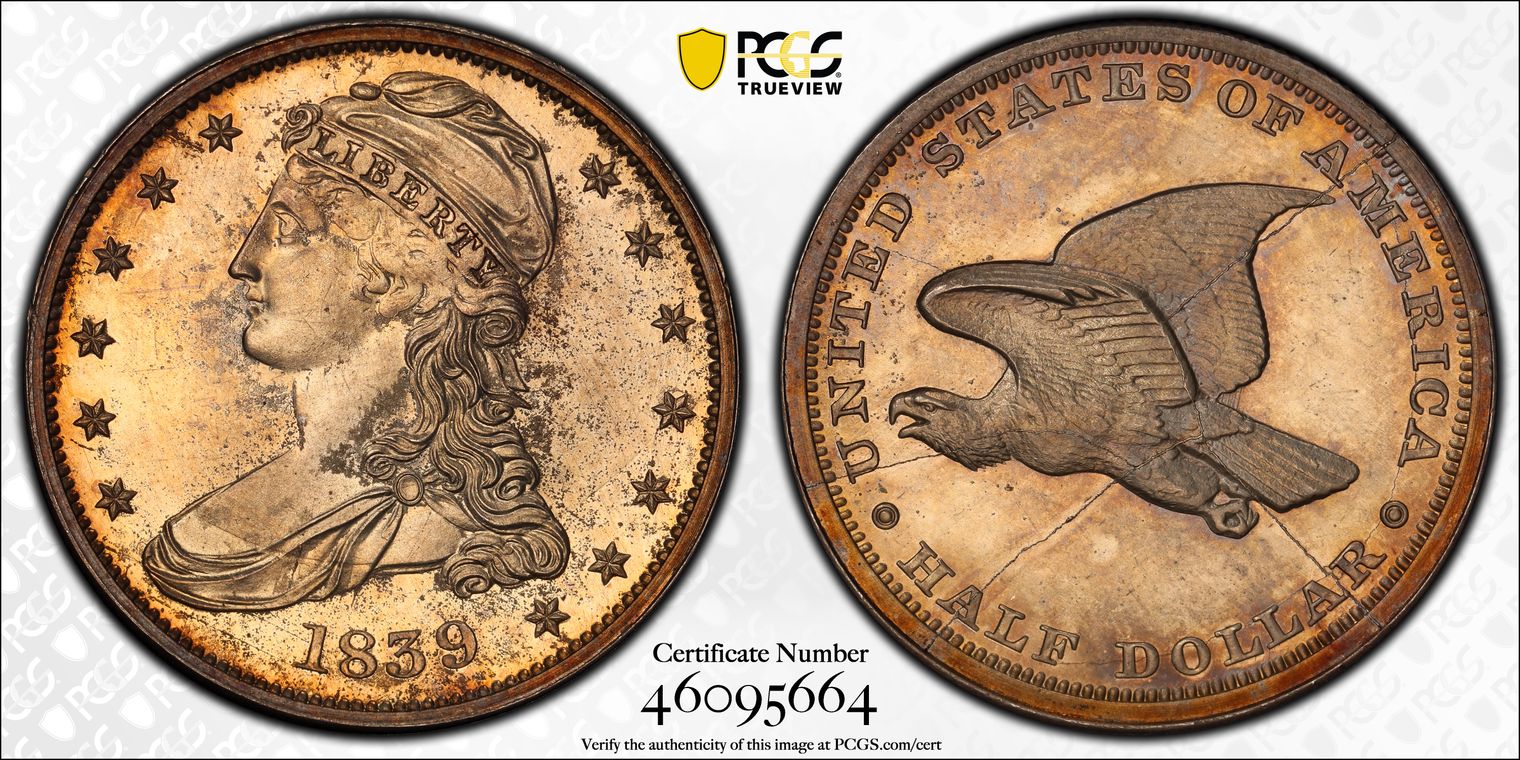
Judd-100. R.8. Bass. Finest of Two Known. Restrike in Silver. Bass. Per Heritage cataloger, "Judd-100 Restrike. Finest of Two Known. 1839 P50C Capped Bust Half Dollar, Judd-100 Restrike, Pollock-110, R.8, PR66 PCGS. Ex: Harry W. Bass Collection, Jr. Collection. The obverse is the regular Capped Bust (1836-1839) die, with date 1839. The reverse is a Flying Eagle design with plain field, similar to the Flying Eagle cents but with an awkward crook in the neck. The usual legends surround the rim. Struck in silver with a reeded edge. Medallic turn. This restrike was made in the 1870s for sale to collectors, according to USPatterns.com. Both obverse and reverse dies show heavy rust, and there are extensive die cracks on the reverse. Only two examples are known, this piece and the ex: Queller-Simpson example that was graded PR63 NGC. At the time this piece was sold by Lester Merkin in 1971 it was the only one known and the discovery piece. Merkin noted something in the catalog that we missed on our initial examination of the piece: "Curved line on drapery and bosom, as made -- a second glancing blow of the blank cutter on this planchet." We would add the curved line extends faintly into the lower-right obverse field also to star 10. However, there is no trace in the left-obverse field, if it was there at the time of striking evidence of it was most likely polished away. The obverse fields show extensive die polishing marks, as well as heavy die rust; the reverse displays almost no die polishing and only small, scattered areas of die rust. The fields are nicely mirrored and both sides display light, even rose toning. William H. Woodin Collection; Waldo C. Newcomer Collection; F.C.C. Boyd Collection; Dr. J. Hewitt Judd Collection; Illustrated History of United States Coins (Dr. J. Hewitt Judd Collection) (Abe Kosoff, 1/1962), lot 121; Burton (or Barton) W. Krouner Collection (A "Gentleman's Study Collection" of United States Half Dollars) (Coronet Coin & Stamp, circa 1968-1969), lot 9; (Lester Merkin, 2/1971), lot 860; Harry W. Bass, Jr. Foundation Collection (HBCC# 6013). The present coin. Plated in United States Pattern, Trial, And Experimental Pieces by Edgar H. Adams and William H. Woodin; plated in United States Pattern, Experimental and Trial Pieces by Dr. John Hewitt Judd." Obtained from Heritage Auction of Bass Collection Part III on May 4, 2023, Lot 4588.
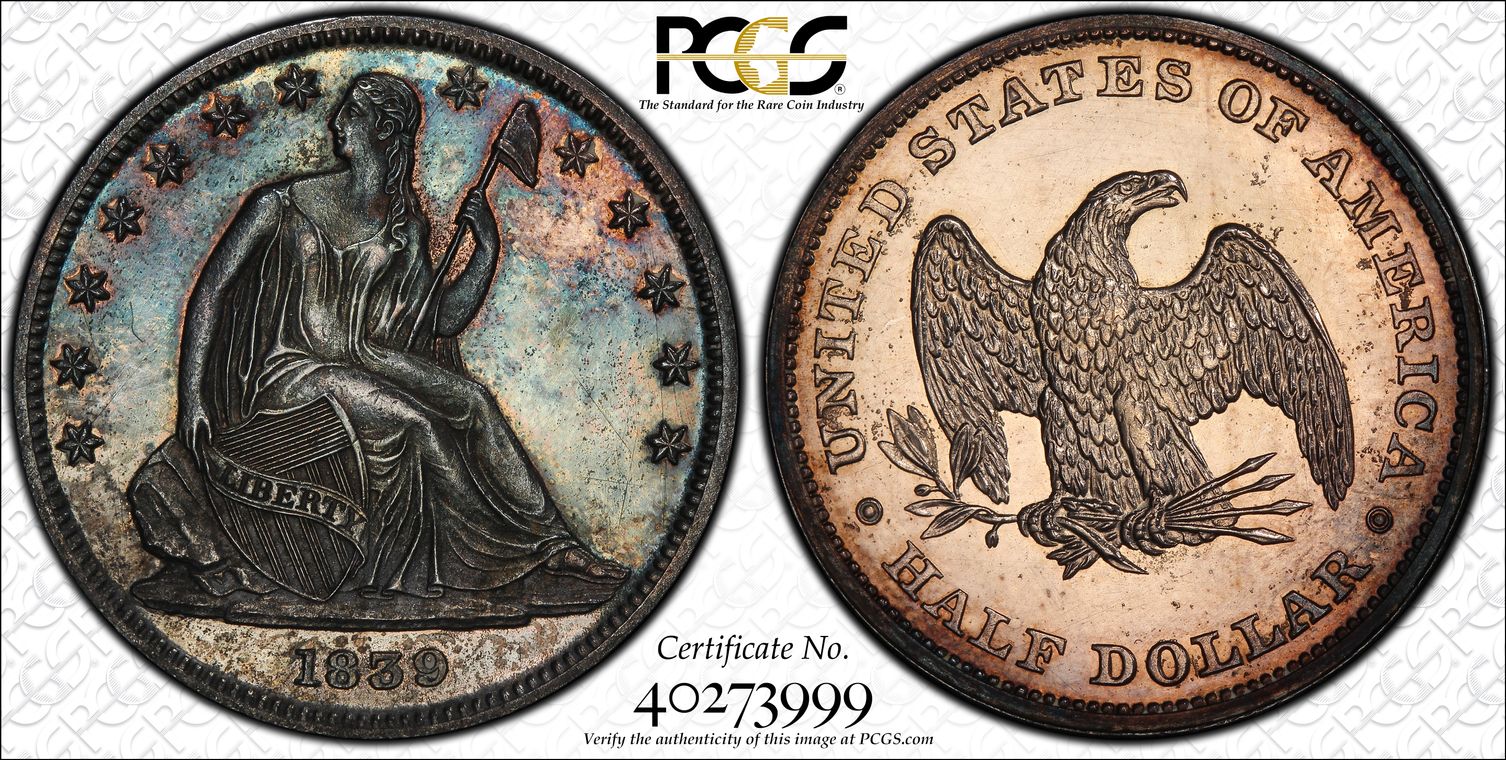
Judd-101. R8. Farouk. Bass. Simpson. Silver Restrike. Per cataloger, "Judd-101 Restrike, Pollock-112, R.8, PR63 PCGS. Ex: Bass-Simpson. The year 1839 marked the transition for half dollars from the old, venerable Capped Bust design -- with reeded edges since 1836 when steam presses took over -- to the new Liberty Seated design, launched first on half dimes and dimes in 1837 before spreading to other denominations in ensuing years. The Judd-101 half dollars are struck in silver with plain edges, featuring the Liberty Seated, With Drapery motif on the obverse. The reverse, however, is the Standing Eagle reverse, a perched eagle facing to the viewer's right sans shield and holding four arrows and an olive branch, as seen on the Judd-76 to Judd-78 issues of 1838. The Judd-101 patterns are restrikes from rusted dies oriented in medallic turn. Only two are known, the other being the John J. Pittman Collection example, PR67 NGC, which we offered in our FUN Signature auction of January 2017. Both the Bass-Simpson and Pittman examples are ca. 1869-70 restrikes of earlier-dated issues that trace to the excesses of Mint Director Henry R. Linderman. This PR63 PCGS example has toned beautifully through its long history, now showing predominantly blue-green patina on the obverse and rose-gold tones on the reverse, a coin with great eye appeal. Ex: Mint Director Henry Linderman; unknown intermediaries; King Farouk Collection (Sotheby's, 2-3/1954, part of lot 173); Cox Collection (Stack's, 4/1962); purchased by Harry W. Bass, Jr., from Numismatics, Ltd. (8/1974); Bass Part I Sale (Bowers and Merena, 5/1999), lot 1158; Southern Collection." Obtained from Heritage Auction of Bob R. Simpson on November 19, 2020, Lot 3101.
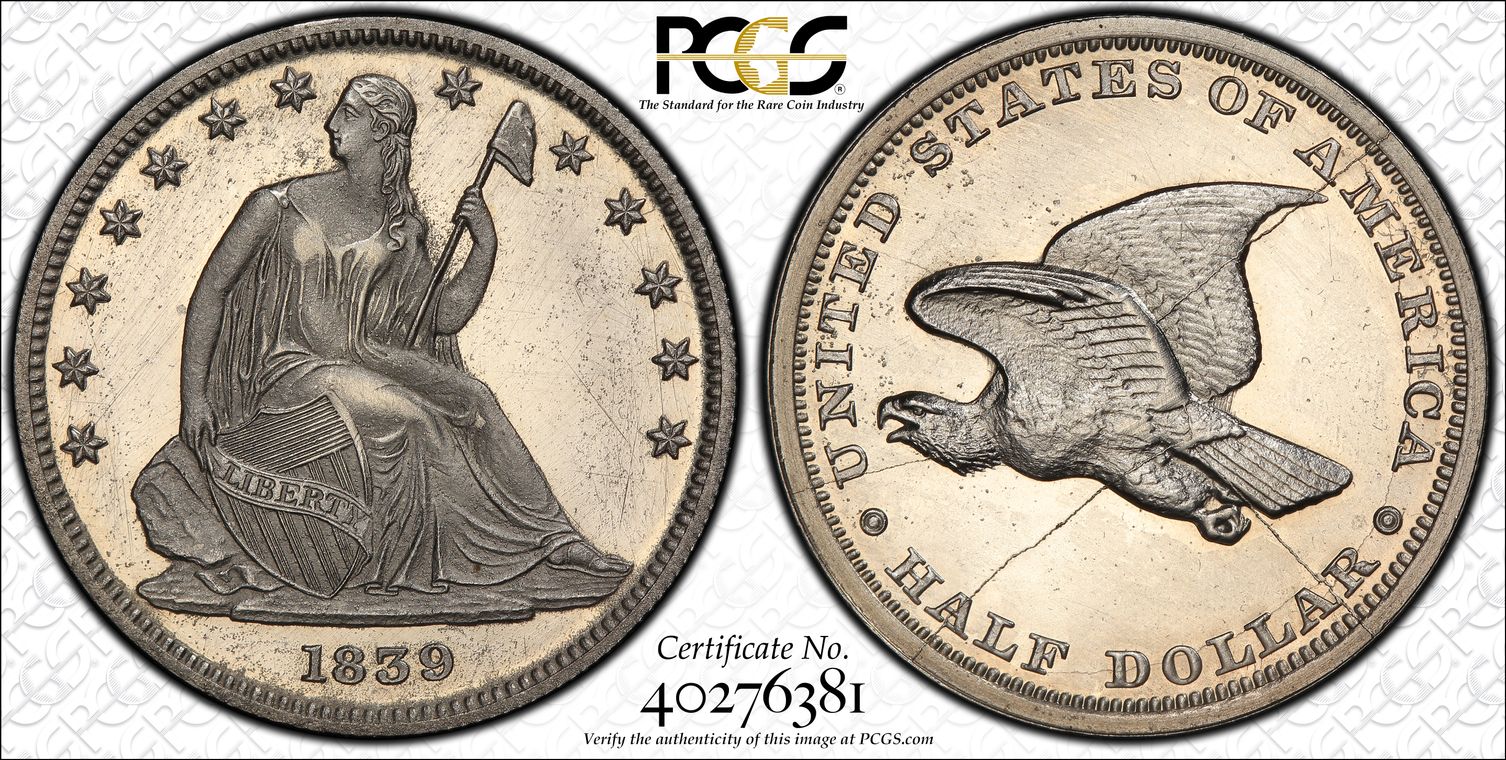
Judd-102. R7+. Simpson. Silver Restrike with Reeded Edge. Per cataloger, " 1839 Seated Liberty Half Dollar in Silver. Judd-102 Restrike, PR66+. 1839 P50C Seated Liberty Half Dollar, Judd-102 Restrike, Pollock-113, High R.7, PR66+ PCGS. Ex: Simpson. The Seated Liberty obverse is struck from a regular With Drapery half dollar die. The reverse exhibits an eagle flying left, UNITED STATES OF AMERICA around the upper periphery, and HALF DOLLAR on the lower portion. The dies were engraved by Christian Gobrecht. The original purpose of the reverse die was Judd-73. Struck in silver with a reeded edge from moderately rusted dies. Five radial cracks converge upon the eagle, and confirm the restrike status of this lightly toned specimen. The strike is good, though the obverse high points show incompleteness, due to metal flow into the die recesses of the high-relief eagle. The obverse exhibits white-on-black cameo contrast. The preservation is exemplary. The finer of only two examples of Judd-102 certified by PCGS (11/20). USPatterns.com states the variety was struck during the 1870s, and suggests that only five specimens are known. All are restrikes. Ex: Pacific Collection (Robert Hughes, 2/1978), lot 1403." Obtained from Heritage Galleries Auction of the Bob R. Simpson Collection part 3 on Jauary 20, 2021, Lot 3064.
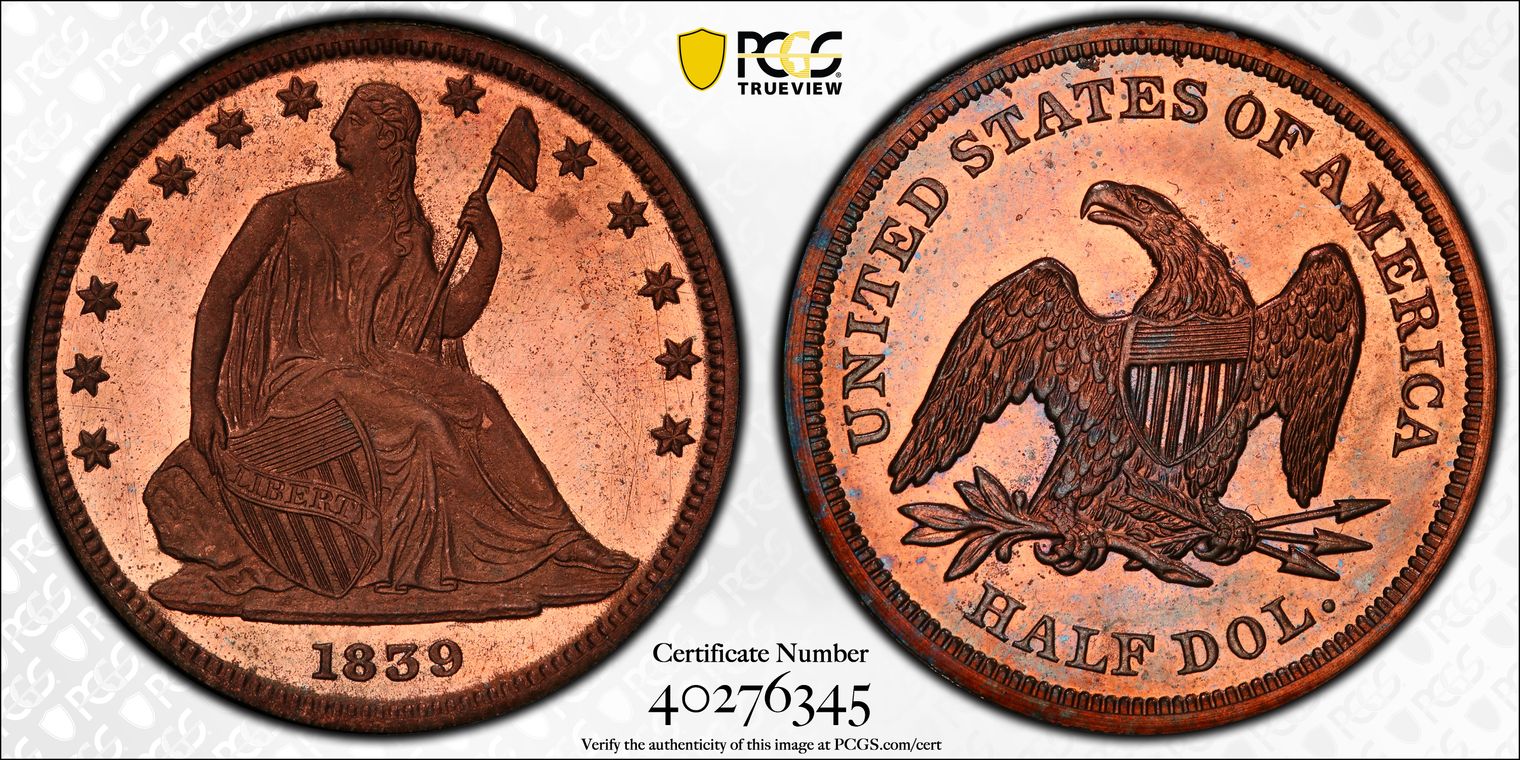
Judd-103. PR66RB. CAC. Farouk. Simpson. Copper Restrike (fantasy). Per cataloger, "Only Example in Private Hands. Judd-103 Restrike, Pollock-115, R.8, PR66 Red and Brown PCGS. CAC. Ex: Simpson. Weight: 178.9 grains. Diameter: 1.199 inches. Die alignment: 180 degrees. The obverse design is the regular-issue Seated Liberty half, With Drapery, of 1839. The reverse is the Medium Letters die, as seen on the regular issue (not pattern) Judd-100A, and later used on the pattern restrikes Judd-95 and Judd-96. Struck in copper with a reeded edge. Judd-103 is a fantasy piece struck long after the date on the die, probably in the 1870s, for sale to collectors. Only two examples are known of this R.8 pattern, and one of them is impounded--presumably permanently--in the Mitchelson Collection at the Connecticut State Library. Like some of the related pieces of this period, Stewart Witham has counted the edge reeds and gotten a total of 152. USPatterns.com notes, "according to a reed count listing from Bill Bugert of the Liberty Seated Collectors Club, [that] means they were likely struck some time between 1861 & 1871. We believe the actual date is closer to the latter date. Ex: Possibly Lorin G. Parmelee Collection (New York Coin & Stamp, 6/1890), lot 43 (per Andrew Pollock); Crosby; unknown intermediaries; King Farouk; Mayflower (5/1959); R.E. Cox Collection (Stack's, 4/1962), lot 2197; ANA Convention Auction (Kosoff, 6/1966), lot 1027; Gentleman's Study Collection (Coronet Coin), lot 11; Stewart Witham; Auction '81 (RARCOA, 7/1981), lot 333; David Queller; Lemus Collection (Heritage, 1/2009), lot 1528; Simpson." Heritage Auction #1327 of Bob R. Simpson Part 4 on February 23, 2021, Lot 3127.
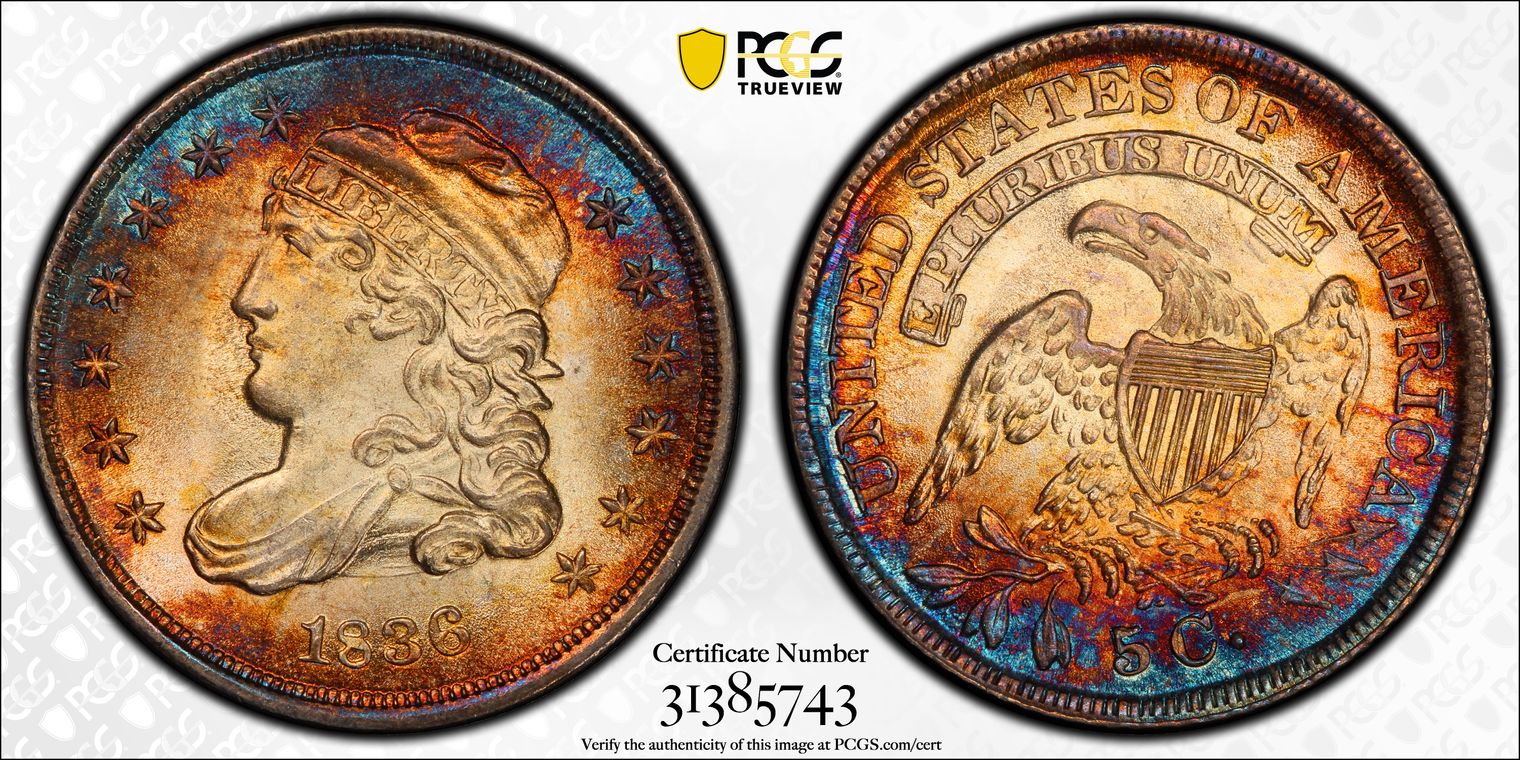
LM-5 R.2. CAC. Pogue. Bender. Finest Known 1836 Small 5C Half Dime. Stunning red and blue color with fantastic eye appeal. Obtained from Heritage Galleries Auction of the Bender Family Collection, Part I on August 24, 2022, Lot 3736.
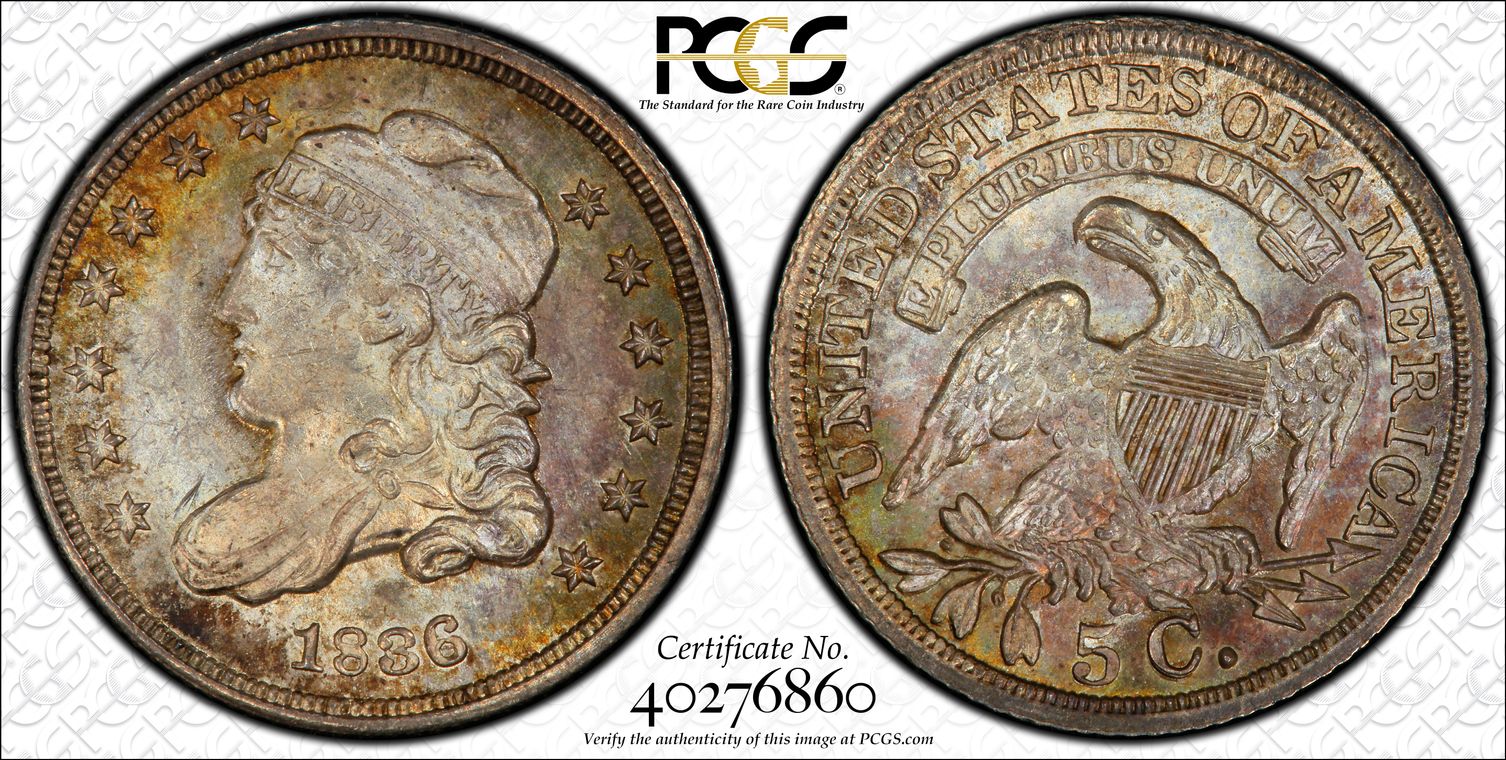
LM-3 R1. CAC. Simpson. 3 over inverted 3. Per cataloger, "H10C 3 Over Inverted 3, V-4, LM-3, FS-301, R.1, MS66+ PCGS. CAC. Ex: Simpson. Remnants of the inverted 3 are visible in the open loop of the primary 3 in the date. The reverse shows the Large 5C, and the U in UNITED is repunched. LM-3 is a plentiful variety, often seen in date and type collectors' cabinets. However, the 1836 Capped Bust half dime as a date is a major condition rarity in MS66 or better grades. Only six Large 5C coins are reported at PCGS in MS66 and finer. This Plus-designated example is within the Condition Census. Sharp detail characterizes the peripheral stars, and the centers show only minor softness. Satiny luster is largely unabraded, and the original toning on each side yields shades of lavender, gold, olive, and russet. The eye appeal of this piece is outstanding." Obtained from Heritage Auction of the Robert Simpson Collection Part 2 on November 19 2020, Lot 3025.
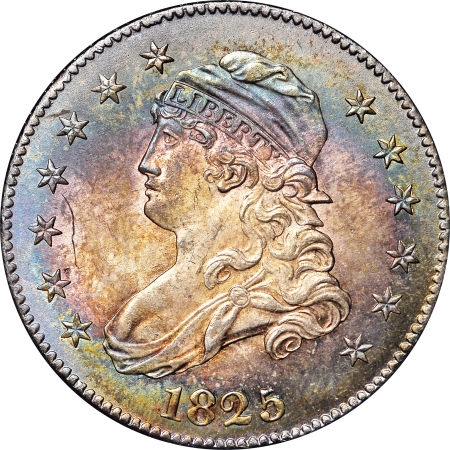
B-3 R3. Newman. Finest known. Lovely original, brightly colorful, blazing luster quarter. "MS66+ NGC. B-3, R.3. Ex: "Col." E.H.R. Green. The 1825/4 B-3 represents the second use of this overdated obverse die. This is the "1825, 5 over 4" type as listed in the Guide Book, for the many collectors who assemble sets by those major varieties. Steve M. Tompkins, in Early United States Quarters 1796-1838, suggests that the obverse die was heavily lapped between its previous use with the B-2 and its next use with the B-3: "After the lapping, the curve of the 2 disappears and the remnants of the 4 [are] much more prominent. The point of the underlying 4 digit can be seen sticking out of the left side of the upright of the 5, as well as more of the crossbar can be seen inside the loop of the 5. This has caused the B-3 die marriage to be called a 5 over 4. The remnant of either the 2 or the upright of the 4 is visible from the upper curve of the 5 to the flag of the 5 on all stages and in both die marriages, and the end of the crossbar from the 4 is visible sticking out of the right outside curve of the 5." The 1825/4 B-3 die marriage was created by using the relapped B-2 obverse die and mating it with a new reverse die. On the B-3 reverse, the scroll begins between the E and D in UNITED and ends under the right foot of the first A in AMERICA. The I in PLURIBUS is under the space between the A and T in STATES. The arrow feather is almost over the right tip of the 2 in 25C and the olive stem is over the right side of the C. This coin was stuck from the perfect state of the dies. This is the plate coin in the Rea-Peterson-Karoleff-Kovach Early Quarter Dollars of the United States Mint. This piece is also the Browning plate coin, hailing before the Green acquisition from the collection of early quarters pioneer-researcher Ard W. Browning. The Newman Collection coin, MS66+ by NGC, is the finest graded for both the die marriage and the date (10/13). This is another spectacularly toned early quarter. The obverse is attractively toned with blue on the outside surrounding lustrous gray and gold centers. The reverse is mostly a medium silver-gray, with blue and gold toning around the peripheral areas. Ex: U.S. Coin Co. (1913); Ard W. Browning; "Colonel" E.H.R. Green; Green Estate; Partnership of Eric P. Newman / B.G. Johnson d.b.a. St. Louis Stamp & Coin Co.; Eric P. Newman @ $10.00; Eric P. Newman Numismatic Education Society," per Heritage Newman catalog. Sold prior in the Heritage Eric P. Newman Auction on November 15, 2013, Lot 33346. Crossed from an NGC MS66+ holder. Private treaty with Pinnacle Rarities on March 7, 2014.
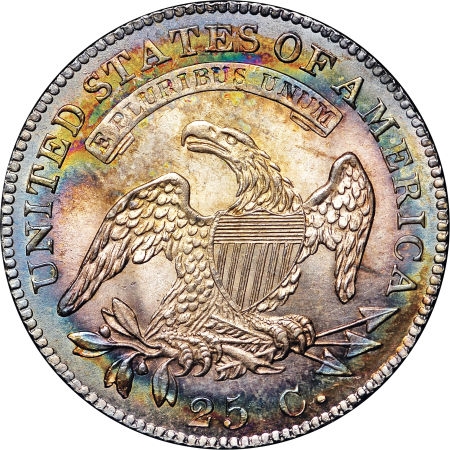
B-3 R3. Newman. Finest known. Lovely original, brightly colorful, blazing luster quarter. "MS66+ NGC. B-3, R.3. Ex: "Col." E.H.R. Green. The 1825/4 B-3 represents the second use of this overdated obverse die. This is the "1825, 5 over 4" type as listed in the Guide Book, for the many collectors who assemble sets by those major varieties. Steve M. Tompkins, in Early United States Quarters 1796-1838, suggests that the obverse die was heavily lapped between its previous use with the B-2 and its next use with the B-3: "After the lapping, the curve of the 2 disappears and the remnants of the 4 [are] much more prominent. The point of the underlying 4 digit can be seen sticking out of the left side of the upright of the 5, as well as more of the crossbar can be seen inside the loop of the 5. This has caused the B-3 die marriage to be called a 5 over 4. The remnant of either the 2 or the upright of the 4 is visible from the upper curve of the 5 to the flag of the 5 on all stages and in both die marriages, and the end of the crossbar from the 4 is visible sticking out of the right outside curve of the 5." The 1825/4 B-3 die marriage was created by using the relapped B-2 obverse die and mating it with a new reverse die. On the B-3 reverse, the scroll begins between the E and D in UNITED and ends under the right foot of the first A in AMERICA. The I in PLURIBUS is under the space between the A and T in STATES. The arrow feather is almost over the right tip of the 2 in 25C and the olive stem is over the right side of the C. This coin was stuck from the perfect state of the dies. This is the plate coin in the Rea-Peterson-Karoleff-Kovach Early Quarter Dollars of the United States Mint. This piece is also the Browning plate coin, hailing before the Green acquisition from the collection of early quarters pioneer-researcher Ard W. Browning. The Newman Collection coin, MS66+ by NGC, is the finest graded for both the die marriage and the date (10/13). This is another spectacularly toned early quarter. The obverse is attractively toned with blue on the outside surrounding lustrous gray and gold centers. The reverse is mostly a medium silver-gray, with blue and gold toning around the peripheral areas. Ex: U.S. Coin Co. (1913); Ard W. Browning; "Colonel" E.H.R. Green; Green Estate; Partnership of Eric P. Newman / B.G. Johnson d.b.a. St. Louis Stamp & Coin Co.; Eric P. Newman @ $10.00; Eric P. Newman Numismatic Education Society," per Heritage Newman catalog. Sold prior in the Heritage Eric P. Newman Auction on November 15, 2013, Lot 33346. Crossed from an NGC MS66+ holder. Private treaty with Pinnacle Rarities on March 7, 2014.
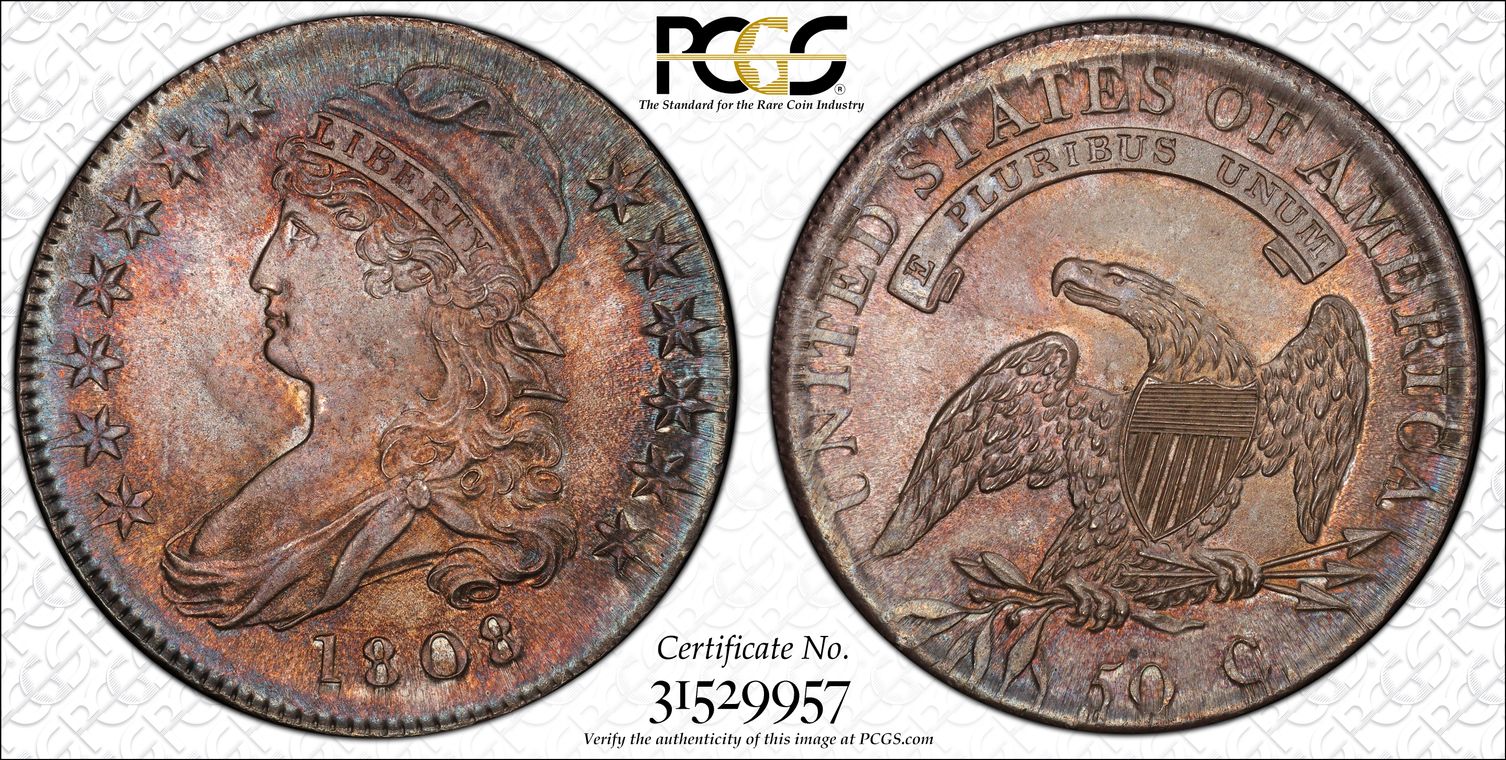
O-103 R1. Pogue. Finest Known. CAC. Obtained fromStacks Bowers Auction of the D. Brent Pogue Collection on September 30, 2015, Lot 2005.
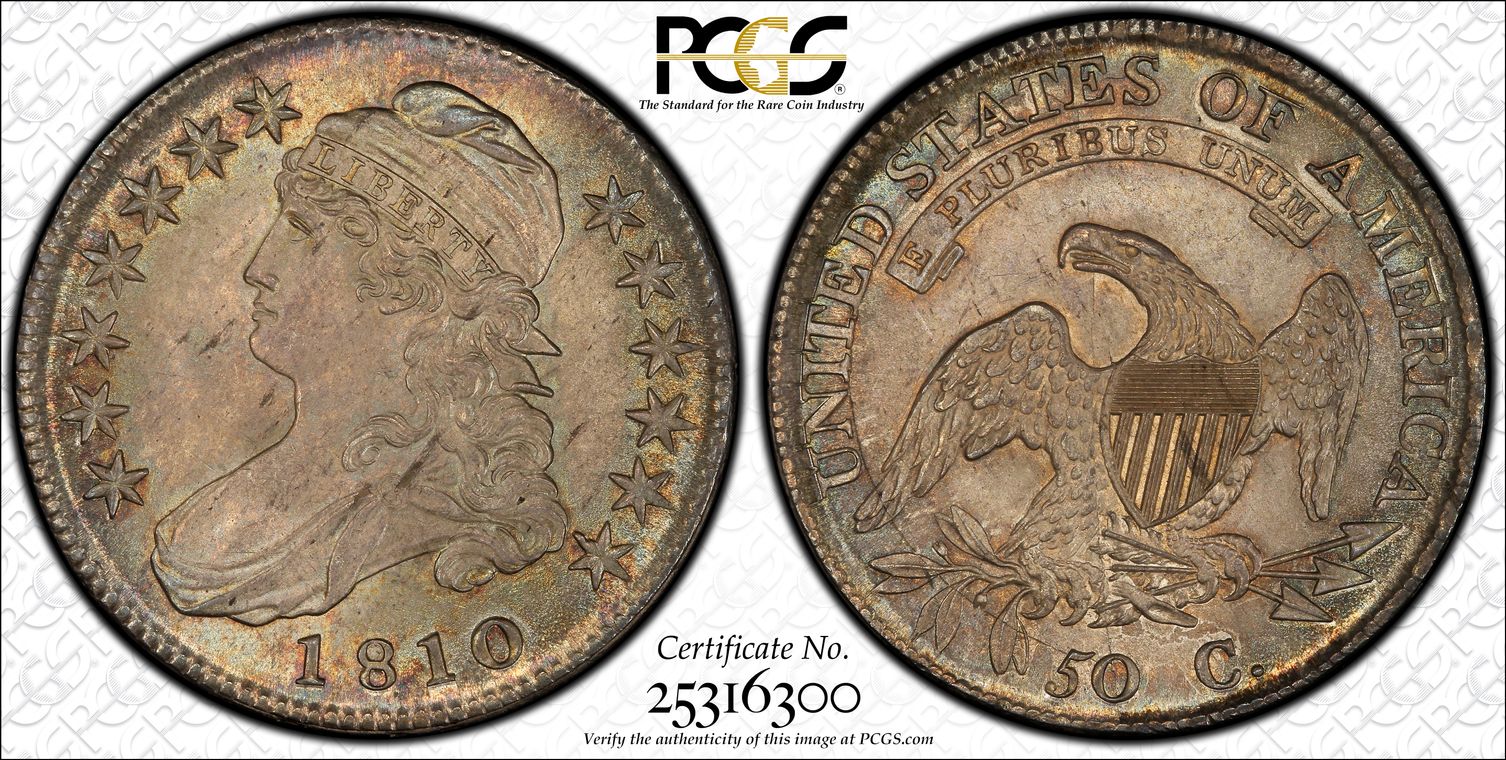
O-108 R3. Newman. CAC. Finest Known 1810 Half Dollar. Fantastic creamy orginal surfaces with stunning eye appeal for an 1810 half dollar. Crossed from NGC MS66.
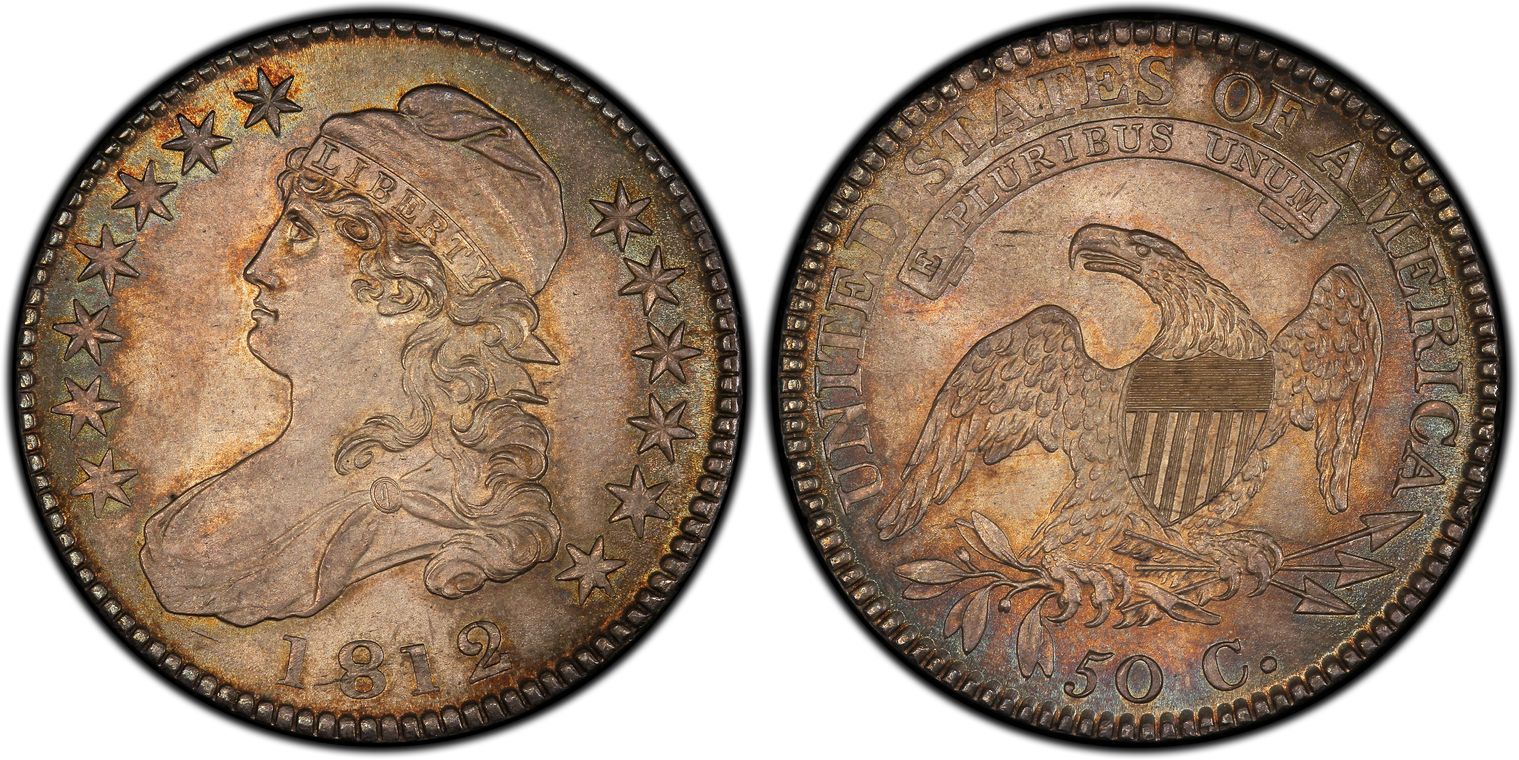
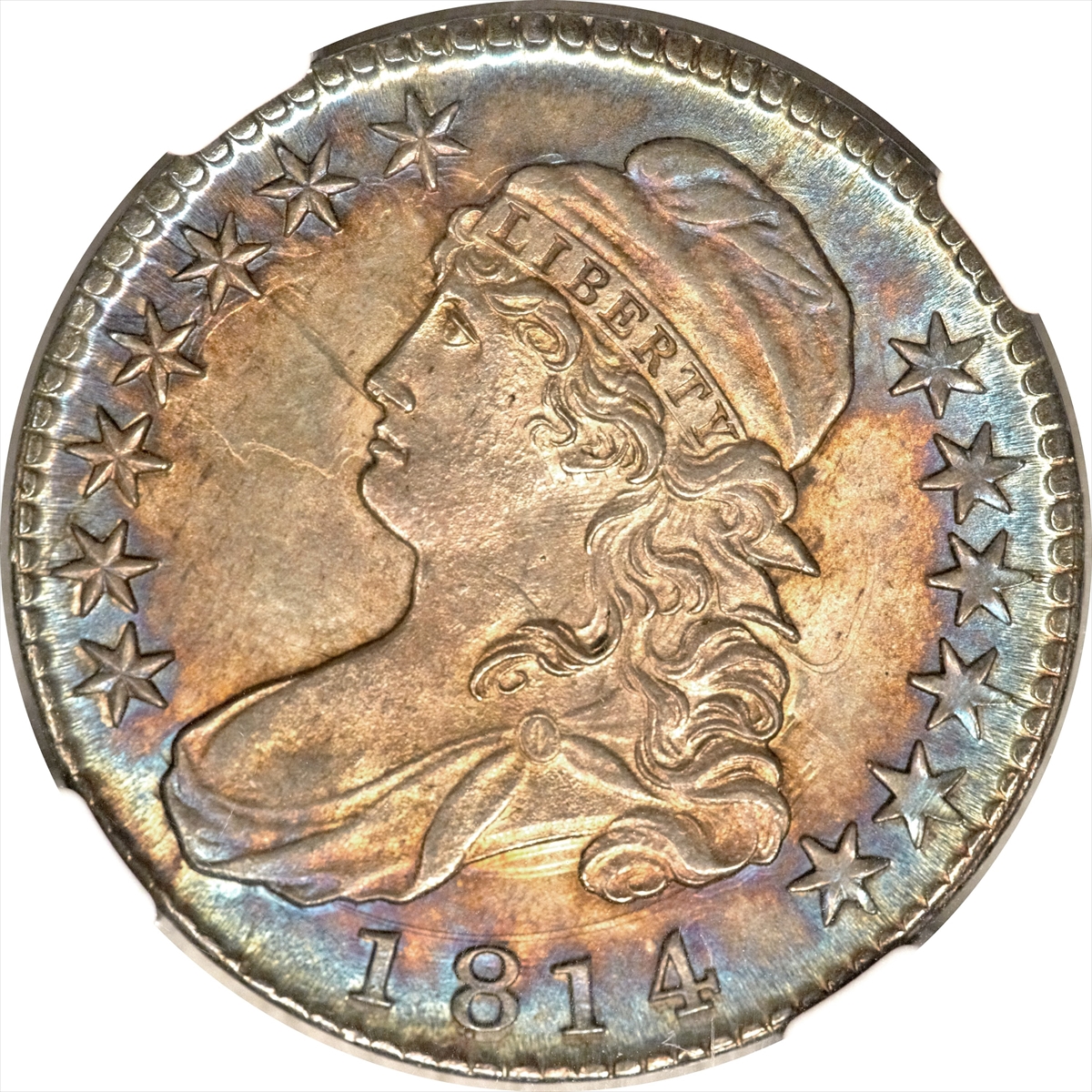
O-103 R1. CAC. Finest Known 1814 half dollar by grade. Actually, tied for another coin graded MS66+ IMHO. Per Heritage cataloger, "marvelous preservation and toning. This available die pairing is recognized on the obverse by star 7, which has one point at the juncture of the upper and lower curls on Liberty's forehead. Most examples, including the present one, show die clashing in obverse fields. Multiple vertical die lines run down to the rim from below the forward portion of the bust. On the reverse, a heavy defect ridge or die line runs from the scroll beneath the initial E, downward to the center of the left (facing) wing. The mint luster, thick and frosted, displays abundantly evident through the toning. The centers are silver-gray, with a light accent of rose surrounded by cobalt-blue at the extreme margins on each side. As is the case for many 1814 half dollars, this piece is quite sharply struck (although, as the Overton reference points out, that sharp strike came at the expense of sharp die clashing when there was no intervening planchet). As demanded at this incredible grade level, there are no visible abrasions or adjustment marks, save for the aforementioned die clashing in the fields." Crossed from NGC MS68* to PCGS in September of 2016. Obtained from Heritage US Coins Signature Auction- Long Beach #1171 on May 31, 2012, Lot 3777.
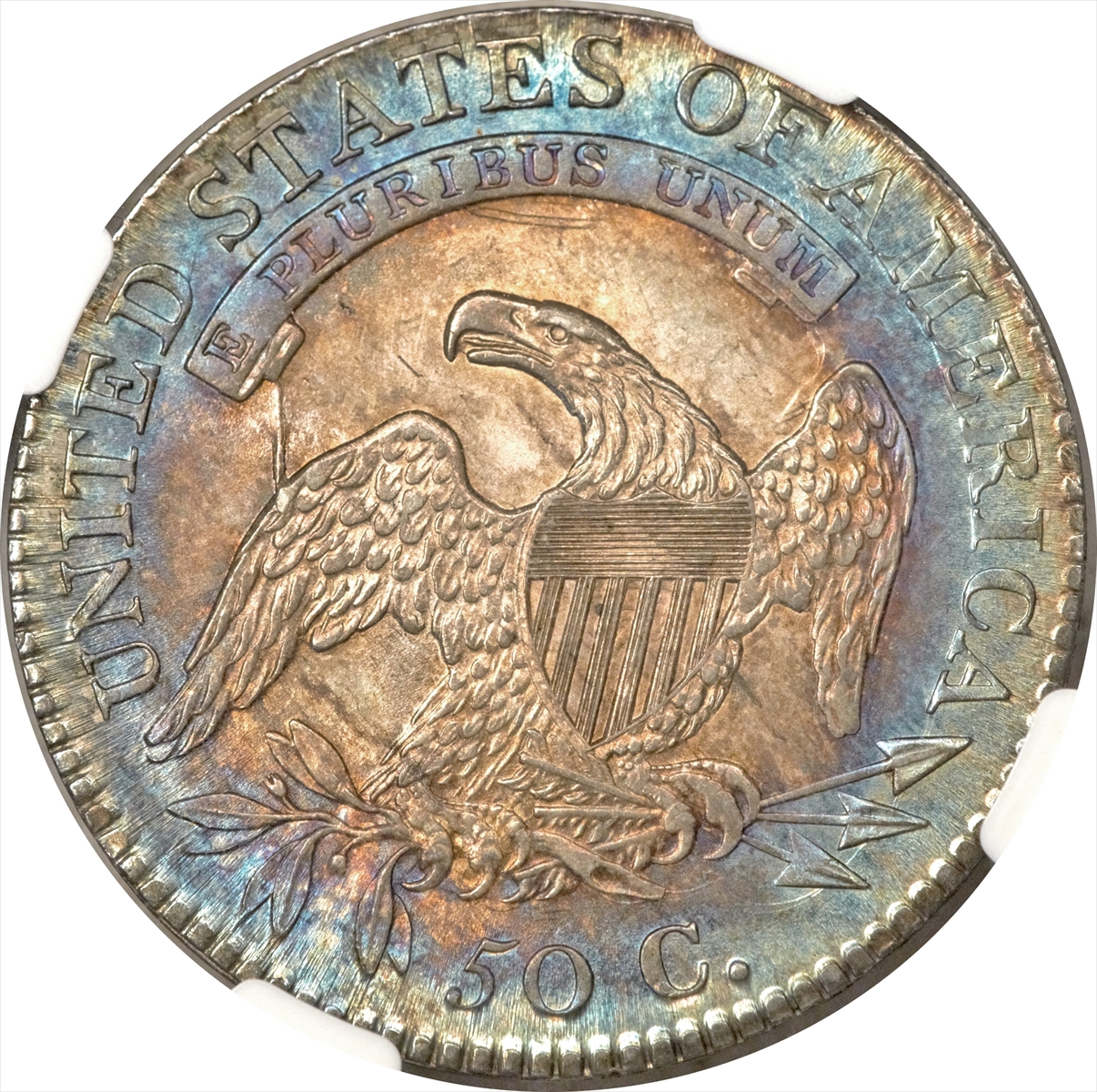
O-103 R1. CAC. Finest Known 1814 half dollar by grade. Actually, tied for another coin graded MS66+ IMHO. Per Heritage cataloger, "marvelous preservation and toning. This available die pairing is recognized on the obverse by star 7, which has one point at the juncture of the upper and lower curls on Liberty's forehead. Most examples, including the present one, show die clashing in obverse fields. Multiple vertical die lines run down to the rim from below the forward portion of the bust. On the reverse, a heavy defect ridge or die line runs from the scroll beneath the initial E, downward to the center of the left (facing) wing. The mint luster, thick and frosted, displays abundantly evident through the toning. The centers are silver-gray, with a light accent of rose surrounded by cobalt-blue at the extreme margins on each side. As is the case for many 1814 half dollars, this piece is quite sharply struck (although, as the Overton reference points out, that sharp strike came at the expense of sharp die clashing when there was no intervening planchet). As demanded at this incredible grade level, there are no visible abrasions or adjustment marks, save for the aforementioned die clashing in the fields." Crossed from NGC MS68* to PCGS in September of 2016. Obtained from Heritage US Coins Signature Auction- Long Beach #1171 on May 31, 2012, Lot 3777.
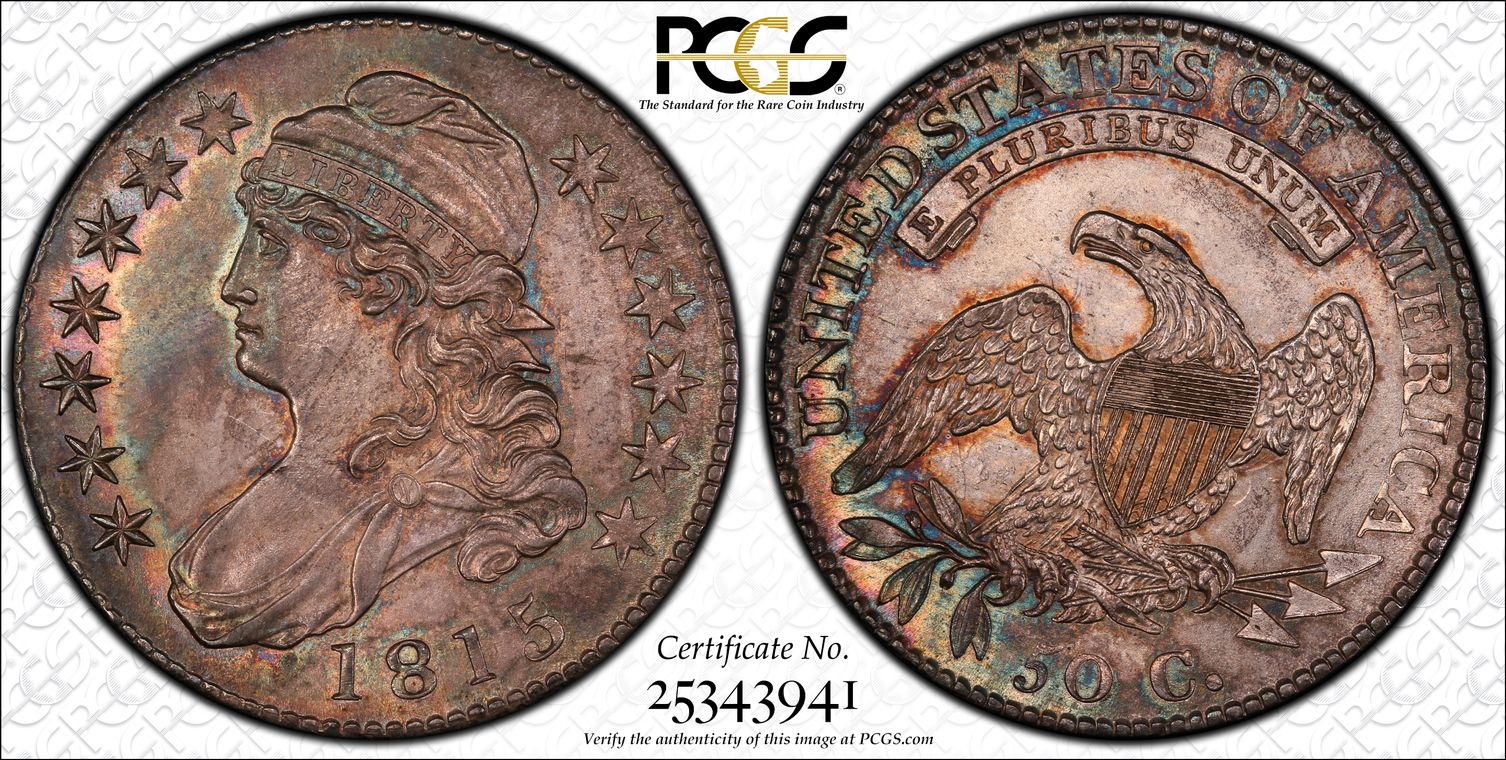
O.101 R2. Finest Known of this key date. A+ Eye Appeal. Per Heritage cataloger, "Ex: Kaufman. Numismatists and collectors who seek a complete date collection must acquire an 1815 half dollar. Similarly, die variety specialists require an example, and those who seek die states must have two different pieces. Many design type collectors have the formation of a complete type set of key-date coins as their goal, and the 1815 half dollar is the best candidate. Finally, a growing trend is the acquisition of "trophy coins," those pieces that combine rarity, quality, and exceptional aesthetic appeal, and this Premium Gem 1815 half dollar combines all of those factors. Demand for a specimen such as this rarity has never been higher. The finest 1815 half dollars are the present early die state piece and the Eliasberg Gem late die state specimen. Following these two pieces, we find approximately 20 other auction records of MS63 and MS64 coins over the last 20 years. However, we have no hesitation calling the present piece the finest known 1815 half dollar. It has bold central details with an almost medallic appearance, the stars at the left border are strong while those to the right are weak. Both sides have soft, frosty silver luster with grayish-gold patina, surrounded by blue-green, gold, rose, and iridescent toning. The surfaces are well-preserved, with no evidence of mishandling. This Premium Gem is one of the landmark opportunities in the current sale, and once sold, may not appear on the market for many years. Ex: The Chicago Sale (RARCOA and David W. Akers, Inc., 8/1991), lot 523; Central States Signature (Heritage, 4-5/2009), Lot 2415 per Heritage cataloger. Obtained from Heritage Platinum Auction on August 8, 2012, Lot 5143. Crossed from NGC MS66+ to PCGS MS66.
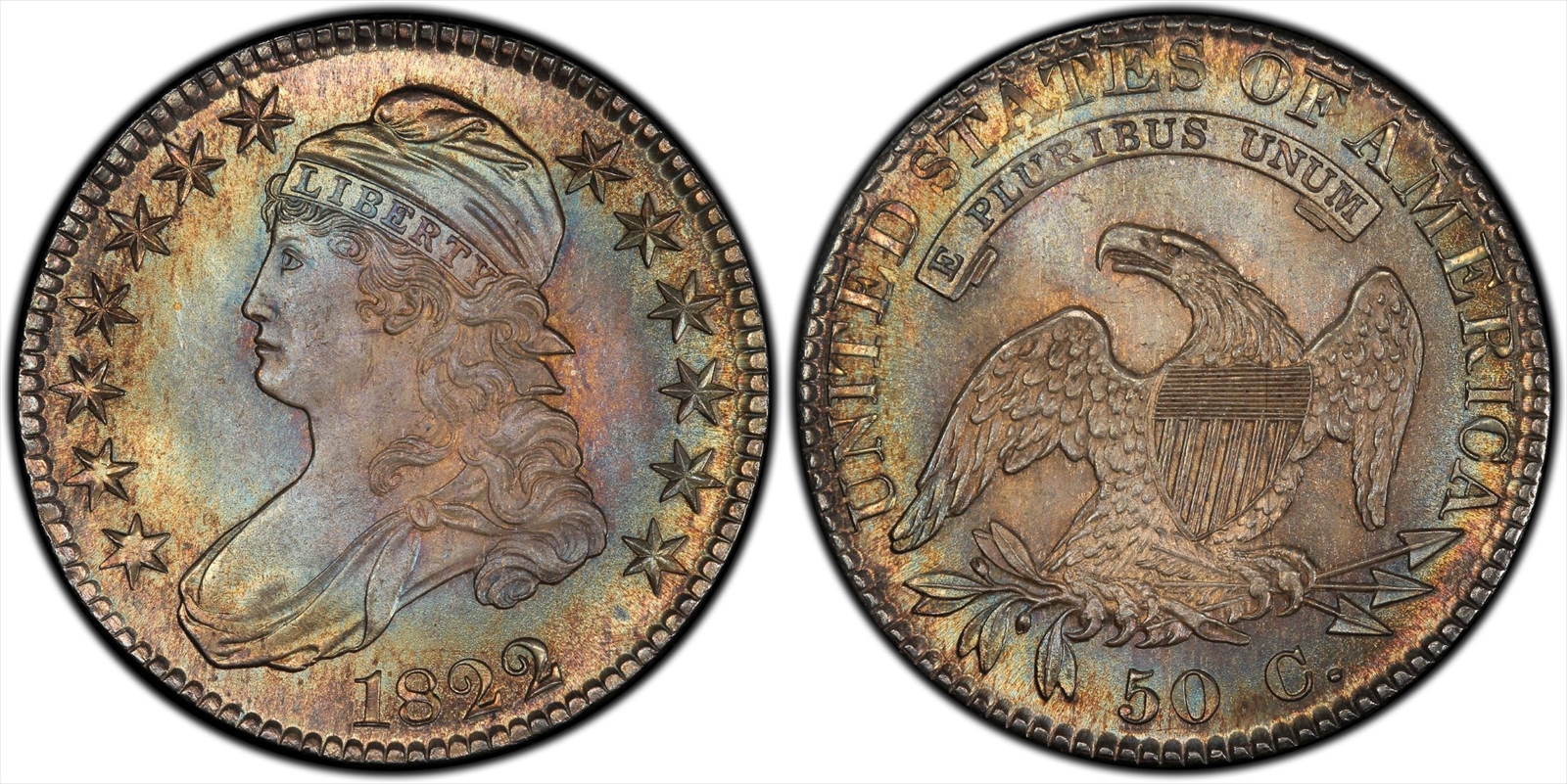
O-106. CAC. R3. Finest Known 1822 Half Dollar. Blazing cartwheel luster and color with pristine surfaces. Visually stunning eye appeal. Obtained by private treaty from Numismatic Americana on August 15, 2018.
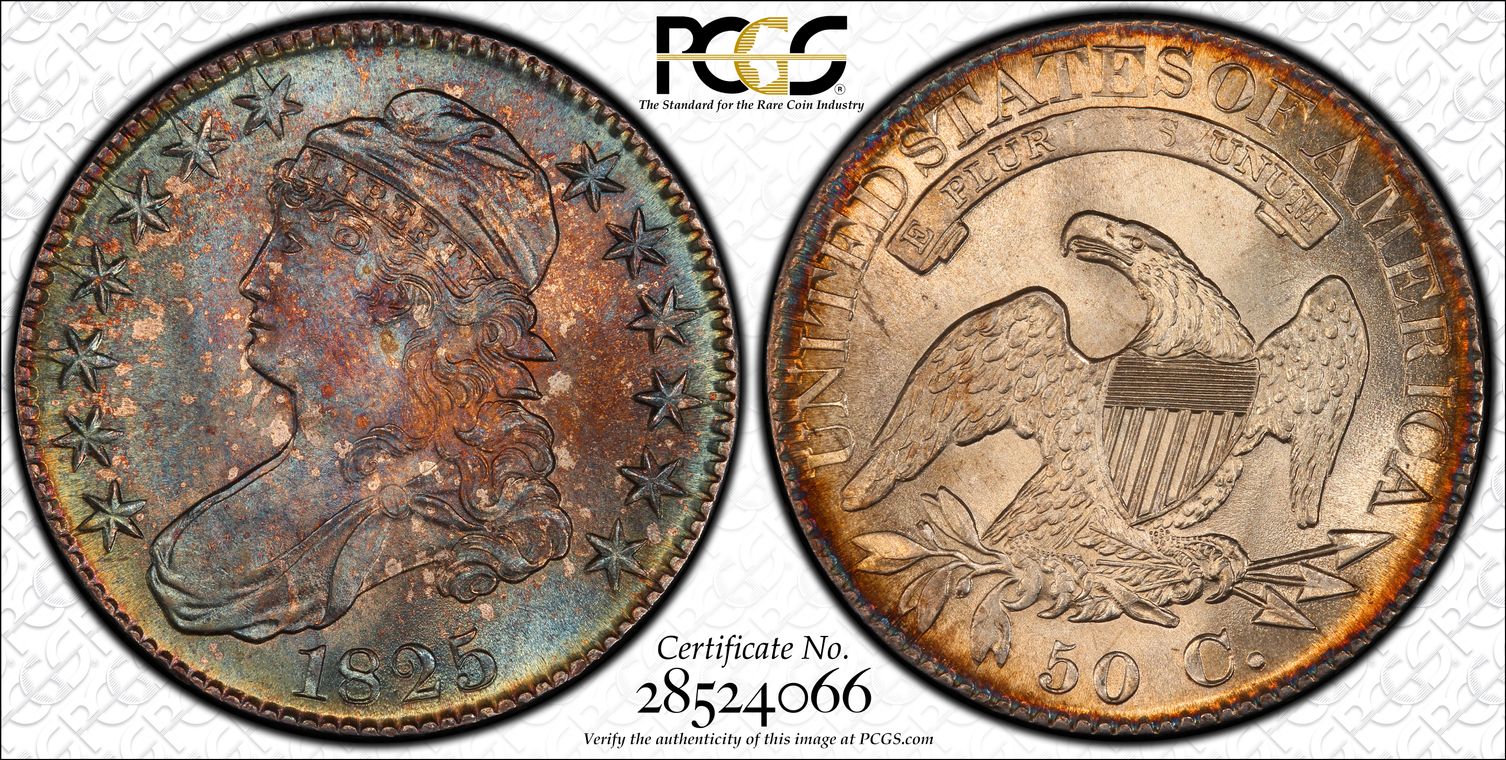
O.104 R4+. "This half dollar is so much more than a Premium Gem. It has amazing eye appeal with green, rose, and iridescent toning on the obverse, and light gold on the reverse. The strike is bold and well-centered, and the surfaces are highly lustrous and pristine. An amazing example, but also an extremely important offering," per Heritage cataloger. Obtained from Heritage Galleries' Auction Auction #1175 on October 12, 2012.
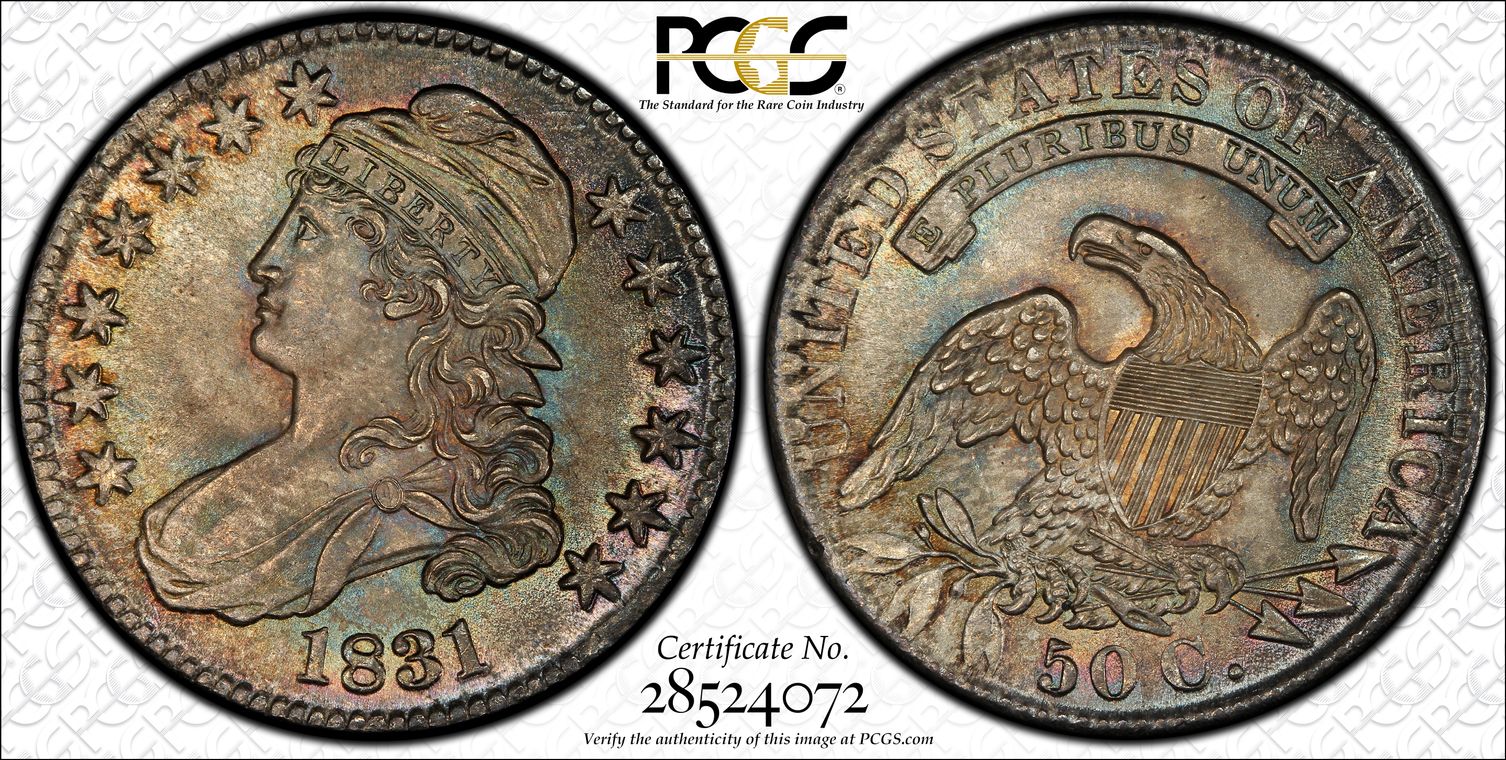
O-107 R3. CAC. Second Finest Known 1831 Capped Half Dollar. Visually stunning, very flashy, wow colors and pizazz! Obtained from Harry Laibstain Rare Coins by private treaty on January 10, 2013.
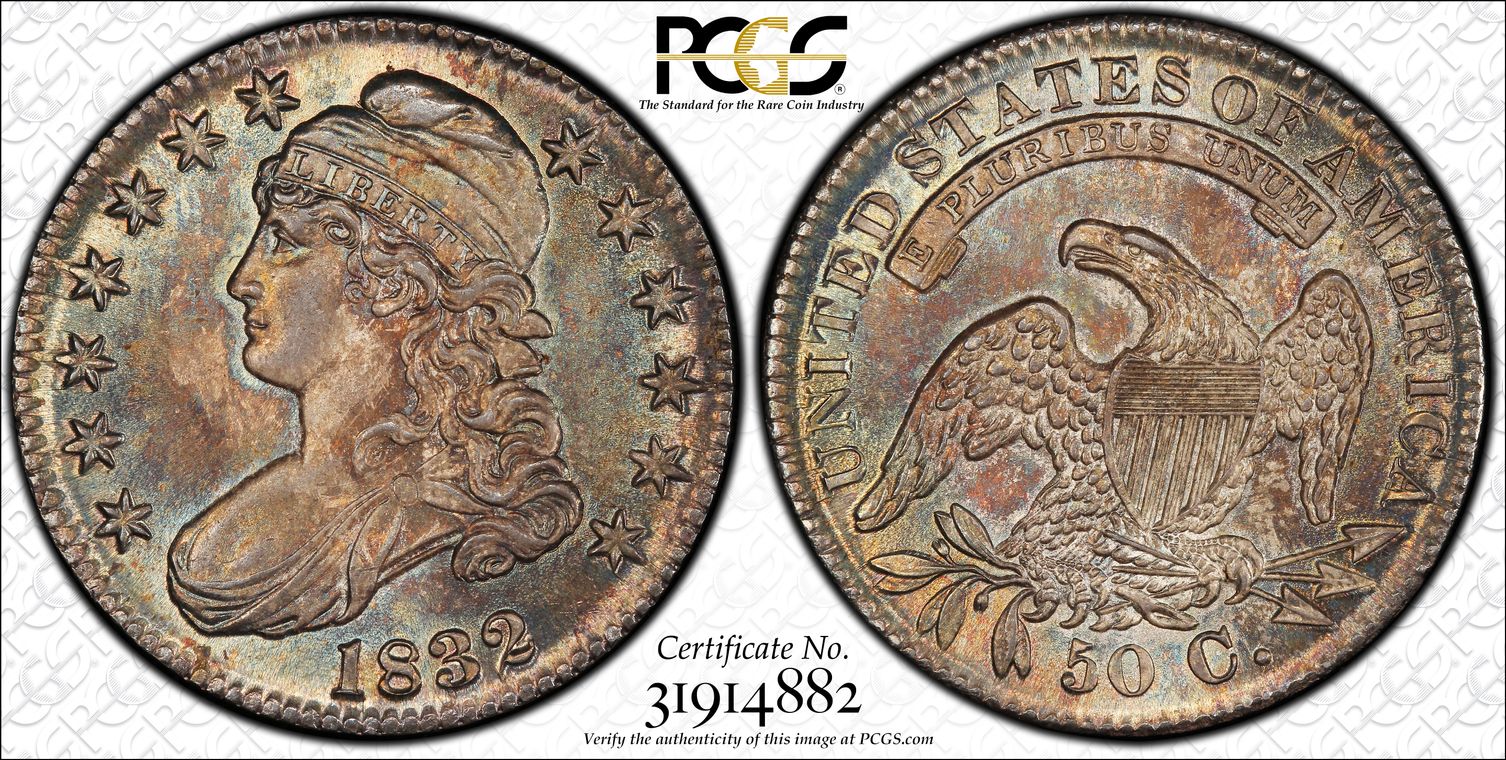
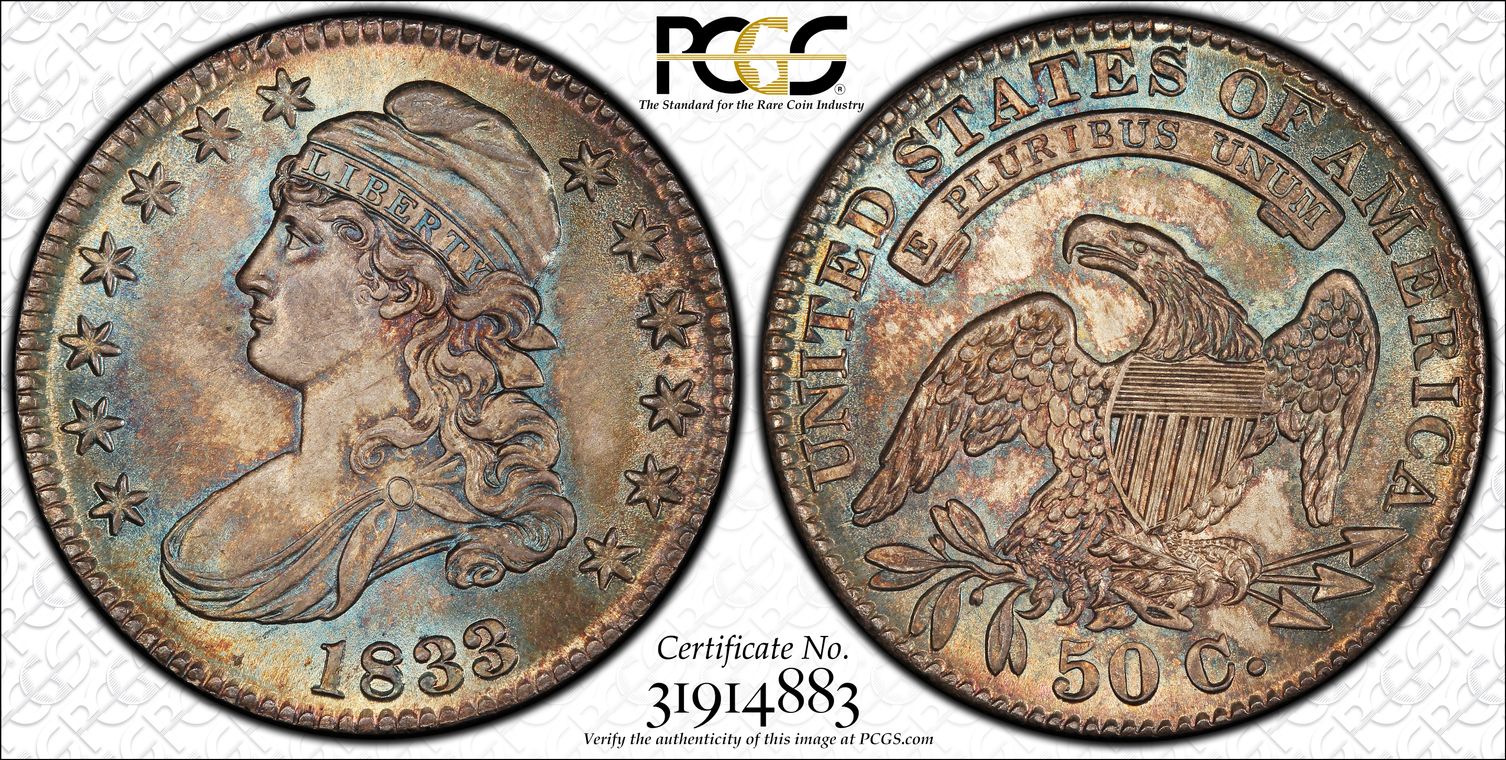
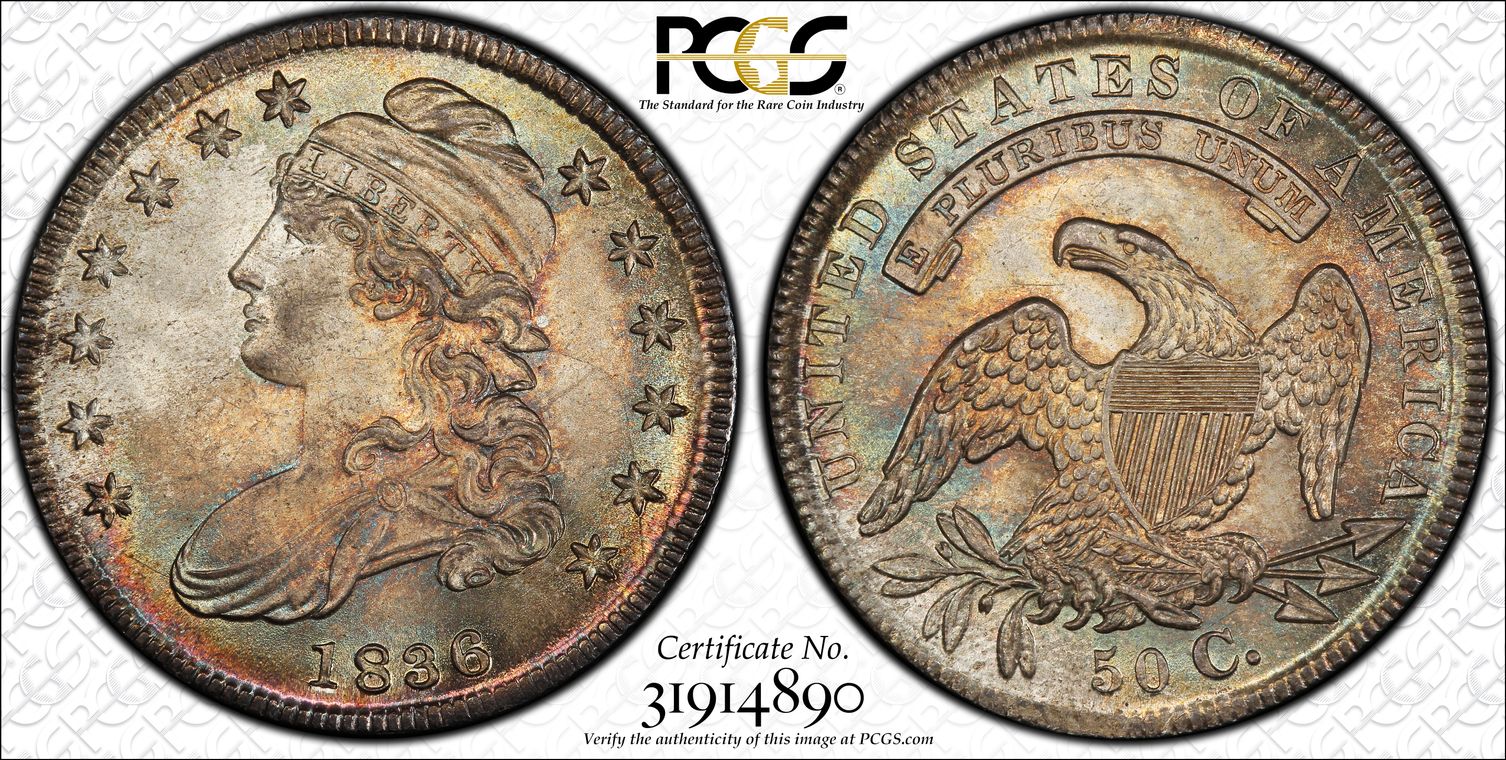
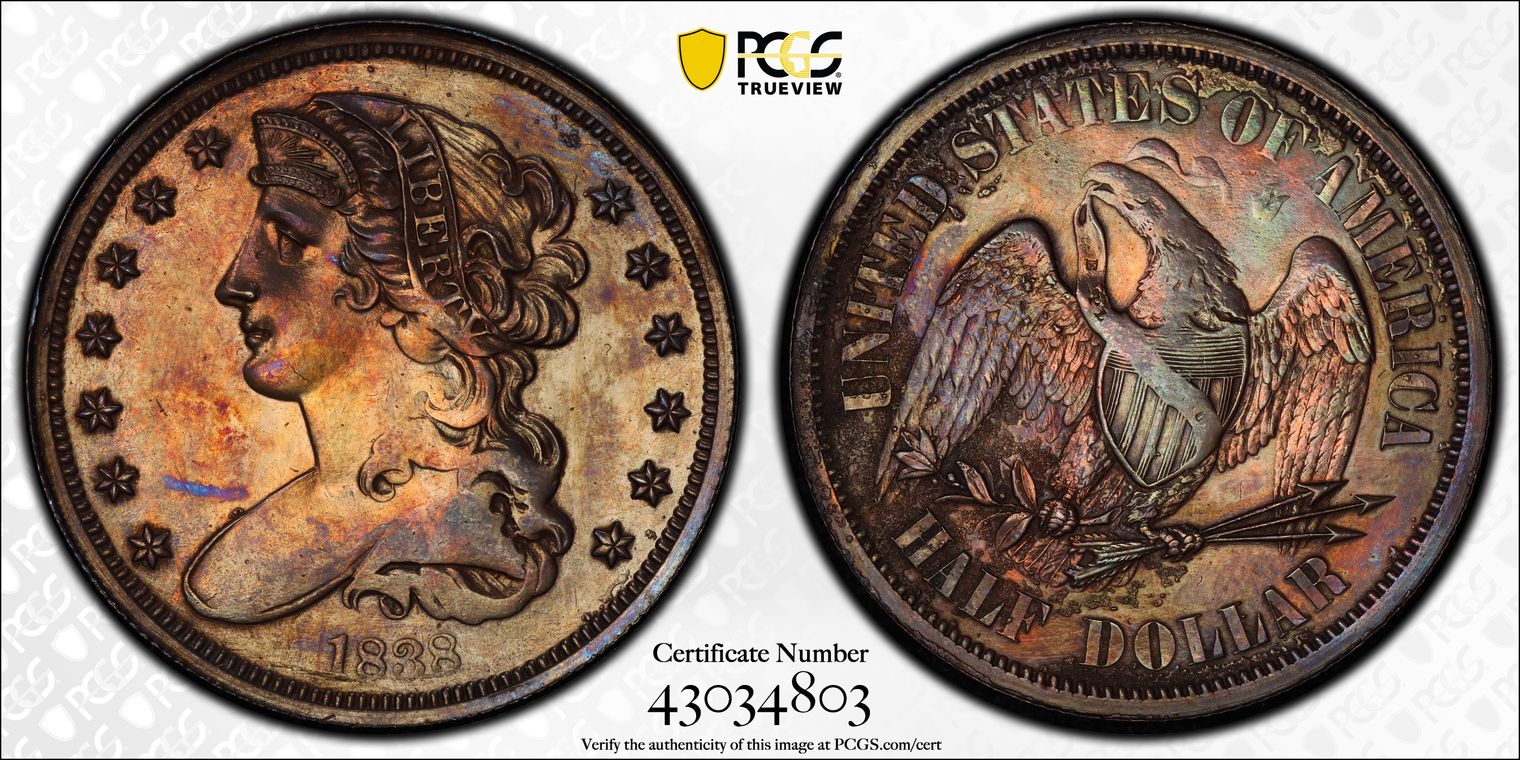
Judd-75b. R8. Liberty Facing Left Half Dollar. Two Known. Copper with a Reeded Edge. Per cataloger, "Perhaps only 2 known. NGC PR62 Brown. Judd-75b (formerly Judd-255), Pollock-81, R.8, PR62 Brown NGC. This mule pairs the Kneass-designed obverse with the bust of Liberty facing left, with the Paquet-designed reverse from 1859 that shows a perched eagle. Struck in copper with a reeded edge. Only two examples of this rare muling are believed known, and both are believed to have come from the Farouk collection. The surfaces are richly toned in multiple shades with significant brightness radiating from the fields. Ex: Auction '81 (RARCOA's session, 7/1981), lot 322; Stewart Witham to Harry Bass, August 12, 1981; Bass I (Bowers and Merena, 5/1999), lot 1146." Obtained from Heritage Auction #1279 on September 6, 2018, Lot 3290.
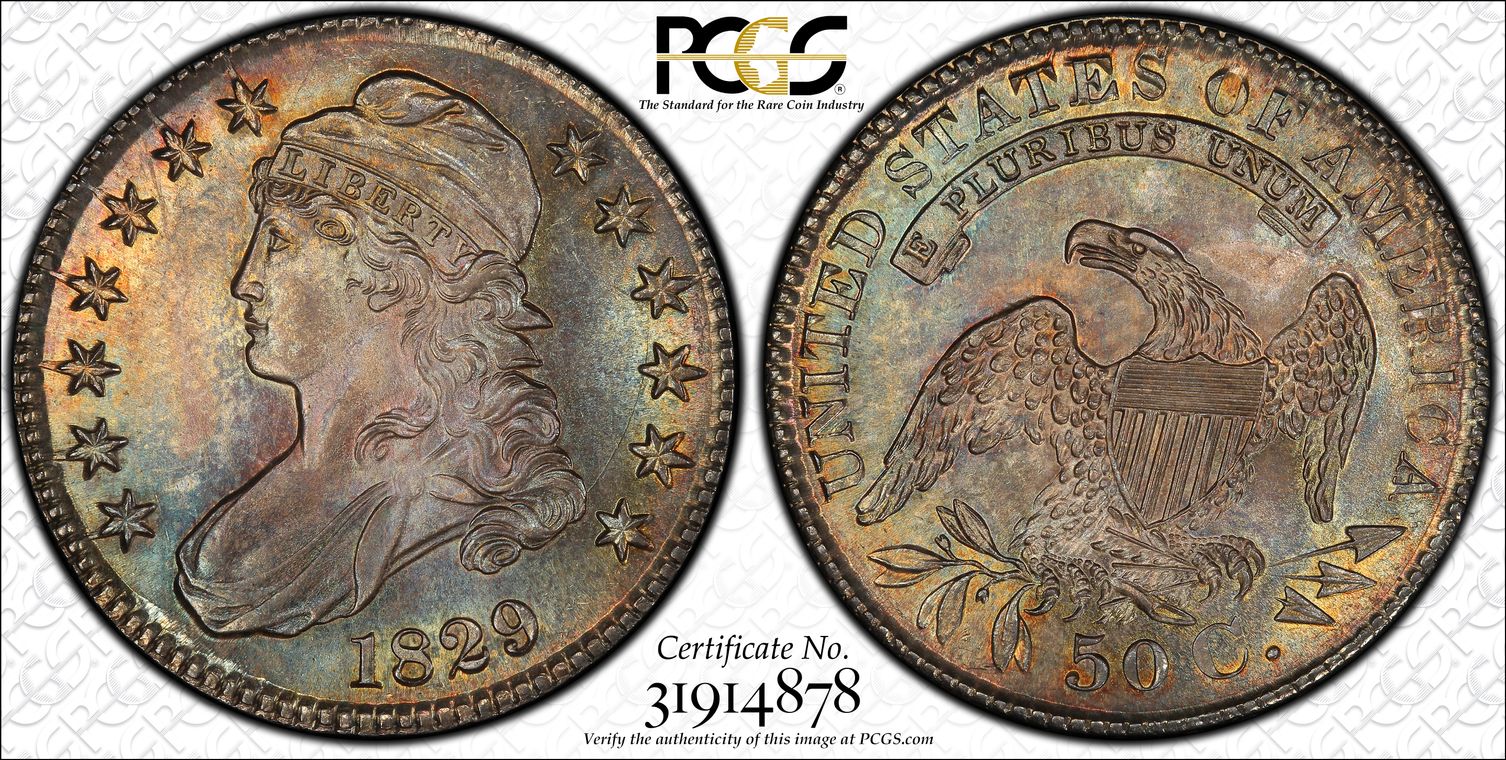
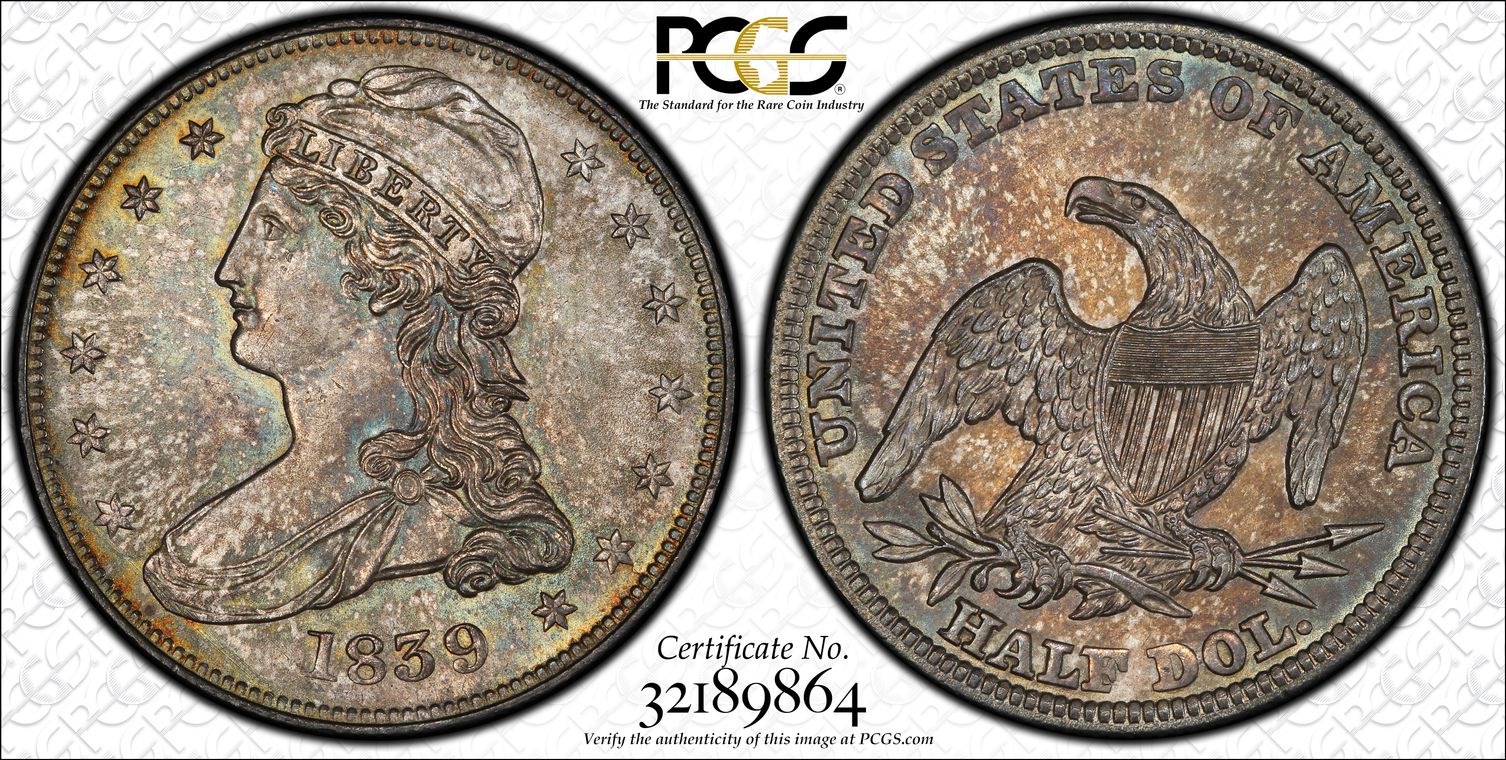
GR-5 CAC. R.2 Finest Known 1839 Half Dollar. Terrific eye appeal and originality. Obtained from Stacks Bowers Auction of the D. Brent Pogue Collection on may 24, 2016, Lot 4009.
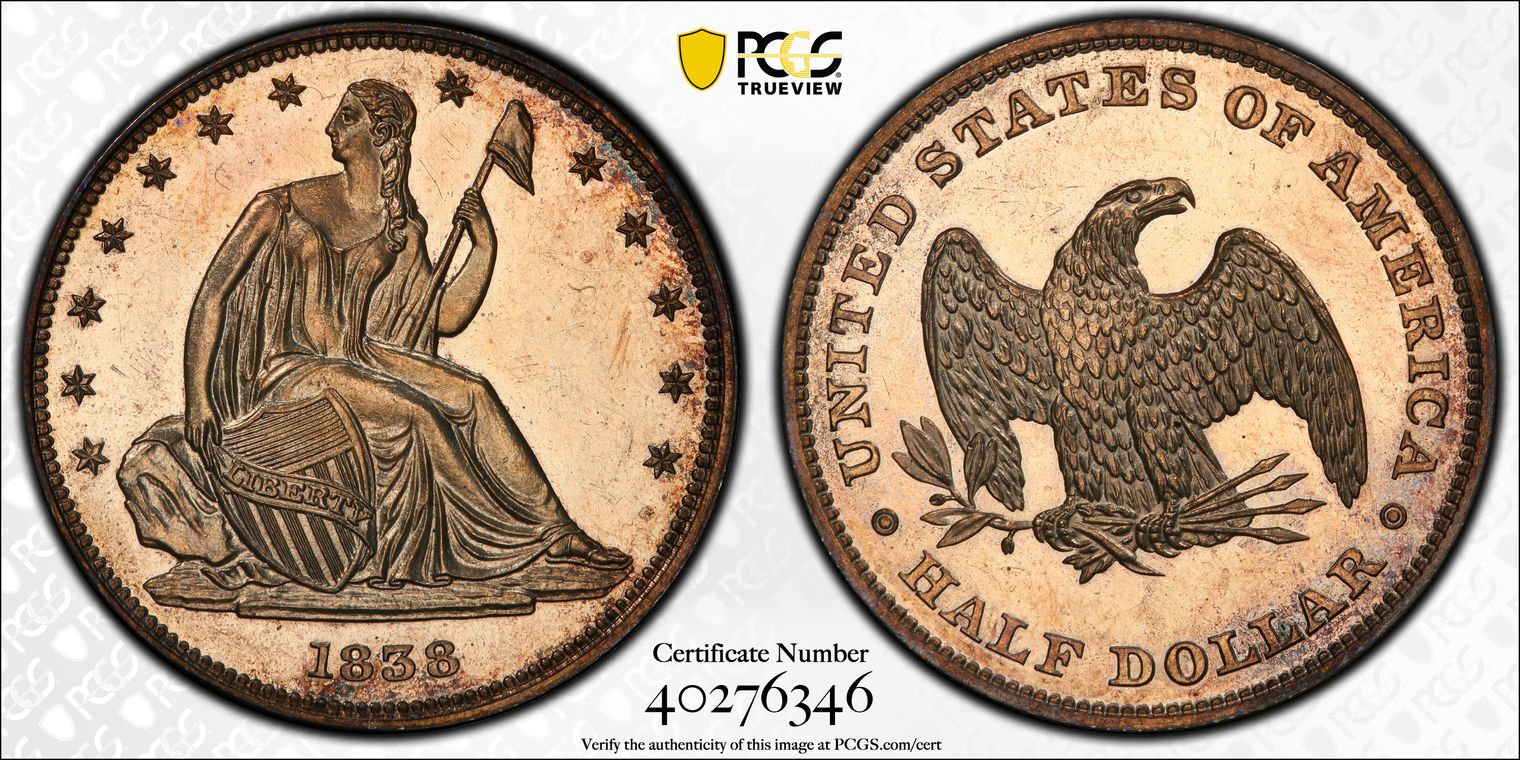
Judd-76b. R.8. PR63 Cameo. CAC. Eliasberg. Simpson. Two Known (one in the Smithsonian). Silver original with reeded edge. Lot 3123. Per cataloger, "Only Two Known, Unique in Private hands. Judd-76b, Pollock-89a, R.8, PR63 Cameo PCGS. CAC. Ex: Simpson. 200.8 grains, per the Eliasberg catalog. The obverse is similar to the adopted design with only slight differences. LIBERTY is raised on the shield and each star has two points near the border, compared to a single point near the border on the 1839 regular issue. The reverse is noticeably different, with a spread-winged eagle that holds four distinctively-shaped arrows and a laurel branch, the legend UNITED STATES OF AMERICA around, and the denomination HALF DOLLAR below. Struck in silver with a reeded edge. The description in the 1996 Eliasberg catalog noted that this was an unlisted pattern variety and the first time it was described. Since that time, the other known example, permanently in the Smithsonian Institution, has been properly identified as this same Judd-76b variety, having received an improper identification in eight editions of Judd, and in the Pollock reference. The present example is extraordinarily important as the only known piece in private hands. Exceptionally well struck with delicate gold toning and iridescent splashes. Ex: Louis E. Eliasberg, Sr. (Bowers and Merena, 5/1996), lot 232; Superior (9/1999), lot 1414; Superior (1/2004), lot 3423; Southern Collection. Earlier, Ex: Mickley, Cohen, Ely, H.P. Smith, and J.H. Clapp Collections."
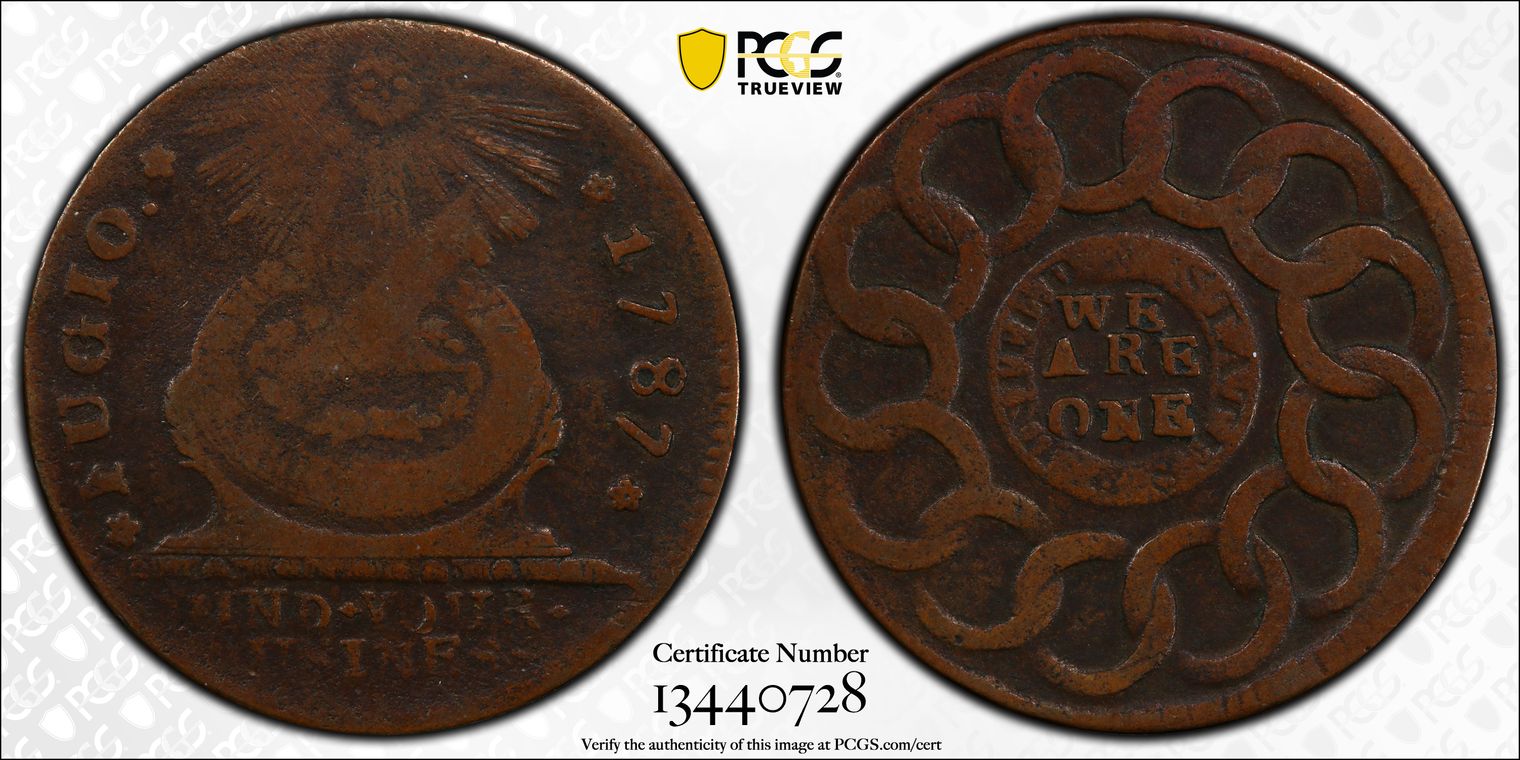
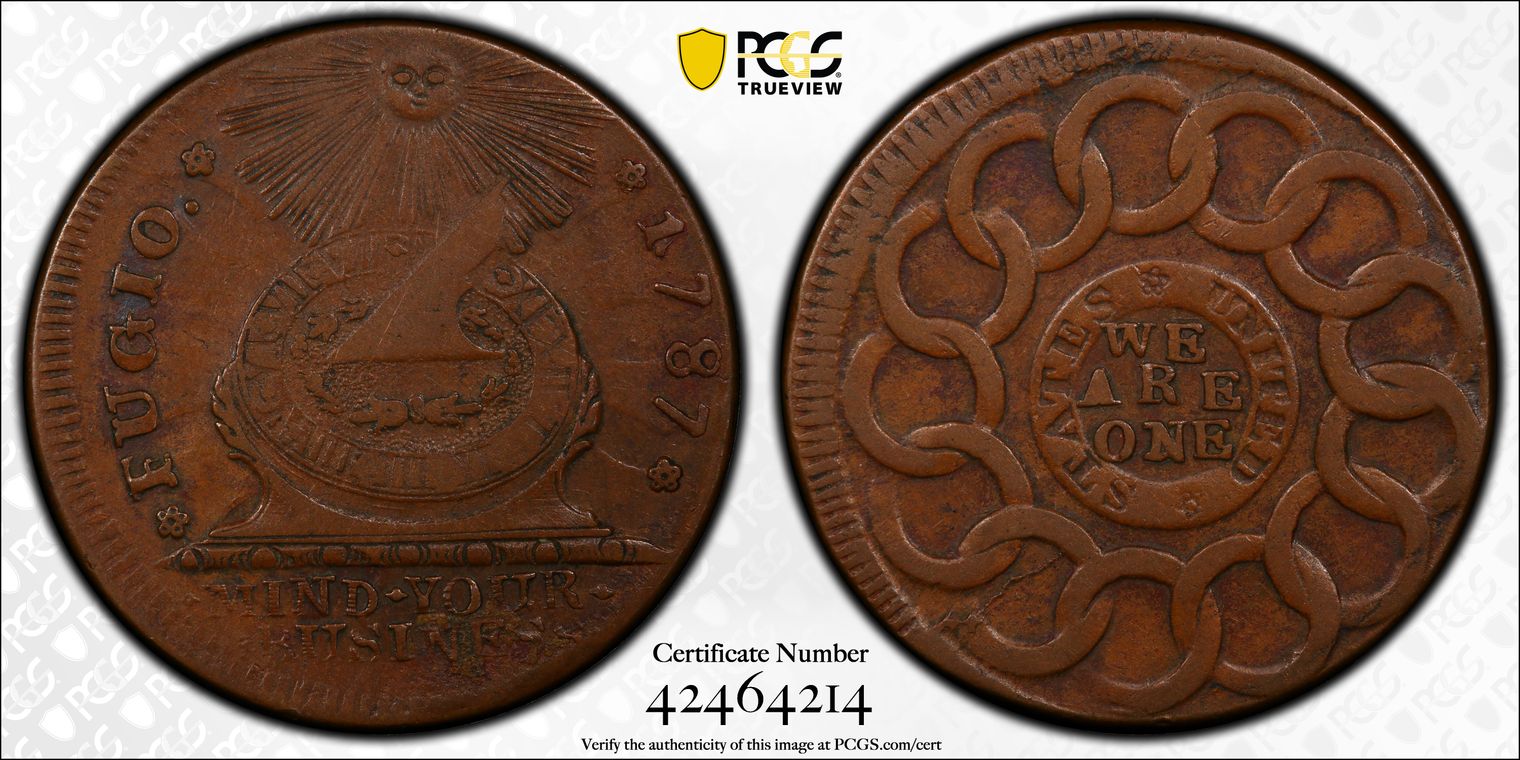
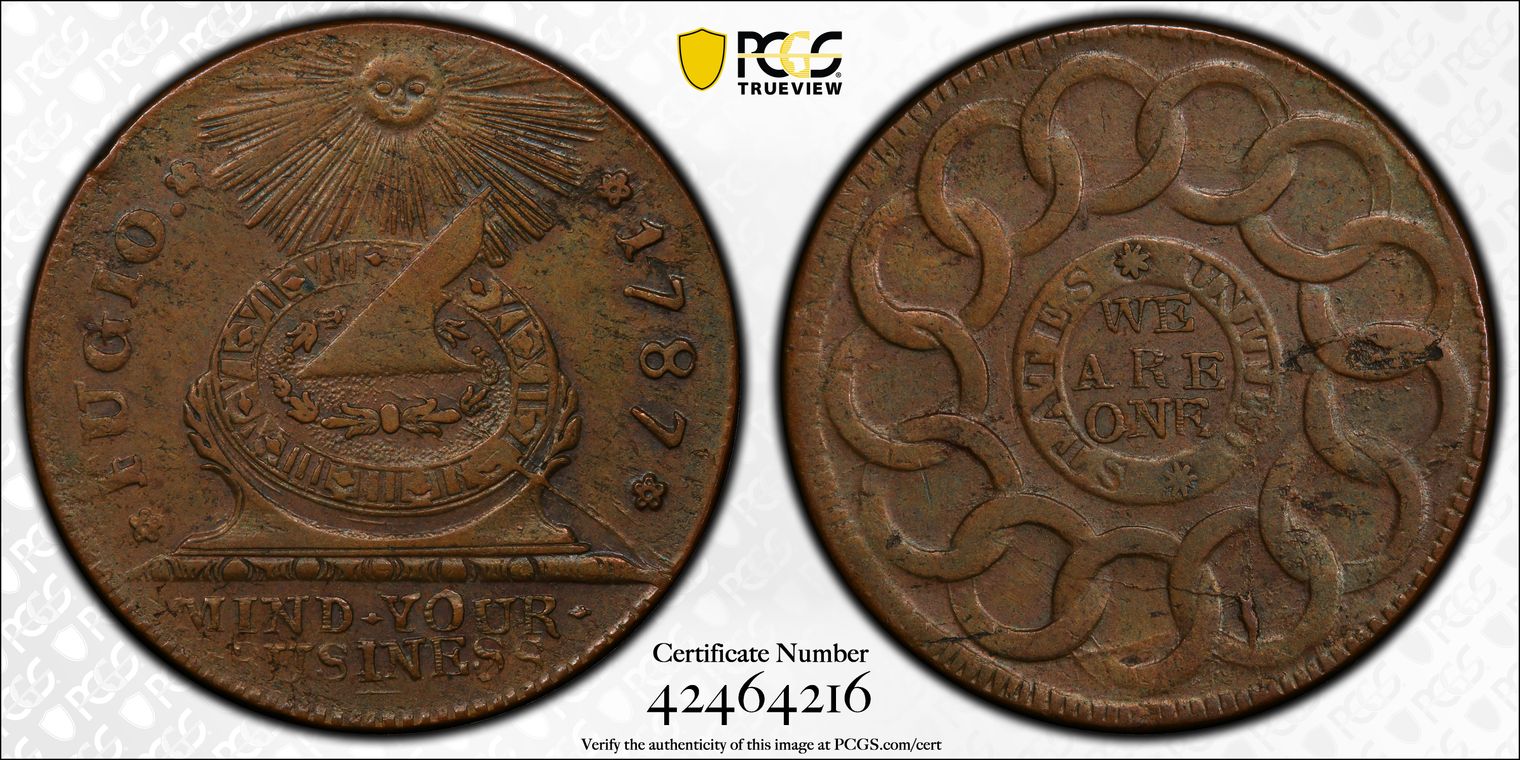
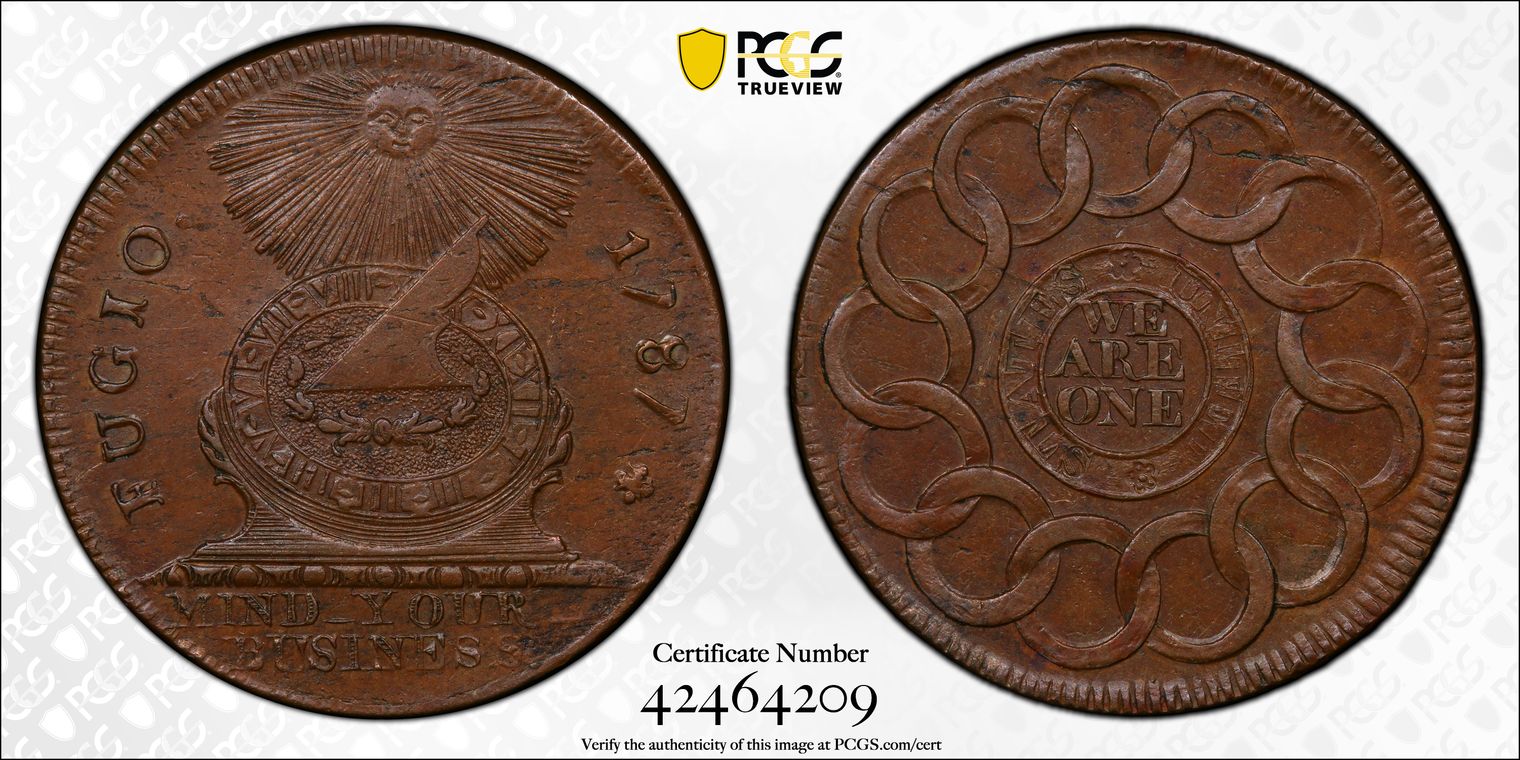
Newman 1-Z. R8. Probable Pattern. Cross after Date, No cinquefoils, STATES UNITED. Finest Known. Per cataloger, "Fugio Copper "Cent," Raised Rims, Cross After Date MS64 Brown NGC. CAC. Newman 1-Z, W-6610, R.7. 154.0 grains. The combination of the Cross After Date obverse and the Raised Rims reverse yields an extremely important single-variety type with claims to pattern status. In the "Fugio Files Updated, Part Twelve," published in the July 1994 issue of Penny-Wise, Michael McLauglin write: "The elements on this die were hand engraved which lends credence to the probability that this die was a pattern. Against this, however, the proportion of survivors of this variety in lower grade attests to their circulation. Perhaps a 'production pattern' designation to this die would not be appropriate." The hand engraving of both dies is not immediately obvious on lower grade pieces, but it is readily apparent on this Mint State piece. This Production Pattern issue may illustrate a stage in the Fugio design process as Michael Hodder suggested in the October 2003 Ford catalog. Since obverse 1 is identified as both a pattern and production obverse, the combination of these two dies is unprecedented among regular issue Fugios. Walter Breen recorded this variety and others from obverse 1 as prototypes of Jarvis & Company's New Haven Mint. The Norweb coin, plated in Newman's 2008 Fugio reference, was graded AU55. The finer of two in the Ford sale was called "Nearly About Uncirculated," which apparently means XF. The Eric P. Newman 1-Z is an impressive example and likely the finest known. The satin surfaces display splendid olive-brown color with a few splashes of steel toning. A few planchet rifts or laminations are typical of the Fugio series. Eric P. Newman Educational Society." Obtained from Heritage Auction on November 9, 2014, Lot 3046. Of note the 2nd finest is only PCGS AU58+ asking 85K in 8/2018.

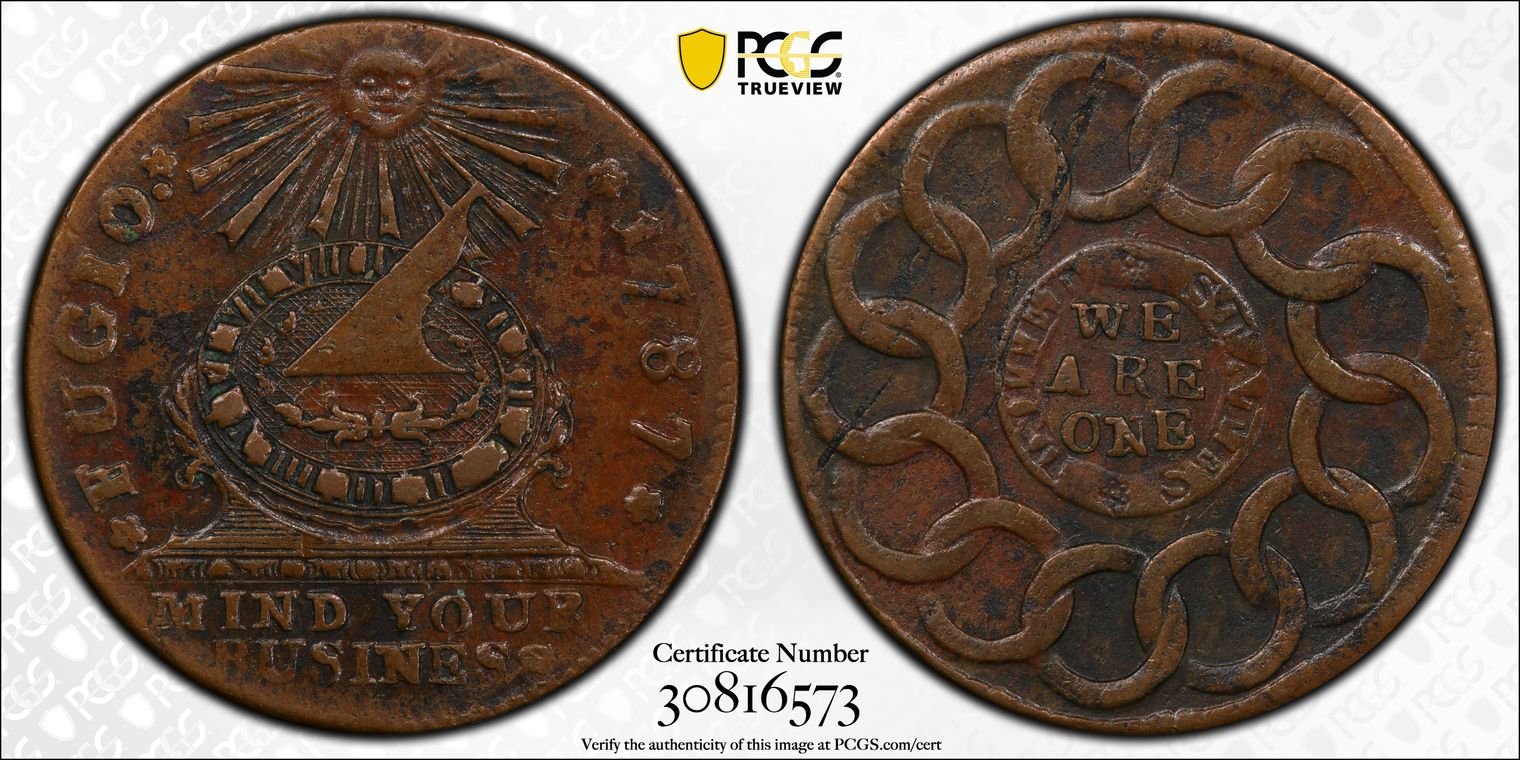
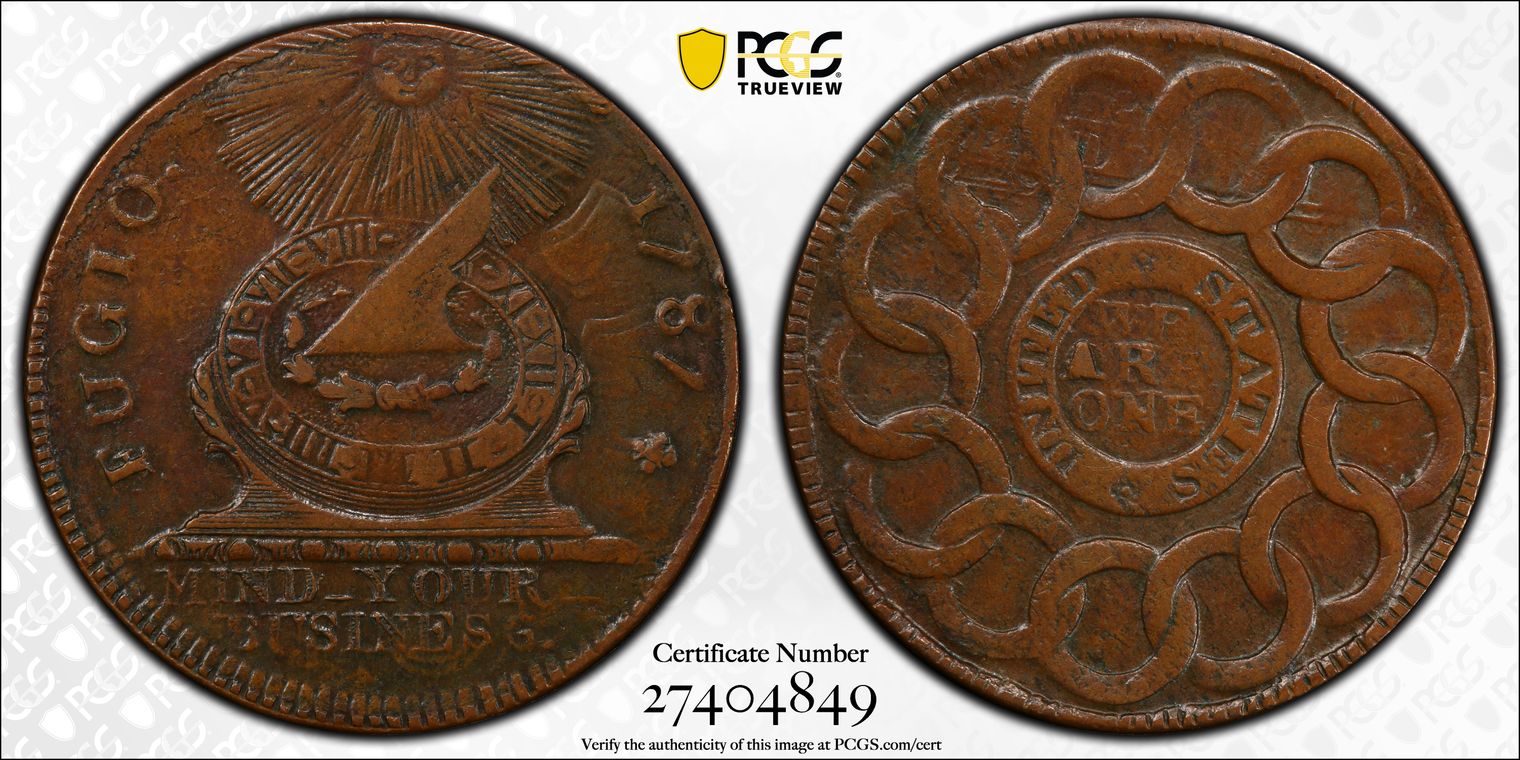
1-B R.4. UNITED STATES No Cinq with Cross
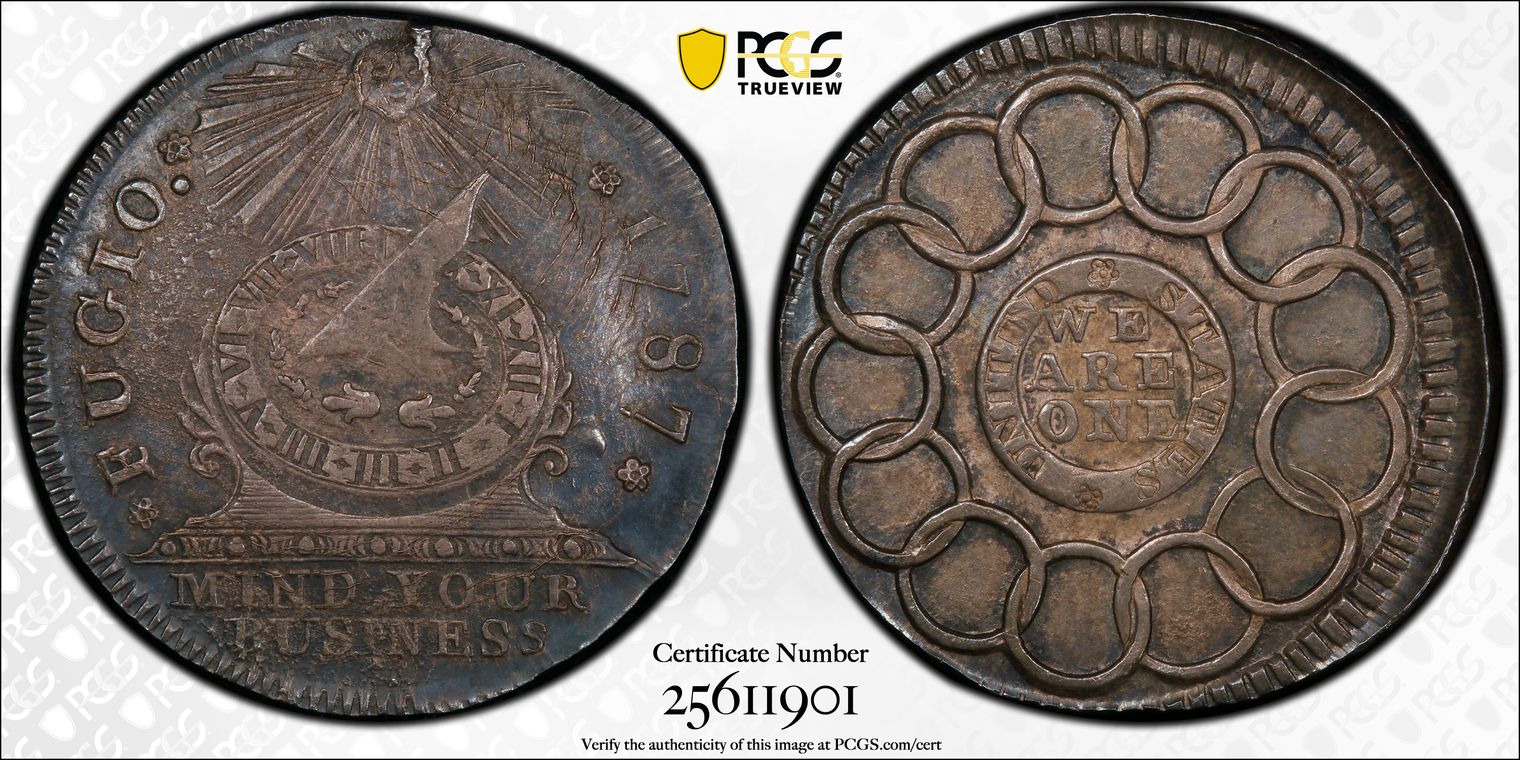
Newman 105-QQ. R7+. Silver Restrike Fugio Cent. Obtained by private treaty from Harry Laibstain Rare Coins on April 1, 2016.
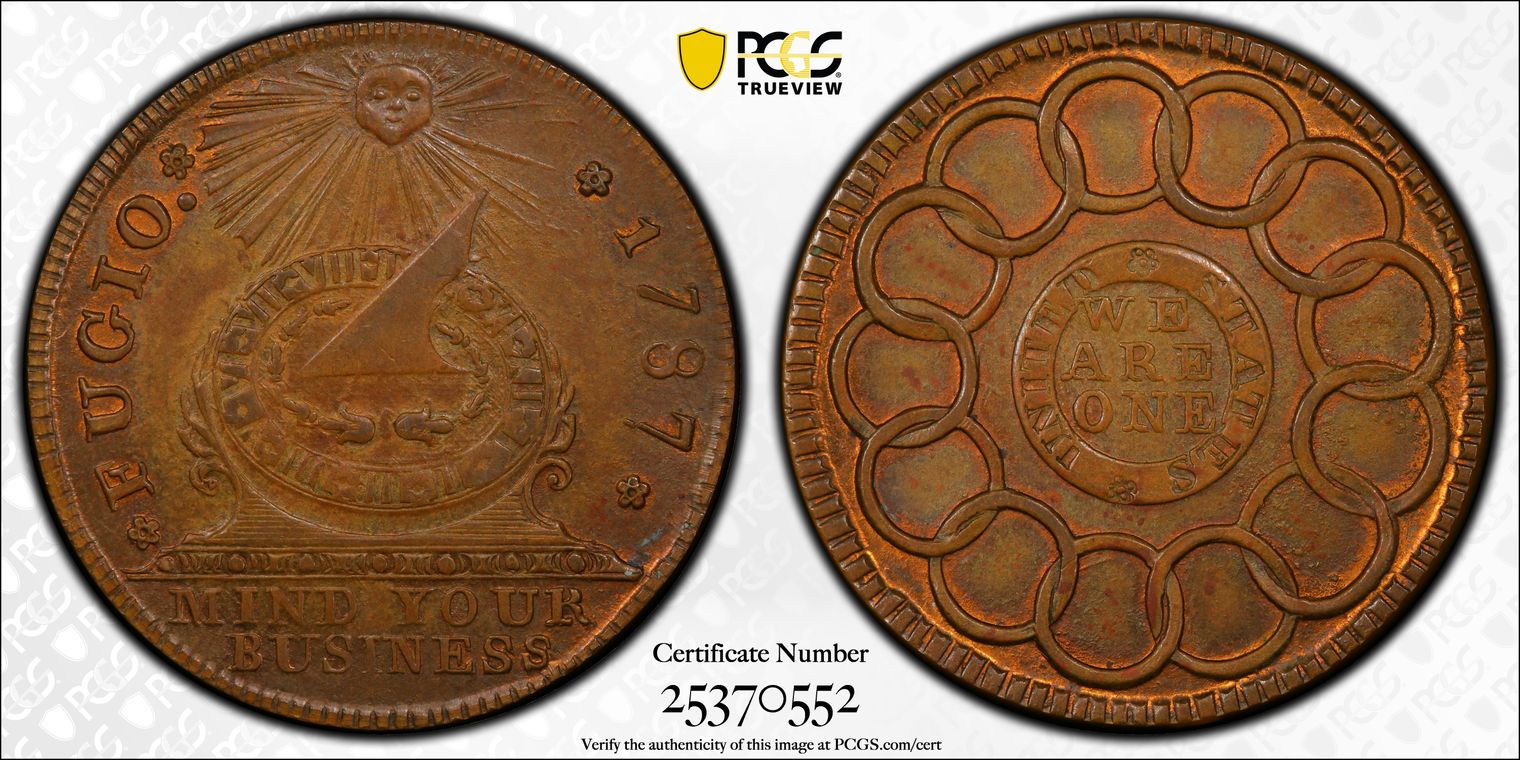
104-FF in Brass. Per cataloger at Stacks Bowers, "Deep tan-gold throughout with traces of mint orange here and there in the protected areas. Sharply struck from copy dies reportedly found in the Broome & Platt storefront in New Haven, Connecticut in the 1860s. Choice for the grade." Obtained from Stacks Auction on 11/7/2015, Lot 23255.
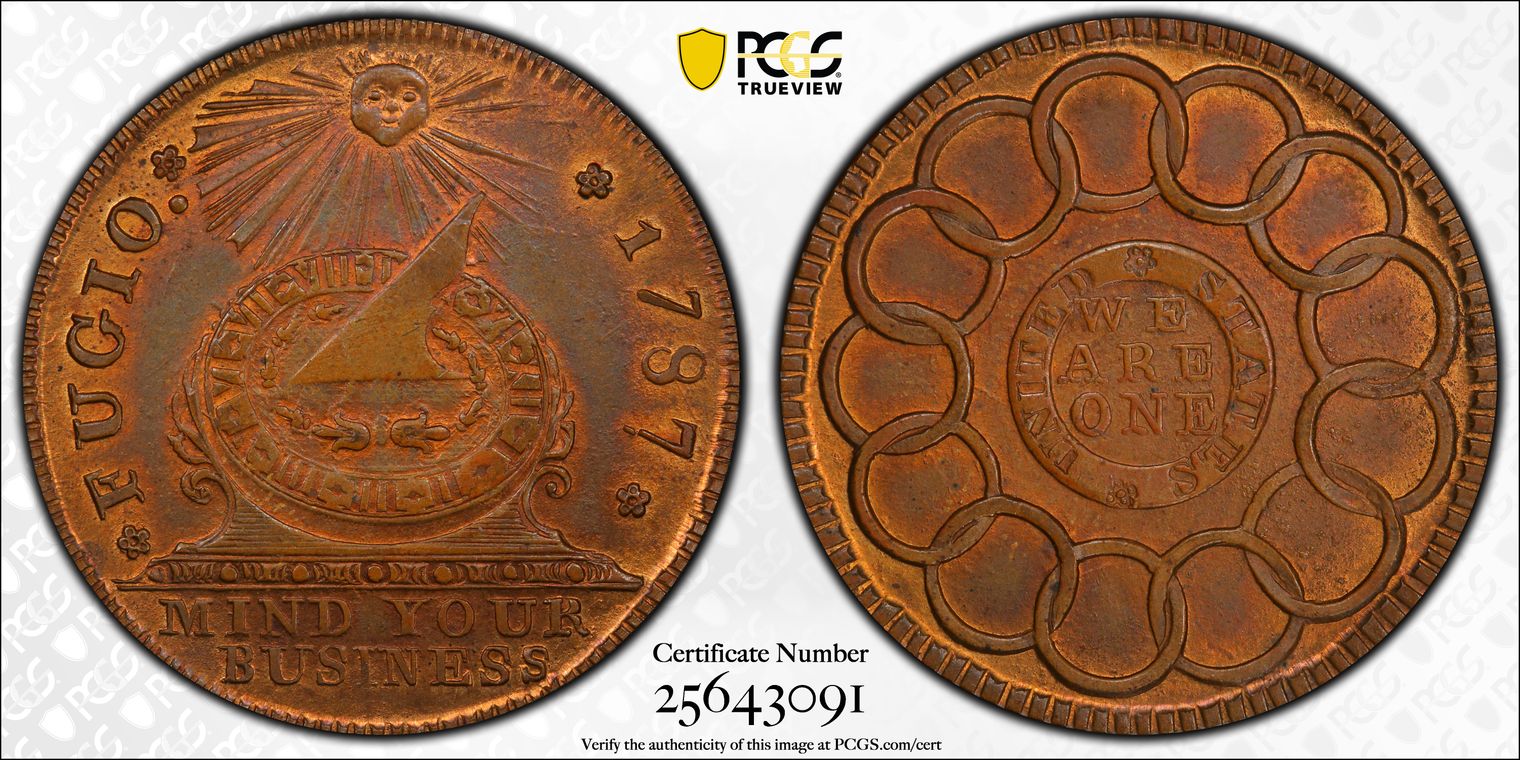
104-FF Finest Known. Mostly red with strong strike and luster. Obtained by private treaty with Harry Laibstain on December 20, 2015.