



Black Cat's Coin Album
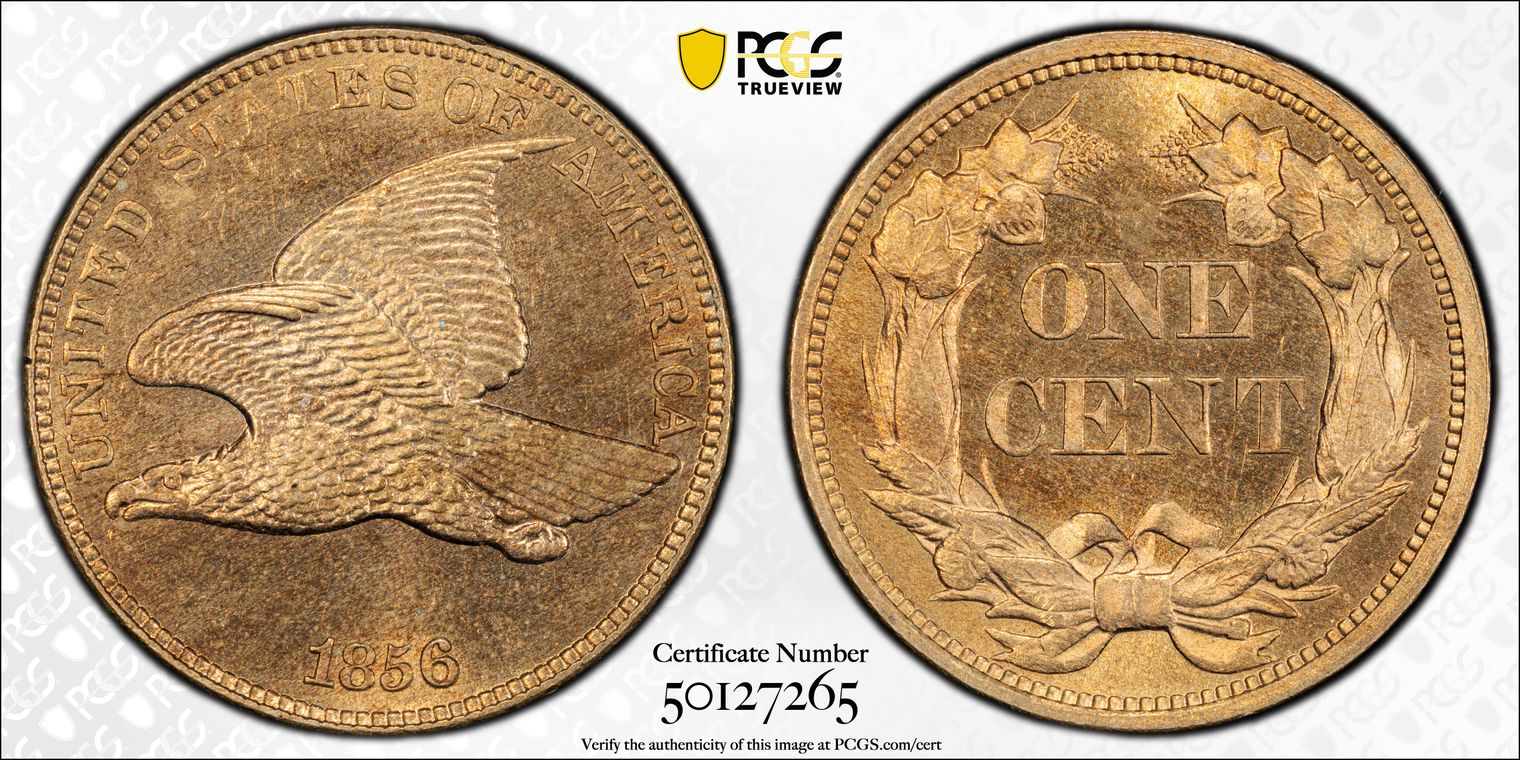
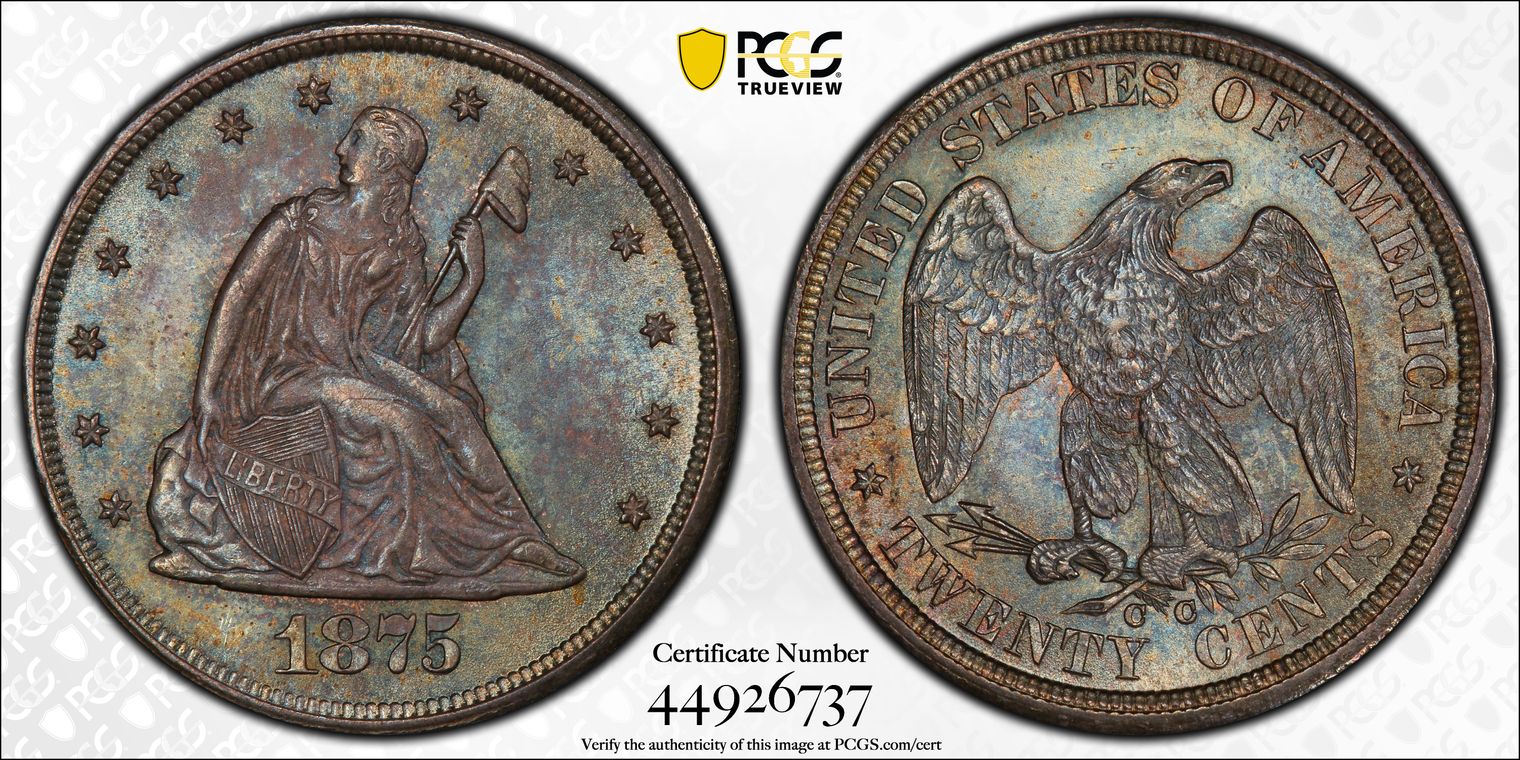
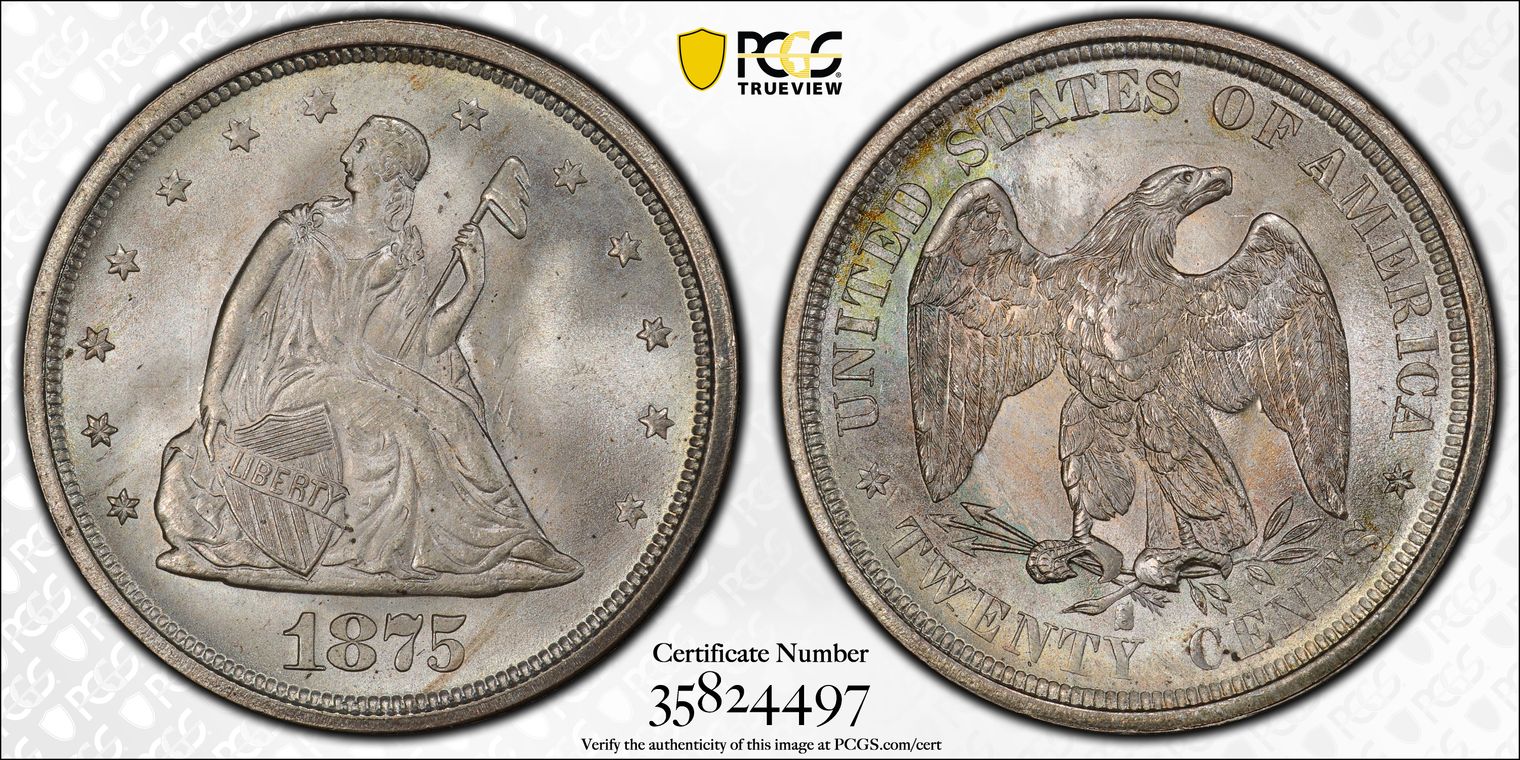
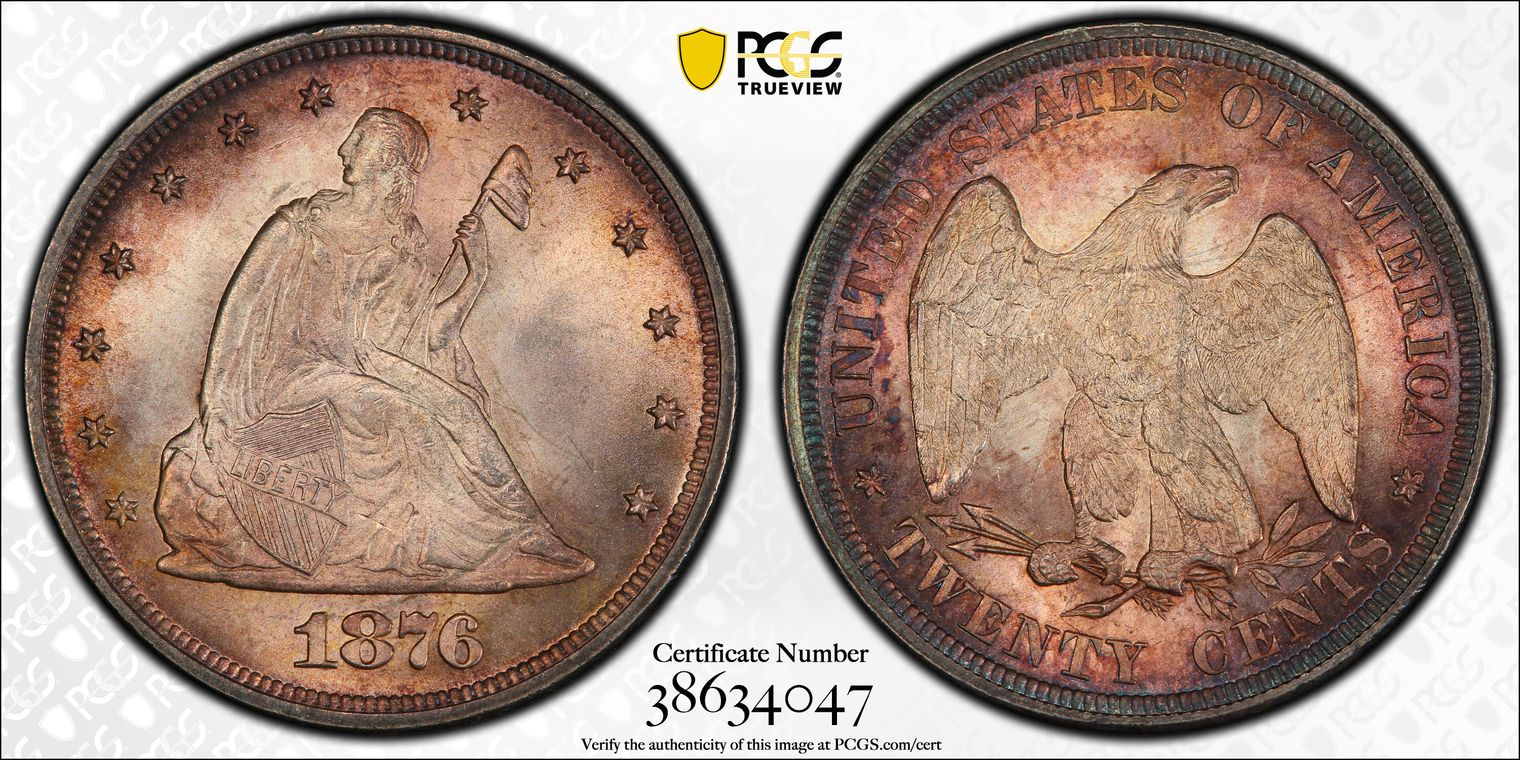
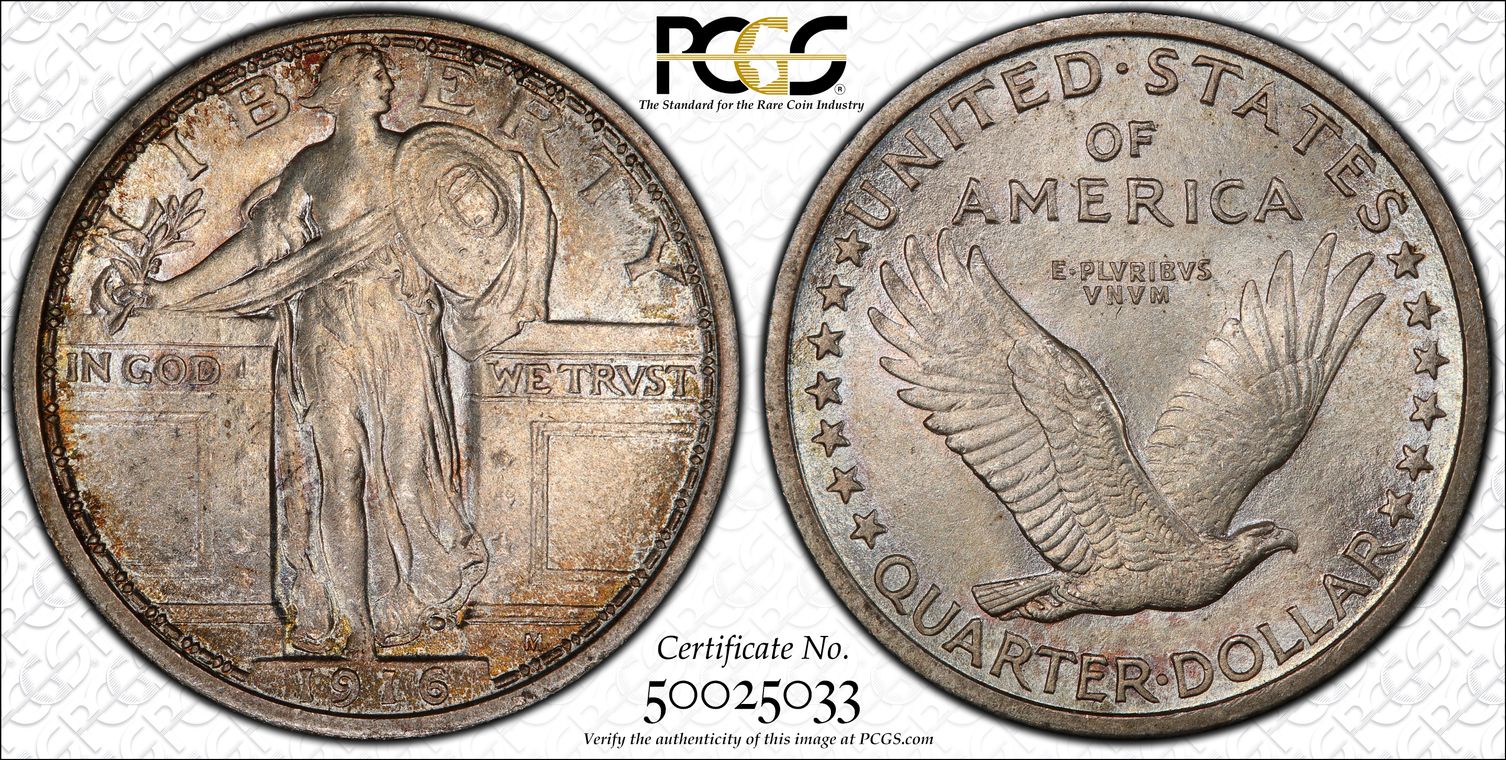
CAC -Intensely lustrous surfaces exhibit a smooth, billowy, frosty texture throughout. The reverse is essentially untoned, while for the obverse we note blushes of pale champagne-pink and reddish-russet patina that are boldest at the border. Smartly impressed with a sharp to full strike that readily upholds the validity of the coveted Full Head designation from PCGS.
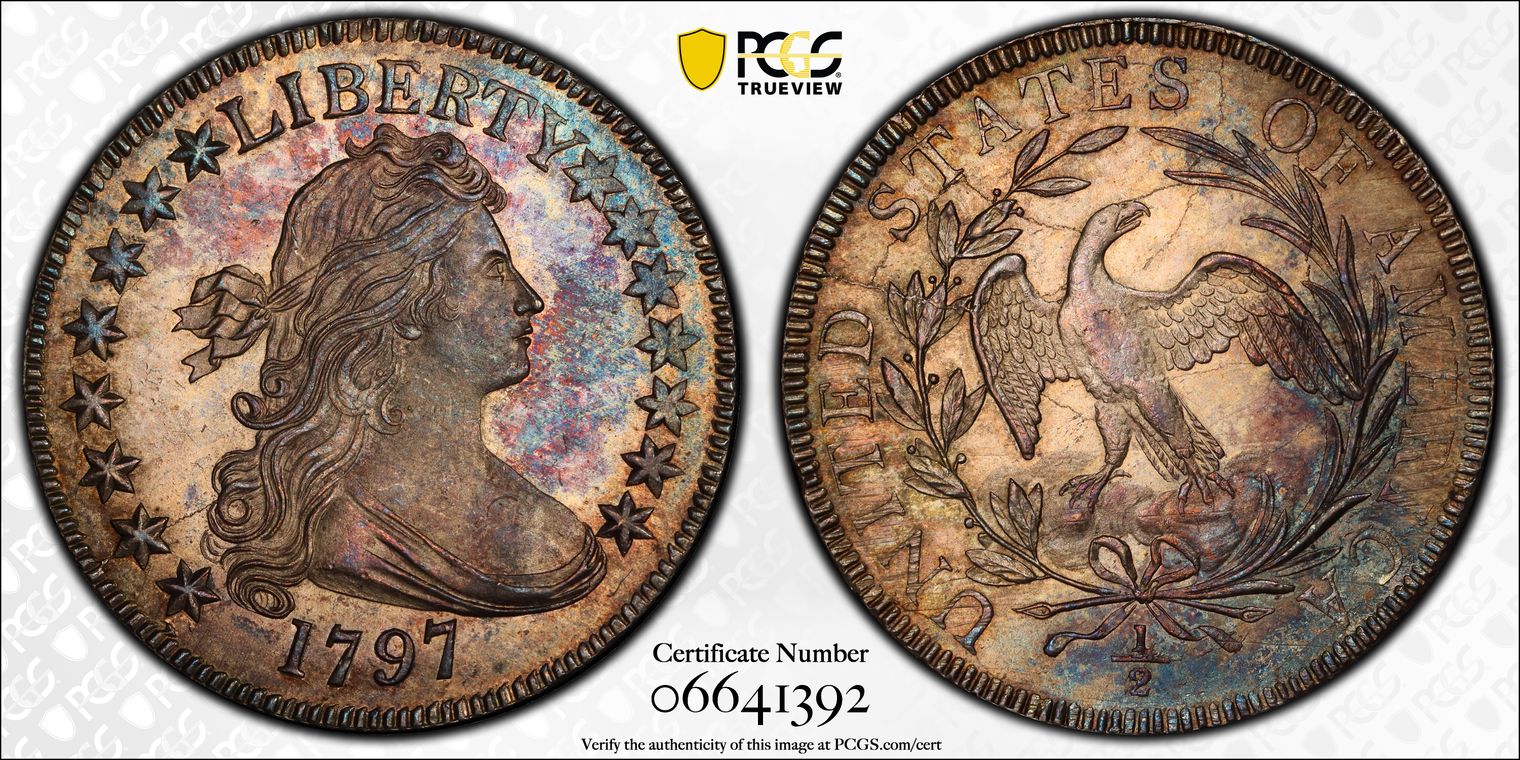
CAC - "Beautiful and original multicolored toning cascades over both sides of this stunning high-end Gem. Gold and silver-gray coloration imbued with whispers of soft bluish-violet, orange, and russet predominate, accented with splashes of deep electric-blue, violet, reddish-gold, and purple at the upper-right and right obverse and on the lower-right quadrant of the reverse. Reflective prooflike fields highlight the frosty central motifs, yielding a pleasing degree of contrast on each side. The design elements are sharply struck, including individual strands of Liberty's hair and curls. The eagle's wing and tail feathers are bold, as are the talons. A curving, as-made lintmark is visible just above Liberty's cleavage, and light horizontal adjustment marks at the left and right reverse border do not affect the clarity of the letters in UNITED and AMERICA. The few minuscule marks that are visible only under a glass are insignificant and unobtrusive. Indeed, the surfaces on both sides are remarkably well-preserved." This easily one of the two finest 1797 halves certified. Ex: Farish Baldenhofer Collection (Stack's, 11/1955), lot 676; Norweb Collection (Bowers and Merena, 11/1988), lot 3027; Dr. Haig A. Koshkarian Collection (American Numismatic Rarities, 3/2004), lot 76; Stack's (7/2008), lot 4261, The Collection of Oliver Jung (Heritage, 8/2014), lot 5582, The Jim O'Neal Collection of U.S. Half Dollar Types.(Heritage, 1/2023), lot 3701
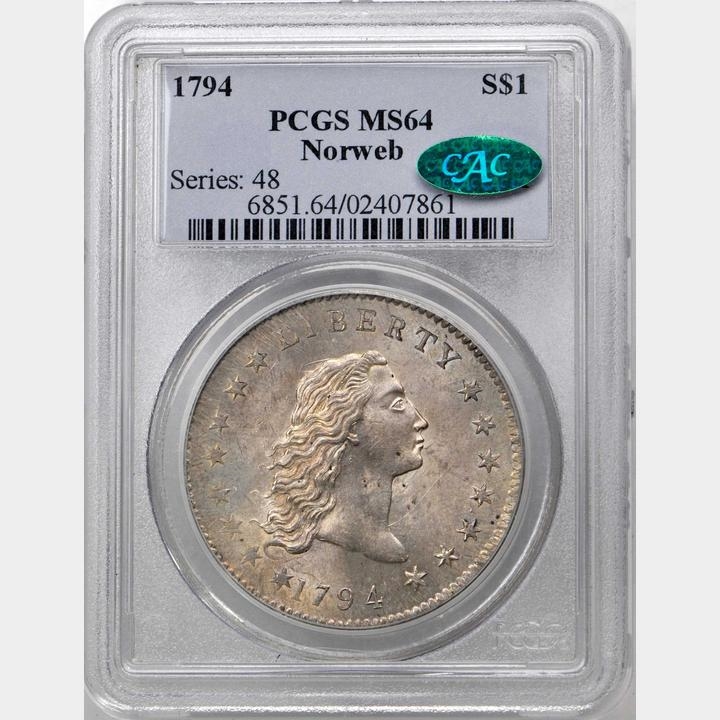
CAC - The Famous Lord St. Oswald-Norweb 1794 Flowing Hair Silver Dollar. Condition Census #4 of Only Six Mint State Examples Known
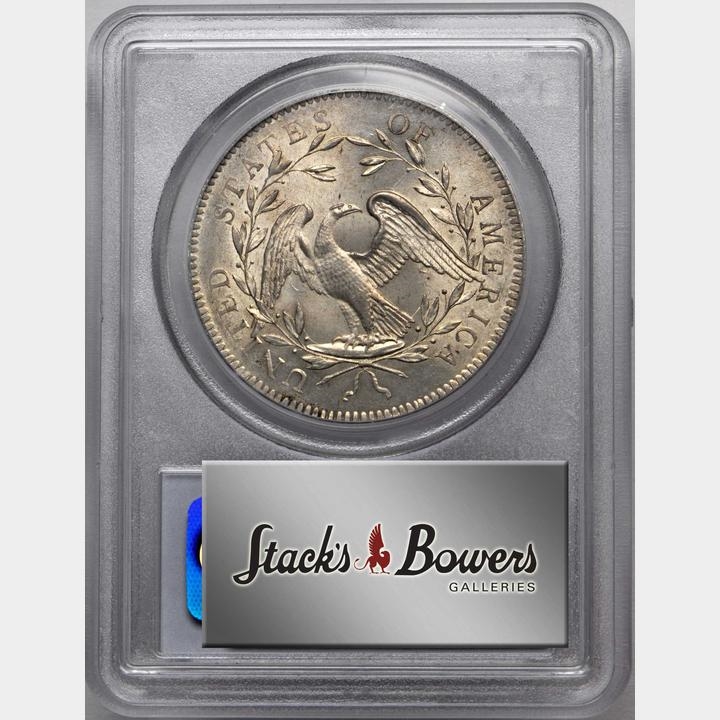
CAC - The Famous Lord St. Oswald-Norweb 1794 Flowing Hair Silver Dollar. Condition Census #4 of Only Six Mint State Examples Known
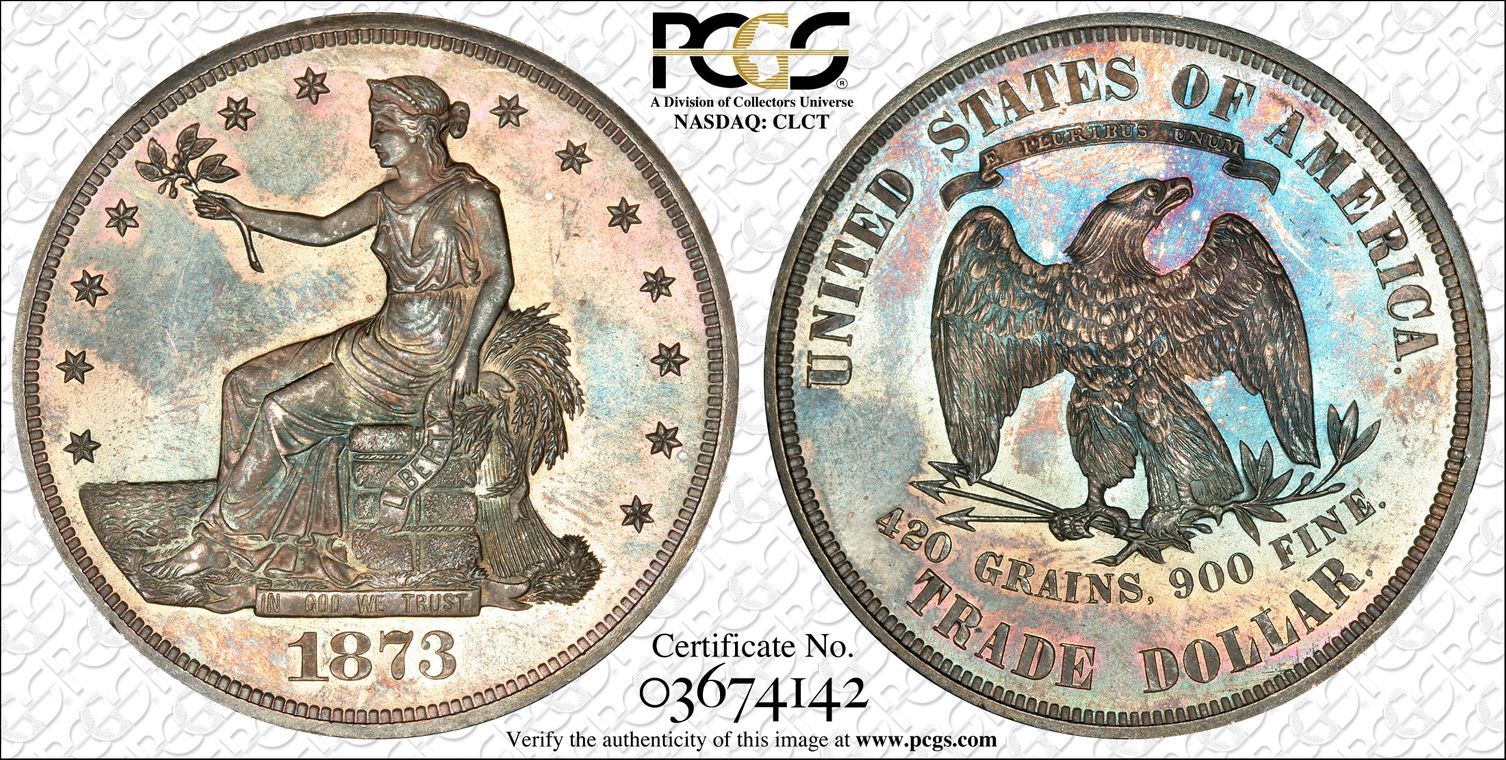
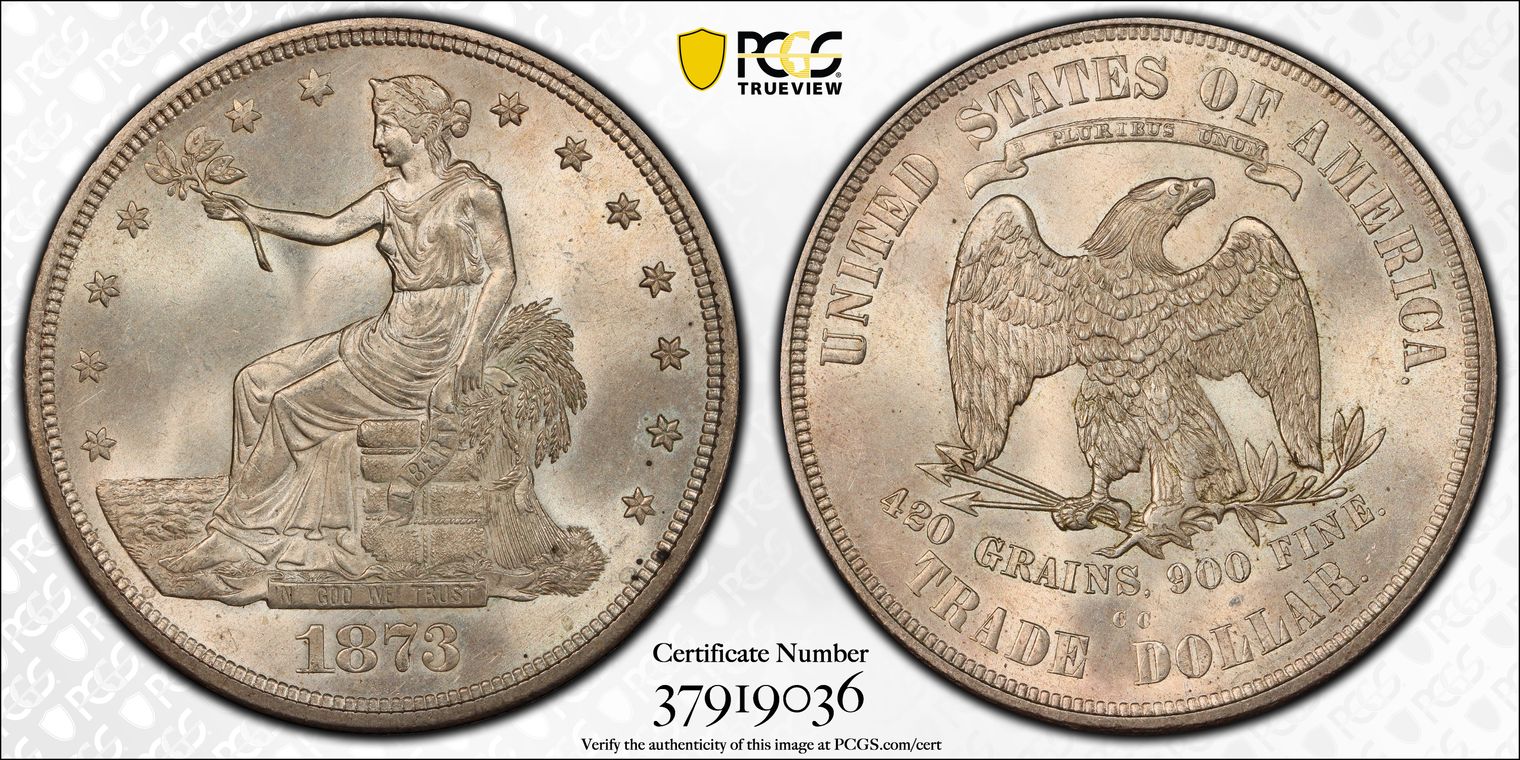
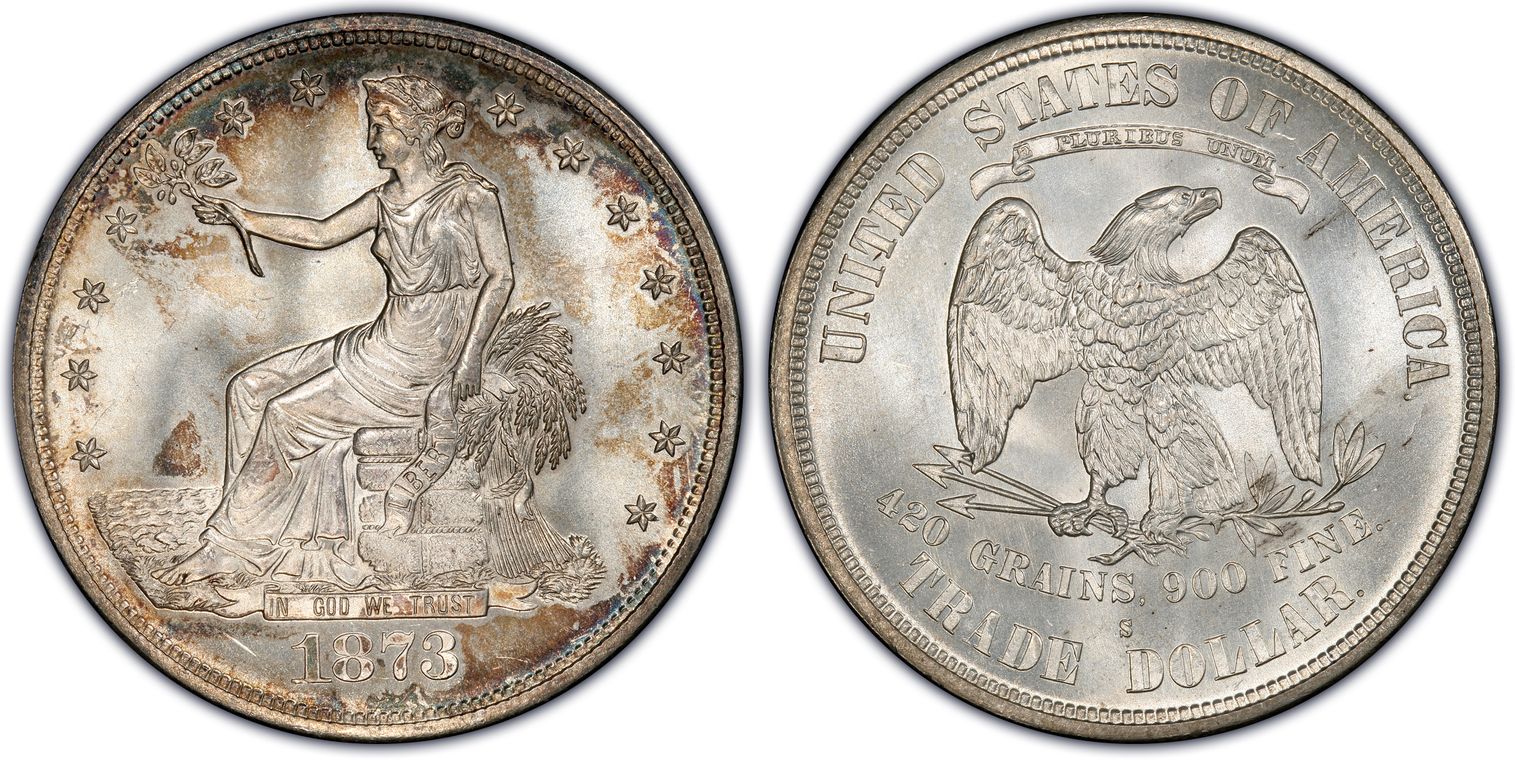
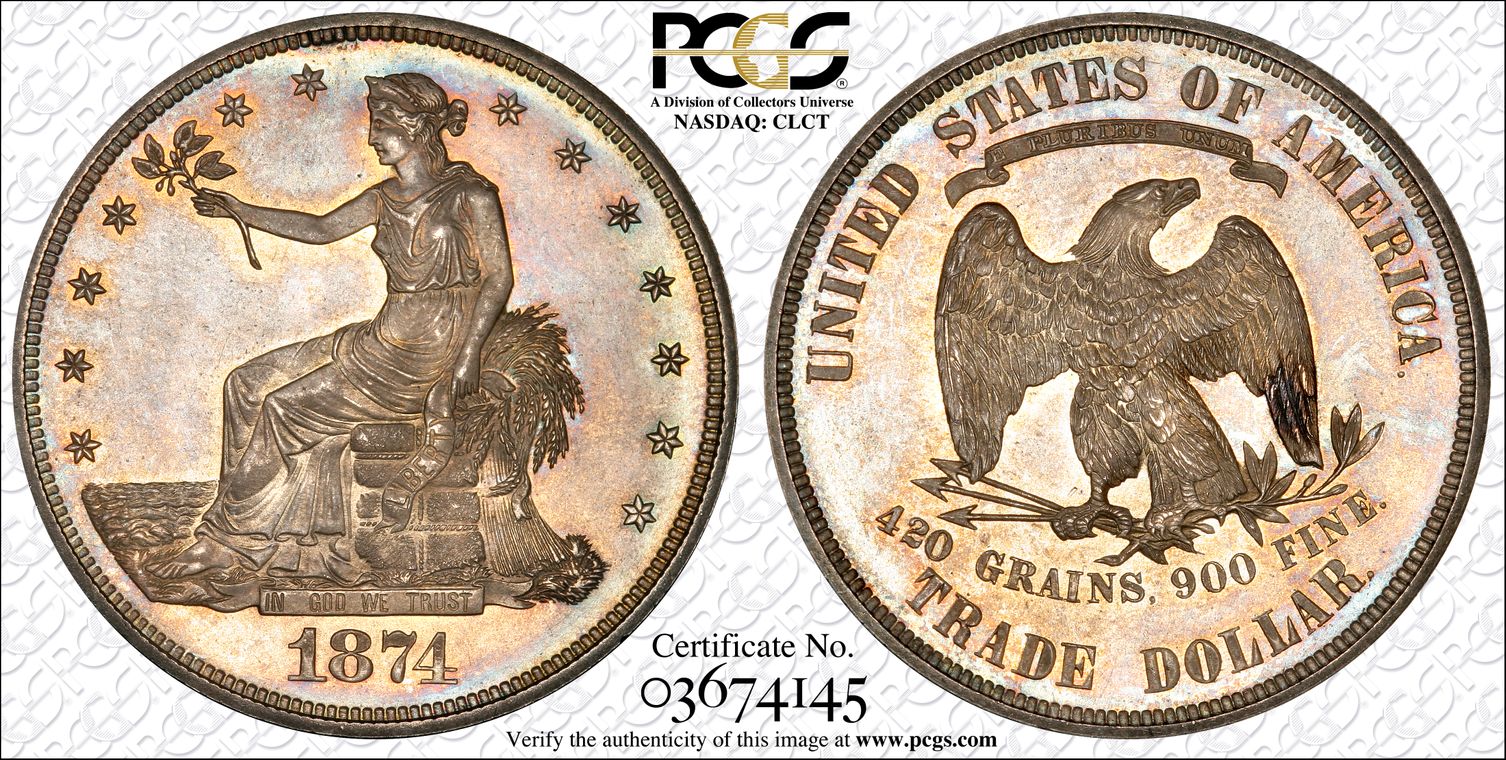
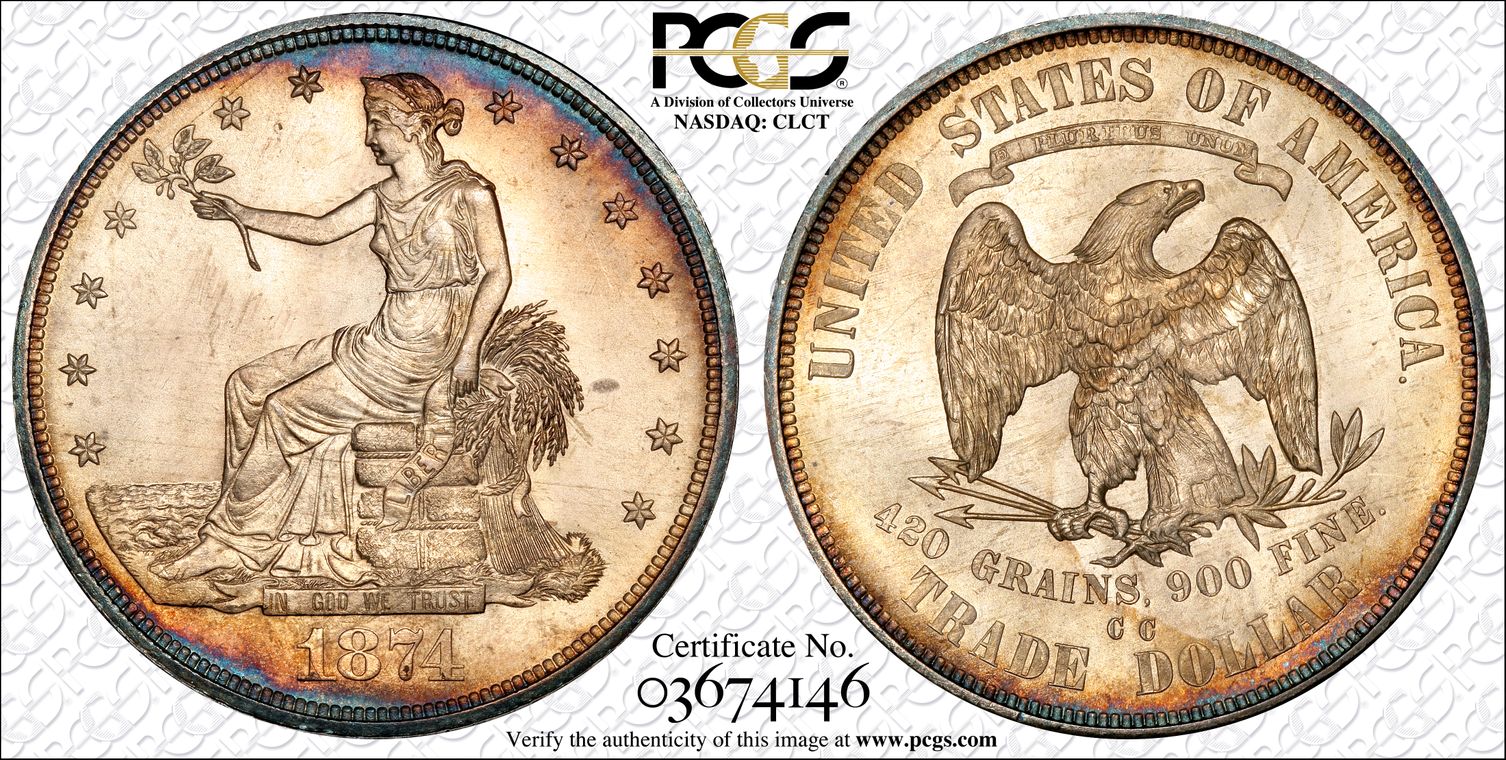
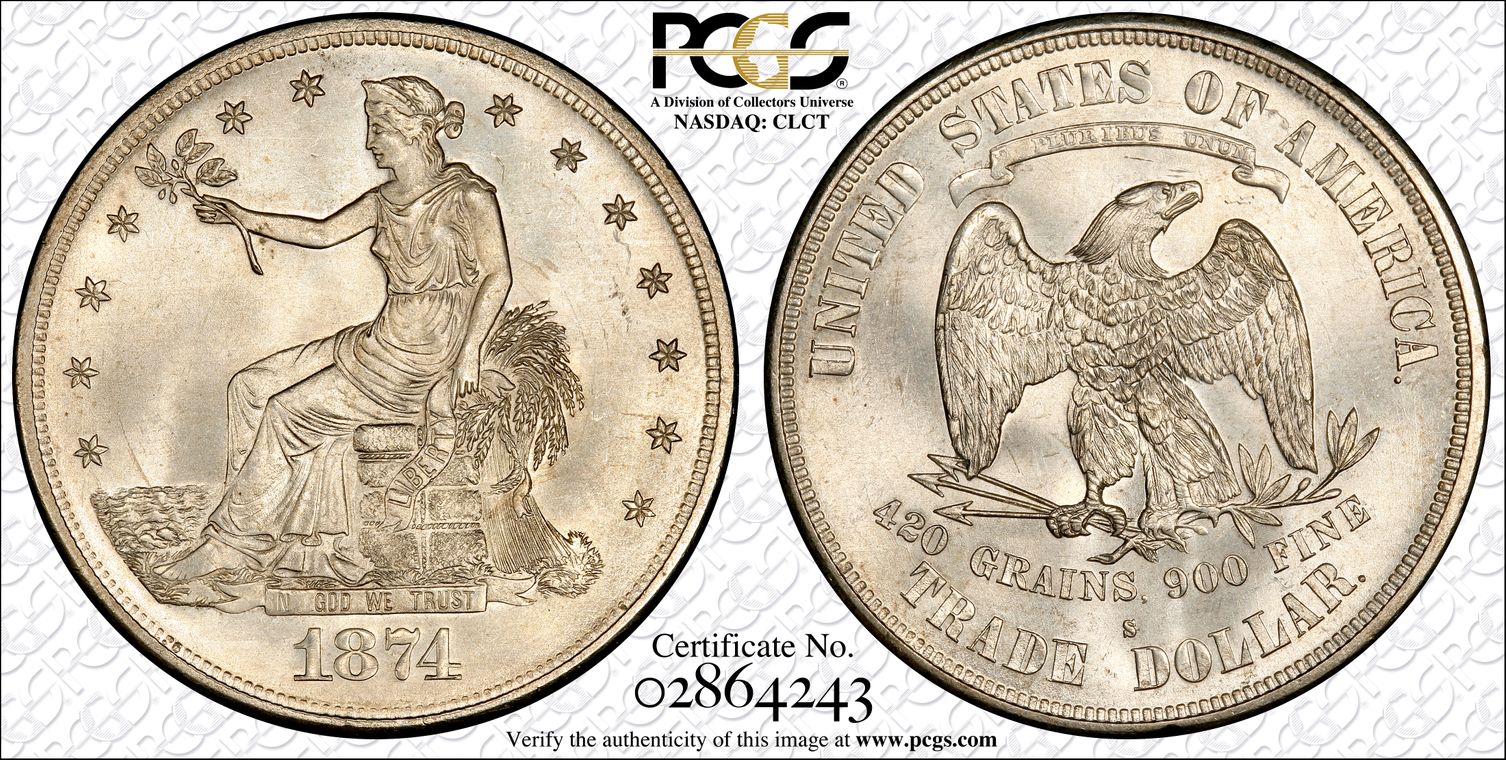
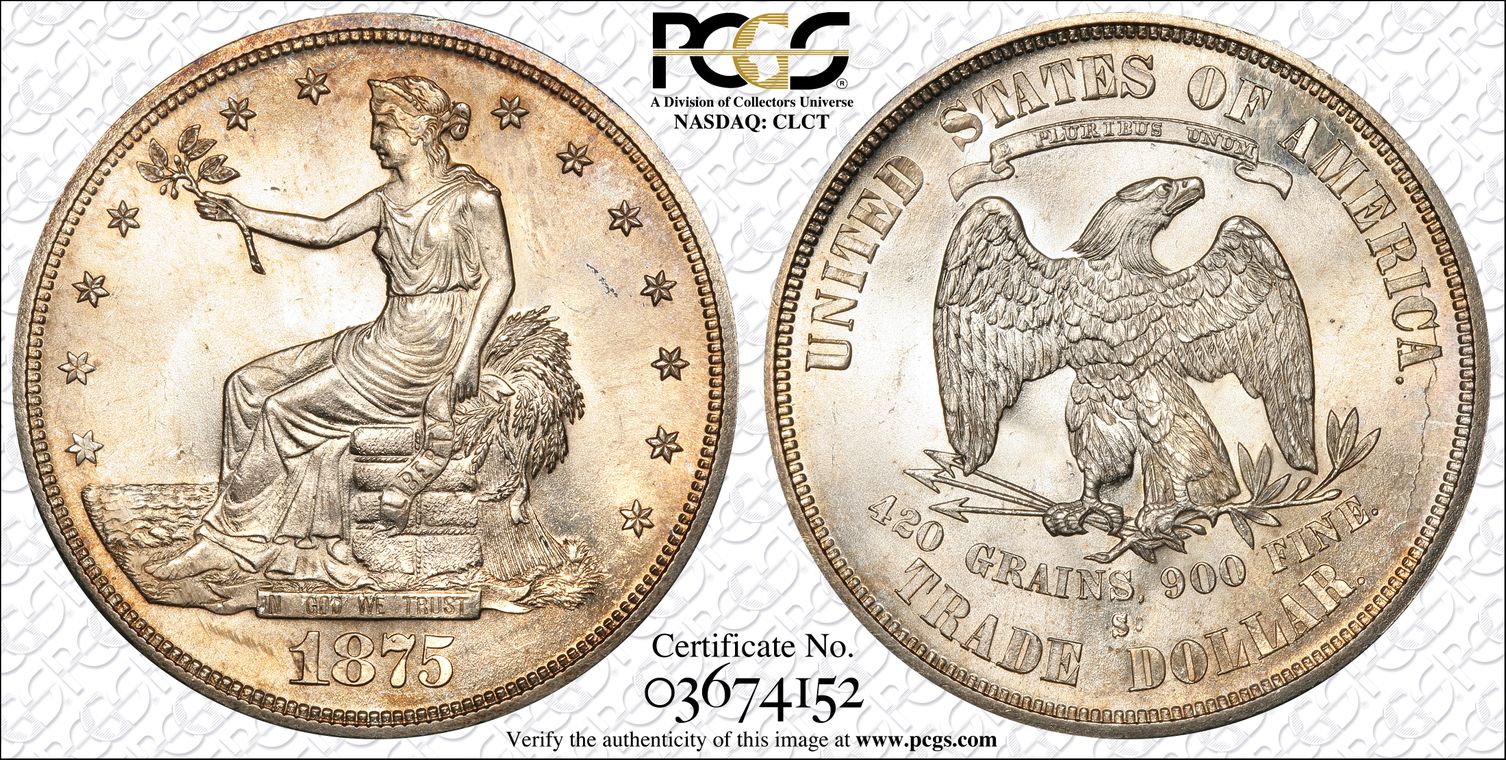
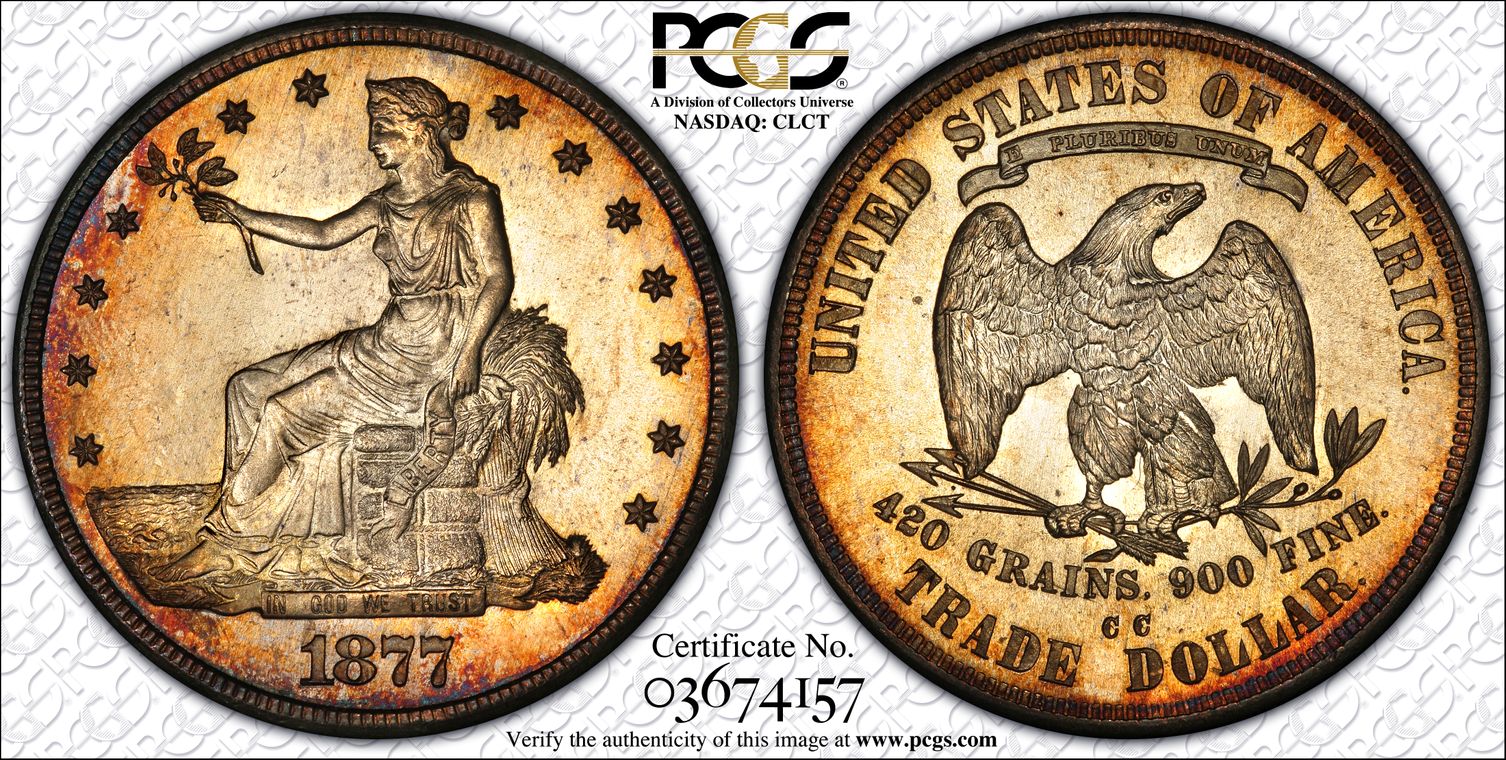
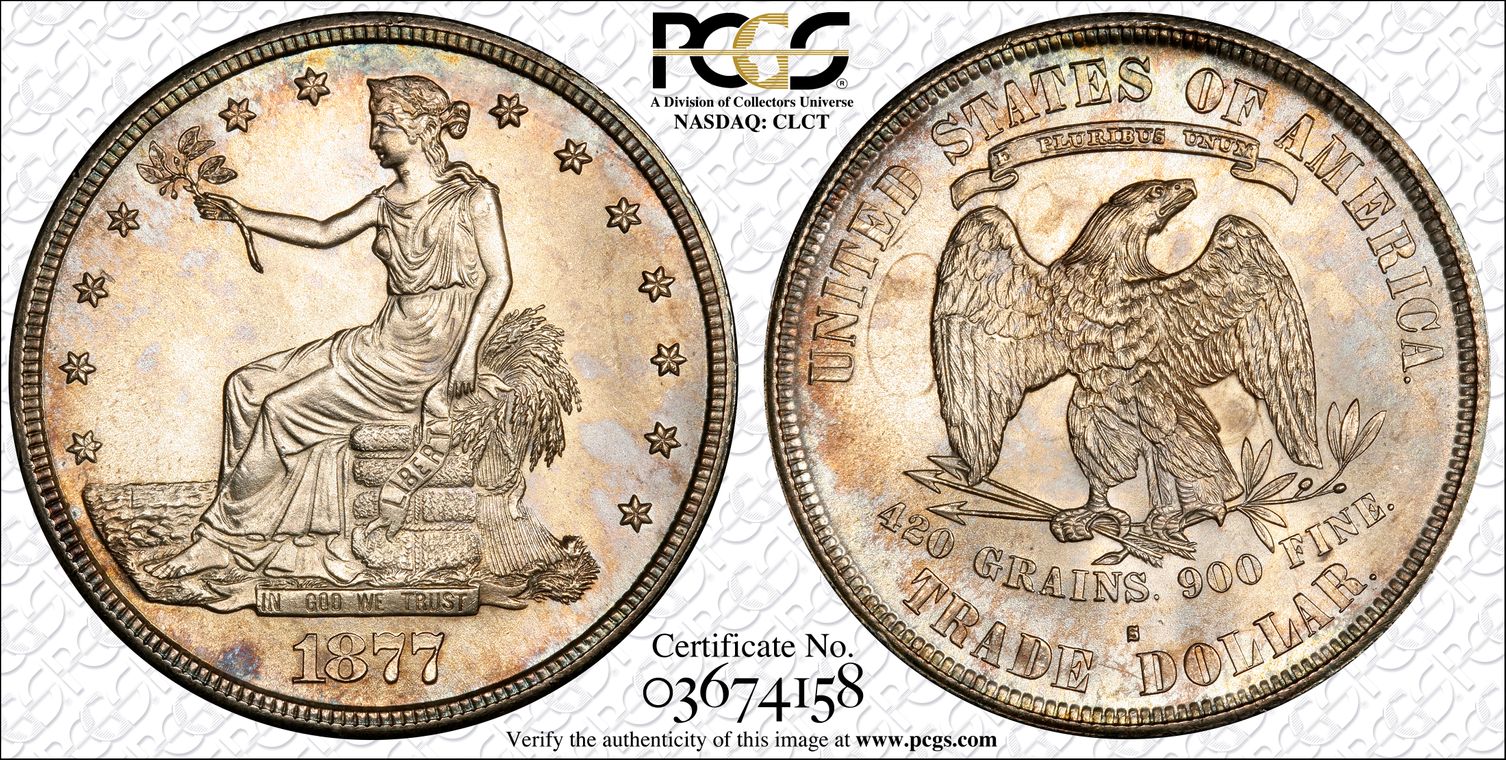
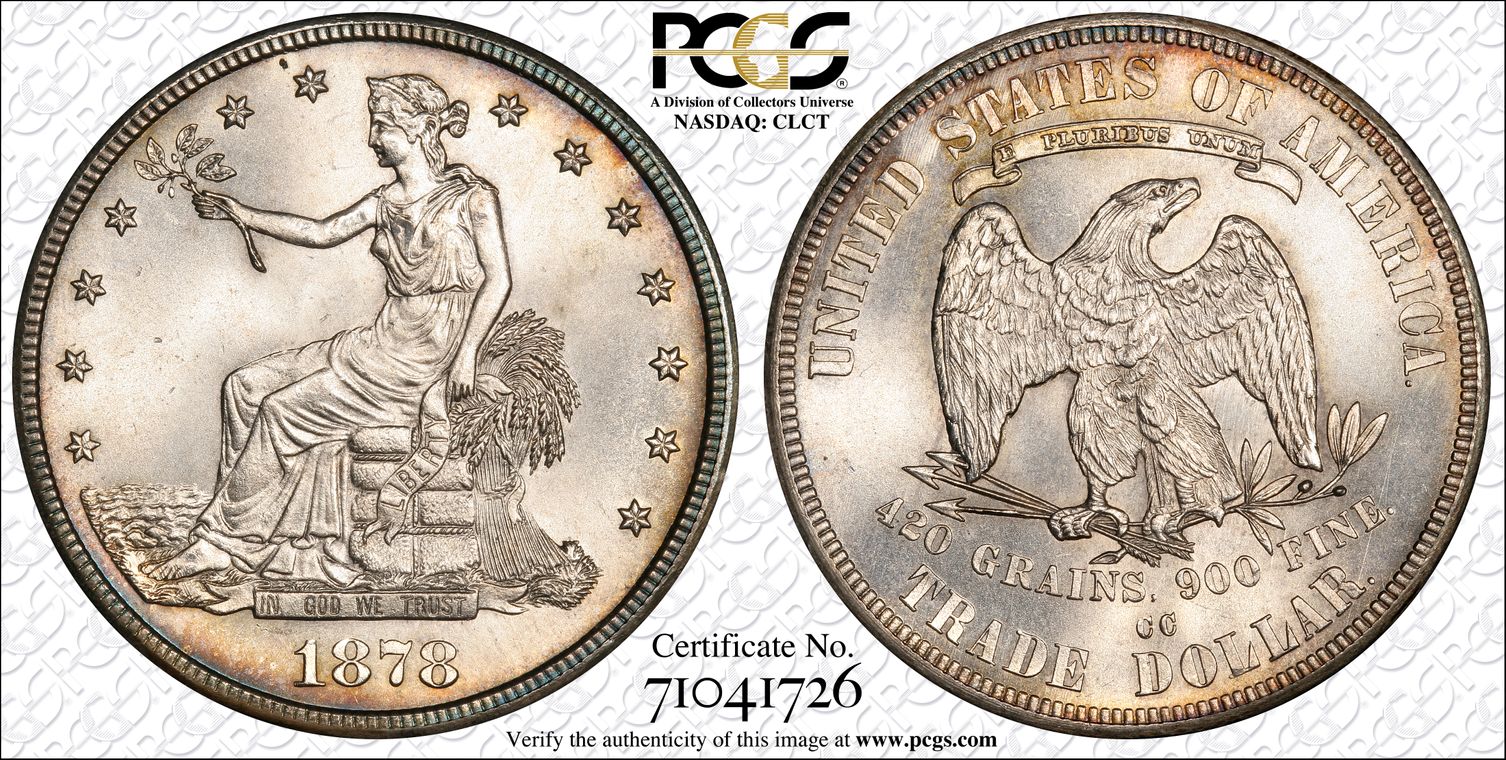
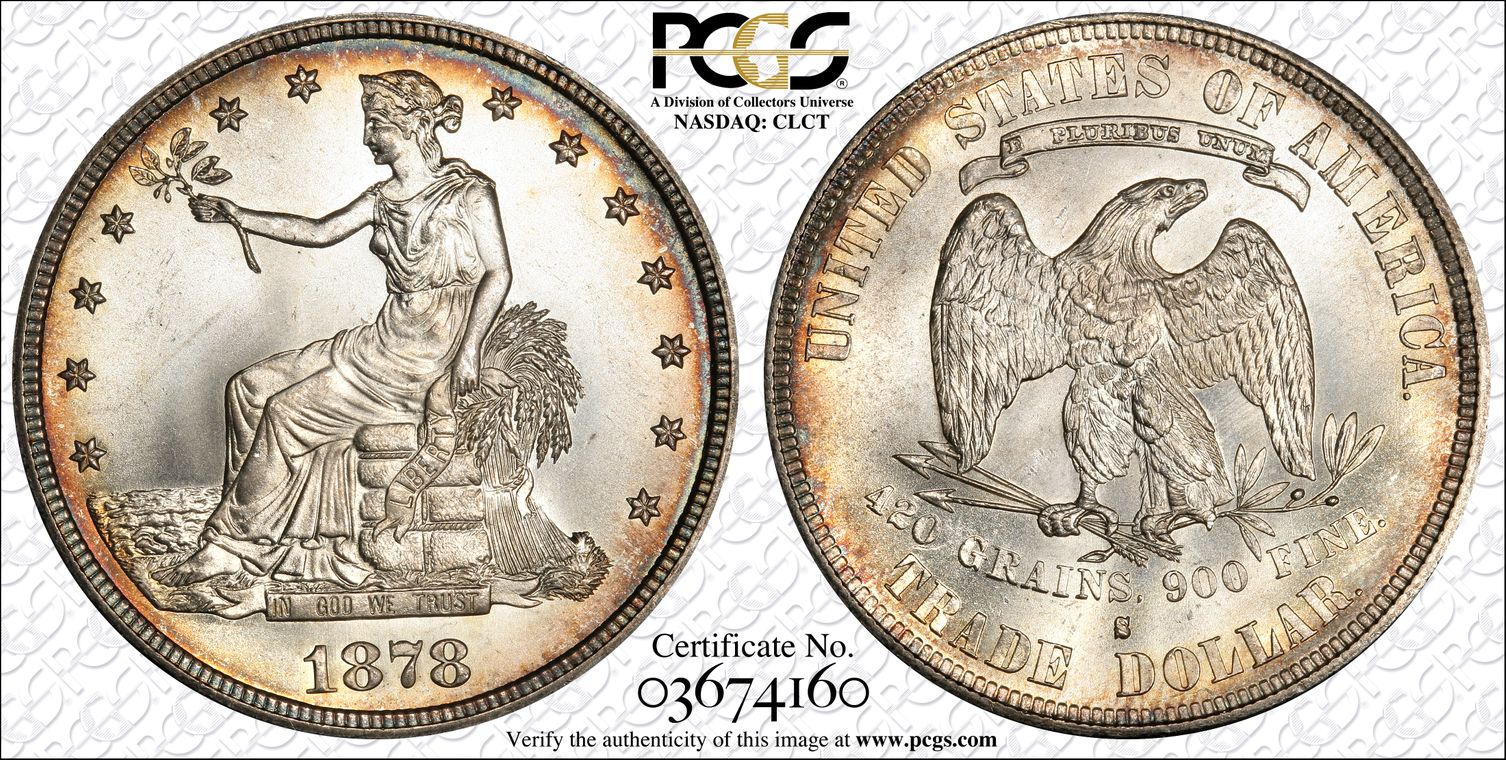
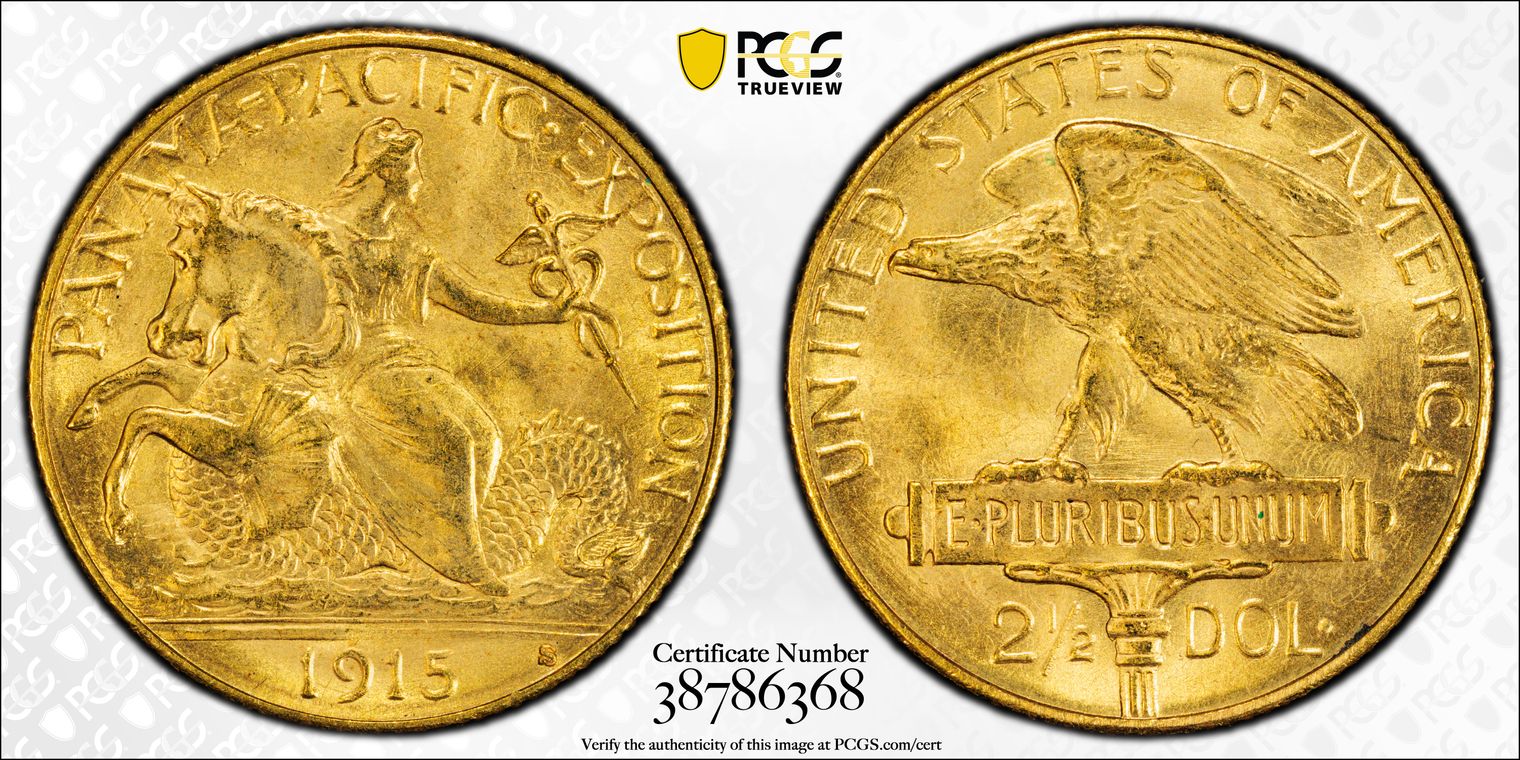
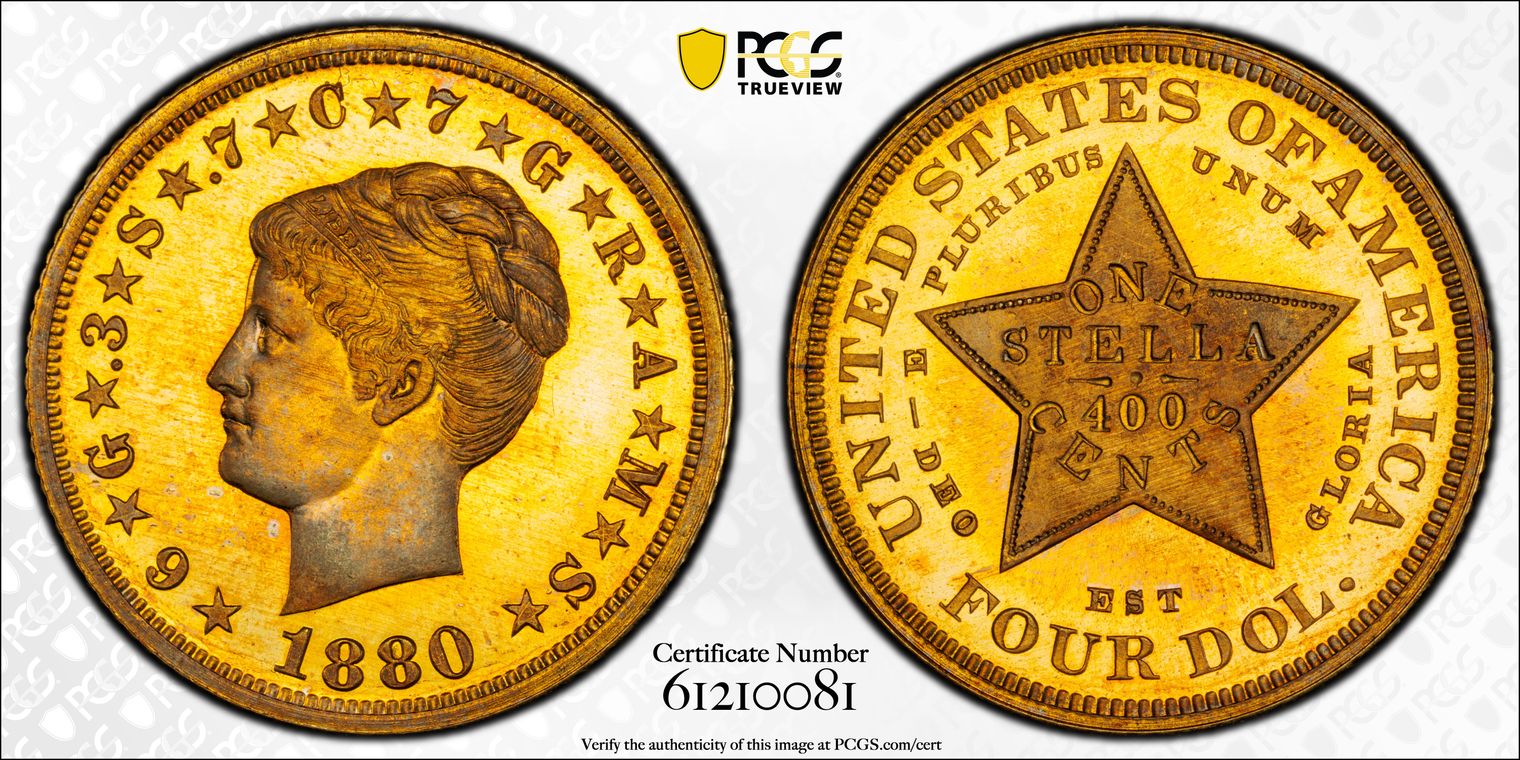
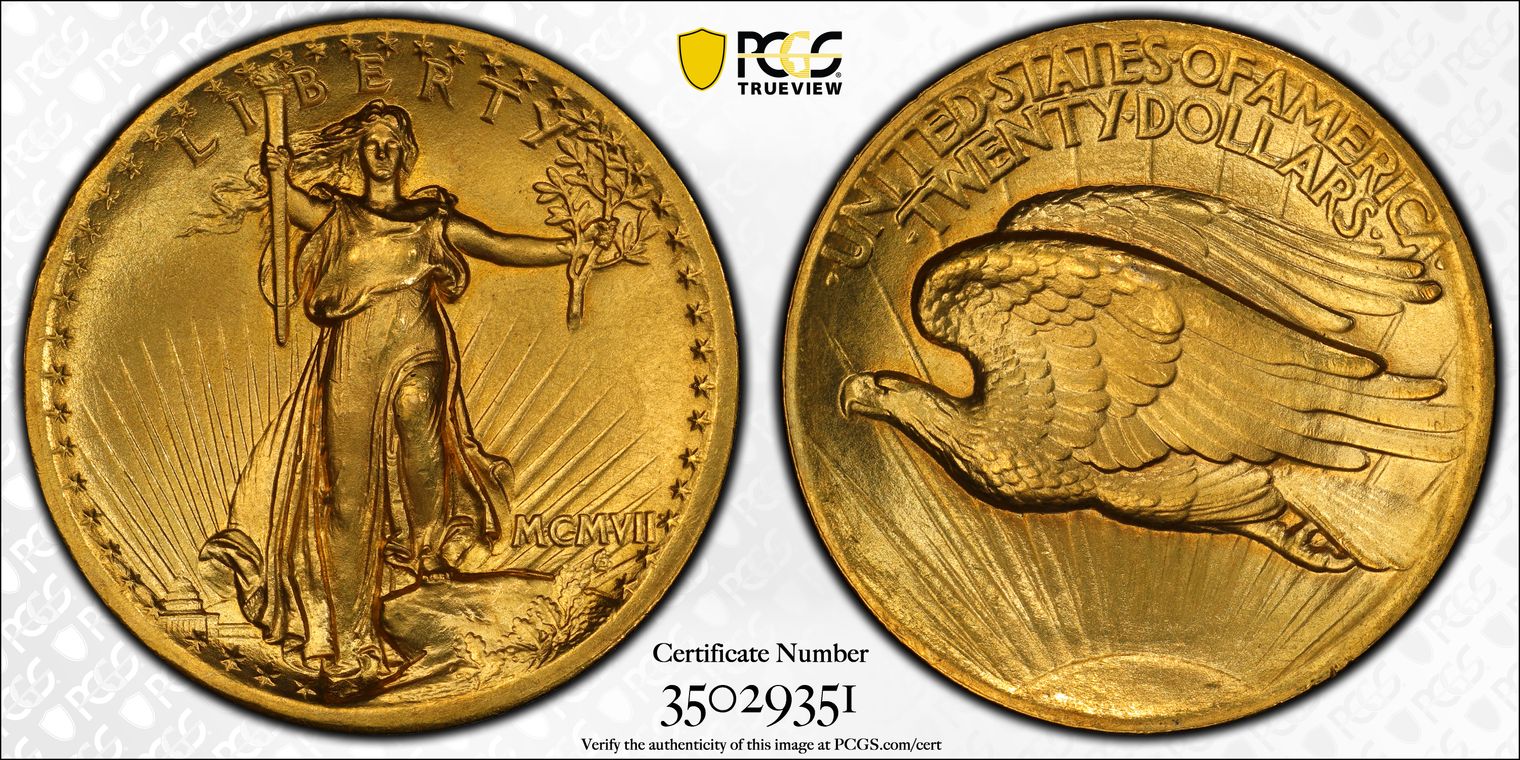
CAC - luster is broad and inviting with tiny prooflike pools within the lettering.
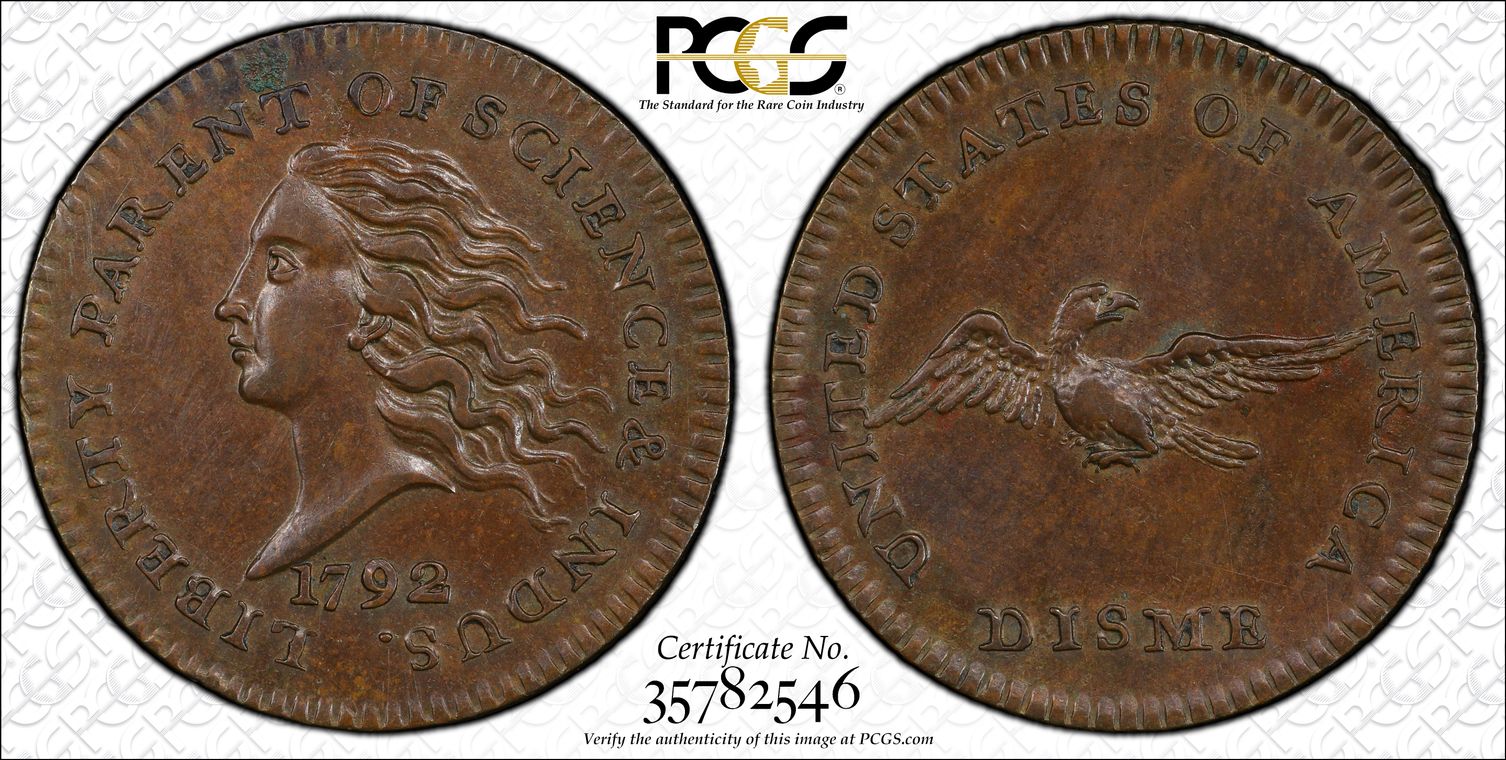
CAC - Reeded edge. Medal turn. Ideally centered on both sides, a broad frame of denticles of even length surround the frosty chocolate brown surfaces on both obverse and reverse. The surfaces are both glossy and lustrous, rich in tone and lightest in the protected areas where mint color was last to fade. The portrait of Liberty was brought into full relief and detail by a single bold strike, standing out in good contrast from the smooth fields that surround it. The reverse is similarly choice, with a nicely rendered eagle showing just the usual flat area at absolute center but maintaining better than usual details in the head, wings, and talons. The light shades around the peripheral legends are gold and olive, barely faded from mint color. The fields on both sides are essentially immaculate, free of any troubling marks or post-striking contact points. Ex. Archangel Collection
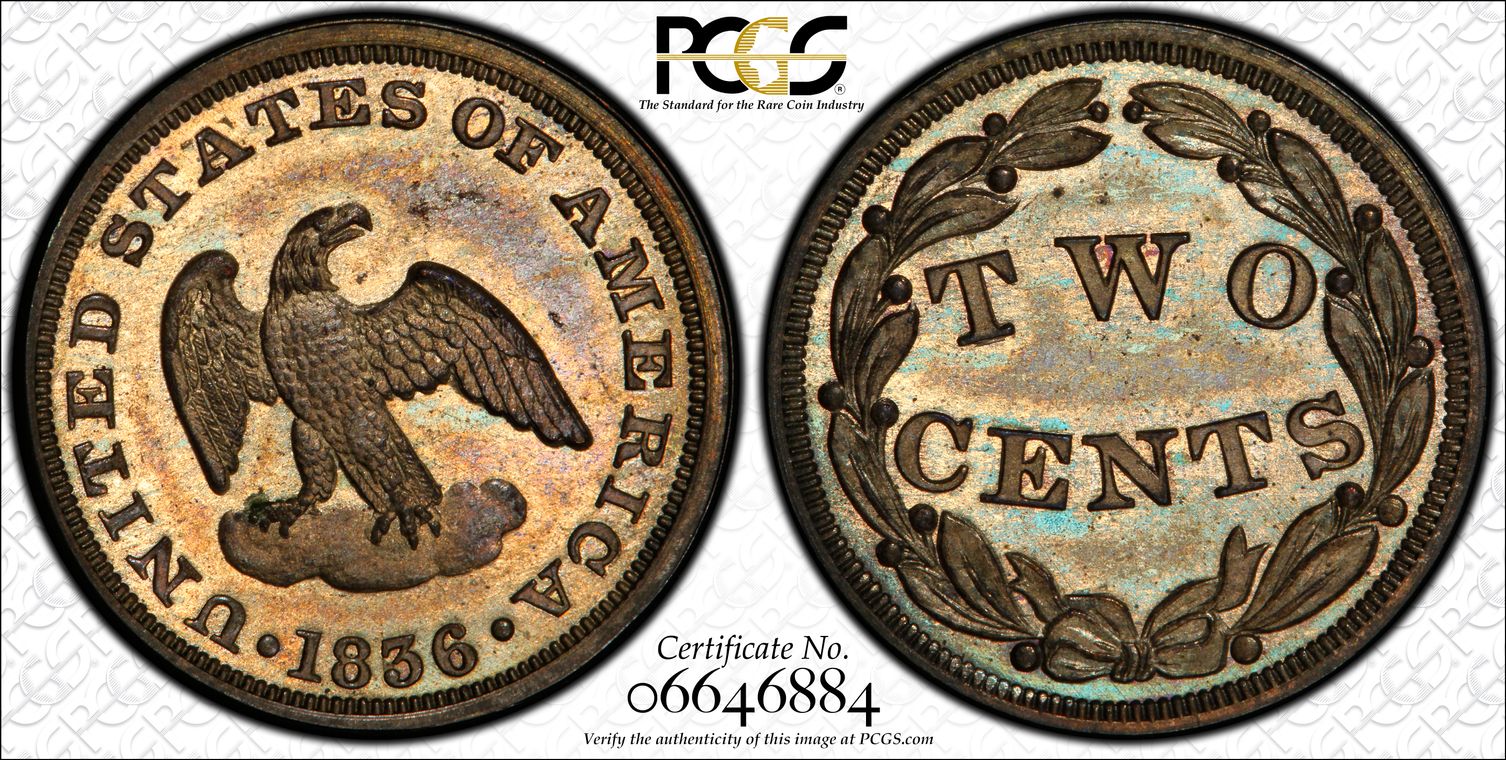
CAC - Low R.6 - Struck in billon with a plain edge. Ex. Denali Collection
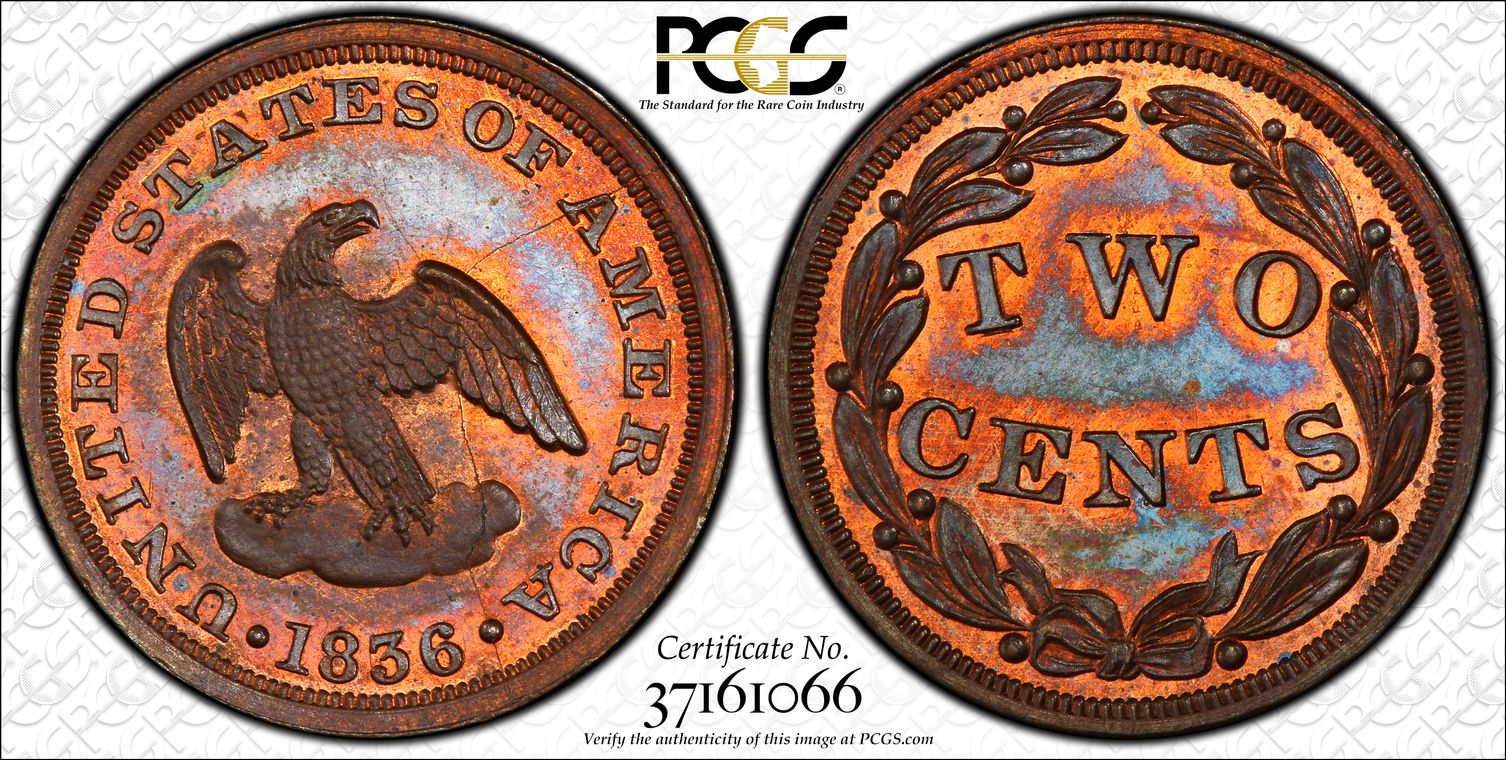
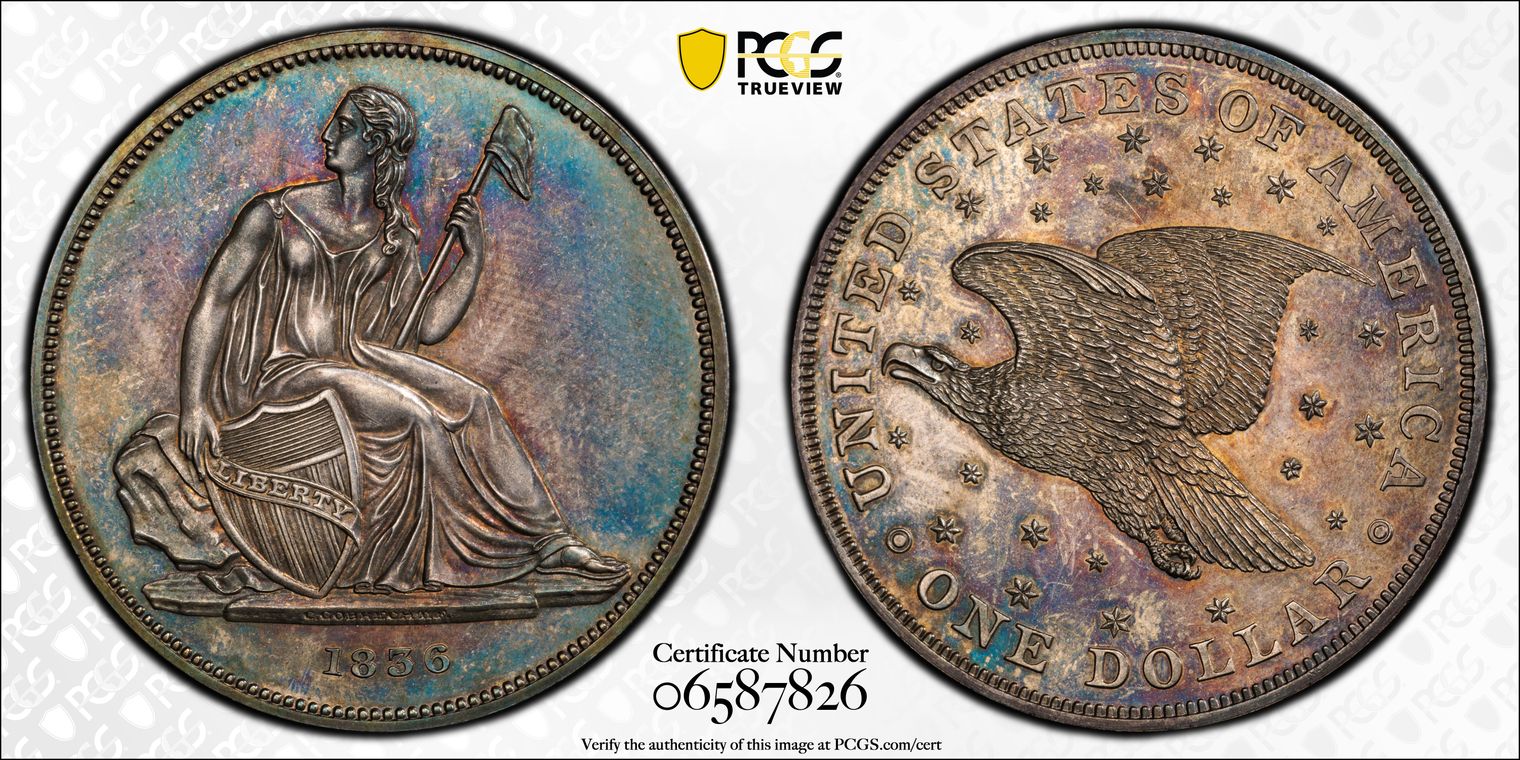

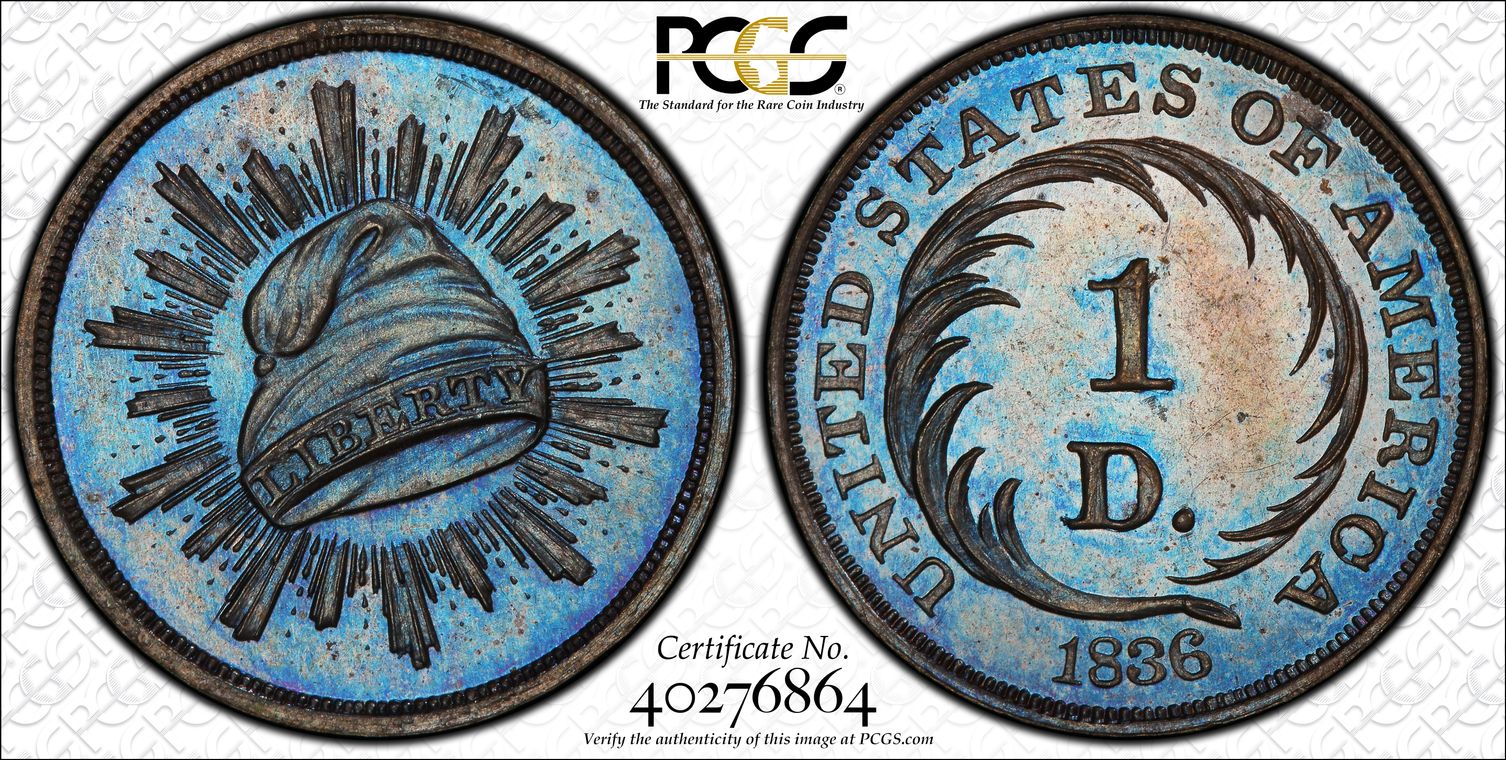
CAC - R7 in Copper. "This stunning Premium Gem displays vivid electric-blue toning over deeply mirrored fields with iridescent splashes primarily on the reverse. The surfaces are flawless." Ex. The Bob R. Simpson Collection.
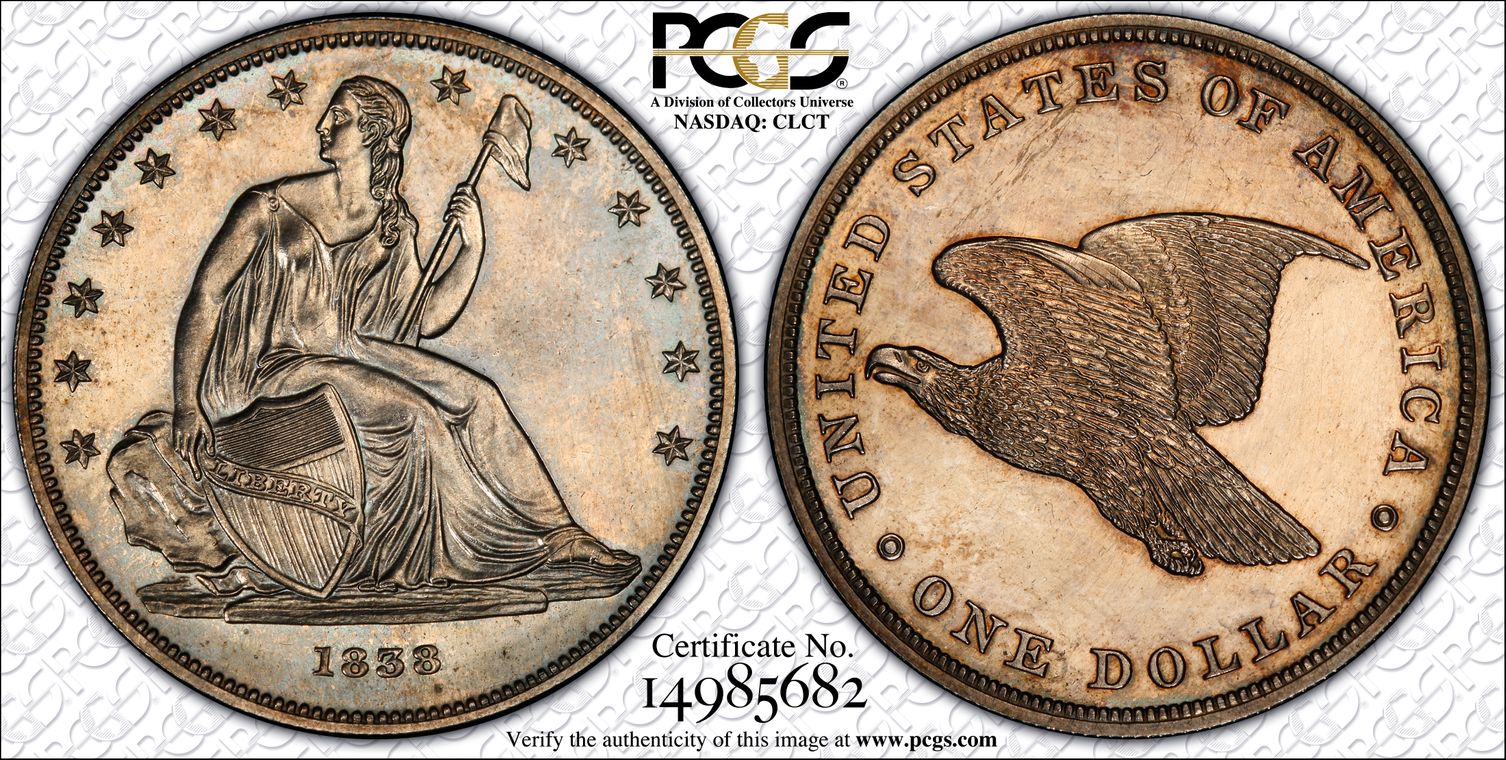
CAC - Die Alignment III (coin turn, center of Liberty's head opposite the N in ONE). The surfaces are deeply reflective, more so on the reverse than the obverse, as always. Just the slightest hint of pinkish-lilac toning can be detected upon close examination; otherwise, the surfaces appear brilliant. Only the slightest contact marks can be detected on either side, and then they are only apparent with magnification. The strike details are full on both obverse and reverse.
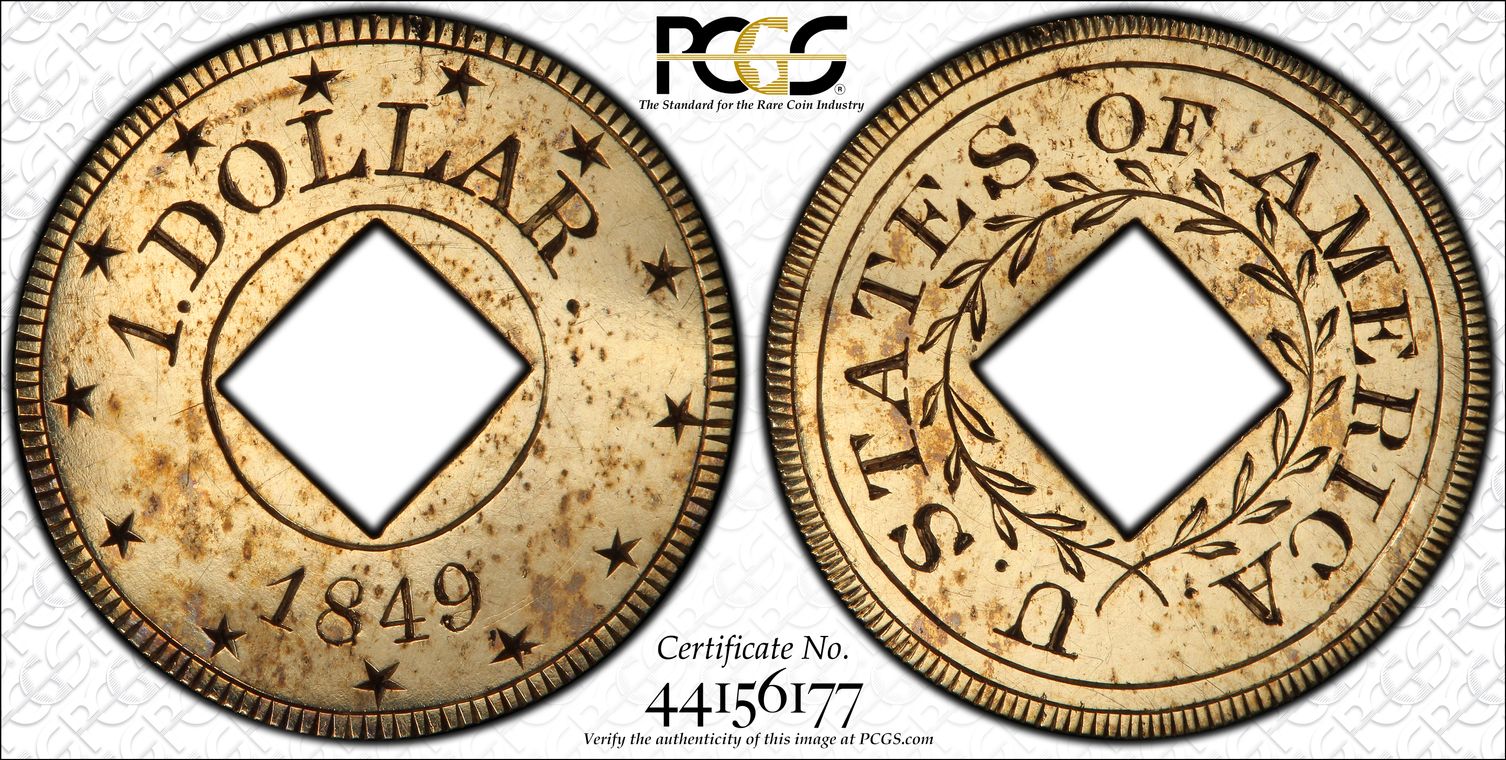
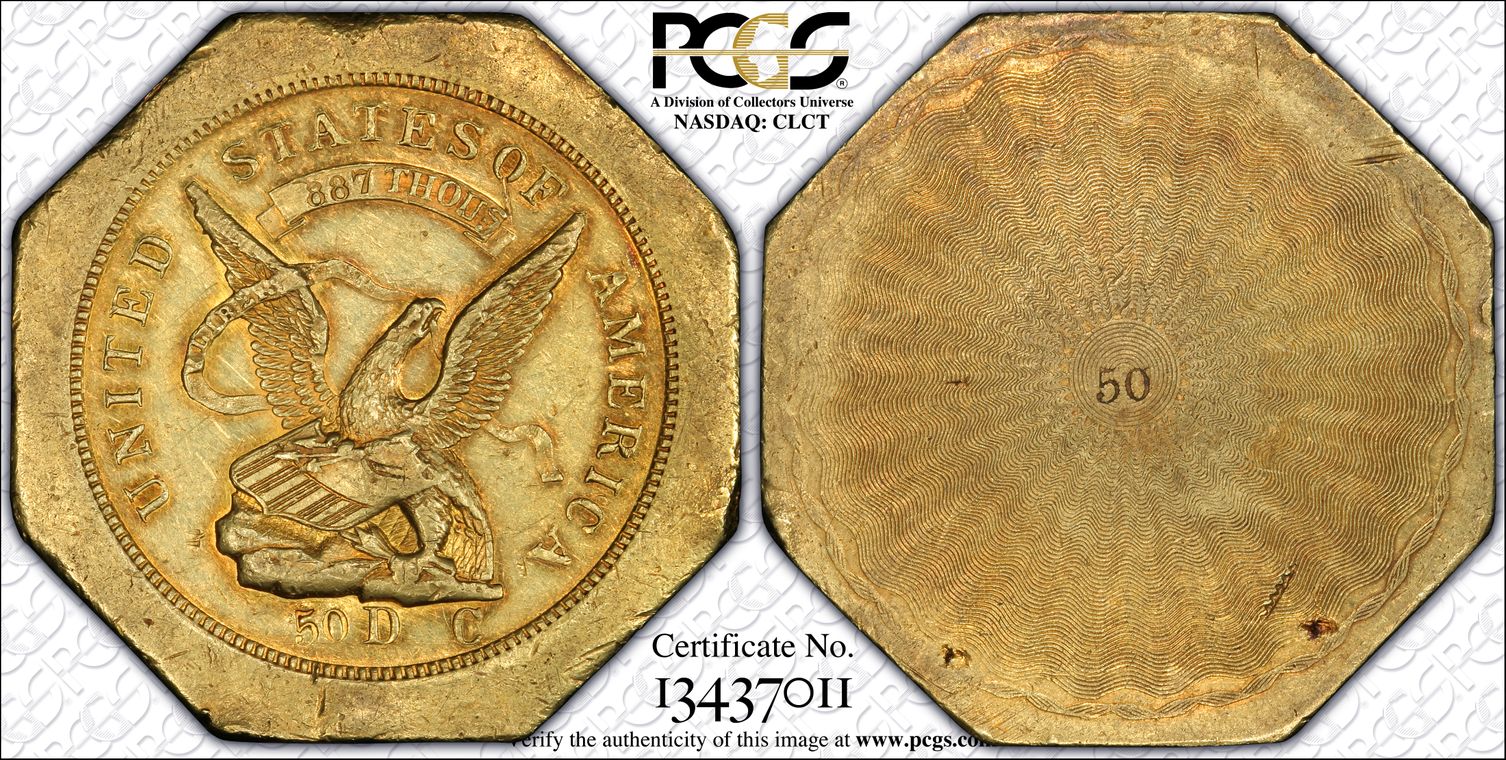
CAC - High R.7 - Struck in gold-silver-copper alloy with a plain edge. The only CAC endorsed example. These extremely rare patterns were had cut by James Longacre and not die struck. This is the only U.S. pattern that was hand engraved. The necessity for hand-engraving and the larger history of these pieces is covered in an in-depth article in The Numismatist in October 2011, written by Ed Rector. In short, these patterns were emergency issues that were hand-engraved to simulate what a struck coin would look like with a square hole in it. They were needed in a hurry because a lame-duck Congressman from North Carolina, James Iver McKay, was pressing hard for the issuance of the pieces (mostly as an outlet for the gold mines from his native state). By January 26, 1849 Congressman McKay was in possession of one of these pieces. On January 30, six additional specimens were produced and sent by Mint Director Robert Maskell Patterson to other Congressmen. "The surfaces of this piece are bright with significant speckling on each side, presumably from the copper in the alloy." Ex. The Bob R. Simpson Collection.
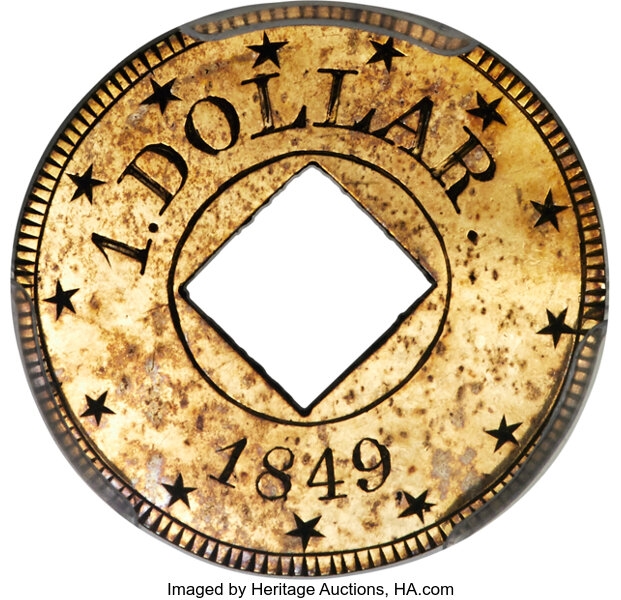
CAC - High R.7 - Struck in gold-silver-copper alloy with a plain edge. The only CAC endorsed example. These extremely rare patterns were had cut by James Longacre and not die struck. This is the only U.S. pattern that was hand engraved. The necessity for hand-engraving and the larger history of these pieces is covered in an in-depth article in The Numismatist in October 2011, written by Ed Rector. In short, these patterns were emergency issues that were hand-engraved to simulate what a struck coin would look like with a square hole in it. They were needed in a hurry because a lame-duck Congressman from North Carolina, James Iver McKay, was pressing hard for the issuance of the pieces (mostly as an outlet for the gold mines from his native state). By January 26, 1849 Congressman McKay was in possession of one of these pieces. On January 30, six additional specimens were produced and sent by Mint Director Robert Maskell Patterson to other Congressmen. "The surfaces of this piece are bright with significant speckling on each side, presumably from the copper in the alloy." Ex. The Bob R. Simpson Collection.
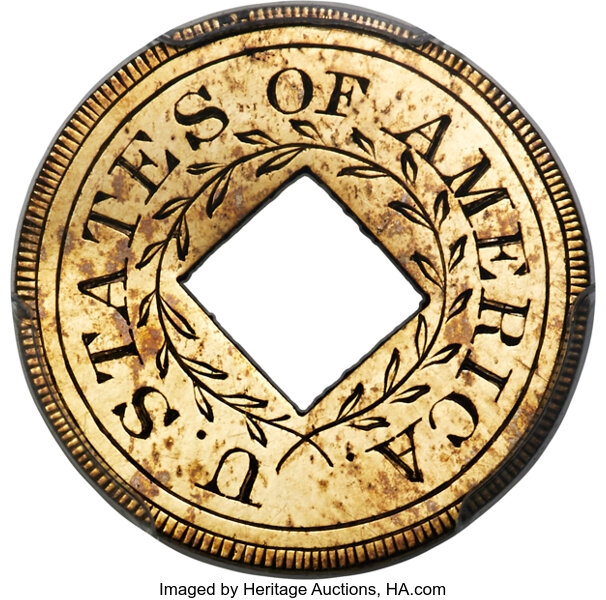
CAC - High R.7 - Struck in gold-silver-copper alloy with a plain edge. The only CAC endorsed example. These extremely rare patterns were had cut by James Longacre and not die struck. This is the only U.S. pattern that was hand engraved. The necessity for hand-engraving and the larger history of these pieces is covered in an in-depth article in The Numismatist in October 2011, written by Ed Rector. In short, these patterns were emergency issues that were hand-engraved to simulate what a struck coin would look like with a square hole in it. They were needed in a hurry because a lame-duck Congressman from North Carolina, James Iver McKay, was pressing hard for the issuance of the pieces (mostly as an outlet for the gold mines from his native state). By January 26, 1849 Congressman McKay was in possession of one of these pieces. On January 30, six additional specimens were produced and sent by Mint Director Robert Maskell Patterson to other Congressmen. "The surfaces of this piece are bright with significant speckling on each side, presumably from the copper in the alloy." Ex. The Bob R. Simpson Collection.
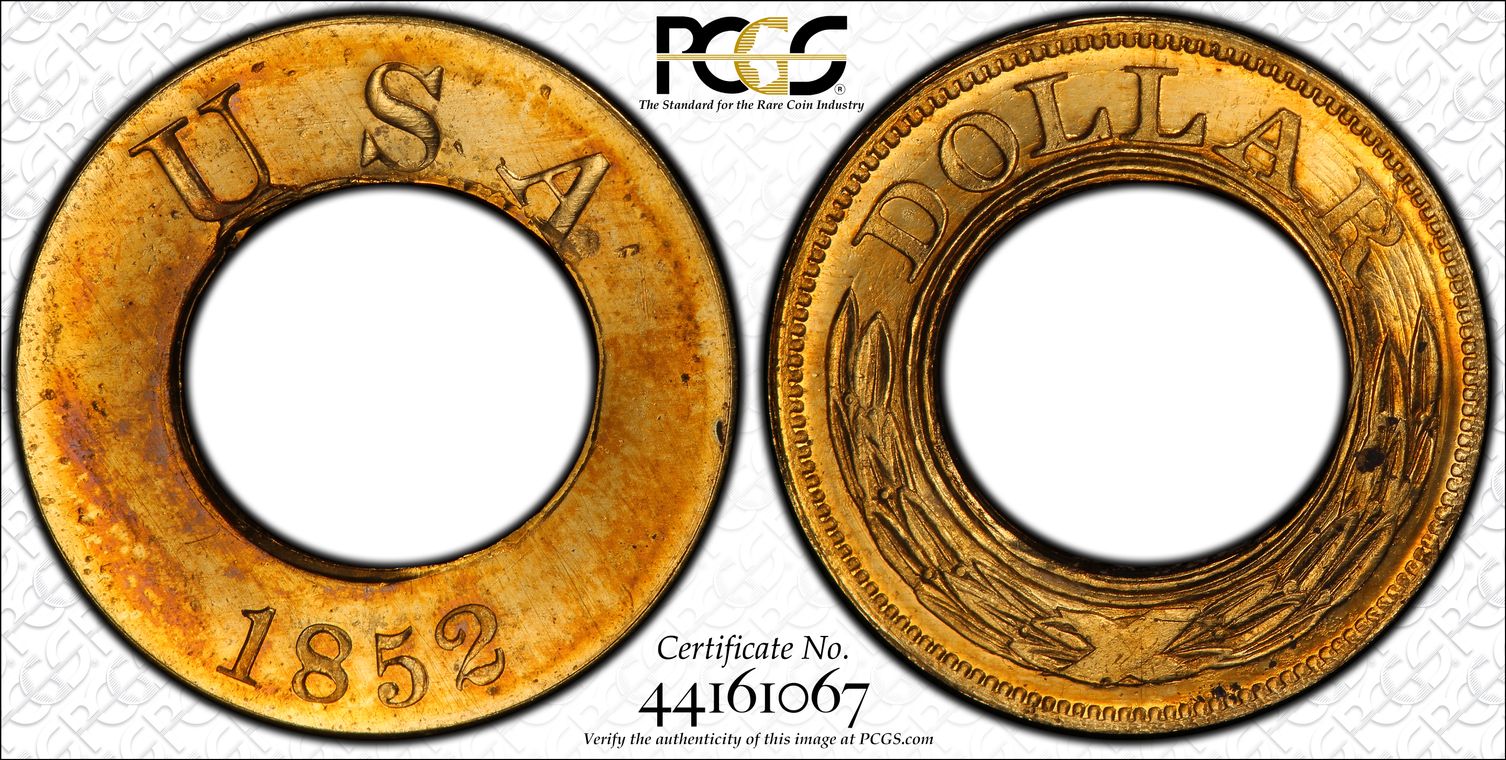
CAC - Low R7 - Struck in gold with a plain edge. Tied for the finest at PCGS and the finest endorsed at CAC (5/24). The obverse has the letters USA above and the date below. The reverse design has the denomination expressed as DOLLAR above and a wreath below. "The surfaces are bright and also show evidence of the 10% copper in the alloy with the obverse displaying considerable reddish patina." Ex. Simpson
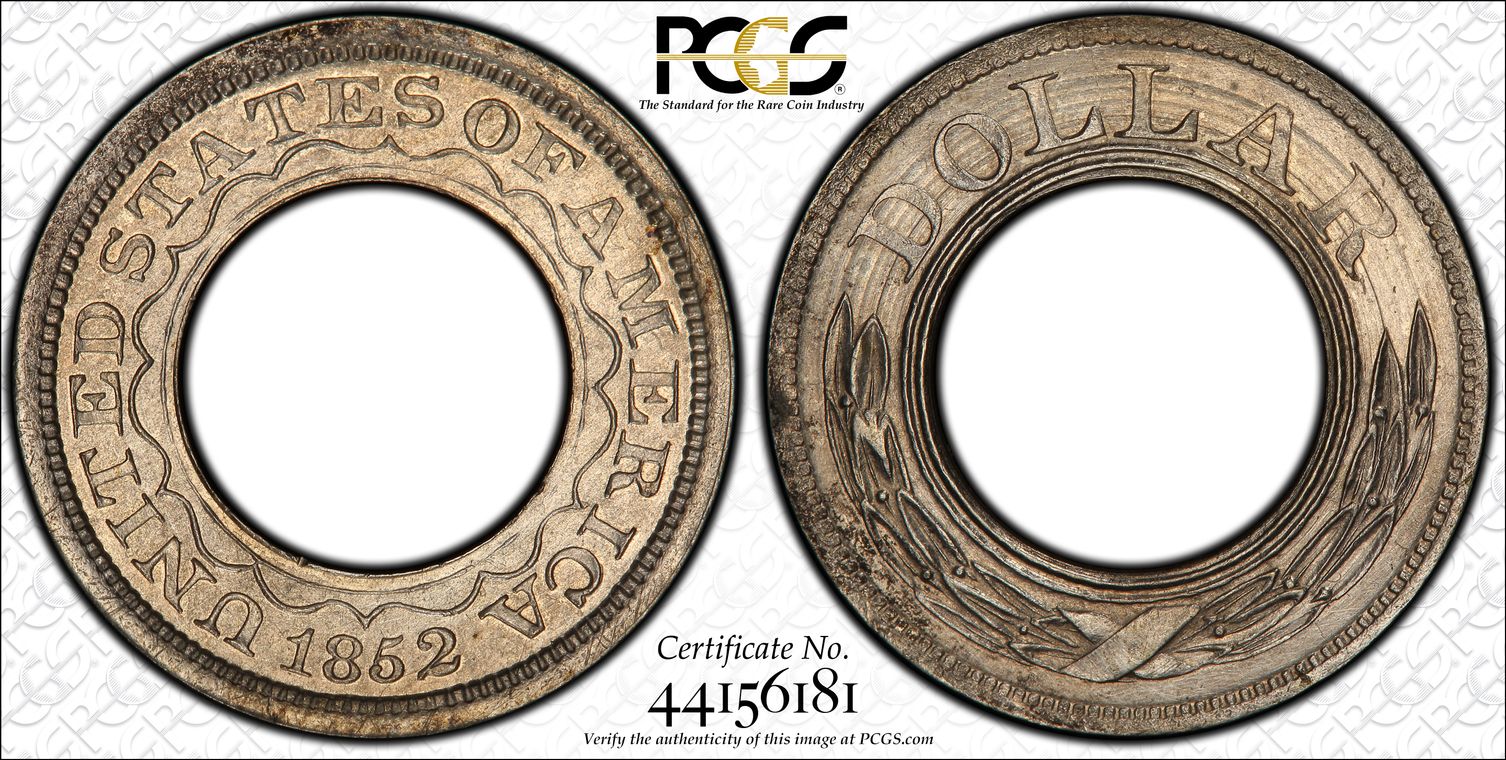
CAC - R7 - Struck on an annular silver planchet with a plain edge. Both thick and thin planchets with fewer than a dozen confirmed, of which 5 are in museums. Only 5 are graded (6/22) at both PCGS (2) and NGC (3) and some of those may be duplicate submissions. "Light, even gray-golden patina is seen over each side." Ex. The Bob R. Simpson Collection.
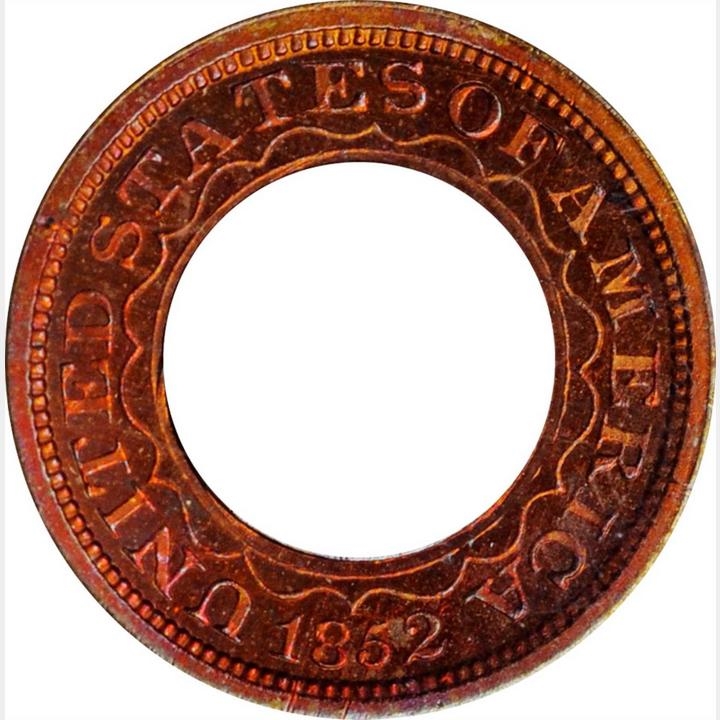
CAC - R7 - Struck in copper with a plain edge. Tied with the finest graded at either service (5/22) and the finest endorsed at CAC 5/22. Obv: The legend UNITED STATES OF AMERICA above and the date 1852 below the central perforation. A crenulated line design encircles the perforation. Rev: The denomination DOLLAR above and an ornamental wreath below the central perforation. "A blazing, fiery deep red and rose Gem with intense luster and amazing aesthetic appeal. Additionally, the strike is bold to sharp and readily equal to the challenge of the grade." Ex. Thomas H. Sebring Collection
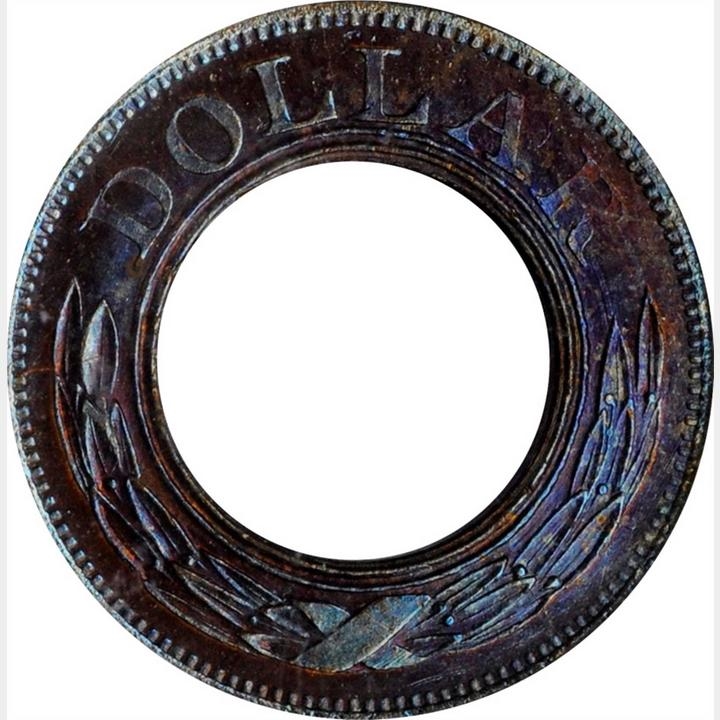
CAC - R7 - Struck in copper with a plain edge. Tied with the finest graded at either service (5/22) and the finest endorsed at CAC 5/22. Obv: The legend UNITED STATES OF AMERICA above and the date 1852 below the central perforation. A crenulated line design encircles the perforation. Rev: The denomination DOLLAR above and an ornamental wreath below the central perforation. "A blazing, fiery deep red and rose Gem with intense luster and amazing aesthetic appeal. Additionally, the strike is bold to sharp and readily equal to the challenge of the grade." Ex. Thomas H. Sebring Collection
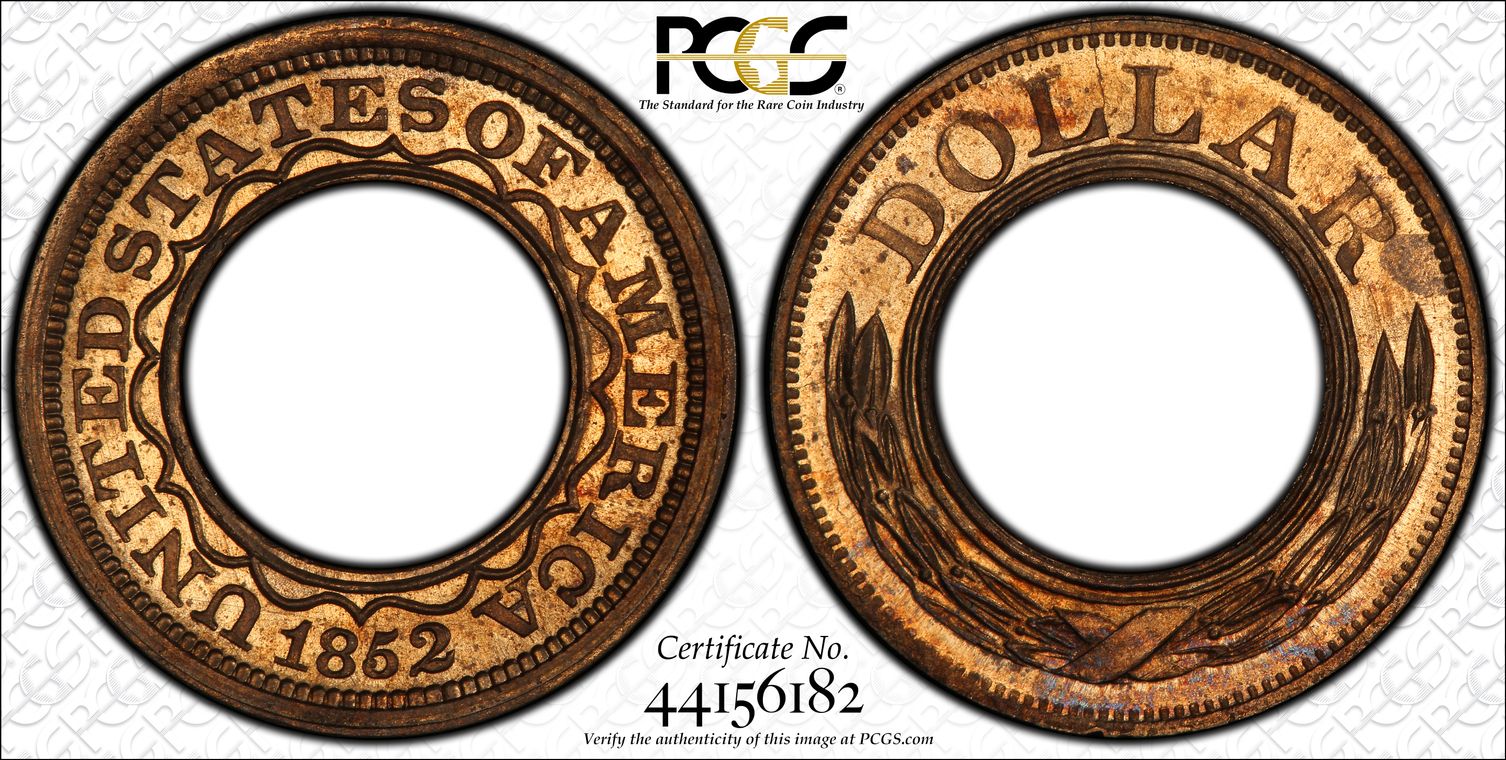
CAC - Low R.7 - Struck on an annular copper-nickel planchet with a plain edge. 1852 Annual Gold Dollar in Copper. The obverse features a line design, described as a circle of six bows by early catalogers, around the central perforation. The legend UNITED STATES OF AMERICA around, with 1852 below. The reverse consists of the denomination DOLLAR above, and an open wreath below. Struck on an annular copper-nickel planchet with a plain edge. "Flashy coppery-orange surfaces exhibit splashes of blue and violet color, as well as deeper elements of tan-gold." Ex. Bob R. Simpson Collection.
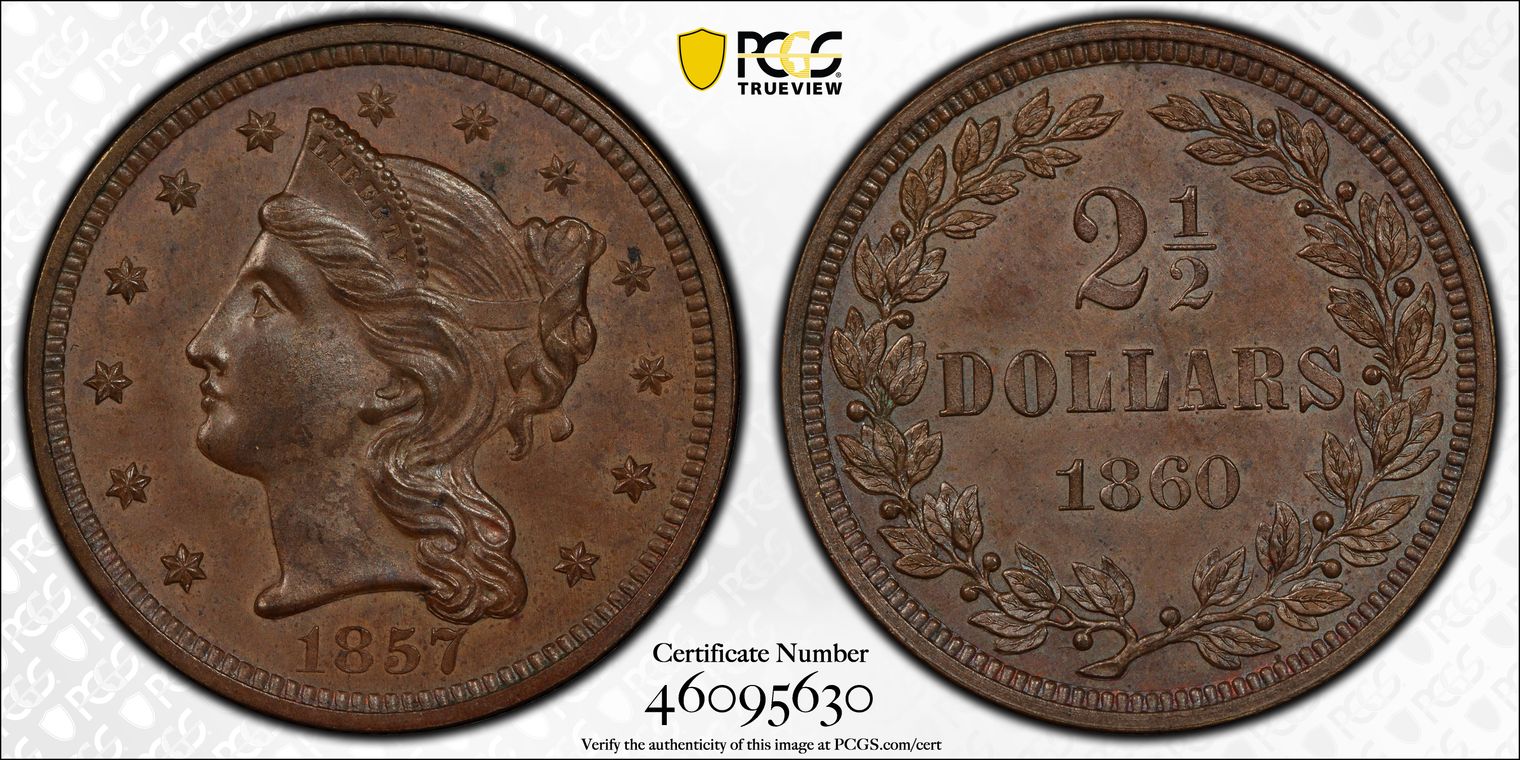
CAC - R.7 - Struck in copper with a reeded edge. The obverse depicts Liberty facing left, her hair flowing down to the shoulder, wearing a coronet inscribed LIBERTY, with 13 stars around and the date below. This Longacre obverse is dated 1857 and was used on Judd-189, reappearing on regular issue three cent nickel pieces in 1865. The 1860-dated reverse has the denomination, 2 ½ DOLLARS, and the date within a laurel wreath. The statutory legend is conspicuously absent. "Glossy golden-brown and mahogany surfaces show glimpses of powder-blue and violet on the reverse, while hints of faded mint red color appear on the obverse." Ex: J. Hewitt Judd Collection (plated in the first seven editions of the Judd reference); Abe Kosoff (1971), The Harry W. Bass, Jr. Core Collection, Part I.
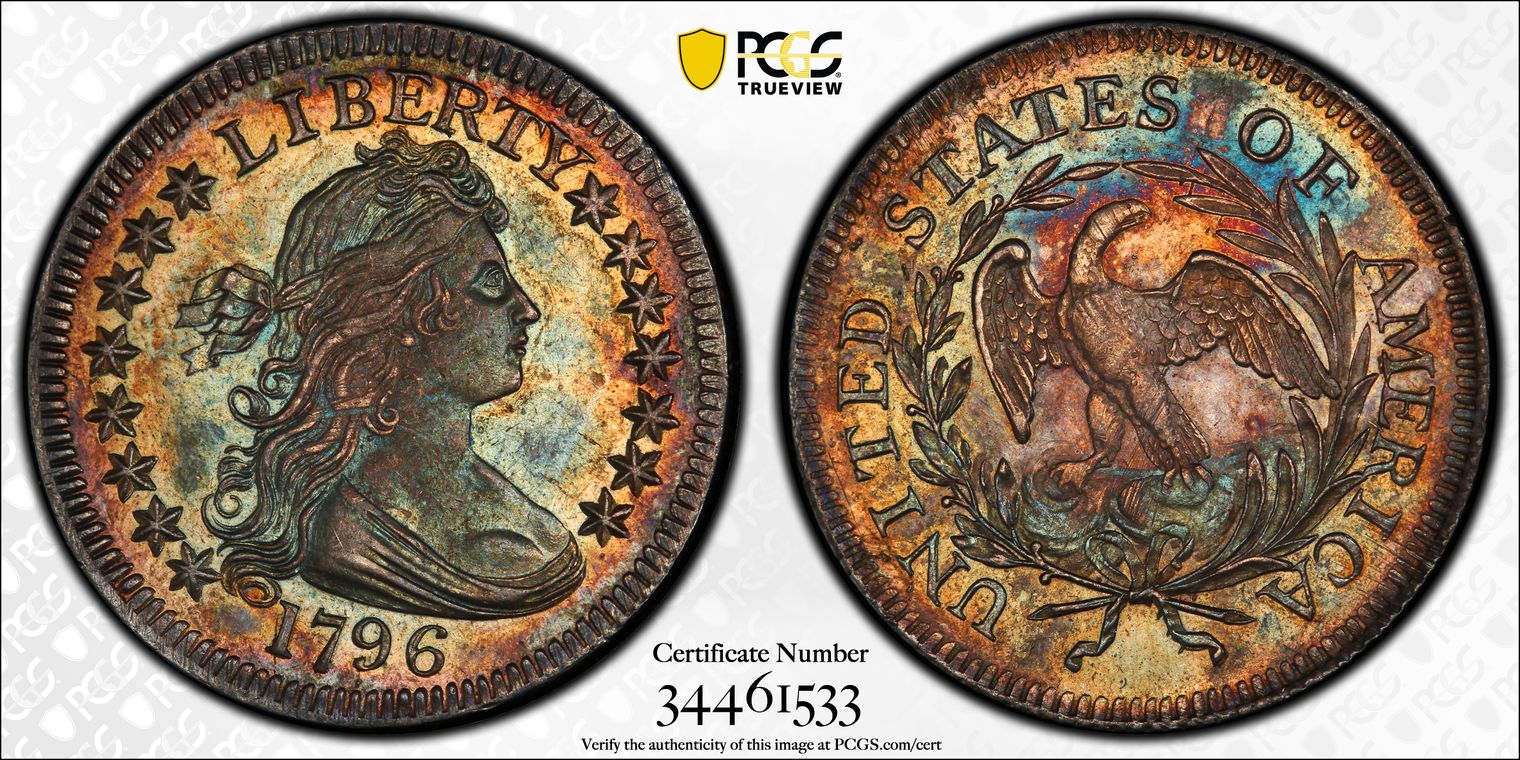
CAC - Reddish-purple, electric-blue, and gold toning clings to the borders, transitioning to yellowish-green toward the centers where it blends with aqua-blue on the obverse and soft silver-gray on the reverse. The surfaces of each side are almost wholly prooflike. Sharply struck design elements complement the magnificent toning. Liberty's hair strands and all curls are well-delineated, as are the eye pupil and drapery folds. The eagle's head is much better struck than seen on most other 1796 quarter dollars, revealing crisp eye detail and a full tongue
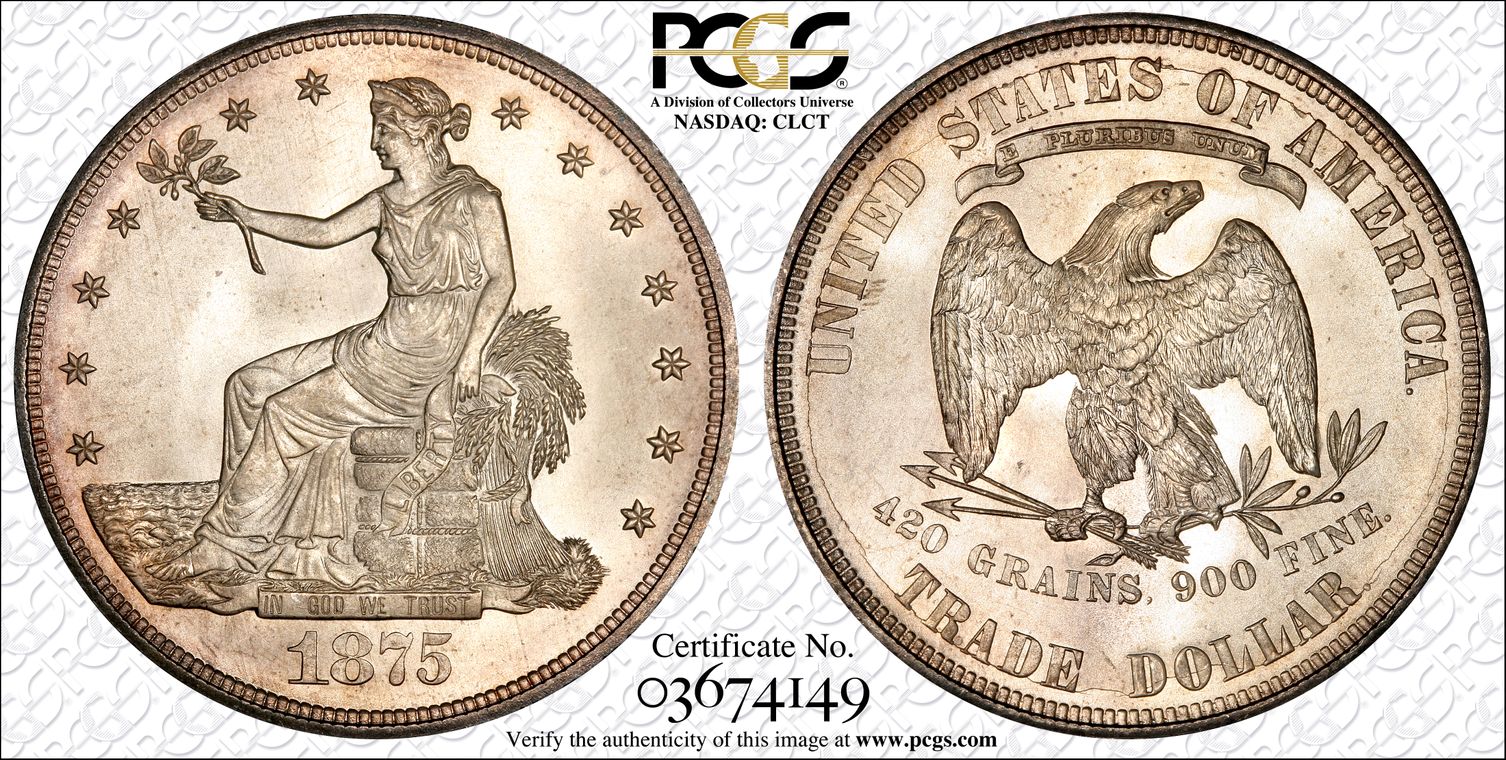
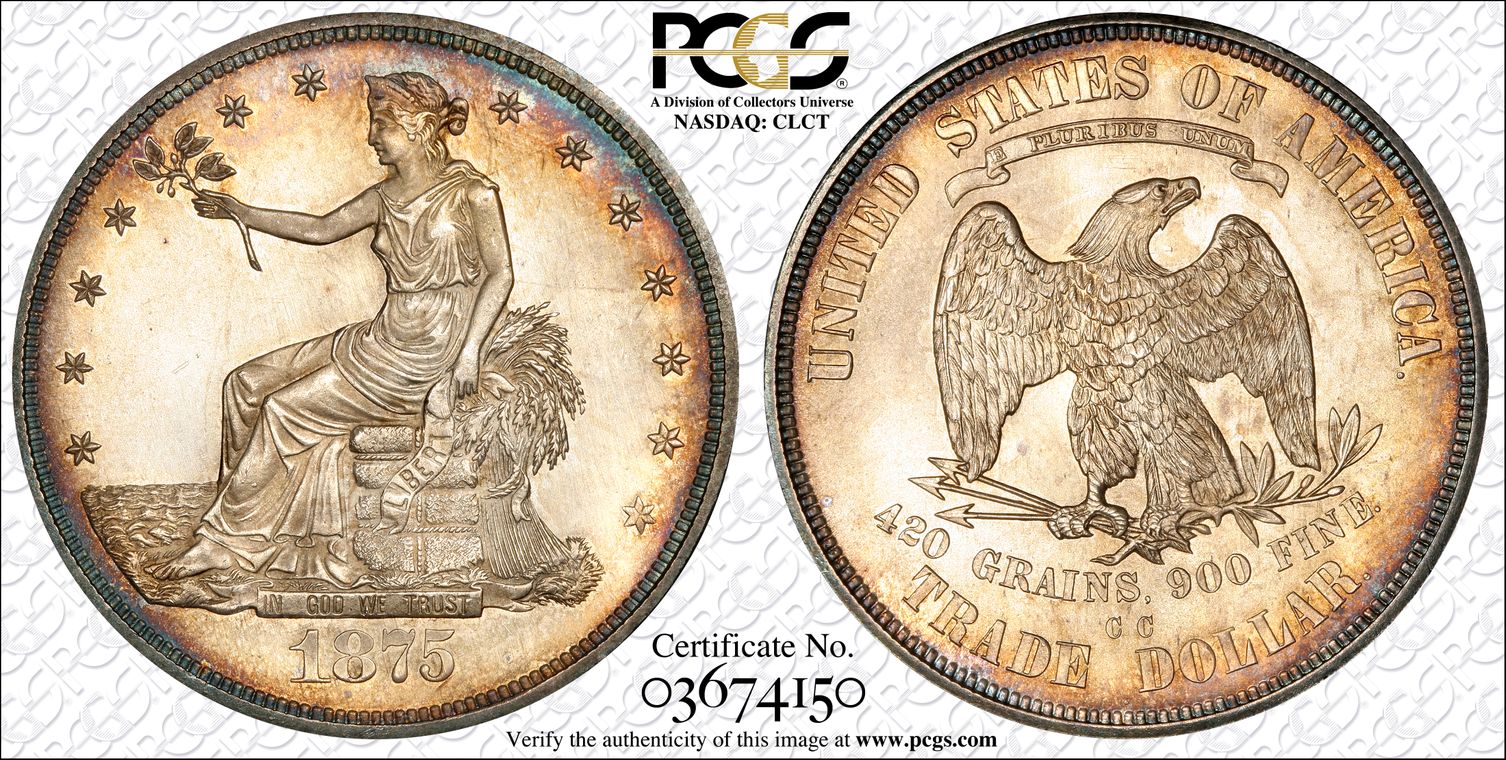
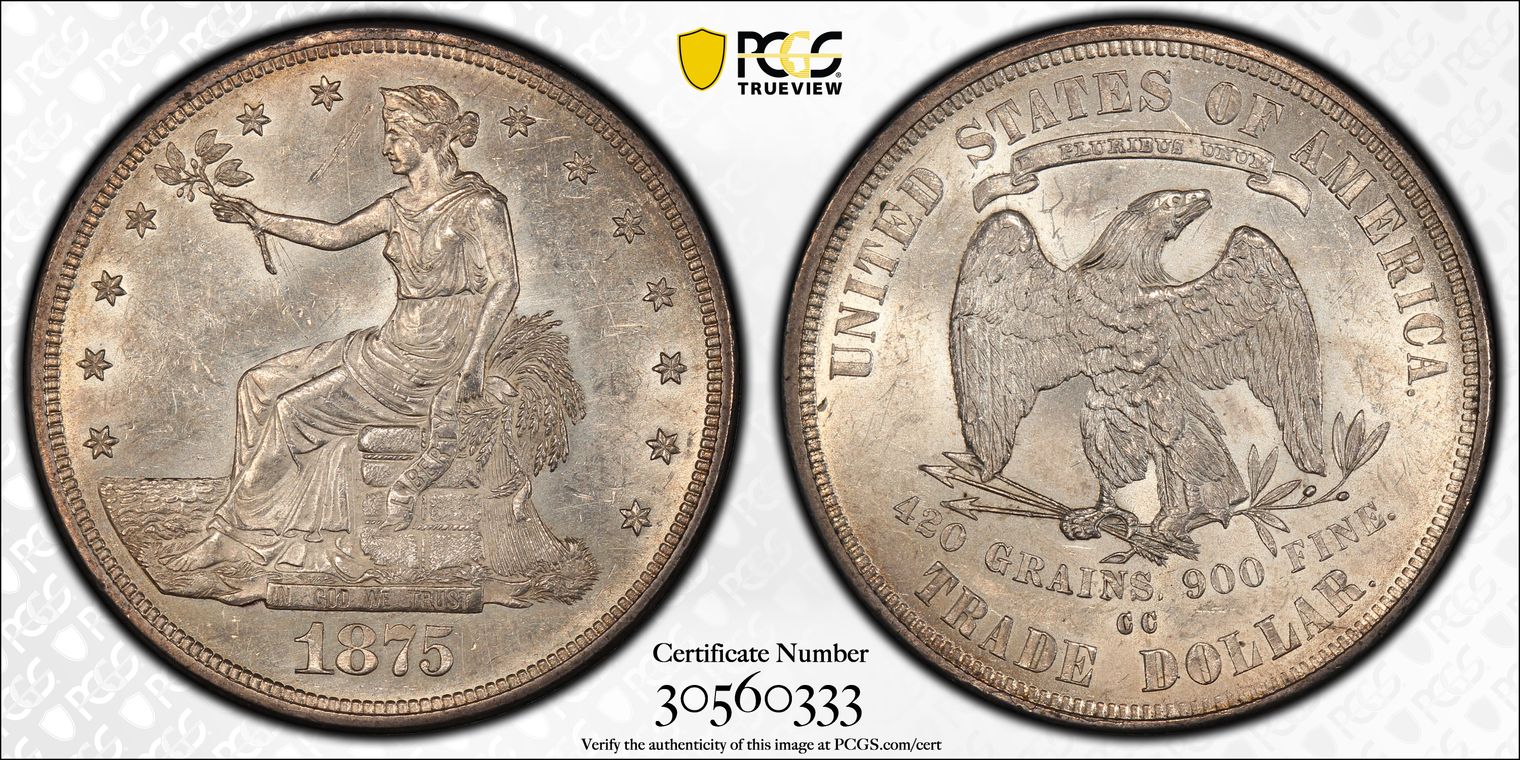
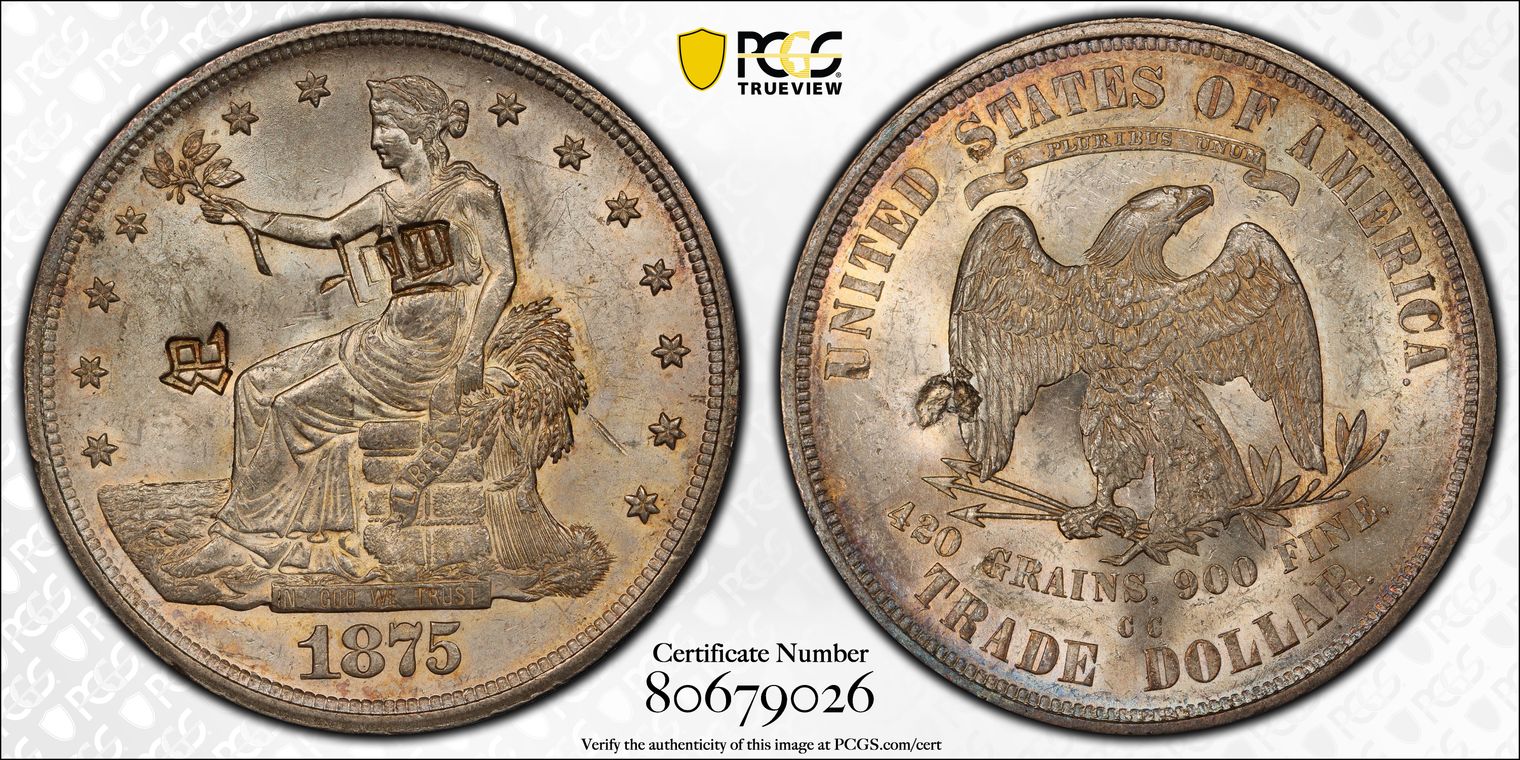
Obverse 1, Reverse 2. The vast majority of known 1875-CC trade dollars are Type 1/1. Nicely lustrous and has an overall sharp strike.
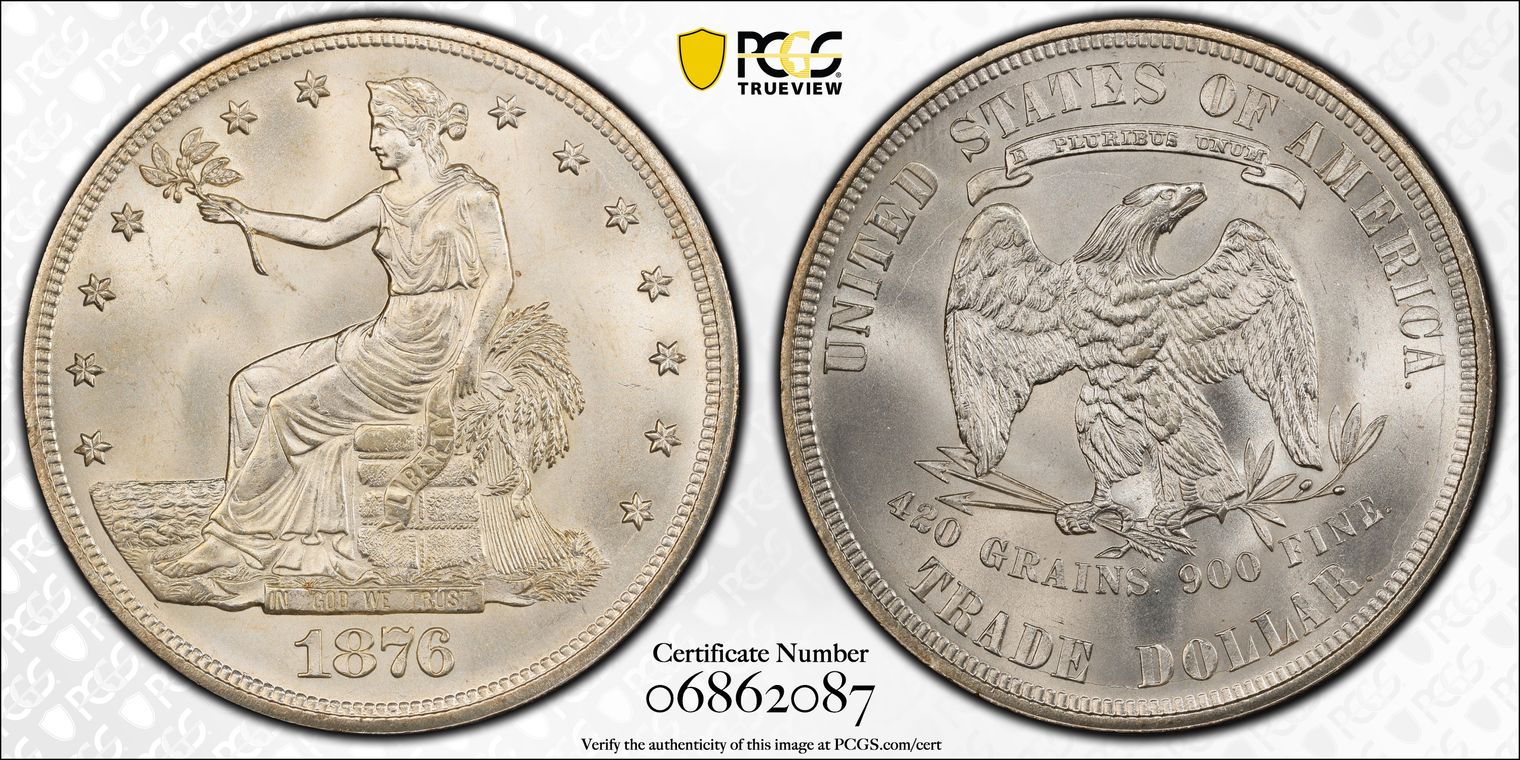
CAC - Type One Obverse, Type Two Reverse. A fully struck Gem with dynamic cartwheel sheen and only a wisp of golden toning. The reverse is nearly pristine, and the obverse is unabraded save for a faint graze on the left field
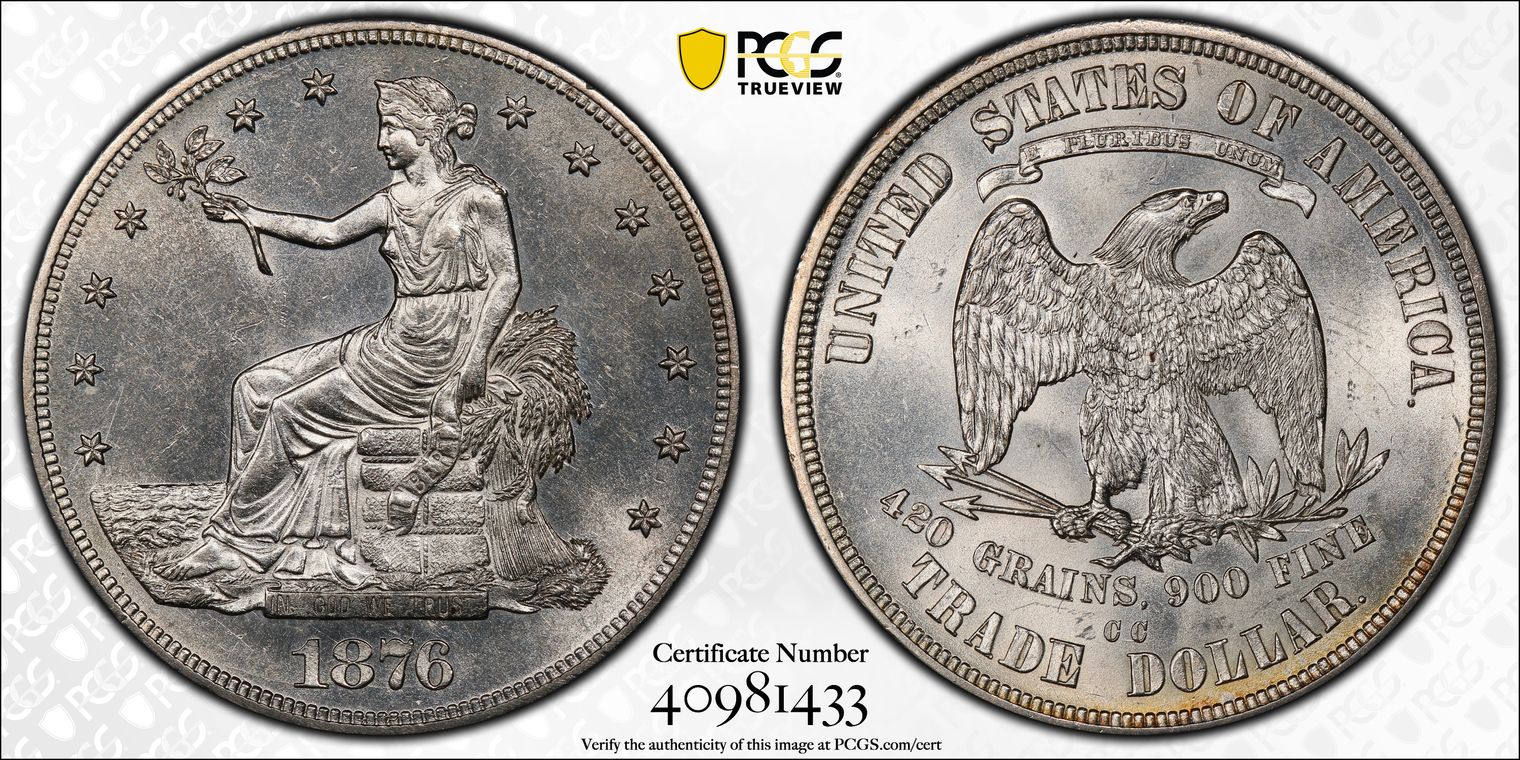
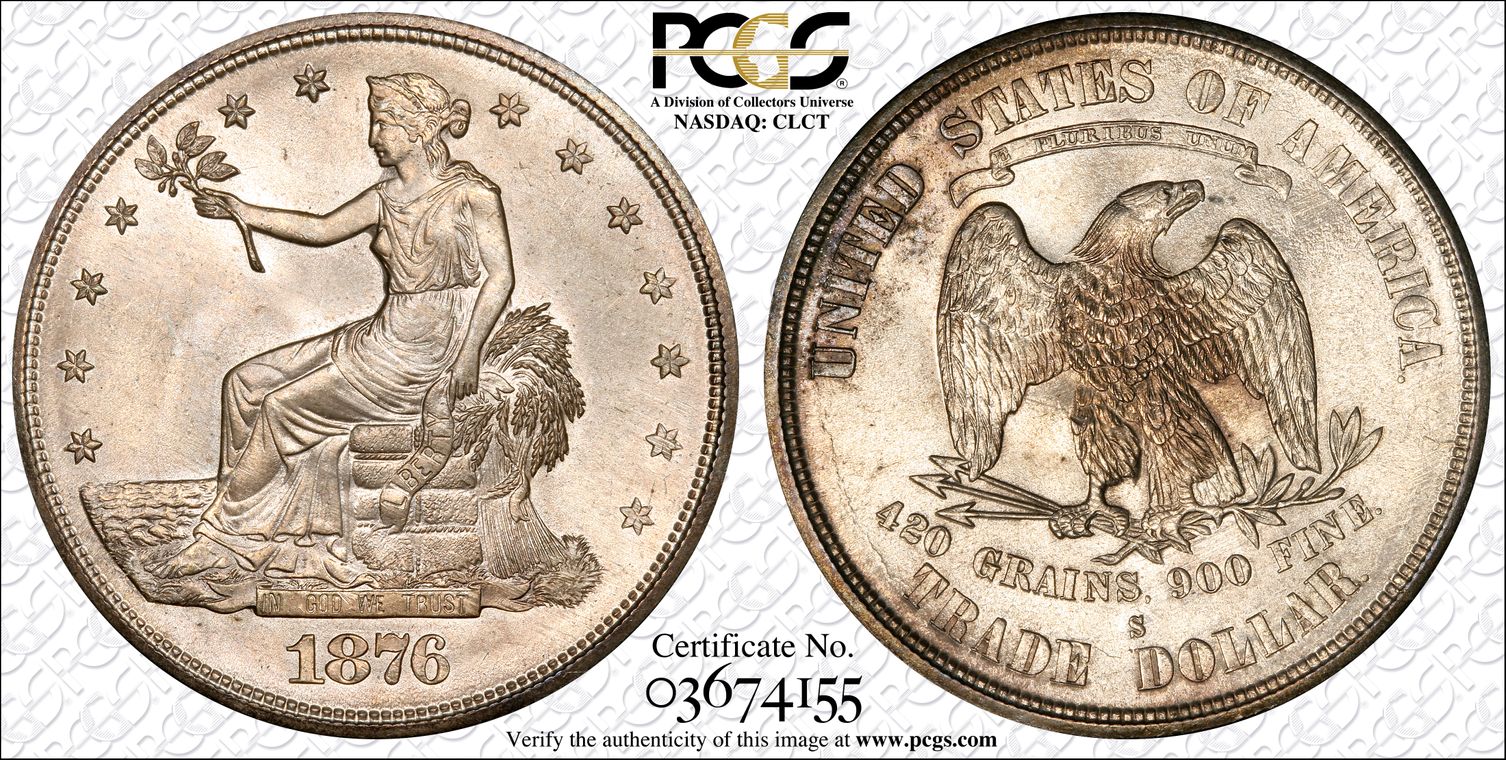
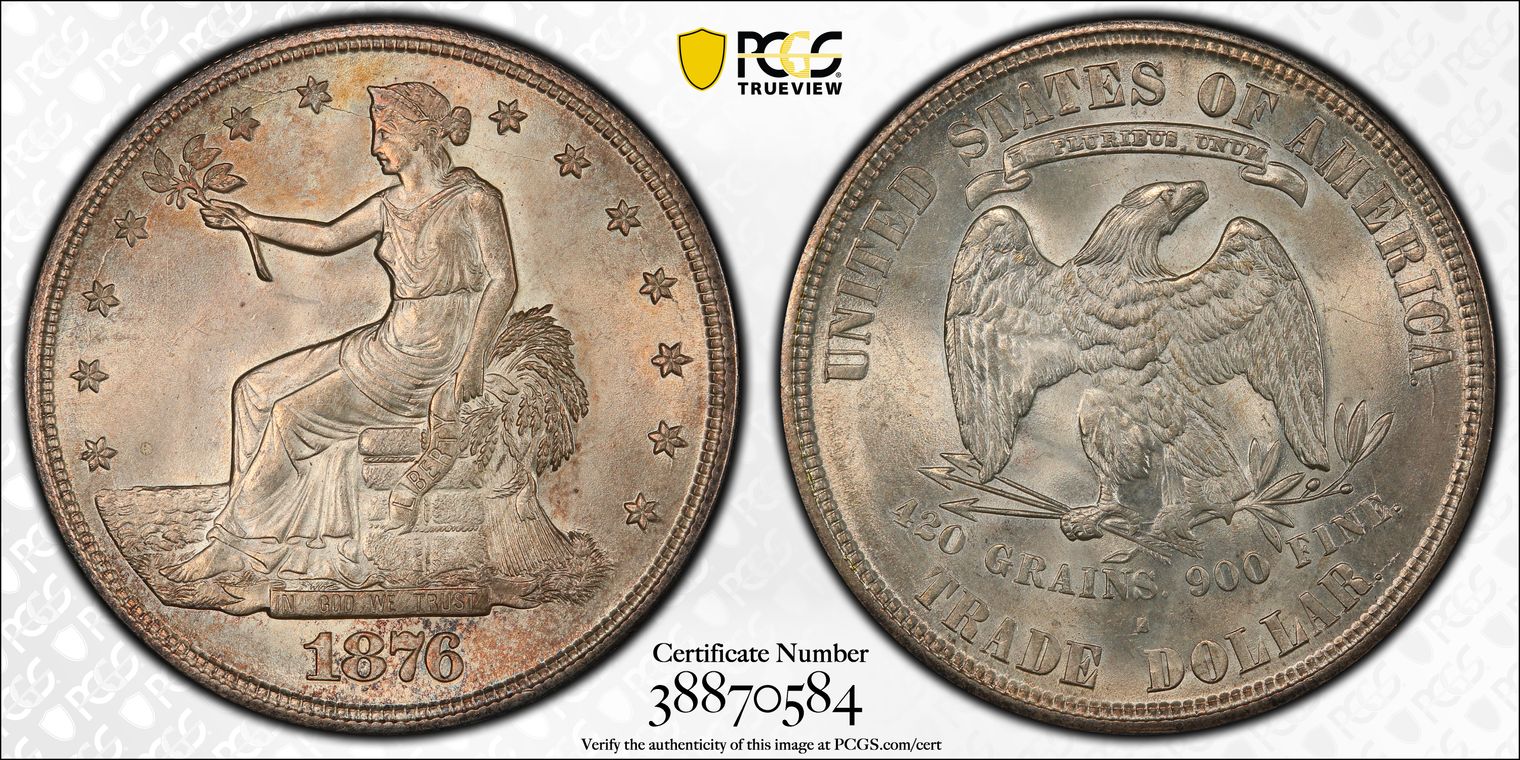
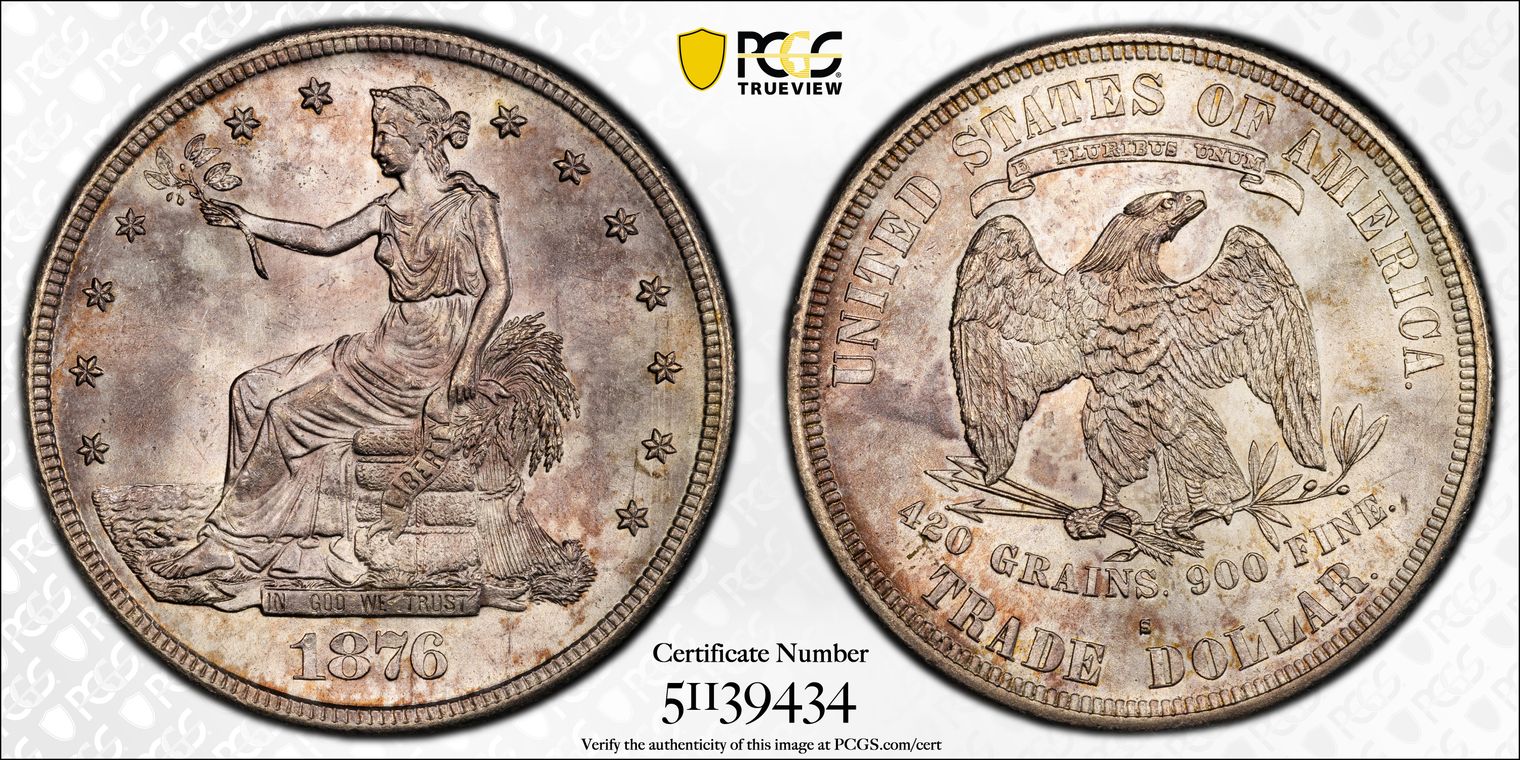
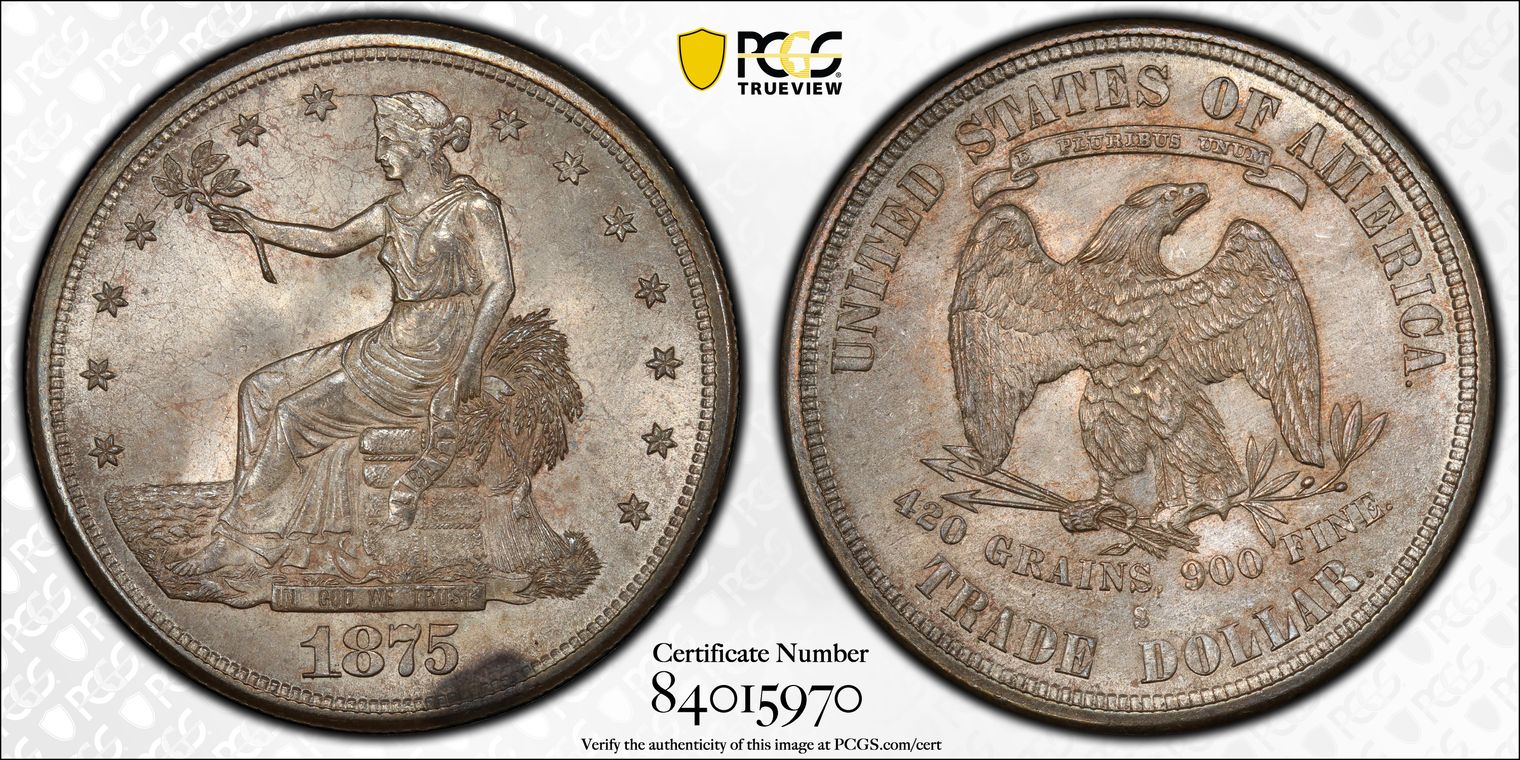
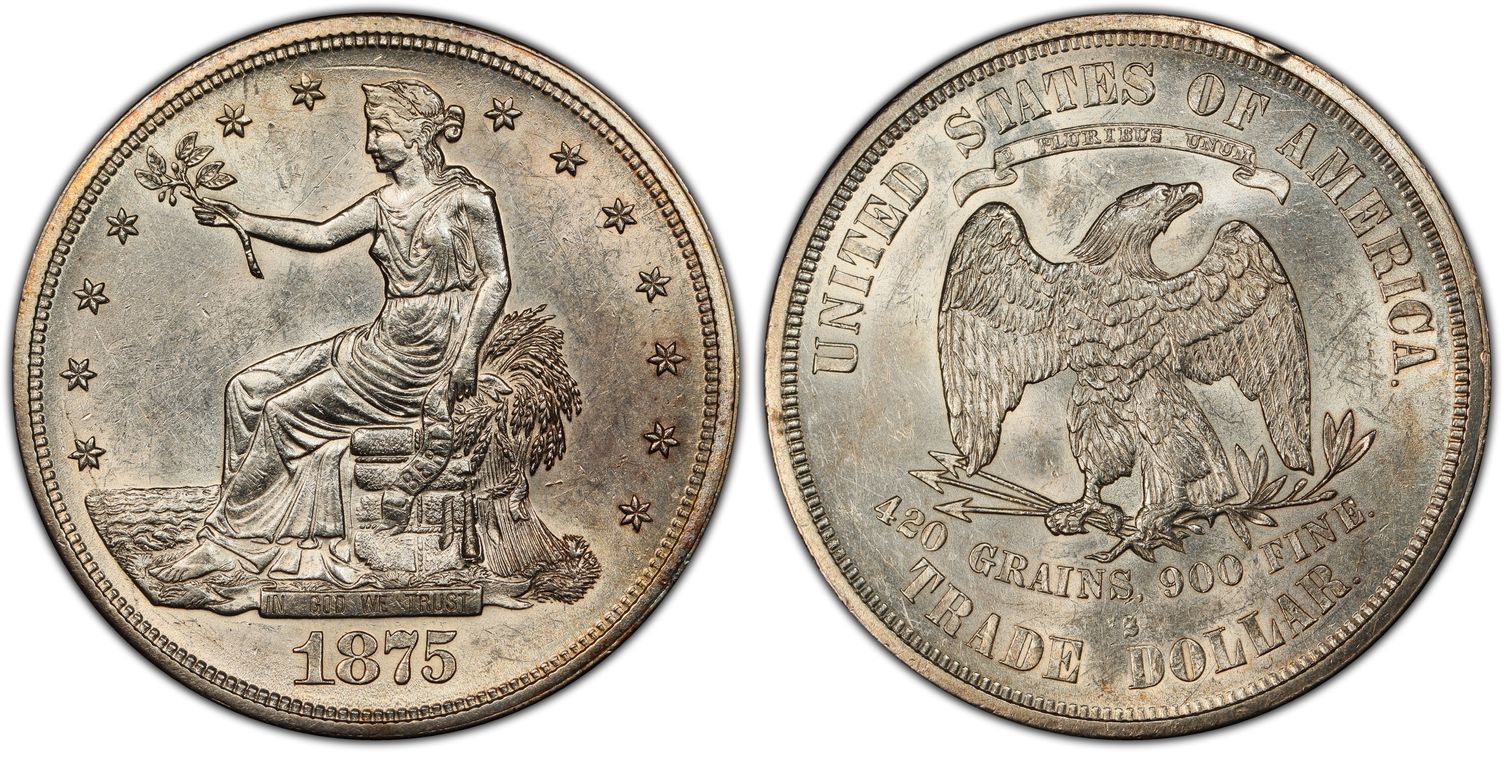
CAC - Type II/II. Minute S mintmark. A crisp strike and original medium golden-brown toning
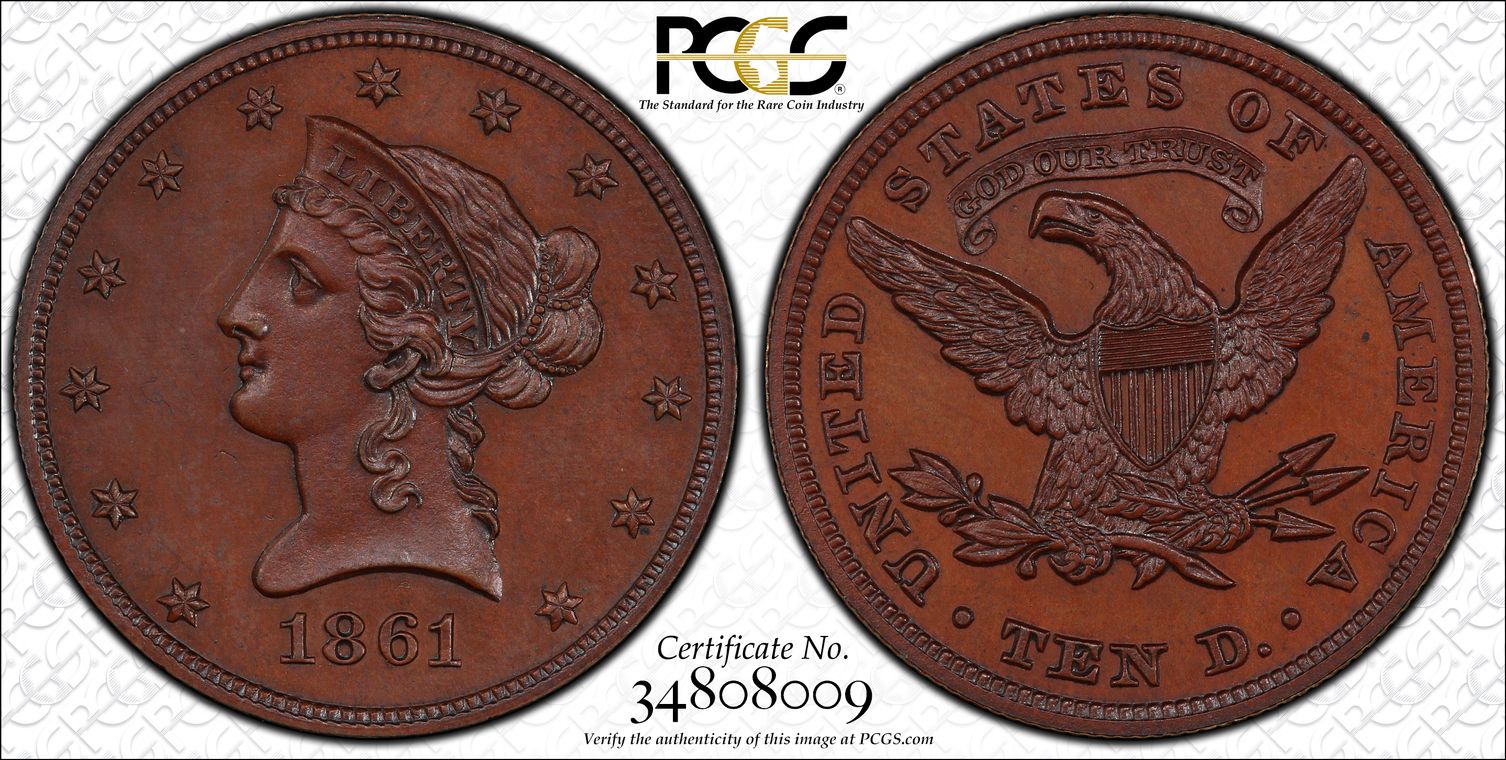
CAC - High R.6 - Struck in copper with a reeded edge. Both the obverse and reverse designs are similar to those used on regular-issue 1861 eagles, but the motto GOD OUR TRUST has been added on a scroll in the upper reverse field.
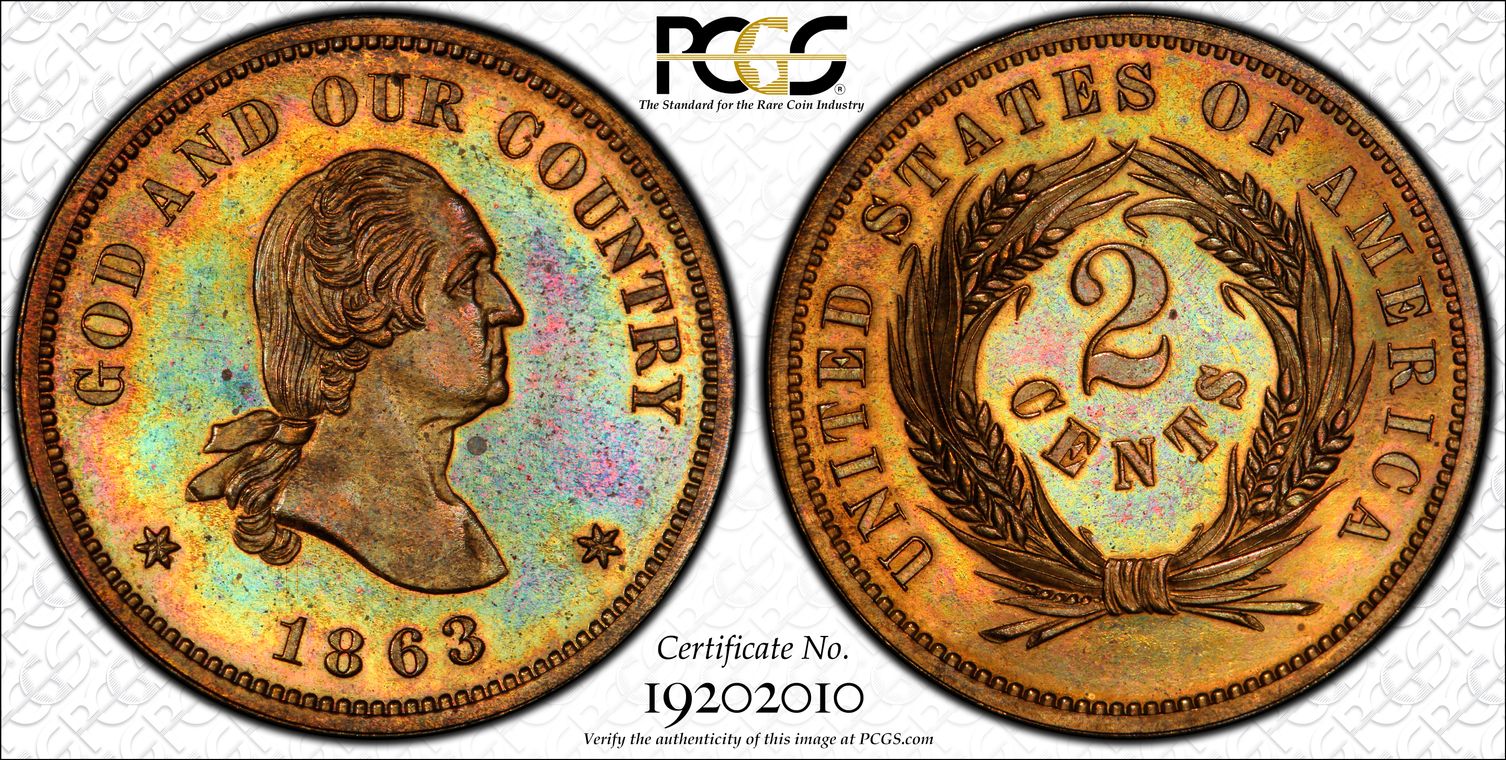
CAC - High R.7 - Struck in a surprising variety of compositions: copper / bronze, copper-nickel, oroide, and aluminum. The obverse displays a portrait of Washington facing right, GOD AND OUR COUNTRY around, date and two stars below. The reverse expresses the denomination 2 CENTS within a wheat wreath, UNITED STATES OF AMERICA around. CENTS is curved dramatically. The fields are deeply mirrored and show what some might call "autumn leaves" toning. Scattered dabs of rose, emerald, and yellow are scattered over each side. Deeply mirrored fields.
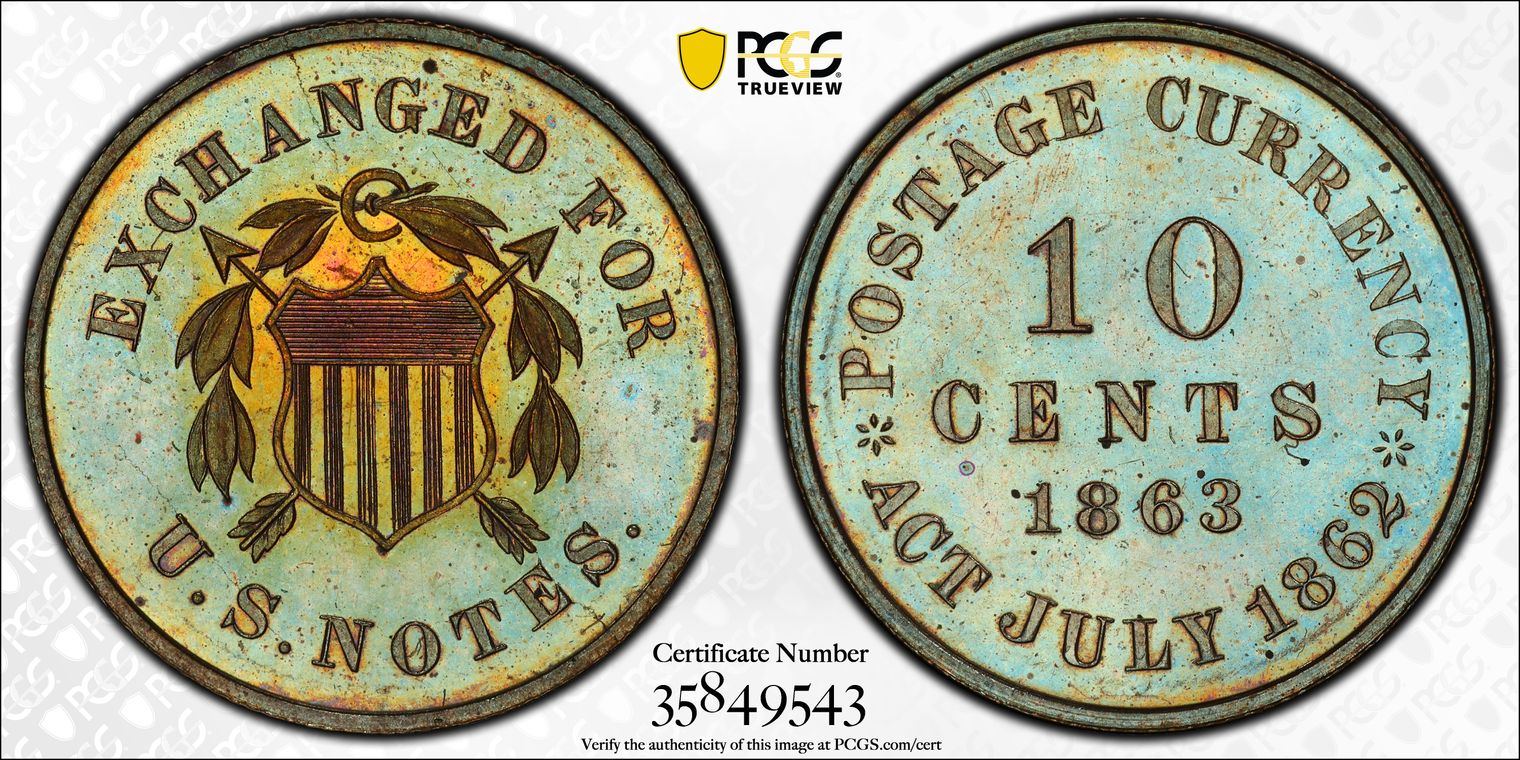
CAC - High R7 - Struck in Copper with a Reeded Edge. The obverse bears a central shield with intersecting arrows behind and a ring atop, from which depends on an inverted laurel wreath framing the shield left and right. EXCHANGED FOR / U.S. NOTES occupies the periphery. The reverse shows two rosettes separating POSTAGE CURRENCY and ACT JULY 1862, with 10 CENTS 1863 on three lines in the center. Mirrors beam intensely from all over. The mirrors are very clean and have remarkably clarity. Phenomenal totally original iridescent colors of pale lime/purple/violet/tangerine/gold colors swirl all over. Every detail is fully struck and appears boldly.
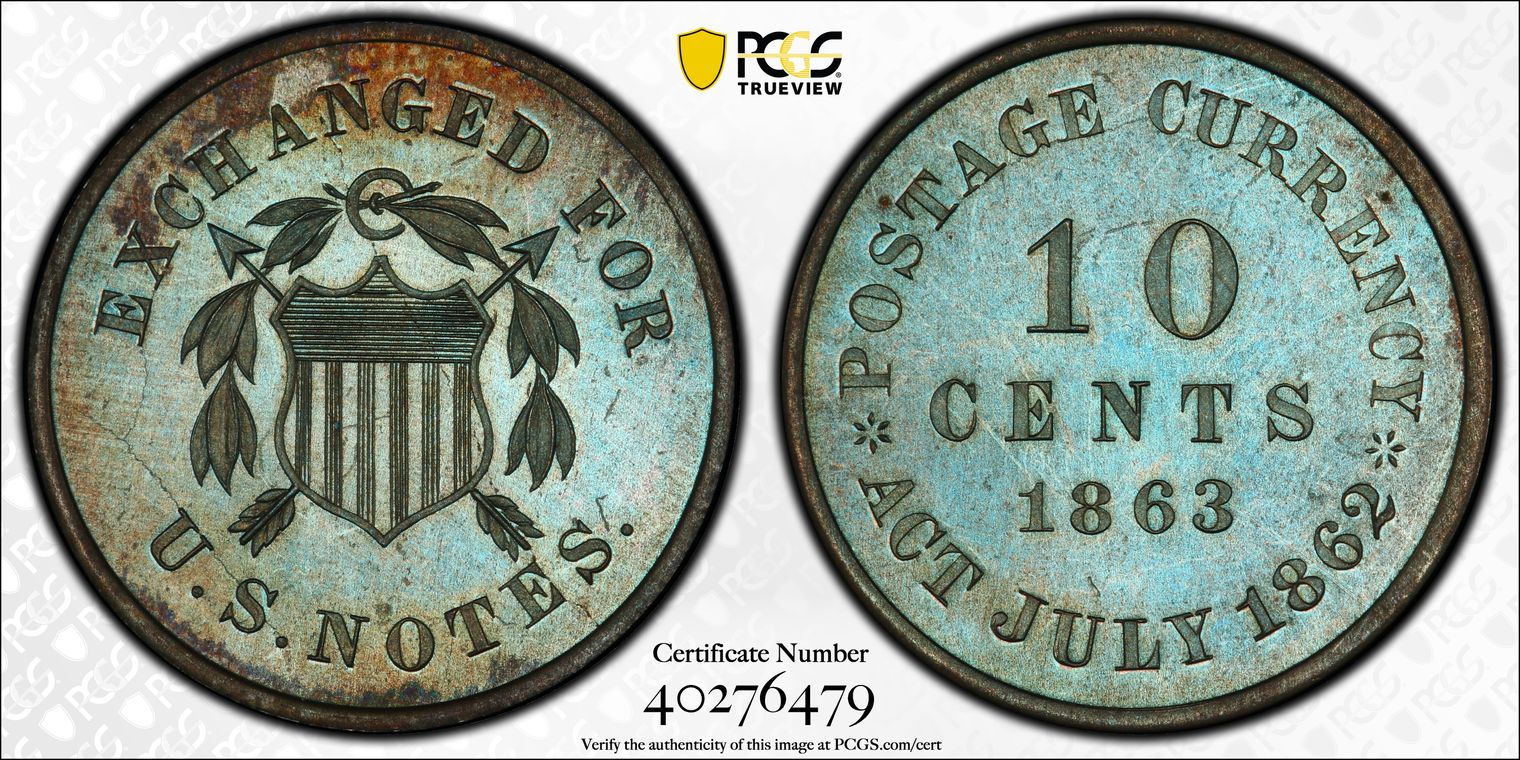
R8 - Only 3 pieces known. Struck in copper with a plain edge. "Both sides showcase magnificent ice-blue patina with golden-olive accents. A rarity with perhaps just three pieces known." Ex: The Bob R. Simpson Collection, Part III
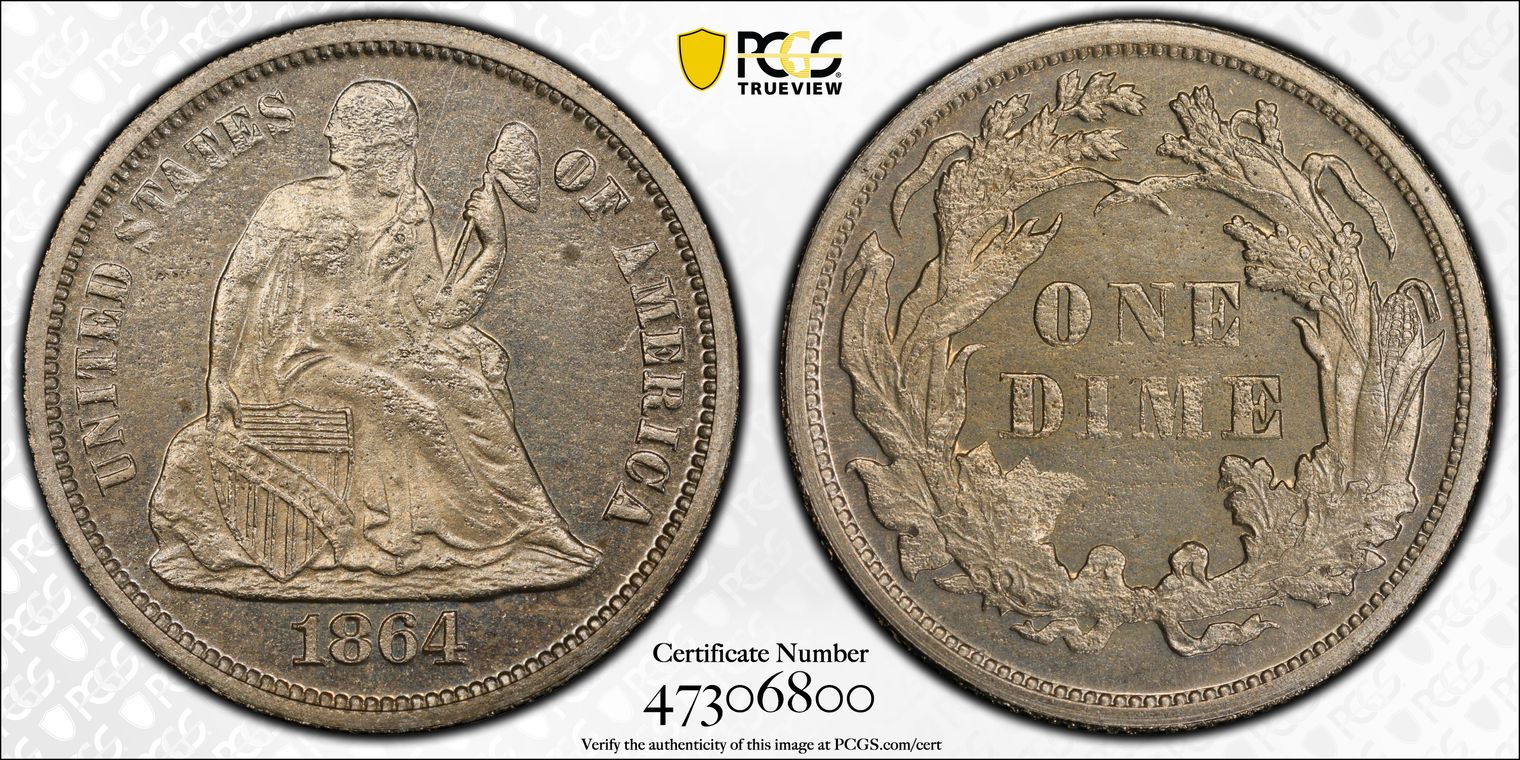
High R.7 - Struck nickel with a reeded edge. Struck from regular issue 1864 Seated dime dies. A very rare pattern variety, from a total population that is estimated at just three or four pieces. Struck from eroded dies, this Select proof has wispy blue toning on its gray-gold surfaces.
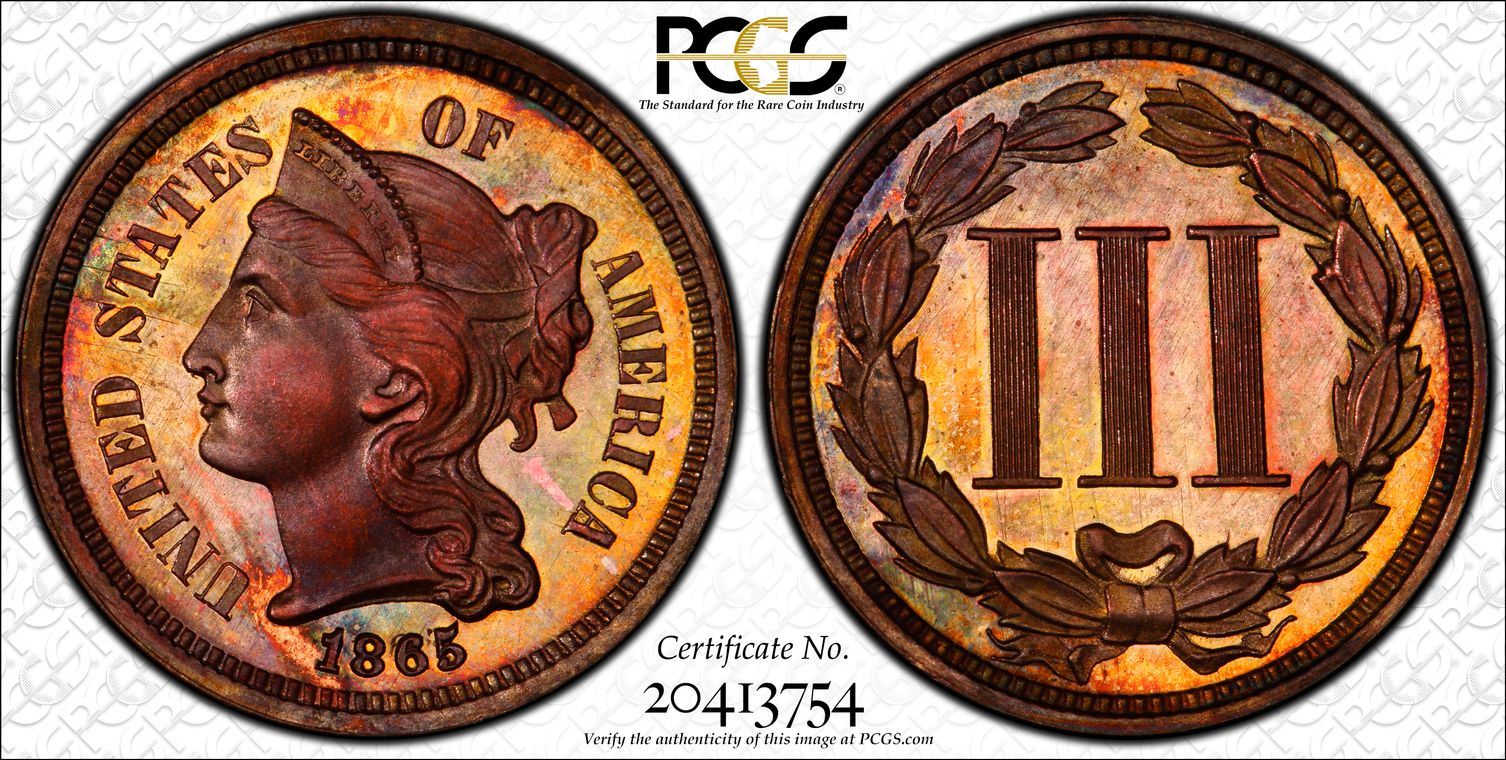
CAC - R.5 - Struck in copper with a plain edge. The highest graded at PCGS. This regular die trial piece shares the same obverse die as the scarce proof 1865 three cent nickel, since the date exhibits similar broad recutting. A high date variant, unlisted in Pollock, is also known. Richly patinated in ruby-red, peach-gold, and jade-green
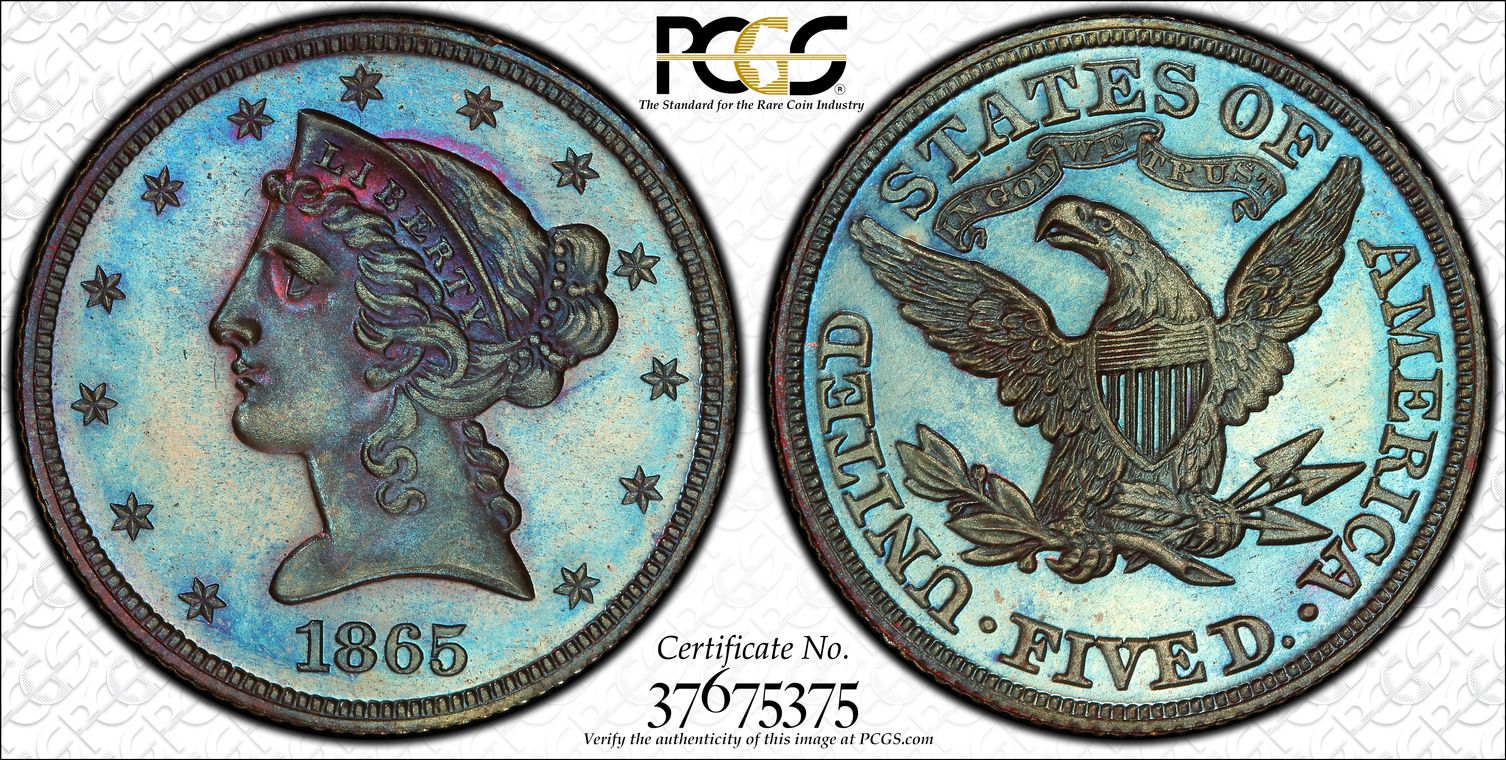
CAC - High R.6 - Struck in copper with a reeded edge. The obverse die is the regular design for the year. The reverse is the design adopted in 1866, with the scroll over the eagle's head and the motto IN GOD WE TRUST added. Struck in copper with a reeded edge.
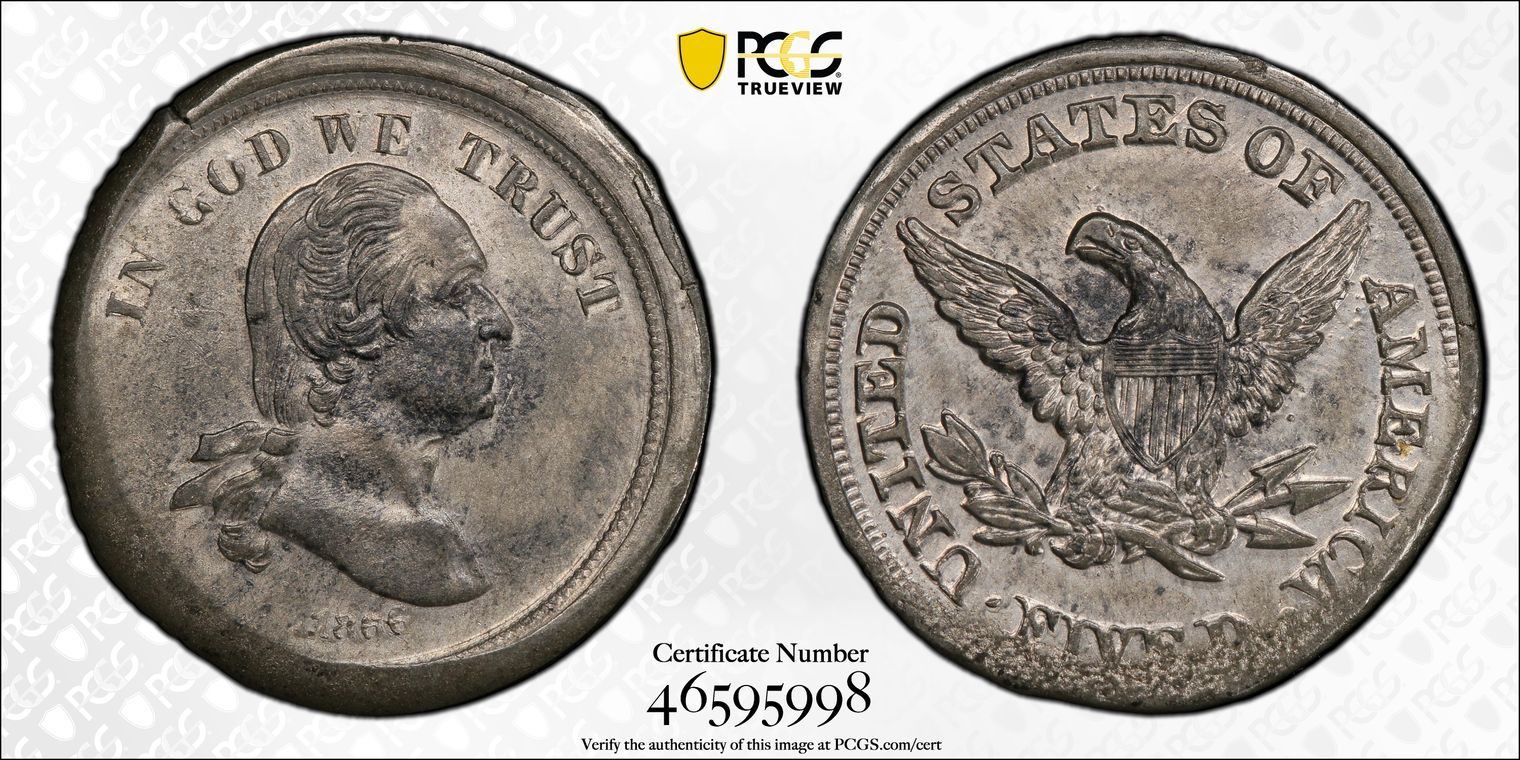
CAC - Unique -Struck out of collar in white metal with a plain edge. "The obverse uses a Washington five cent pattern die, while the reverse employs the normal No Motto half eagle reverse of the pre-1866 era.The coin displays uniform nickel-gray patina with gunmetal overtones. Detail is pleasing, and minimal marks are noted." EX. Historical Scholar Collection
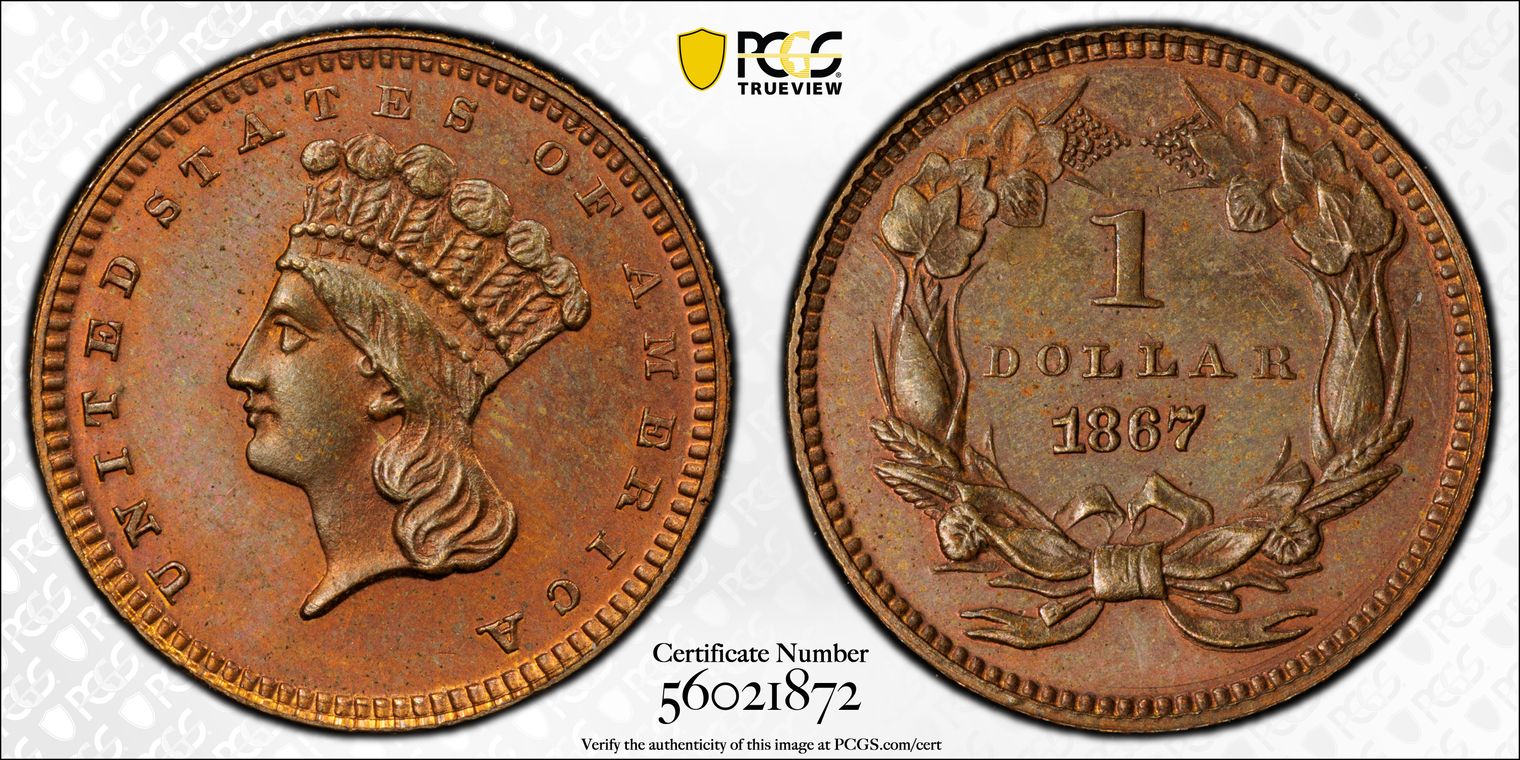
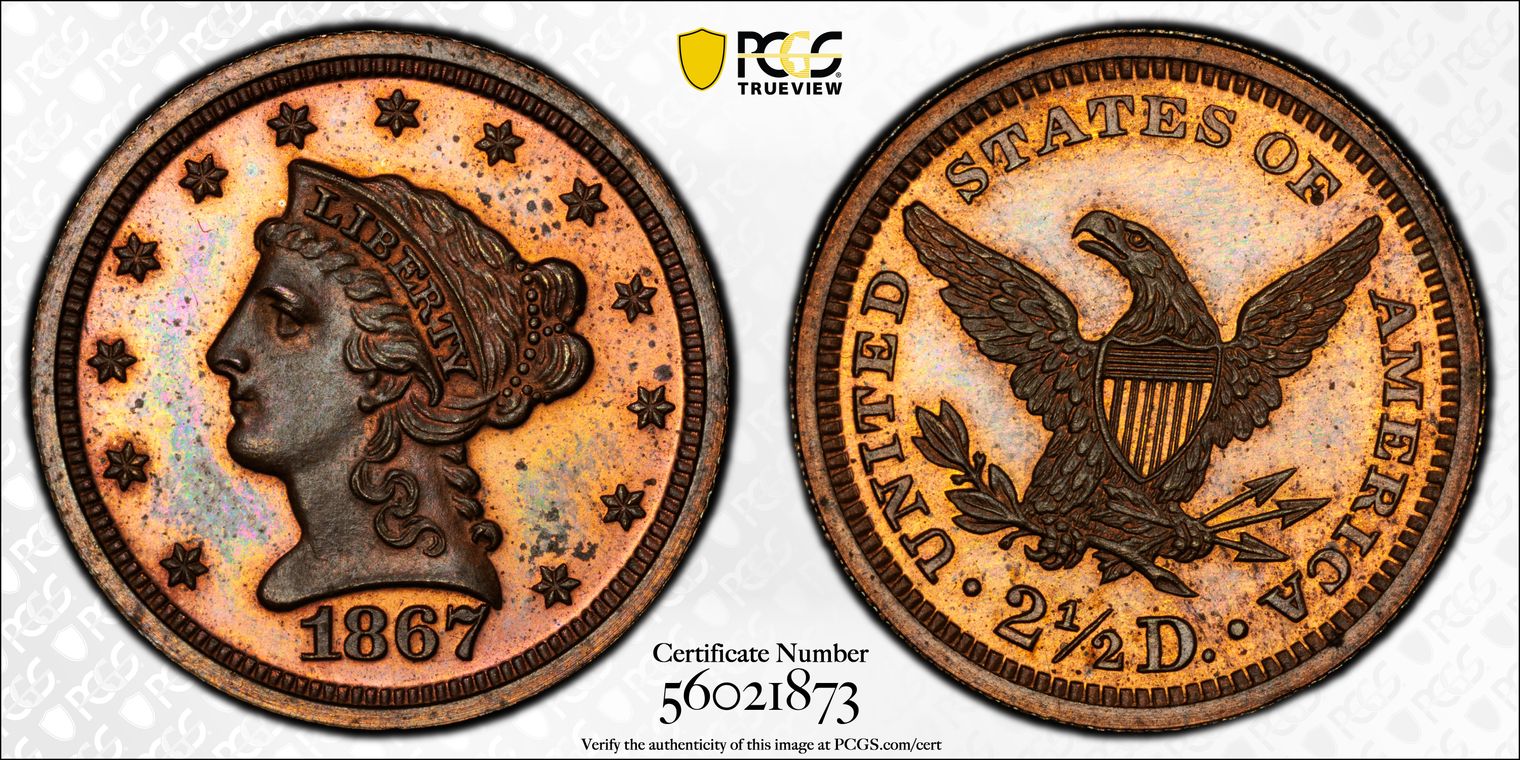
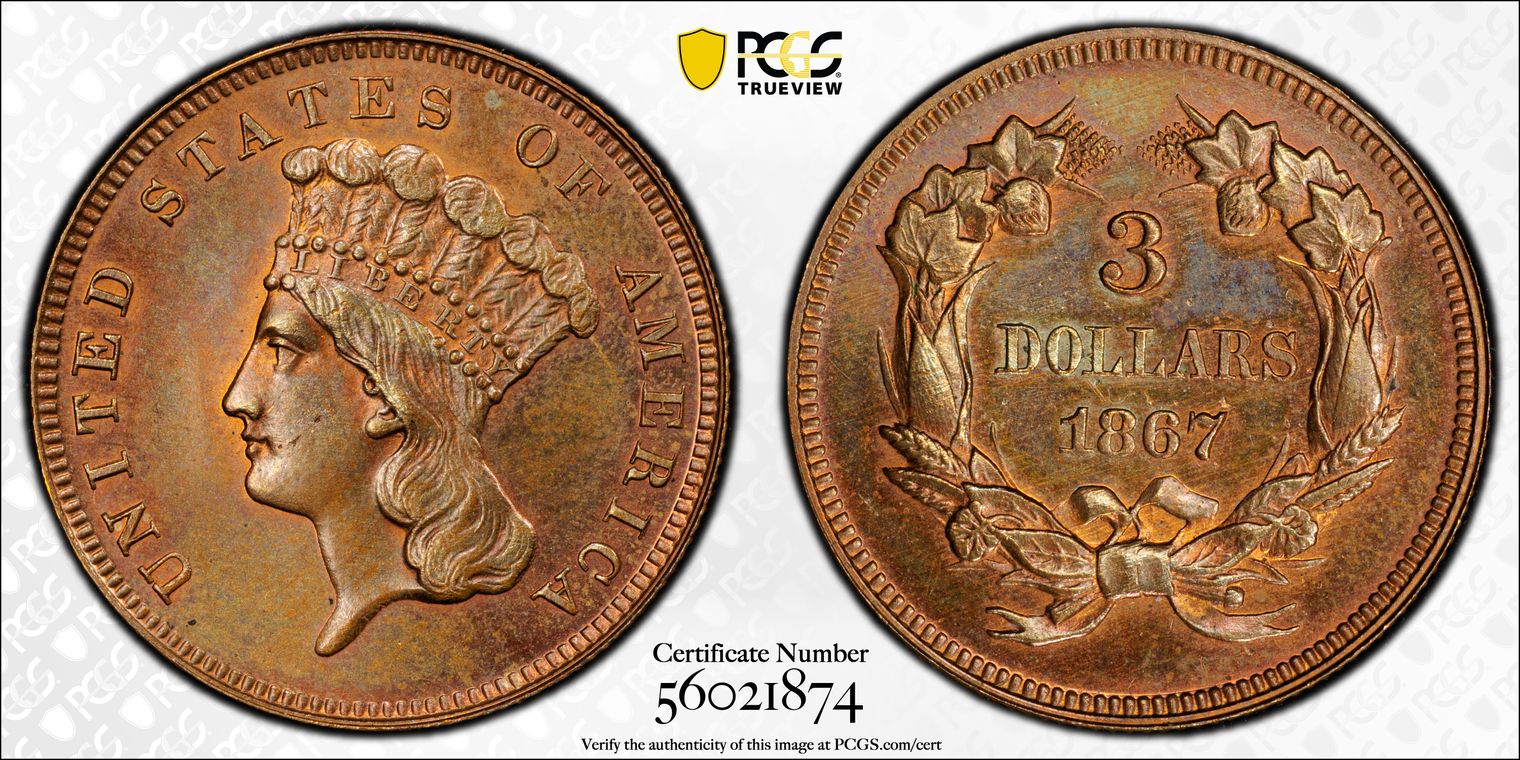
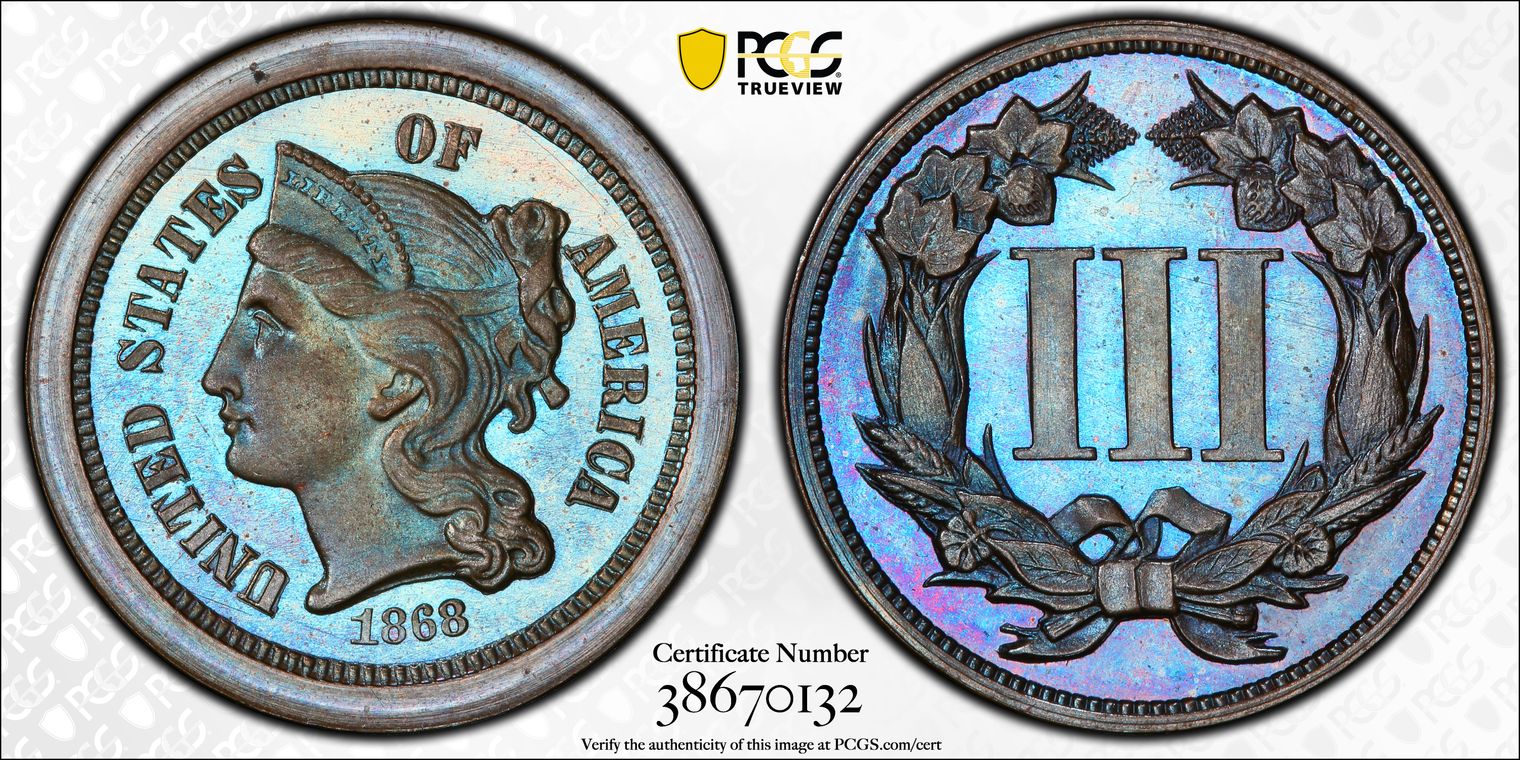
CAC - R-7+ - Regular issue proof dies struck in copper with a plain edge. Flashy Proof fields offer a lovely watery reflection bringing out an impressive array of totally original toning. The devices are sharply struck up and frosty. The surfaces are totally devoid of any flaws. Ex:Denali / Seattle Collection
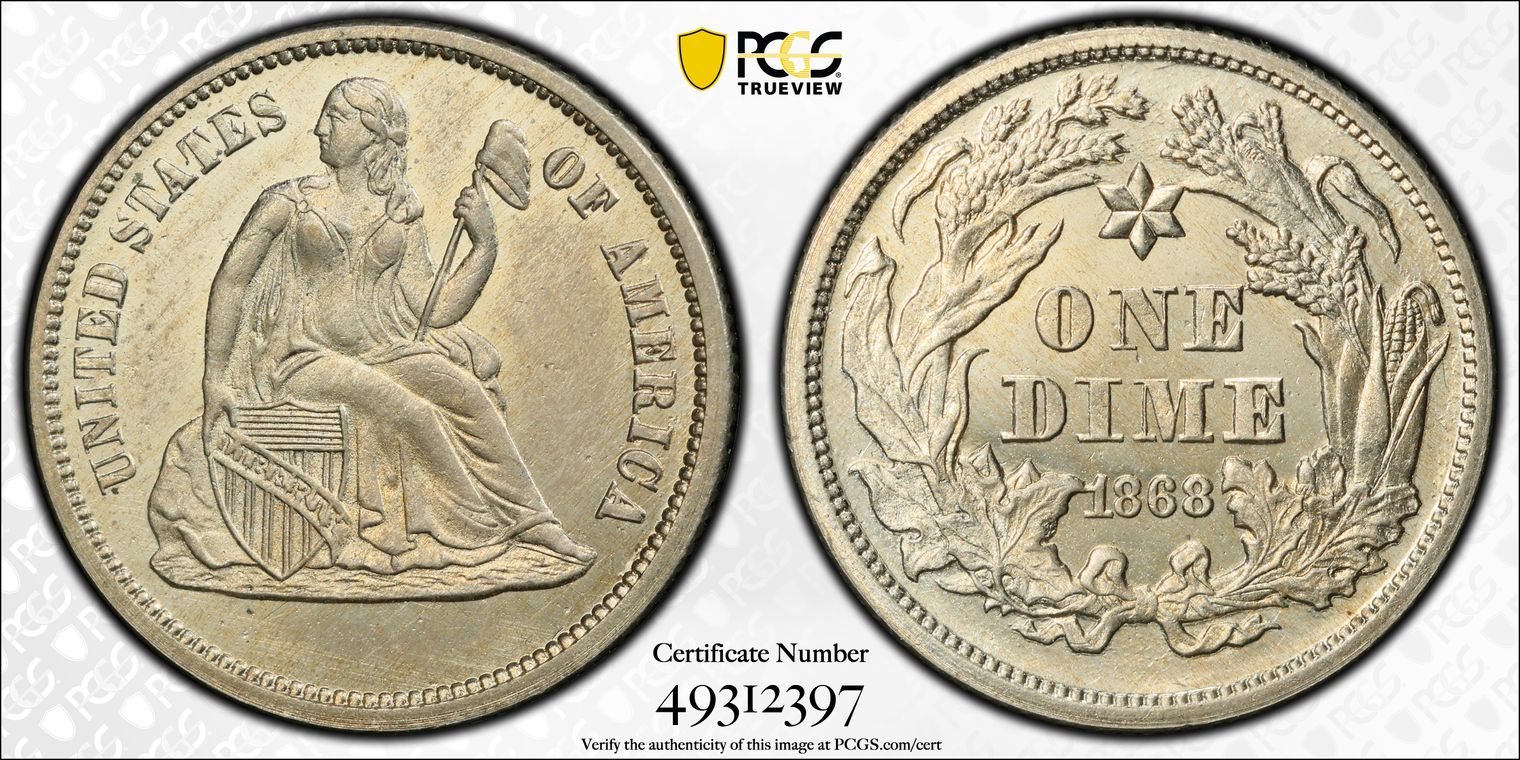
CAC - Low R.7 - Struck in copper-nickel alloy with a reeded edge. Was in an NGC holder - Judd-641A Unique. Years ago SEM-EDX testing was conducted by Ledoux & Company on NGC certificate number 581886-002. That testing revealed the composition of this piece as: 76% copper, 23% nickel, 0.3% cobalt, 0.2% iron, and 0.1% silicon. "The fields show the expected die polishing marks, and they are exceptionally mirrored. Additionally, the devices display significant mint frost, giving the coin considerable field-device contrast on each side. Just a hint of pale golden-rose toning is present across each side. The devices are fully struck in all areas."
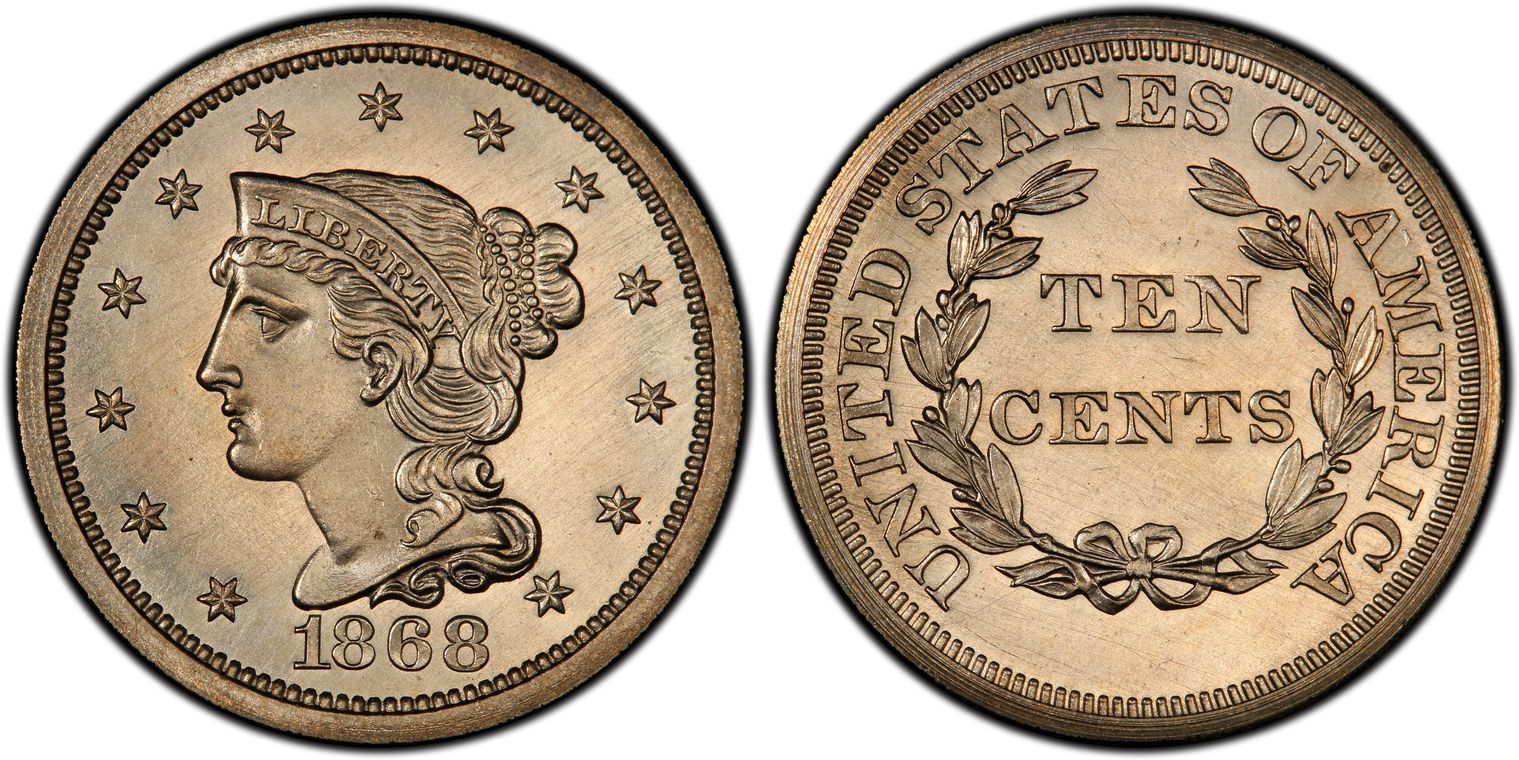
CAC - Low R.6 - Struck in nickel with a plain edge. The obverse features the almost identical design used on large cents from 1843 to 1857, while the reverse is similar except TEN CENTS is in the center of the wreath. The leftover Braided Hair design from large cents, last struck a decade before this piece, was used for pattern cents and ten cents in 1868. This nickel example is fully brilliant with satiny smooth surfaces and excellent design definition.
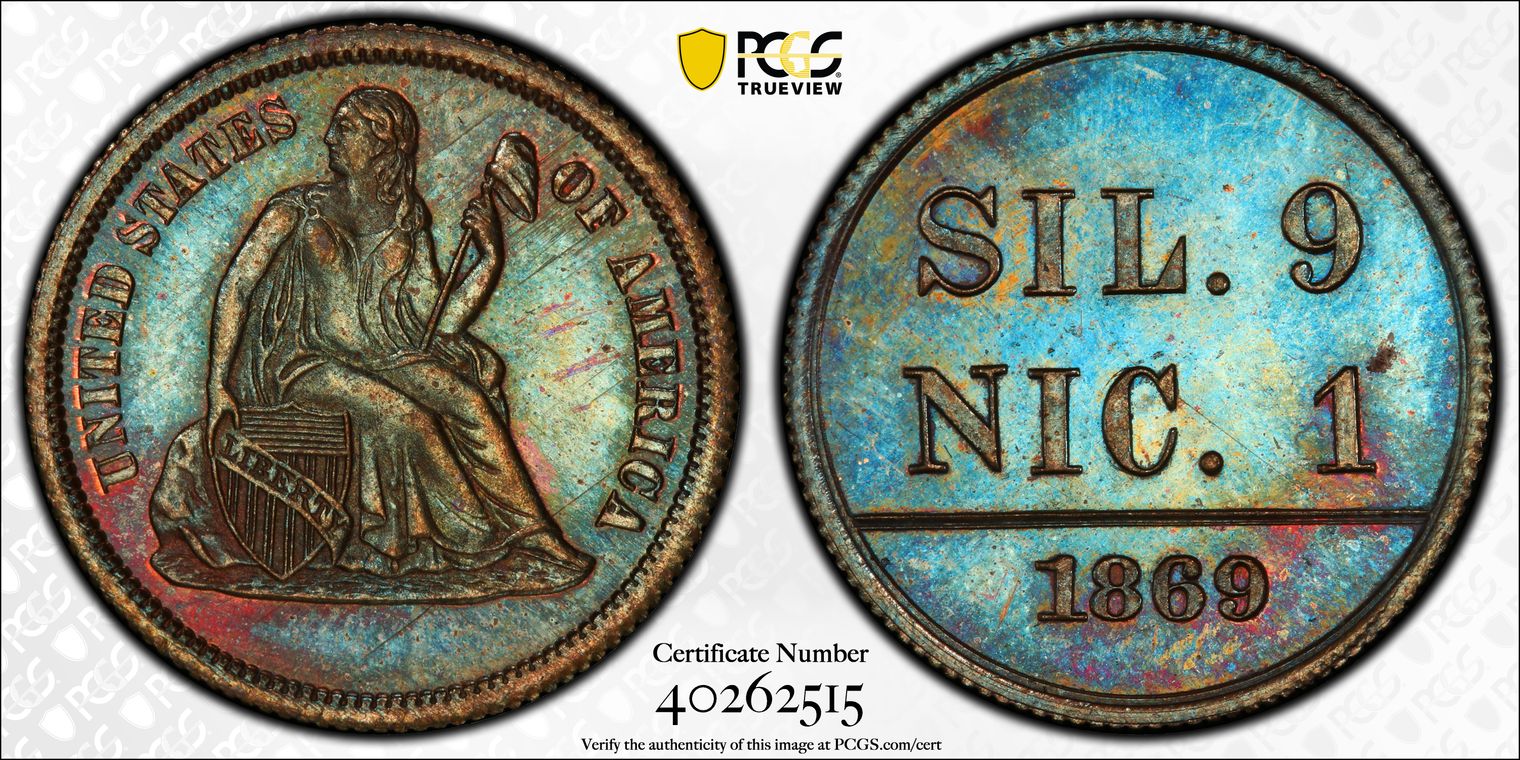
CAC - R.7 - Struck in copper with a reeded edge. ..."well struck and lustrous with rich apple-green, ocean-blue, and rose-red toning." Ex. Louis E. Eliasberg, Sr. Collection / Simpson
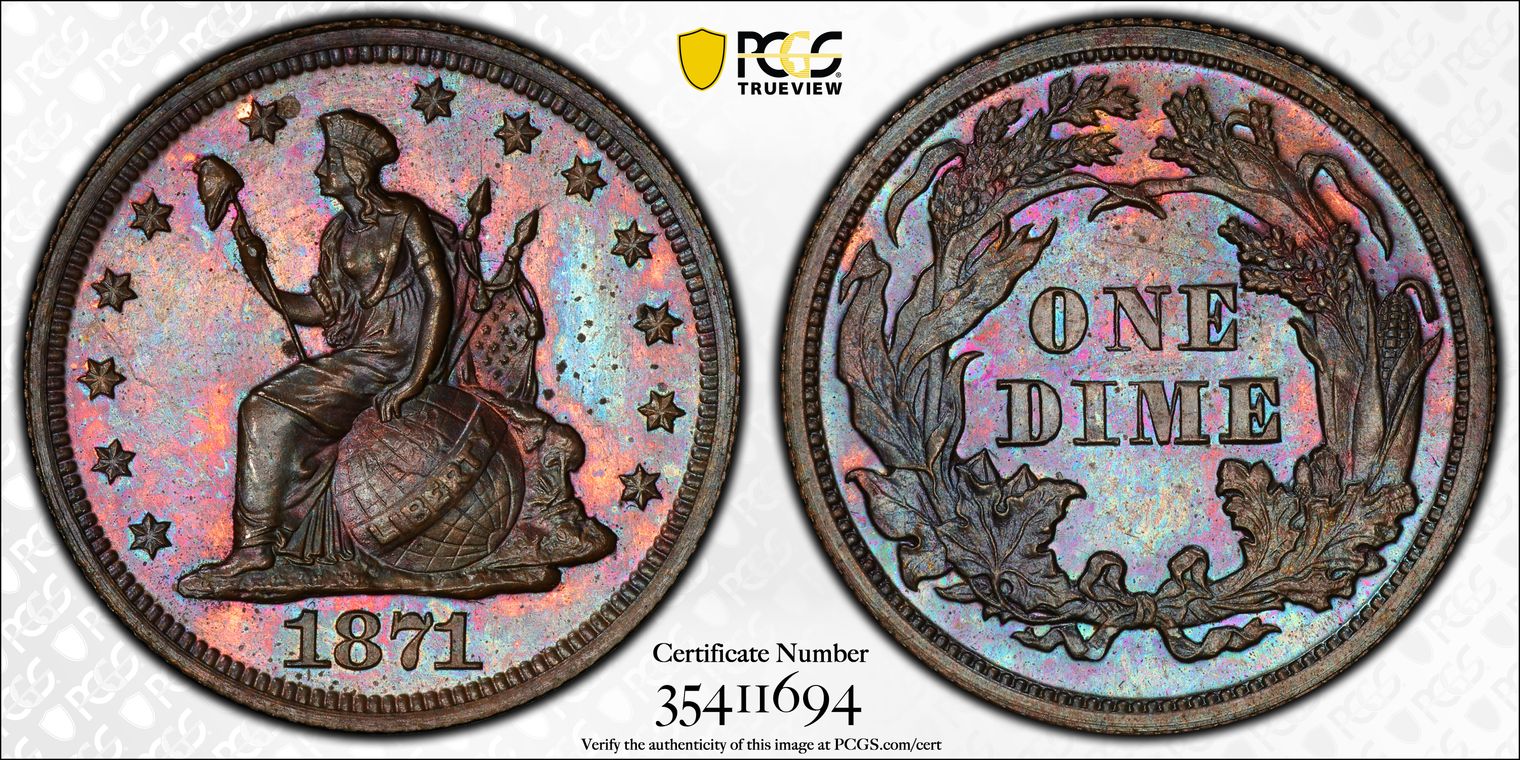
CAC - High R.6 -Struck in copper with a reeded edge. The Longacre Indian Princess design on the obverse features Liberty seated with left hand resting on a globe, right hand holding a pole with cap on top, and conjoined flags behind. The reverse is from the regular issue dies. Most of each side is subdued blue, brown. Fully struck. Ex: The Collection of William Rau.
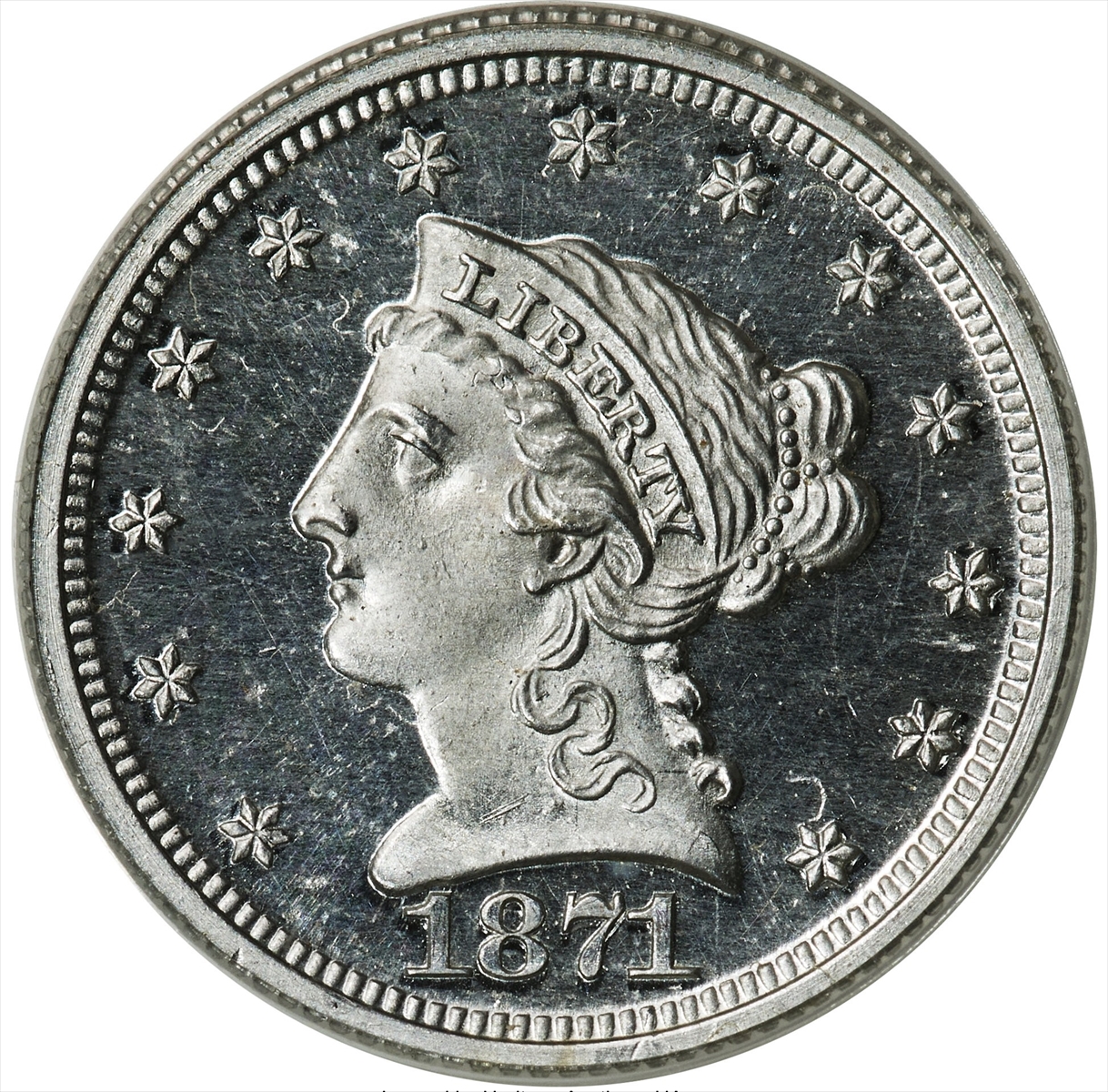
CAC - R.8 - OGH - The only known example - The regular proof dies for the 1871 quarter eagle, struck in aluminum with a reeded edge. "...both sides exhibit strong cameo contrast. Fully mirrored light gray fields provide an exquisite background for the lustrous and sharply detailed devices." Ex. Estate of Charles W. Montgomery.
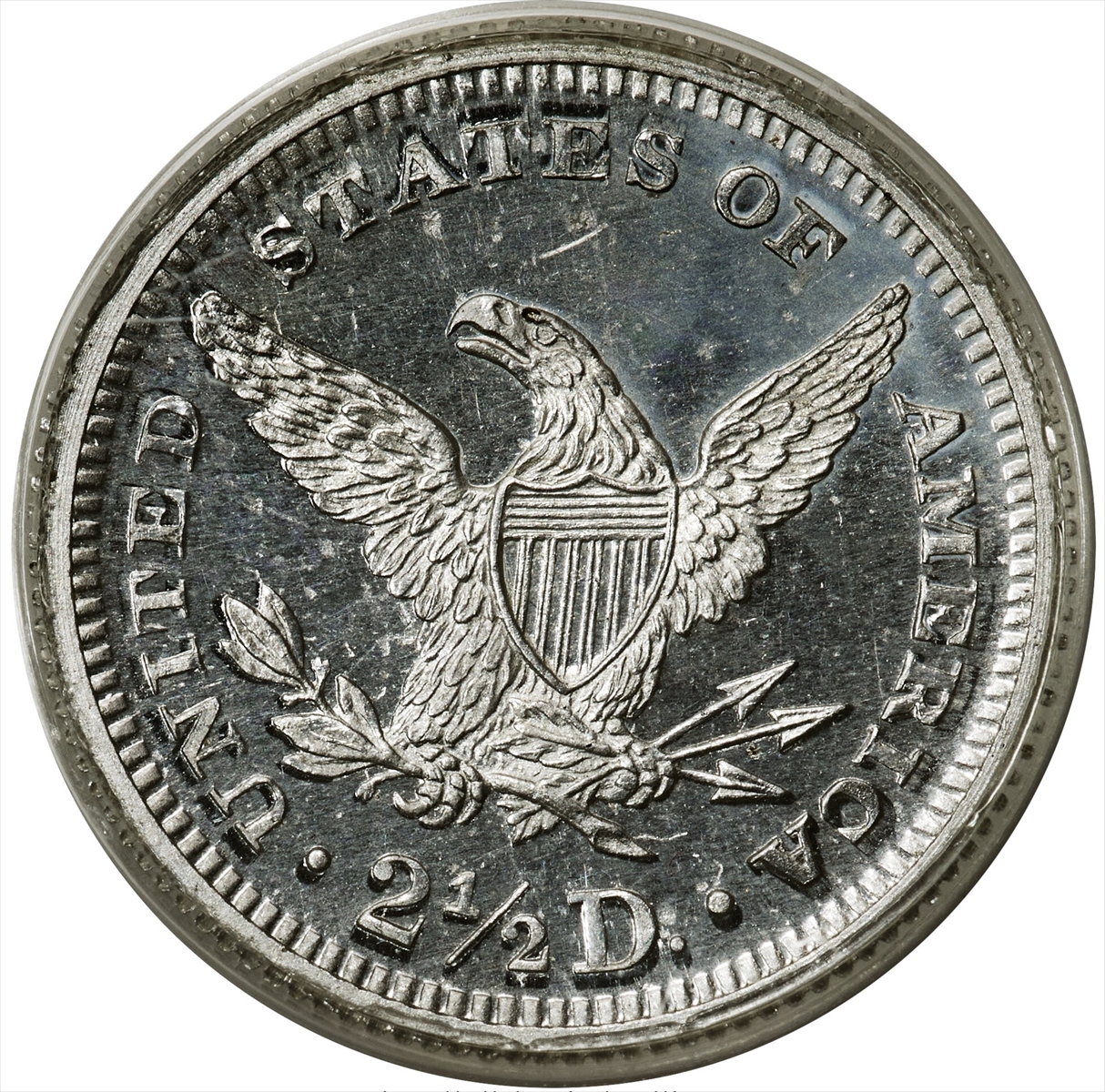
CAC - R.8 - OGH - The only known example - The regular proof dies for the 1871 quarter eagle, struck in aluminum with a reeded edge. "...both sides exhibit strong cameo contrast. Fully mirrored light gray fields provide an exquisite background for the lustrous and sharply detailed devices." Ex. Estate of Charles W. Montgomery.
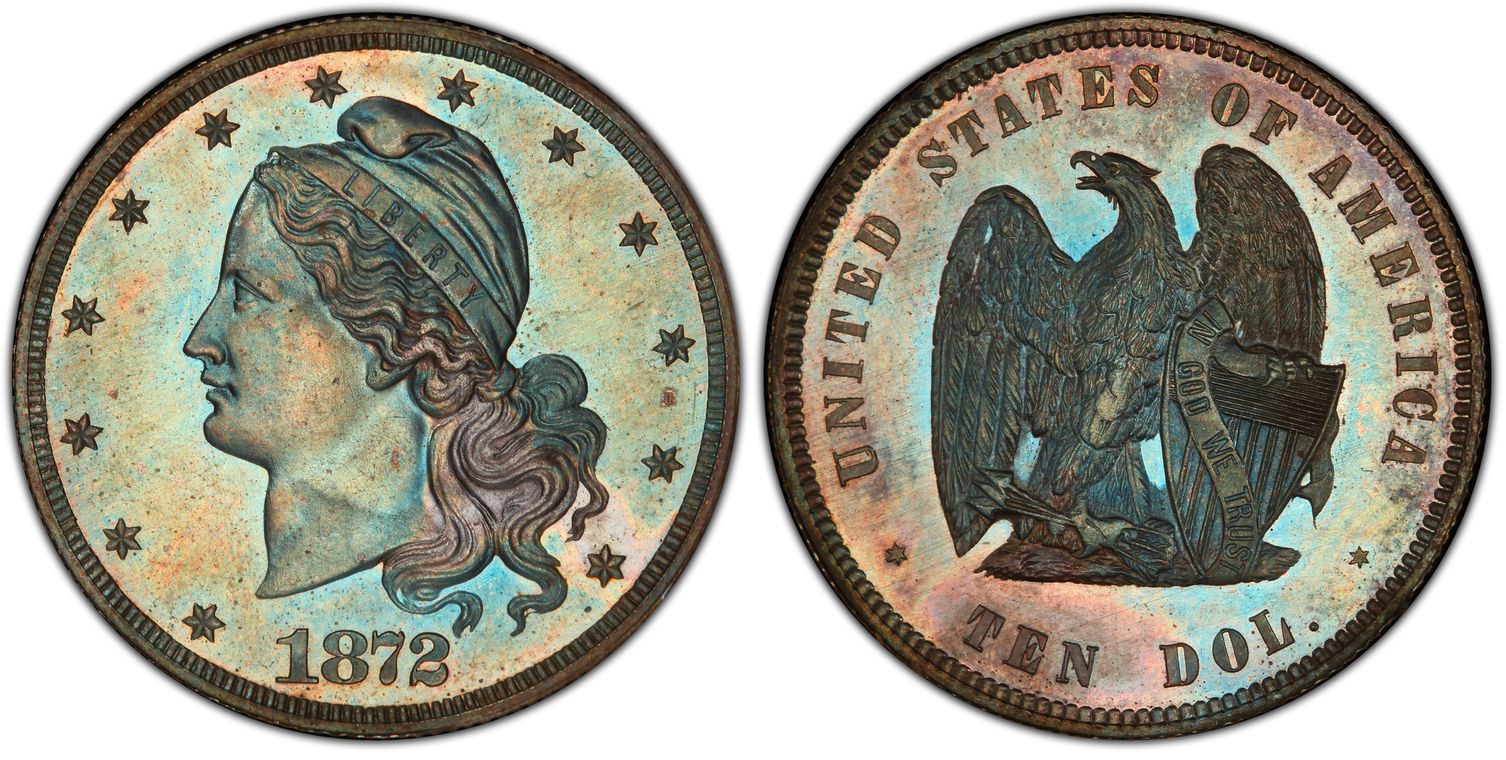
CAC - R7 - Struck in Copper with a Reeded Edge. Obv: William Barber's celebrated Amazonian design with a bust of Liberty facing left, 13 stars around the border, and the date 1872 below. Liberty is wearing a Phrygian cap inscribed LIBERTY. Rev: An eagle with spread wings clutches a group of three arrows in its right talon and supports a shield with its left talon. A scroll crossing the shield is inscribed with the motto IN GOD WE TRUST. The legend UNITED STATES OF AMERICA is above and the denomination TEN DOL. is below. This beautiful near-Gem is vividly toned in a blend of steel-blue and copper-rose colors. Both sides are smooth and attractive with a lively satin to semi-reflective finish.
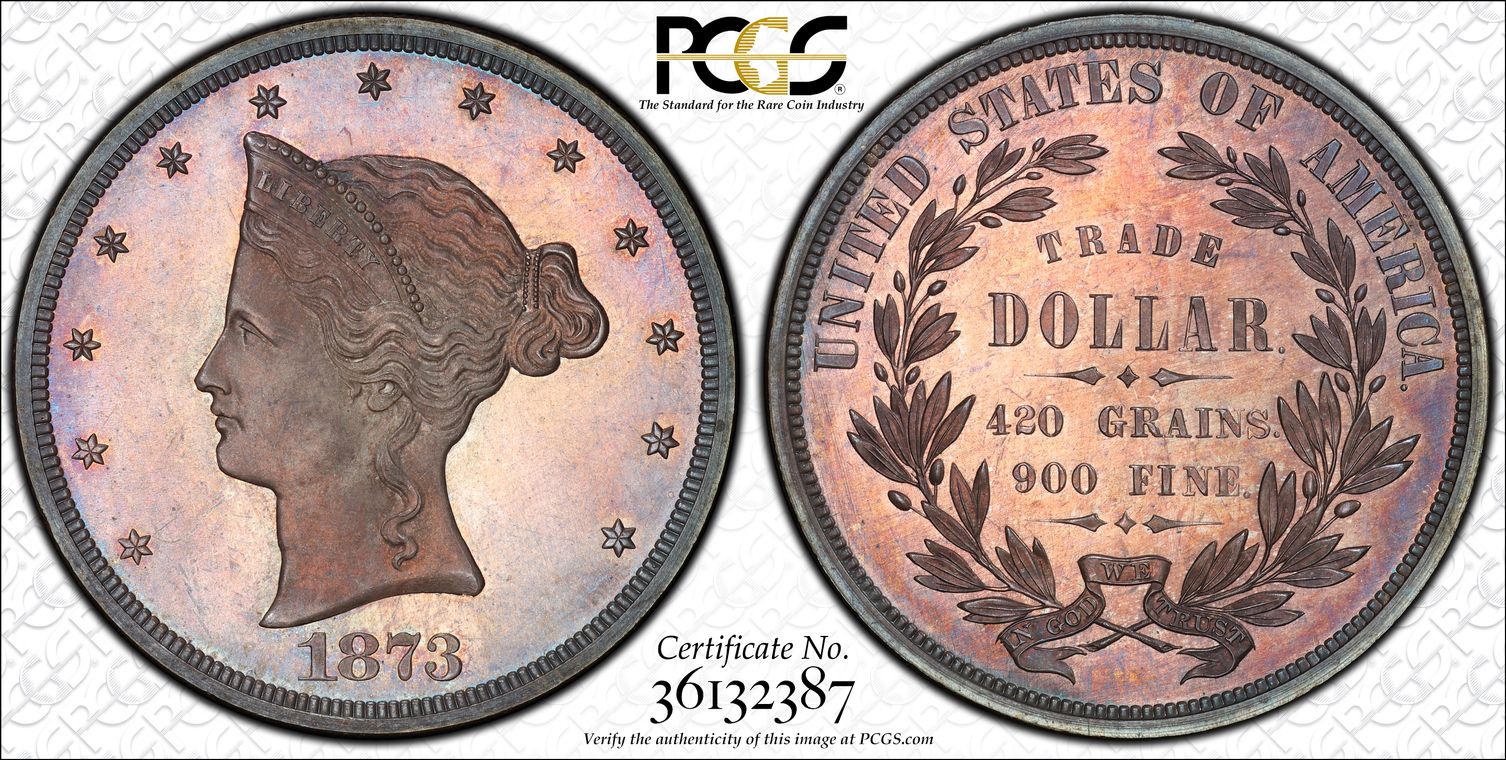
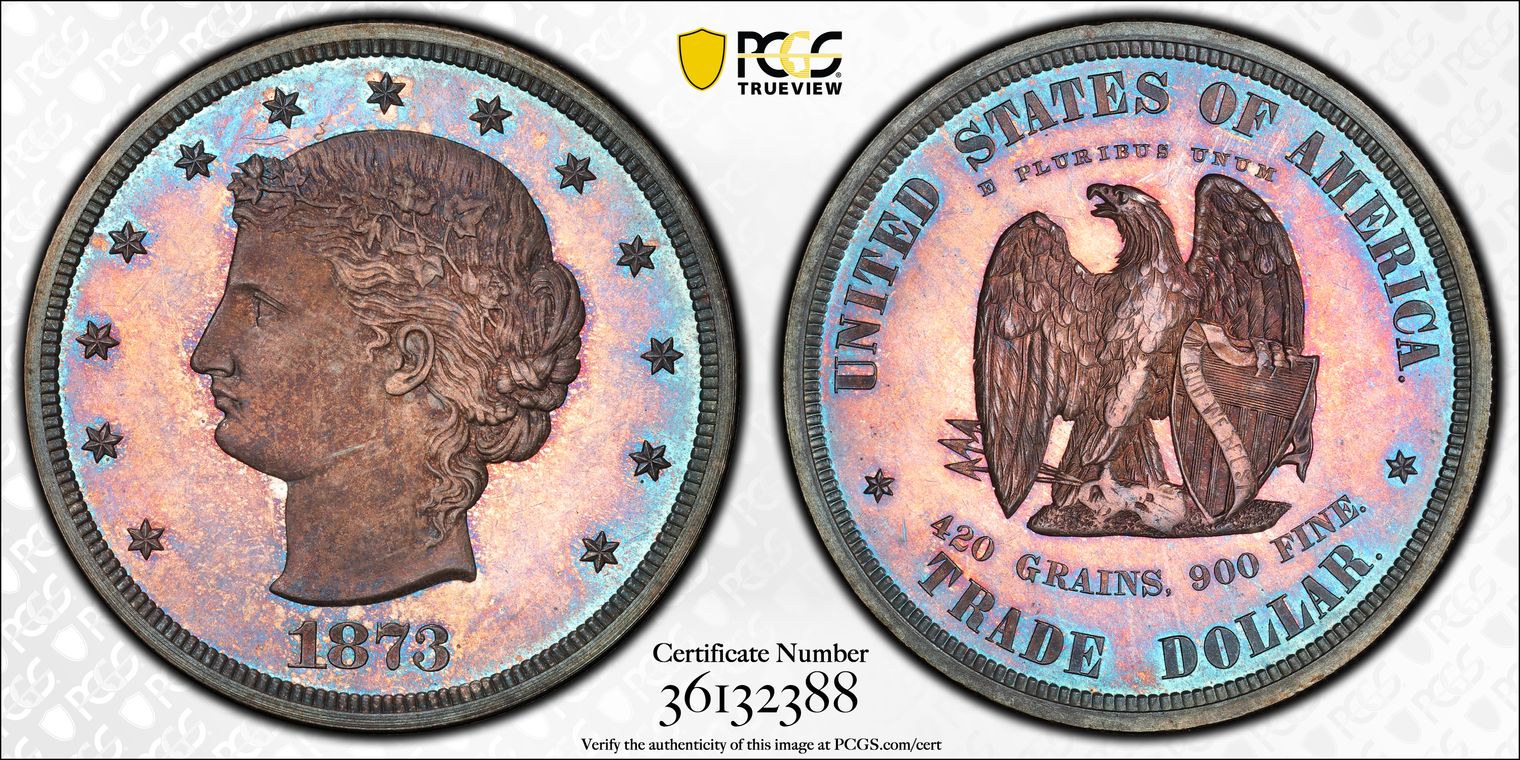
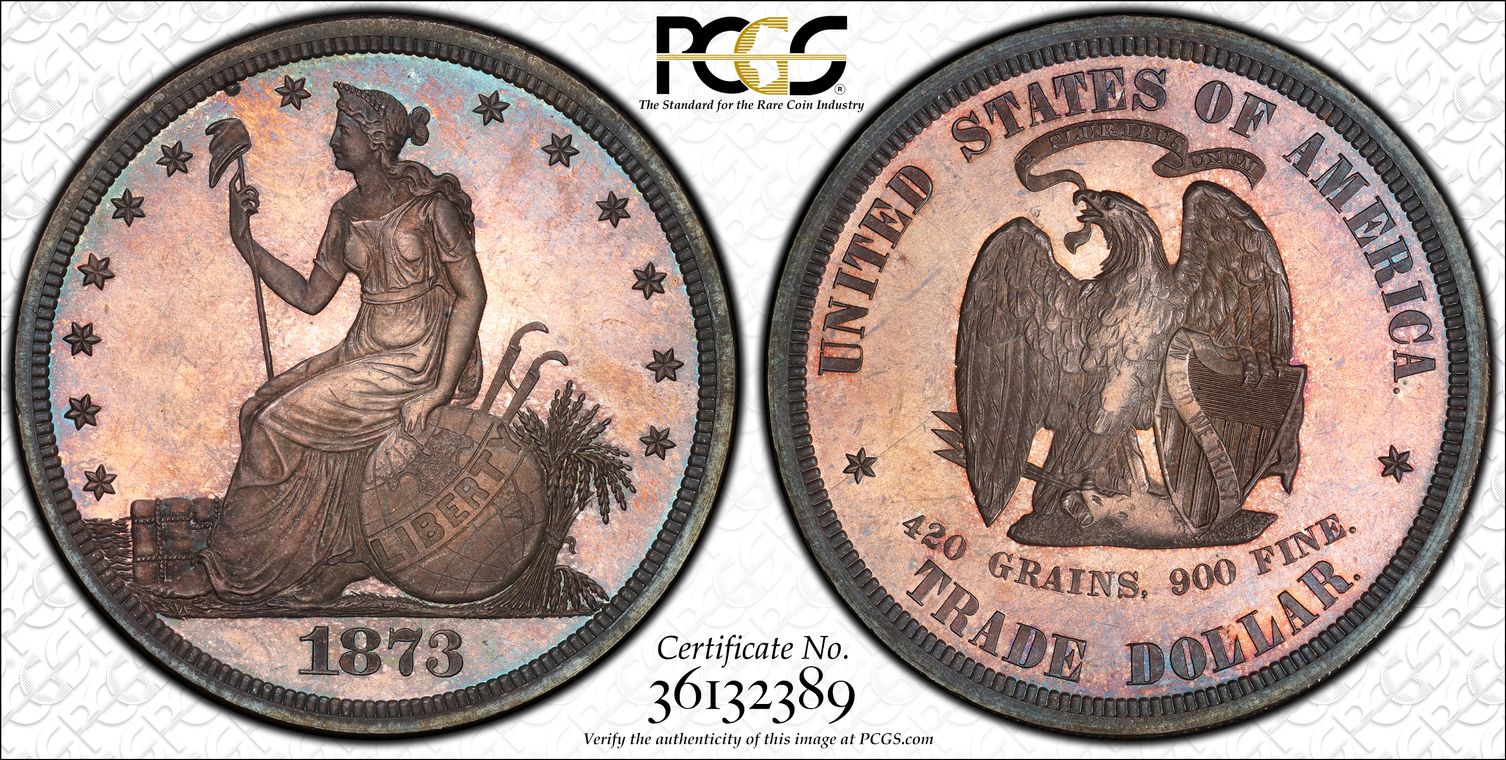
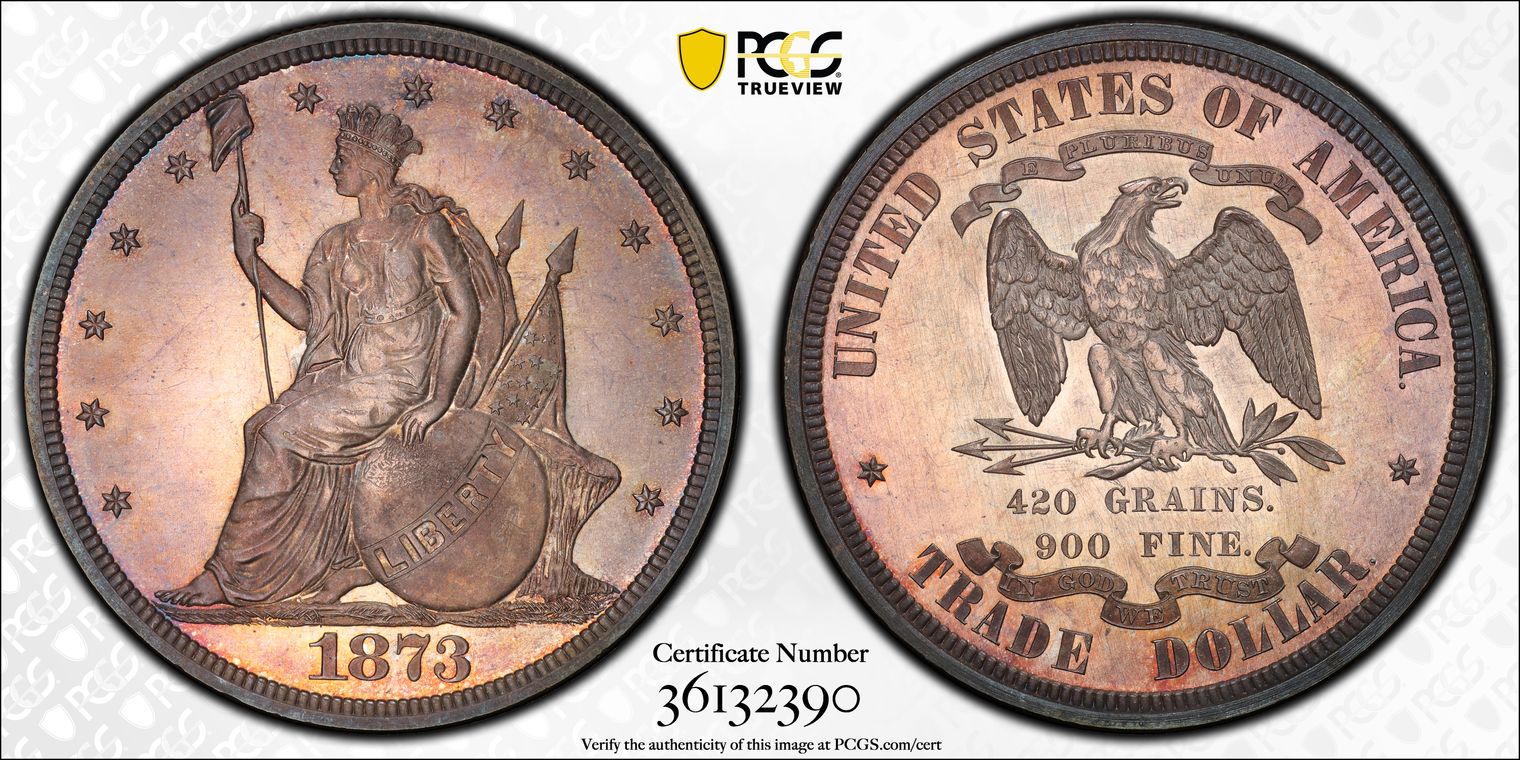
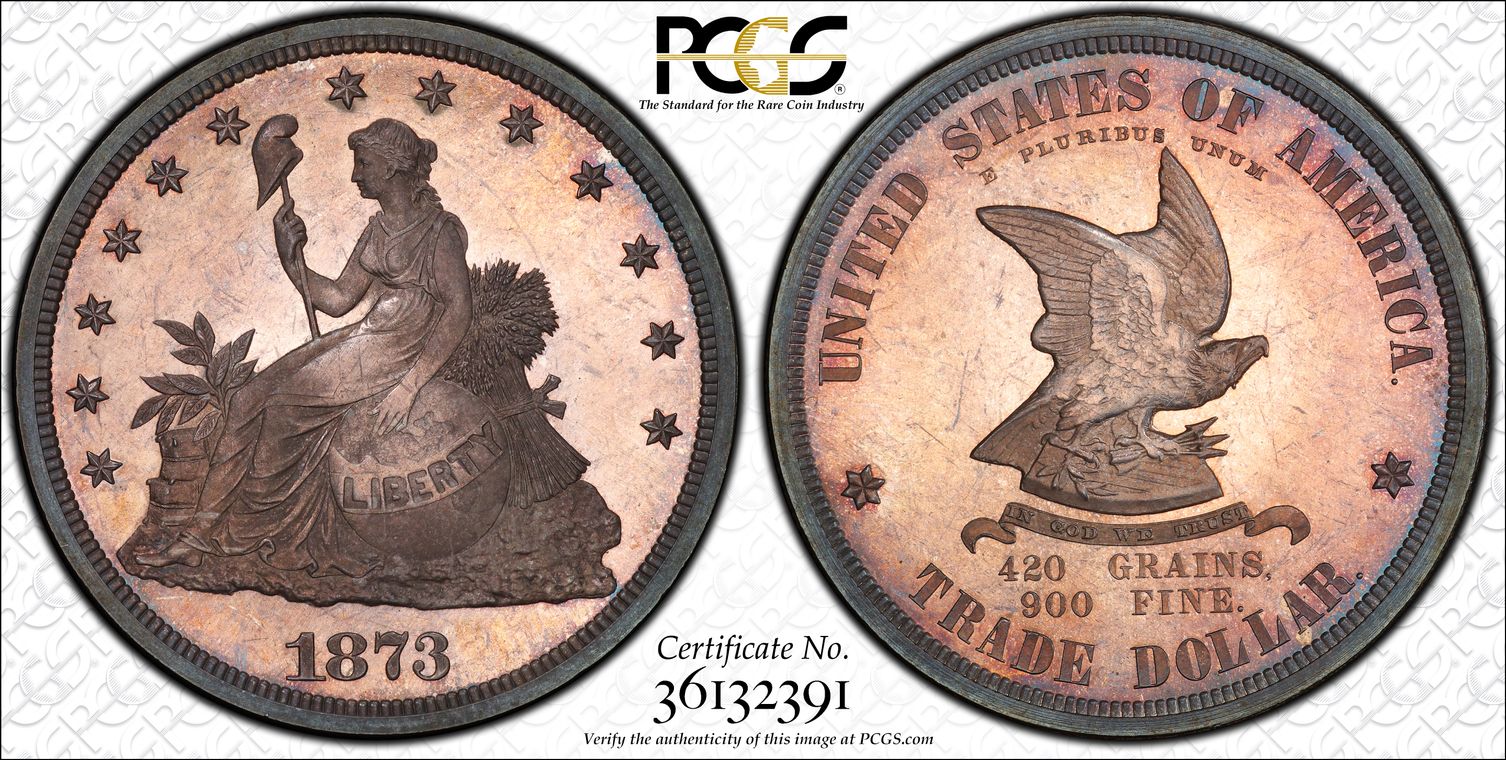
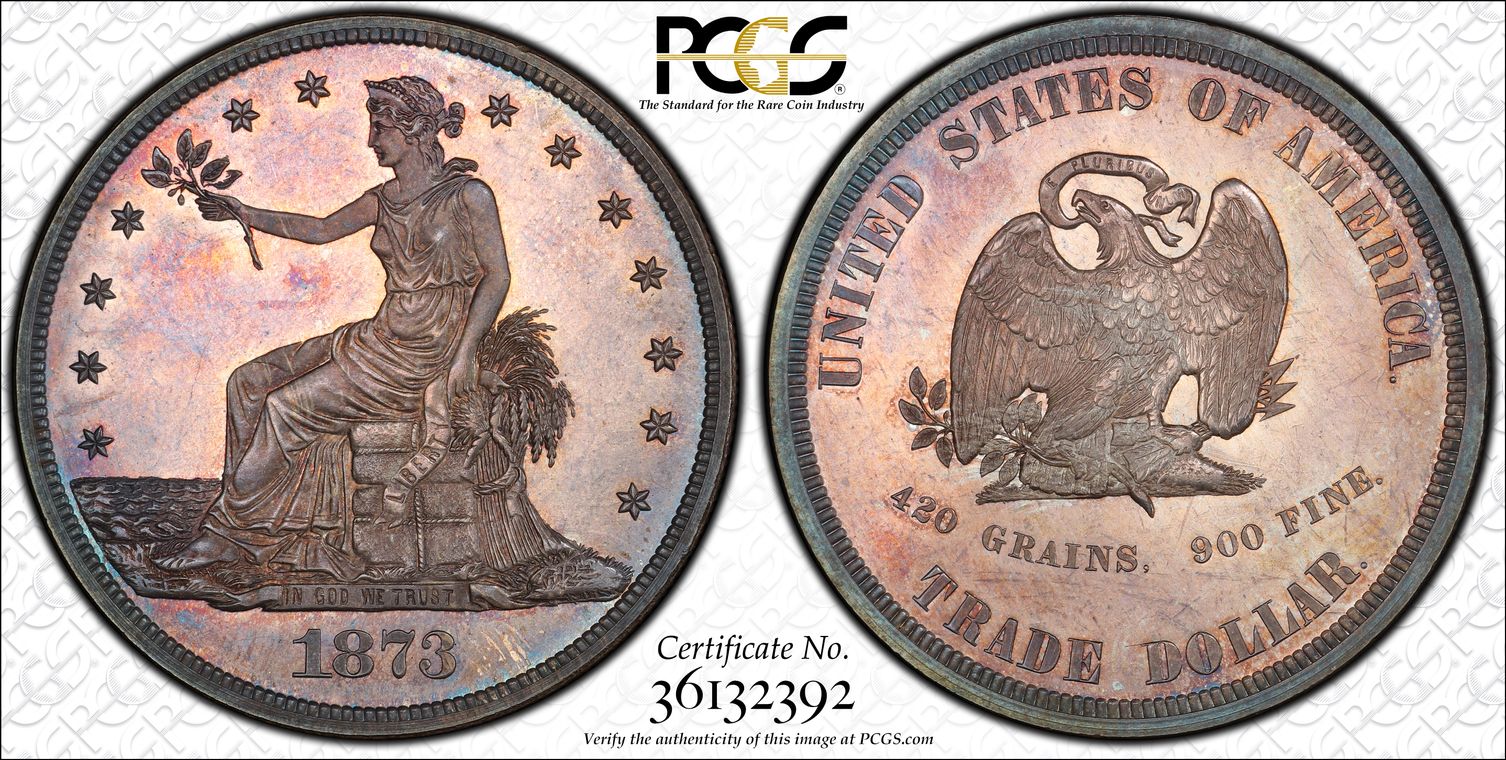
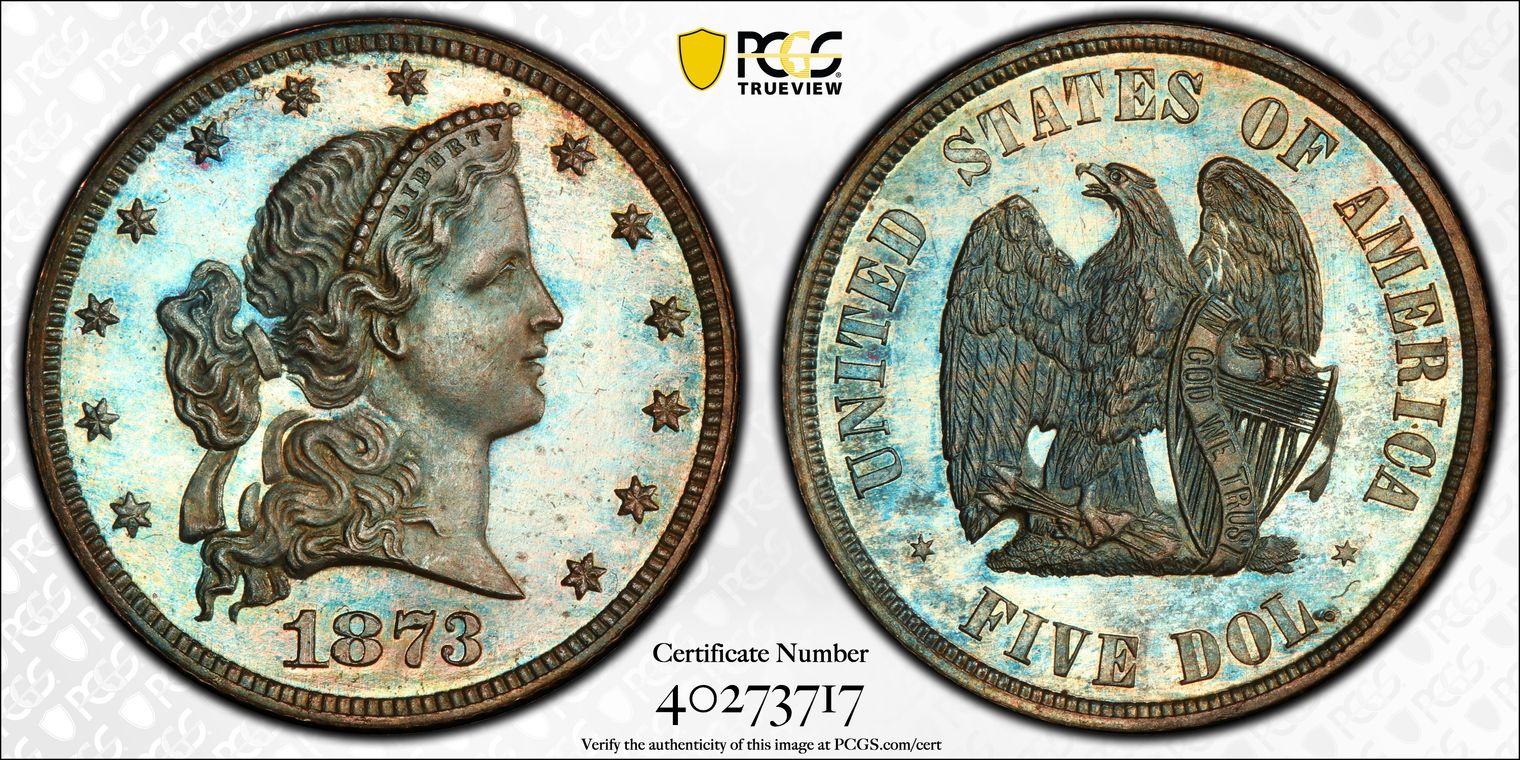
CAC - High R.7 - Struck in copper with a reeded edge. Five Examples Extant -Two of them are gilt. Struck in copper with a reeded edge. "Olive-gold and ocean-blue tones cover glossy brown surfaces. Essentially void of carbon or contact." Ex: The Bob R. Simpson Collection, Part II
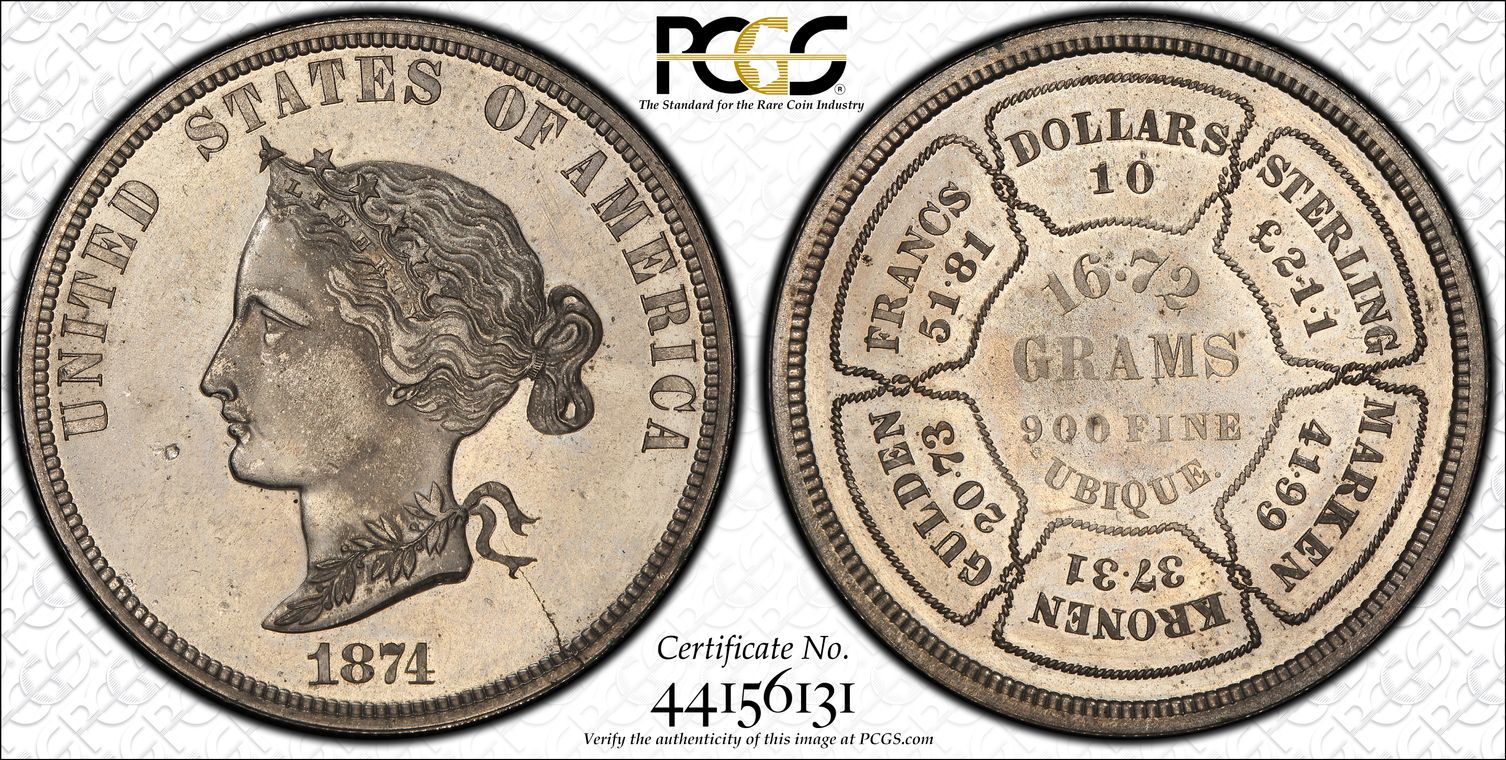
CAC - High R.7- Only Two or Three Known. $10 Bickford - Struck in nickel with a reeded edge. "The obverse depicts a bust of Liberty facing left with the legend UNITED STATES OF AMERICA above and the date below. Liberty wears a diadem inscribed with the word LIBERTY and ornamented with six stars. The weight 16.72 GRAMS, the standard of the metal 900 FINE, and the word UBIQUE are centered on the reverse. Around the periphery is the U.S. denomination DOLLARS 10 and the following international equivalents: STERLING (Pound) 2.1.1; MARKEN 41.99; KRONEN 37.31; GULDEN 20.73; and FRANCS 51.81." Ex: Simpson.
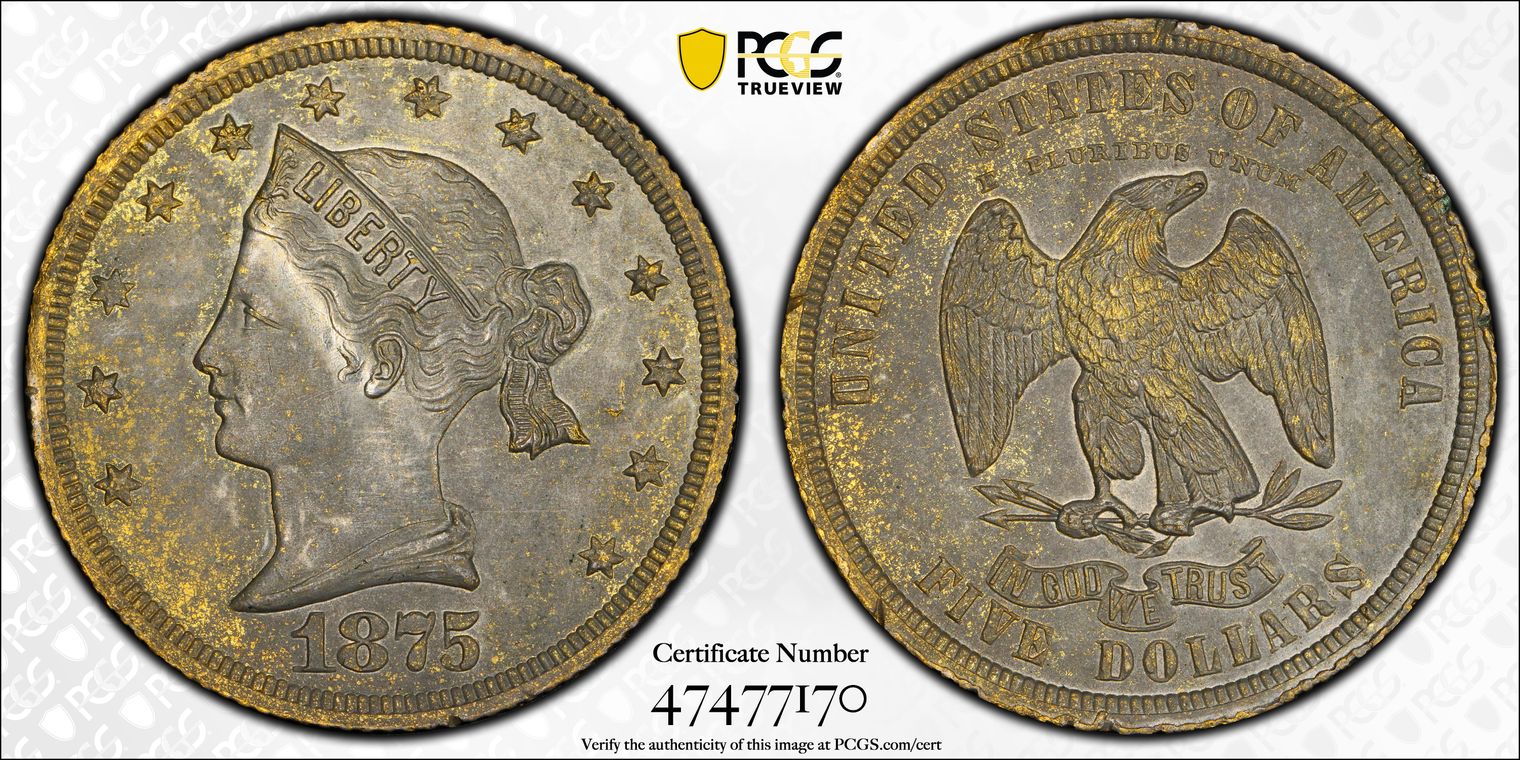
Unique - Struck in white with a reeded edge. "William Barber's famous Sailor Head design, the obverse features a head of Liberty facing left. The drapery over Liberty's shoulders presents the appearance of a collar on a sailor's uniform. Also, the word Liberty is set on a squared-off coronet with two trailing ribbons, this also resembling a sailor's cap. On the reverse, an eagle similar to the one featured on the regular issue twenty cent piece is poised in heraldic fashion. Beneath the eagle is a ribbon with the motto IN GOD WE TRUST, and above the words E PLURIBUS UNUM are set directly onto the field in tiny letters." Ex: Dr. Henry R. Linderman, King Farouk, Abe Kosoff; Kosoff Collection
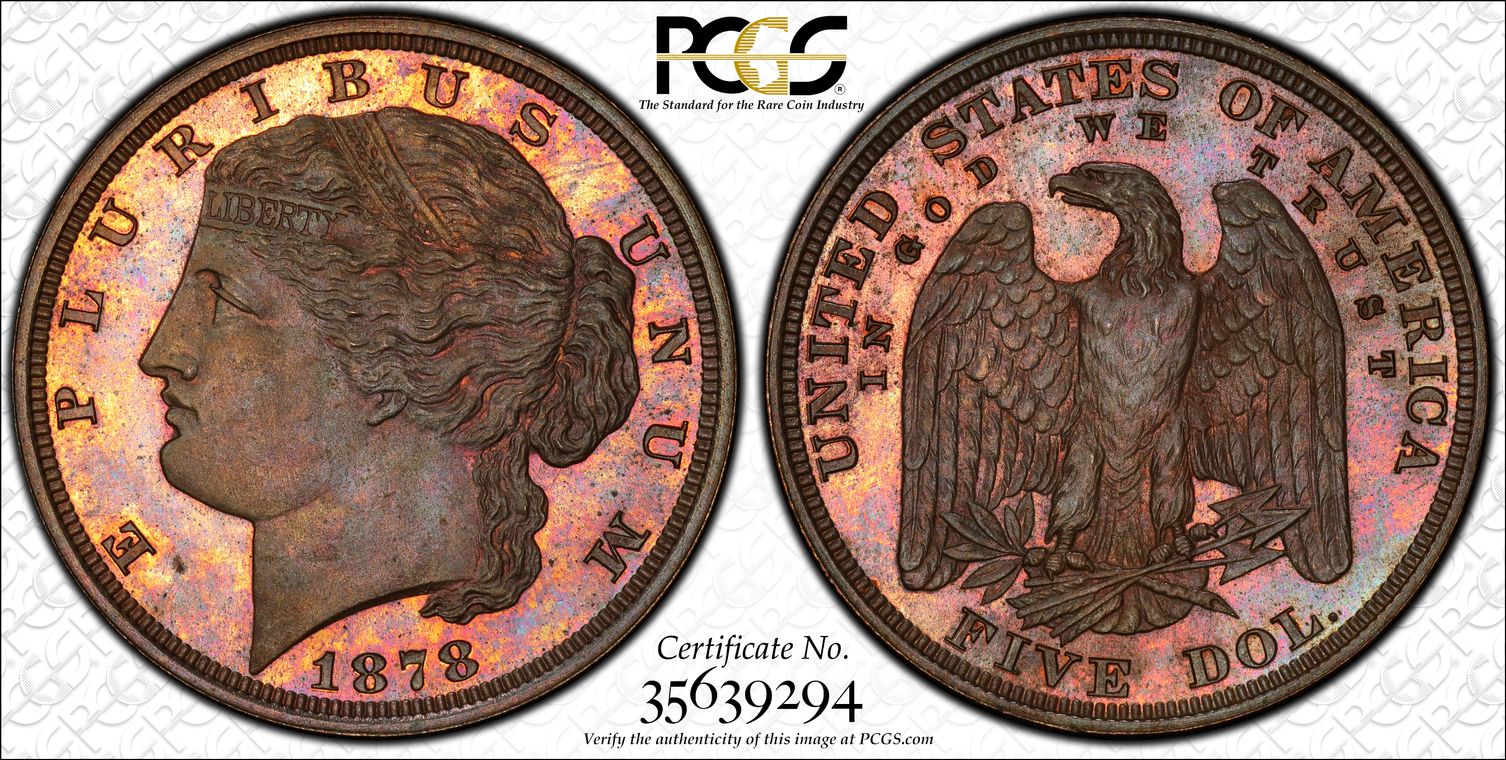
CAC - R.7 - Struck in copper with a reeded edge. The large Liberty head faces left and has an expression similar to that of the regular issue Morgan dollar. However, her hair is tied in a bun, and she does not wear a cap or any cereal grains. The reverse features an eagle with spread wings holding an olive branch in its right talon and three arrows in its left. Differentiated from similar patterns by the letter E below the chin, no obverse periods, and IN GOD WE TRUST on the upper reverse border. This intricately struck Gem displays ample faded fire-red amid olive-brown toning. No contact or carbon is apparent. Ex. The Collection of William Rau.
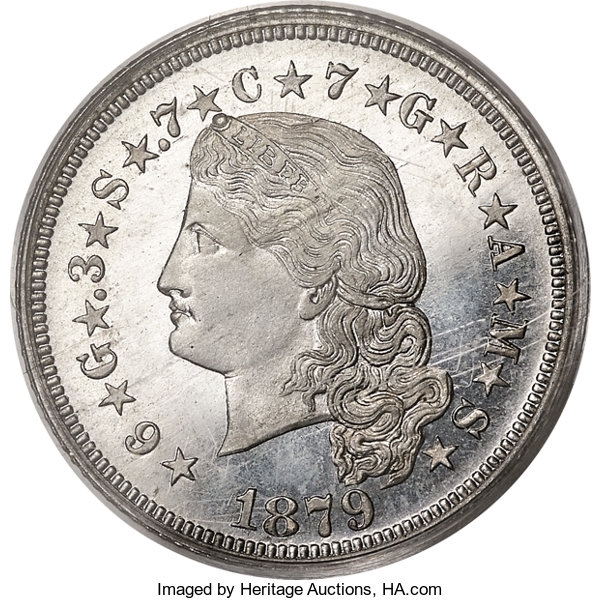
CAC - High R-7- Struck in aluminum with a reeded edge with only five known in aluminum. This Superb specimen has bright surfaces with mirrored fields. Tied with the finest graded and the only coin endorsed by CAC. The aluminum striking's are estimated to be fifty times rarer than their gold counterparts. Ex. Harry W. Bass, Jr. Research Foundation
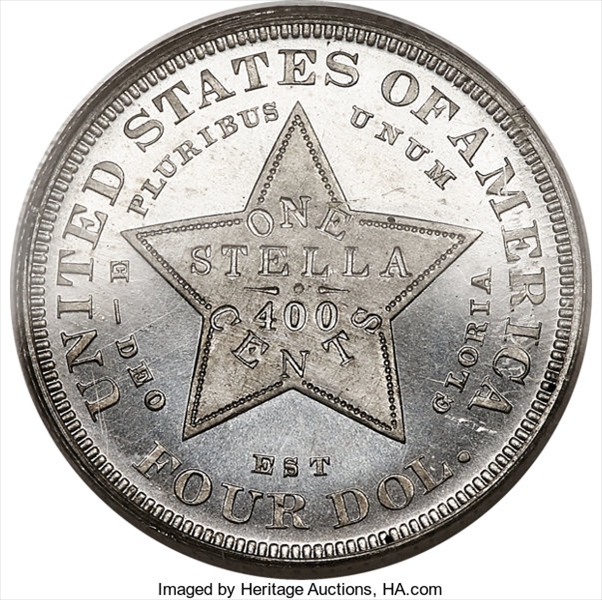
CAC - High R-7- Struck in aluminum with a reeded edge with only five known in aluminum. This Superb specimen has bright surfaces with mirrored fields. Tied with the finest graded and the only coin endorsed by CAC. The aluminum striking's are estimated to be fifty times rarer than their gold counterparts. Ex. Harry W. Bass, Jr. Research Foundation
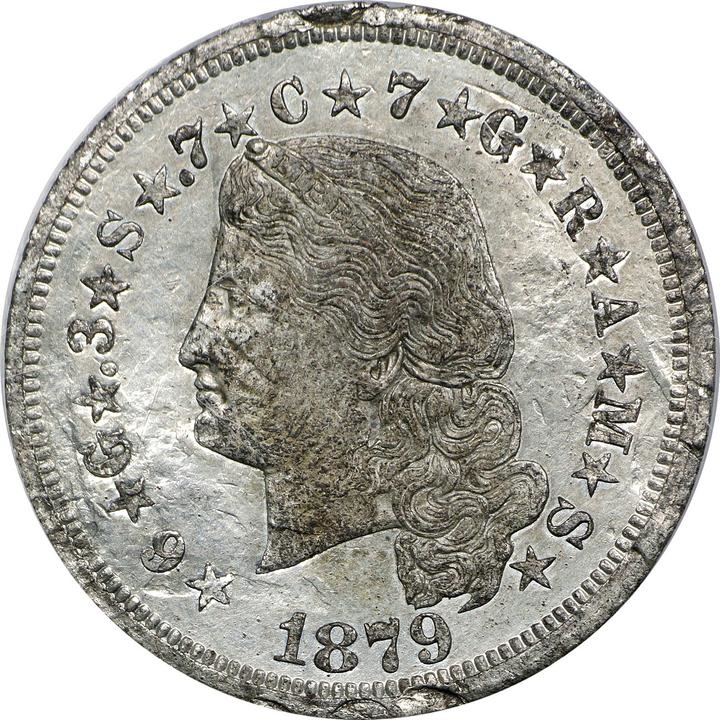
Unique - White Metal with Reeded Edge. "The fields are irregular, having a texture somewhat reminiscent of the "orange peel" type surface found on Proof gold coins of the period.... Perhaps the most significant physical attribute of this piece is that it is overstruck on what appears to be a cut down white metal pattern of a different denomination/type. Remnants of the under type are discernible on both sides but not with enough detail to enable positive attribution." Ex N.M, Kaufman
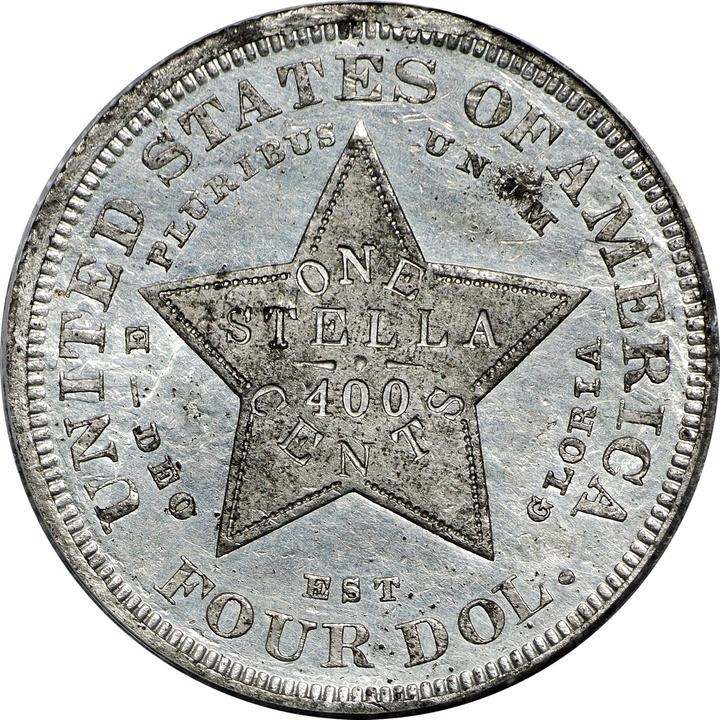
Unique - White Metal with Reeded Edge. "The fields are irregular, having a texture somewhat reminiscent of the "orange peel" type surface found on Proof gold coins of the period.... Perhaps the most significant physical attribute of this piece is that it is overstruck on what appears to be a cut down white metal pattern of a different denomination/type. Remnants of the under type are discernible on both sides but not with enough detail to enable positive attribution." Ex N.M, Kaufman
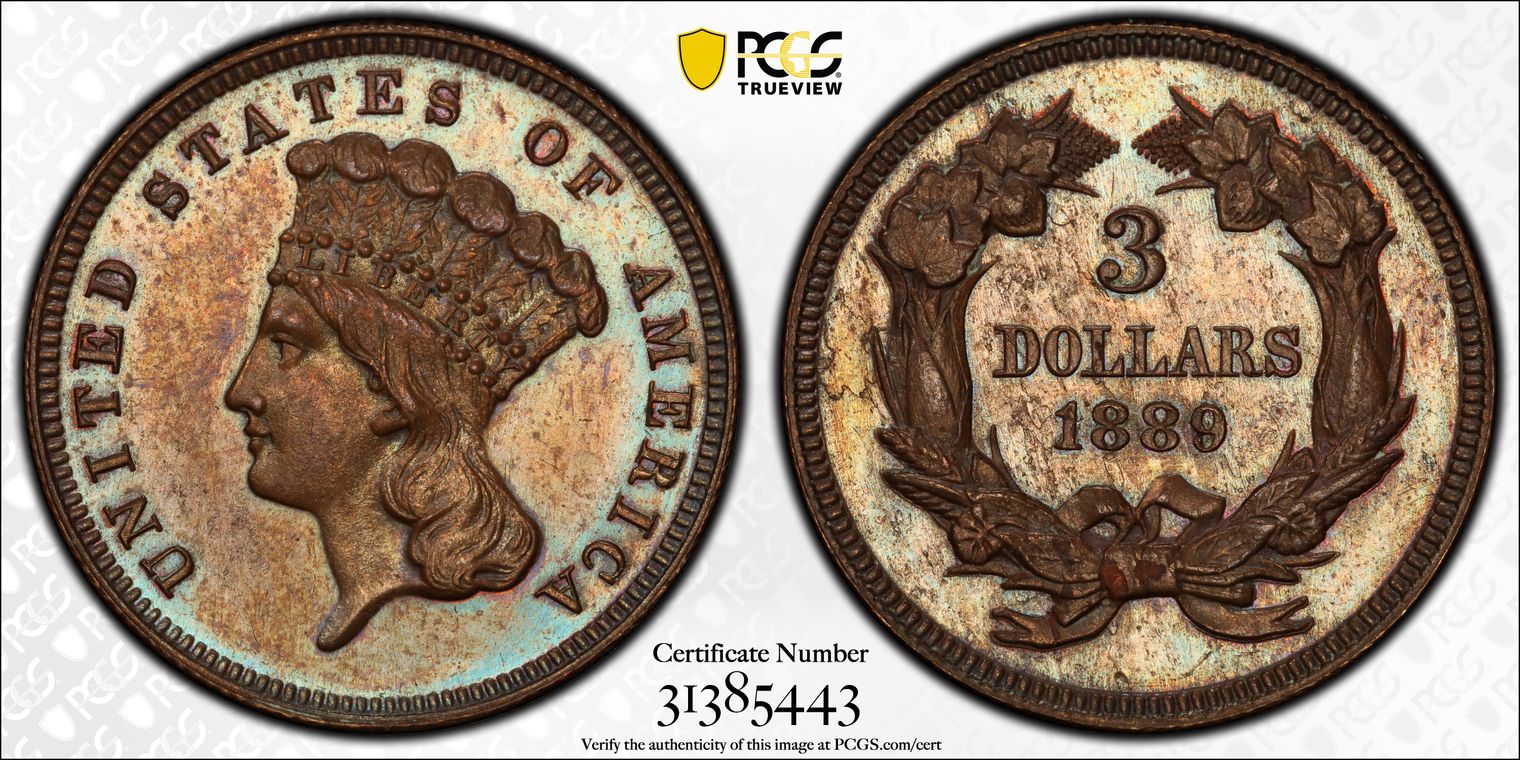
CAC - Unique - Struck in copper with a reeded edge. The sole pattern issue produced in 1889. The regular issue obverse and reverse design for the three dollar gold piece. "...rich chocolate-brown and olive color, graced by pale blue toning. Both sides have reflective and partially mirrored fields.". Ex. Simpson
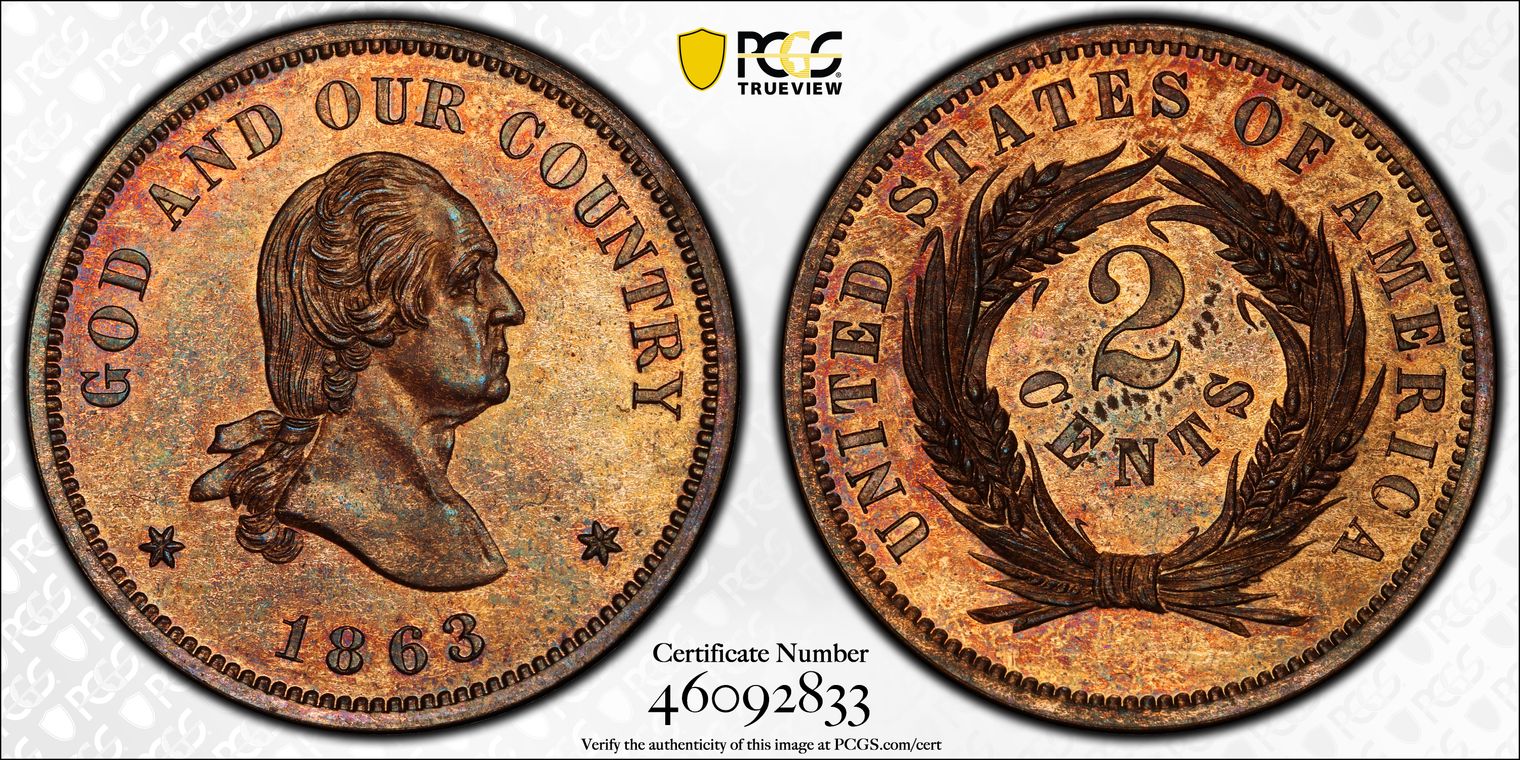
CAC - R.4 - Struck in copper with a plain edge. A bust of George Washington faces right on the obverse, flanked by two stars, the legend GOD AND OUR COUNTRY above, and the date below. The reverse has the denomination 2 CENTS that is sharply curved in a wreath with the legend UNITED STATES OF AMERICA around. "....natural copper golden-brown surfaces with accents of blue, magenta, green, and violet. Just a few small spots occur at the central reverse. Eye appeal is tremendous." Ex: Purchased from Julian Leidman (7/28/1972), The Harry W. Bass, Jr. Core Collection, Part I.
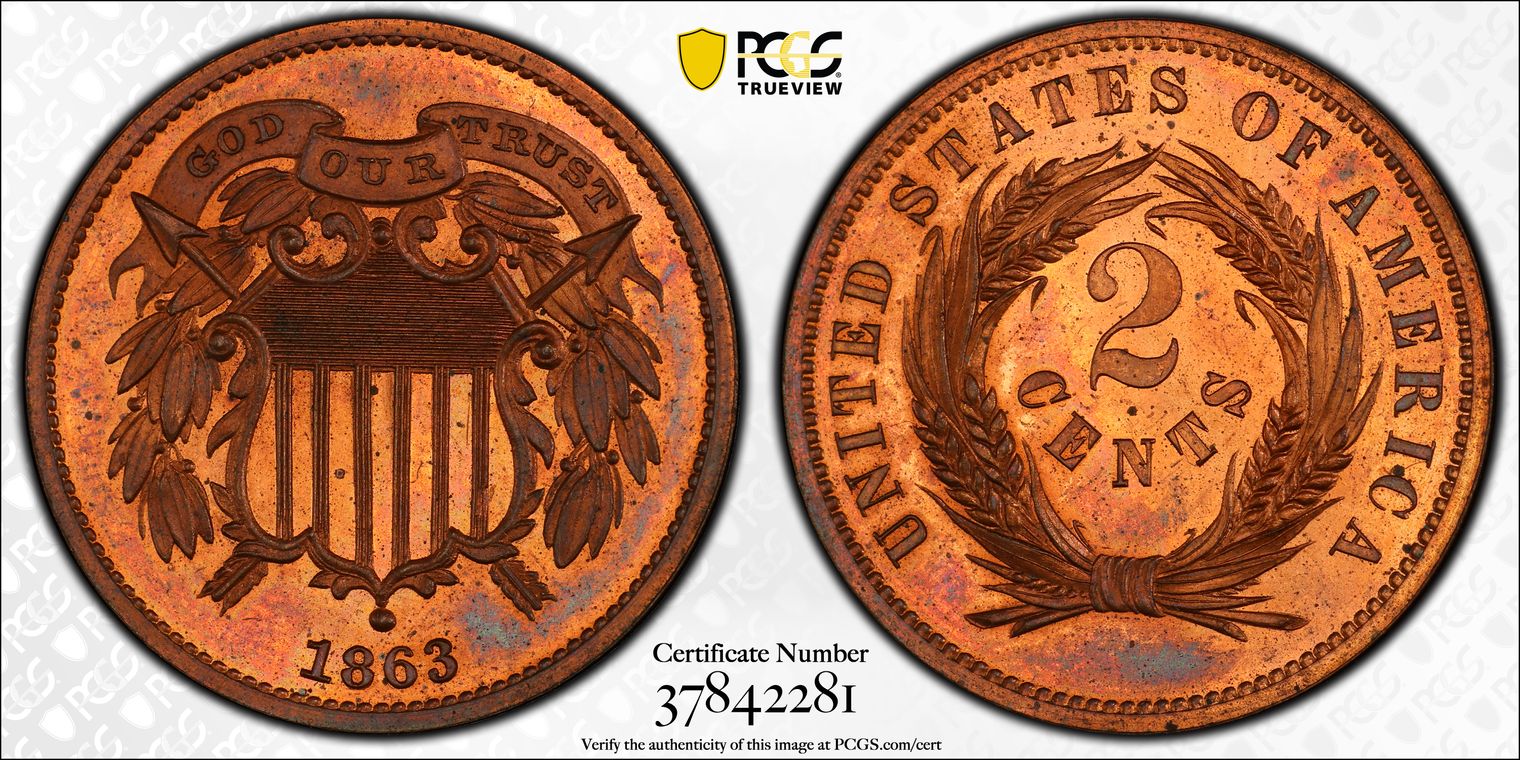
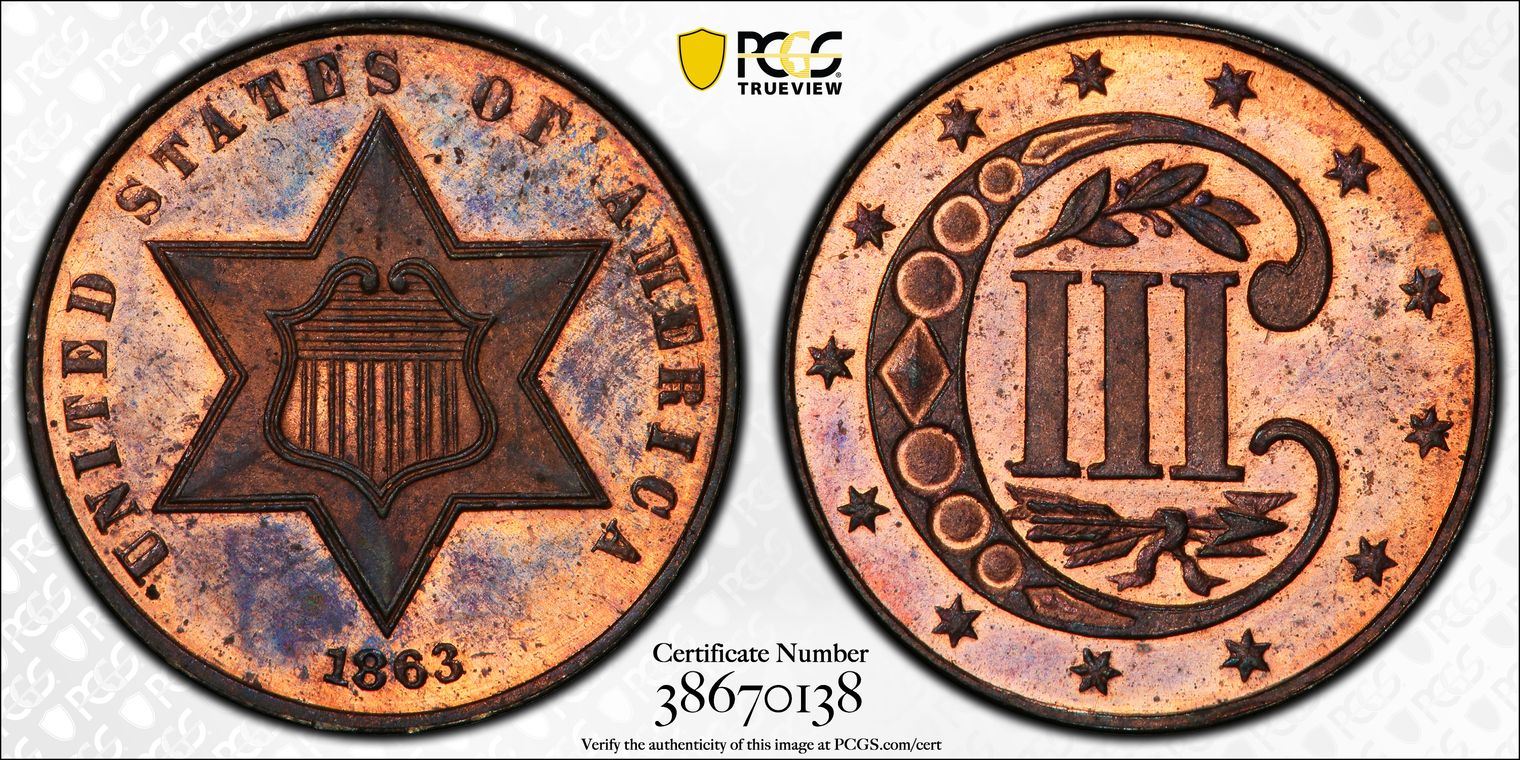
CAC - R-7 - Struck in copper from the regular issue Proof dies. Highly reflective surfaces gleam with a strong, watery mirrored texture. Pleasing color, including the majority of the surfaces boasting the original red mint color, with faded accents of azure and violet that really pop in a brilliant light source. Ex: Seattle Collection
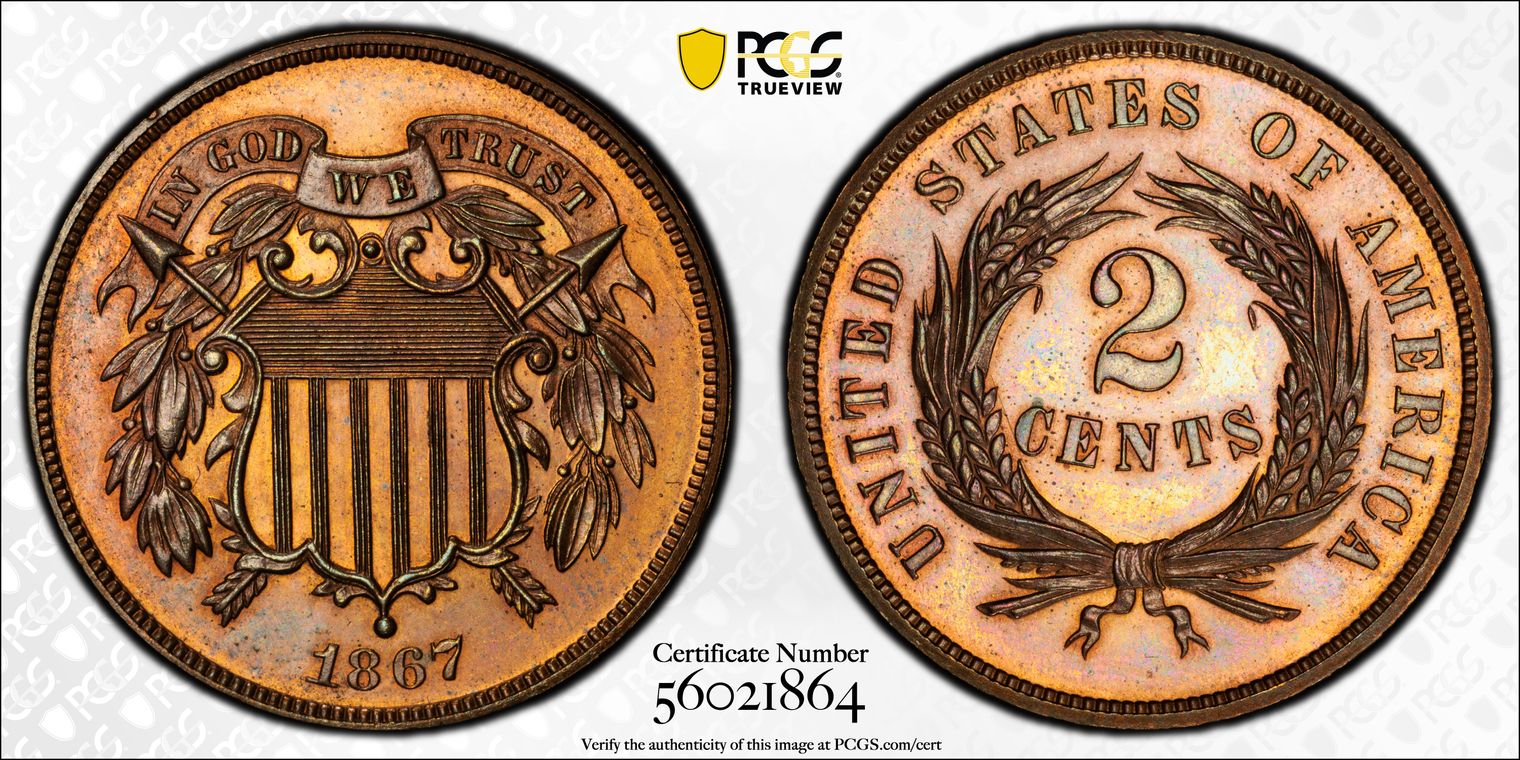
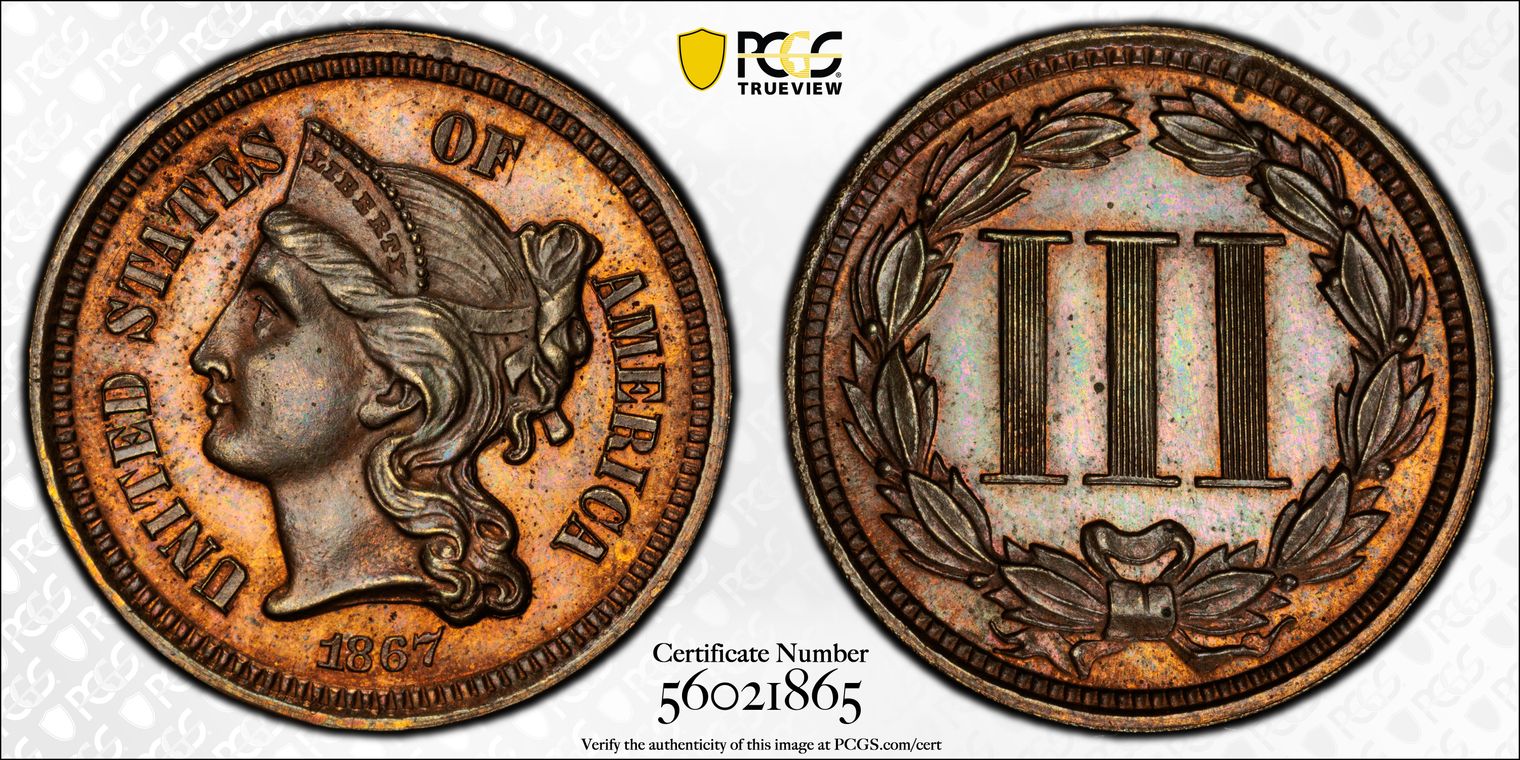
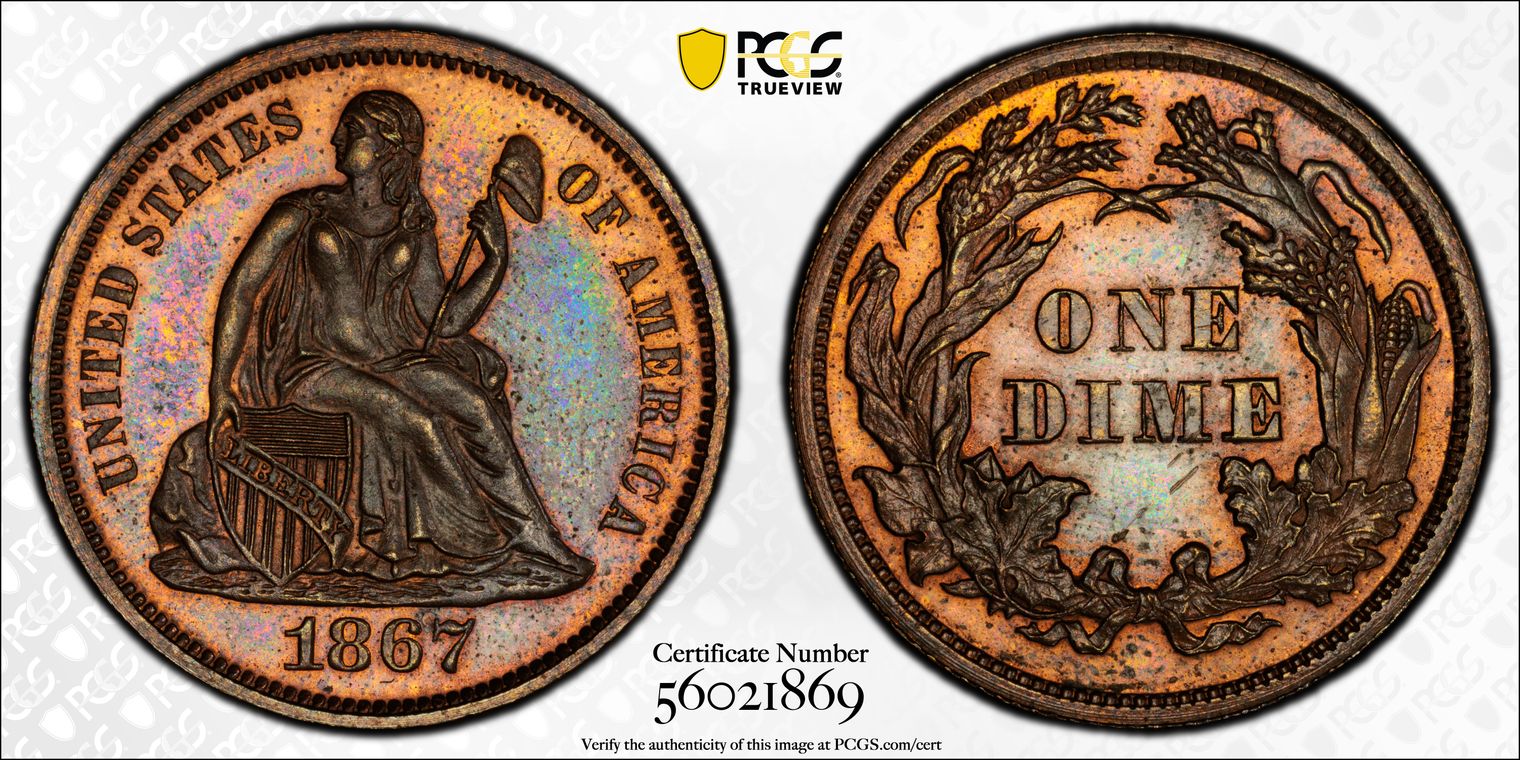
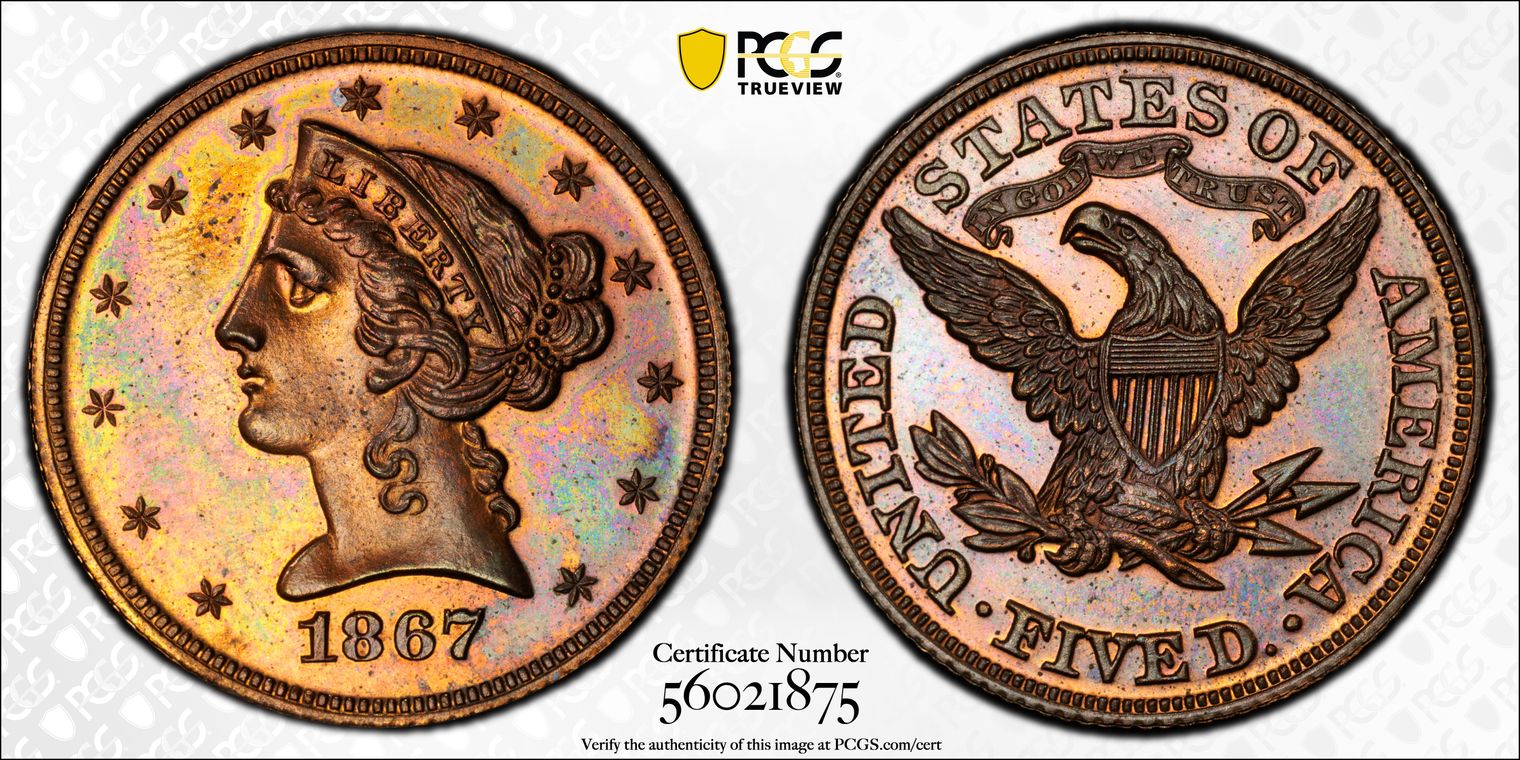
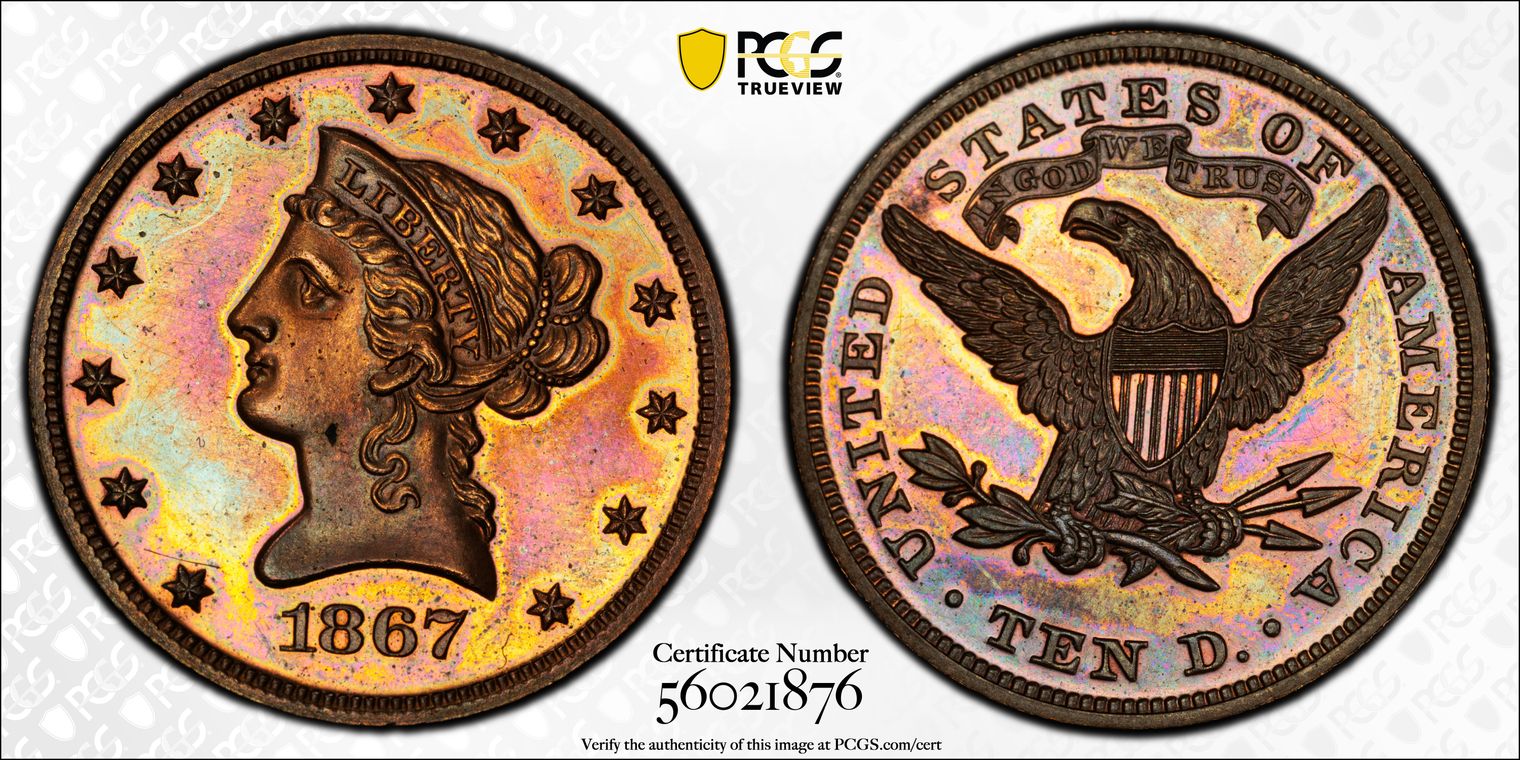
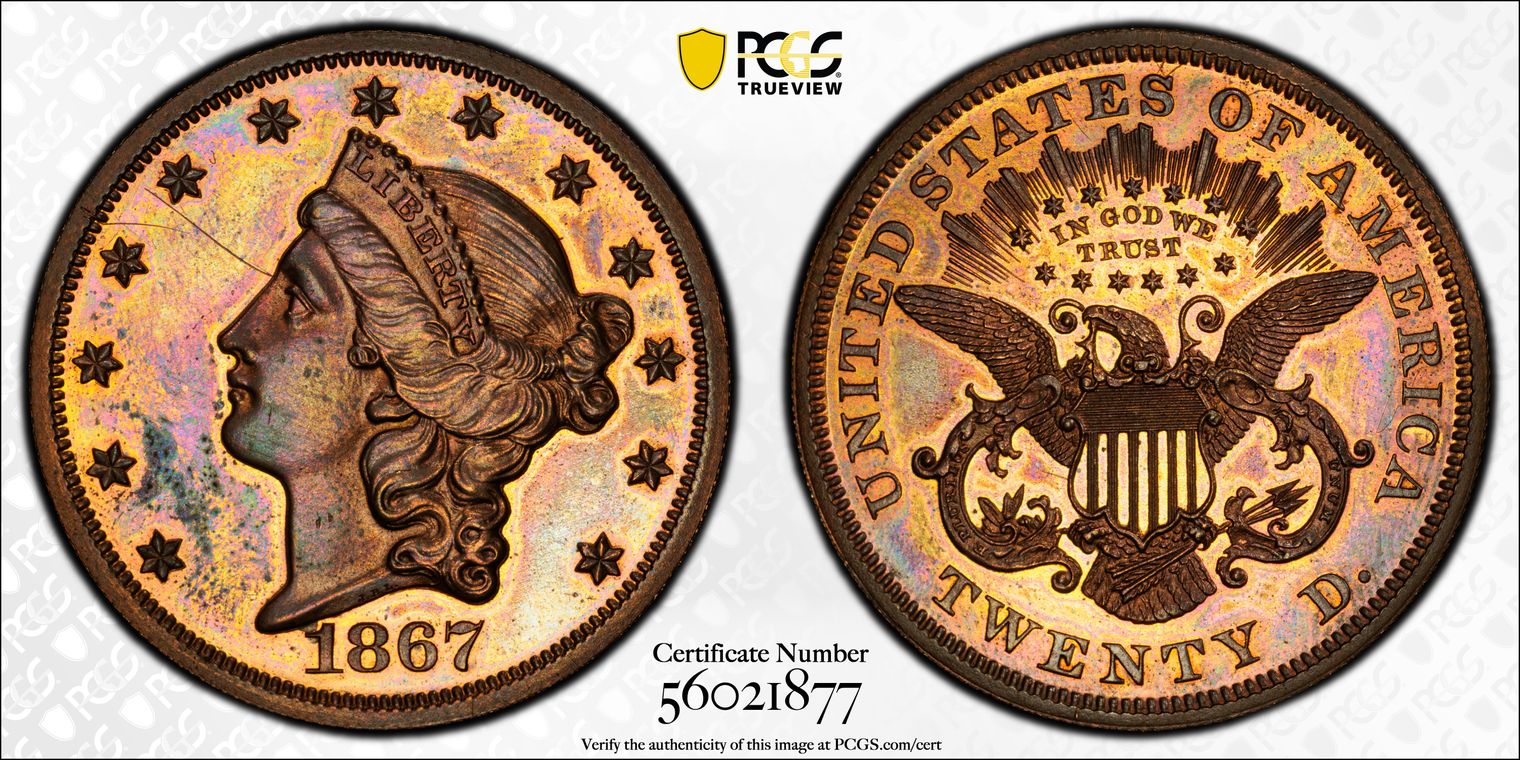
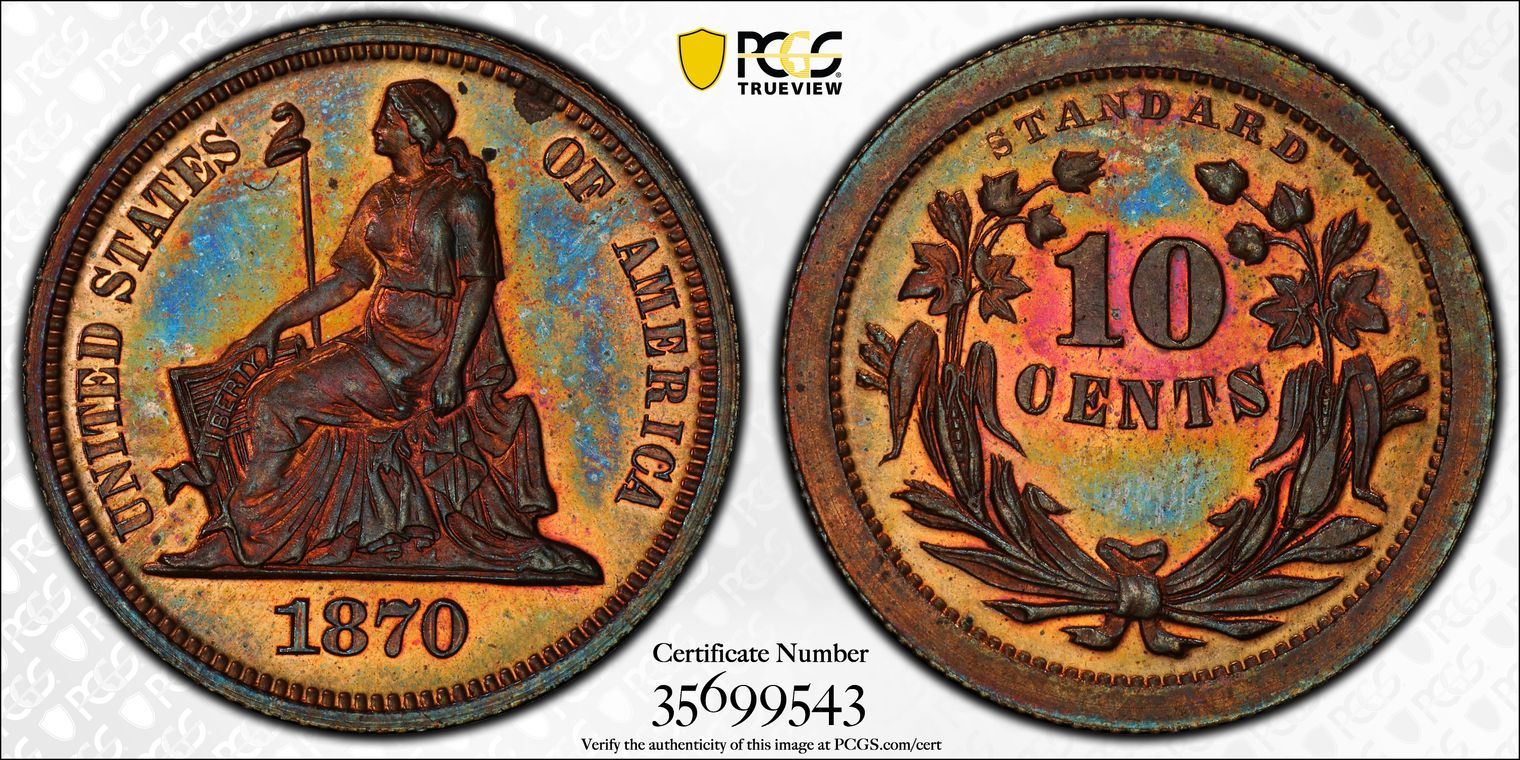
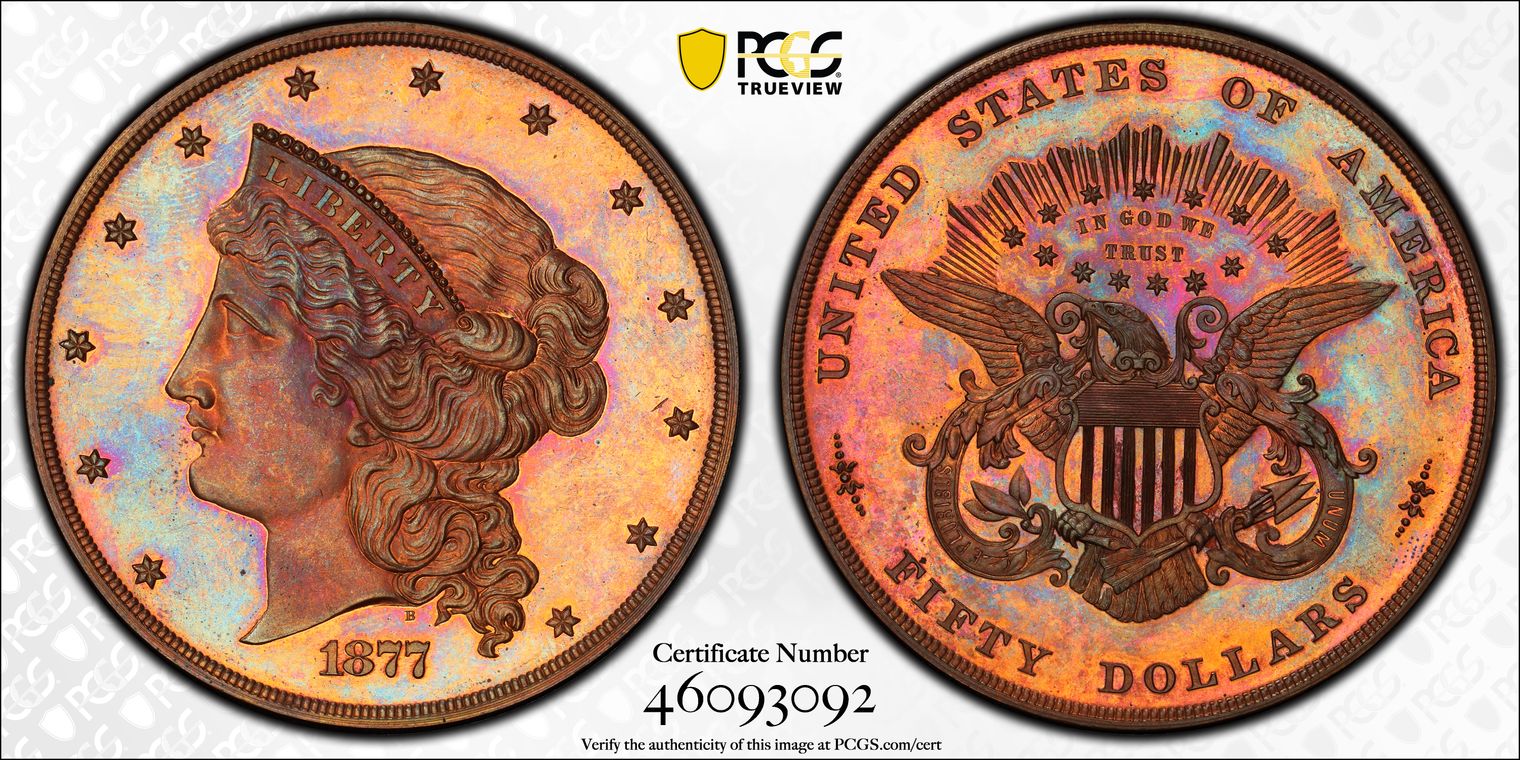
CAC - Low R.7 - Stuck in copper with a reeded edge. 1877 Half Union in Copper - The finest endorsed by CAC. The obverse features a large Liberty Head design by William Barber, while the reverse design is similar to contemporary double eagles, except for FIFTY DOLLARS, which appears along the bottom rim. "Incredible splashes of rich violet, rose, and blue fairly leap from the surfaces of this beautiful pattern." That iridescence remains throughout this coppery-gold proof." Ex: Harry W. Bass, Jr. Collection.
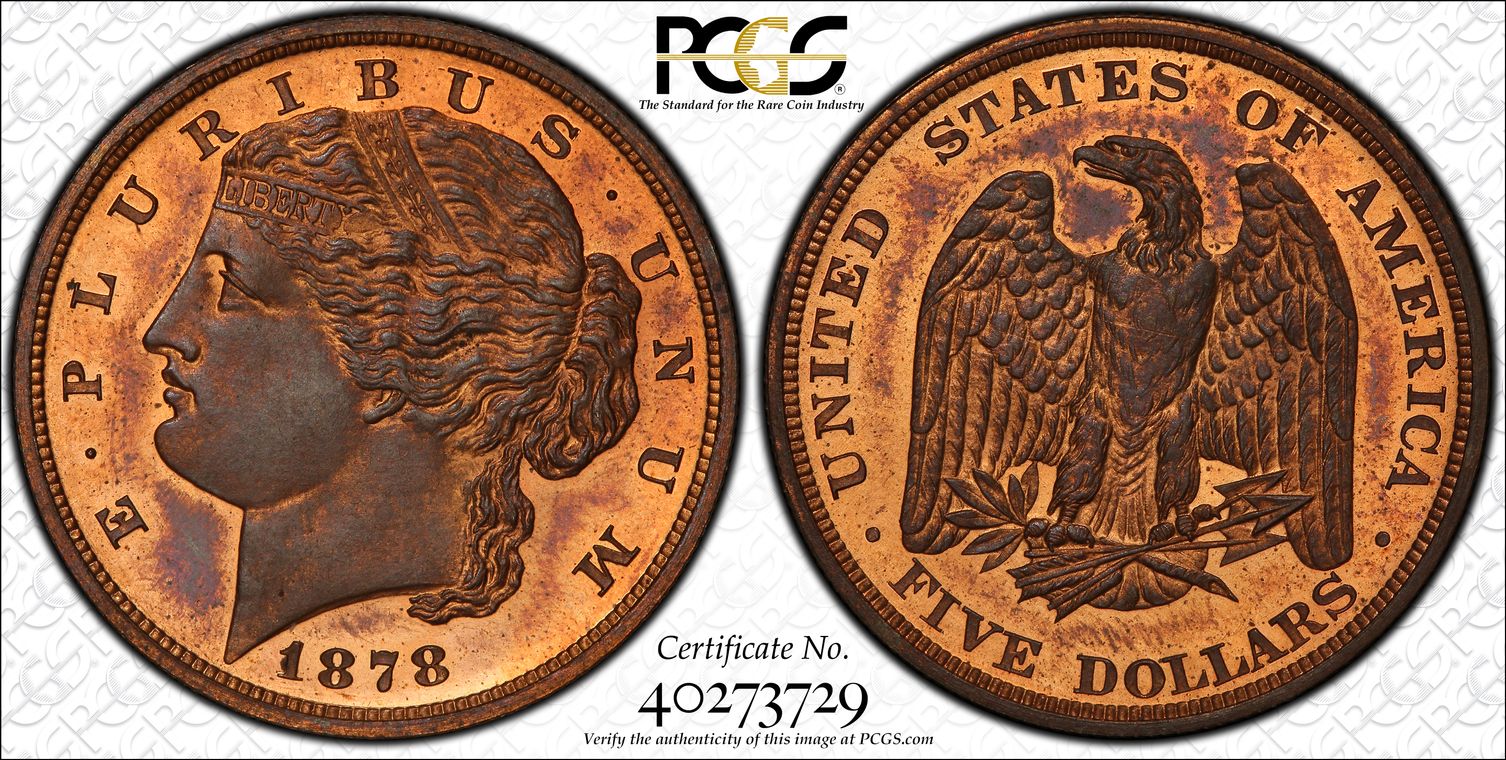
CAC - Low R.7. Struck in copper with a reeded edge. Certified Red and Brown, there is a strong presence of original mint red in the fields on each side with the Brown almost exclusively limited to the devices." Ex: The Bob R. Simpson Collection, Part II
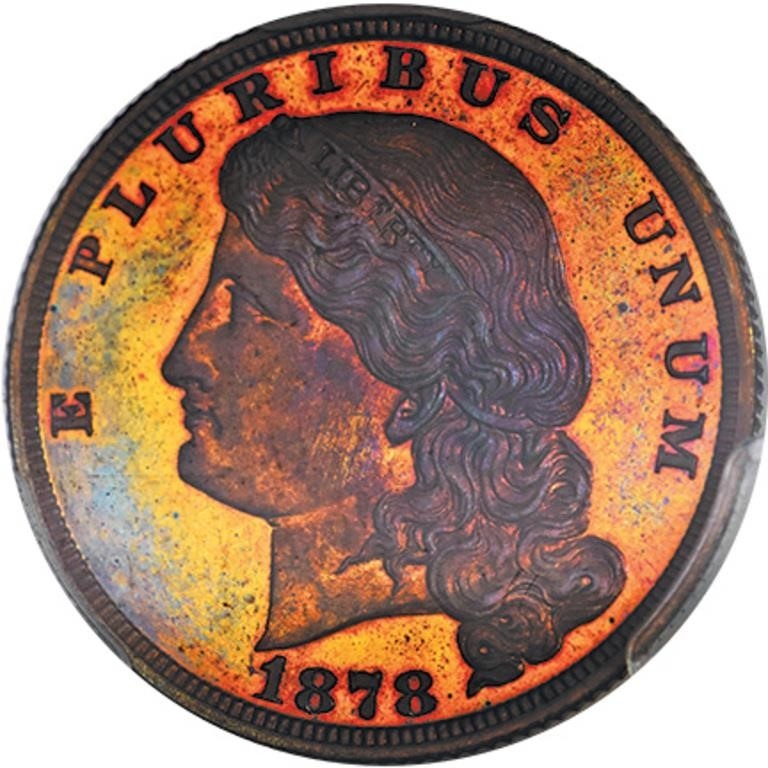
CAC - R6+ - Struck in Copper. The Barber design with flowing hair. Tied for FINEST graded in the RB category (5/22). "Ultra flashy copper fields have a bold reflection and deep mirrors. The original RED is fiery and intense with just a dusting of violet-azure that is gracefully dusted on the surfaces. The devices show precision details, fully struck up and with full definition from an exacting blow. Nearly FLAWLESS". Ex. Glorious
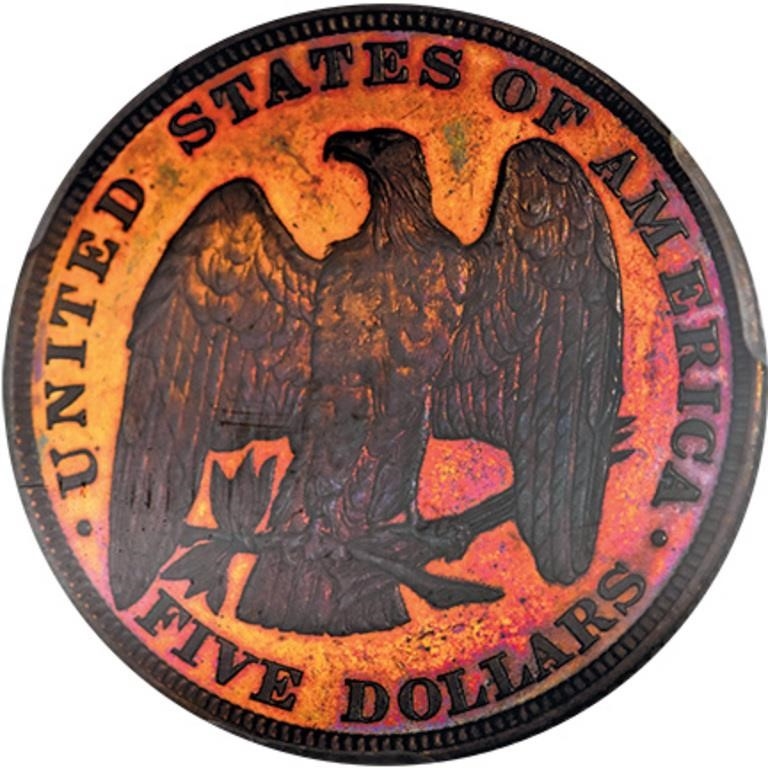
CAC - R6+ - Struck in Copper. The Barber design with flowing hair. Tied for FINEST graded in the RB category (5/22). "Ultra flashy copper fields have a bold reflection and deep mirrors. The original RED is fiery and intense with just a dusting of violet-azure that is gracefully dusted on the surfaces. The devices show precision details, fully struck up and with full definition from an exacting blow. Nearly FLAWLESS". Ex. Glorious
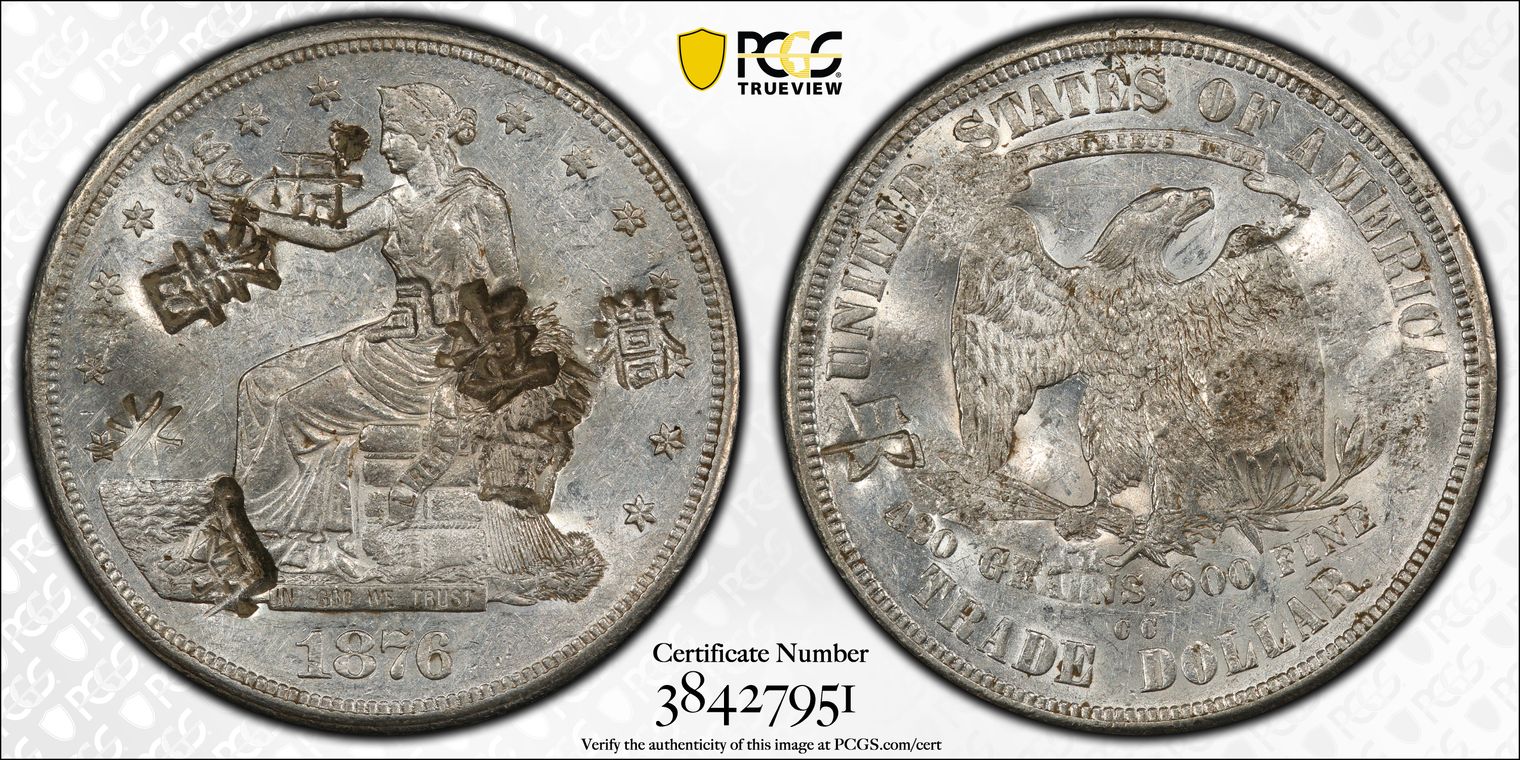
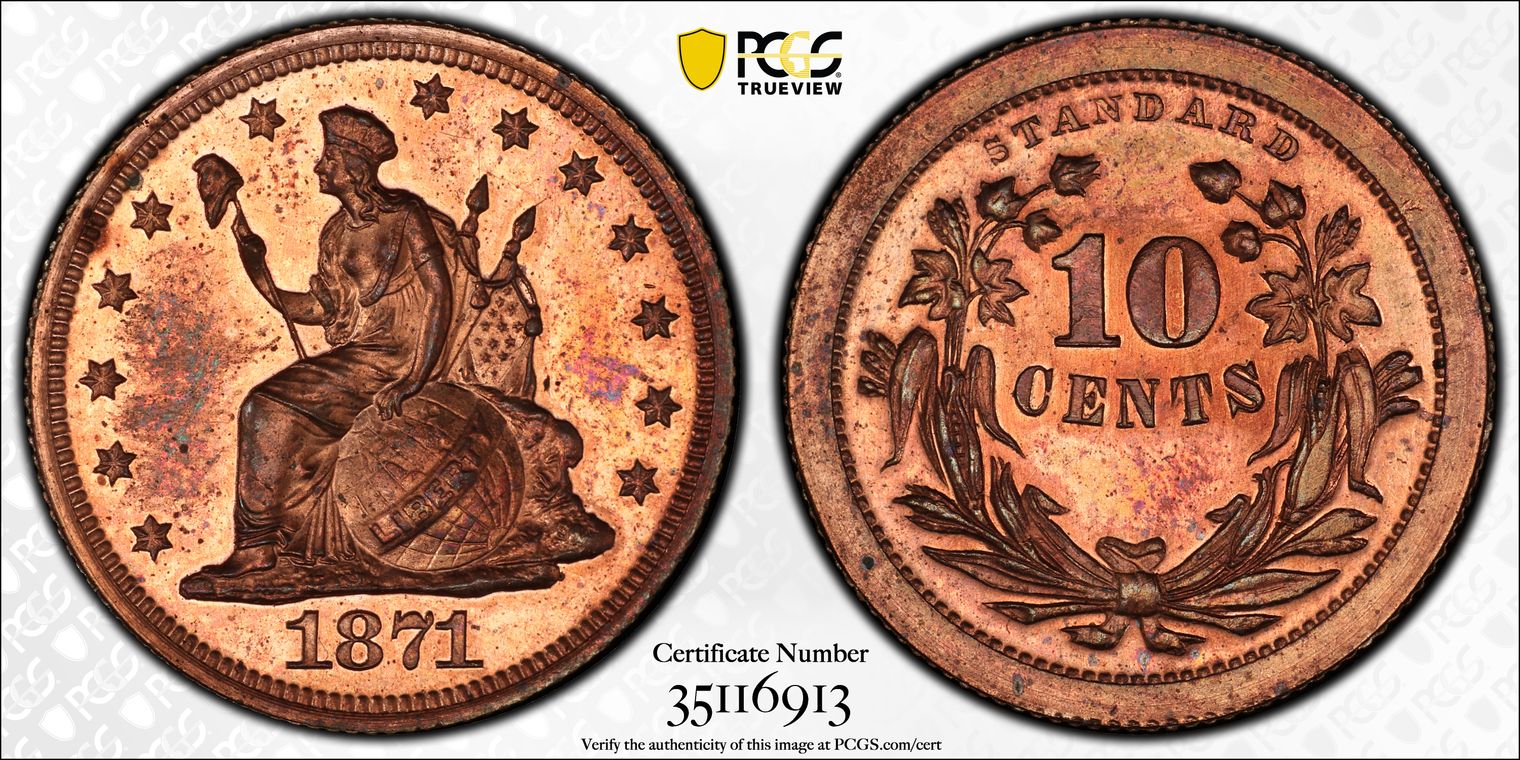
CAC - R7 - Struck in copper with a reeded edge. James Longacre's Indian Princess design and Standard Silver reverse. This is the finest PCGS graded example that exists! Deep red mirrors are flashy and beautiful, that surround razor sharp design elements that stand out with a bold eye appeal. Superficial, delicate dusting of violet can be seen in areas, but do not detract from the ultra-red color.
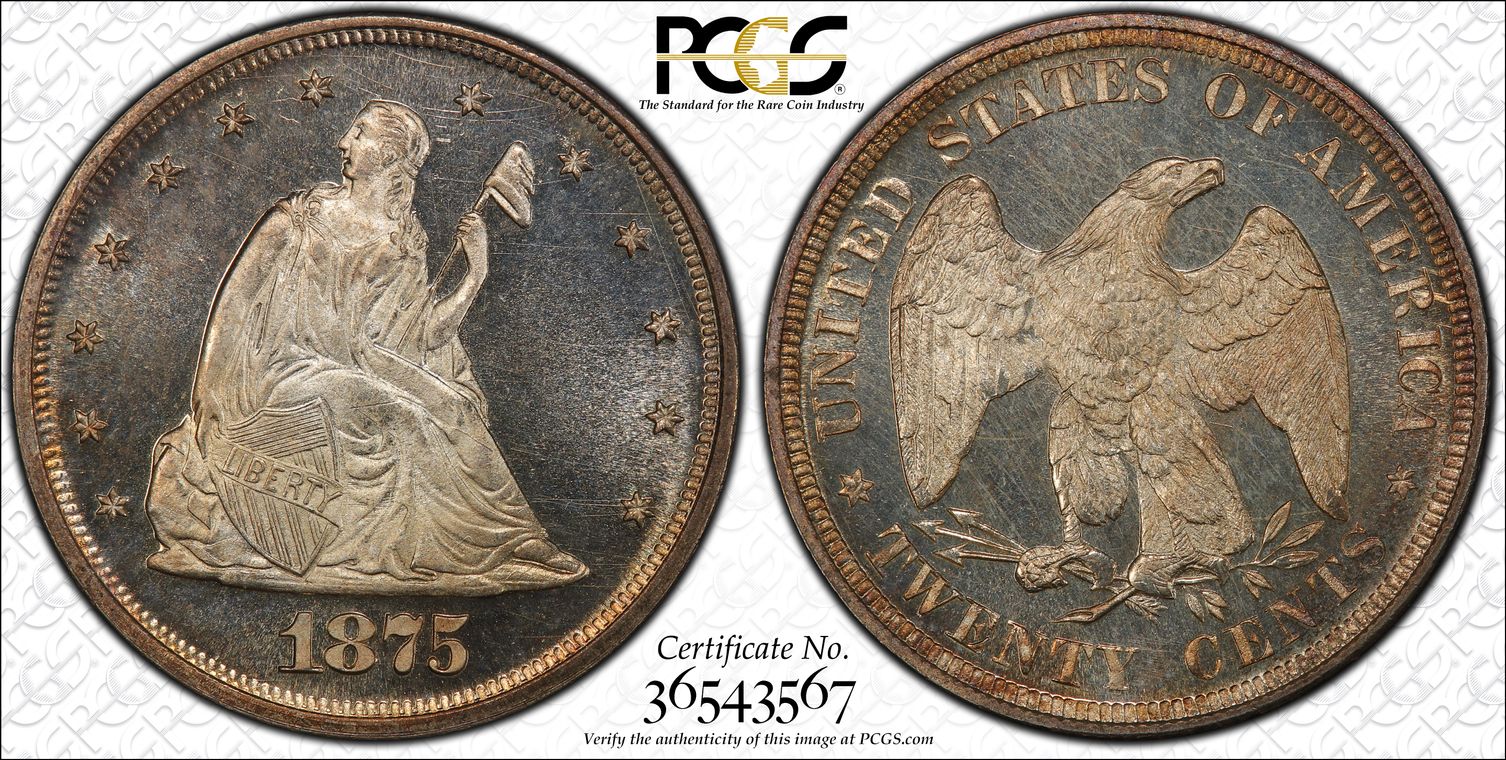
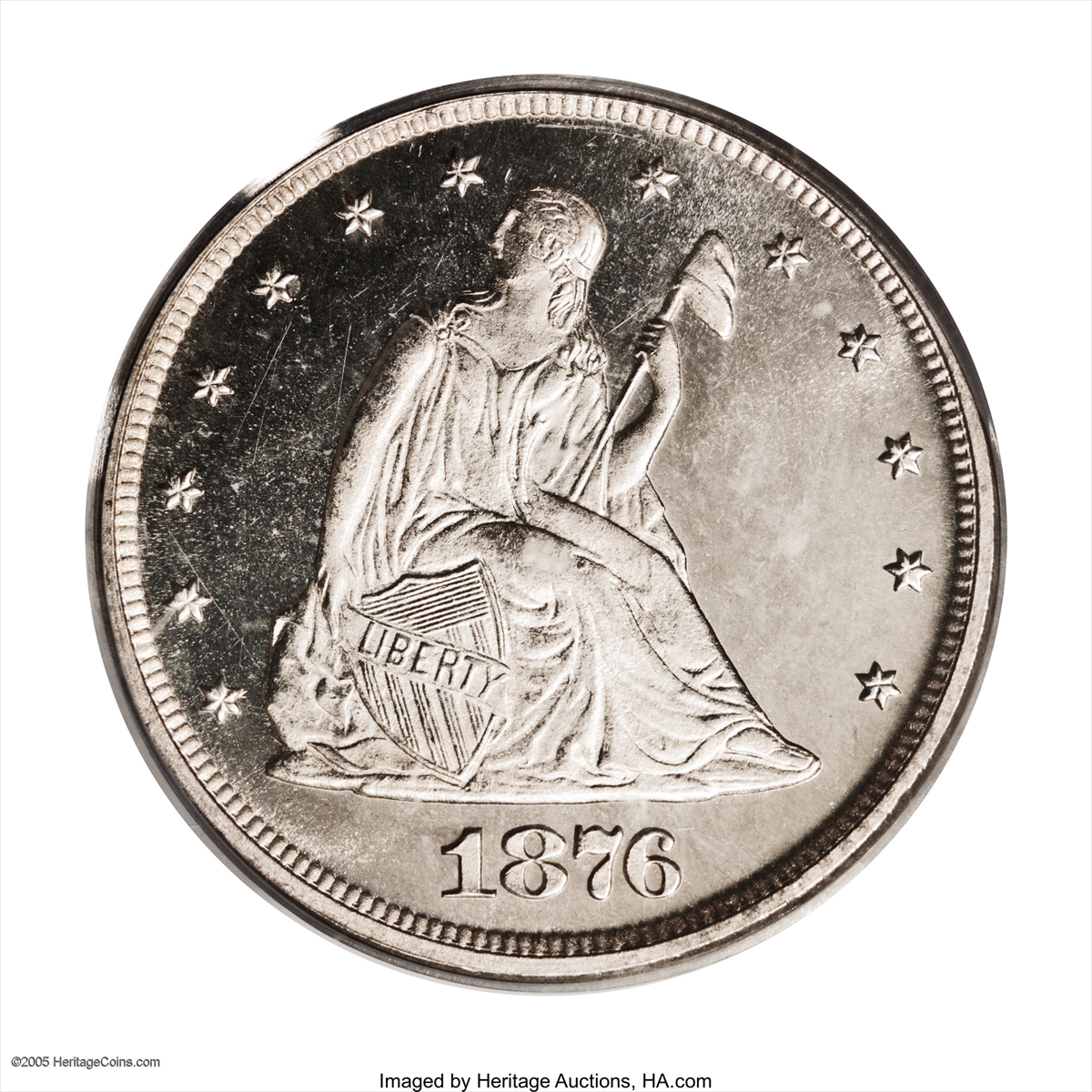
CAC -One of the finest certified examples with a Cameo designation. Both sides possess virtually no toning, a feature that permits full appreciation of the glassy mirrored fields as they contrast with the coolly frosted devices. The fully struck, pristine surfaces display details that are often overlooked, or are absent, on less fully struck coins. Those include bold star centrils on the obverse and, on the reverse, breathtakingly full plumage on the eagle design that this piece shares with the trade dollar.
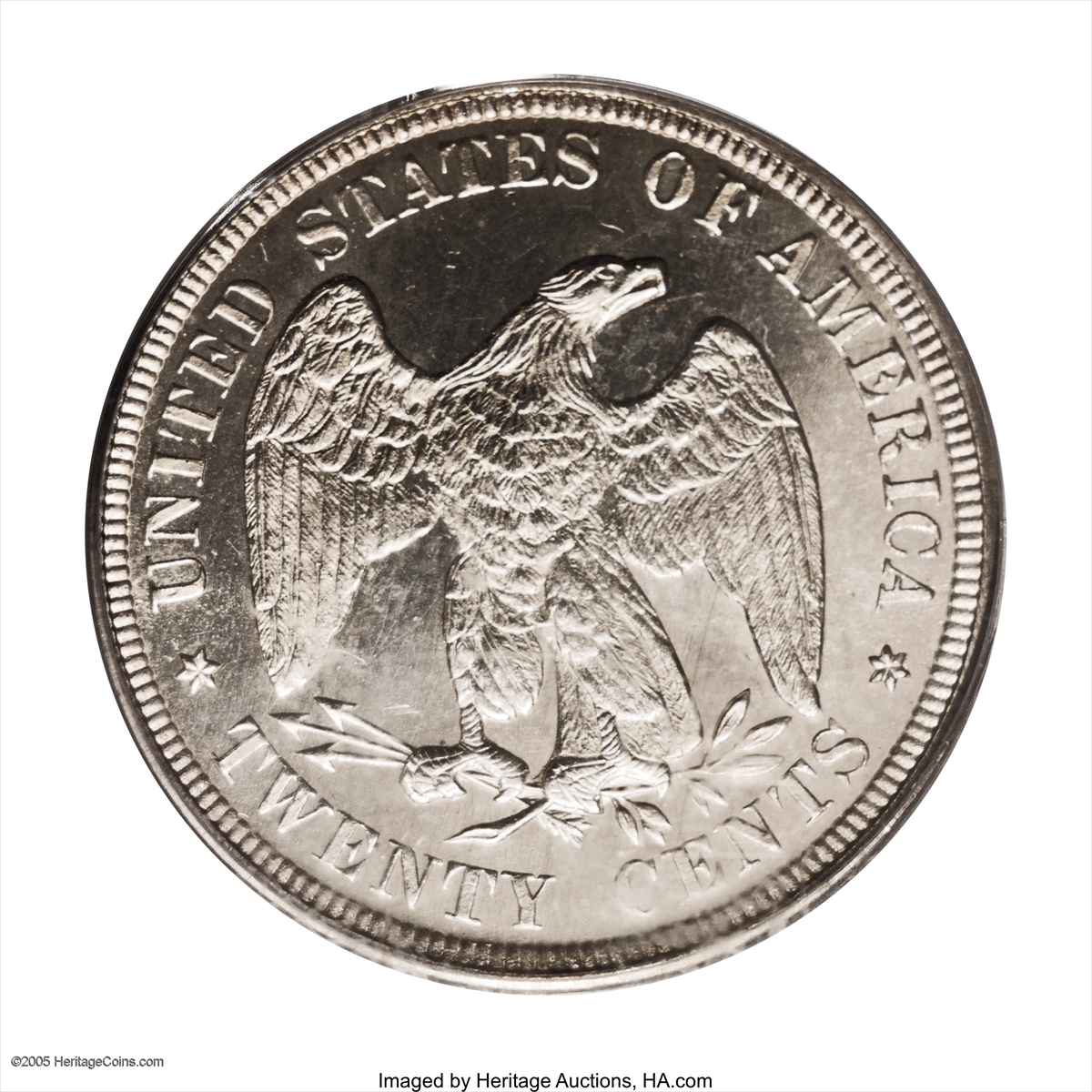
CAC -One of the finest certified examples with a Cameo designation. Both sides possess virtually no toning, a feature that permits full appreciation of the glassy mirrored fields as they contrast with the coolly frosted devices. The fully struck, pristine surfaces display details that are often overlooked, or are absent, on less fully struck coins. Those include bold star centrils on the obverse and, on the reverse, breathtakingly full plumage on the eagle design that this piece shares with the trade dollar.
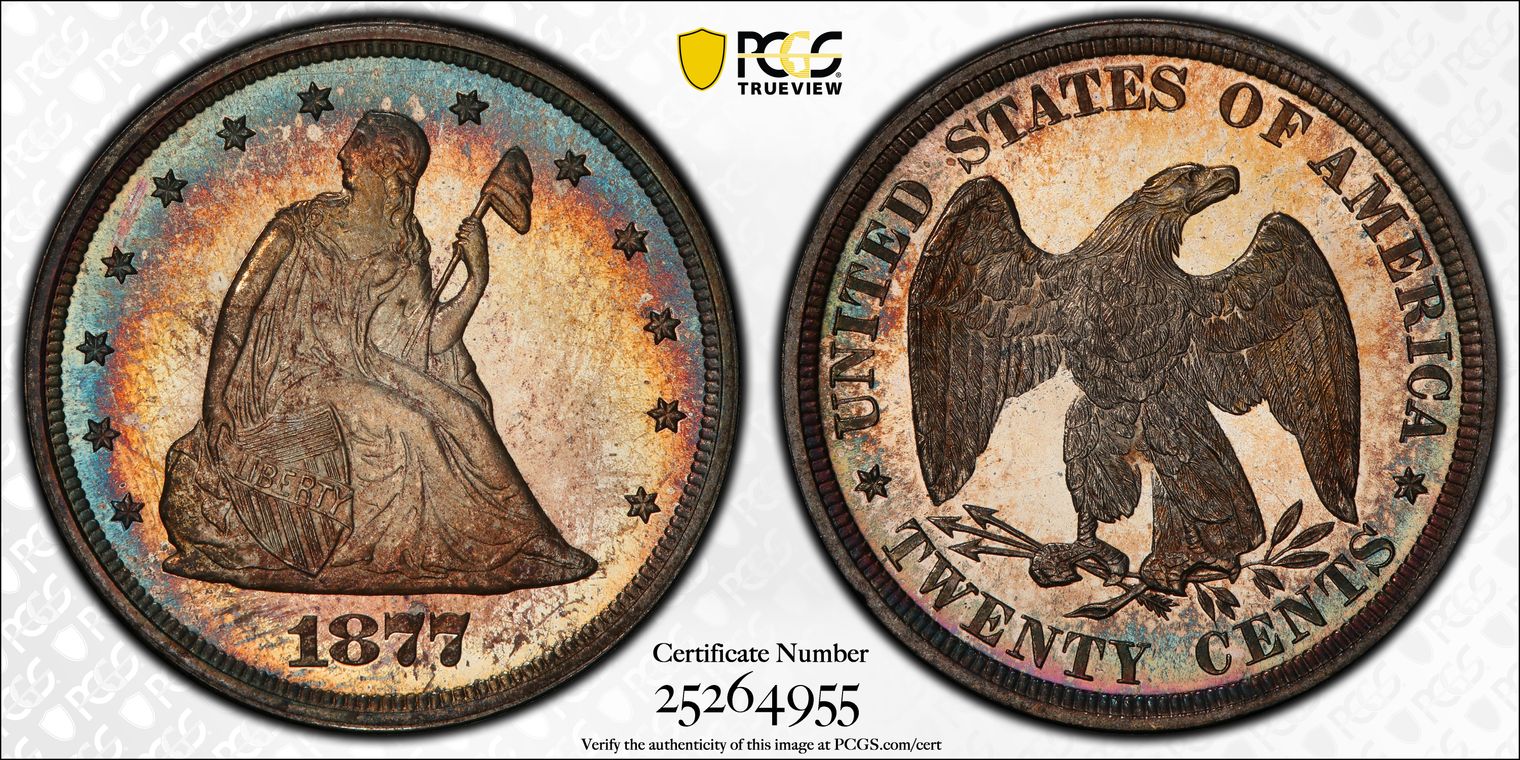
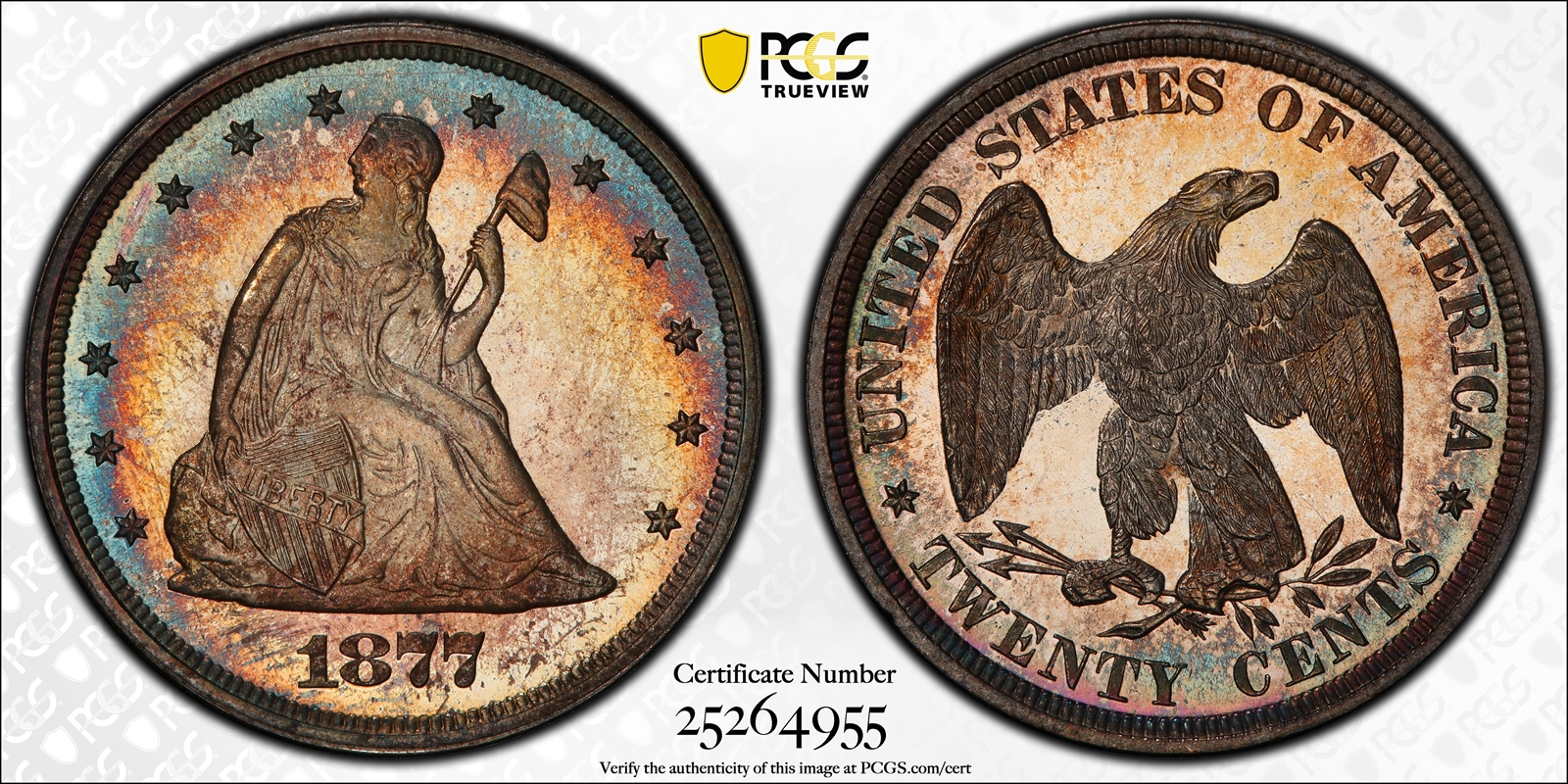
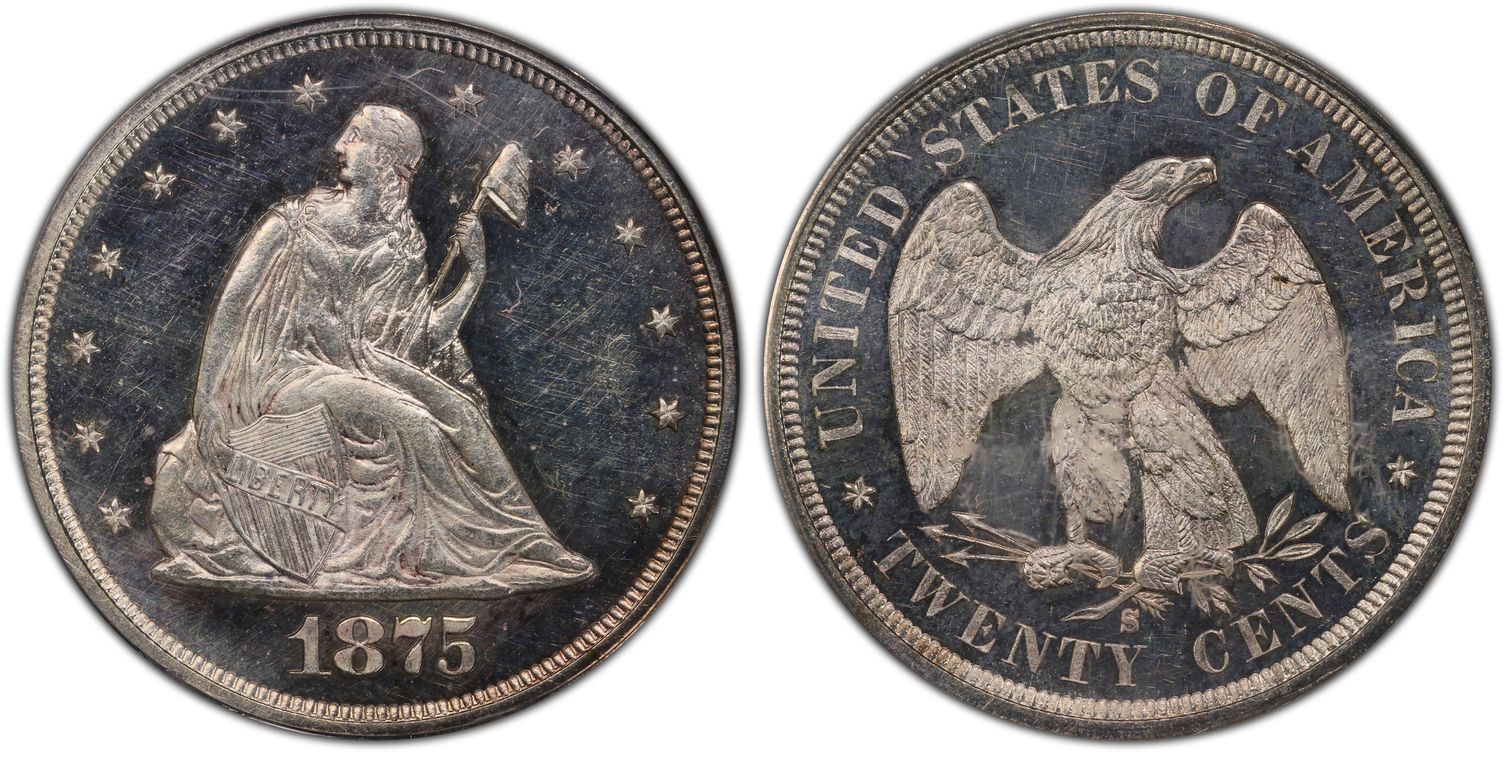
CAC - The only one endorsed by CAC. "Deeply reflective silver gray surfaces on both sides, heavily frosted devices stand out in bold cameo contrast, radiant satiny lustre on both sides." ANR
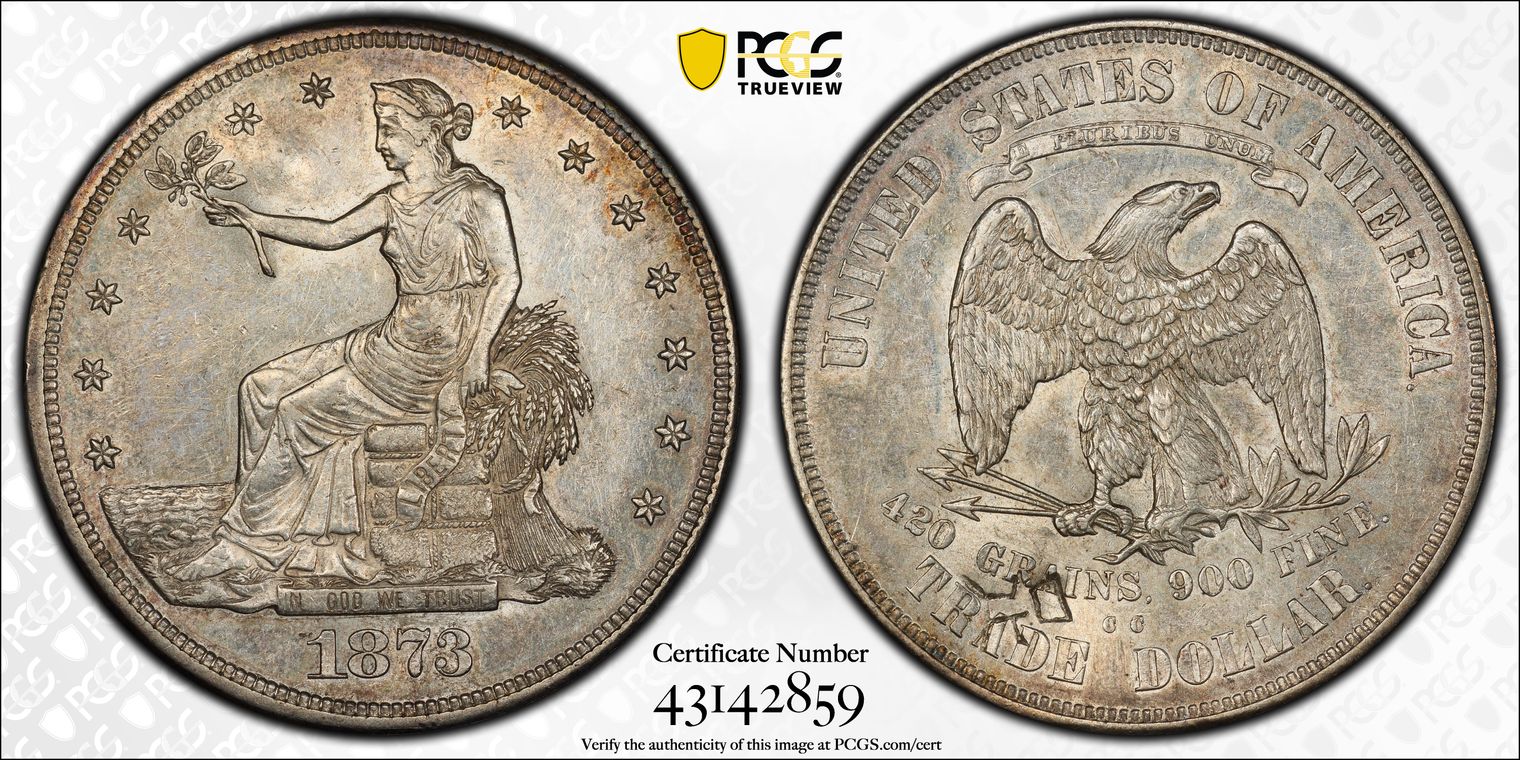
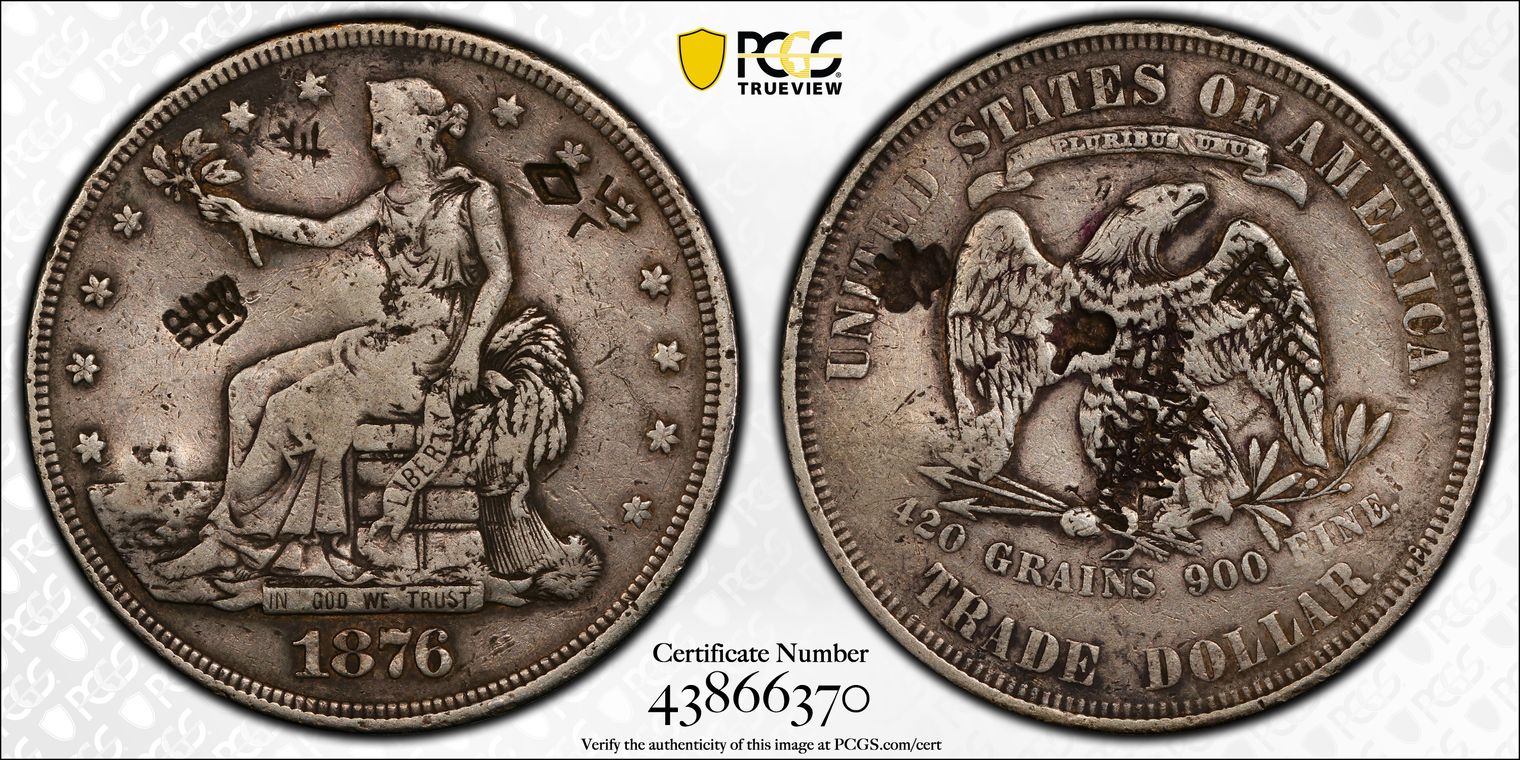
CAC - The only CAC-approved example as of 12/21. "...featuring a small chop mark on the reverse from TRADE to GRAINS.......Choice AU representative has only light wear, and the cream-gray surfaces are only moderately abraded save for that noted chop mark."
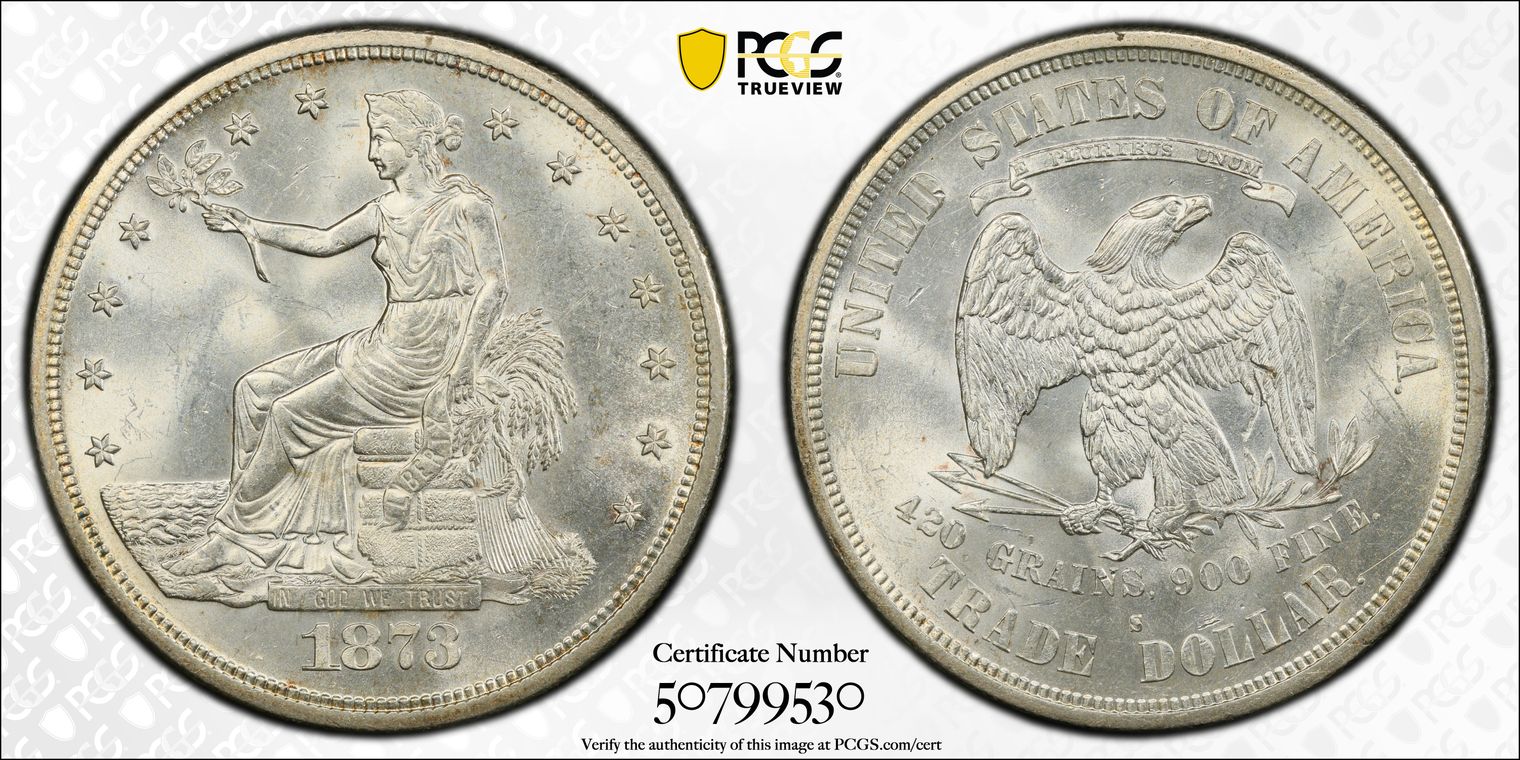
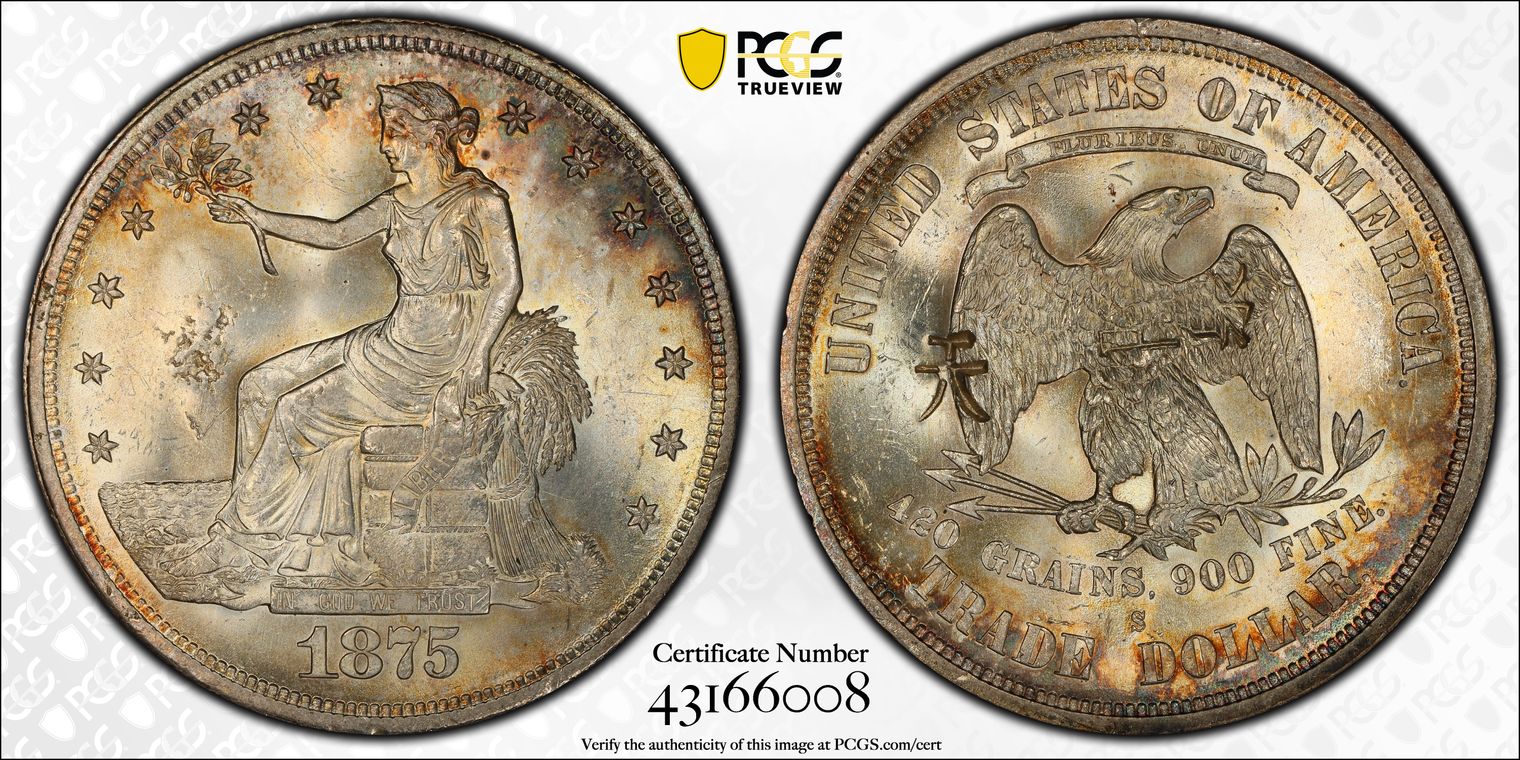
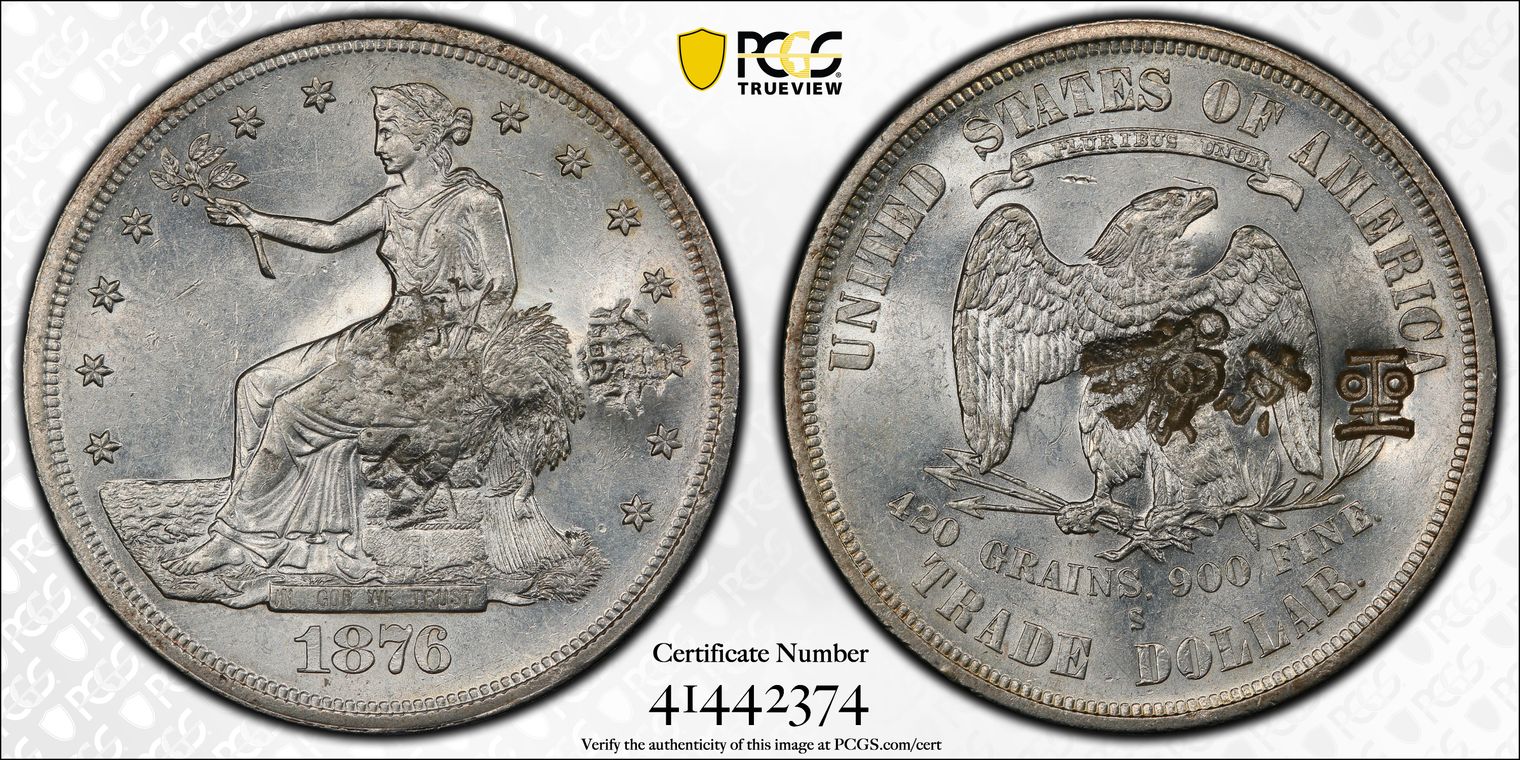
CAC - Finest at PCGS - Lustrous and lightly patinated near-Gem has only a single chop, on the eagle's right (facing) wing. The obverse is surprisingly unabraded, and the reverse displays only wispy field marks. The margins exhibit hints of tan-gold toning.
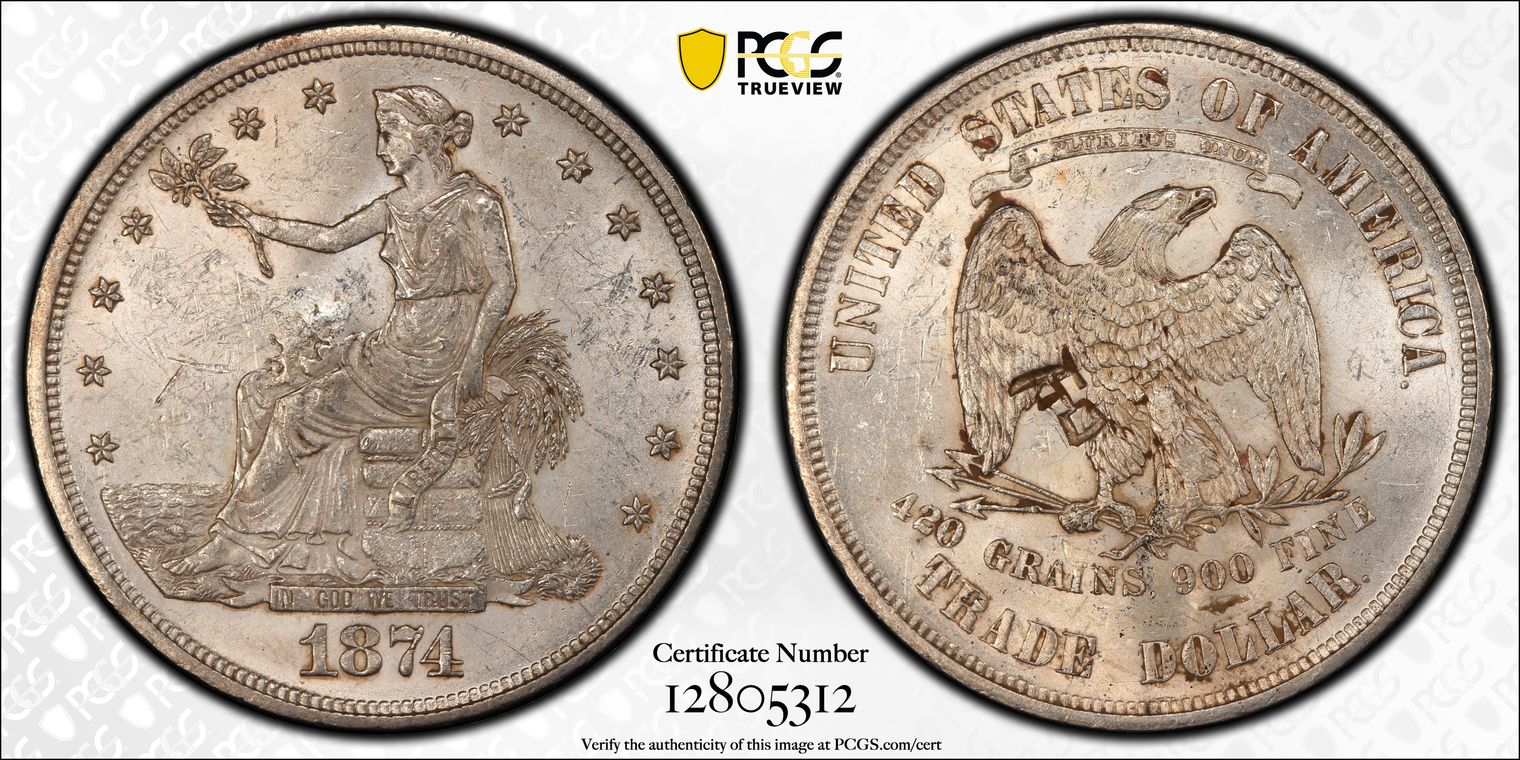
Type 1/1, No period after FINE. Ex - Saltydog4, Ex-DDR, Ex-Blackhawk.
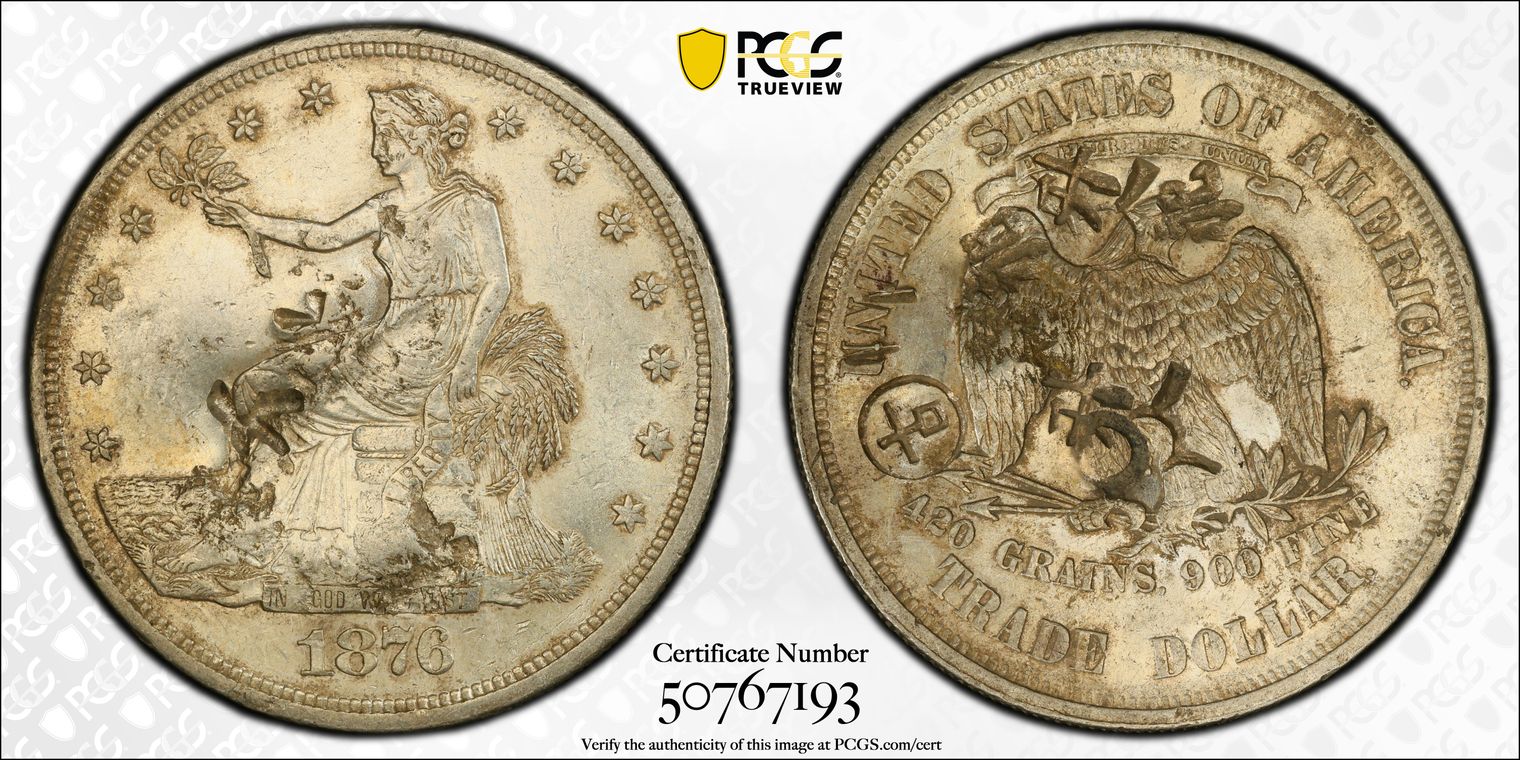
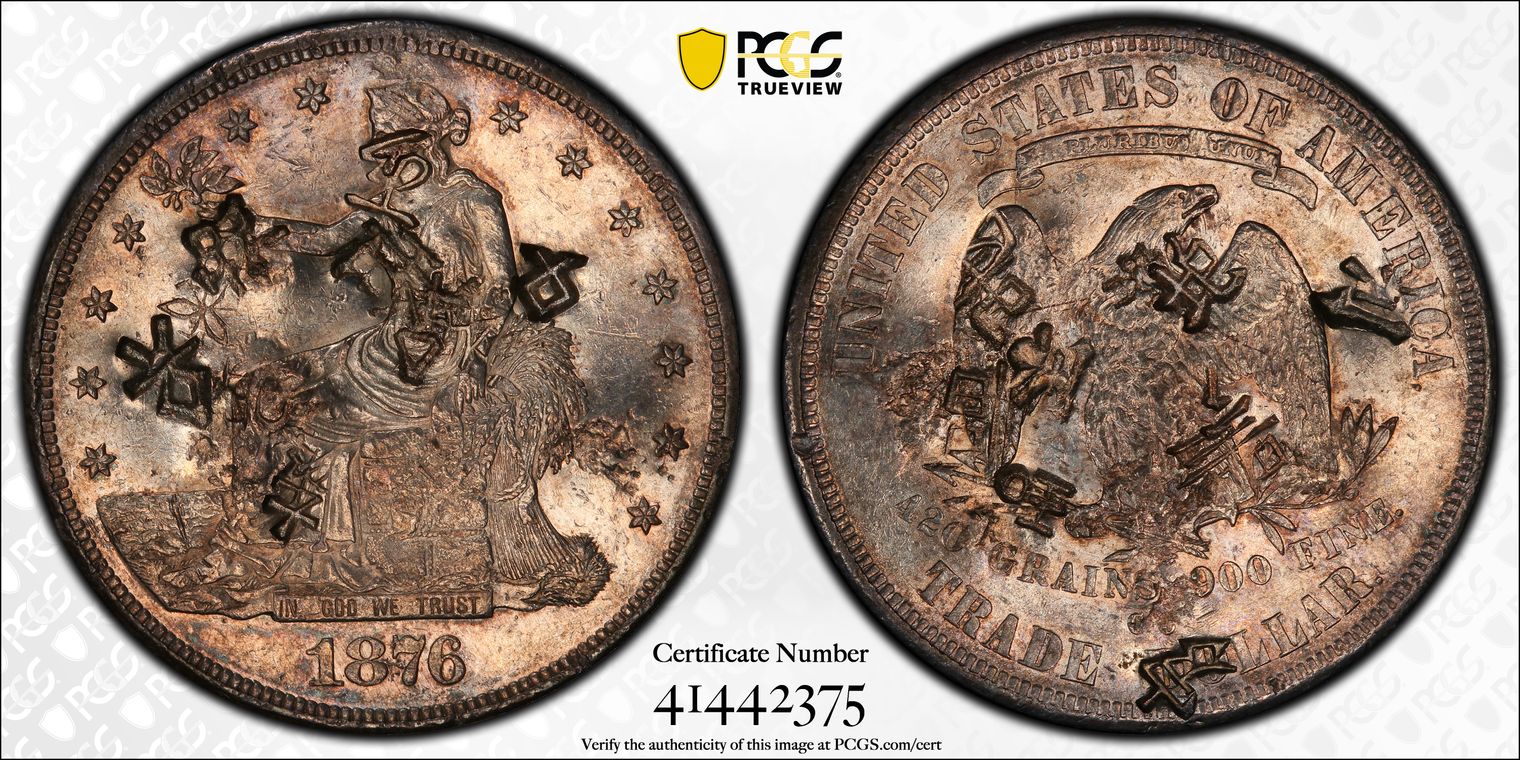
Type One Obverse, Type One Reverse. Even, light-gray surfaces contain areas of deeper gunmetal gray around the design elements. A plethora of chopmarks exist on both sides of the coin, concentrated on the reverse.
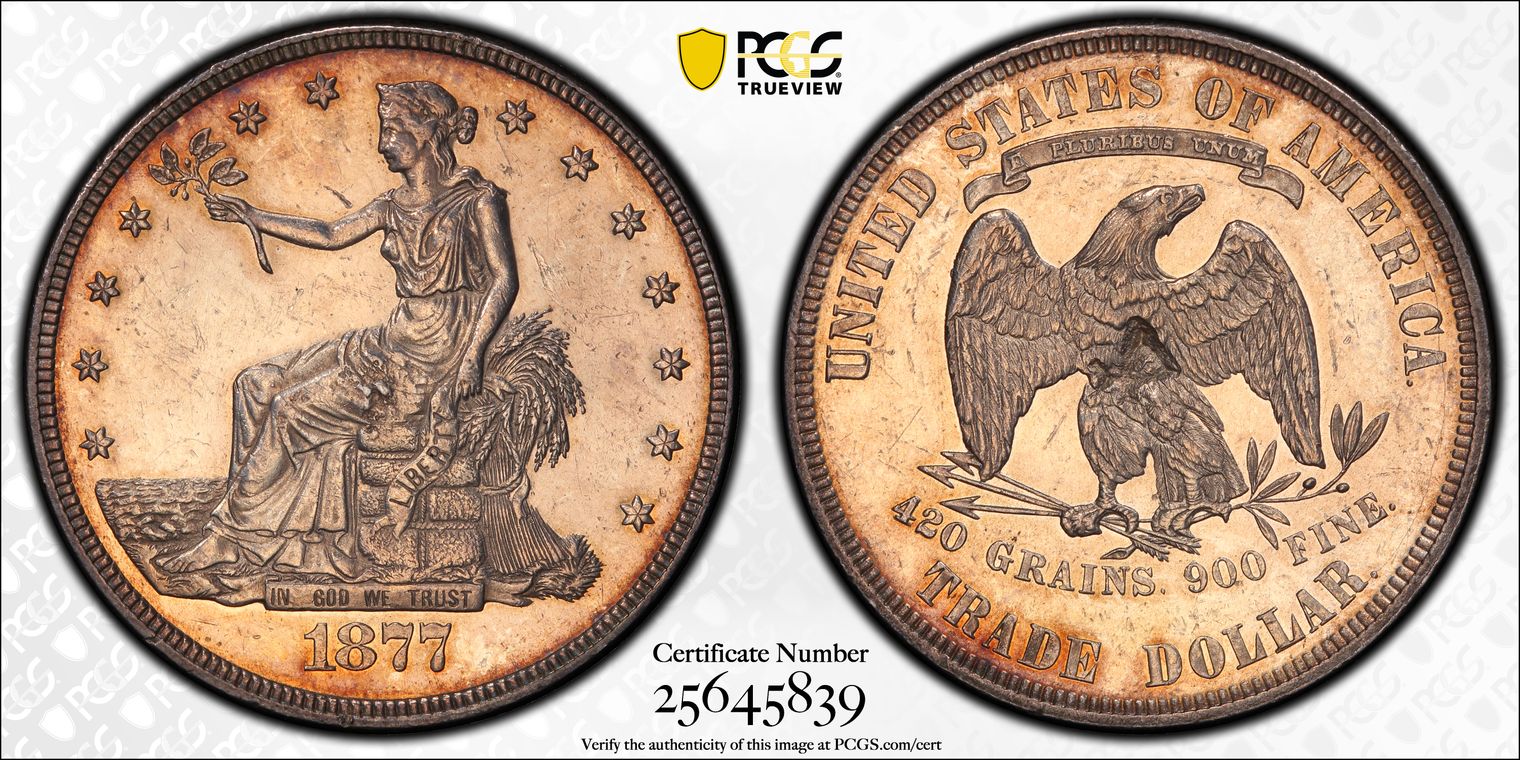
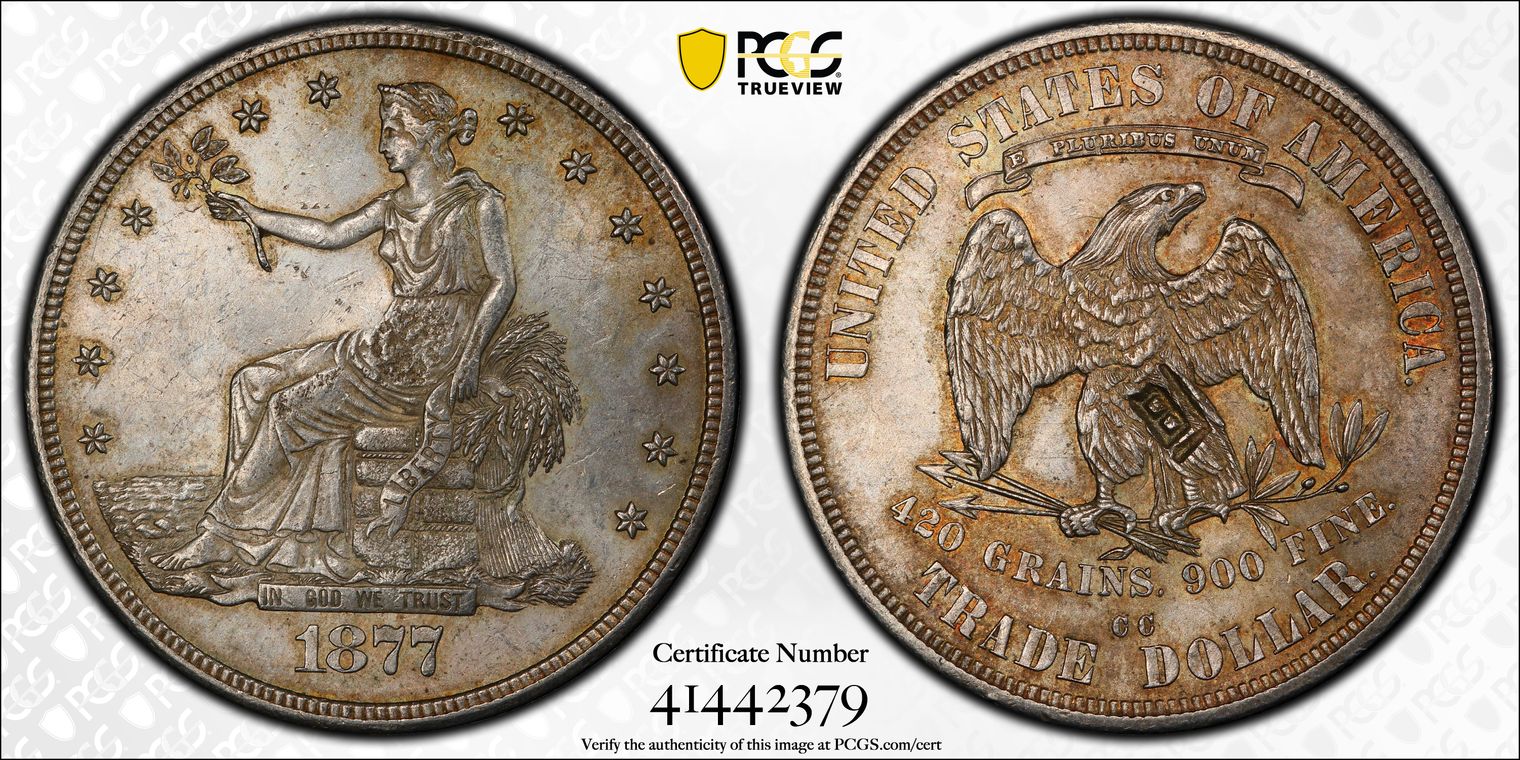
CAC - The highest graded CAC endorsed example (12/24). Luster remains in the fields, complementing the original olive-gold and slate-gray patina covering each side. The devices exhibit bold detail. A lone chopmark appears on the reverse, on the eagle's right (facing) wing.
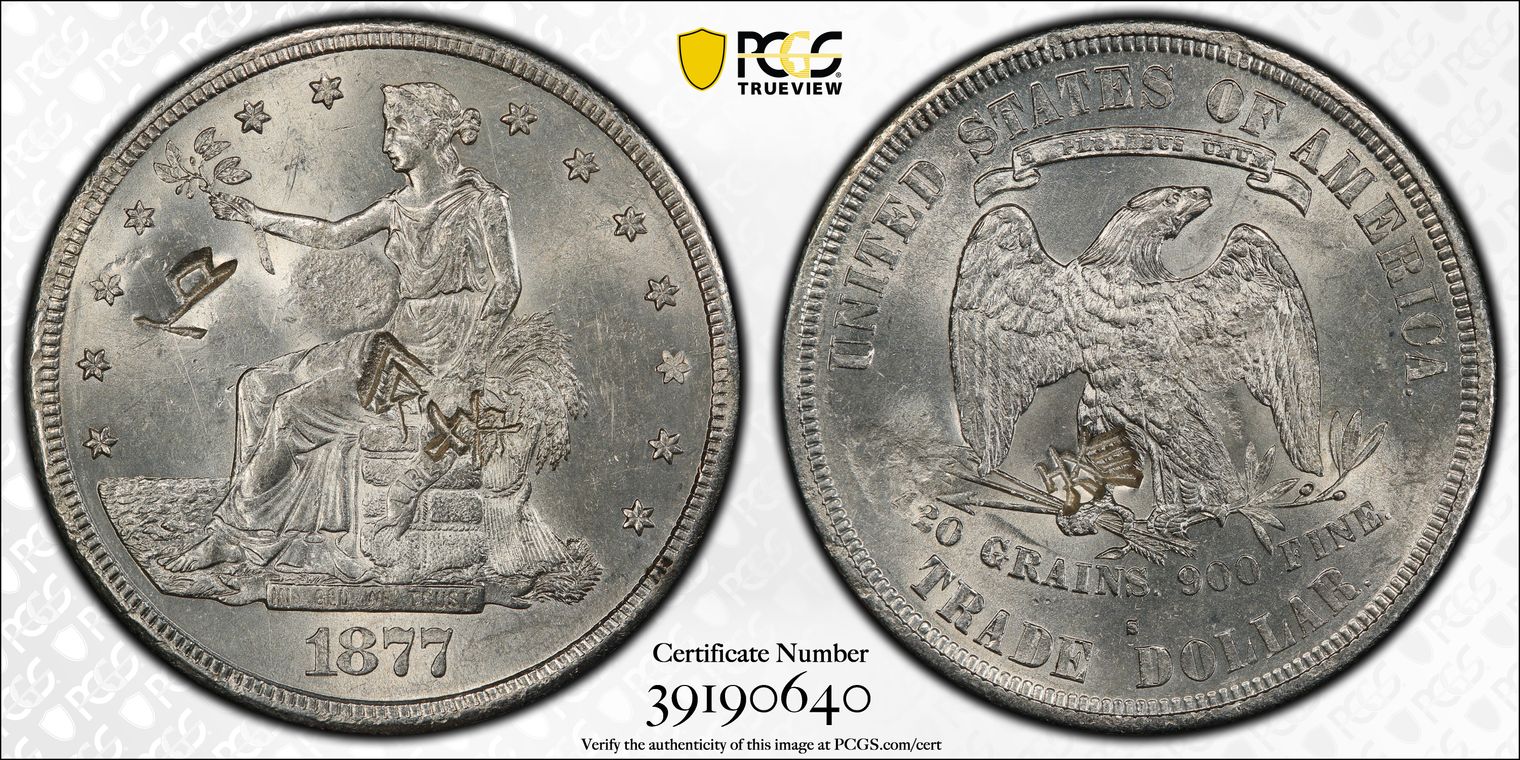
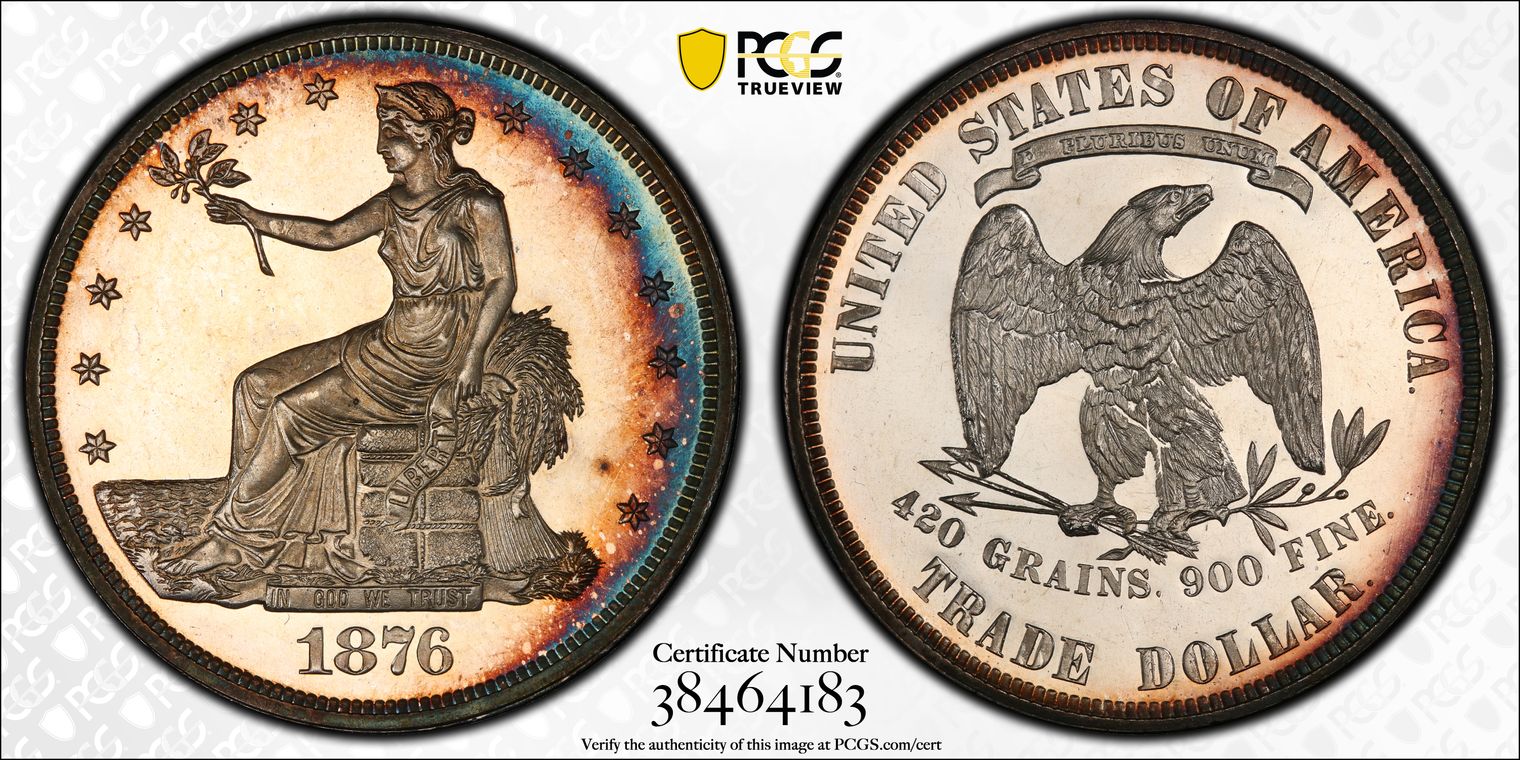
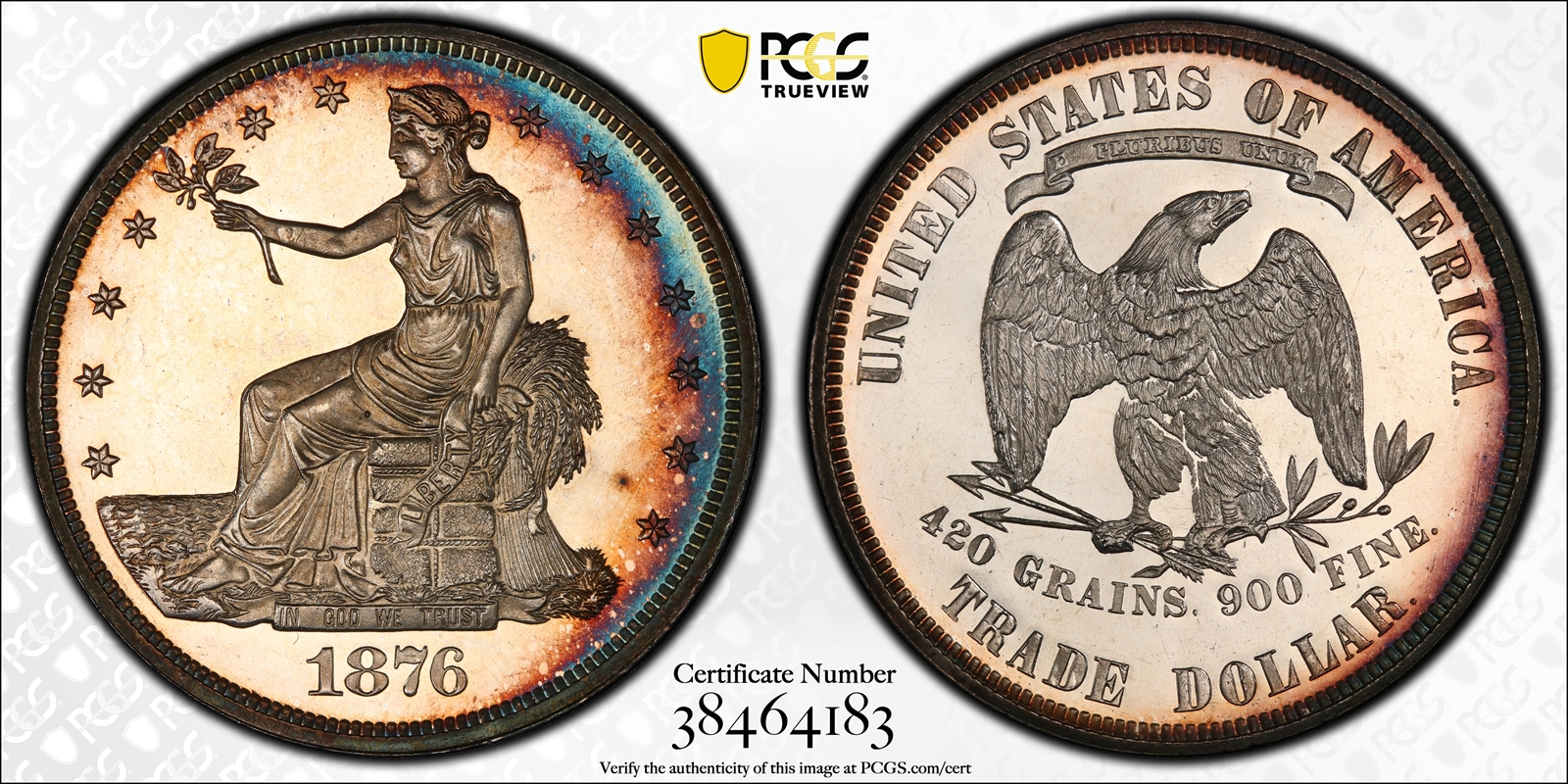
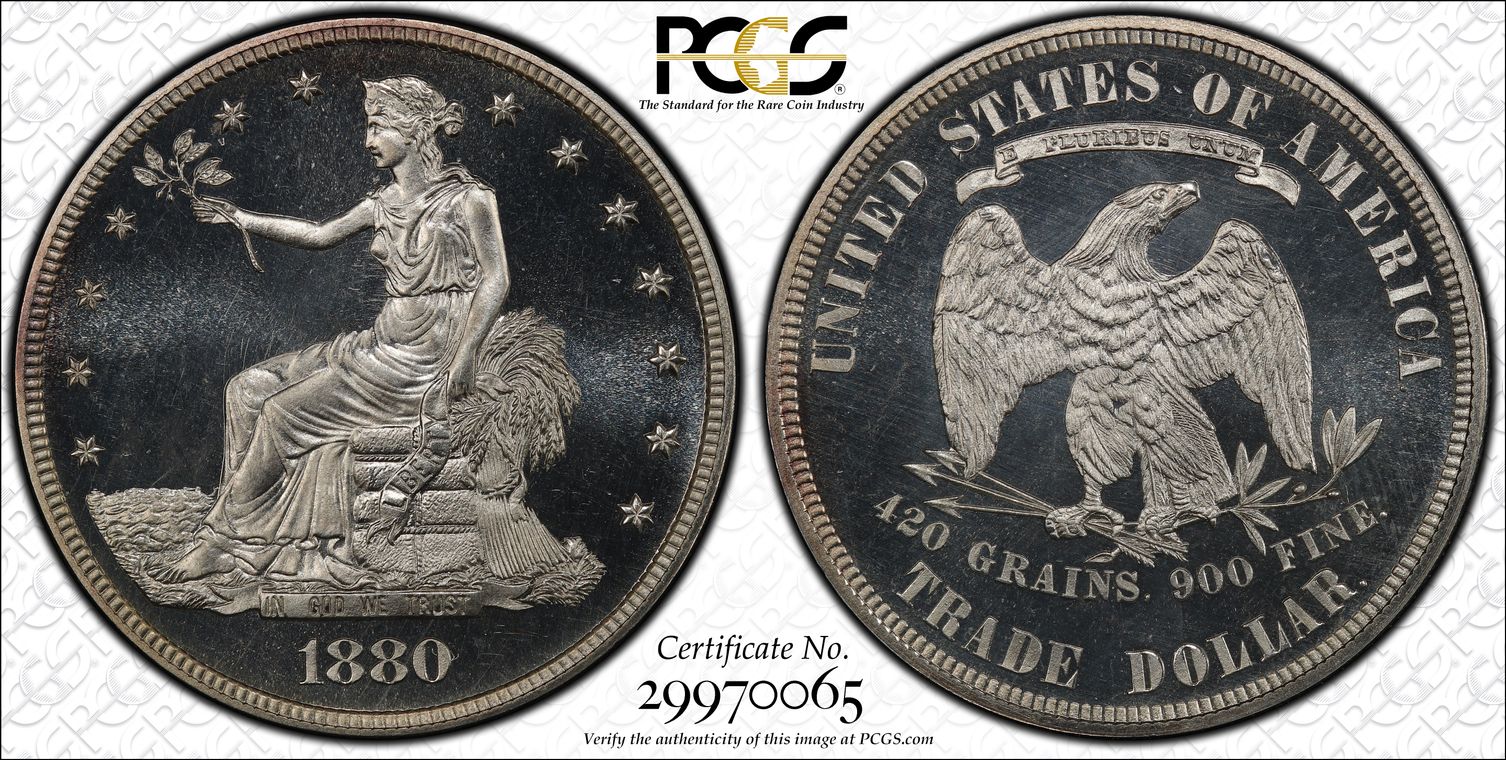
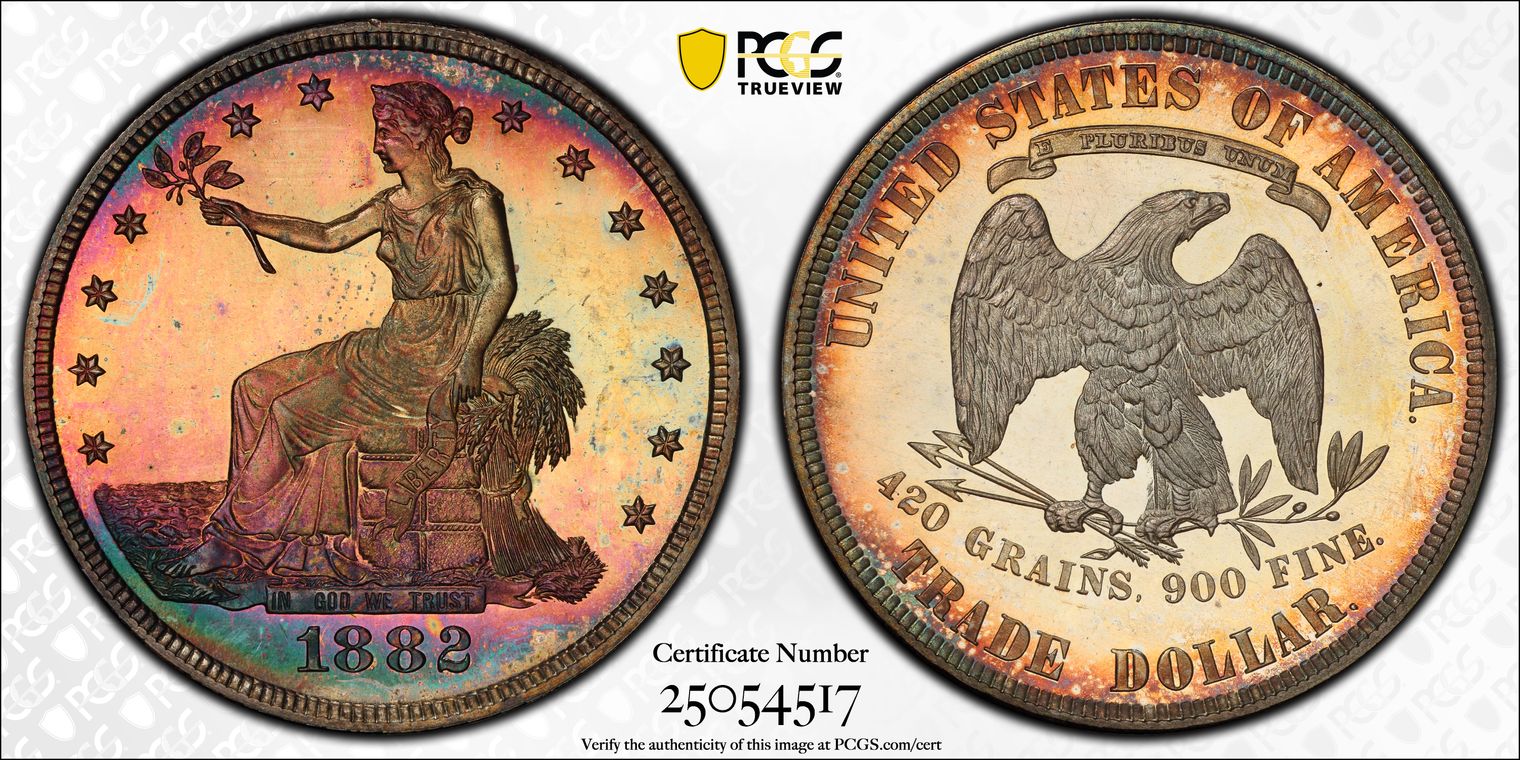
CAC - "The bright, beautifully preserved mirrors shine with wonderful reflectivity through lovely olive-gold, magenta, and blue tints."
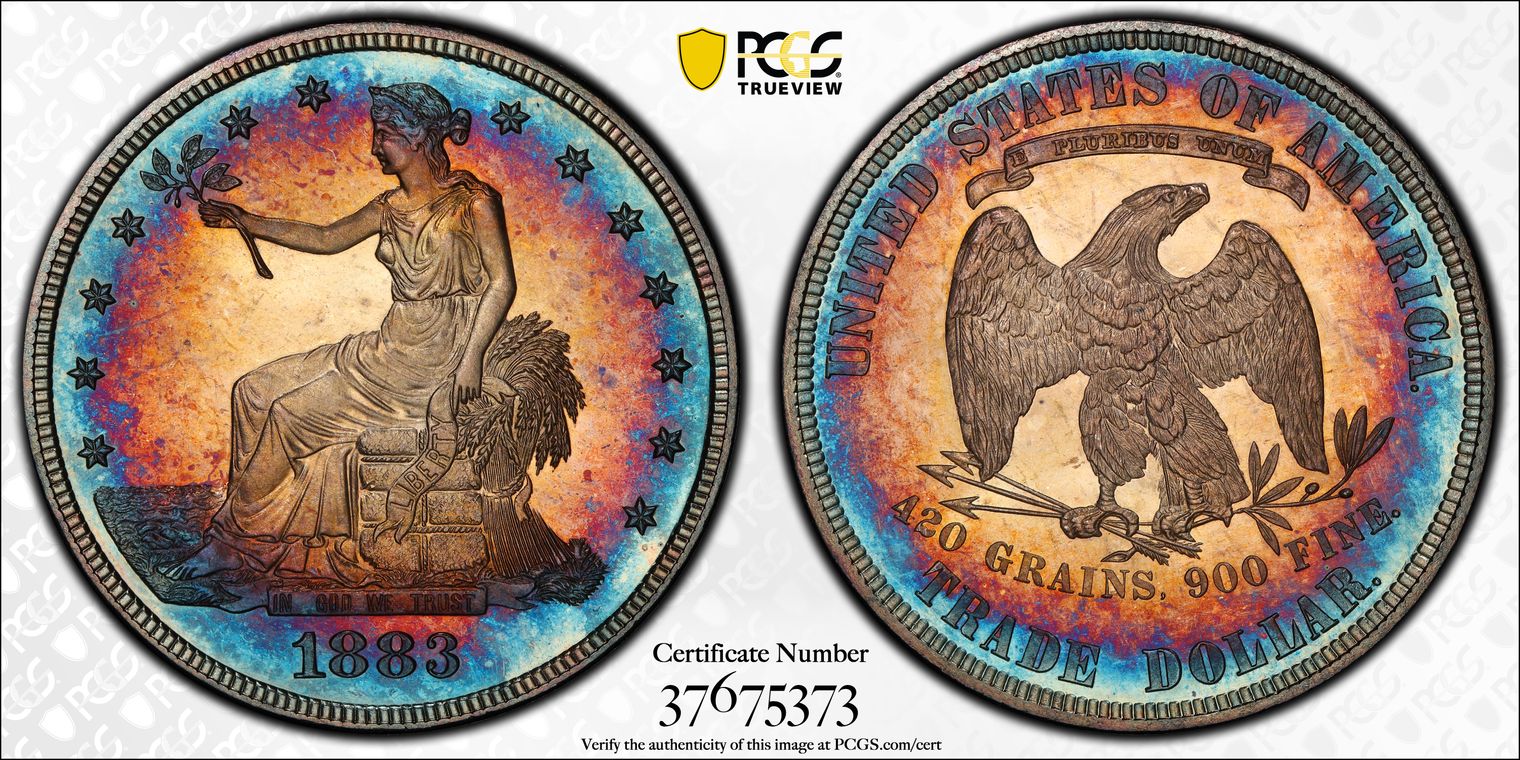
CAC - Down crossed from a Proof-68 Cameo NGC. (It was the Finest graded by NGC). "Both obverse and reverse are splendid to behold, brilliant deep mirror surfaces, silver, overlaid with natural toning. At the center is light gold, changing to magenta, then to blue, no doubt the result of having resided in a Wayte Raymond "National” album page for a few decades." A truly beautiful coin.
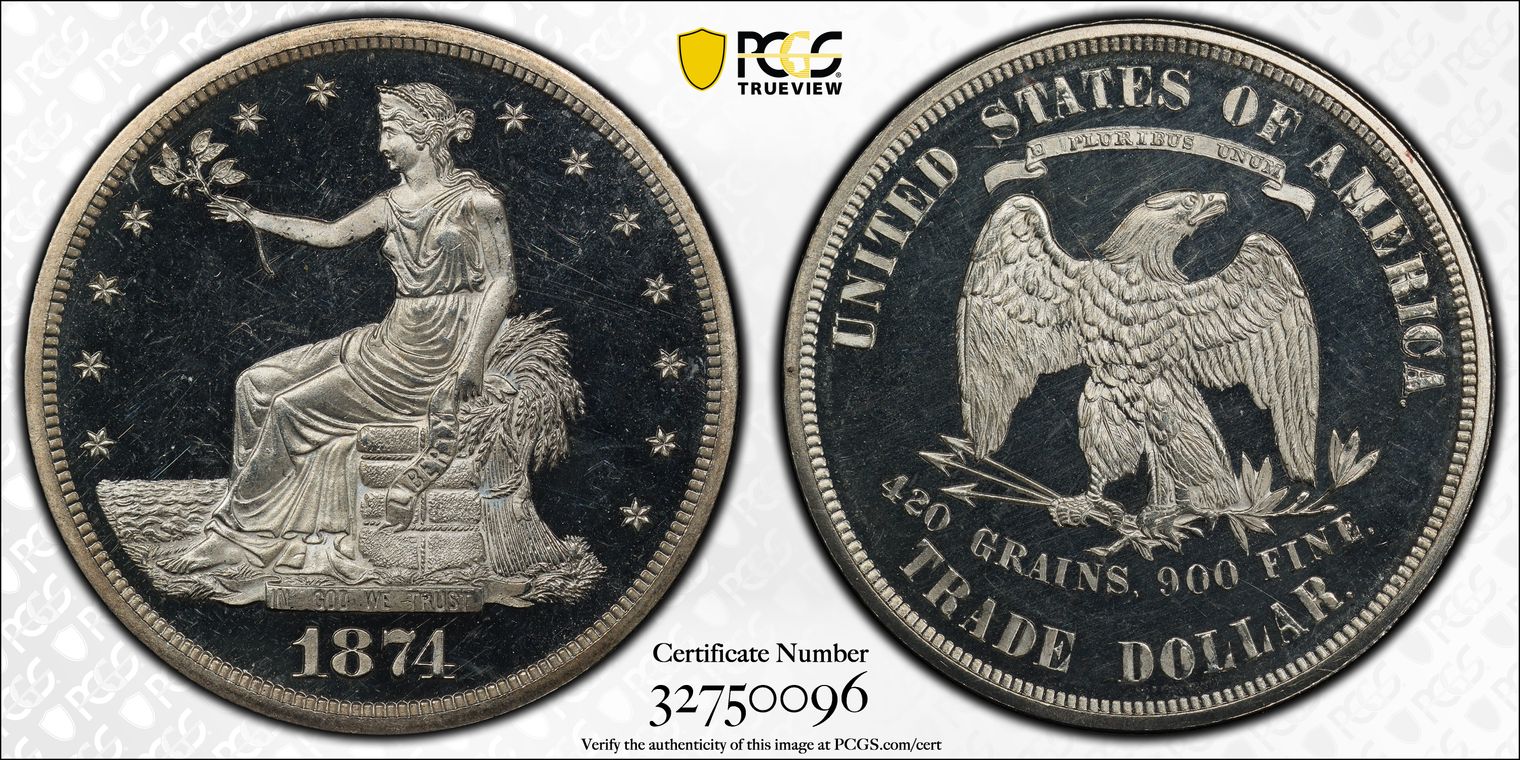
CAC - Untoned mirrors offer deep, bright reflectivity and provide sharp contrast against the frosted design elements. Captivating eye appeal and high-end technical quality come together to create a stunning piece to view in hand.
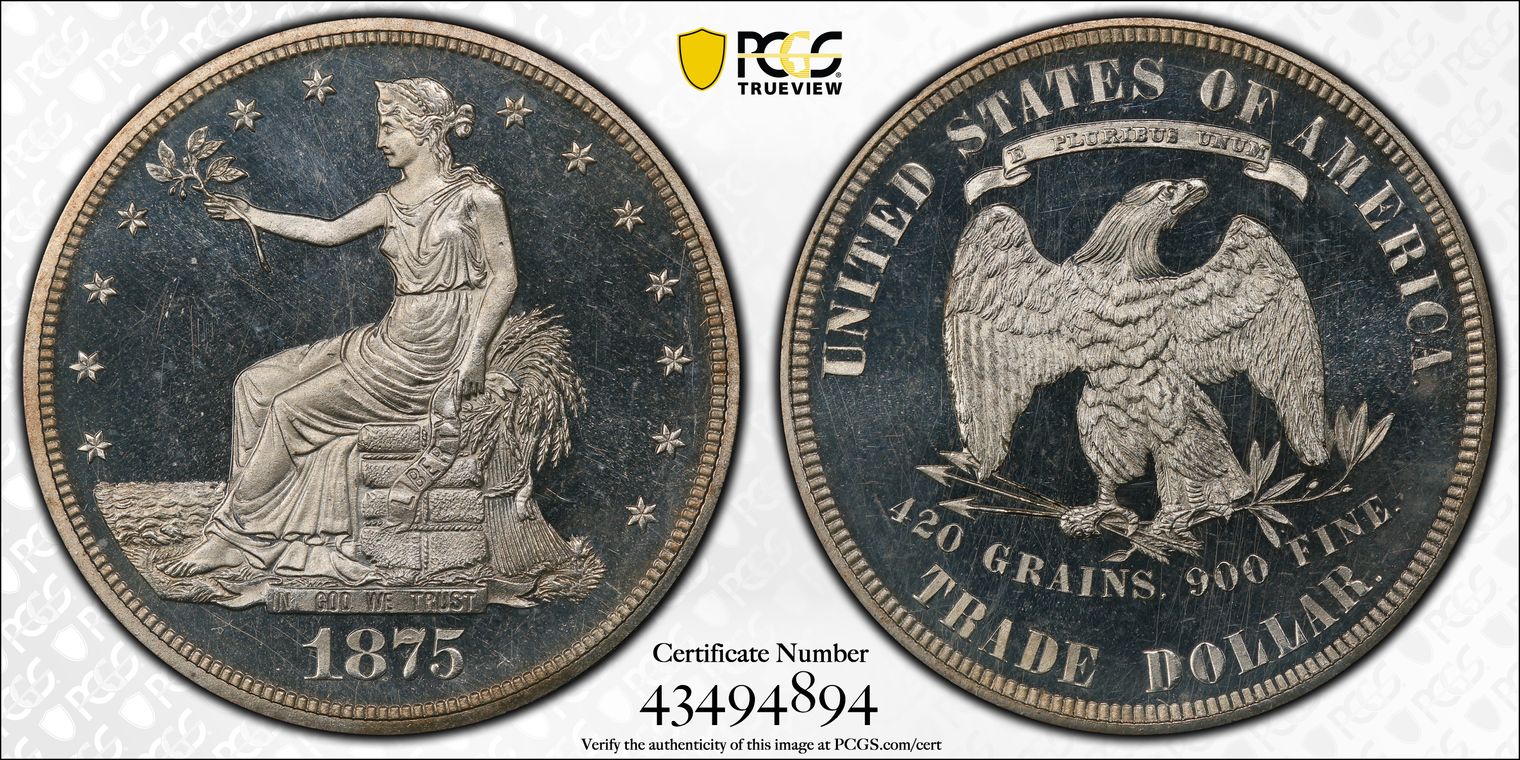
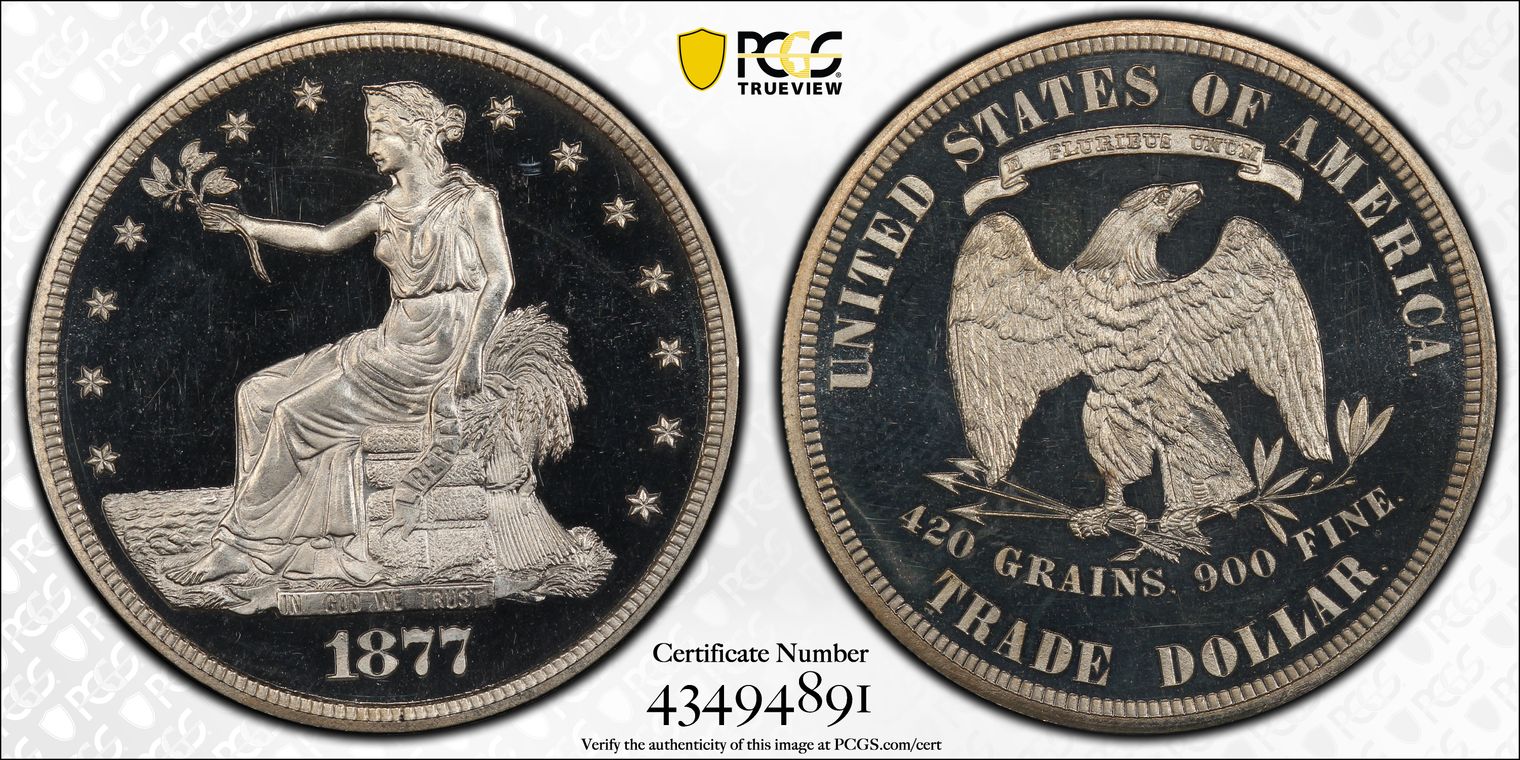
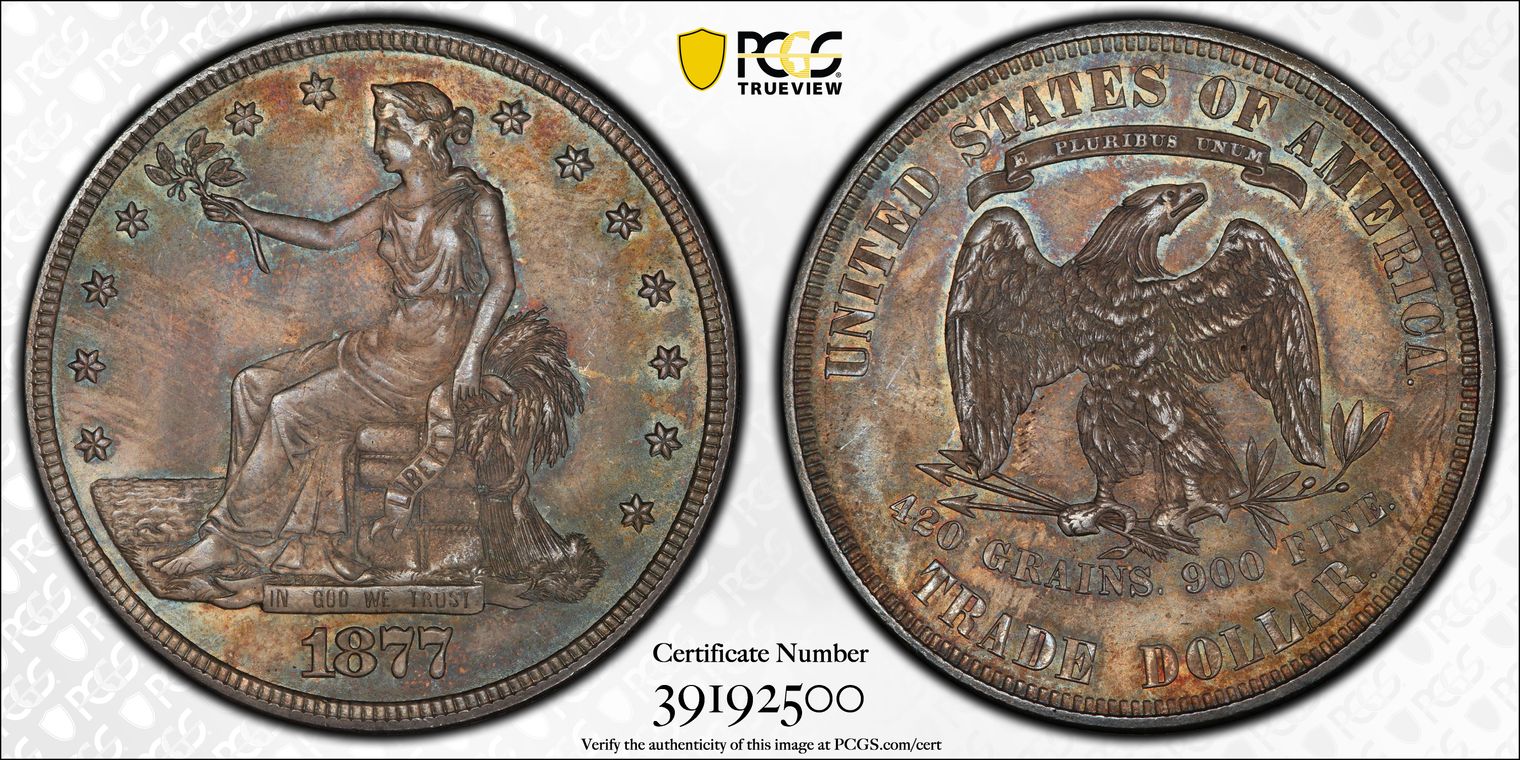
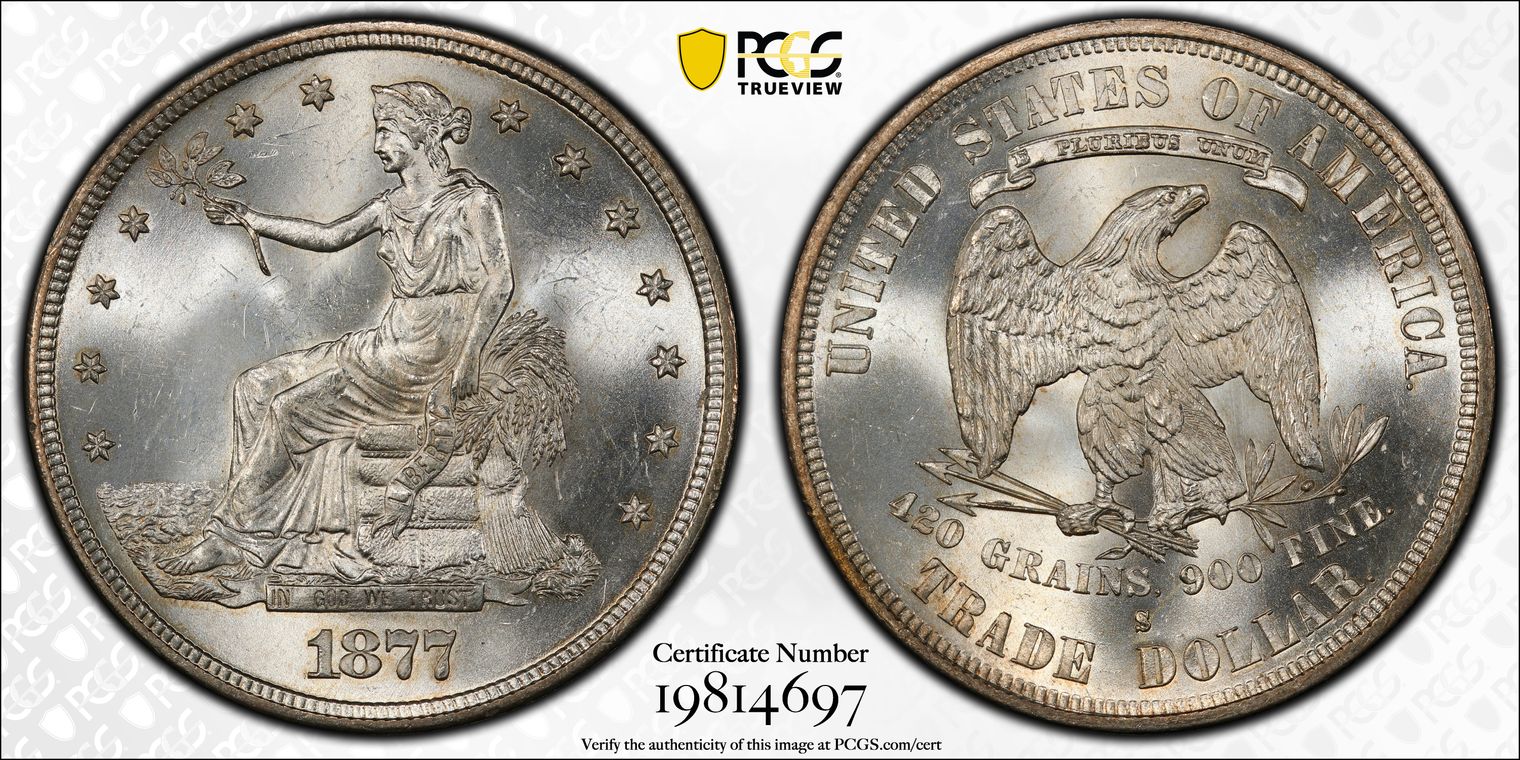
CAC - Coxe Slot 34 - 1877-S FS-802 DDR. Far Right Date C-16.1
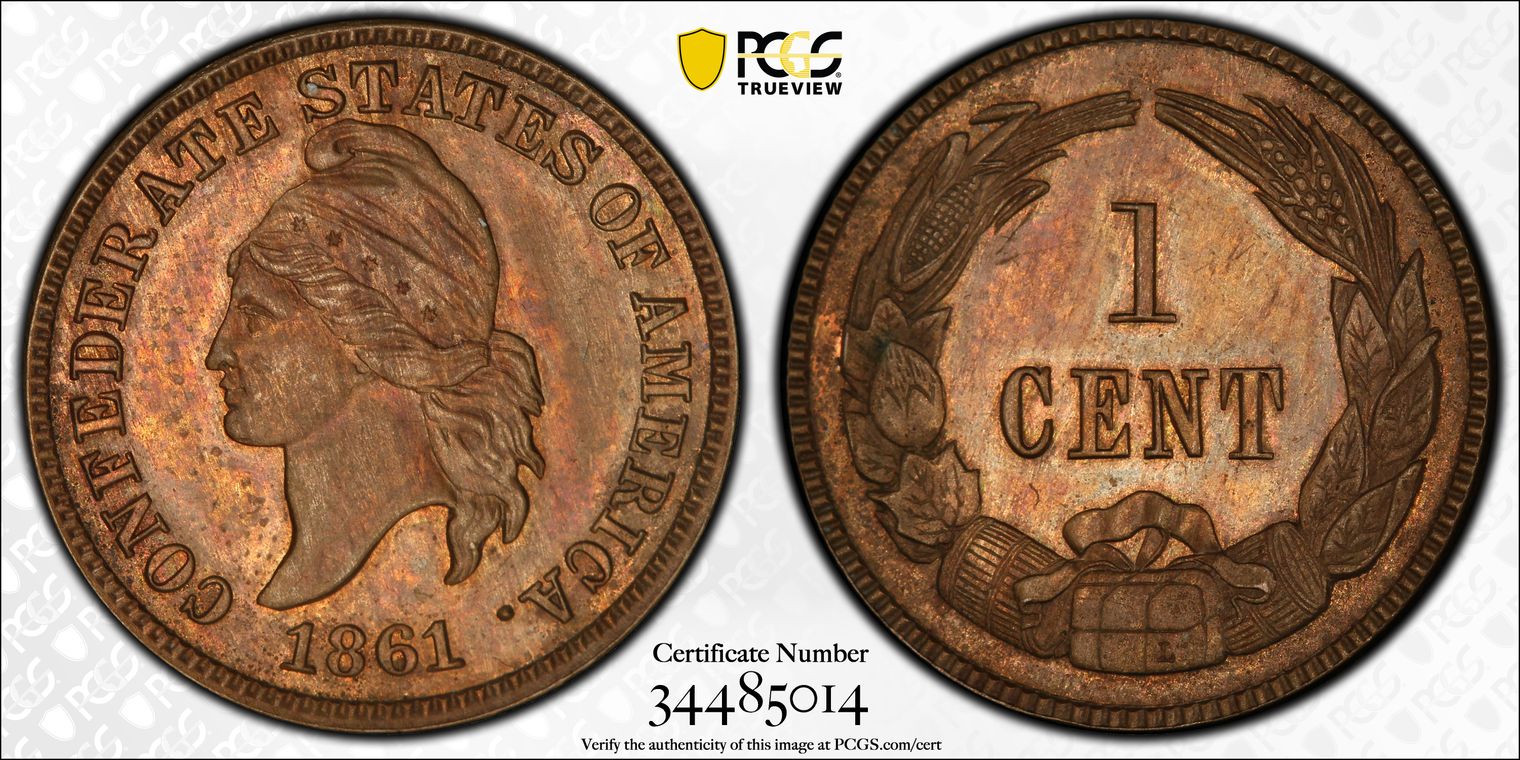
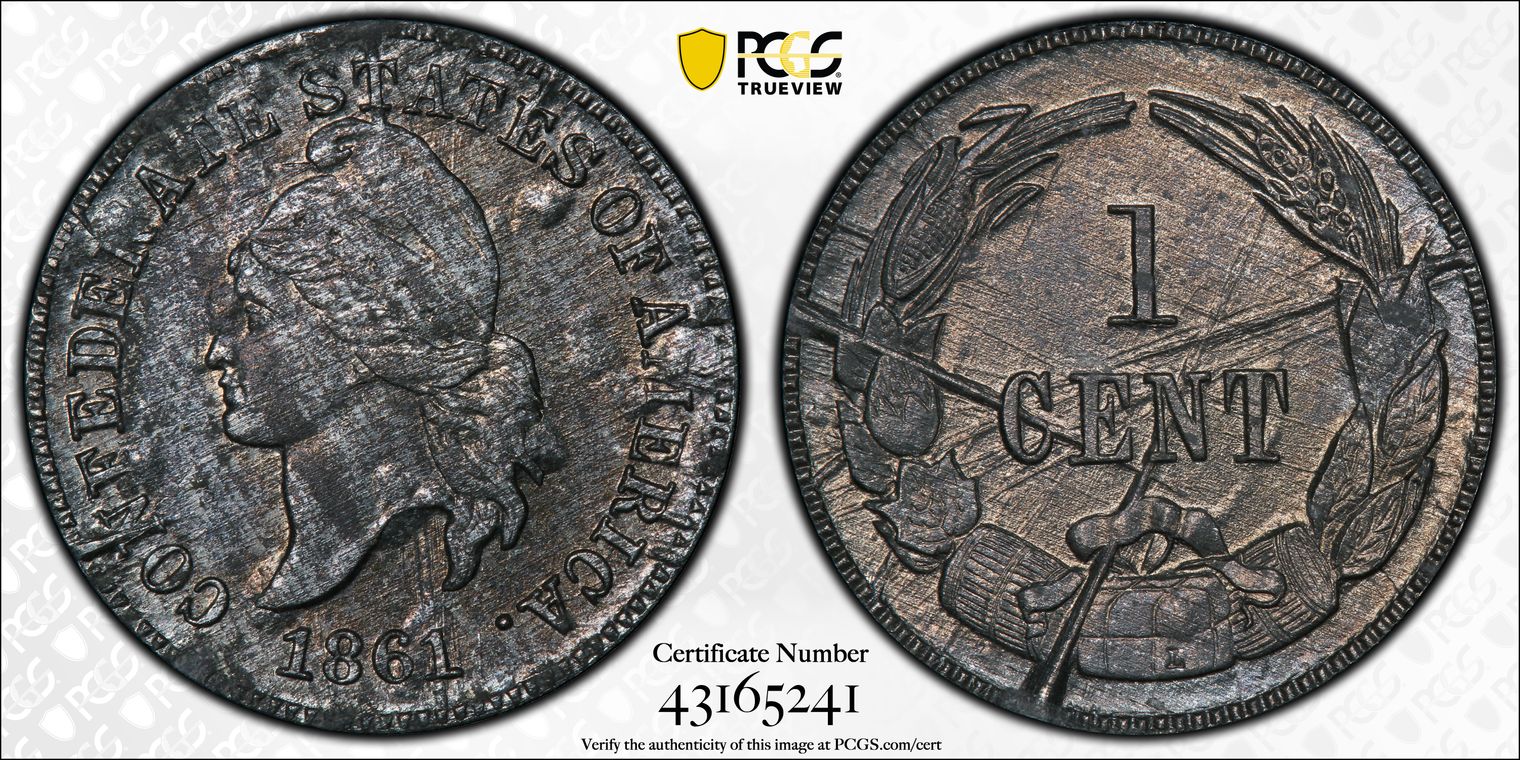
CAC - Well-preserved reflective surfaces that are blanketed in attractive shades of reddish-brown and gold toning. The design elements exhibit razor-sharp definition in most areas, with just the slightest trace of softness on Liberty's hair. On the reverse, the veins in the leaves and slats in the barrels are finely delineated, and Lovett's all-important initial is especially bold. The coin was struck in medallic alignment, a characteristic of all Originals (Restrikes have a coin turn). This piece is the third-finest certified proof example of this rare and charismatic issue.
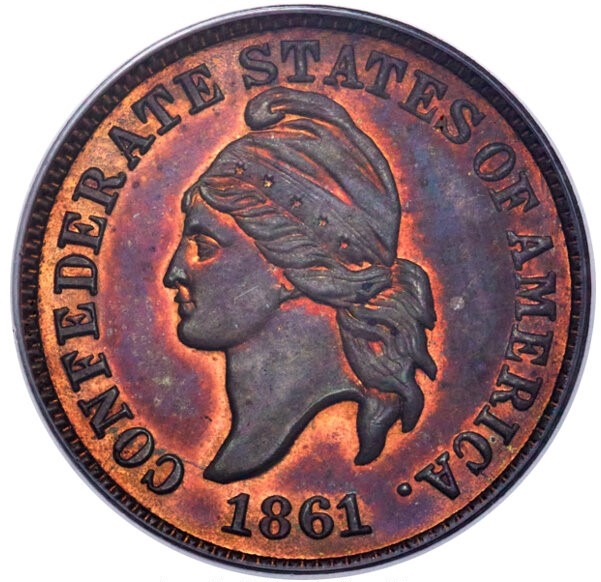
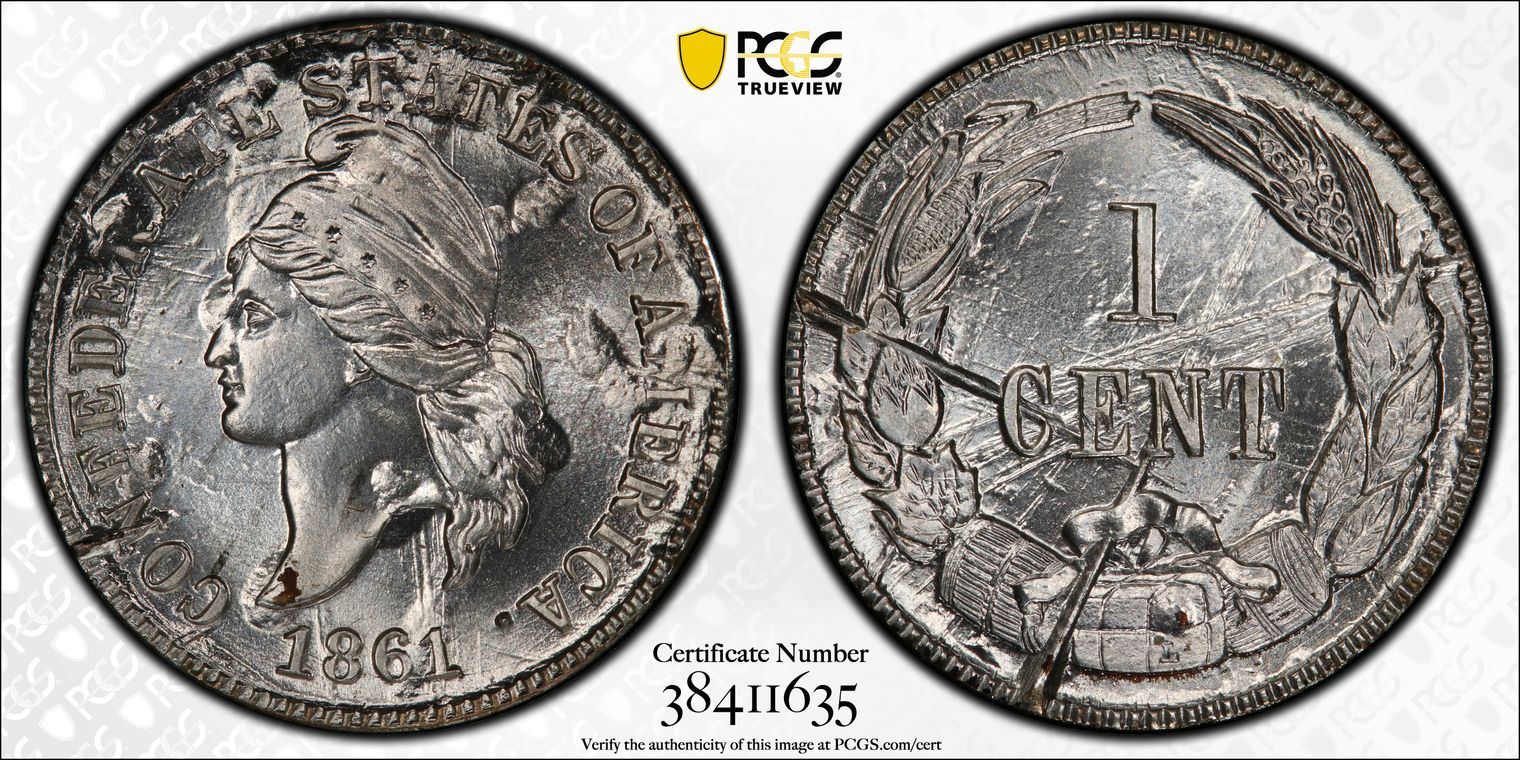
CAC - 1861 Confederate States of America Cent Haseltine Restrike of 1874 Struck in Copper from the Original Robert Lovett Dies. The only CAC endorsed example. "Under a lamp, considerable mint red outlines the devices and legends on both sides, with some lovely brown and purple field accents. Mirrorlike reflectivity glistens around the devices." Ex: Houston Signature (Heritage, 11/2012).
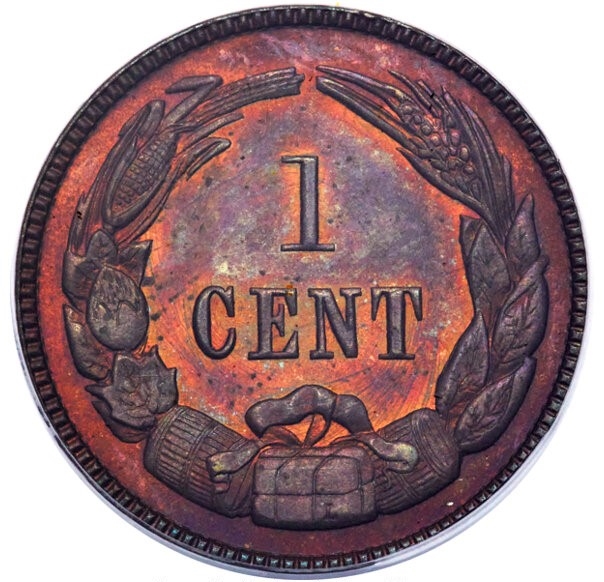
CAC - 1861 Confederate States of America Cent Haseltine Restrike of 1874 Struck in Copper from the Original Robert Lovett Dies. The only CAC endorsed example. "Under a lamp, considerable mint red outlines the devices and legends on both sides, with some lovely brown and purple field accents. Mirrorlike reflectivity glistens around the devices." Ex: Houston Signature (Heritage, 11/2012).
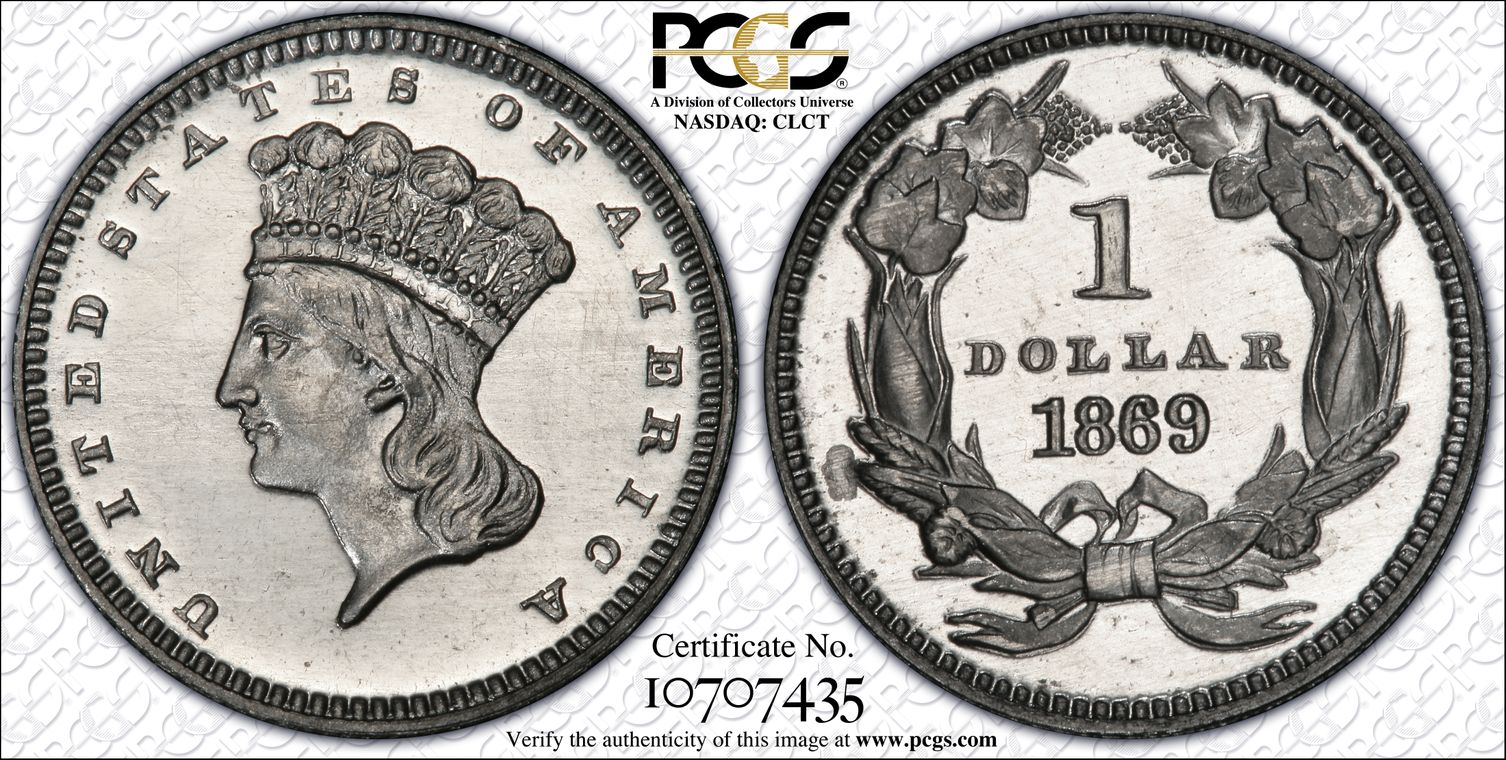
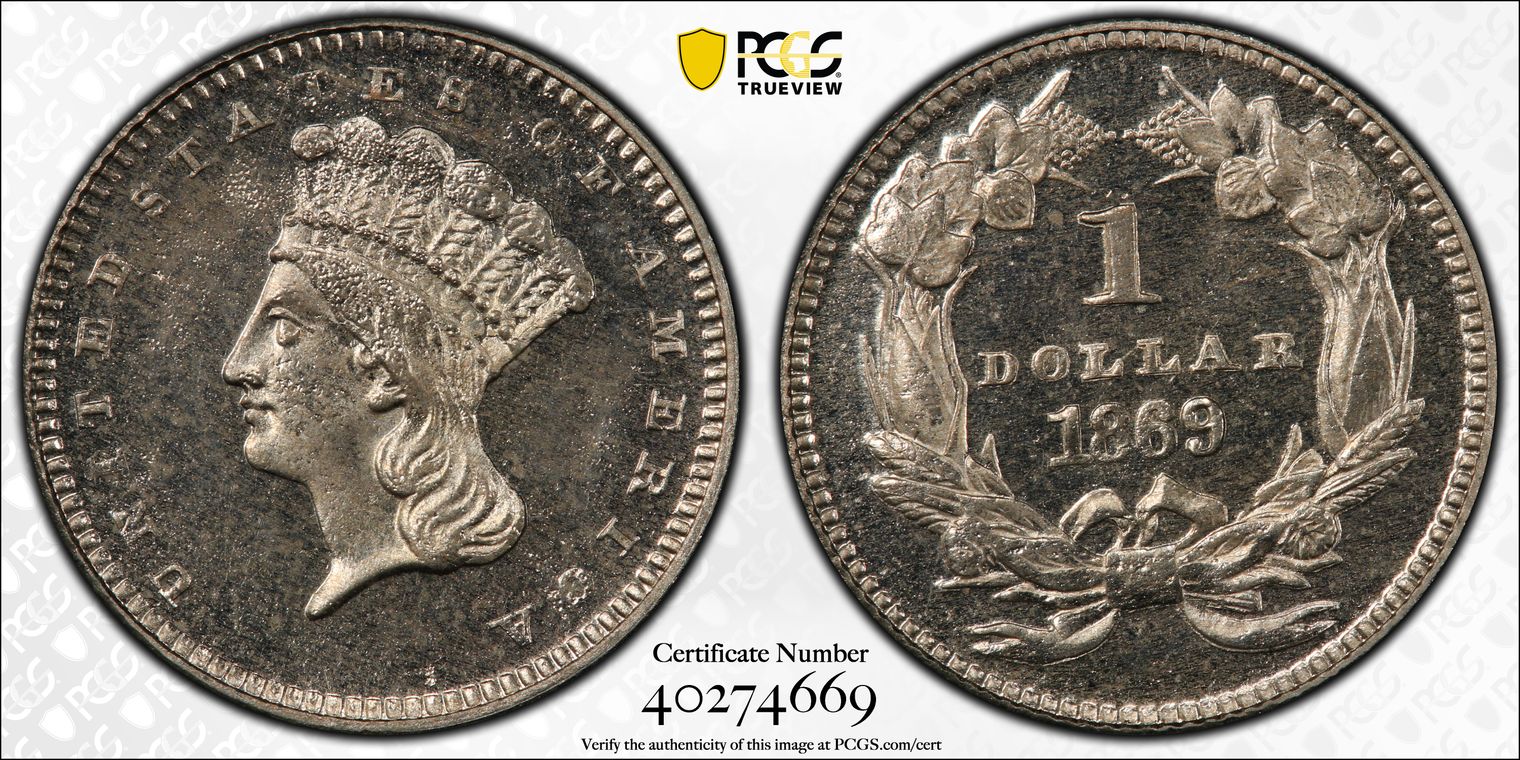
CAC - R-7+ - Struck from regular proof 1869 gold dollar dies in aluminum with a reeded edge. Intense contrast captivates the viewer. Bold, deep, highly reflective fields beam against the frosted sharply struck design elements.
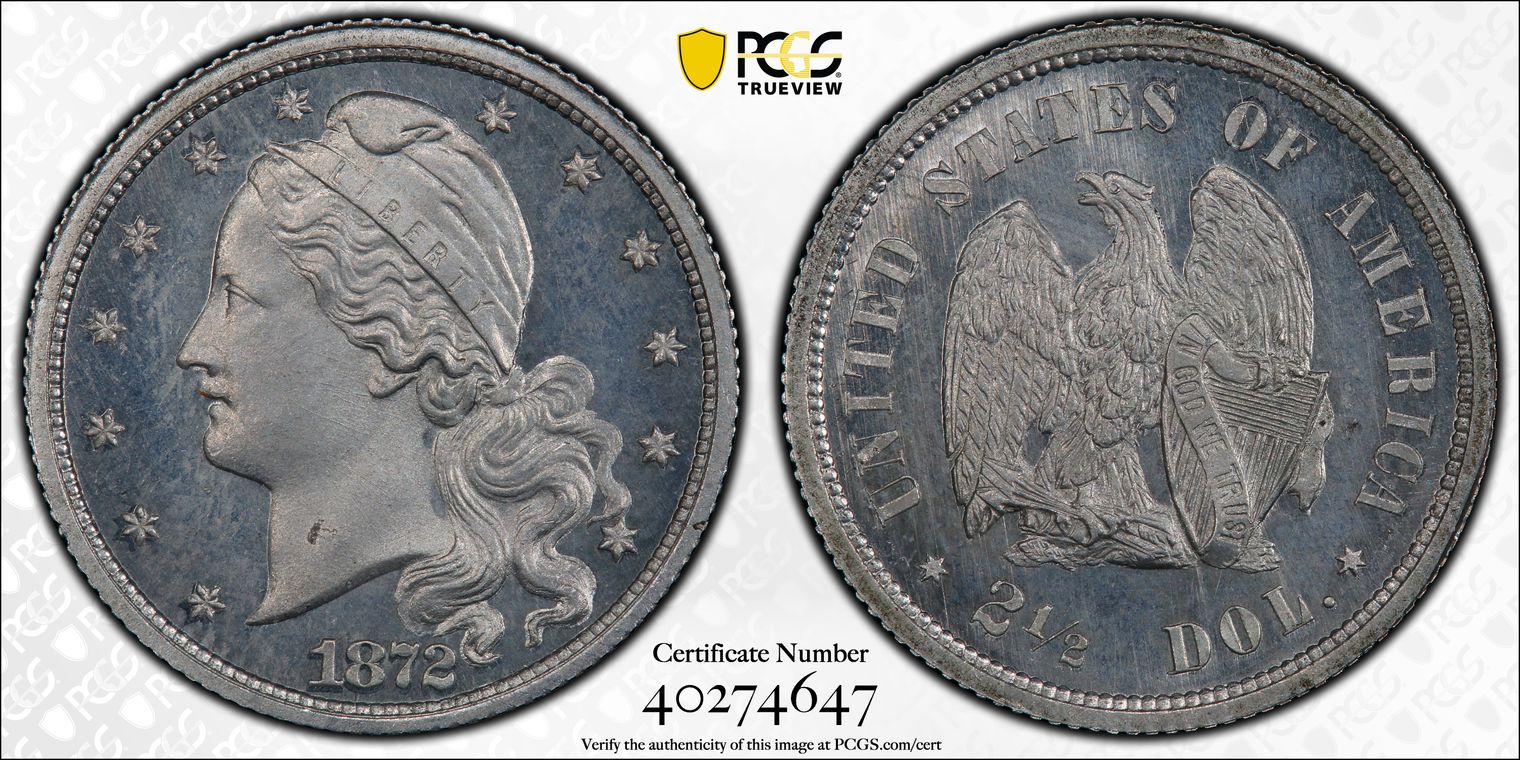
CAC - R.8 - Struck in aluminum with a reeded edge. Only three pieces are known in aluminum. "This exceptional piece is arguably the finest by virtue of its Plus designation. The surfaces are brilliant throughout and the aluminum alloy shows the expected depth of reflectivity in the fields along with frosted devices. Ex: Pittman-Simpson.
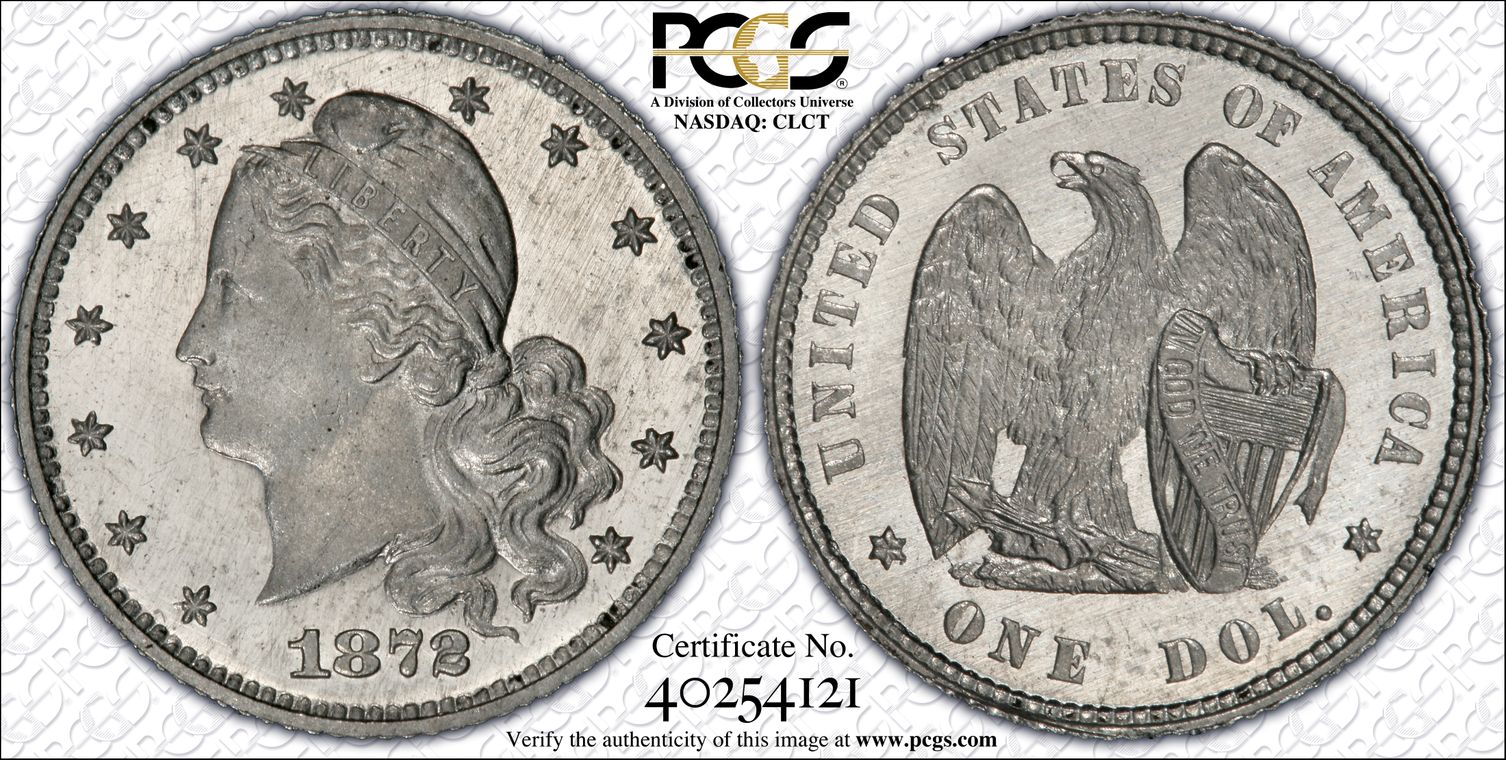
CAC - R.8 - Struck in aluminum with a reeded edge. Only three pieces are known in aluminum. "The fields are deeply mirrored and show pronounced die striations. The devices are nicely frosted and give the piece a stark cameo contrast." Ex: Farouk-Sieck - Simpson
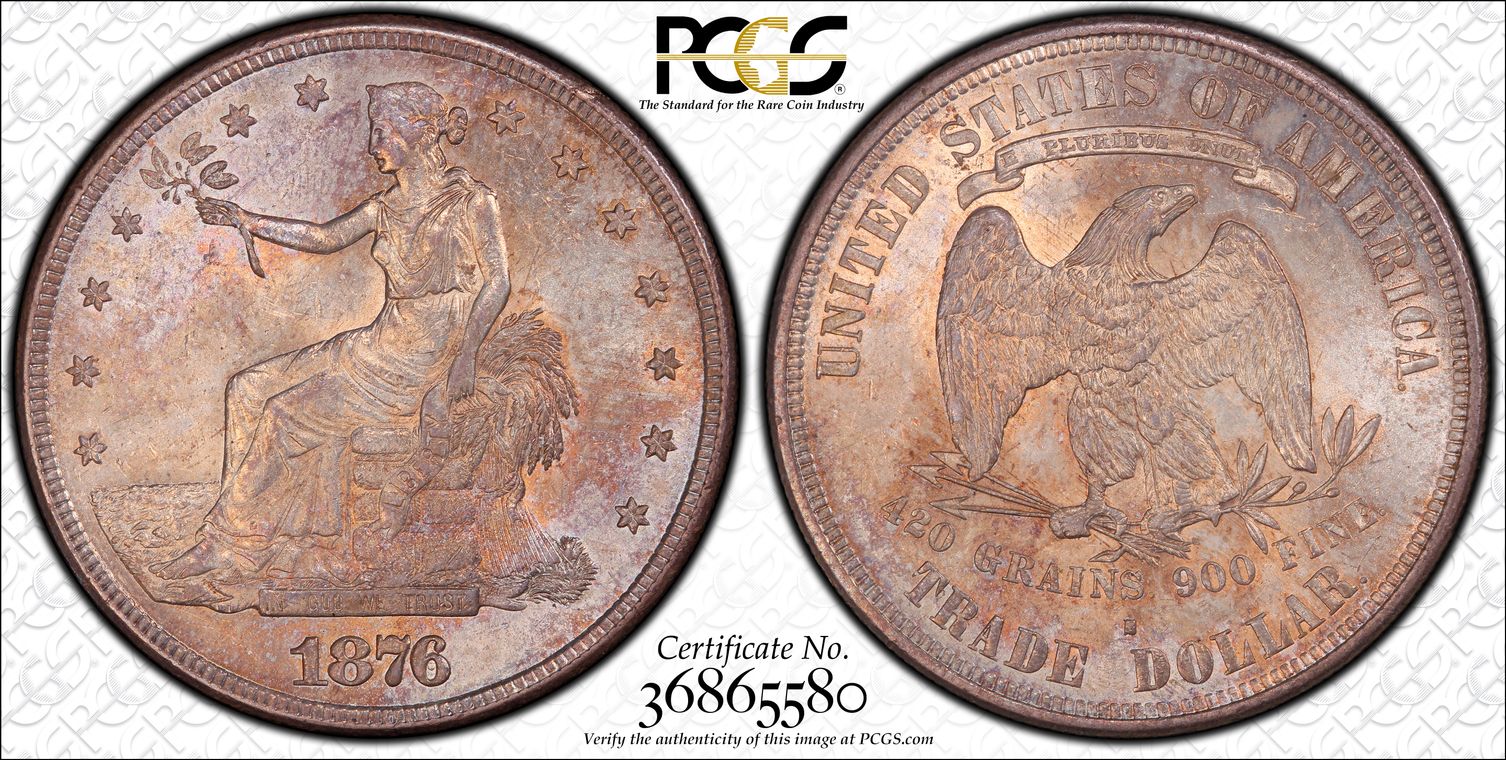
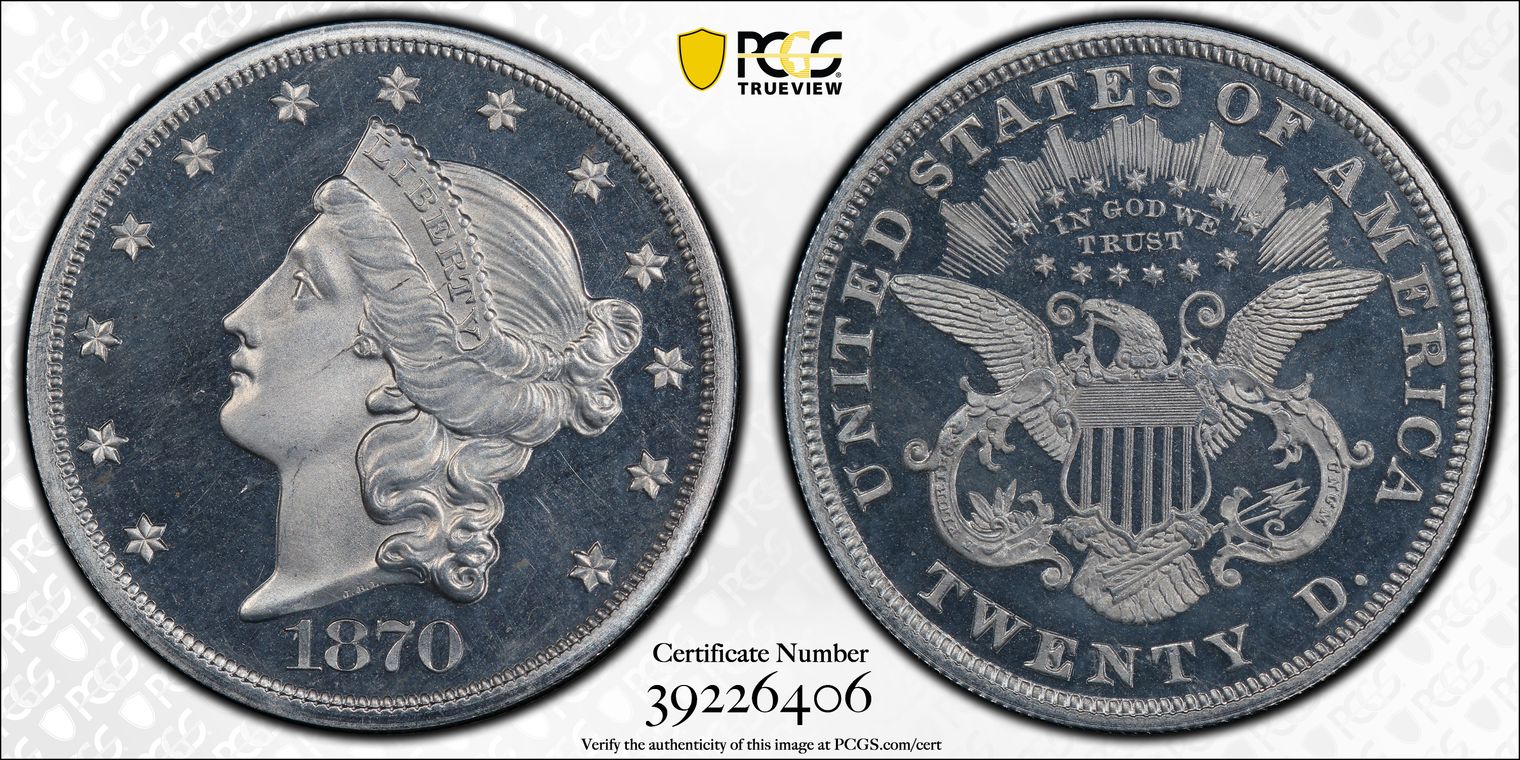
CAC - R7 - This rare die trial piece is struck from regular issue dies in aluminum with a reeded edge. James Longacre's standard design for the regular issue double eagles of 1870. As per USPatterns.com, only three are believed to be known and one of the 3 is slightly impaired. Deep mirrors beam boldly from all over and exhibit strong clarity and are clean. Miss Liberty and the details are fully struck and have thick standout frost. The only deep cameo graded by either service. Ex: Simpson Collection.
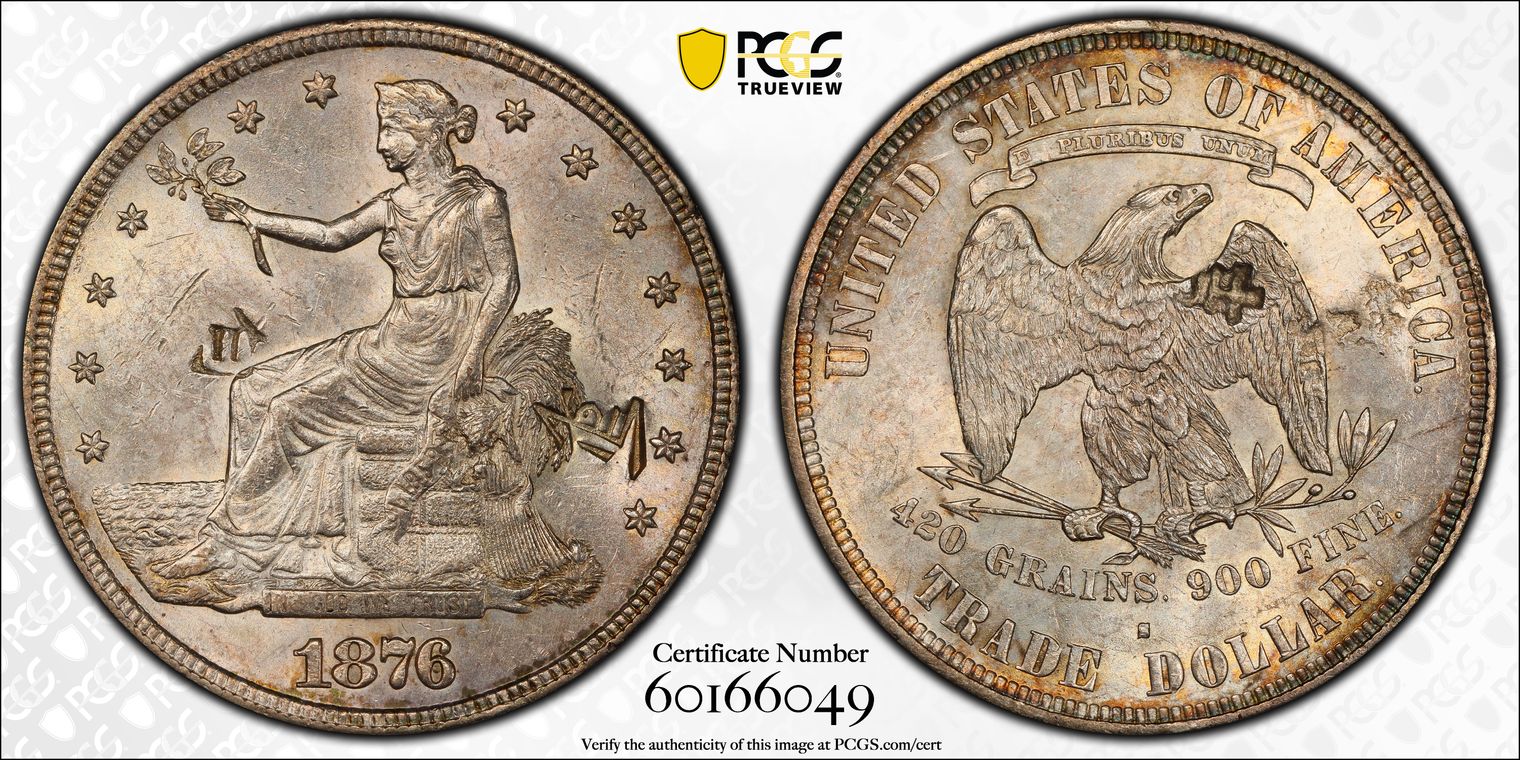
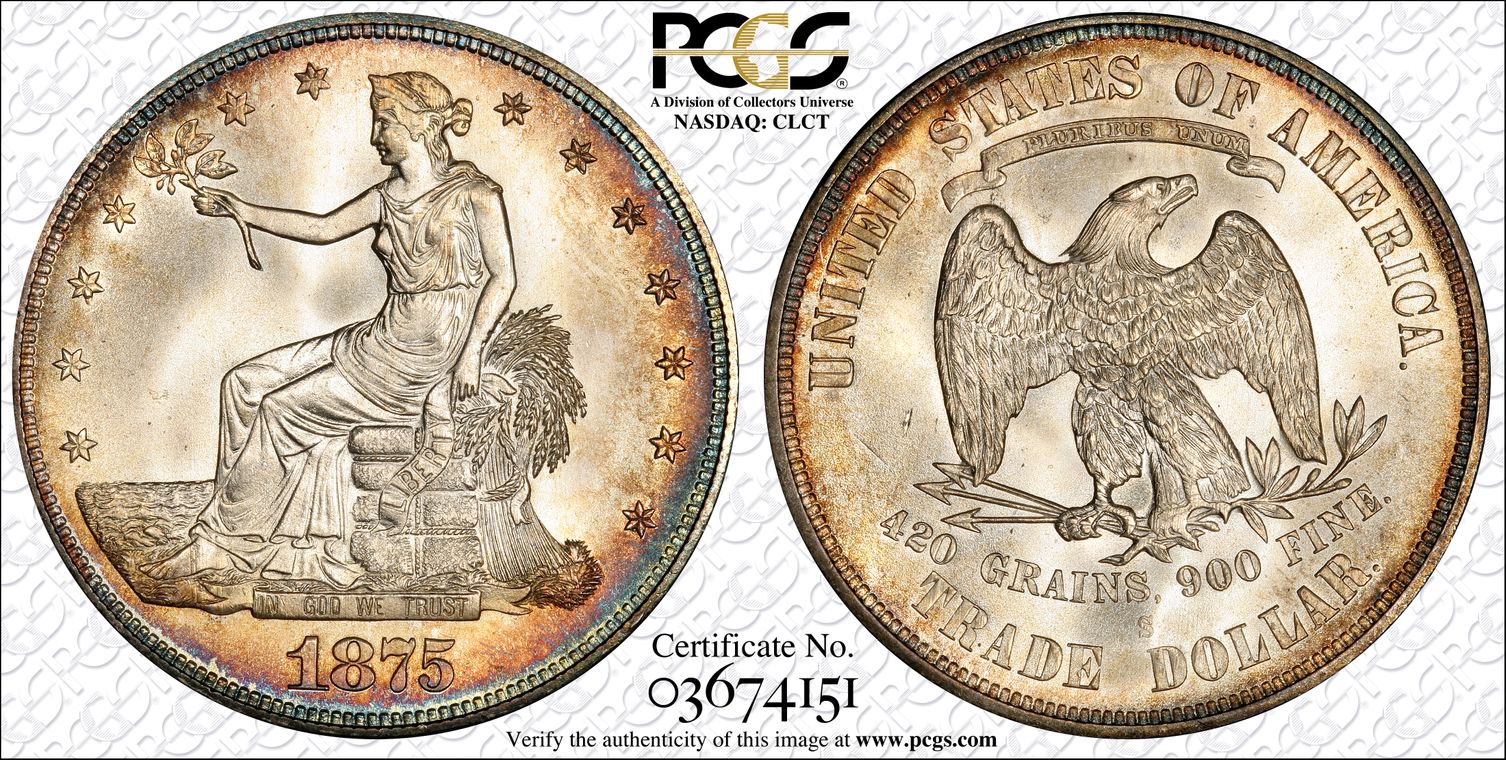
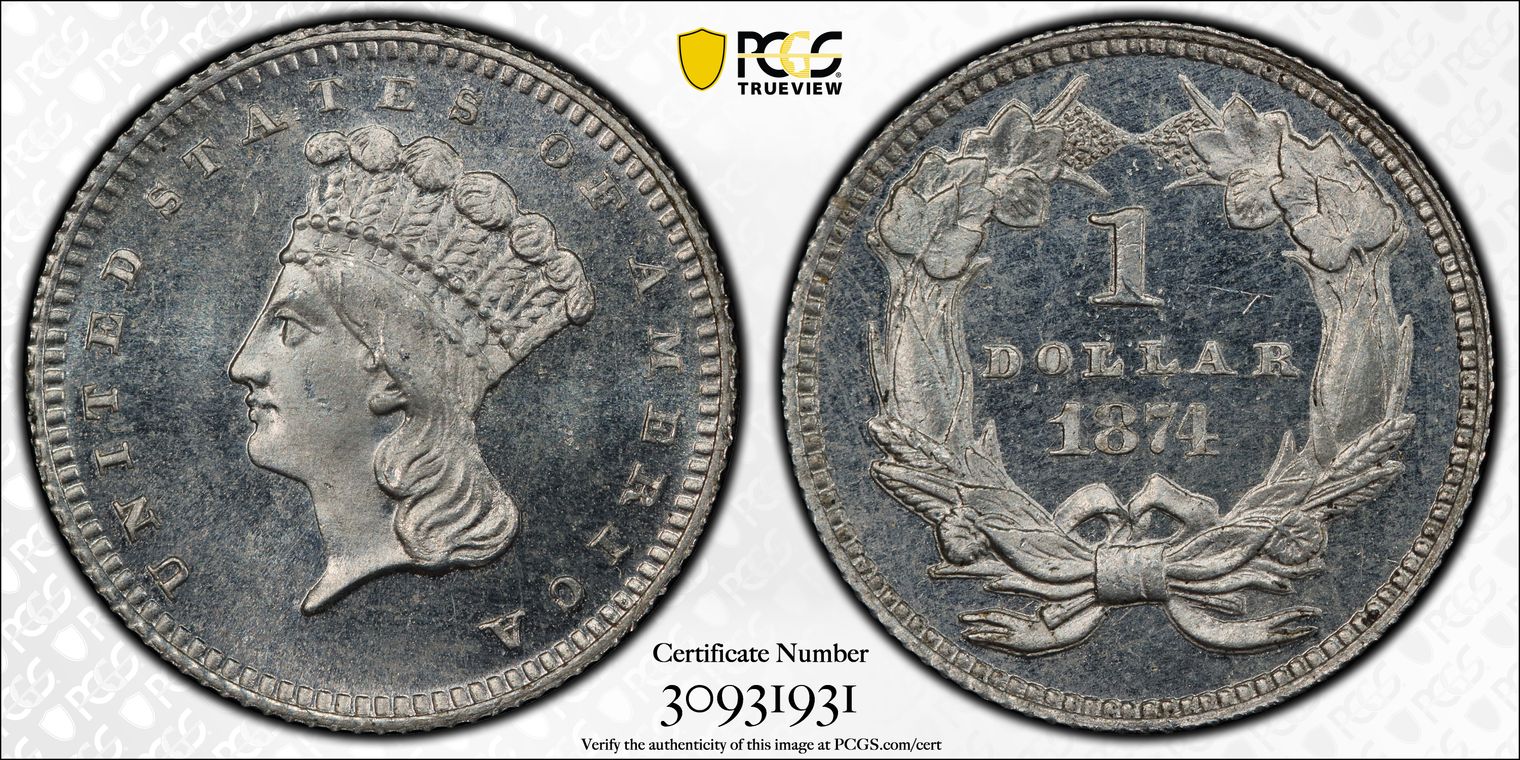
CAC - R8 - Struck in aluminum with a reeded edge. Only two coins known. A regular dies trial piece. "This sharply defined Premium Gem Cameo proof has excellent contrast with light gray devices within a blue-gray frame." Ex. Simpson
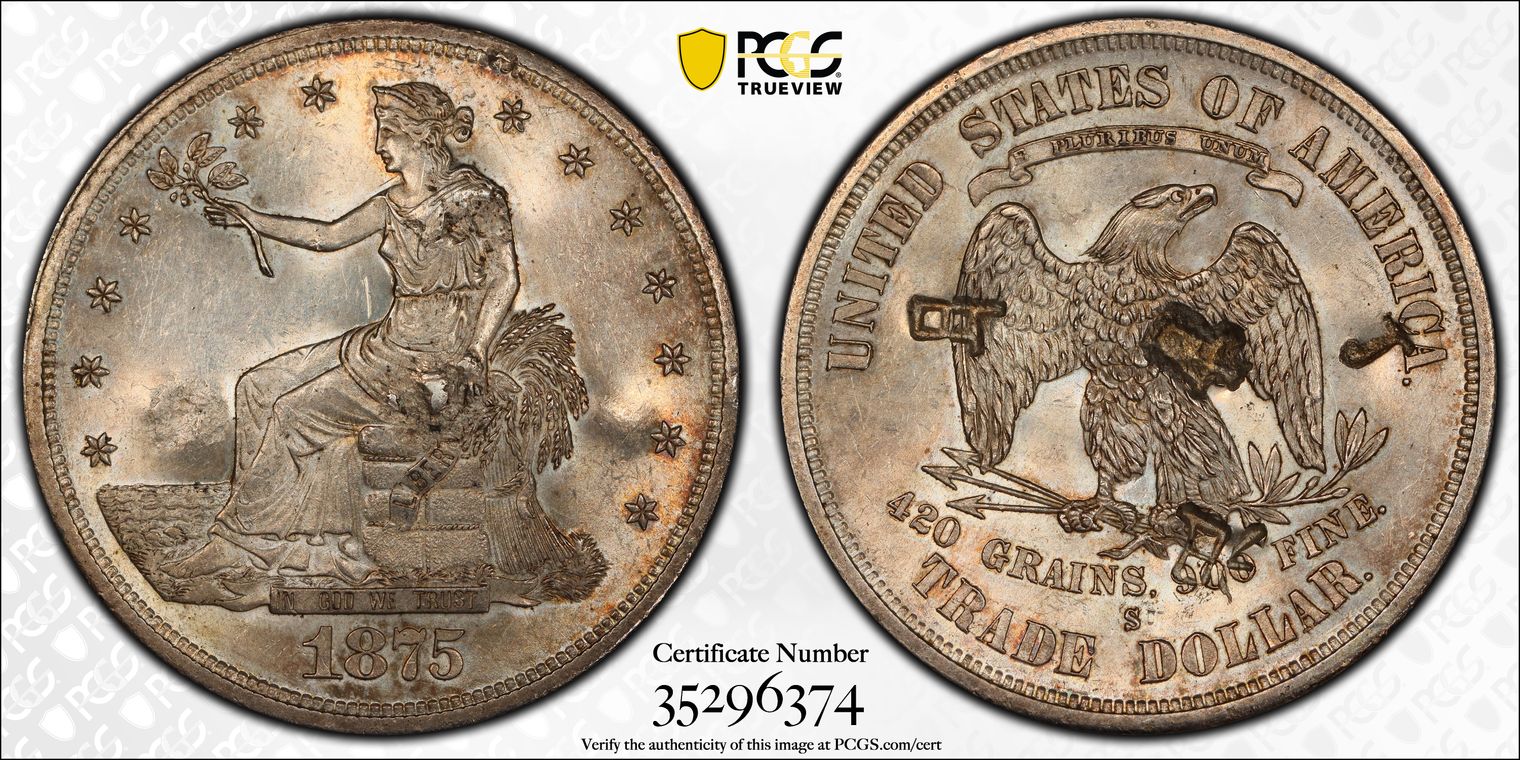
CAC - Type 1/1, Large S, FS-501, Breen-5792. Very scarce and the less common of the two overdates.
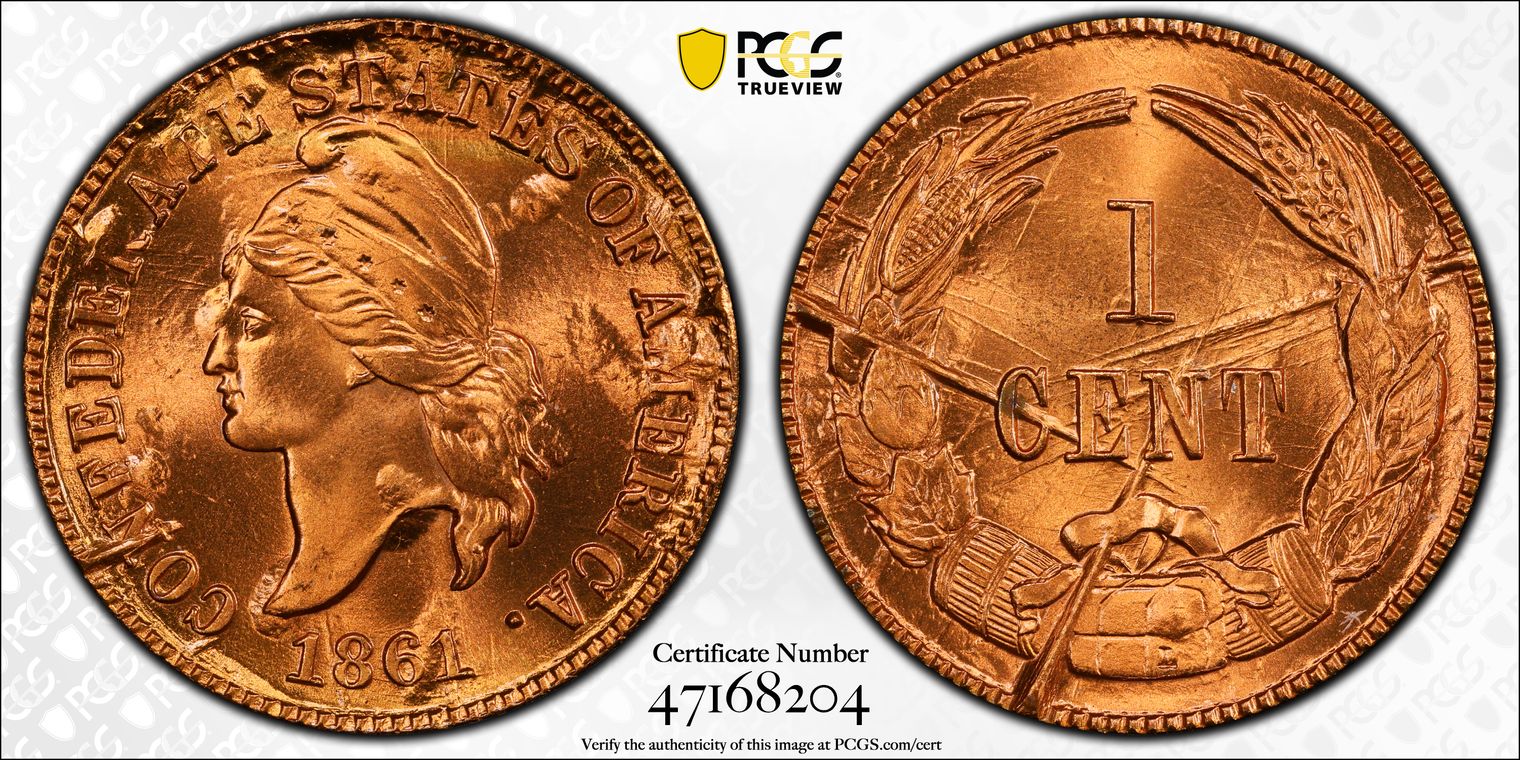
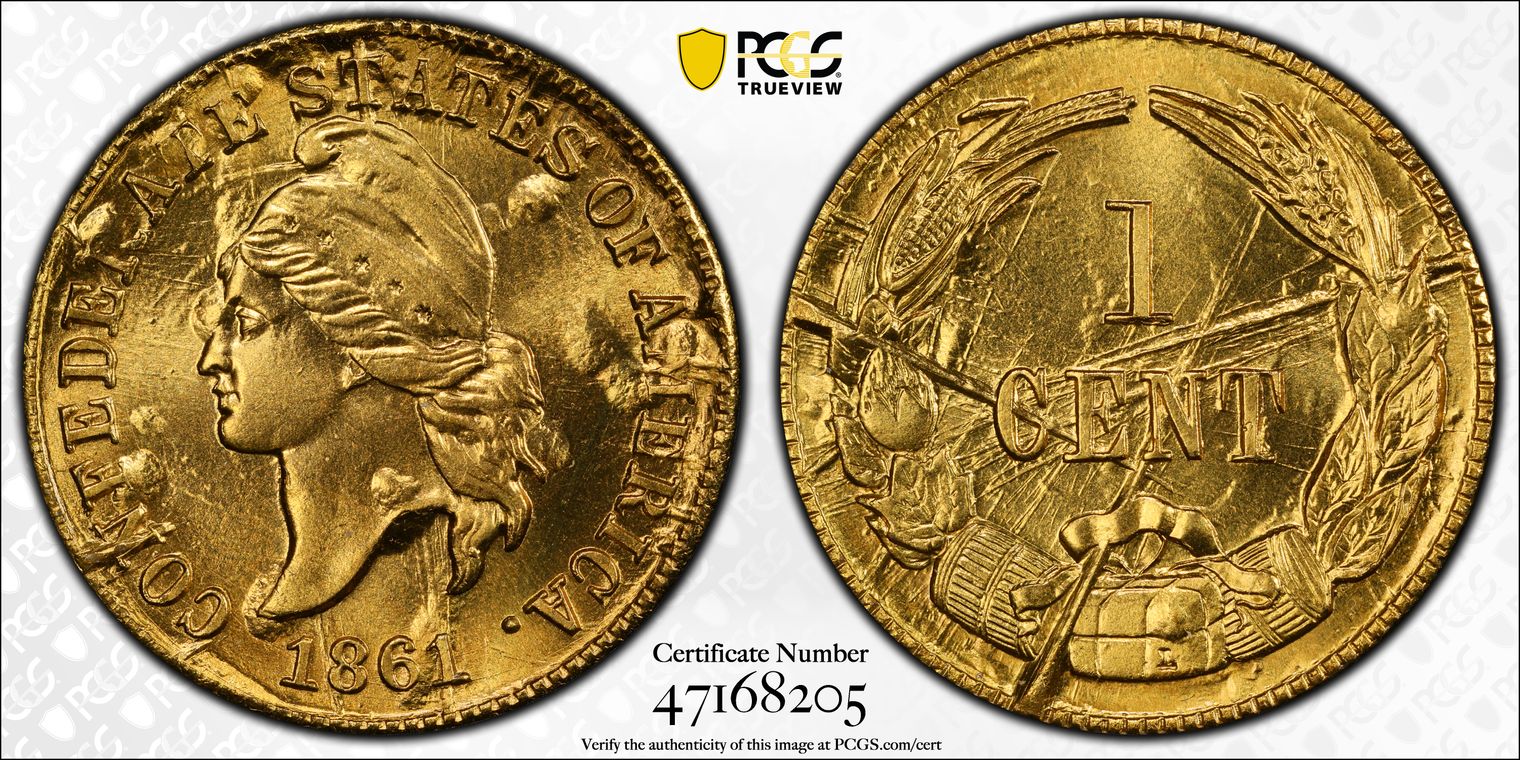
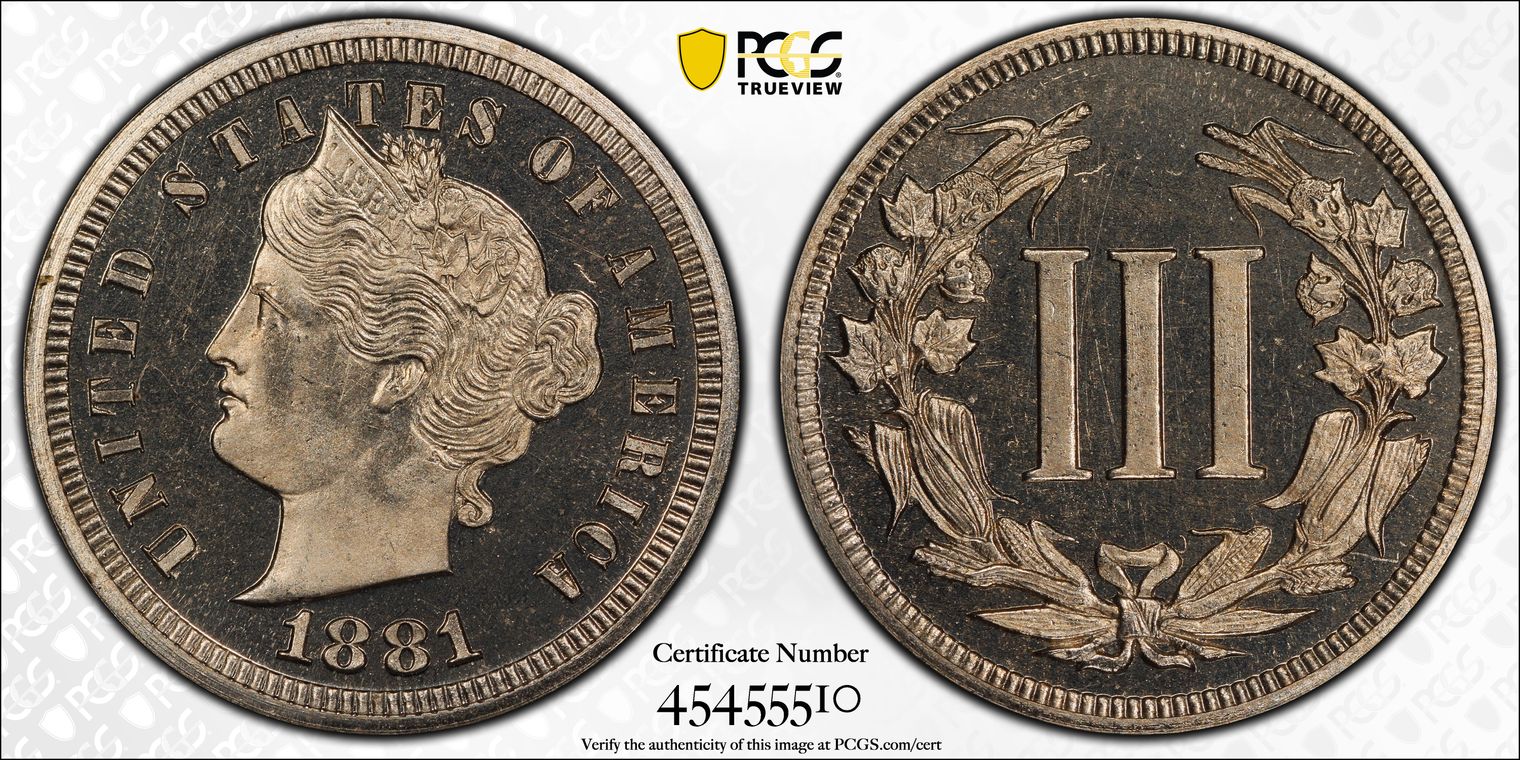
CAC - High R.6 - Struck in nickel with a plain edge. "A flashy, reflective GEM with icy mirrors. Sharply struck." The highest graded at PCGS and the highest endorsed by CAC. Ex Denali Collection
CAC - Unique. Struck in nickel with a reeded edge. " ... is brilliant nickel-gray with moderately frosted devices." Ex: The Bob R. Simpson Collection, Part III
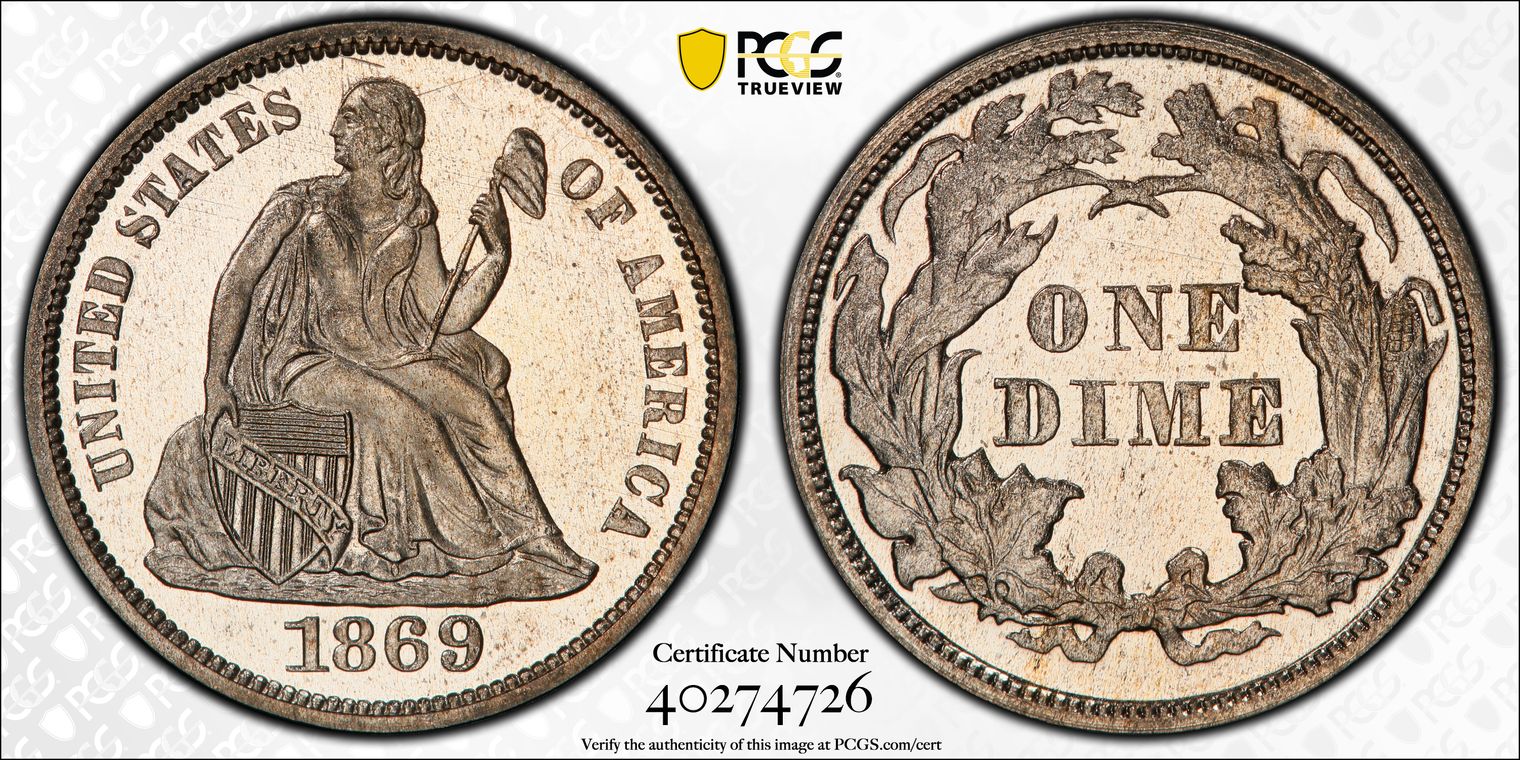
CAC - High R.7 - only three or four examples of Judd-720 are believe to exist. Struck in nickel with a reeded edge. "Minimally toned nickel-gray surfaces showcase dramatic Cameo contrast. Barely a hint of golden color graces this Premium Gem dime." Ex: The Bob R. Simpson Collection, Part III
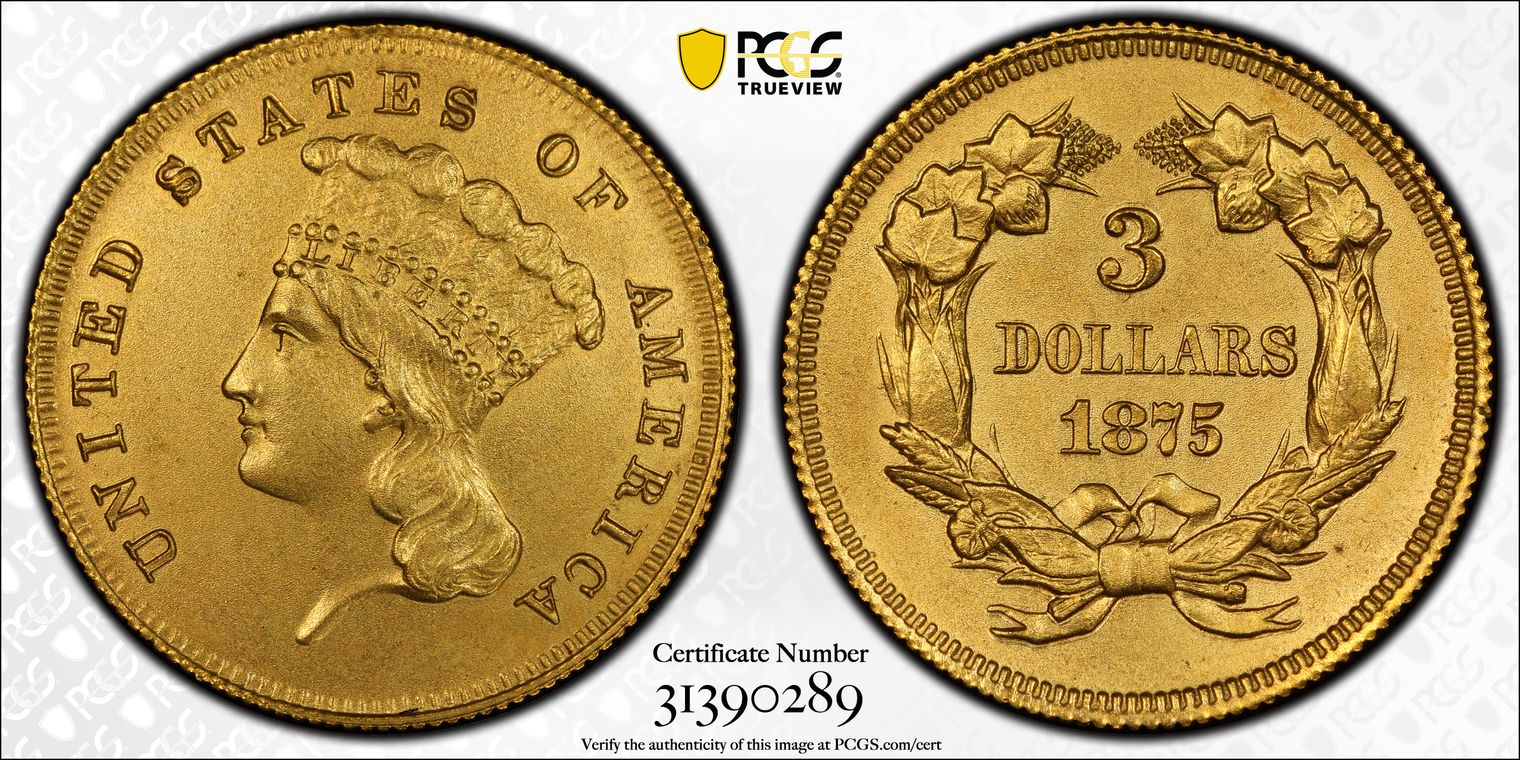
CAC - R8 - Guilt. Regular dies trial striking for the three dollar gold piece. T"he lustrous, satiny light yellow surfaces are pristine, lacking marks on either side." This is the only example that PCGS has certified (12/23)
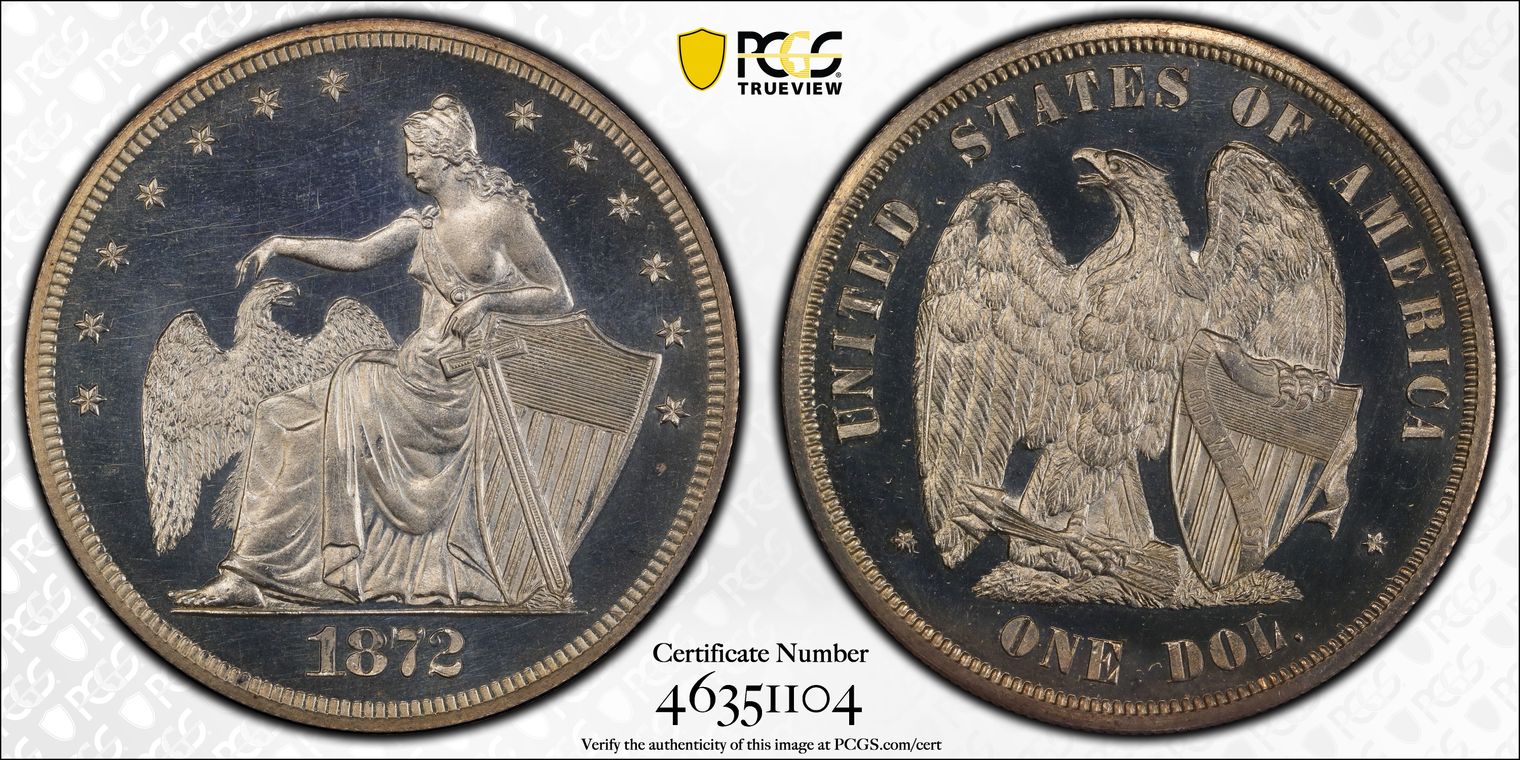
CAC - R-7-. Silver with a Reeded Edge. A beautiful cameo specimen with light golden toning. Extremely rare.
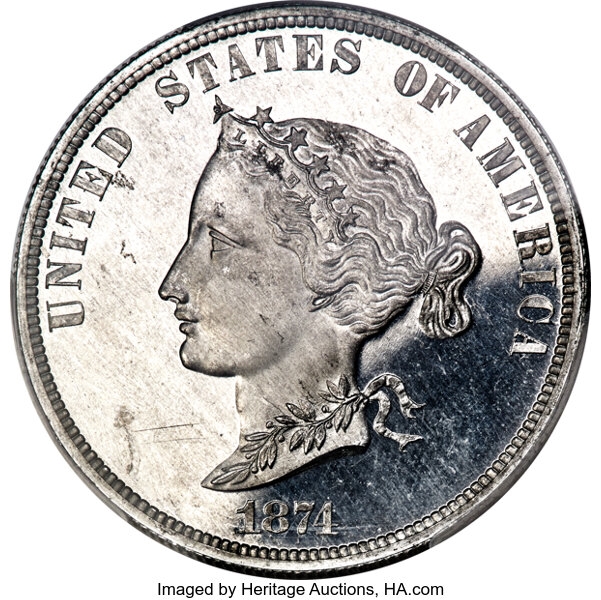
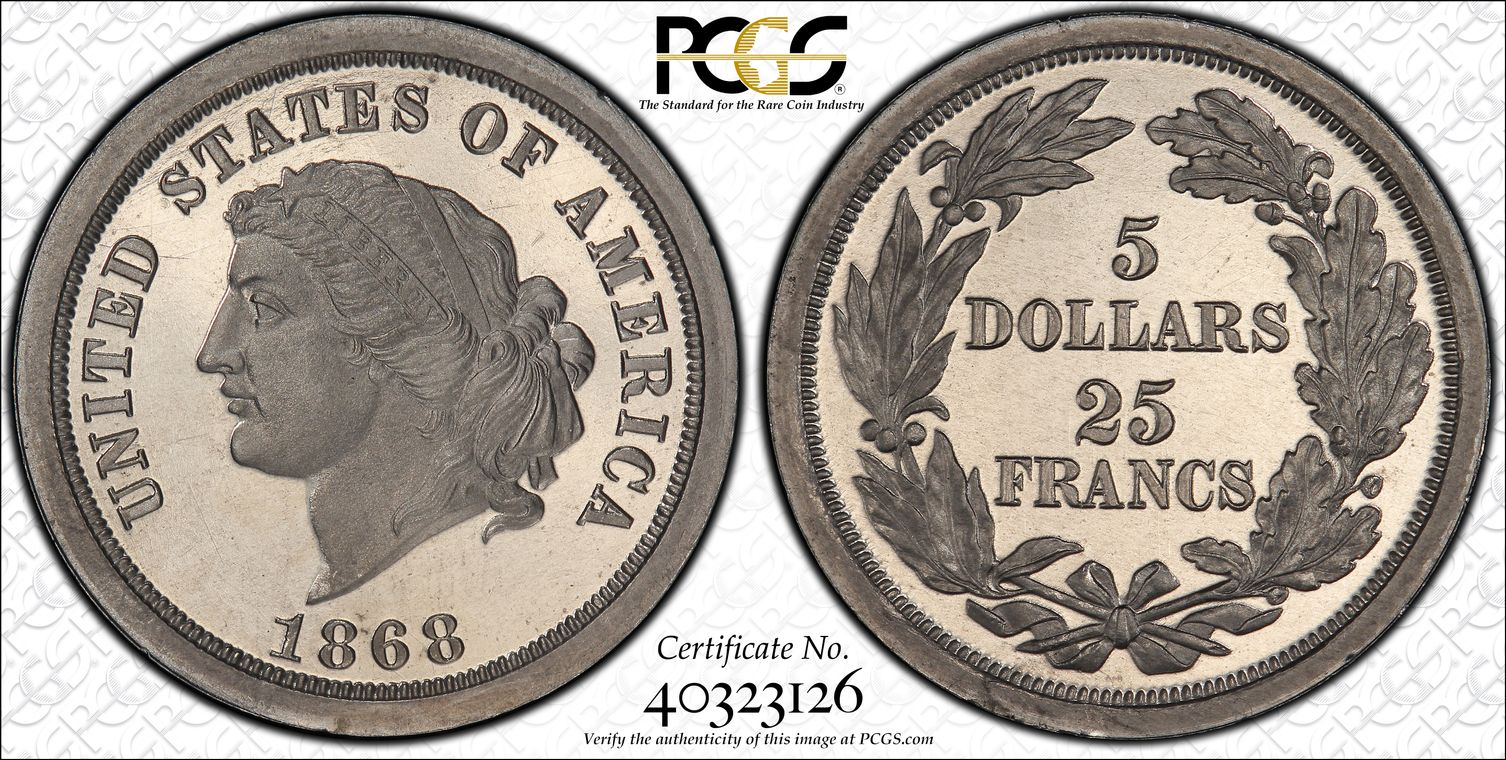
CAC - R8 - Struck in aluminum with a reeded edge. $10 Bickford. This is one of only two examples of Judd-1376 known. The obverse depicts a bust of Liberty facing left with the legend UNITED STATES OF AMERICA above and the date below. Liberty wears a diadem inscribed with the word LIBERTY and ornamented with six stars. The weight 16.72 GRAMS, the standard of the metal 900 FINE, and the word UBIQUE are centered on the reverse. Around the periphery is the U.S. denomination DOLLARS 10 and the following international equivalents: STERLING (Pound) 2.1.1; MARKEN 41.99; KRONEN 37.31; GULDEN 20.73; and FRANCS 51.81. "The surfaces of this Gem Cameo proof exhibit pronounced black-and-white contrast, with deeply reflective fields and thickly frosted devices typical of an aluminum pattern. Delicate streaks of thin golden patina appear over each side without minimizing the overwhelming brilliance." Ex: Simpson.
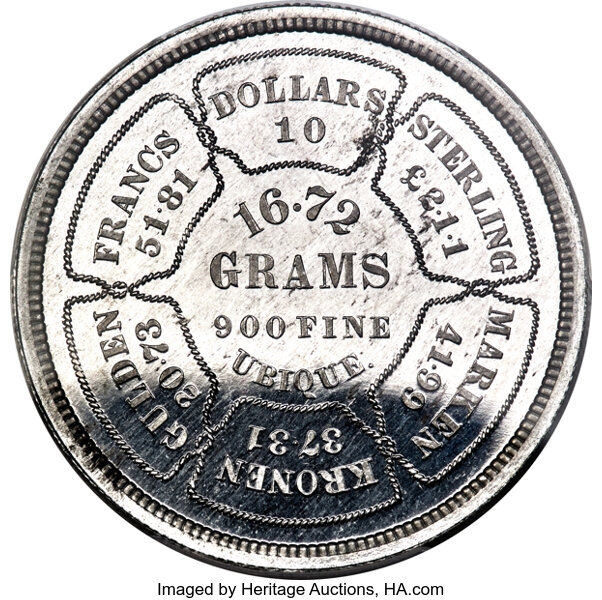
CAC - R8 - Struck in aluminum with a reeded edge. $10 Bickford. This is one of only two examples of Judd-1376 known. The obverse depicts a bust of Liberty facing left with the legend UNITED STATES OF AMERICA above and the date below. Liberty wears a diadem inscribed with the word LIBERTY and ornamented with six stars. The weight 16.72 GRAMS, the standard of the metal 900 FINE, and the word UBIQUE are centered on the reverse. Around the periphery is the U.S. denomination DOLLARS 10 and the following international equivalents: STERLING (Pound) 2.1.1; MARKEN 41.99; KRONEN 37.31; GULDEN 20.73; and FRANCS 51.81. "The surfaces of this Gem Cameo proof exhibit pronounced black-and-white contrast, with deeply reflective fields and thickly frosted devices typical of an aluminum pattern. Delicate streaks of thin golden patina appear over each side without minimizing the overwhelming brilliance." Ex: Simpson.
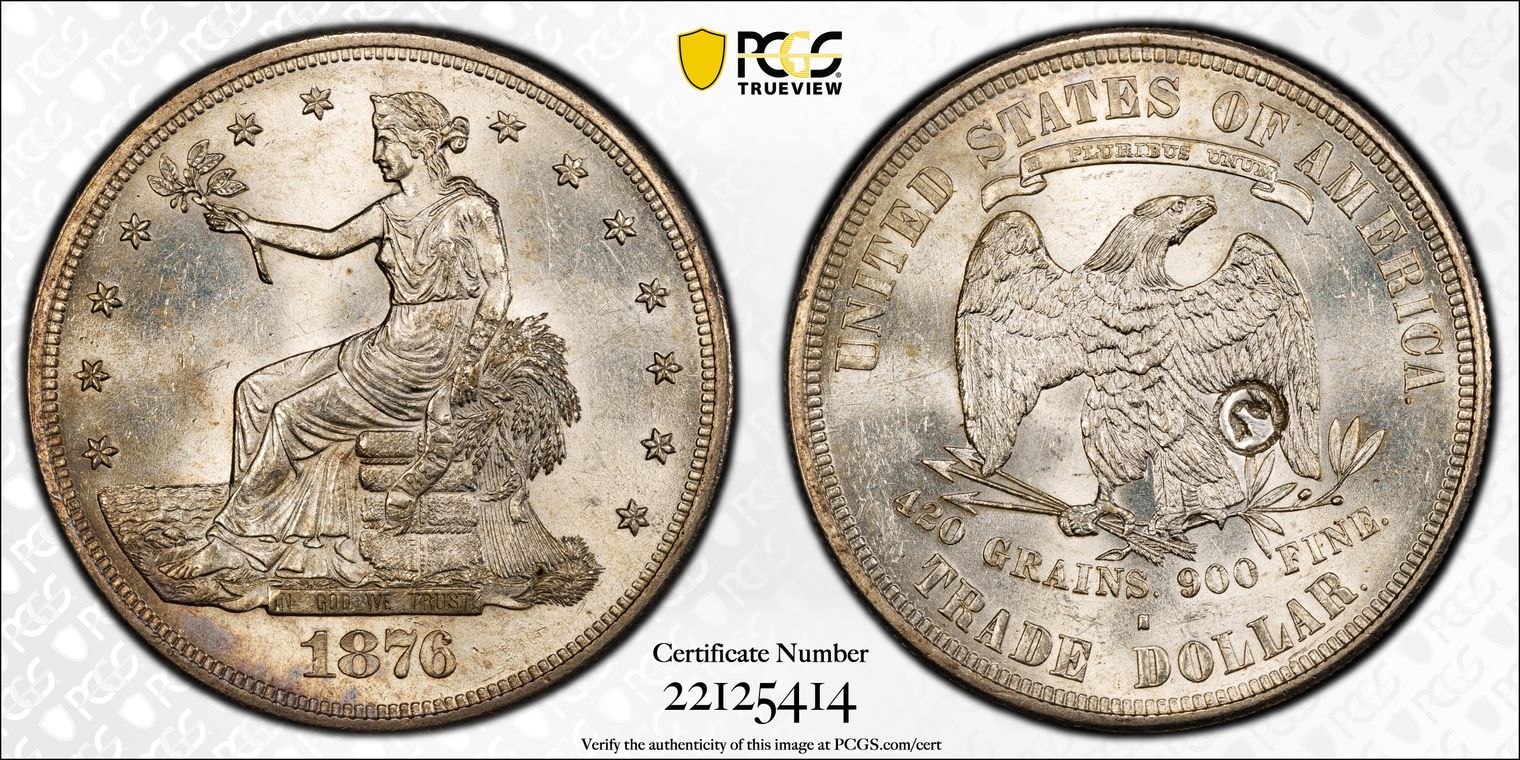
Type One Obverse, Type Two Reverse, Chop Mark MS63 PCGS. Minute S.
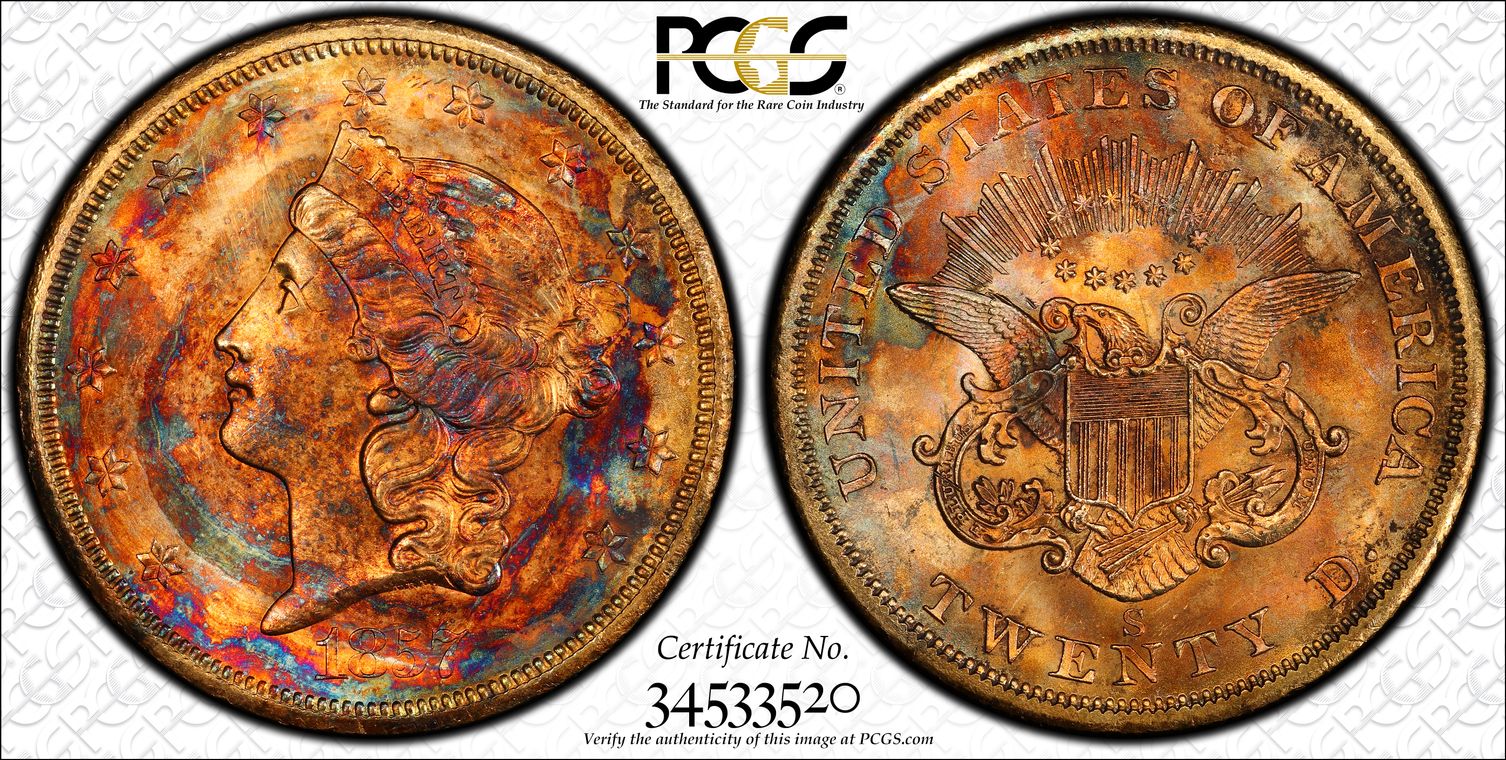
CAC - "The vivacious brilliance of the original luster glows through and highlights the stunning patination on both sides. Swirling bands of tangerine, crimson, aquamarine, violet, cobalt, peach, and yellow gold blend together and frame Liberty's portrait, accenting her facial details. Similar tones grace the reverse."
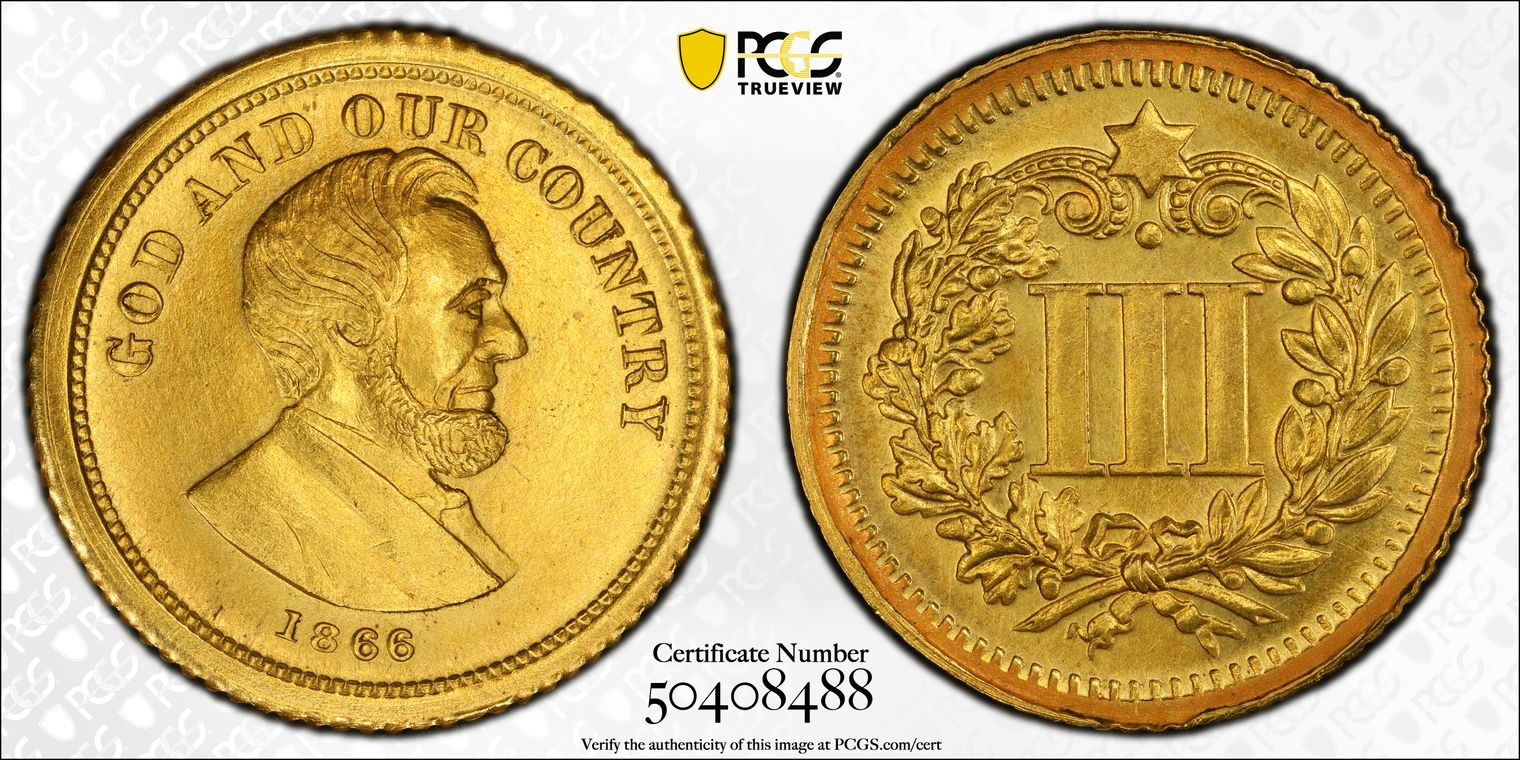
High R7+ - Struck in Gold with a Reeded Edge. Obv: A bearded bust of President Lincoln faces right, the motto GOD AND OUR COUNTRY above and the date 1866 below. Rev: A wreath of oak and laurel surrounds the denomination expressed as a Roman numeral III. Scroll ornamentation is at the top of the wreath, above which is a six-pointed star. Delightful satin to softly frosted surfaces display a sharp to full strike throughout. Even medium gold color on both sides.
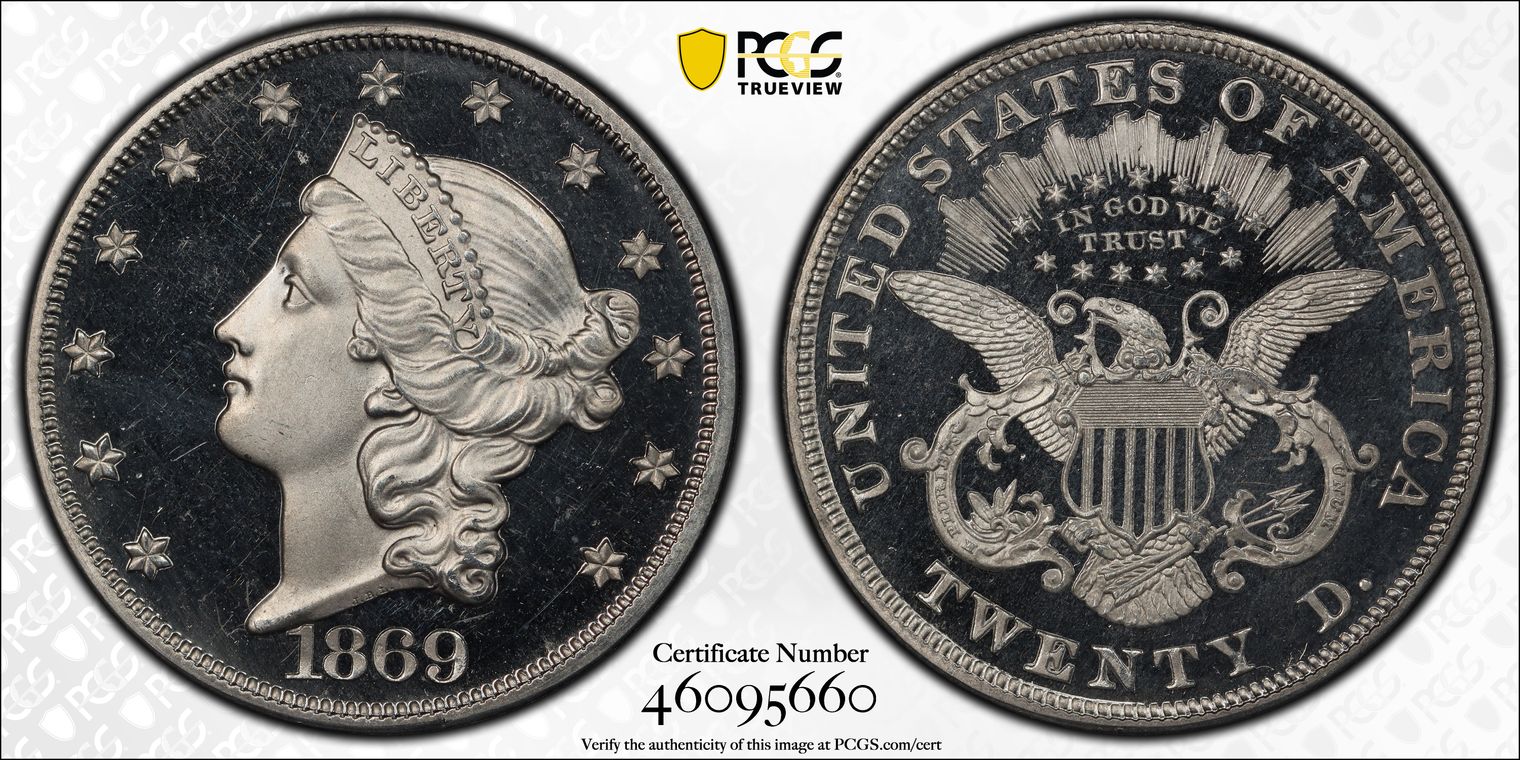
CAC - High R.7 - Regular die trials issue struck in aluminum with a reeded edge. Four or Five known - The finest Graded. This is the only Deep Cameo example certified as of 03/24. "The fields are deeply mirrored and establish an almost total black background for the frosted, white devices." Ex: DiBello Collection (Stack's, 5/1970), The Harry W. Bass, Jr. Core Collection, Part II.
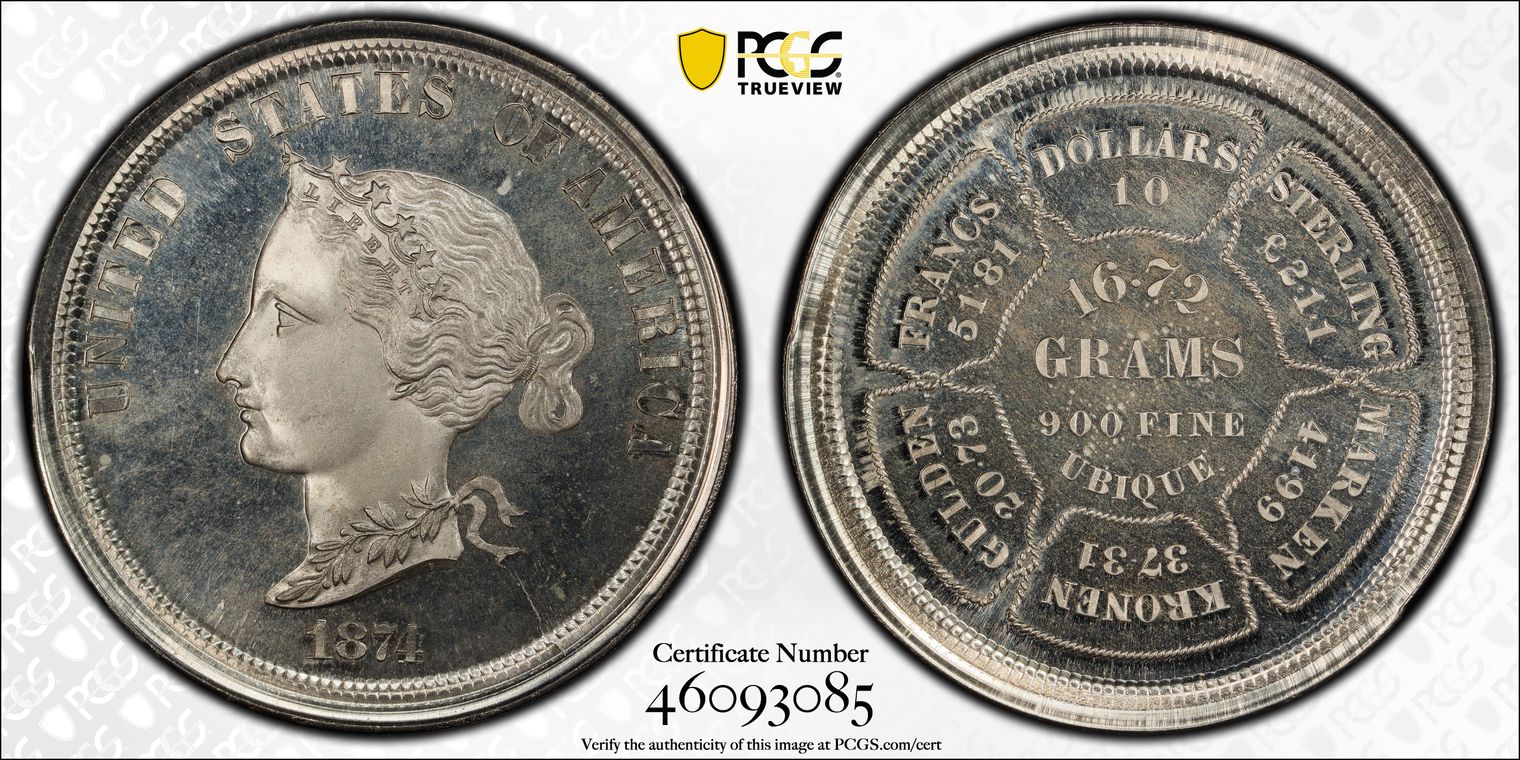
CAC - R.8 - One of Two Known. Struck in nickel with a plain edge. Broadstruck. "The fields are bright silver-gray with near-white mint frost over the design elements, the combination providing a distinct cameo effect." Ex: William Woodin, exhibited at the 1914 ANS exhibit; "Colonel" Green; Kreisberg-Schulman (2/1960); gifted by Brinton T. Shorer (5/3/1973) via Mike Brownlee. From The Harry W. Bass, Jr. Core Collection, Part II.
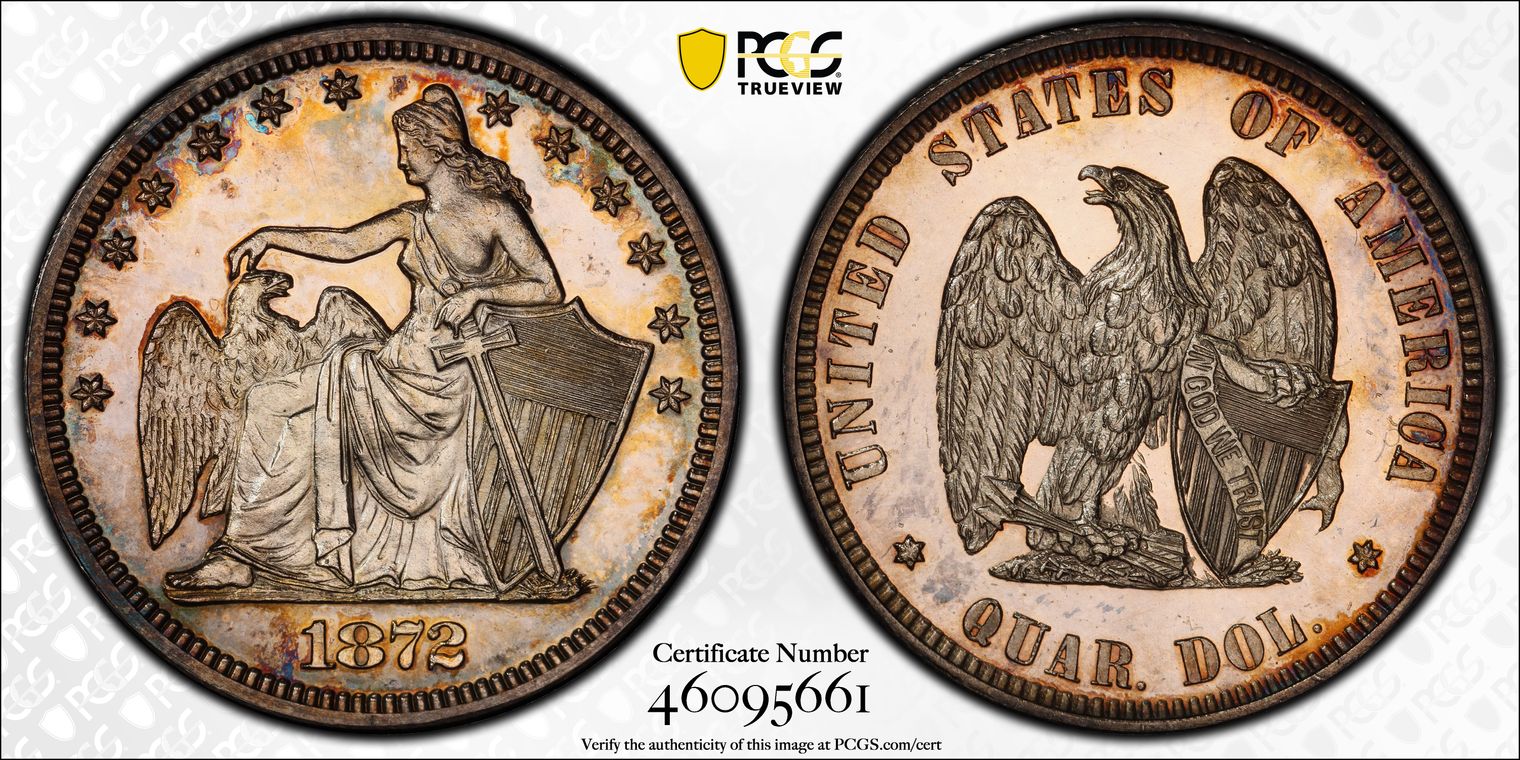
CAC - Low R.7 - Struck in silver with a reeded edge. William Barber's Amazonian design with Liberty seated, facing left, her right hand touching the head of a spread-wing eagle, sword in left hand. Thirteen stars are on the upper portion of that side with the date below. The reverse has a reversed variant of the eagle seen on the obverse, denomination below, and UNITED STATES OF AMERICA around much of the perimeter on that side. "Dappled elements of golden-orange and ice-blue toning complement silvery, thickly frosted devices and clean, fathomless fields. Extraordinary rarity and quality." Ex: River Oaks and C.W. Krugjohann, Part II Collections (Bowers and Ruddy, 11/1976), lot 957. From The Harry W. Bass, Jr. Core Collection, Part I.
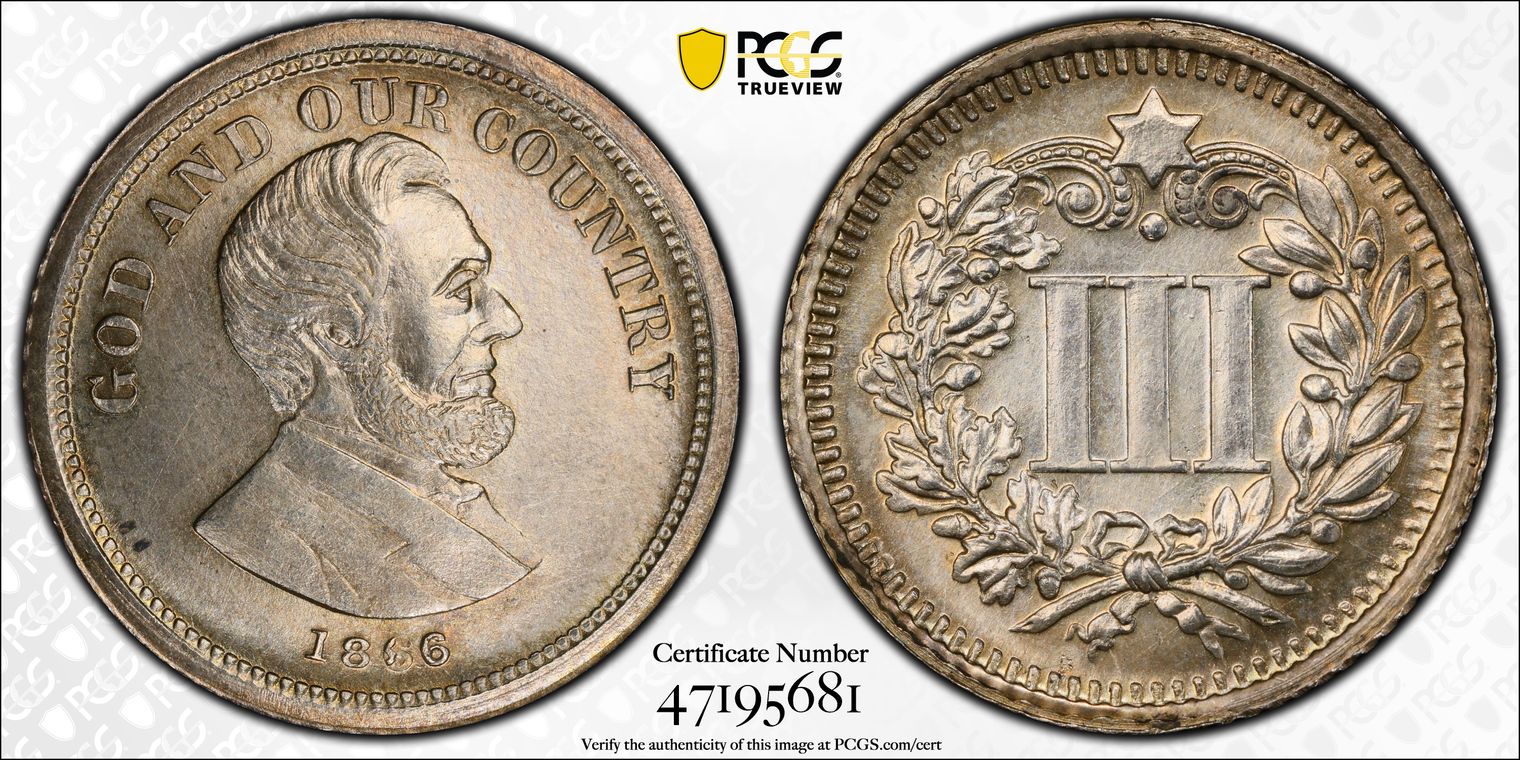
CAC - R8 with 3 known including one in the Smithsonian. Struck in silver with reeded edge. The only one graded at PCGS (8/23). Bust of Abraham Lincoln right with the motto GOD AND OUR COUNTRY above, date 1866 below. Rev: The denomination as a Roman numeral III is centered within an oak and laurel wreath. The wreath has some scroll ornamentation at its apex and is surmounted by a six-pointed star. Lovely satin surfaces are smooth, lustrous and framed by halos of delicate champagne-apricot iridescence. RARE
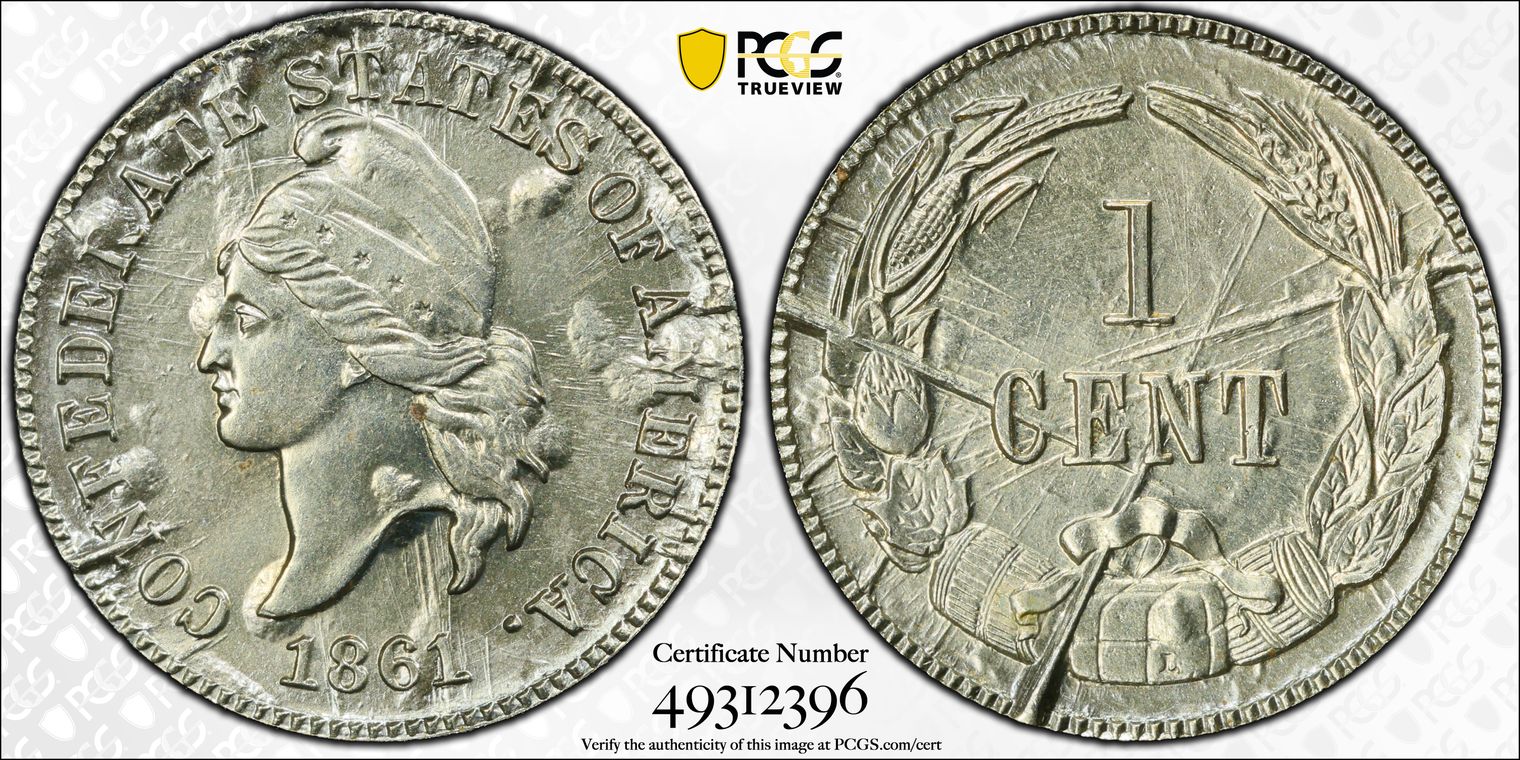
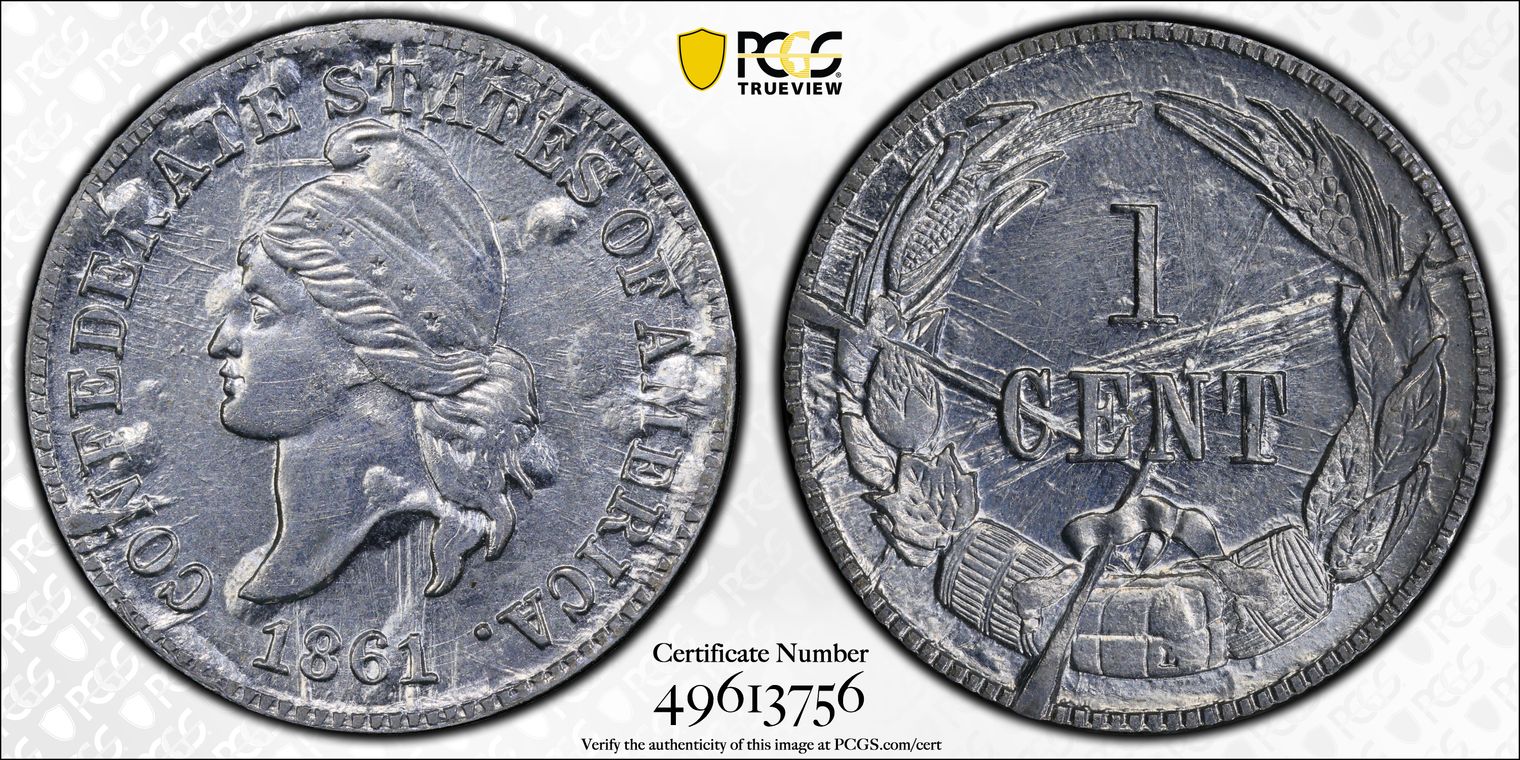
Both sides exhibit a pleasing pewter gray appearance. One of just 50 Bashlow restrikes produced in this metallic composition.
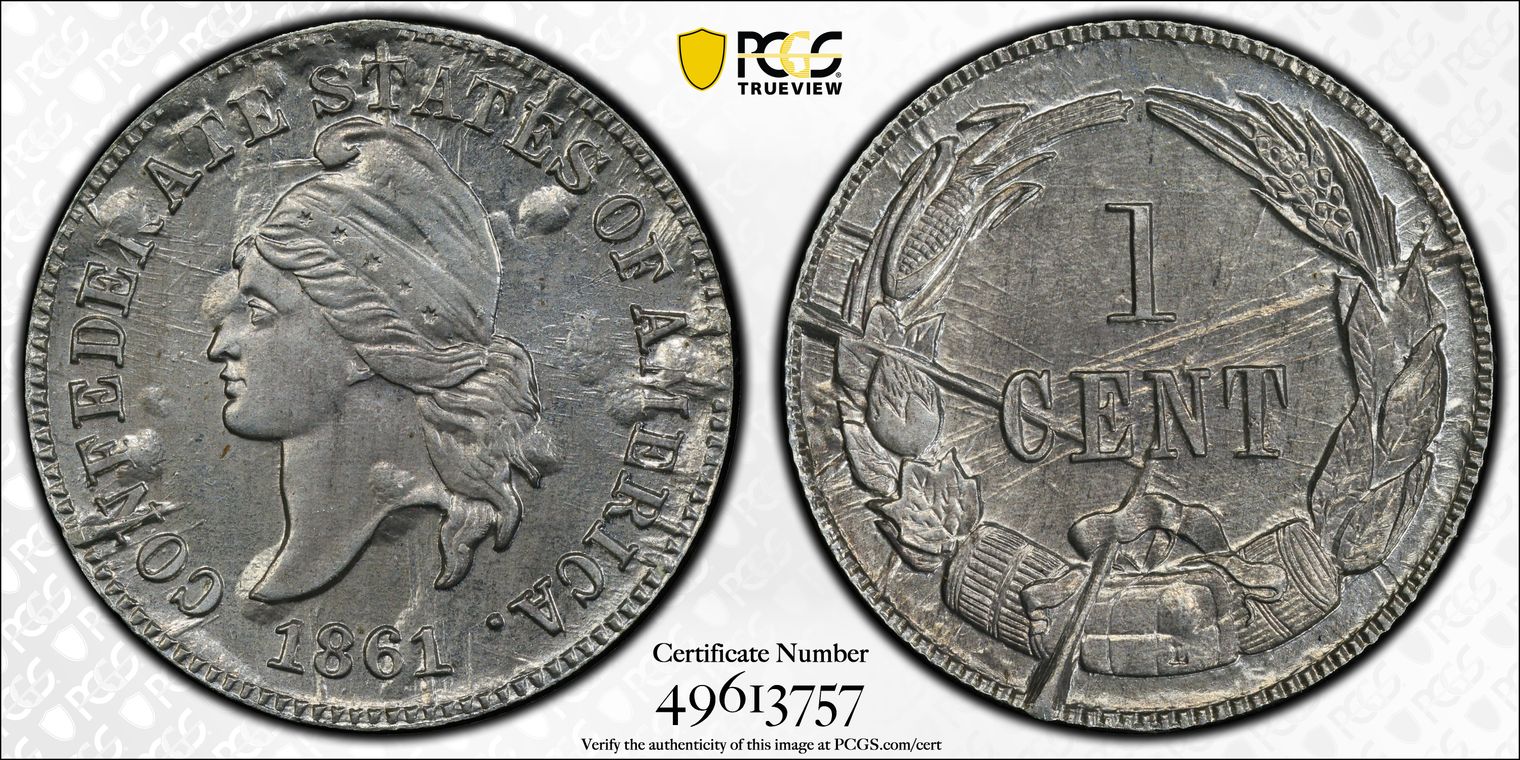
This is a minimally toned, light silver piece that exhibits flickers of modest reflectivity in the fields. The Bashlow restrikes in tin are rare items with a reported mintage of just 50 pieces.
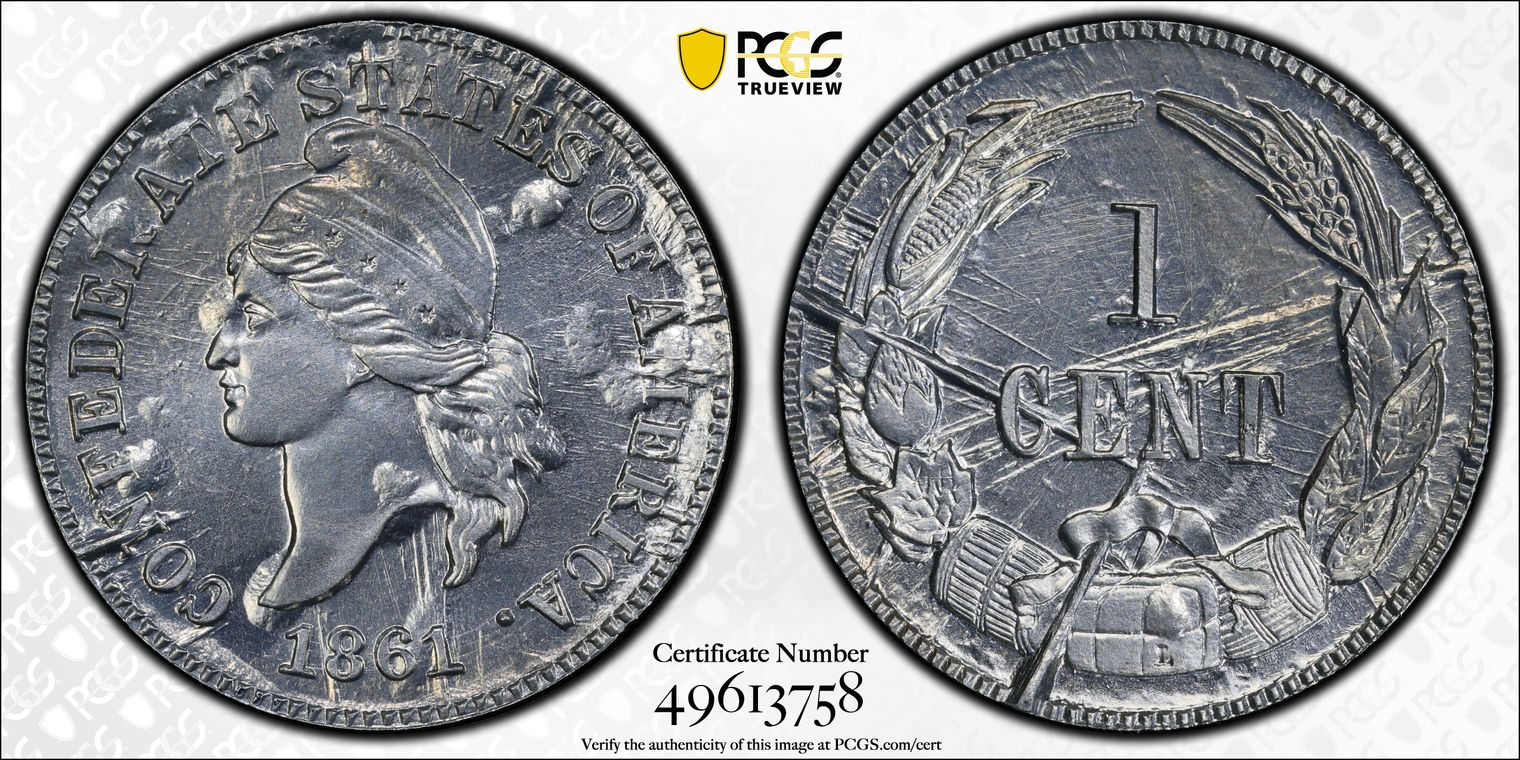
Intensely bright silver gray with impressive frosty luster and delightful eye appeal. Rare, with a mintage of the aluminum cent restrikes as just 50 pieces.
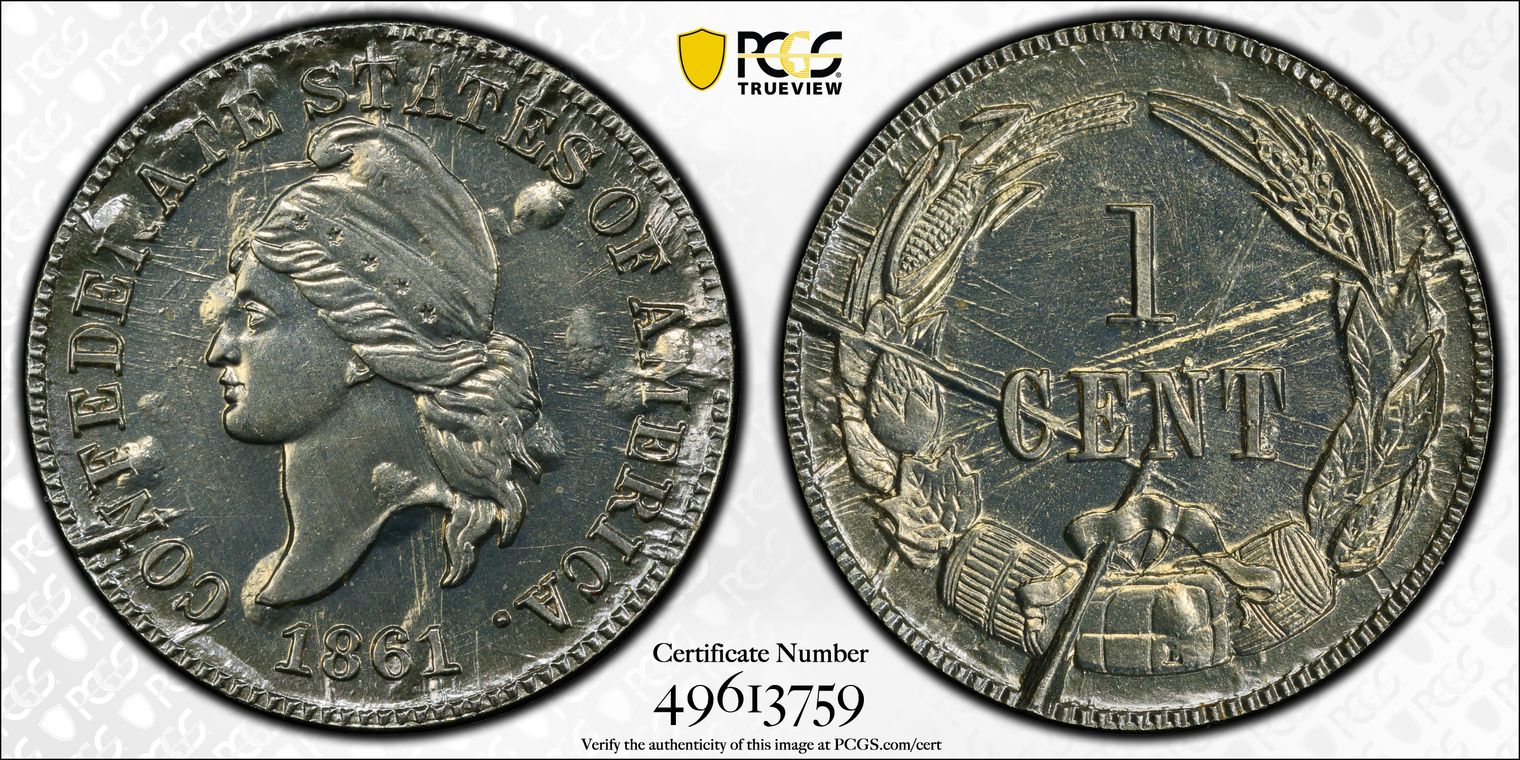
Lustrous frosty surfaces exhibit delicate champagne-gold tinting to dominant bright silver-gray. The Breen Encyclopedia (1988) notes for this type: "May exist in other metals." This is one of those "other metals," and it is presumably very rare.